Datanyze vs Spherescout (2026): Which B2B Data Tool Wins?
Datanyze and Spherescout both promise clean B2B contact data, but they win at different jobs. Here's an honest, side-by-side breakdown of accuracy, pricing, and fit — plus where a dedicated email finder beats both.
Choosing between Datanyze and Spherescout usually comes down to one question you don't hear vendors ask out loud: what job are you actually hiring the tool to do? One leans hard into technographics and Chrome-extension prospecting. The other positions itself as a broader, lighter prospecting-and-enrichment layer. Pick on brand recognition alone and you'll overpay for data you never use.
This is a neutral, side-by-side breakdown — no marketing gloss. You'll get a feature-by-feature table, honest pricing context, the use cases each tool actually fits, and where a dedicated email finder quietly beats both on cost-per-verified-contact.
TL;DR: Datanyze vs Spherescout at a glance#
- Datanyze is strongest for technographics — knowing what software a company runs — plus quick, in-browser contact lookups via its Chrome extension. Best for SDRs who prospect off company websites and LinkedIn.
- Spherescout positions itself as a lighter, prospecting-and-enrichment tool: build lists, enrich contacts, push to your CRM. Best for small teams that want one simple workflow rather than deep tech-stack data.
- Neither is a pure email-finder. Both bundle contact data into a wider platform, which means you pay for features you may not touch.
- Accuracy varies by data type. Technographic signals age fast; direct-dial and email accuracy differ between vendors and should be tested on your own ICP before you commit.
- The cost-efficient play for teams that mainly need verified emails is a dedicated finder like Tomba Email Finder, used alongside — not instead of — a full intelligence platform.
What is Datanyze?#
Datanyze is a B2B sales intelligence tool best known for technographics — data on the technologies a company uses (their CRM, analytics stack, e-commerce platform, and so on). It grew up as a "what tech does this site run" service and later added a Chrome extension that surfaces contact details (business email, direct dial, LinkedIn) while you browse a company site or a prospect's profile.
The pitch is intent-adjacent targeting: if you sell a Shopify app, you can find companies running Shopify; if you sell a Salesforce add-on, you can filter for Salesforce shops. That tech-stack lens is Datanyze's real differentiator. You can read its own positioning on the Datanyze homepage and third-party reviews on G2.
Where Datanyze is weaker: it's not a bulk list-building powerhouse the way larger databases are, and technographic data is only as useful as it is fresh. A company that swapped platforms last quarter can still show the old stack.
What is Spherescout?#
Spherescout markets itself as a streamlined prospecting and enrichment platform — the idea being that a rep can search for accounts, pull contact data, enrich existing records, and sync everything to a CRM without stitching five tools together. It aims at the "keep it simple" segment: small sales teams, solo founders, and agencies that want a single, approachable workflow.
Because Spherescout is a smaller and newer name than Datanyze, public, independently verified benchmarks are thinner. That's worth stating plainly: treat any headline accuracy or coverage number — from either vendor — as a claim to test, not a fact to trust. Run both against a sample of your own ideal-customer accounts before you sign an annual deal.
Datanyze vs Spherescout: feature comparison#
Here's the head-to-head on the attributes that actually change your workflow. Where a vendor's public numbers are unverified or vary by plan, the cell says so rather than inventing precision.
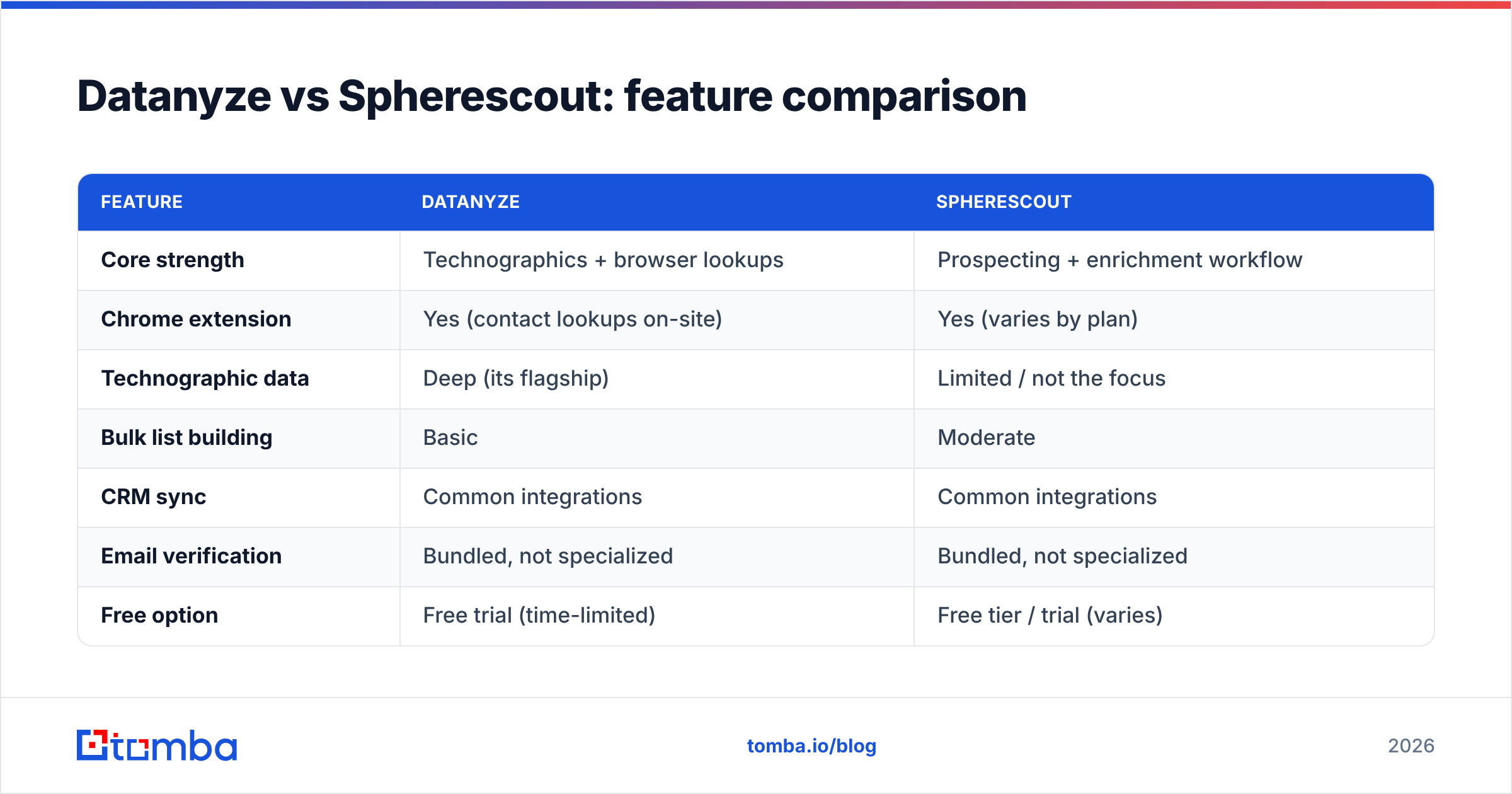
| Feature | Datanyze | Spherescout |
|---|---|---|
| Core strength | Technographics + browser lookups | Prospecting + enrichment workflow |
| Chrome extension | Yes (contact lookups on-site) | Yes (varies by plan) |
| Technographic data | Deep (its flagship) | Limited / not the focus |
| Bulk list building | Basic | Moderate |
| CRM sync | Common integrations | Common integrations |
| Email verification | Bundled, not specialized | Bundled, not specialized |
| Free option | Free trial (time-limited) | Free tier / trial (varies) |
| Best-fit team | SDRs targeting by tech stack | Small teams wanting one simple tool |
| Public benchmark data | Some third-party reviews | Sparse — test yourself |
The pattern: Datanyze wins on depth of tech-stack signal; Spherescout wins on simplicity and an all-in-one feel. Neither is optimized purely for finding and verifying email addresses at volume, which is the gap we'll come back to.
Is Datanyze better than Spherescout for accuracy?#
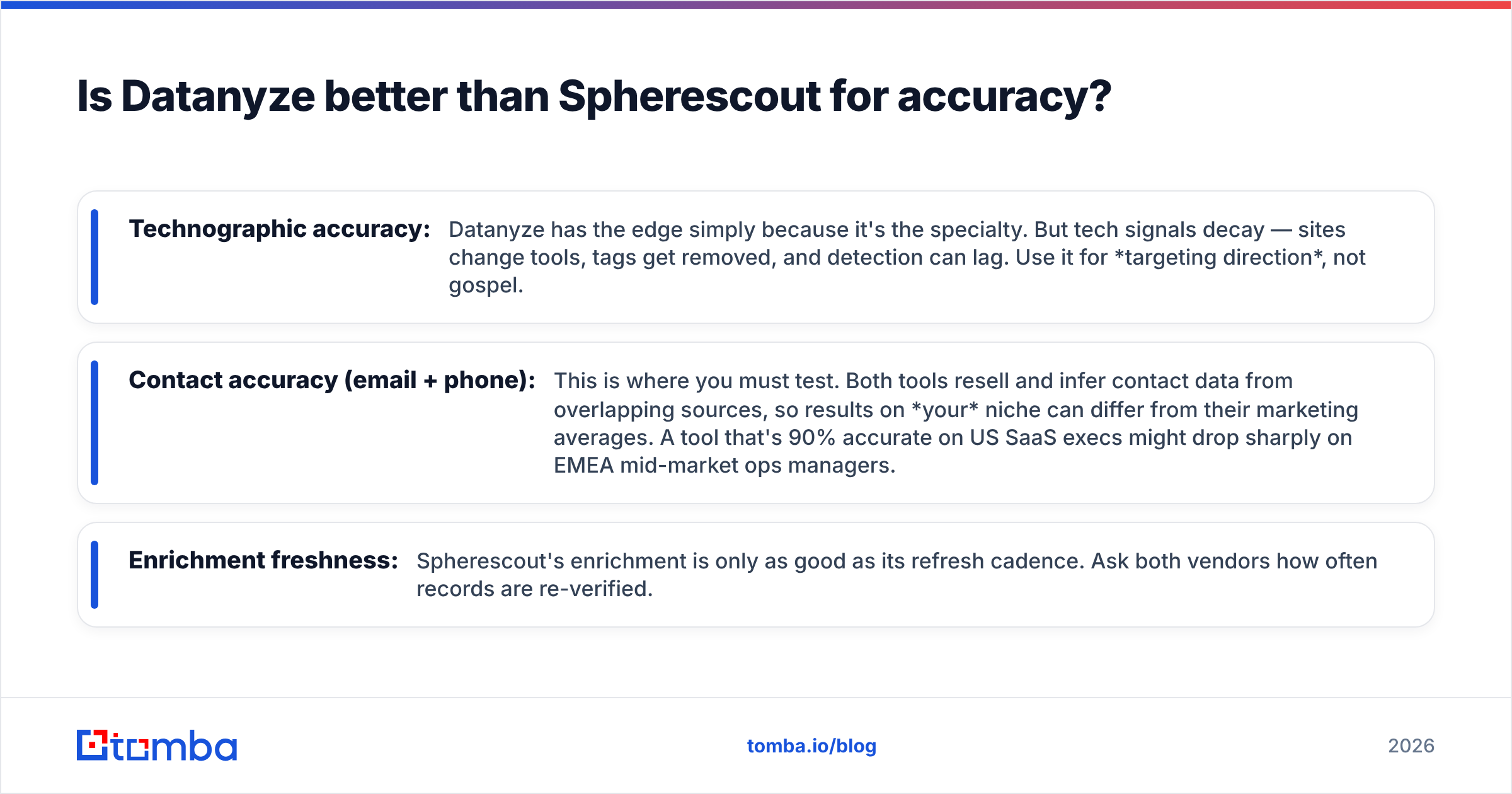
It depends on the data type, and that nuance matters more than any single "accuracy %."
- Technographic accuracy: Datanyze has the edge simply because it's the specialty. But tech signals decay — sites change tools, tags get removed, and detection can lag. Use it for targeting direction, not gospel.
- Contact accuracy (email + phone): This is where you must test. Both tools resell and infer contact data from overlapping sources, so results on your niche can differ from their marketing averages. A tool that's 90% accurate on US SaaS execs might drop sharply on EMEA mid-market ops managers.
- Enrichment freshness: Spherescout's enrichment is only as good as its refresh cadence. Ask both vendors how often records are re-verified.
A durable rule: never send to an address you haven't verified, regardless of the source platform. Bounces hurt your sender reputation and can drag entire campaigns into spam. Run any list — Datanyze, Spherescout, or otherwise — through a dedicated email verifier before your first send. That single habit protects deliverability more than choosing "the more accurate vendor" ever will.
How do Datanyze and Spherescout price their plans?#
Pricing is the least transparent part of this matchup, so read it carefully.
Datanyze has historically offered a time-limited free trial followed by paid tiers, with credits governing how many contact reveals you get per month. Spherescout typically fronts a free or trial tier and scales pricing by seats, credits, and enrichment volume. Exact numbers move often, so confirm current pricing directly with each vendor rather than trusting a blog snapshot — including this one.
What actually drives your bill on both platforms:
- Credit consumption — every contact reveal or enrichment burns a credit; heavy prospecting empties a plan fast.
- Seats — per-user pricing adds up quickly for a growing SDR team.
- Data scope — technographics, direct dials, and enrichment are often gated to higher tiers.
- Annual lock-in — the headline monthly rate usually assumes an annual commitment.
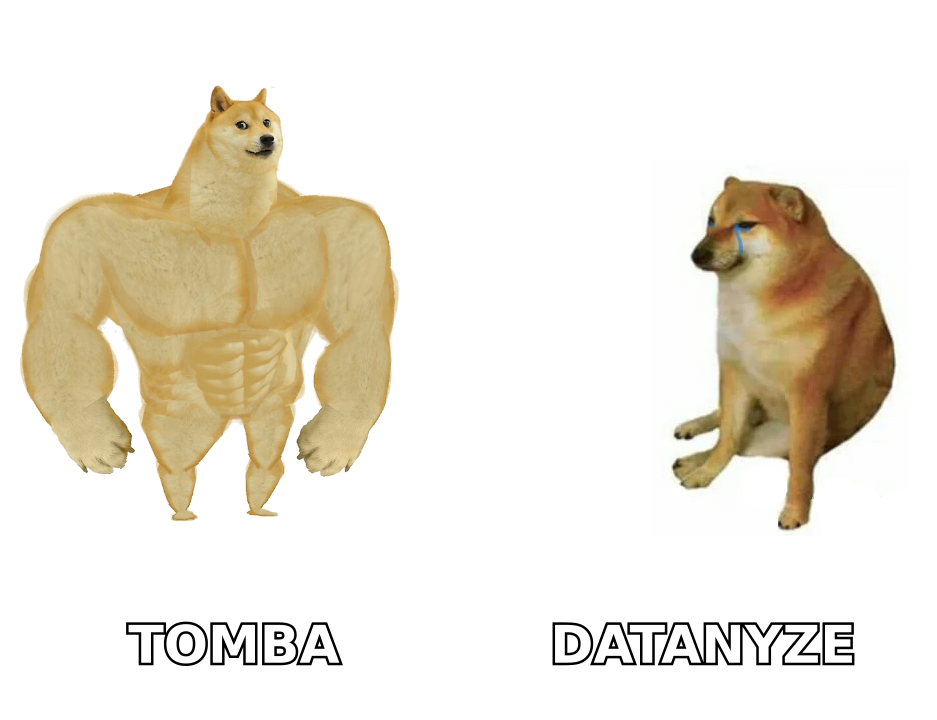
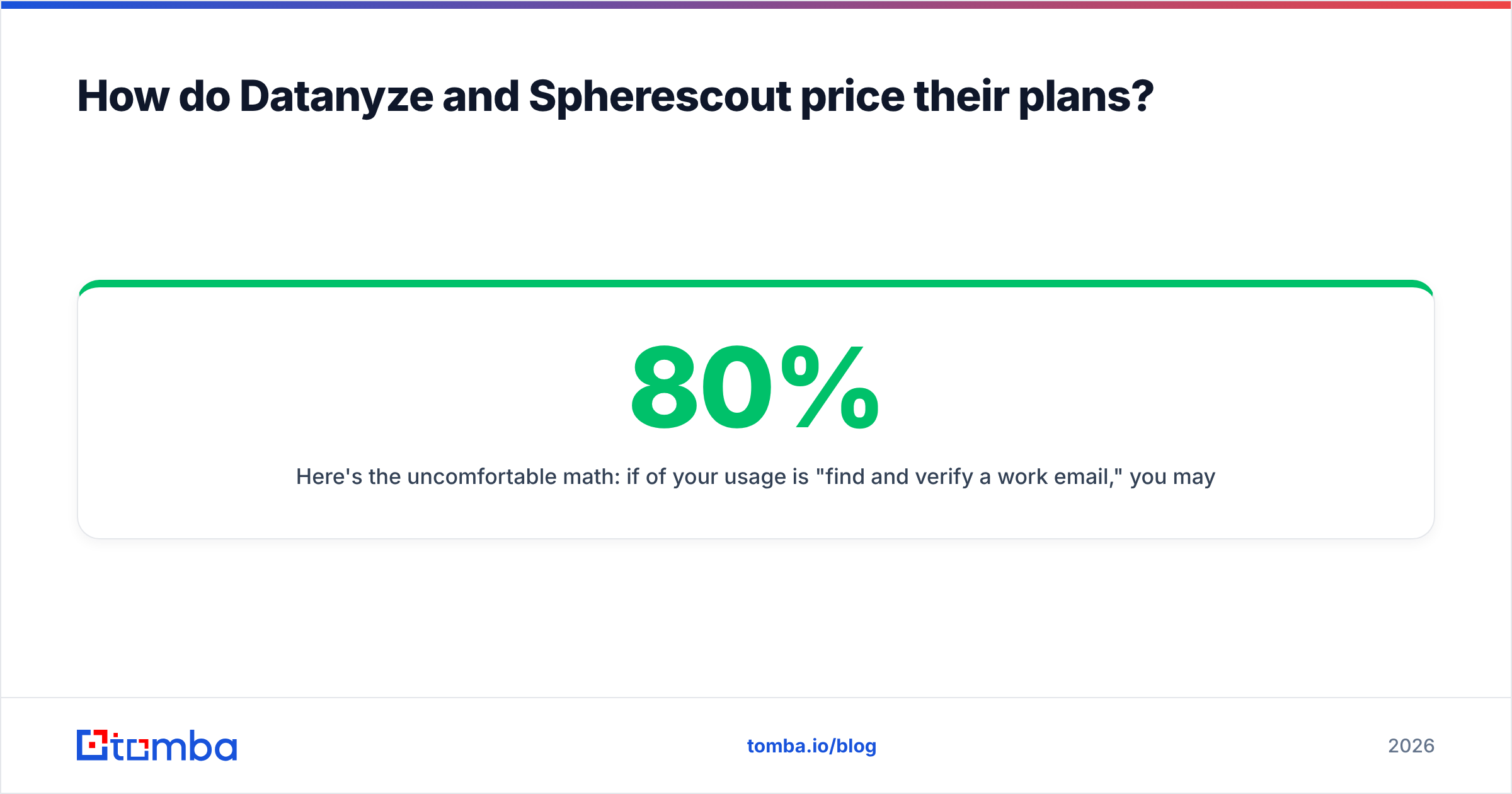
Here's the uncomfortable math: if 80% of your usage is "find and verify a work email," you may be paying platform prices for finder-grade work. That's exactly the scenario a focused tool is built for. Compare the credit economics against transparent Tomba pricing — Free (25 searches/mo), Starter $49/mo, Growth $99/mo, and Pro $249/mo — and the per-verified-contact cost often tells a very different story than the sticker price.

When should you choose Datanyze?#
Pick Datanyze when tech-stack targeting is central to how you sell.
- You sell an app, integration, or service tied to a specific platform (Shopify, Salesforce, HubSpot, Magento) and need to find companies running it.
- Your reps prospect account-by-account off company websites and LinkedIn, and want contact reveals inside the browser.
- You value technographic filtering more than raw database size.
- You already have a system for verifying emails downstream.
Skip it if you mainly need large, clean contact lists at a low cost-per-record — that's not its sweet spot.
When should you choose Spherescout?#
Pick Spherescout when simplicity and a single workflow beat depth.
- You're a small team or solo founder who wants search → enrich → CRM in one place.
- You don't need deep technographics and won't pay for them.
- You want a gentle learning curve over a feature-dense platform.
- You're comfortable validating the tool on your own ICP because independent benchmarks are limited.
Skip it if tech-stack intelligence or heavy, audited data coverage is a hard requirement — that's Datanyze (or a larger database) territory.
Where does a dedicated email finder fit?#
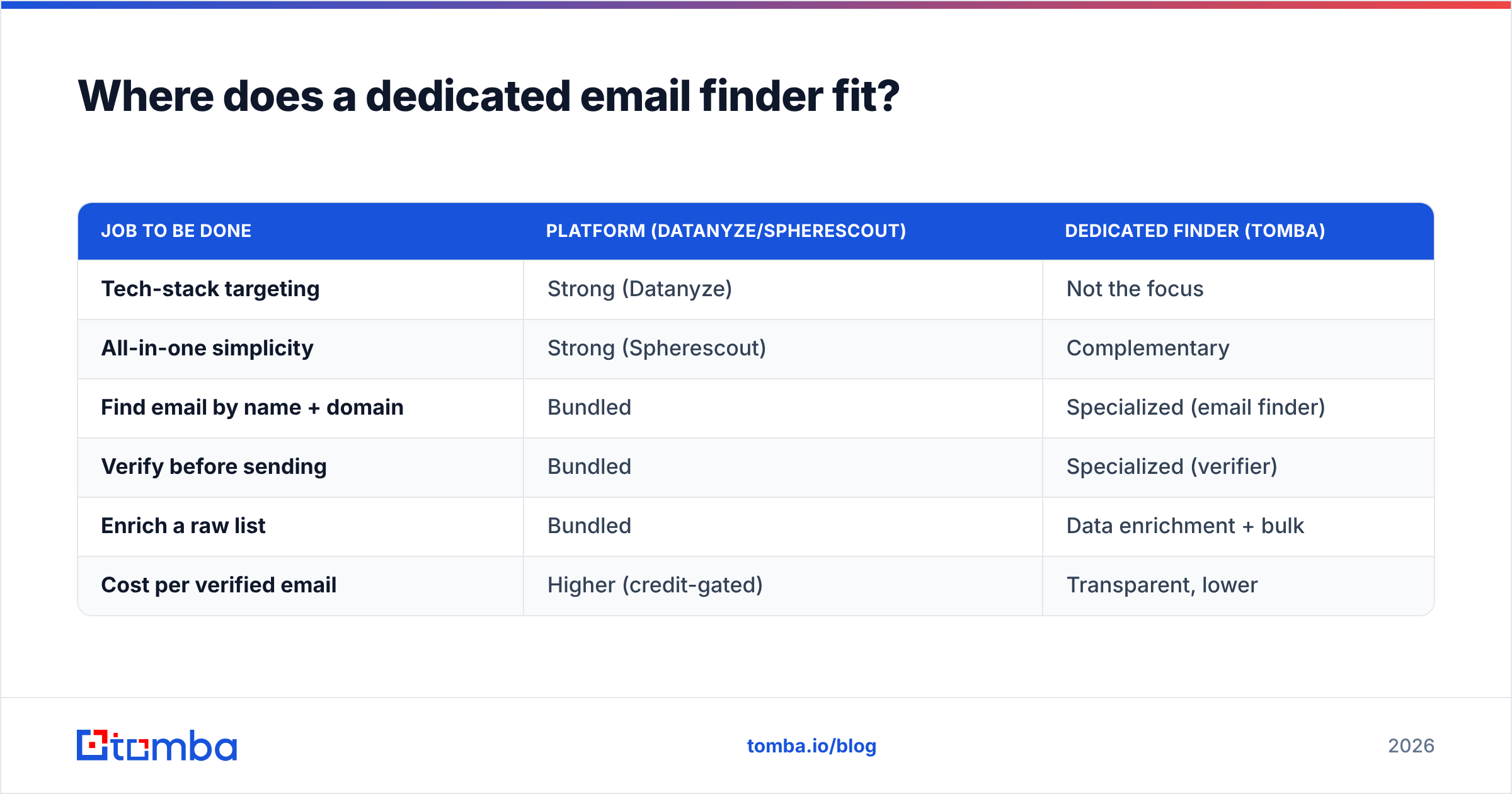
Both platforms bundle contact-finding into a wider product. That's convenient, but it means the finding-and-verifying core isn't necessarily their sharpest tool — and you pay platform prices for it. A focused stack often looks like this:
| Job to be done | Platform (Datanyze/Spherescout) | Dedicated finder (Tomba) |
|---|---|---|
| Tech-stack targeting | Strong (Datanyze) | Not the focus |
| All-in-one simplicity | Strong (Spherescout) | Complementary |
| Find email by name + domain | Bundled | Specialized (email finder) |
| Verify before sending | Bundled | Specialized (verifier) |
| Enrich a raw list | Bundled | Data enrichment + bulk |
| Cost per verified email | Higher (credit-gated) | Transparent, lower |
The point isn't "replace your intelligence platform." It's that finding and verifying emails is a distinct job best done by a tool built for it. Many teams keep Datanyze or Spherescout for targeting and layer a finder underneath for the high-volume, cost-sensitive part of the funnel. If you want to see how data quality is sourced, Tomba documents its data sources openly.
Datanyze vs Spherescout: the honest verdict#
There's no universal winner — there's a winner for your job.
- Choose Datanyze if technographics drive your targeting and your reps live in the browser. It's the more established name with the deepest tech-stack signal.
- Choose Spherescout if you're a small team that values one simple, all-in-one workflow over depth — and you're willing to test its data yourself, since public benchmarks are thin.
- Choose neither as your email engine. If most of your spend is "get me a verified work email," a dedicated finder will almost always beat a bundled platform on cost-per-contact and deliverability discipline.
Whatever you pick, verify every address before you send. Data from any vendor ages, and your email deliverability depends on catching dead addresses before they bounce.
Ready to lower your cost per verified contact?#
If your real bottleneck is finding and confirming decision-maker emails — not admiring a dashboard — start with the tool built for exactly that. Tomba Email Finder locates professional email addresses by name, domain, or company, and pairs with a built-in verifier so every contact is checked before it hits your sequence. Begin free with 25 searches a month, then scale on transparent, credit-honest Tomba plans — no annual lock-in required to try it. Keep Datanyze or Spherescout for targeting; let Tomba handle the part that actually fills your pipeline.
Related guides#
Ready to find emails that actually work?
Join 150,000+ professionals who stopped guessing and started sending. Free credits on signup — no credit card required.
Get the Tomba newsletter
Practical outbound tactics and product updates — once every two weeks.
About the author