Datanyze vs The Data City: B2B Data Platforms Compared 2026
Datanyze leans on technographics and US contact data; The Data City maps real UK companies with live web signals. Here's which B2B data platform actually fits your GTM motion in 2026.
Choosing between Datanyze and The Data City feels harder than it should, because the two tools barely play the same game. One sells technographics and US-centric contact data bolted onto a Chrome extension. The other builds a live, machine-classified map of real companies — heavily UK and innovation-economy focused — from what those companies actually publish on the web. Picking the wrong one doesn't just waste budget; it points your whole outbound motion at the wrong accounts.
This comparison cuts through the positioning. You'll see where each platform's data actually comes from, who each one is built for, what the real trade-offs are, and where a dedicated contact-data layer beats both.
TL;DR: Datanyze vs The Data City at a glance#
- Datanyze is a sales-intelligence and technographics tool: it tells you what software a company runs and hands reps contact records through a browser extension. Best for US SaaS teams selling to a specific tech stack.
- The Data City is a company-intelligence platform: it classifies firms by what they do using real-time web data and custom "Real-Time Industrial Classifications." Best for market mapping, TAM sizing, and UK/policy research.
- They solve different problems. Datanyze answers "who uses HubSpot?"; The Data City answers "which UK companies work in synthetic biology?"
- Neither is a great pure contact-finder. Emails and direct dials are the weak link for both — accuracy and coverage lag specialist tools.
- Best move for outbound teams: use a data/market platform for targeting, then a dedicated email finder like Tomba to turn accounts into verified, reachable contacts.
What is Datanyze?#
Datanyze is a B2B sales-intelligence tool best known for technographics — data about the technologies a company uses. If you sell a product that competes with, integrates with, or replaces a specific platform (say, Shopify, Salesforce, or Marketo), Datanyze lets you build lists of companies running that stack.
It ships mainly as a Chrome extension that surfaces contact details and company info while you browse LinkedIn or a company website. Reps grab a name, an email guess, and a phone number without leaving the tab. Datanyze is owned by ZoomInfo, and its positioning has narrowed over the years into a lightweight, credit-based prospecting add-on rather than a full data warehouse.
Its center of gravity is North American contact and company data. Coverage outside the US thins out fast, and the emphasis is on individual-rep prospecting rather than analyst-grade market intelligence.

What is The Data City?#
The Data City is a UK-based company-intelligence platform that takes a fundamentally different approach: instead of relying on old, static industry codes (like SIC), it reads what companies publish on the web in real time and classifies them by what they actually do.
The headline feature is its Real-Time Industrial Classifications (RTICs) — bespoke sector definitions built from live web signals, so you can find, for example, every company genuinely working in "AI safety," "green hydrogen," or "quantum computing," even when no official industry code exists for it. It blends this with Companies House registration data, growth signals, headcount, and funding.
That makes The Data City less of a rep's prospecting extension and more of a market-research and strategy engine. Its typical users are economists, local-government and policy teams, investors, universities, and corporate strategy functions sizing markets or mapping ecosystems. Coverage is deep on UK companies, with growing international data, but it is not built to hand a sales rep a verified mobile number.
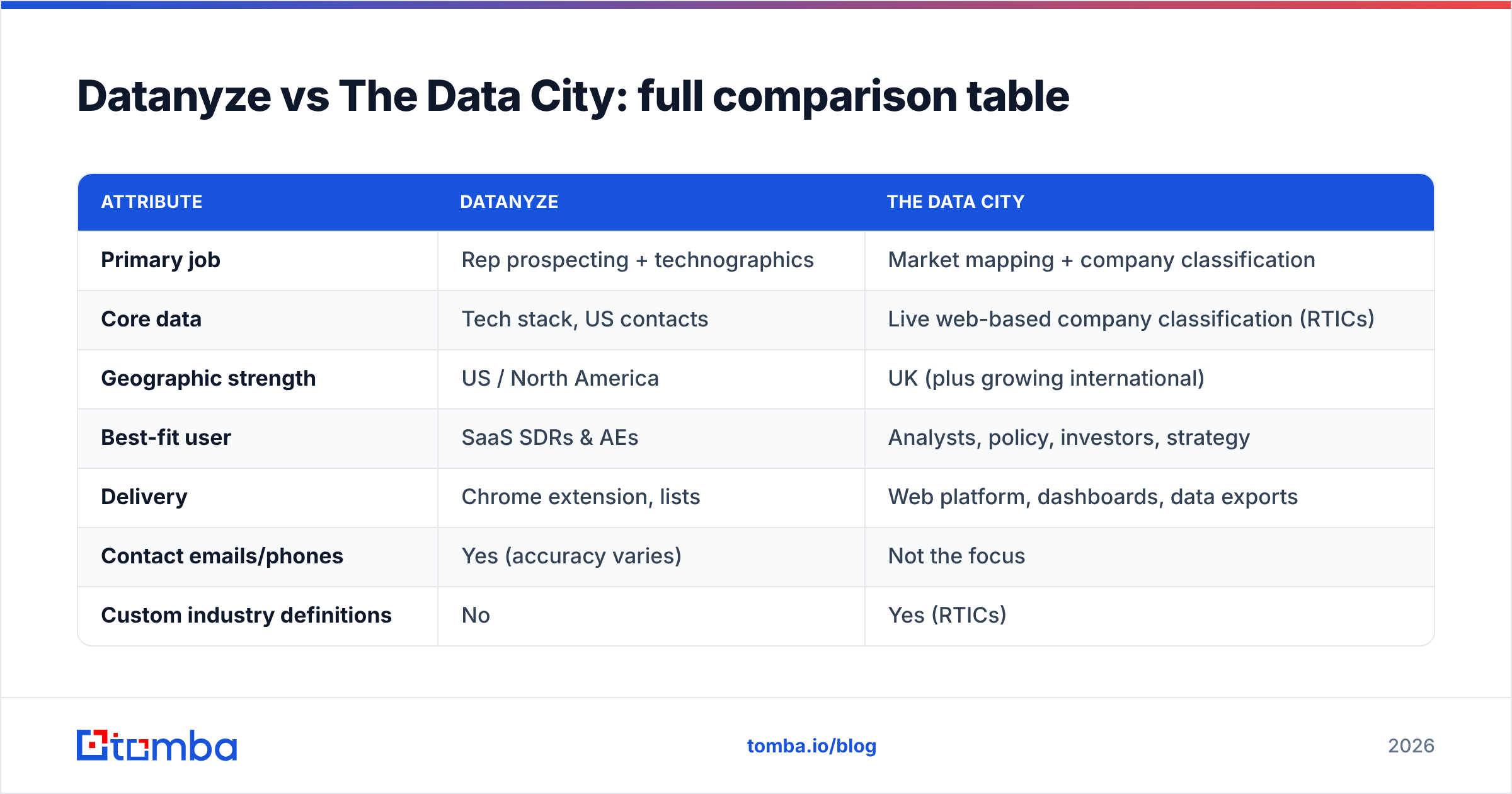
Datanyze vs The Data City: full comparison table#
| Attribute | Datanyze | The Data City |
|---|---|---|
| Primary job | Rep prospecting + technographics | Market mapping + company classification |
| Core data | Tech stack, US contacts | Live web-based company classification (RTICs) |
| Geographic strength | US / North America | UK (plus growing international) |
| Best-fit user | SaaS SDRs & AEs | Analysts, policy, investors, strategy |
| Delivery | Chrome extension, lists | Web platform, dashboards, data exports |
| Contact emails/phones | Yes (accuracy varies) | Not the focus |
| Custom industry definitions | No | Yes (RTICs) |
| Pricing model | Credit-based, per seat | Custom / subscription quote |
| Free self-serve tier | Limited/trial | Demo-led, no open free tier |
Is Datanyze better than The Data City?#
Neither is "better" — they win in different arenas. The honest answer depends entirely on the question you're trying to answer.
Datanyze wins when your targeting is technology-driven and your buyers are in the US. If your pitch is "we replace Tool X" or "we plug into Platform Y," Datanyze's technographics let you build a list of exactly those accounts and start prospecting the same afternoon. It's a rep tool: fast, tactical, credit-metered.
The Data City wins when your question is strategic and market-shaped. "How big is the UK cultivated-meat sector, who's in it, and how fast is it growing?" is a question Datanyze simply can't answer — there's no tech-stack signal for it. The Data City's real-time classification was purpose-built for exactly that, which is why so many of its customers are analysts and public-sector economists rather than quota-carrying reps.
Where both disappoint is contact data. Datanyze's emails and phones are serviceable but its accuracy is inconsistent, and coverage collapses outside North America. The Data City doesn't really try to be a contact-level outreach database at all. So if your end goal is landing a verified email in a sequence, both tools leave you doing extra work — or paying a second vendor.
How do they compare on data accuracy and freshness?#
Data freshness is where the philosophical split shows up most clearly.
The Data City's whole premise is freshness through live web crawling. Because classification is derived from what a company currently publishes, a firm that pivots into a new sector gets reclassified as its website changes — not years later when an industry code is manually updated. That's a genuine edge for spotting emerging companies and fast-moving sectors.
Datanyze relies on detected technology signals plus a contact database. Technographic detection is reasonably current for popular platforms but noisier for niche tools, and the underlying contact records suffer the usual B2B decay: people change jobs, emails bounce, direct dials go dead. Industry research consistently pegs B2B contact-data decay at around 2–2.5% per month, which compounds to roughly a quarter of a database going stale in a year. No provider is immune, which is why verification matters more than raw record counts.
That's the core reason we tell teams to treat any bulk B2B database — Datanyze, The Data City, or otherwise — as a starting list, then re-verify contact details at the moment of outreach. You can read more about where accurate B2B data comes from and how sourcing affects deliverability.
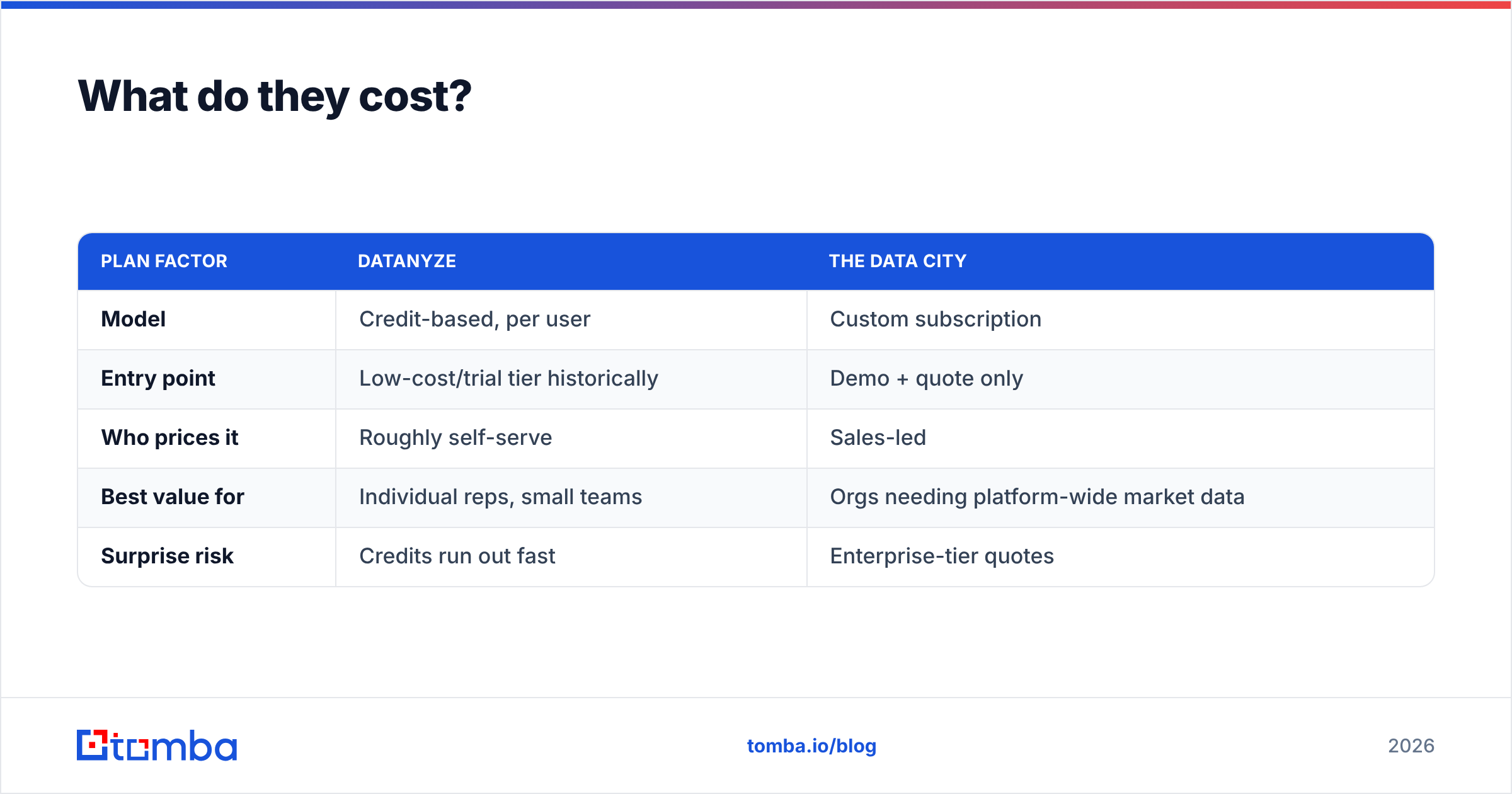
What do they cost?#
Pricing is one of the sharper practical differences, and neither vendor makes it fully transparent.
| Plan factor | Datanyze | The Data City |
|---|---|---|
| Model | Credit-based, per user | Custom subscription |
| Entry point | Low-cost/trial tier historically | Demo + quote only |
| Who prices it | Roughly self-serve | Sales-led |
| Best value for | Individual reps, small teams | Orgs needing platform-wide market data |
| Surprise risk | Credits run out fast | Enterprise-tier quotes |
Datanyze has historically offered a lower-cost, credit-metered entry point that individual reps can adopt, though credits deplete quickly if you prospect at volume. The Data City is demo-led and quote-based — there's no public self-serve price, and it's positioned as a platform investment for a team or organization rather than a single seat.
If predictable, published pricing matters to you, that's worth weighing. For comparison, transparent contact-data pricing — like Tomba's plans starting free (25 searches/month) and moving to $49/mo Starter, $99/mo Growth, and $249/mo Pro — removes the "request a quote" friction entirely.
Which should you choose for outbound sales?#
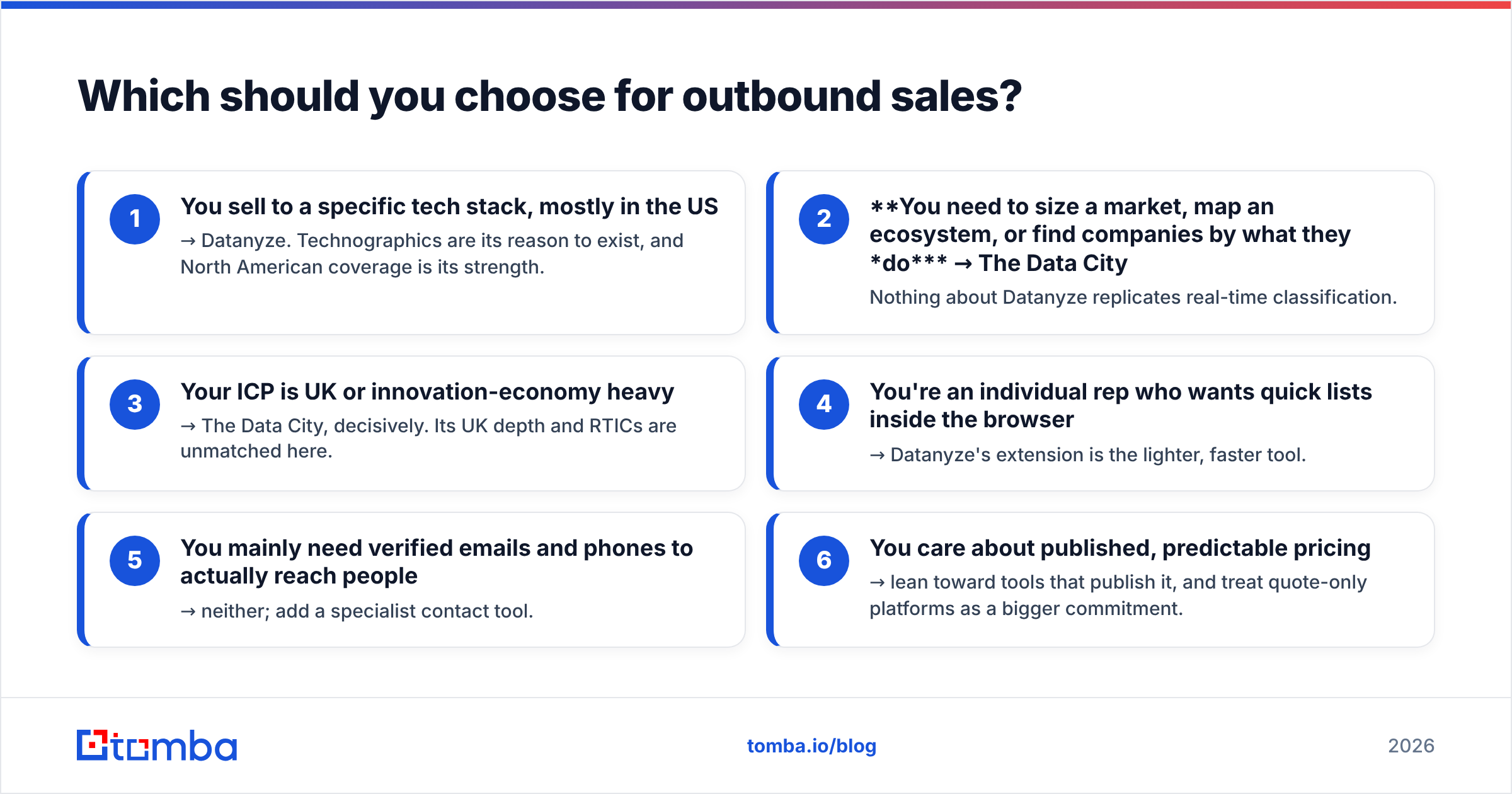
For most outbound teams, the real answer is "one of these for targeting, plus a dedicated contact layer for reach." Here's how to decide the targeting half:
- You sell to a specific tech stack, mostly in the US → Datanyze. Technographics are its reason to exist, and North American coverage is its strength.
- You need to size a market, map an ecosystem, or find companies by what they do → The Data City. Nothing about Datanyze replicates real-time classification.
- Your ICP is UK or innovation-economy heavy → The Data City, decisively. Its UK depth and RTICs are unmatched here.
- You're an individual rep who wants quick lists inside the browser → Datanyze's extension is the lighter, faster tool.
- You mainly need verified emails and phones to actually reach people → neither; add a specialist contact tool.
- You care about published, predictable pricing → lean toward tools that publish it, and treat quote-only platforms as a bigger commitment.
That fifth point is the one teams underestimate. A perfectly targeted account list is worthless if 30% of the emails bounce and half the phone numbers are wrong. This is exactly why a B2B database and a verification step belong in the same workflow — targeting tells you who, contact data tells you how to reach them, and only the second one gets your message delivered.
Where does a dedicated email-finder fit?#
Both Datanyze and The Data City are strongest at the account layer — which companies to pursue and why. The gap is the person layer: the specific decision-maker's email, verified, at the moment you're ready to send.
That's the job a focused tool does best. Instead of trusting a bulk record that may be a year stale, you look up the exact person on the exact domain and verify the address before it enters a sequence:
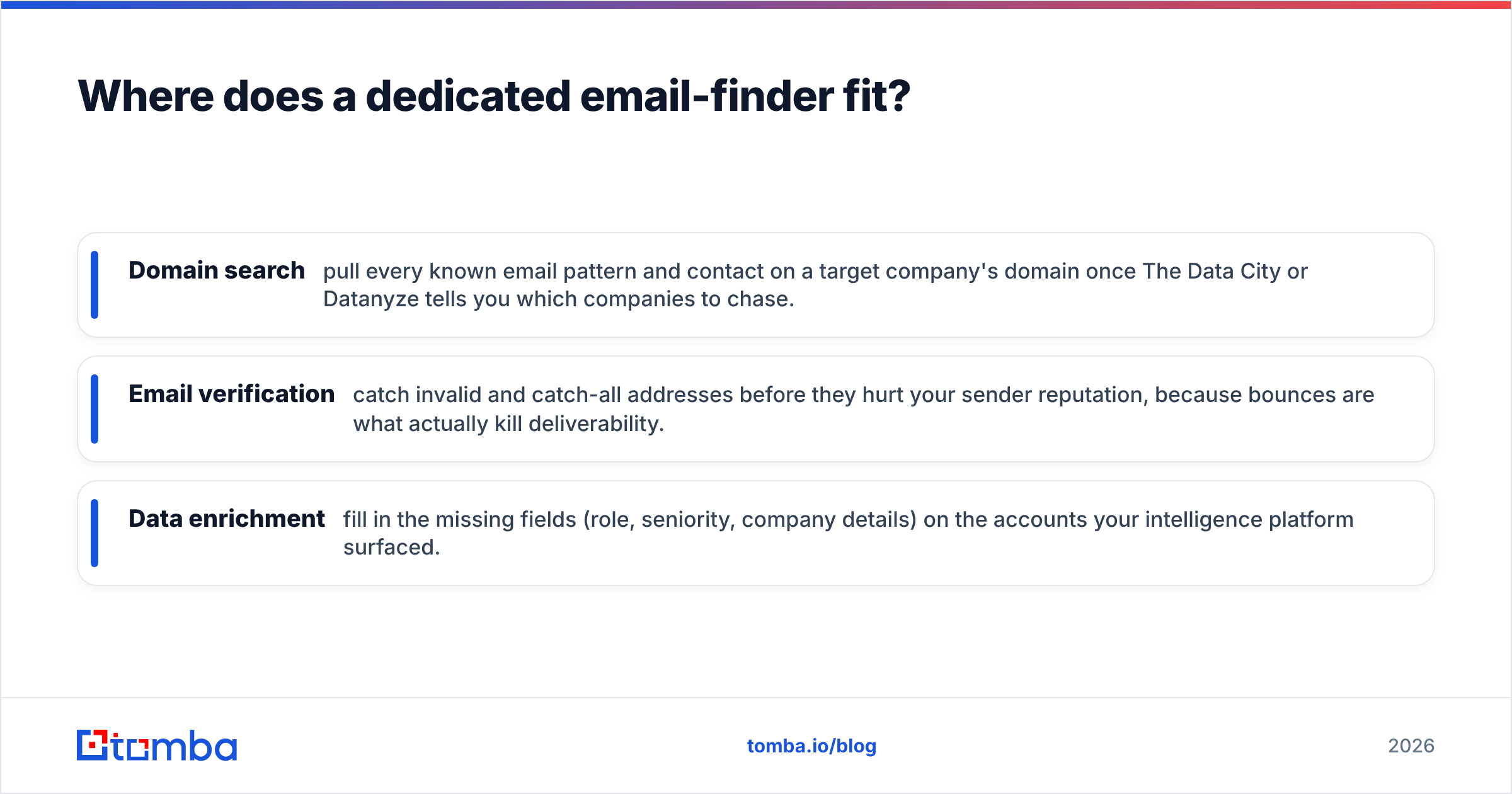
- Domain search — pull every known email pattern and contact on a target company's domain once The Data City or Datanyze tells you which companies to chase.
- Email verification — catch invalid and catch-all addresses before they hurt your sender reputation, because bounces are what actually kill deliverability.
- Data enrichment — fill in the missing fields (role, seniority, company details) on the accounts your intelligence platform surfaced.
Used this way, the two platforms in this comparison and a contact tool aren't competitors — they're consecutive steps. Reviews on G2 show the same pattern across the category: teams routinely stack a targeting source with a separate, verification-first contact source rather than expecting one vendor to nail both.
The verdict#
Datanyze and The Data City are both good at their real jobs and mediocre at each other's. Choose Datanyze if you're a US SaaS team prospecting by technology stack and you want a fast, rep-friendly browser tool. Choose The Data City if you need to understand or map markets — especially UK and emerging sectors — with genuinely fresh, web-derived company classifications. Don't buy either expecting a clean, verified contact database; that's the layer both leave you to solve.
If reliable, verified emails are what stands between your targeting and actual replies, start there. Tomba's Email Finder turns the accounts your intelligence platform surfaces into verified, deliverable contacts — with transparent pricing, a free tier to test coverage, and verification built in so your sequences reach real inboxes instead of bouncing. Point your Datanyze or Data City list at it and let the outreach half take care of itself.
Related guides#
Ready to find emails that actually work?
Join 150,000+ professionals who stopped guessing and started sending. Free credits on signup — no credit card required.
Get the Tomba newsletter
Practical outbound tactics and product updates — once every two weeks.
About the author