How to Revive Dead Leads in 2026: A Practical Playbook
Most "dead" leads aren't dead — they're stale, misrouted, or held by the wrong contact. Here's how to audit, re-qualify, and revive dead leads without wasting a single new-lead dollar.
You paid to acquire every lead sitting in your CRM. When one goes quiet, the instinct is to mark it closed-lost and chase a fresh name. That instinct is expensive and usually wrong.
This guide breaks down what a dead lead actually is, why most of them aren't truly dead, and the exact sequence to bring the salvageable ones back to life — without burning your sender reputation or your reps' time.
TL;DR#
- A "dead lead" is a status, not a diagnosis. Most went cold because of bad timing, a stale email, or a champion who left — not because the buyer stopped needing you.
- Audit before you re-engage. Segment dead leads by why they died. Different causes need different plays.
- Data decays ~22–30% per year. A large share of dead leads are just contacts you can no longer reach — fixable with re-verification and enrichment, not new prospecting.
- Revival costs a fraction of net-new. Reviving an existing lead skips the awareness and trust-building stages you already funded.
- Not every lead is worth saving. A clean disqualification list is as valuable as a revival list — it stops you re-spending on the truly dead.
What Is a Dead Lead, Really?#
A dead lead is any prospect that has stopped responding and sits in your pipeline with no next step. That's the operational definition. The problem is that "no response" hides at least five very different situations, and lumping them together is why revival campaigns fail.
Think of your dead-lead pile like a lost-and-found box at a train station. Some items in there are genuinely trash. But a lot are perfectly good wallets, phones, and keys that someone just walked away from in a hurry — and their owners would love them back. You don't throw out the whole box. You sort it.
Here's the sort:
- Timing-dead — The buyer was interested but had no budget, no mandate, or a competing priority. Nothing was wrong with the fit; the calendar was wrong.
- Contact-dead — Your emails bounce or your calls go nowhere because the person changed jobs, the email format changed, or the number is stale. The company is still a fit; your data isn't.
- Champion-dead — Your internal advocate left. The deal didn't die; your relationship to it did.
- Fit-dead — The lead was never actually qualified. Wrong size, wrong industry, wrong problem. These belong in disqualification, not revival.
- Trust-dead — Something went wrong: a bad demo, a pricing surprise, a support horror story. These are the hardest and slowest to recover.
Only two of those five — fit-dead and some trust-dead — justify writing the lead off. The other three are recoverable, and they're the majority.
Why Do Leads Actually Go Dead?#
Reps love to blame the prospect ("they ghosted"), but the data tells a less flattering story. A big chunk of "dead" leads die inside your own systems.
According to sales research aggregated by HubSpot, the average follow-up sequence stops far too early, and a large share of leads that never convert simply never received enough touches at the right cadence. Layer on top of that the natural decay of B2B contact data — Gartner and other analysts consistently put annual data decay in the 20–30% range as people switch roles and companies — and you get a pipeline where a meaningful fraction of "unresponsive" contacts are unreachable rather than uninterested.
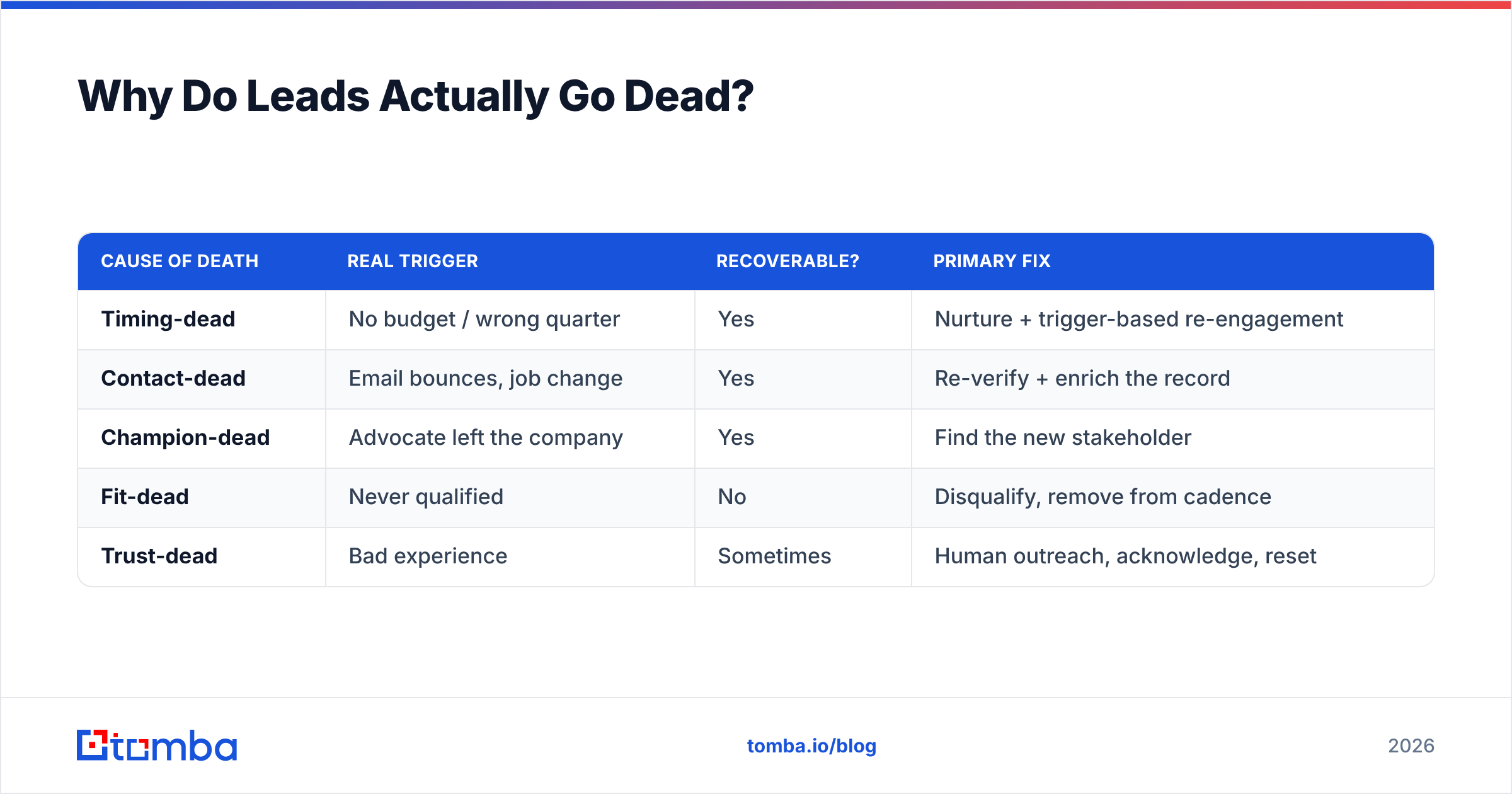
| Cause of death | Real trigger | Recoverable? | Primary fix |
|---|---|---|---|
| Timing-dead | No budget / wrong quarter | Yes | Nurture + trigger-based re-engagement |
| Contact-dead | Email bounces, job change | Yes | Re-verify + enrich the record |
| Champion-dead | Advocate left the company | Yes | Find the new stakeholder |
| Fit-dead | Never qualified | No | Disqualify, remove from cadence |
| Trust-dead | Bad experience | Sometimes | Human outreach, acknowledge, reset |
The takeaway: before you write a single revival email, you need to know which row each lead belongs to. A generic "just checking in" blast treats all five the same and gets the response rate all five deserve — near zero.
How Do You Audit a Pile of Dead Leads?#
Run a four-step triage before any outreach. The goal is to turn one undifferentiated "dead" bucket into scored, actionable segments.
Step 1 — Pull and timestamp. Export every lead marked closed-lost, unresponsive, or stale. Record the date of last meaningful contact. Anything older than 18 months needs data validation before anything else.
Step 2 — Validate the contact data. This is the step most teams skip, and it's the one that quietly kills revival campaigns. Before you email a two-year-old list, run it through an email verifier to strip out hard bounces. Bouncing a stale list into your primary domain is one of the fastest ways to wreck email deliverability for your live pipeline too.
Step 3 — Re-map the humans. For contact-dead and champion-dead records, the company is still a target but the person is gone. Use a reverse email lookup or domain-level search to find the current holder of that role, then rebuild the record with fresh data enrichment so your rep walks in with an accurate title, seniority, and email.
Step 4 — Score and route. Assign each surviving lead a revival score based on original fit, engagement depth before they went cold, and how recently. High scores go to a rep for a personal touch; medium scores go into an automated nurture; low and fit-dead scores get archived.
If you want a repeatable scoring model, our primer on lead management frameworks pairs well with this triage.
Which Dead Leads Are Worth Reviving?#
Not all. Chasing the wrong ones is just re-buying a bad lead. Use a simple worth-it filter — a lead needs at least three "yes" answers to earn a spot in the revival campaign:
- Fit: Does the account still match your ICP on size, industry, and use case?
- Signal: Did they ever show real intent — a demo, a pricing page visit, a reply — not just a form fill?
- Reachability: Can you confirm a valid, current contact? (This is where re-verification pays off.)
- Recency: Was the last touch within ~24 months? Older leads need heavier enrichment.
- No hard no: Did they explicitly say "never," or just go quiet? Silence is recoverable; a hard no is not.
Leads that fail this filter aren't failures — they're clarity. Archiving them frees your reps to spend cycles where the odds are real.
What's the Right Sequence to Revive a Dead Lead?#
Once a lead clears the worth-it filter and has verified contact data, run a structured re-engagement — not a single "circling back" email. Match the play to the cause of death.
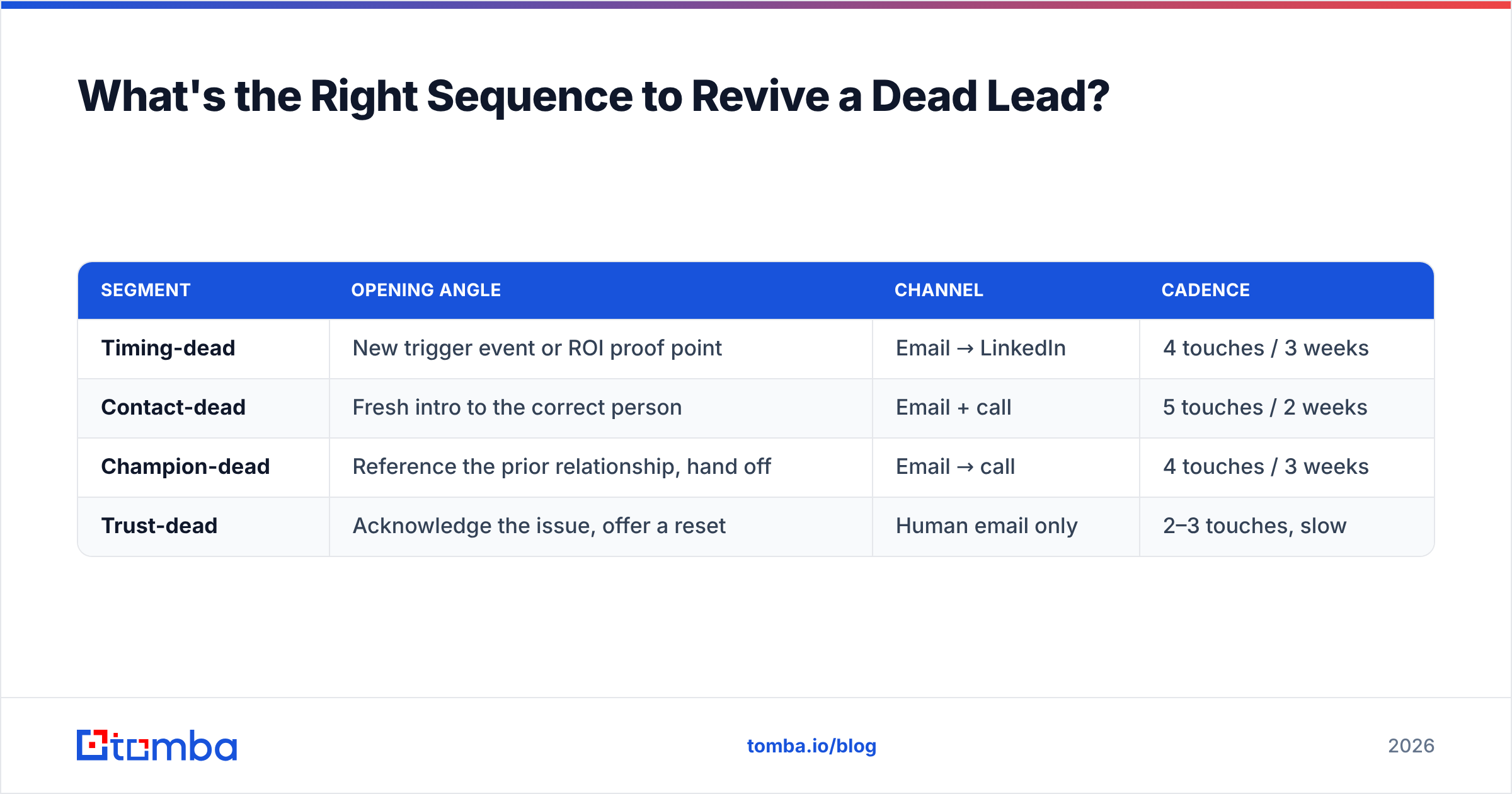
| Segment | Opening angle | Channel | Cadence |
|---|---|---|---|
| Timing-dead | New trigger event or ROI proof point | Email → LinkedIn | 4 touches / 3 weeks |
| Contact-dead | Fresh intro to the correct person | Email + call | 5 touches / 2 weeks |
| Champion-dead | Reference the prior relationship, hand off | Email → call | 4 touches / 3 weeks |
| Trust-dead | Acknowledge the issue, offer a reset | Human email only | 2–3 touches, slow |
A few rules that separate revival from spam:
- Lead with what changed on your side. New feature, new pricing, a case study in their industry. "Just checking in" gives the prospect no reason to reply. A concrete change does.
- Reference the past honestly. "We spoke last spring about X — here's why now might be different" respects their time and signals you're not a fresh SDR working a cold list.
- Keep the list clean between touches. Re-verify before each new push so you're not re-bouncing contacts and dragging down your sender reputation.
- Cap the sequence. If a well-built revival cadence gets no response, mark it disqualified and stop. Reviving isn't the same as harassing.
How Does Reviving Compare to Buying New Leads?#
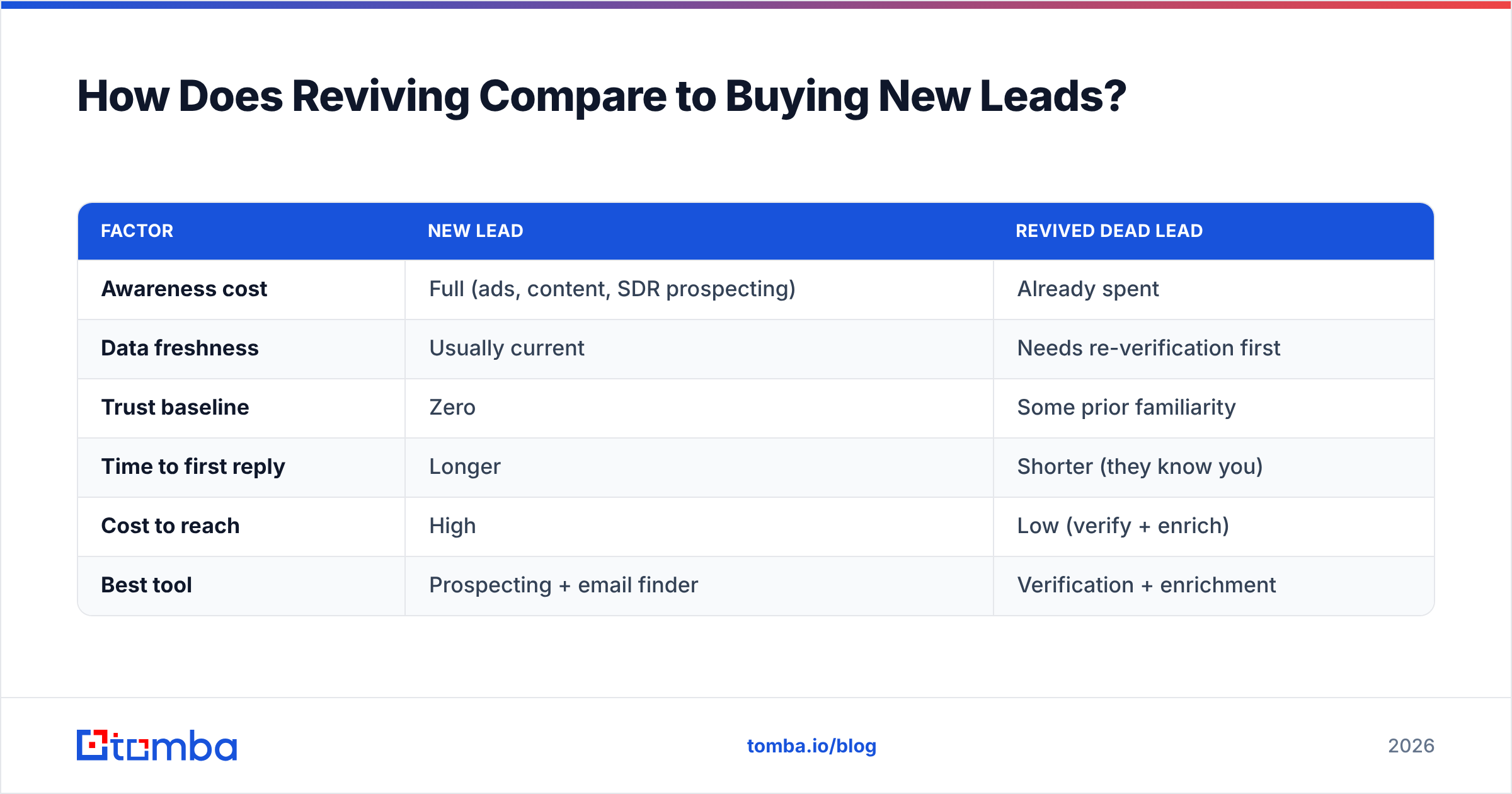
This is the argument that gets budget approved. Reviving a dead lead skips the two most expensive stages of the funnel — awareness and initial trust — because you already paid for them.
| Factor | New lead | Revived dead lead |
|---|---|---|
| Awareness cost | Full (ads, content, SDR prospecting) | Already spent |
| Data freshness | Usually current | Needs re-verification first |
| Trust baseline | Zero | Some prior familiarity |
| Time to first reply | Longer | Shorter (they know you) |
| Cost to reach | High | Low (verify + enrich) |
| Best tool | Prospecting + email finder | Verification + enrichment |
The economics are lopsided. If even a modest share of your dead pile is contact-dead or timing-dead, the cost of re-verifying and re-mapping those records is a rounding error next to a new-lead acquisition budget. You can validate the reachability of a whole segment for less than you'd spend acquiring a handful of net-new names.
That said, revival isn't free money. It only works if the underlying data is trustworthy, which is exactly why the audit and verification steps come first. Skip them and you're just emailing ghosts.
What Tools Do You Actually Need?#
You don't need a new platform. You need three capabilities working together:
- Verification — to strip dead addresses before you send, protecting deliverability.
- Enrichment — to rebuild stale records with current titles, emails, and firmographics.
- Re-discovery — to find the new person when your old contact has moved on.
Tomba covers all three. Beyond the email verifier and enrichment tools mentioned above, its B2B database helps you re-map champion-dead accounts to their current decision-makers. Independent reviews on G2 are a good place to sanity-check any tool you're evaluating against your own volume and accuracy needs before you commit a plan.
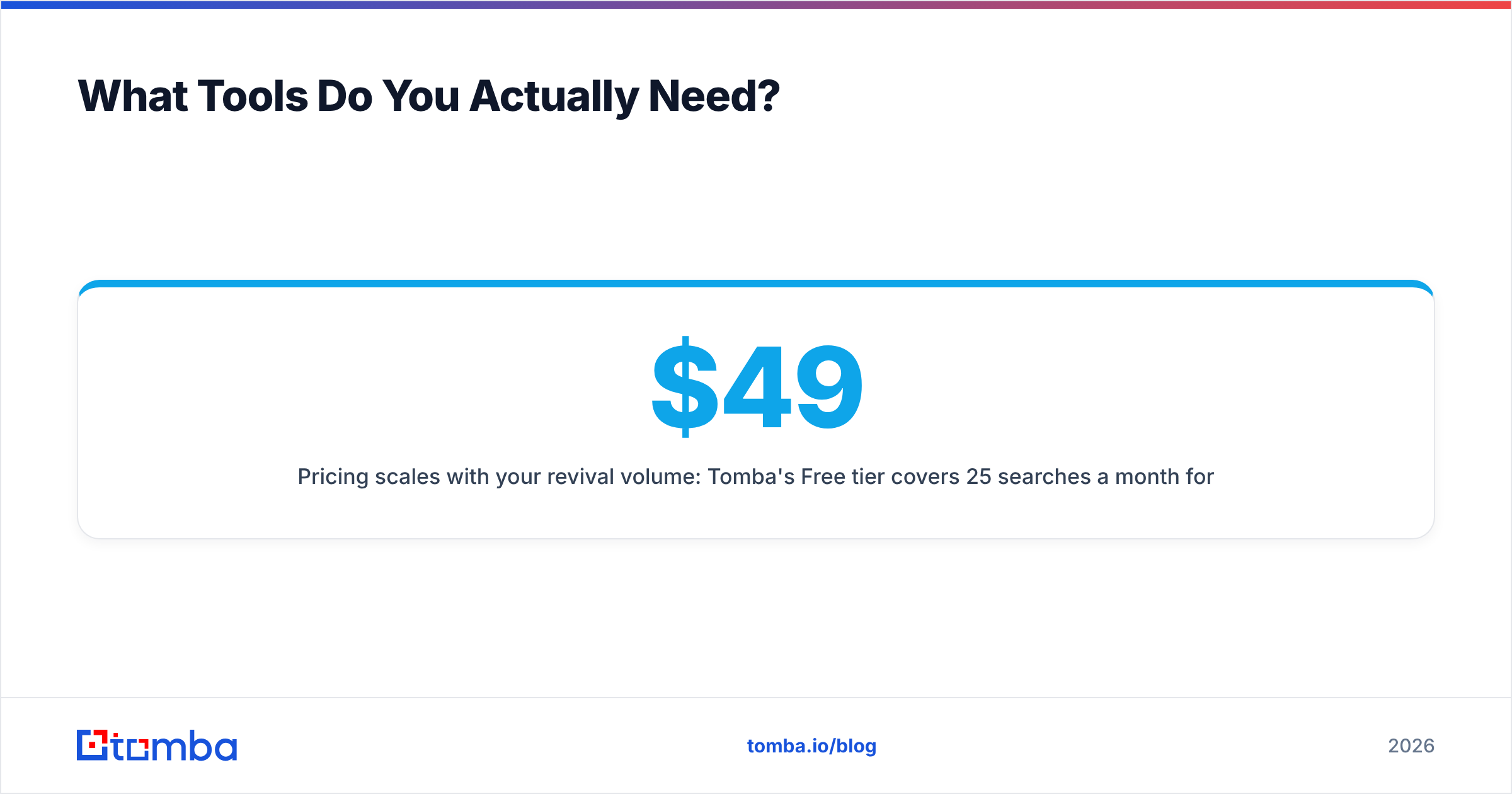
Pricing scales with your revival volume: Tomba's Free tier covers 25 searches a month for a small test batch, Starter runs $49/mo, Growth $99/mo, and Pro $249/mo for teams cleaning large lists regularly. Full breakdowns live on the Tomba pricing page.
Common Mistakes That Keep Leads Dead#
- Blasting the whole pile at once. Untriaged, unverified, one generic message. This is the number-one revival killer and a deliverability risk.
- Never verifying first. A two-year-old list will bounce hard. Bounces train inbox providers to distrust your domain.
- Reviving fit-dead leads. No amount of clever copy fixes a lead that was never qualified. Disqualify and move on.
- Giving up after one touch — or overdoing it after twenty. Both extremes waste the effort. Build a capped, multi-touch cadence and honor the cap.
- Not updating the record. If you revive a lead but leave the stale title and email in the CRM, the next rep repeats your mistake.
The Bottom Line#
Your dead-lead pile is the cheapest pipeline you own — but only the part of it that's still reachable and still a fit. The work is sorting: separate the timing-dead, contact-dead, and champion-dead (recoverable) from the fit-dead and hard-no (not). Verify the data before you touch it, enrich what's stale, re-map the humans who moved, and run a cause-matched sequence with a hard stop.
Do that and revival stops being a hopeful blast and becomes a predictable, low-cost channel.
Ready to see how many of your "dead" leads are just unreachable? Start with clean, current contact data. The Tomba Email Finder — paired with its verifier and enrichment tools — lets you re-verify a stale segment, find the new decision-maker when yours has moved on, and reach the leads you already paid for. Spin up the free tier, run one dead segment through it, and let the response rate settle the debate.
Related guides#
Ready to find emails that actually work?
Join 150,000+ professionals who stopped guessing and started sending. Free credits on signup — no credit card required.
Get the Tomba newsletter
Practical outbound tactics and product updates — once every two weeks.
About the author