Deal Desk in 2026: What It Is and How to Build One That Works
A deal desk is the cross-functional team that turns messy, high-stakes deals into fast, clean approvals. Here's what it does, when you need one, and how to build a deal desk that speeds reps up instead of slowing them down.
Your best rep just lost a week chasing three internal approvals for a deal the customer already wanted to sign. Legal flagged a clause, finance questioned the discount, and the quote bounced between four inboxes. By the time everyone agreed, the buyer's budget cycle had moved on.
That is the exact problem a deal desk exists to kill. It is the difference between "we'll get back to you on pricing" and a clean, approved quote in the buyer's hands before their coffee gets cold.
TL;DR#
- A deal desk is a cross-functional team that owns pricing, quoting, approvals, and contract structure for complex or non-standard deals, so reps can sell instead of chase.
- It is not just a discount-approval gate. A good deal desk shortens sales cycles, protects margin, and standardizes how deals get built.
- You need one once non-standard deals, custom pricing, or multi-party approvals start eating your reps' selling time — usually somewhere past Series A or the first enterprise logo.
- The core stack is people (RevOps, finance, legal, sales), a defined process, and tooling (CPQ, CRM, clean contact data).
- Start lean: one owner, a simple approval matrix, and a shared queue beat a bloated committee every time.
What is a deal desk?#
A deal desk is a centralized, cross-functional function that helps sales teams structure, price, approve, and close complex deals. Think of it as air traffic control for revenue: individual reps are the pilots flying the deals, but the deal desk clears the runway, sequences approvals, and makes sure nothing collides on the way to signature.
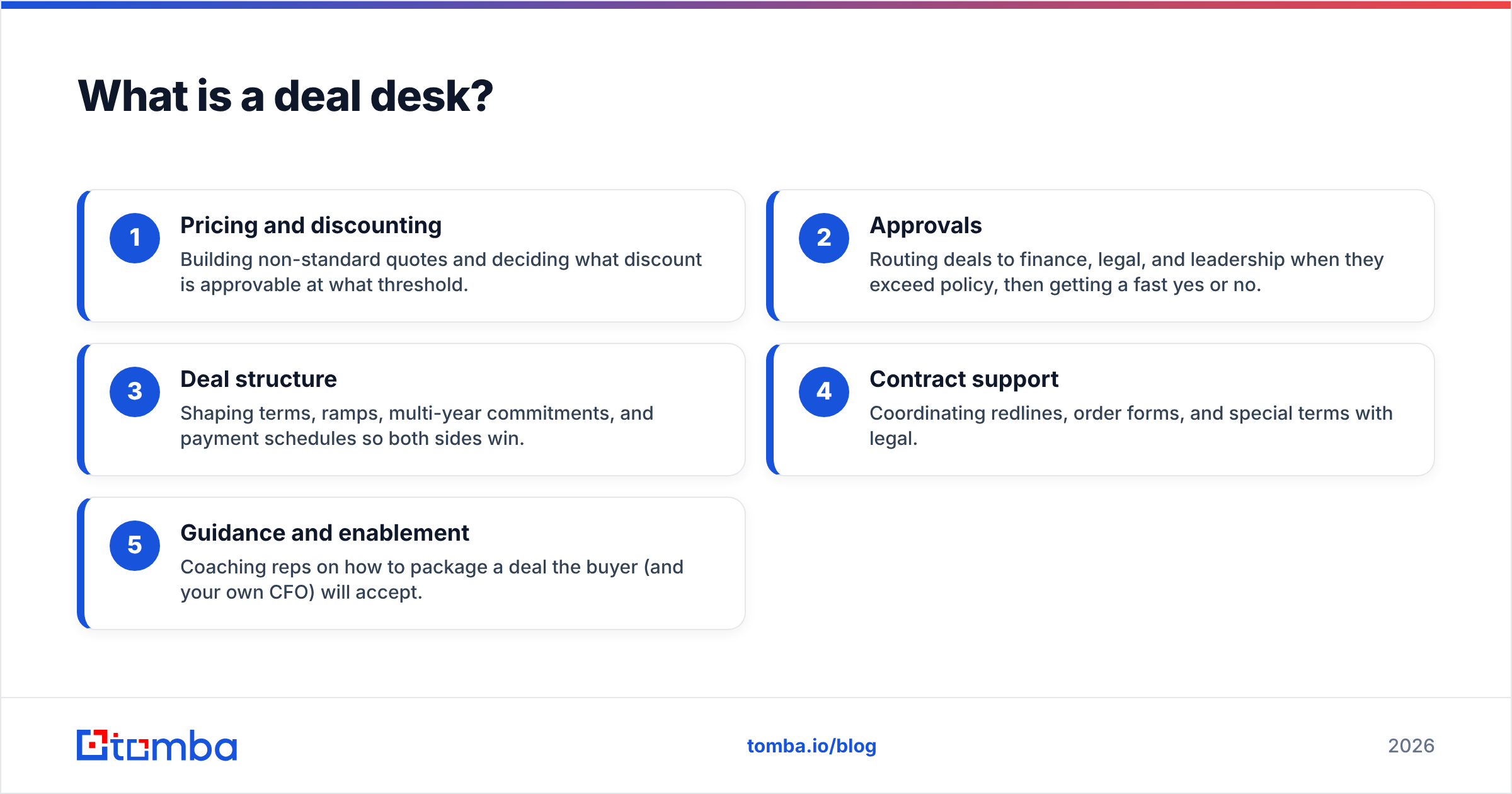
In practice, the deal desk owns the parts of a deal that are too risky, too technical, or too cross-functional for a single account executive to handle alone:
- Pricing and discounting — Building non-standard quotes and deciding what discount is approvable at what threshold.
- Approvals — Routing deals to finance, legal, and leadership when they exceed policy, then getting a fast yes or no.
- Deal structure — Shaping terms, ramps, multi-year commitments, and payment schedules so both sides win.
- Contract support — Coordinating redlines, order forms, and special terms with legal.
- Guidance and enablement — Coaching reps on how to package a deal the buyer (and your own CFO) will accept.
The deal desk sits inside revenue operations at most companies, because it touches sales, finance, and legal at once and needs a neutral owner who reports to the whole revenue engine — not to any single rep's quota.

Why do sales teams need a deal desk?#
Because complexity does not scale by adding more heroic reps. It scales by adding process.
When every non-standard deal is a bespoke negotiation between a rep and five internal stakeholders, three expensive things happen. Sales cycles stretch because approvals live in inboxes. Margin leaks because reps discount to whatever closes the quarter. And your best sellers spend 20-30% of their week doing operations work instead of selling. Salesforce's own research on sales productivity consistently finds reps spend less than a third of their time actually selling — the rest disappears into admin, approvals, and internal coordination. A deal desk is one of the highest-leverage ways to claw that time back.
Here is what changes when a deal desk is doing its job:
- Faster cycles. A defined approval matrix means a $50k discount request gets a yes in hours, not days.
- Protected margin. Guardrails on discounting stop the race to the bottom every quarter-end.
- Consistency. Every quote follows the same logic, so deals are comparable, auditable, and forecastable.
- Rep focus. AEs sell; the desk handles the paperwork gauntlet.
- Cleaner data. Standardized deals feed a cleaner pipeline and more reliable forecasting.
When should you build a deal desk?#
Not on day one. A five-person startup selling a single-price SaaS plan does not need a deal desk — it needs customers. But the signals below usually mean you have outgrown ad-hoc dealmaking:
| Signal | What it looks like | Deal desk urgency |
|---|---|---|
| Non-standard deals | More than ~20% of deals need custom pricing or terms | High |
| Approval chaos | Discount approvals happen over Slack DMs and hallway chats | High |
| Enterprise motion | You're landing 5-6 figure deals with procurement and legal | Critical |
| Margin erosion | Average discount creeping up quarter over quarter | High |
| Rep complaints | AEs say they spend more time on quotes than on calls | Medium |
| Forecast noise | Deals slip because "it's stuck in approvals" | Medium |
If three or more of those describe your team, you are past due. Most B2B companies stand up a formal deal desk somewhere between their first enterprise segment and $10-20M ARR, though the trigger is complexity, not a specific revenue number.
What does a deal desk actually do day to day?#
A deal desk is a workflow, not a meeting. A healthy one runs on a repeatable loop:
- Intake — A rep submits a deal request with the account, the ask, and the context. This lives in a shared queue (a CRM object, a form, or a ticketing tool), never a personal inbox.
- Triage — The desk classifies the deal: standard (auto-approve), non-standard (needs structuring), or exception (needs leadership).
- Structure — The desk builds or reviews the quote, models the margin, and proposes terms.
- Approve — Anything over policy routes to the right approver automatically, with SLAs attached.
- Deliver — A clean quote or order form goes back to the rep, ready for the buyer.
- Learn — Outcomes feed back into pricing rules and playbooks, so the desk gets smarter every quarter.
The magic is in the SLAs and the approval matrix. When everyone knows a Tier 1 request clears in four hours and a Tier 3 in one business day, the guessing stops and the selling starts.
Who sits on a deal desk?#
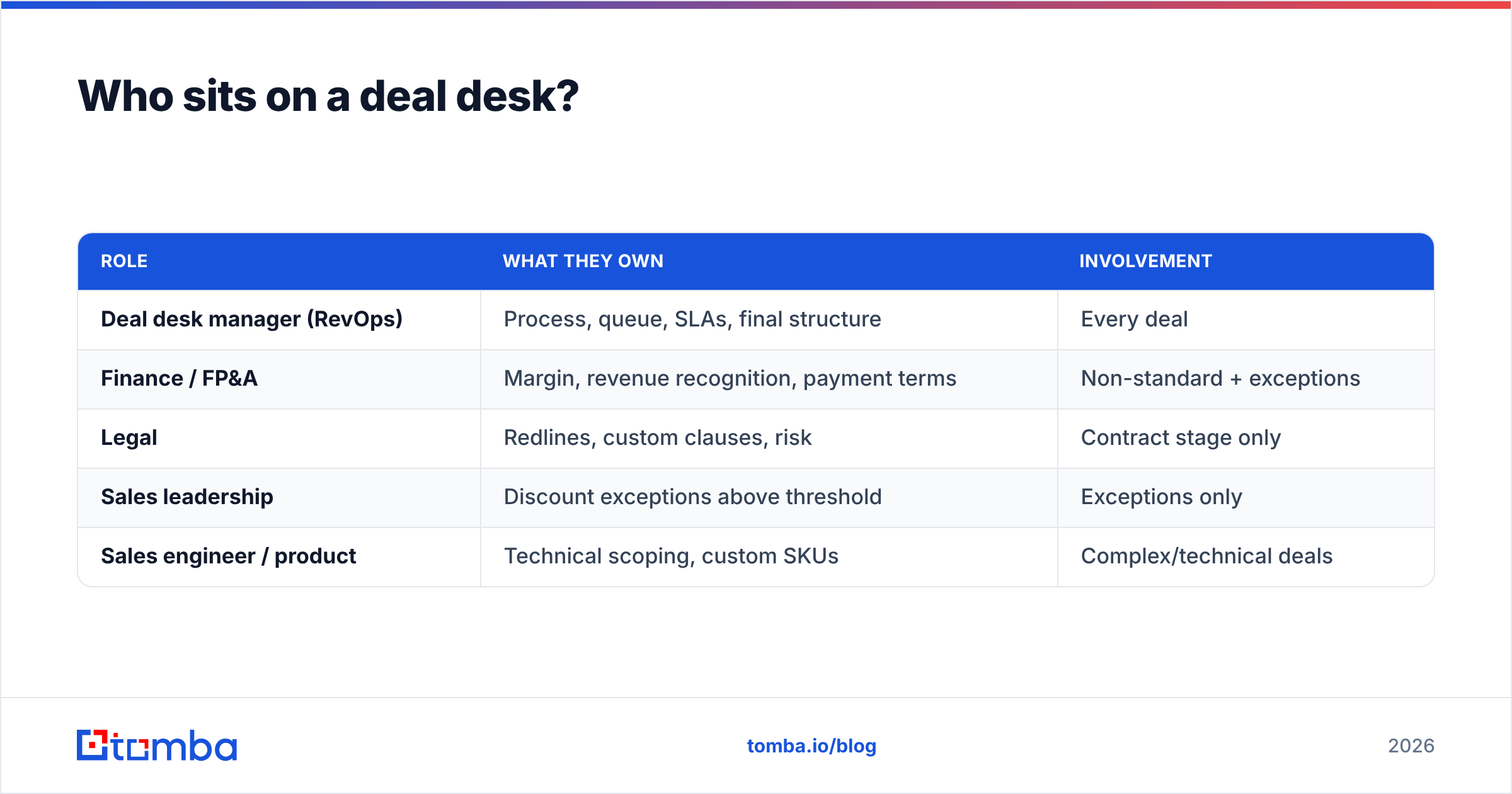
A deal desk is deliberately small and cross-functional. You do not need one of each on day one — early-stage teams often start with a single RevOps owner who pulls in finance and legal only when a deal demands it.
| Role | What they own | Involvement |
|---|---|---|
| Deal desk manager (RevOps) | Process, queue, SLAs, final structure | Every deal |
| Finance / FP&A | Margin, revenue recognition, payment terms | Non-standard + exceptions |
| Legal | Redlines, custom clauses, risk | Contract stage only |
| Sales leadership | Discount exceptions above threshold | Exceptions only |
| Sales engineer / product | Technical scoping, custom SKUs | Complex/technical deals |
The anti-pattern is turning the desk into a committee where five people approve every deal. That recreates the bottleneck you were trying to remove. Push authority down with a clear matrix; escalate only the true exceptions.
What tools power a modern deal desk?#
Process first, tools second — but the right stack turns a good process into a fast one.
- CRM — Salesforce, HubSpot, or Pipedrive is the system of record where deals, approvals, and stages live. A Salesforce integration keeps the desk working inside the tool reps already use.
- CPQ (Configure, Price, Quote) — Automates quoting, enforces pricing rules, and routes approvals. This is the beating heart of a mature deal desk.
- Approval workflow — Native CRM flows or a tool like a ticketing queue, with SLAs and audit trails.
- Contract lifecycle management (CLM) — Manages templates, redlines, and e-signature.
- Clean contact and account data — Every deal starts with knowing who the real decision-makers are. Enriched, verified contact data means fewer stalled deals from reaching the wrong stakeholder.
That last point is where a lot of desks quietly leak time. You can have a perfect approval matrix and still lose a week because the order form went to a champion who left the company, or because the procurement contact's email bounced. Feeding your CRM with reliable data enrichment and verified emails keeps the humans in the loop reachable — which matters more than most CPQ demos admit.

Deal desk vs. sales ops vs. RevOps: what's the difference?#
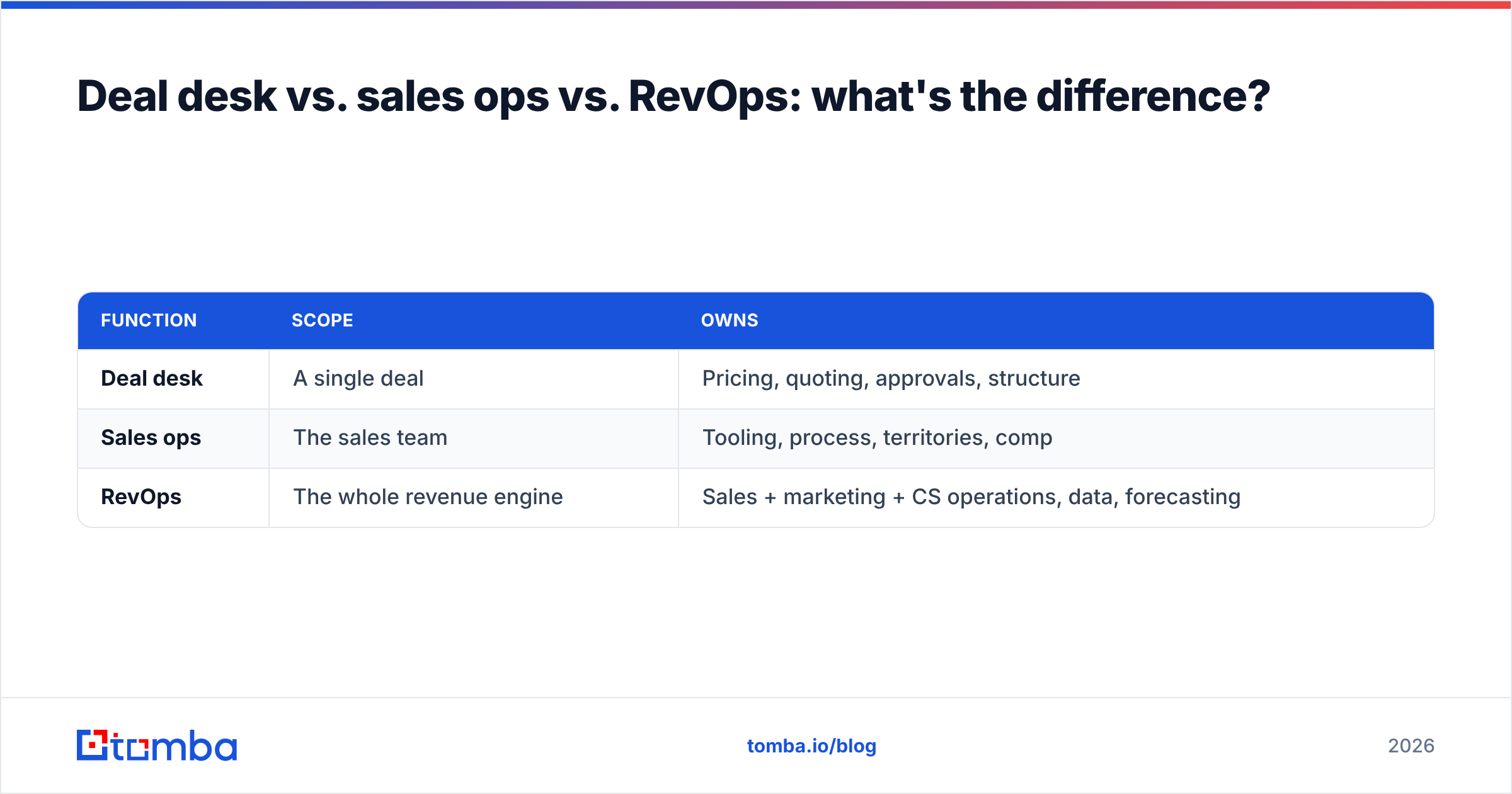
These get blurred constantly, so here is the clean version:
| Function | Scope | Owns |
|---|---|---|
| Deal desk | A single deal | Pricing, quoting, approvals, structure |
| Sales ops | The sales team | Tooling, process, territories, comp |
| RevOps | The whole revenue engine | Sales + marketing + CS operations, data, forecasting |
A deal desk is the most zoomed-in of the three. Sales ops keeps the sales machine running; RevOps aligns the entire go-to-market motion. In smaller orgs one team wears all three hats. As you scale, the deal desk usually emerges as a specialized function within RevOps precisely because deal-level work is high-stakes and needs a dedicated owner.
How do you build a deal desk in 5 steps?#
You can stand up a functional deal desk in a few weeks. Resist the urge to over-engineer.
- Define the trigger. Decide exactly which deals go through the desk. A simple rule like "any discount over 15% or any non-standard term" is enough to start. Everything else auto-approves.
- Build the approval matrix. Map discount and term thresholds to approvers, with SLAs. Publish it so every rep knows the rules before they submit.
- Create one intake queue. Kill the inbox chaos. One form, one CRM object, one shared view. If it is not in the queue, it does not exist.
- Assign one owner. Even part-time, someone in RevOps must own the process, the SLAs, and the metrics. Diffuse ownership is how desks die.
- Measure and tighten. Track cycle time, approval time, average discount, and win rate. Feed what you learn back into the rules quarterly.
Start with a spreadsheet and a Slack channel if you must. The process discipline matters far more than the tooling on day one. You can layer CPQ and automation on once the workflow is proven.
What metrics prove a deal desk is working?#
If you cannot measure it, you cannot defend the headcount. Track these from day one:
- Deal desk cycle time — Median time from intake to approved quote. This is your north star.
- Approval SLA hit rate — Percentage of requests cleared within their promised window.
- Average discount — Should stabilize or drop as guardrails take hold.
- Win rate on desk-touched deals — Compare against the win rate of deals that skip the desk.
- Rep selling time — Survey or measure how much time AEs get back.
- Quote accuracy — Fewer reissued quotes means less rework downstream.
A mature desk moves cycle time down and win rate up at the same time. If cycle time drops but win rate craters, your guardrails are too tight and you are strangling good deals. Analyst firms like Gartner have long tied disciplined deal governance to both margin protection and faster cycles — the trick is balancing speed with control, not maximizing one at the expense of the other.
What are the biggest deal desk mistakes?#
The failure modes are predictable, which means you can dodge them:
- Turning it into a discount police force. A desk that only ever says "no" gets routed around. Its job is to help deals close cleanly, not to block them.
- Committee sprawl. Five approvers on every deal is not rigor; it is a bottleneck with a nice name.
- No SLAs. Without published response times, "the deal desk" becomes the new excuse for slippage.
- Ignoring data quality. Perfect approvals mean nothing if the contract goes to a stale contact. Reaching the right buyer starts with an accurate email finder and verified records.
- Set-and-forget rules. Pricing guardrails from last year strangle this year's deals. Revisit them every quarter.
Avoid those five and you are ahead of most revenue teams.
Build the reachability layer your deal desk runs on#
A deal desk optimizes what happens after you know who to talk to. But every clean quote still has to reach a real, current decision-maker — and stale or wrong contact data quietly wrecks even the best-run approval process.
That is where Tomba's Email Finder fits into your revenue stack. Find and verify the professional emails of the exact stakeholders on a deal — the economic buyer, the procurement lead, the legal contact — so your desk-approved quotes and order forms land in the right inbox the first time. Plans start free with 25 searches a month, and paid tiers begin at $49/mo on the Starter plan; see full Tomba pricing for Growth and Pro options.
Your deal desk clears the runway. Make sure the plane is pointed at the right buyer. Start finding verified contacts free and give your desk clean data to build every deal on.
Related guides#
Ready to find emails that actually work?
Join 150,000+ professionals who stopped guessing and started sending. Free credits on signup — no credit card required.
Get the Tomba newsletter
Practical outbound tactics and product updates — once every two weeks.
About the author