Deal Flow Management: The 2026 Guide to a Healthier Pipeline
Deal flow management is where good pipelines are won or lost. Here's a practical 2026 framework for sourcing, scoring, and moving deals faster — without the guesswork.
Deal flow management is the discipline of controlling how opportunities enter, move through, and exit your pipeline — deliberately, not by accident. Get it right and forecasting stops being a monthly guessing game. Get it wrong and you end up with a CRM full of "maybe" deals that never close.
This guide gives you a concrete 2026 framework: the stages that actually matter, the metrics that predict revenue, and the data hygiene that keeps the whole system from rotting.
TL;DR#
- Deal flow management = the end-to-end system for sourcing opportunities, qualifying them, and moving them through defined stages to a close (won or lost).
- A healthy process has clear stage definitions, exit criteria, and a single source of truth — usually your CRM, fed by clean contact data.
- The metrics that predict revenue are stage conversion rate, velocity (days in stage), and slippage, not the vanity "total pipeline value" number.
- Bad contact data is the silent killer: deals stall when reps chase dead emails and wrong numbers. Enrichment at the top of the funnel fixes this.
- Tools range from a spreadsheet to a full RevOps stack — pick based on deal volume and team size, then layer in accurate data with a tool like the Tomba Email Finder.
What Is Deal Flow Management?#
Think of your pipeline like a busy kitchen. Orders (leads) come in, each moves through prep, cooking, and plating (your sales stages), and finally goes out the door (closed). Deal flow management is the head chef's job: making sure nothing sits forgotten on a counter, every station knows what's next, and you can predict when each plate lands.
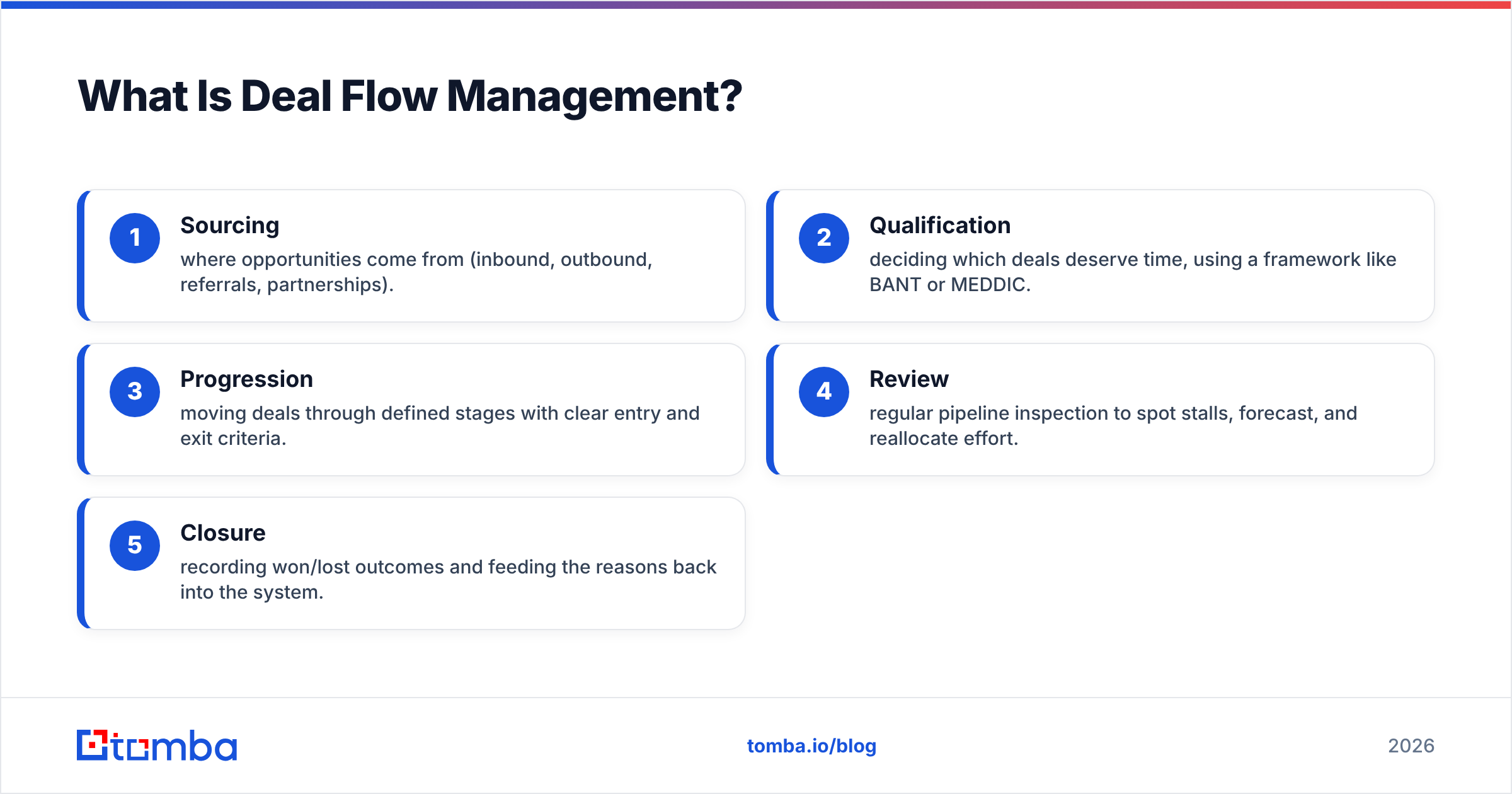
Technically, deal flow management is the set of processes and rules that govern:
- Sourcing — where opportunities come from (inbound, outbound, referrals, partnerships).
- Qualification — deciding which deals deserve time, using a framework like BANT or MEDDIC.
- Progression — moving deals through defined stages with clear entry and exit criteria.
- Review — regular pipeline inspection to spot stalls, forecast, and reallocate effort.
- Closure — recording won/lost outcomes and feeding the reasons back into the system.
The term originated in venture capital, where "deal flow" meant the rate of investment opportunities a firm sees. In B2B sales it has broadened to mean the health and movement of your entire opportunity pipeline. HubSpot's sales pipeline research consistently shows that companies with a formally defined process outperform those winging it — the discipline itself is the edge.
Why Does Deal Flow Management Matter in 2026?#
Because guessing is expensive. When you don't manage deal flow deliberately, three things happen:
- Forecasts drift. Reps sandbag or over-commit because no one agrees on what "Stage 3" means.
- Good deals go cold. Opportunities stall silently while attention chases the loudest prospect.
- Effort gets misallocated. Your best rep spends Tuesday emailing a contact who left the company six months ago.
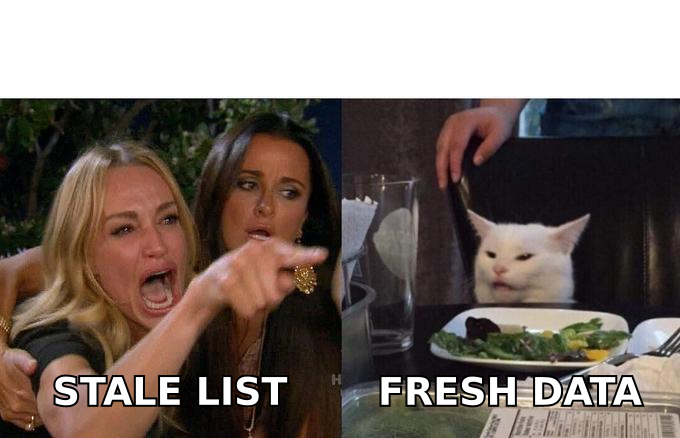
That last point is the one most teams underrate. A pipeline is only as good as the contacts inside it, and B2B data decays fast — roughly 30% of contact records go stale every year as people change jobs. If your data enrichment isn't continuous, your beautifully designed stages are moving dead weight.
In 2026, buyers also expect faster, more relevant outreach. A managed deal flow lets you prioritize the accounts most likely to convert and reach the right person on the first try instead of the fourth.
What Are the Core Stages of a Deal Flow Pipeline?#
Every business is different, but most B2B pipelines map to a version of these six stages. The key is not the names — it's writing down the exit criteria for each, so a deal can't advance on optimism alone.
| Stage | What it means | Exit criteria (deal advances when…) | Typical owner |
|---|---|---|---|
| 1. Sourced | A qualified account/contact is identified | Contact verified, ICP fit confirmed | SDR / Marketing |
| 2. Engaged | Two-way conversation started | Prospect responds and books a meeting | SDR |
| 3. Qualified | Need, budget, timeline confirmed | MEDDIC/BANT criteria met | AE |
| 4. Proposal | Formal offer presented | Prospect reviews pricing and scope | AE |
| 5. Negotiation | Terms being finalized | Verbal agreement or redlines resolved | AE / Sales Lead |
| 6. Closed | Won or lost, with reason logged | Contract signed OR loss reason recorded | AE |
Two rules make this table work in practice:
- A deal in a stage must meet that stage's entry criteria — no exceptions. This stops "happy ears" from inflating late-stage pipeline.
- Losses get a reason code. "No budget," "chose competitor," and "no decision" are three very different problems. Only reason-coded losses teach you anything.
How Do You Measure a Healthy Deal Flow?#
Pipeline value alone is a vanity metric. A $2M pipeline that never moves is worth less than a $500K pipeline that turns over every 45 days. Track movement, not size.
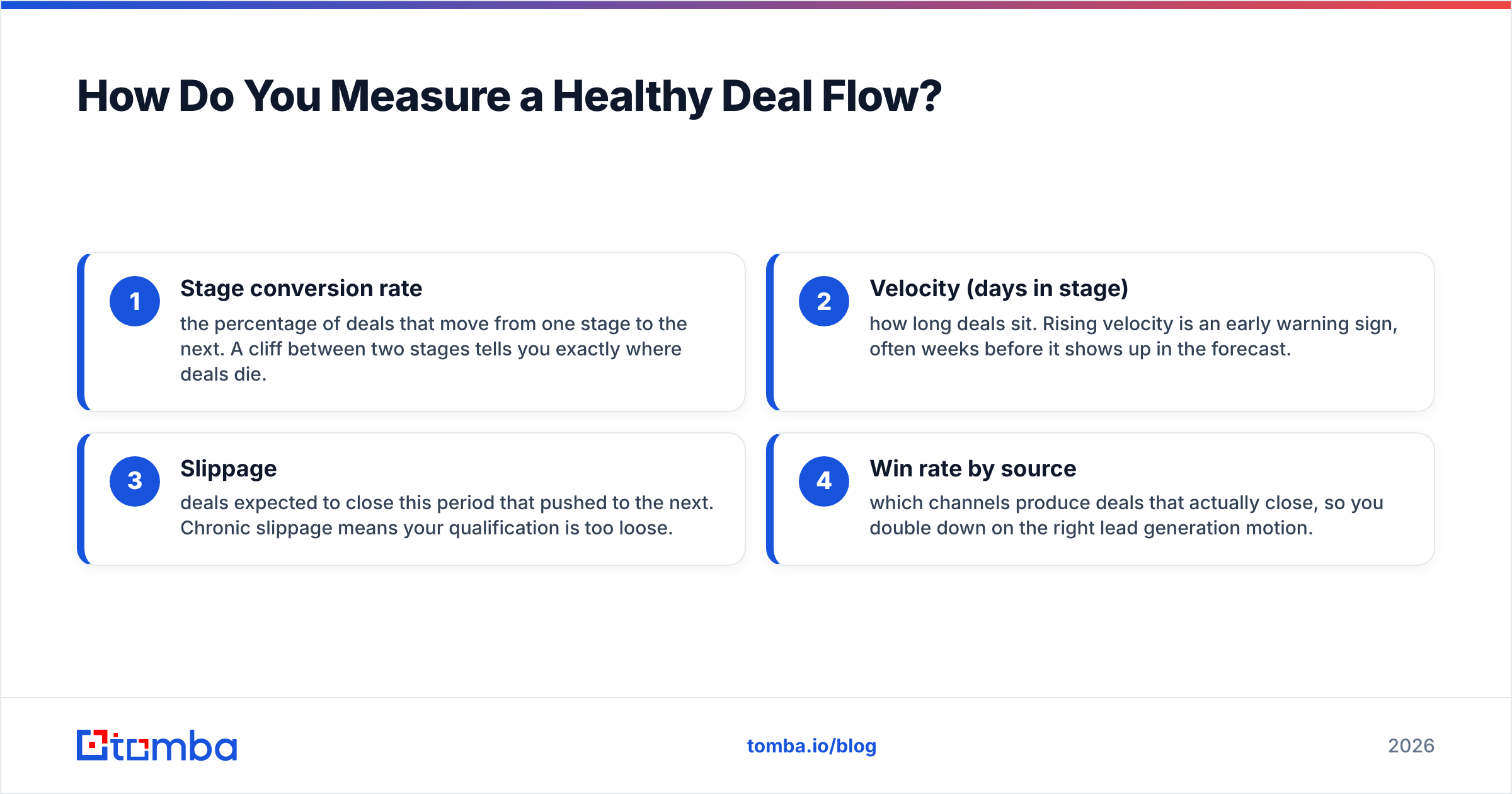
The four metrics that actually predict revenue:
- Stage conversion rate — the percentage of deals that move from one stage to the next. A cliff between two stages tells you exactly where deals die.
- Velocity (days in stage) — how long deals sit. Rising velocity is an early warning sign, often weeks before it shows up in the forecast.
- Slippage — deals expected to close this period that pushed to the next. Chronic slippage means your qualification is too loose.
- Win rate by source — which channels produce deals that actually close, so you double down on the right lead generation motion.
A quick benchmark: if you know your average deal size, win rate, and sales-cycle length, you can calculate pipeline velocity and forecast with far more confidence than a gut-feel roll-up. Salesforce's guidance on pipeline management walks through the same core idea from a CRM angle.
What Tools Do You Need for Deal Flow Management?#
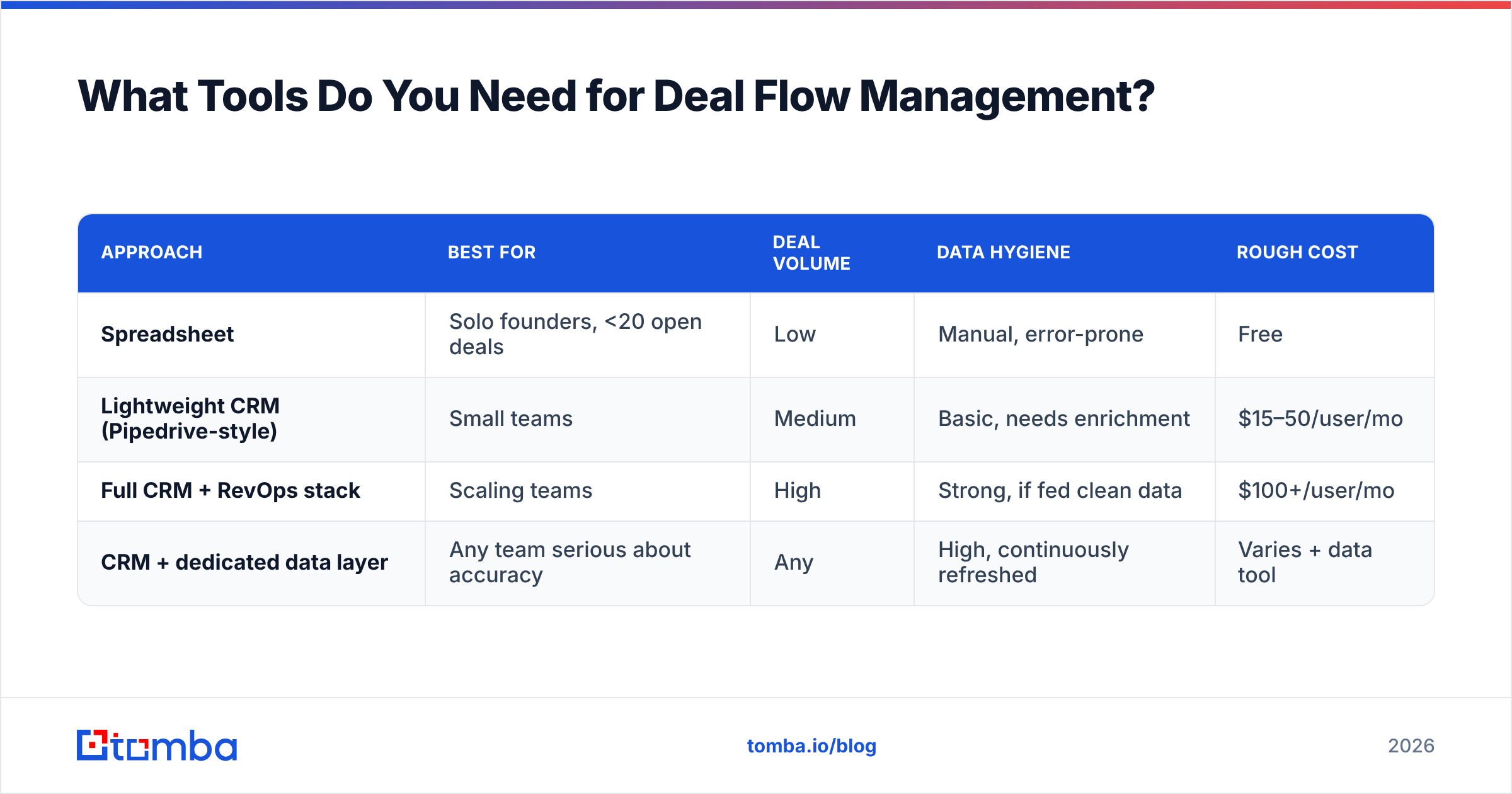
Match the tool to your deal volume, not to what a competitor uses. Here's an honest breakdown.
| Approach | Best for | Deal volume | Data hygiene | Rough cost |
|---|---|---|---|---|
| Spreadsheet | Solo founders, <20 open deals | Low | Manual, error-prone | Free |
| Lightweight CRM (Pipedrive-style) | Small teams | Medium | Basic, needs enrichment | $15–50/user/mo |
| Full CRM + RevOps stack | Scaling teams | High | Strong, if fed clean data | $100+/user/mo |
| CRM + dedicated data layer | Any team serious about accuracy | Any | High, continuously refreshed | Varies + data tool |
Whichever tier you land on, the pipeline is only as reliable as the contact data flowing into it. That's the piece spreadsheets and even premium CRMs get wrong — they store data, they don't keep it accurate. Pairing your CRM with a verified data source through Tomba's HubSpot integration or the Tomba API means new opportunities enter the pipeline already enriched and verified, so stage 1 exit criteria ("contact verified") are met automatically.
How Do You Keep Deals Moving (and Not Stalling)?#
Stalled deals are the tax you pay for a passive process. Three habits keep flow healthy:
- Run a weekly pipeline review with exit-criteria discipline. For each deal, ask: "What's the exit criterion for its current stage, and is it met?" If not, it either moves back or gets a next-step date. No deal leaves the review without an action.
- Set aging thresholds per stage. If a deal sits in Negotiation for 3x the normal duration, it auto-flags for manager review. Stale is a status, and it should be visible.
- Fix the data at the top, not the bottom. Most stalls trace back to reaching the wrong person. Before an SDR ever writes an email, verify the address with an email verifier and confirm you have the right decision-maker. A deal that starts with a bounced email was never really in the pipeline.
A practical anti-pattern to avoid: reps who "keep" dead deals in early stages to pad their numbers. This is why reason-coded losses and aging thresholds matter — they make the pipeline tell the truth.
Deal Flow Management vs. General Pipeline Management: What's the Difference?#
People use these interchangeably, but the distinction is useful:
- Pipeline management is the broader function — forecasting, capacity planning, and reporting across all open deals.
- Deal flow management is more specific: the movement of individual opportunities through the system, with an emphasis on sourcing quality and velocity.
Put simply, pipeline management asks "how much can we close this quarter?" Deal flow management asks "are the right deals entering and moving at the right speed?" You need both, but flow is the leading indicator — it's what the pipeline number is made of. For teams building this out from scratch, aligning it with your broader revenue operations motion keeps sales, marketing, and data on one page.
A 5-Step Framework to Build Deal Flow Management from Scratch#
If you're starting today, do it in this order:
- Define your stages and exit criteria. Write them down. Get the whole team to agree. This is 80% of the value.
- Pick your source of truth. One CRM. No shadow spreadsheets. Everything lives where the team already works.
- Clean and enrich your inbound data. Verify every contact before it becomes an opportunity. Use bulk verification for existing lists and enrichment on new leads.
- Instrument your metrics. Conversion rate, velocity, and slippage — dashboards, not vibes.
- Run the weekly review religiously. The process only works if it's inspected. Consistency beats sophistication here.
Start lean. A well-run six-stage pipeline in a mid-tier CRM beats an over-engineered 12-stage system nobody updates.
Frequently Asked Questions#
What is deal flow management in simple terms? It's the system you use to control how sales opportunities enter your pipeline, move through defined stages, and reach a close — so you can predict revenue instead of guessing.
How is deal flow different in sales vs. venture capital? In VC, deal flow means the volume of investment opportunities a firm evaluates. In B2B sales, it refers to the movement and health of your opportunity pipeline. Same root idea, different objects.
What's the single biggest cause of stalled deals? Reaching the wrong person or a dead contact. Data decay silently breaks pipelines, which is why verifying and enriching contacts before outreach matters so much.
Do I need a CRM to manage deal flow? Not at very low volume — a disciplined spreadsheet works for under ~20 deals. Past that, a CRM as your single source of truth becomes essential.
The Bottom Line#
Deal flow management isn't about buying the flashiest tool. It's about defining clear stages, measuring movement, and feeding the pipeline clean, accurate data so your team spends time on deals that can actually close.
The fastest win most teams overlook is data quality at the top of the funnel. If your reps are chasing bounced emails and outdated contacts, no amount of process design will save the forecast. Start there: use the Tomba Email Finder to source and verify decision-maker contacts before they ever enter your pipeline, so every deal starts on solid ground and your stages measure real progress — not wishful thinking. Check the Tomba pricing to find the plan that matches your deal volume, from the free tier up.
Related guides#
Ready to find emails that actually work?
Join 150,000+ professionals who stopped guessing and started sending. Free credits on signup — no credit card required.
Get the Tomba newsletter
Practical outbound tactics and product updates — once every two weeks.
About the author