Deal Funnel: How to Build One That Actually Closes in 2026
Most deal funnels leak long before the proposal stage — usually because nobody defined what "qualified" means. Here are the six stages, the exit criteria, and the four metrics that tell you where deals really die.
TL;DR
- A deal funnel tracks individual opportunities from first qualified contact to closed-won. It is narrower than a marketing funnel and more opinionated than a generic pipeline view.
- The single biggest cause of funnel leakage is undefined exit criteria — reps advance deals on optimism, not evidence.
- Six stages is the sweet spot for most B2B teams: Identified, Engaged, Qualified, Evaluating, Committed, Closed. More stages create forecast noise, fewer hide problems.
- Measure four things per stage: conversion rate, average time in stage, deal value, and slip rate. Everything else is vanity.
- Funnel math breaks when the top is built on stale or unverified contact data, so the data layer matters as much as the process layer.
What is a deal funnel?#
A deal funnel is the staged path a single opportunity travels from "we think this company might buy" to "signed" or "dead." Think of it like an airport security line: everyone entering is a passenger, but each checkpoint removes people who do not have the right documents. What comes out the other side is not more people — it is more certainty about the people who are left.
The important distinction is scope. A marketing funnel counts anonymous traffic, leads, and MQLs. A deal funnel starts later, at the point where a named opportunity exists with a named buyer, a rough budget range, and an identified problem. Everything upstream feeds it; nothing upstream belongs inside it.
That precision matters because the deal funnel is what your forecast is built on. If your funnel contains 400 "leads" that nobody has spoken to, your coverage ratio is fiction. Gartner's research on the B2B buying journey makes the point plainly: buyers spend a minority of their time with any single vendor, and the linear stages sellers imagine are messier in reality. Your funnel is a model, not a map — its job is to make decisions cheaper, not to be perfectly accurate.
Deal funnel vs sales pipeline vs marketing funnel — what is the difference?#
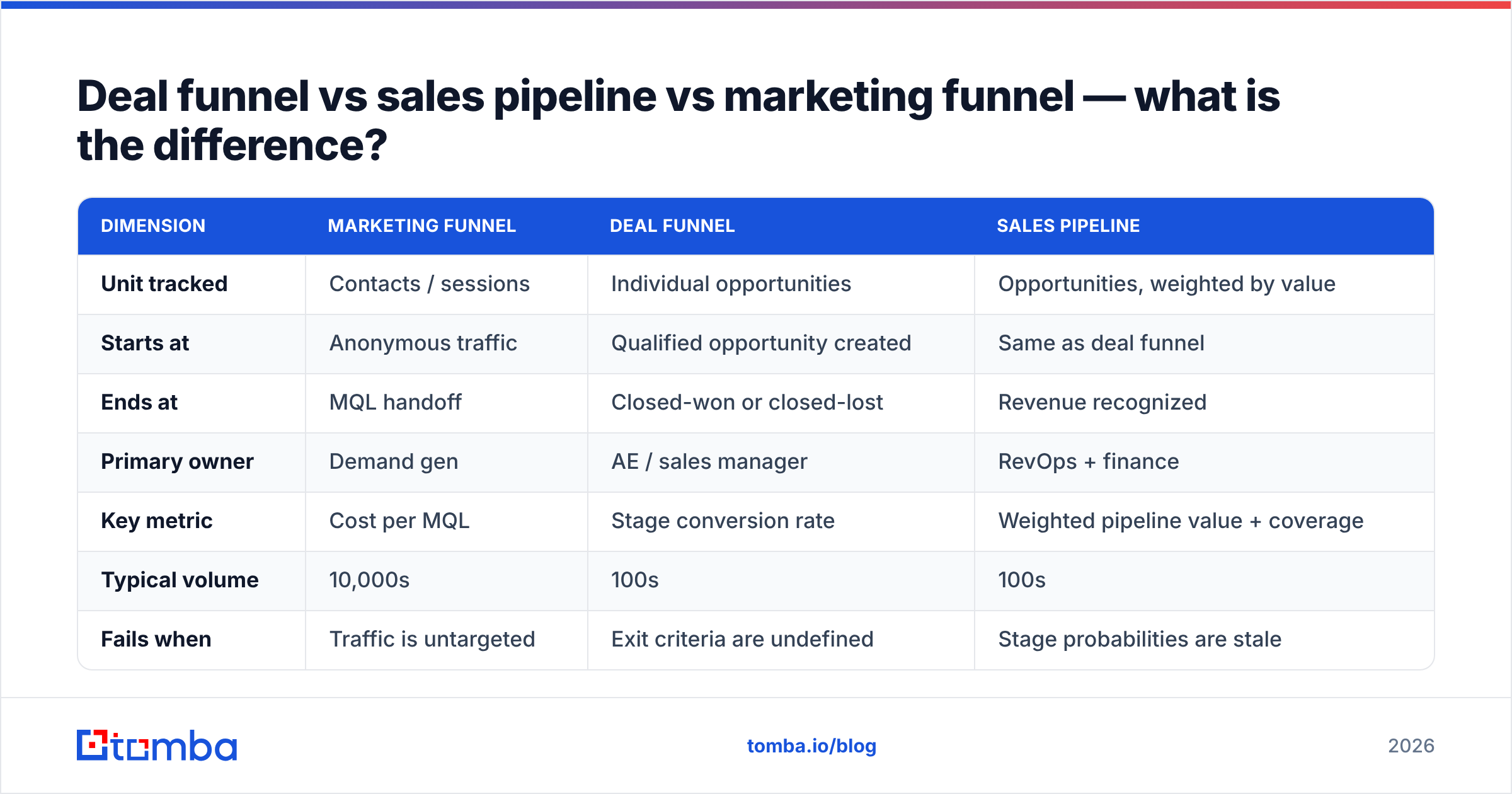
These three terms get used interchangeably in most sales meetings, which is exactly why forecasts disagree with each other. Here is the practical split.
| Dimension | Marketing Funnel | Deal Funnel | Sales Pipeline |
|---|---|---|---|
| Unit tracked | Contacts / sessions | Individual opportunities | Opportunities, weighted by value |
| Starts at | Anonymous traffic | Qualified opportunity created | Same as deal funnel |
| Ends at | MQL handoff | Closed-won or closed-lost | Revenue recognized |
| Primary owner | Demand gen | AE / sales manager | RevOps + finance |
| Key metric | Cost per MQL | Stage conversion rate | Weighted pipeline value + coverage |
| Typical volume | 10,000s | 100s | 100s |
| Fails when | Traffic is untargeted | Exit criteria are undefined | Stage probabilities are stale |
The pipeline is the financial view of the same objects the deal funnel manages operationally. You need both, but you should never debug a pipeline problem without first debugging the funnel underneath it. A pipeline coverage gap is a symptom; a stage-two conversion collapse is the disease.
What are the stages of a deal funnel?#
Six stages covers almost every B2B motion from $5K SMB deals to six-figure enterprise cycles. Each stage below has a name, a definition, and — critically — an exit criterion that is observable rather than felt.
- Identified — The account matches your ICP and you have a verified contact for at least one relevant persona. Exit criterion: a real, deliverable email address or direct dial exists in the CRM, not a guessed
firstname@pattern. - Engaged — The buyer has responded in a way that implies interest: a reply, a booked call, a demo attended. Exit criterion: a two-way conversation has occurred. An opened email is not engagement.
- Qualified — You have confirmed a problem worth solving, a budget range, and a decision process. Exit criterion: the buyer has stated a business consequence of inaction and named at least one other person involved in the decision.
- Evaluating — The buyer is actively comparing options, running a trial, or building a business case. Exit criterion: you have seen or contributed to the internal document they will use to justify the purchase.
- Committed — Verbal agreement exists, procurement or legal is engaged, and a target start date is on the calendar. Exit criterion: a redlined contract or a signed order form is in motion.
- Closed — Won or lost, with a mandatory structured loss reason. Exit criterion: none. This is terminal, and "closed-no-decision" is its own category, not a synonym for lost.
Notice what every exit criterion has in common: someone other than the rep could verify it. That is the whole trick. When a stage advance requires evidence rather than a hunch, your funnel stops being a mood ring.
Why does most funnel leakage happen after the demo?#
Because that is where the seller runs out of things they control. Up to the demo, the rep drives: they source the contact, write the email, book the call, run the deck. After the demo, the buyer drives — and most sellers respond by sending a follow-up and waiting.
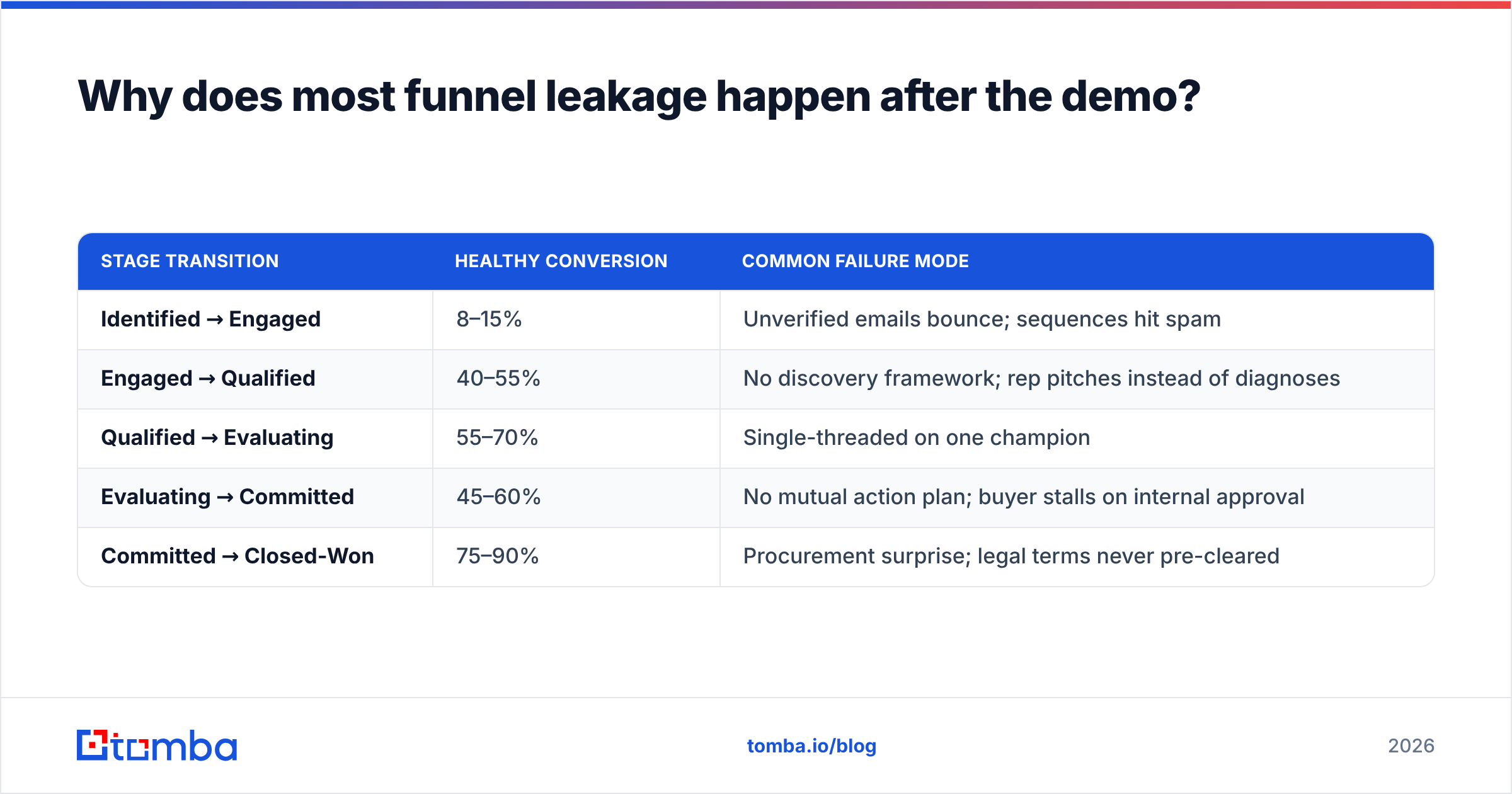
Look at where the volume actually disappears in a typical B2B deal funnel:
| Stage transition | Healthy conversion | Common failure mode |
|---|---|---|
| Identified → Engaged | 8–15% | Unverified emails bounce; sequences hit spam |
| Engaged → Qualified | 40–55% | No discovery framework; rep pitches instead of diagnoses |
| Qualified → Evaluating | 55–70% | Single-threaded on one champion |
| Evaluating → Committed | 45–60% | No mutual action plan; buyer stalls on internal approval |
| Committed → Closed-Won | 75–90% | Procurement surprise; legal terms never pre-cleared |
The two transitions that quietly destroy the most revenue are Qualified → Evaluating and Evaluating → Committed. Both fail for the same structural reason: the deal is single-threaded. One champion, one relationship, one point of failure. When that person goes on leave, changes roles, or loses an internal argument, the deal evaporates and gets logged as "no budget."
The fix is unglamorous. Before a deal leaves Qualified, you should have contact details for at least three people in the buying group — the champion, the economic buyer, and one likely blocker (usually security, finance, or IT). That is a data problem before it is a selling problem, which is why teams use a phone finder and enrichment tooling to fill the org chart rather than waiting for the champion to make introductions that never come.
How do you measure deal funnel health?#
Four metrics, tracked per stage, per rep, and per segment. Anything beyond these tends to be a dashboard someone built once and nobody reads.
- Stage conversion rate. Of deals that entered this stage, what percentage reached the next one? Track it on a cohort basis — deals created in March — not as a snapshot, or open deals will distort the denominator.
- Average time in stage. Deals that sit 3x longer than the median in any stage are effectively dead. Set an auto-flag, not a reminder.
- Slip rate. What percentage of deals forecast to close this month moved to next month? Above 30% means your Committed stage definition is too loose.
- Funnel velocity.
(Opportunities × Win rate × Average deal size) ÷ Sales cycle length. This is the only number that tells you whether a process change actually made you money. Improving your win rate by 5 points while doubling the sales cycle is a net loss.
Run these monthly. The failure mode of funnel analytics is not having the wrong metrics — it is reviewing them quarterly, by which time the cohort you could have fixed has already closed-lost.
What does a good funnel review actually look like?#
Most pipeline reviews are theater: a manager reads the CRM aloud while reps narrate optimism. A useful review inverts that. Instead of walking the list top to bottom, pick the three largest deals in Evaluating and ask one question about each: what is the evidence this deal advances?
If the answer contains the words "they seemed really positive," the deal is not in Evaluating. Move it back. Downgrading deals feels like losing pipeline; it is actually finding out sooner. HubSpot's sales pipeline guidance makes a similar case — a clean pipeline you trust beats a large one you do not.
Three habits separate teams whose forecasts land from teams whose forecasts do not:
- Backwards stage movement is normal and rewarded. If reps get punished for moving a deal from Committed back to Evaluating, they will never do it, and your forecast will be wrong every single quarter.
- Loss reasons are structured, not free text. Five options maximum, and "price" is not one of them unless a competitor won on price with a documented quote.
- Every deal in Evaluating or later has a next step with a date. No date, no stage. This single rule usually cleans out 20–30% of a bloated funnel within one review cycle.
How does contact data quality affect the deal funnel?#
It compounds. A 15% bounce rate at the top of the funnel does not cost you 15% of deals — it costs you 15% of contacts, and then a further penalty on everything downstream because your sending domain reputation degrades and even your valid contacts stop landing in the inbox.
Run the math. Say you need 20 closed-won deals a quarter at a 3% end-to-end conversion. That is roughly 667 qualified opportunities. At a 10% Identified → Engaged rate, you need about 6,670 verified contacts entering the funnel. If a fifth of your list is invalid, you are not starting at 6,670 — you are starting at 5,336, and your reputation damage pushes the engagement rate below 10% at the same time. The funnel does not shrink linearly. It collapses.
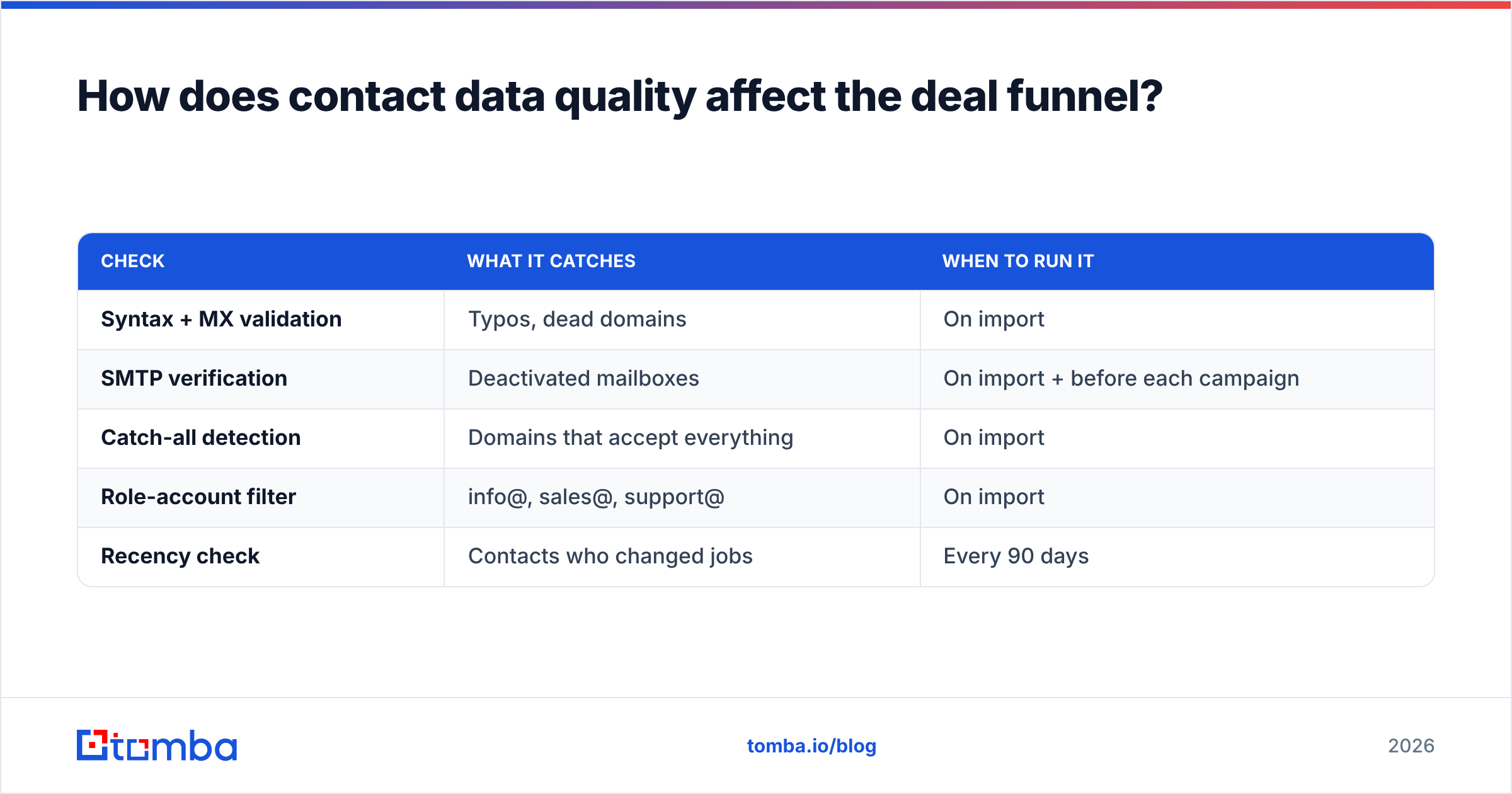
This is why the data layer sits underneath the process layer, not beside it. Practical checks before contacts enter stage one:
| Check | What it catches | When to run it |
|---|---|---|
| Syntax + MX validation | Typos, dead domains | On import |
| SMTP verification | Deactivated mailboxes | On import + before each campaign |
| Catch-all detection | Domains that accept everything | On import |
| Role-account filter | info@, sales@, support@ | On import |
| Recency check | Contacts who changed jobs | Every 90 days |
The 90-day recency check is the one most teams skip and the one that matters most in 2026, with B2B job-change rates still running high enough that a year-old list is closer to half accurate than fully accurate. Running a scheduled bulk verify pass on your active funnel is cheaper than the deliverability hit from not doing it — and far cheaper than a rep spending a week chasing a champion who left in April.
For accounts where you know the company but not the people, domain search closes the gap: give it a domain, get back the verified addresses and patterns for that organization, then filter down to the personas your funnel actually needs. That is how you get to three contacts per account without waiting on an introduction.
What tooling does a deal funnel need?#
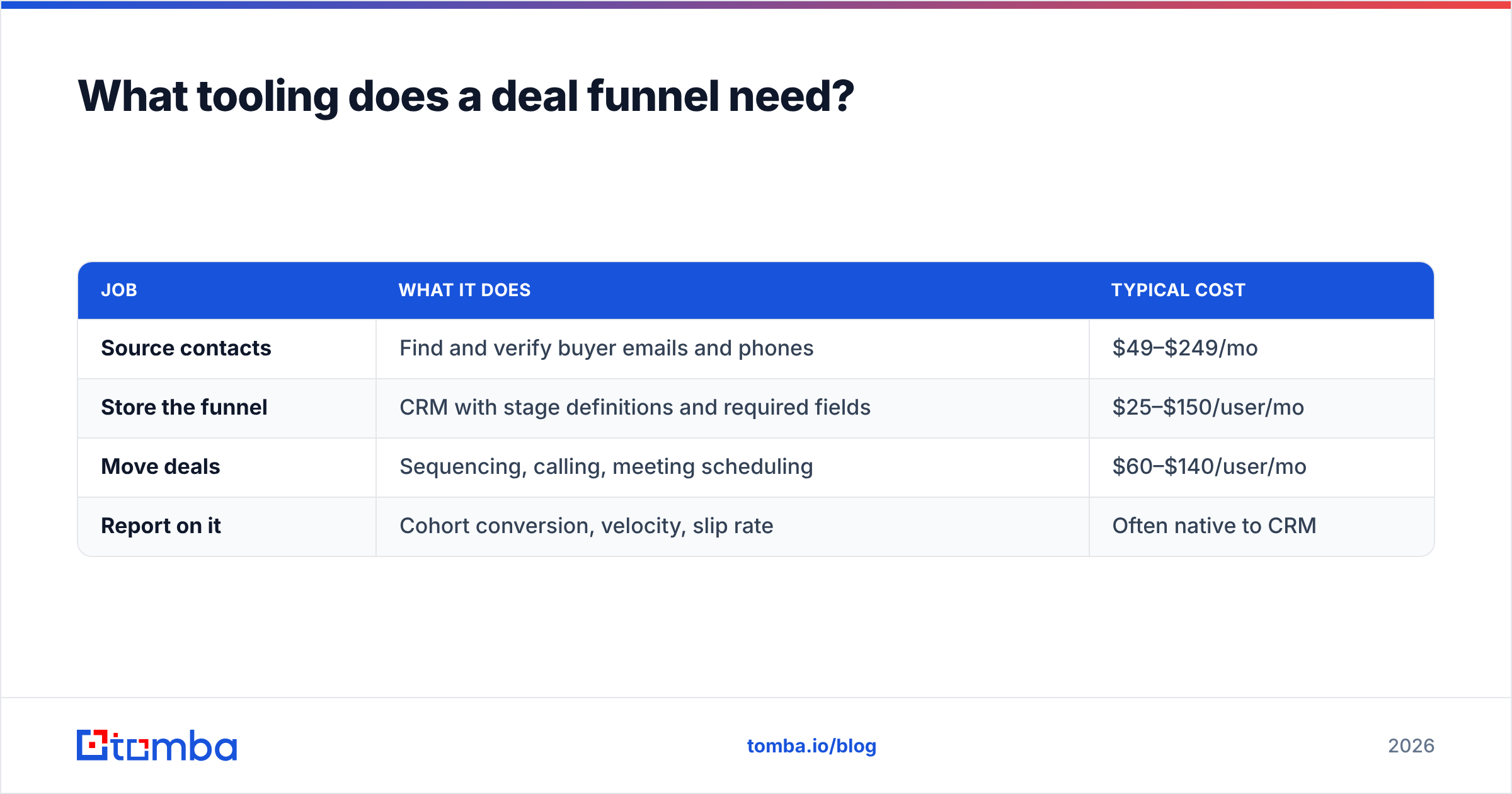
Less than vendors would like you to believe. The stack breaks into four jobs, and you should be able to name which tool owns each one.
| Job | What it does | Typical cost |
|---|---|---|
| Source contacts | Find and verify buyer emails and phones | $49–$249/mo |
| Store the funnel | CRM with stage definitions and required fields | $25–$150/user/mo |
| Move deals | Sequencing, calling, meeting scheduling | $60–$140/user/mo |
| Report on it | Cohort conversion, velocity, slip rate | Often native to CRM |
The mistake is buying an all-in-one platform to solve a definition problem. If your stage exit criteria are vague, a $150/user/month sales engagement suite will simply help you advance the wrong deals faster. Fix the definitions first, then buy tooling that enforces them. A well-configured CRM with mandatory fields at each stage gate does more for forecast accuracy than most AI forecasting add-ons.
On sourcing specifically, evaluate on verified-match rate rather than database size. A provider claiming 700 million contacts is not useful if only half of the ones matching your ICP resolve to deliverable addresses. Ask for a trial against your own target account list, measure the bounce rate yourself, and compare cost per verified contact — not cost per credit. Tomba pricing starts with a free tier at 25 searches a month, then $49/mo for Starter, $99/mo for Growth, and $249/mo for Pro, which makes that kind of head-to-head test cheap to run before you commit. Cross-reference vendor claims with third-party reviews on G2 rather than trusting the marketing page.
How do you fix a leaking deal funnel in 30 days?#
Week one: audit. Export every open deal, tag each one with its last verifiable next step and date. Anything without one goes back to Engaged or gets closed. Expect to lose 20–30% of your reported pipeline. That pipeline was never real.
Week two: redefine. Write exit criteria for each stage in one sentence each, using only observable evidence. Make them mandatory CRM fields. Get rep input, because criteria imposed without it get worked around within a fortnight.
Week three: fix the top. Re-verify your entire active contact list, remove role accounts, and add a second and third contact to every account sitting in Qualified or later. This is the highest-leverage week of the four.
Week four: instrument. Build one cohort conversion report by stage and one time-in-stage report. Review both in the first pipeline meeting of the next month and every month after. Do not add a fifth dashboard.
Thirty days will not change your win rate — that takes a full sales cycle to show. What it changes immediately is the honesty of your forecast, which is the thing that lets you make every other decision.
Where should you start?#
Start at the top, because everything downstream inherits the quality of what enters. A deal funnel built on guessed email patterns and one-contact-per-account will leak no matter how sharp your stage definitions are.
Tomba Email Finder is built for exactly that first stage: give it a name and a domain, or a company domain alone, and get back verified professional email addresses with a confidence score attached — so a contact only enters your funnel once it has cleared verification. Pair it with the email verifier on a 90-day cycle to keep your active funnel clean, and start free with 25 searches a month before deciding whether Starter at $49/mo fits your volume. Fix the input, then fix the process — in that order.
Related guides#
Ready to find emails that actually work?
Join 150,000+ professionals who stopped guessing and started sending. Free credits on signup — no credit card required.
Get the Tomba newsletter
Practical outbound tactics and product updates — once every two weeks.
About the author