Deal Health: How to Score Pipeline Risk Before Deals Slip
Stage and rep confidence are lagging indicators. Here is how to build a deal health score from engagement, multithreading, and buyer-side signals that actually predicts which deals slip.
TL;DR
- Deal health is a composite score of how likely an open opportunity is to close on the amount and date currently in your CRM — not how far it has moved through the stages.
- Stage and rep-entered probability are lagging, self-reported, and optimistic. Engagement recency, multithreading depth, and buyer-side momentum are leading and observable.
- A workable score needs five to seven weighted signals, a red/amber/green cutoff, and a mandatory action attached to red. Scores without playbooks are decoration.
- Bad contact data quietly breaks the whole model: if you only have one contact on a $60k deal and that email bounces, "single-threaded" reads as "engaged" because there is nothing to measure.
- Start manual. Build the score in a spreadsheet against 40 closed deals from last year, prove it separates won from lost, then automate it in the CRM.
What is deal health?#
Deal health is a diagnostic score on an open opportunity that answers one question: will this deal close for the amount and on the date it currently says in the CRM?
Think of it like a check-engine light versus a speedometer. Stage tells you how fast the deal appears to be moving. Deal health tells you whether the engine is about to seize. A deal can sit in "Negotiation" at 80% probability while nobody on the buyer side has replied in three weeks, the champion has quietly changed jobs, and procurement was never looped in. The speedometer says 70mph. The engine is on fire.
The distinction matters because most pipeline reviews inspect the wrong artifact. Reps update stage because the CRM forces them to. They do not update stage because something real happened. Deal health is designed to be measured from signals the rep does not control: email replies, meeting cadence, number of distinct contacts engaged, days in current stage relative to your own historical median, and whether the deal has produced any buyer-generated artifact (a security questionnaire, a pricing pushback, a legal redline).
Three things deal health is not:
- It is not forecast category. Commit/Best Case/Pipeline is a judgment about revenue reporting. Deal health is an input to that judgment, not a synonym for it.
- It is not lead scoring. Lead scoring ranks whether someone should enter the pipeline. Deal health tracks whether they should stay in it.
- It is not a rep performance metric. The moment reps believe deal health scores them rather than the deal, they will game it, and the signal dies.

Why do stage and probability fail as health signals?#
Because both are self-reported by the person with the strongest incentive to be optimistic.
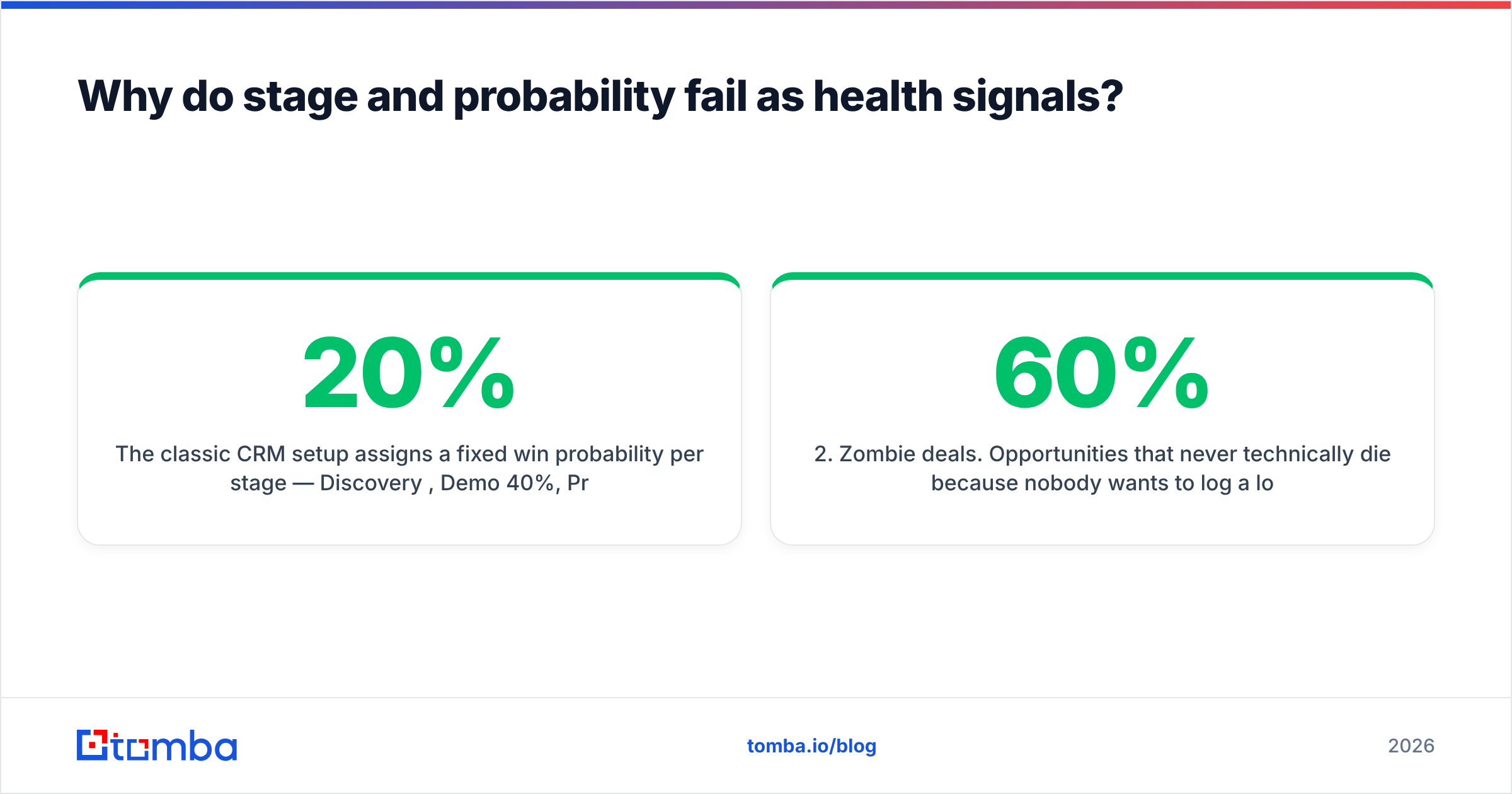
The classic CRM setup assigns a fixed win probability per stage — Discovery 20%, Demo 40%, Proposal 60%, Negotiation 80%. That mapping is a fossil. It assumes every deal in Negotiation has the same risk profile, which is obviously false: a deal in Negotiation with four engaged stakeholders and a signed mutual action plan is not the same asset as one where a single manager went dark after receiving the quote.
Four specific failure modes show up in almost every pipeline audit:
- Stage inflation. Reps advance deals to justify pipeline coverage targets. The deal moves in the CRM; nothing moves at the account.
- Zombie deals. Opportunities that never technically die because nobody wants to log a loss. They sit at 60% for two quarters, inflating coverage and making the win rate look worse than it is when they finally close-lose.
- Recency blindness. Stage carries no time dimension. A deal that entered Proposal yesterday and one that entered Proposal 74 days ago are identical to the report.
- Single-thread fragility. Deals with one contact convert far worse than multithreaded ones, but stage does not know how many humans are involved.
Gartner's research on B2B buying has consistently found that buying groups now involve six to ten decision-makers, and that buyers spend a small fraction of their evaluation time with any one vendor. If your health model has no variable for "how much of the buying group have we actually reached," it is modelling a world that stopped existing a decade ago.
Which signals actually predict a slipped deal?#
Use signals that are observable without asking the rep. Here are the six that carry the most weight in practice, roughly in order of predictive strength:
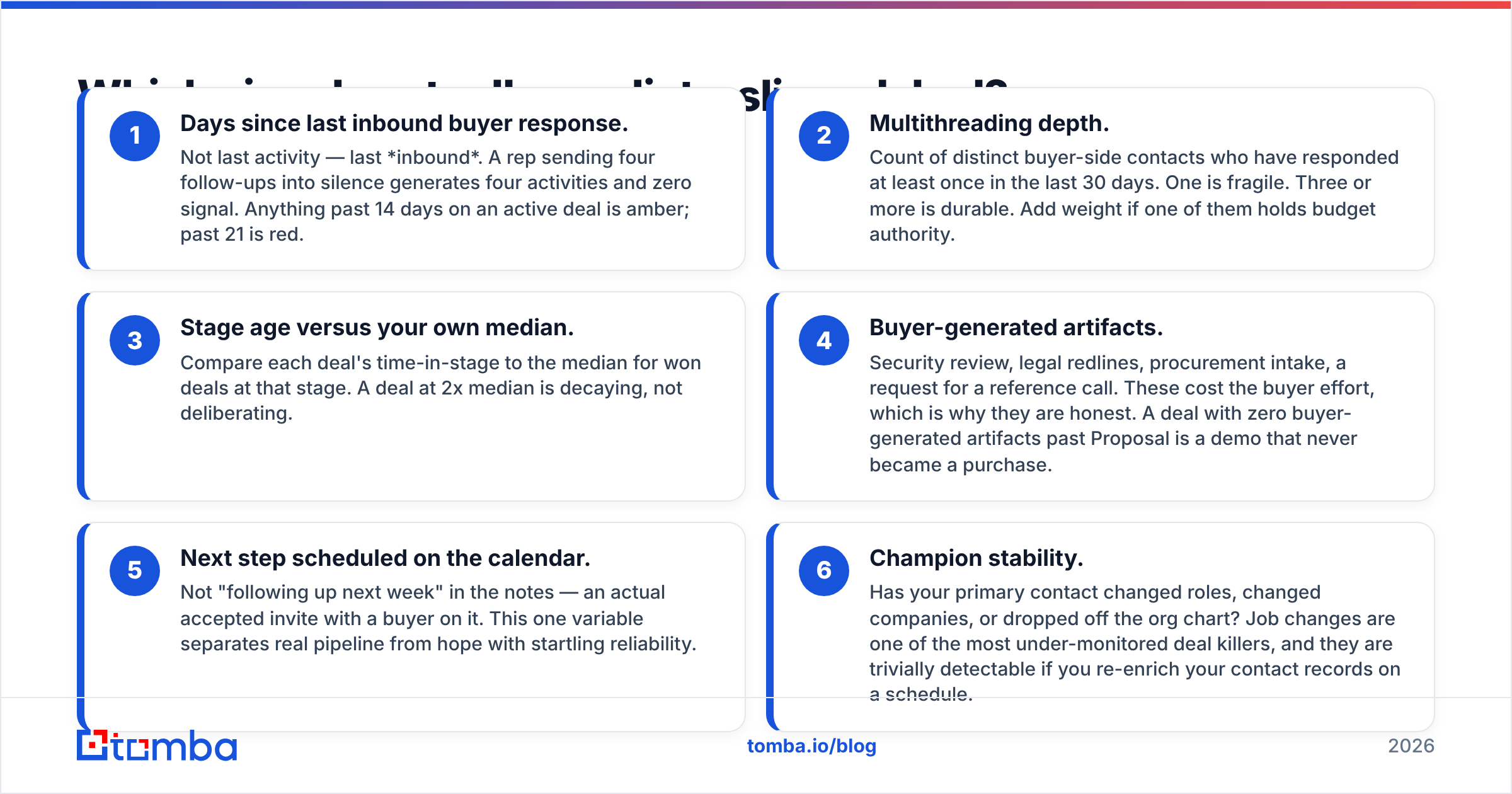
- Days since last inbound buyer response. Not last activity — last inbound. A rep sending four follow-ups into silence generates four activities and zero signal. Anything past 14 days on an active deal is amber; past 21 is red.
- Multithreading depth. Count of distinct buyer-side contacts who have responded at least once in the last 30 days. One is fragile. Three or more is durable. Add weight if one of them holds budget authority.
- Stage age versus your own median. Compare each deal's time-in-stage to the median for won deals at that stage. A deal at 2x median is decaying, not deliberating.
- Buyer-generated artifacts. Security review, legal redlines, procurement intake, a request for a reference call. These cost the buyer effort, which is why they are honest. A deal with zero buyer-generated artifacts past Proposal is a demo that never became a purchase.
- Next step scheduled on the calendar. Not "following up next week" in the notes — an actual accepted invite with a buyer on it. This one variable separates real pipeline from hope with startling reliability.
- Champion stability. Has your primary contact changed roles, changed companies, or dropped off the org chart? Job changes are one of the most under-monitored deal killers, and they are trivially detectable if you re-enrich your contact records on a schedule.
Notice that four of the six depend on knowing who is on the other side and being able to reach them. That is where deal health quietly becomes a data problem rather than a process problem.
How do you weight the signals into a score?#
Keep it simple enough that a rep can explain their own score without opening a dashboard. A 100-point model with clear weights beats a black-box ML score that nobody trusts.
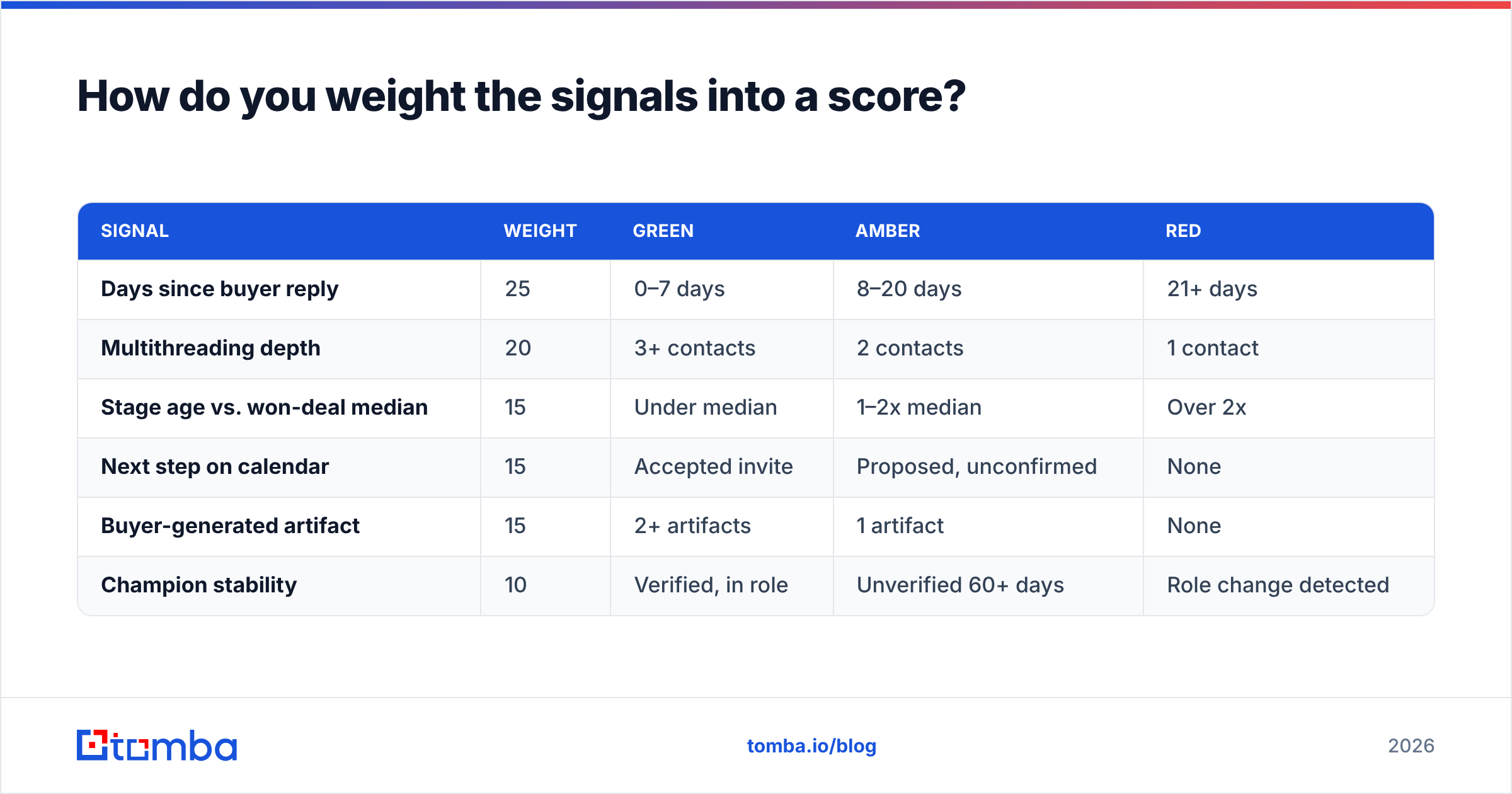
| Signal | Weight | Green | Amber | Red |
|---|---|---|---|---|
| Days since buyer reply | 25 | 0–7 days | 8–20 days | 21+ days |
| Multithreading depth | 20 | 3+ contacts | 2 contacts | 1 contact |
| Stage age vs. won-deal median | 15 | Under median | 1–2x median | Over 2x |
| Next step on calendar | 15 | Accepted invite | Proposed, unconfirmed | None |
| Buyer-generated artifact | 15 | 2+ artifacts | 1 artifact | None |
| Champion stability | 10 | Verified, in role | Unverified 60+ days | Role change detected |
Score bands: 75–100 green, 50–74 amber, below 50 red. Calibrate the cutoffs against your own closed-won and closed-lost history rather than adopting these numbers blindly — a 90-day enterprise cycle and a 12-day SMB cycle need different thresholds on every time-based variable.
Two rules make the difference between a score that works and a score that gets ignored:
- Attach a mandatory action to red. Red means the deal gets a documented recovery plan or the close date moves. No exceptions, no "it's fine, I know this account."
- Recalculate nightly. A score refreshed at quarterly business review time is a post-mortem, not a diagnostic.
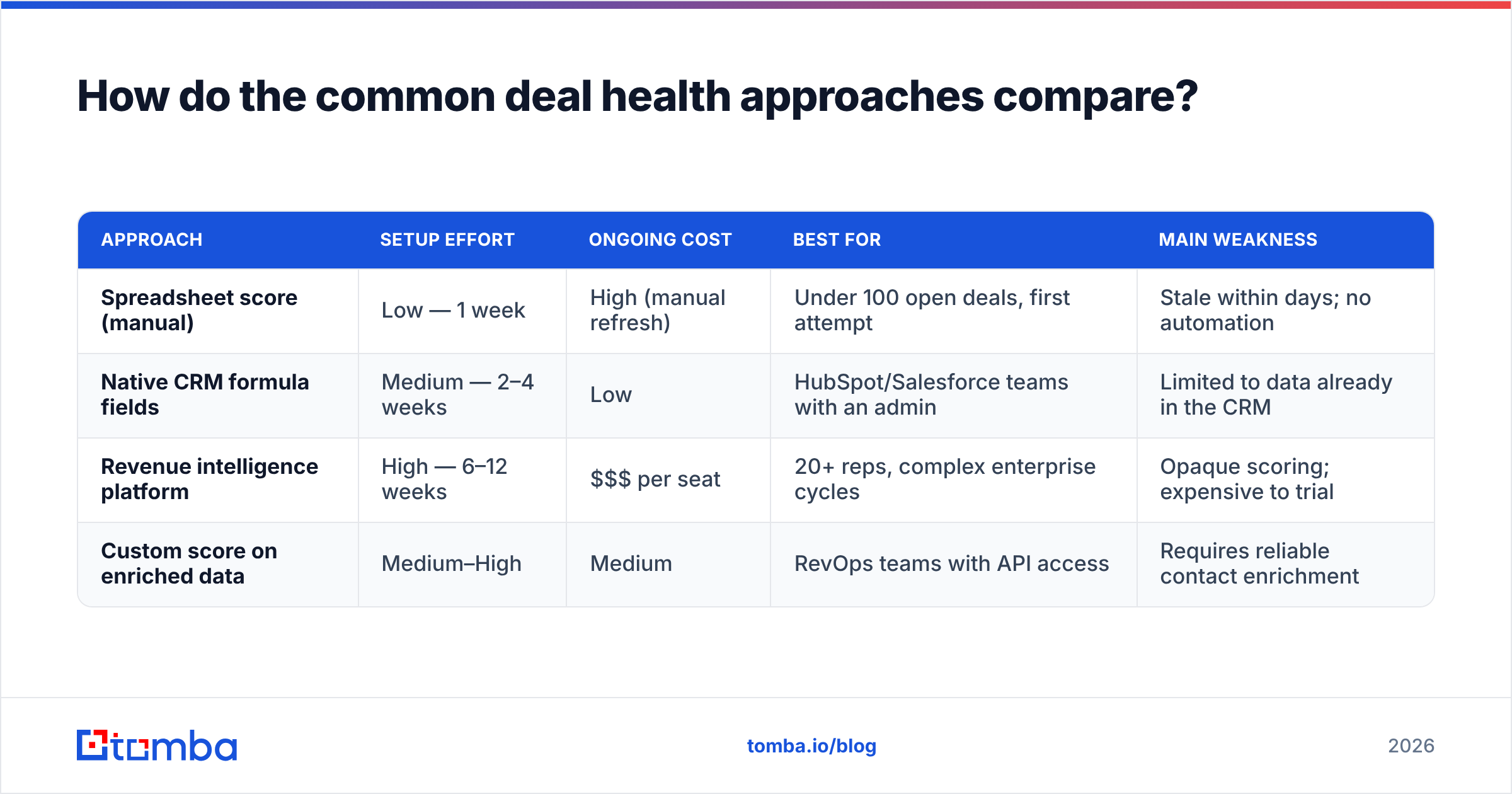
How do the common deal health approaches compare?#
There are broadly four ways teams operationalise this. None is universally right; the correct pick depends on deal volume, deal size, and how much engineering support you can get.
| Approach | Setup effort | Ongoing cost | Best for | Main weakness |
|---|---|---|---|---|
| Spreadsheet score (manual) | Low — 1 week | High (manual refresh) | Under 100 open deals, first attempt | Stale within days; no automation |
| Native CRM formula fields | Medium — 2–4 weeks | Low | HubSpot/Salesforce teams with an admin | Limited to data already in the CRM |
| Revenue intelligence platform | High — 6–12 weeks | $$$ per seat | 20+ reps, complex enterprise cycles | Opaque scoring; expensive to trial |
| Custom score on enriched data | Medium–High | Medium | RevOps teams with API access | Requires reliable contact enrichment |
The honest recommendation for most teams: start in the spreadsheet, move to native CRM fields once the weights are proven, and only buy a platform when you can articulate exactly which signal you cannot compute yourself. Most teams buy the platform first and then discover their CRM hygiene was the actual constraint.
HubSpot's own deal management documentation covers the mechanics of custom properties and workflows if you take the native route; both major CRMs support scored formula fields without third-party tooling.

Why does contact data quality break deal health scoring?#
Because half of the score depends on signals that only exist if you can identify and reach the buying group. This is the part most deal health articles skip.
Run through the failure chain. Your model says multithreading depth is worth 20 points. To measure it, the CRM needs contact records for the buying group. If your reps only ever added one contact — the person who filled in the demo form — the score has nothing to count. The deal reads as "single-threaded," which is technically true and analytically useless, because you never attempted to reach anyone else.
Now the second failure. Your model penalises deals where the buyer has not replied in 21 days. But some percentage of those non-replies are not disengagement at all: the address is stale, the contact left the company, or the message is landing in a quarantine because the domain is a catch-all and your sends are being filtered. You are scoring a delivery problem as a buying signal.
Three practical fixes, in order of impact:
- Enrich the buying group at deal creation, not at deal rescue. When an opportunity is created, pull the other likely stakeholders at that company so multithreading is measurable from day one. A domain search against the account domain surfaces the roles you are missing — finance, security, the VP above your champion — before the deal stalls rather than after.
- Re-verify contacts on a schedule. Run open-deal contacts through an email verifier monthly. Bounces on an active opportunity are a champion-departure alarm, not an email problem. Treat a newly invalid address on a Commit deal as an immediate red flag.
- Enrich for the escalation path. When a deal goes red, the recovery play is almost always "go above or around the silent contact." That requires knowing who that person is. Contact enrichment and a phone finder turn a theoretical escalation into an actual one this week.
If you run HubSpot, wiring enrichment directly into the deal record via the HubSpot integration means the multithreading count updates itself instead of depending on a rep remembering to add contacts.
How do you run a pipeline review with deal health?#
Change the meeting agenda and the metric changes behaviour. The old format — walk the list top to bottom, rep narrates each deal — rewards storytelling. The health-scored format inverts it.
- Only red and newly-amber deals get airtime. Green deals get 30 seconds or nothing. This alone cuts review length in half.
- The rep does not narrate the score. The score is on screen before they speak. Their job is to explain the recovery plan, not to relitigate the inputs.
- Every red deal exits with one of three outcomes: a dated recovery action with a named new contact to reach, a pushed close date, or a close-lost. "Still working it" is not an outcome.
- Track score-at-day-30 against outcome. After a quarter, check whether red deals actually lost at a higher rate. If they did not, your weights are wrong — fix them rather than abandoning the model.
The measurable win here is usually not a higher win rate in the first quarter. It is forecast accuracy: fewer deals sliding out in the last week of the quarter, because the slip was visible six weeks earlier when there was still time to act.
What are the most common deal health mistakes?#
Too many variables. A 14-signal model is unauditable. Reps stop trusting it, and untrusted scores get ignored. Six signals, clearly weighted.
Scoring activity instead of engagement. Outbound touches from your side are not health. Only buyer-side responses count. A model that rewards rep activity will produce reps who send more email into the void.
No decay function. A meeting from 60 days ago should not carry the same weight as one from last Tuesday. Every time-based signal needs to decay.
Using it as a rep scorecard. The fastest way to kill a deal health program is to put the average score in a leaderboard. Reps will inflate contact counts and log fake next steps. Score the deal, coach the rep.
Ignoring the data layer. You cannot score multithreading you never attempted, and you cannot escalate to a contact you cannot find. Every deal health model eventually bottlenecks on contact coverage.
Where should you start?#
Pick 40 opportunities that closed last year — 20 won, 20 lost. Score each one as it looked 30 days before its close date, using the six signals above. If the won deals cluster green and the lost deals cluster red, your weights are roughly right and you can roll them into the CRM. If the two groups overlap, adjust weights and re-test before you automate anything. That backtest takes an afternoon and saves a quarter of arguing about whether the score means anything.
Then fix the input layer, because it is the constraint you will hit fastest. Deal health scoring only works when your CRM actually contains the buying group — verified, current, and reachable. Tomba Email Finder gives you the stakeholders behind every account domain so multithreading becomes something you can measure and improve rather than a box that is permanently red. Start on the free tier at 25 searches a month, or check Tomba pricing — Starter is $49/mo — when you are ready to enrich every open deal in the pipeline.
Related guides#
Ready to find emails that actually work?
Join 150,000+ professionals who stopped guessing and started sending. Free credits on signup — no credit card required.
Get the Tomba newsletter
Practical outbound tactics and product updates — once every two weeks.
About the author