Deal Intelligence Pricing 2026: Reviews, Pros and Cons
Deal intelligence platforms rarely publish list prices, and the quote you get is not the price you pay. Here is what buyers actually spend in 2026, where the hidden fees sit, and when a cheaper stack wins.
TL;DR
- Deal intelligence vendors almost never publish list prices. Buyer-reported ranges in 2026 land at roughly $1,200–$1,800 per seat per year, plus a platform fee of $5,000–$50,000 that most teams do not budget for.
- The seat price is the smallest part of the bill. Minimum seat counts, multi-year lock-ins, CRM connector fees, and recording-storage tiers are where the real money goes.
- Deal intelligence pays off when you have 15+ reps, a long sales cycle, and a forecast that is already wrong. Below that, it is an expensive dashboard.
- The most common regret is buying deal intelligence to fix a pipeline problem that was actually a data problem — bad contacts, missing decision-makers, stale account records.
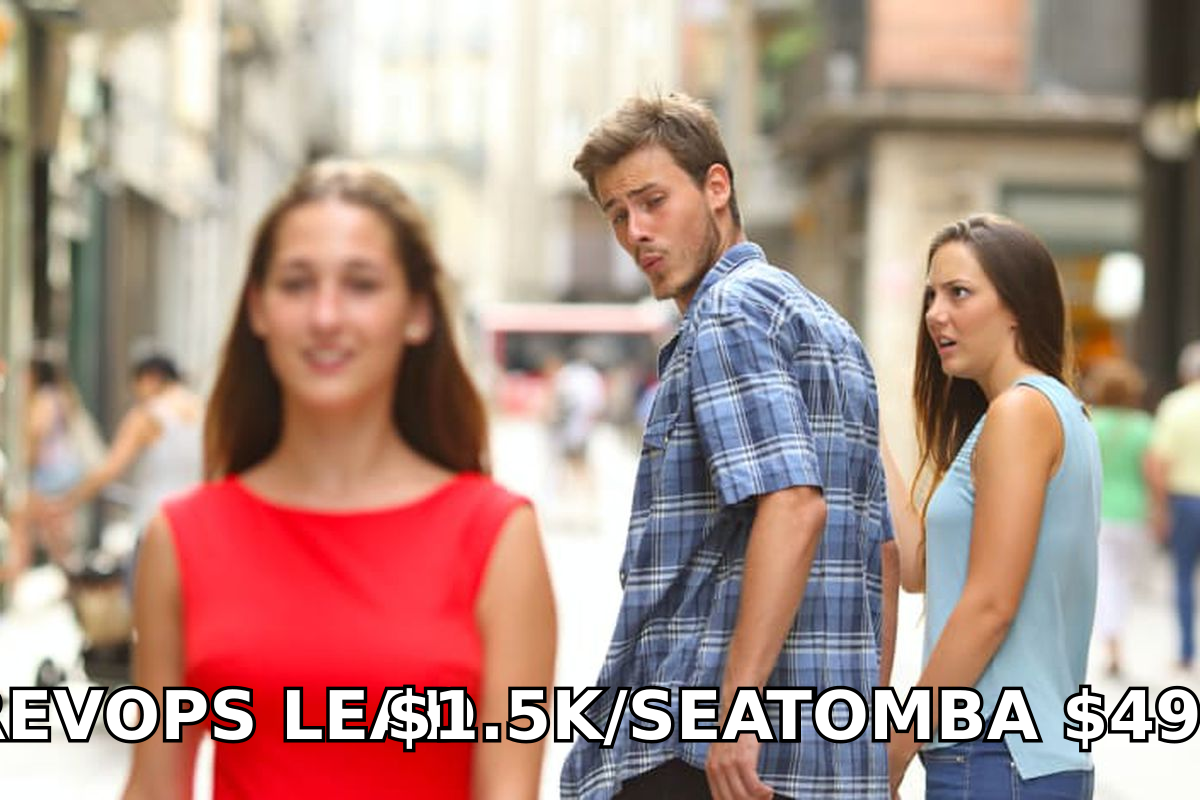
- A realistic 2026 stack: fix contact data first (roughly $49–$99/mo), then layer deal intelligence once your CRM is worth analyzing.
What is deal intelligence, and what are you actually paying for?#
Deal intelligence is software that watches your pipeline and tells you which deals are real. It ingests CRM records, calendar invites, email threads, and call recordings, then scores each opportunity on engagement depth, multi-threading, stage velocity, and how closely it resembles deals that historically closed.
That is the pitch. What you are actually paying for breaks into four layers, and vendors price each one differently:
- Capture — the connectors that pull email, calendar, call, and CRM activity into the platform. Usually bundled, occasionally a line item, and almost always the reason the implementation takes six weeks instead of one.
- Conversation analysis — transcription, keyword tracking, talk-ratio metrics, competitor mentions. This is the most compute-heavy layer and the one most often metered by recording hours or storage.
- Forecast and pipeline modeling — deal scoring, roll-up forecasts, risk flags, scenario planning. Frequently sold as a separate SKU from conversation analysis, even by the same vendor.
- Coaching and enablement — scorecards, call libraries, manager workflows. Sold per manager seat in some contracts, per rep seat in others.
The pricing confusion starts here. Two vendors can quote "$1,400 per seat" and mean completely different bundles. One includes forecasting; the other charges another $400 per seat for it and requires a 25-seat minimum on that SKU.
How much does deal intelligence actually cost in 2026?#
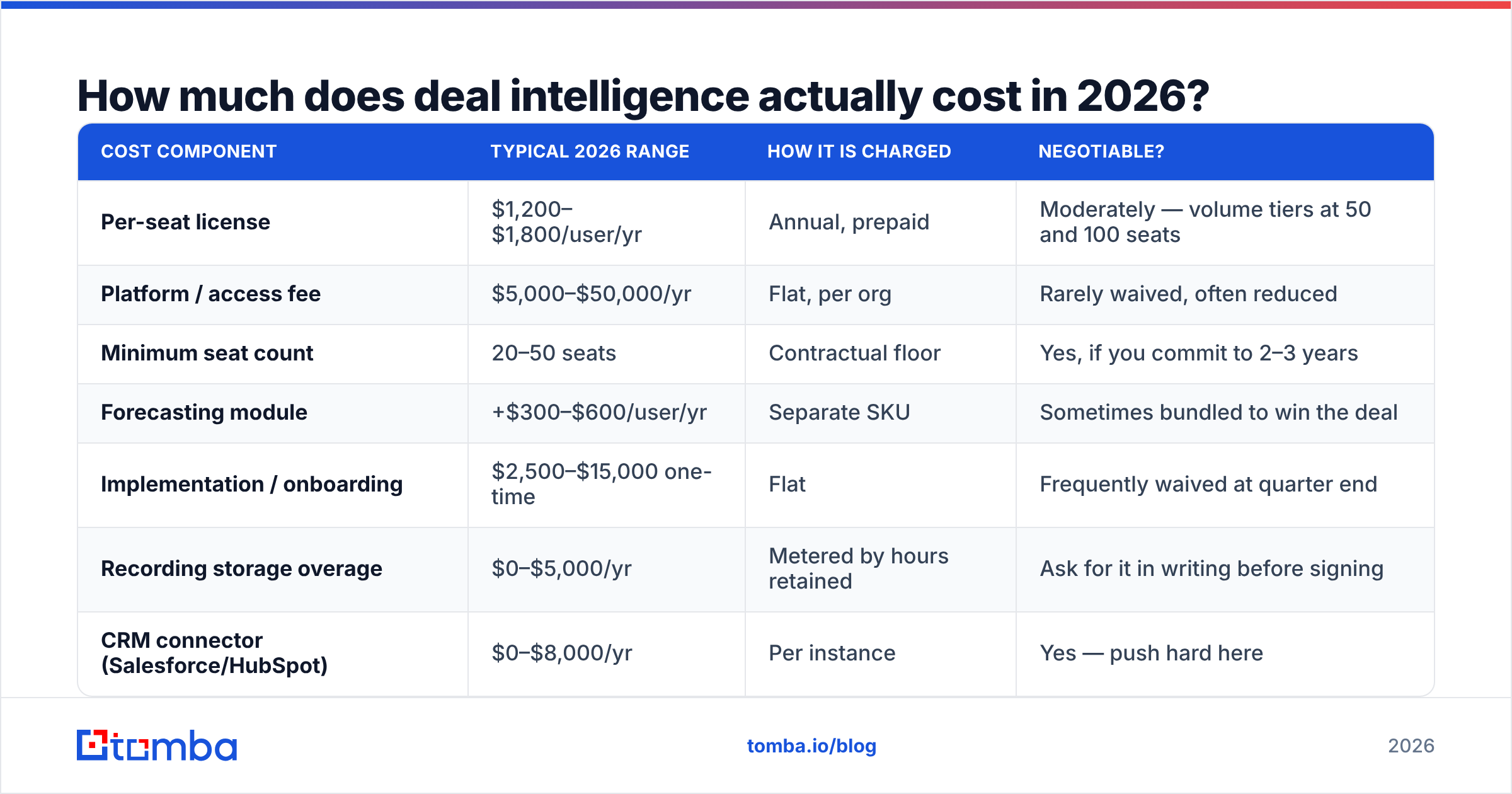
No major vendor in this category publishes a public price list, which is itself a signal — pricing is set by what your company looks like, not by what the software costs to run. Gong and Clari both route you to a demo before a number. The figures below are the ranges buyers consistently report on review sites and in procurement benchmarks; treat them as a negotiating baseline, not a quote.
| Cost component | Typical 2026 range | How it is charged | Negotiable? |
|---|---|---|---|
| Per-seat license | $1,200–$1,800/user/yr | Annual, prepaid | Moderately — volume tiers at 50 and 100 seats |
| Platform / access fee | $5,000–$50,000/yr | Flat, per org | Rarely waived, often reduced |
| Minimum seat count | 20–50 seats | Contractual floor | Yes, if you commit to 2–3 years |
| Forecasting module | +$300–$600/user/yr | Separate SKU | Sometimes bundled to win the deal |
| Implementation / onboarding | $2,500–$15,000 one-time | Flat | Frequently waived at quarter end |
| Recording storage overage | $0–$5,000/yr | Metered by hours retained | Ask for it in writing before signing |
| CRM connector (Salesforce/HubSpot) | $0–$8,000/yr | Per instance | Yes — push hard here |
Run the math for a 25-rep team on a mid-tier contract: 25 seats × $1,400 = $35,000, plus a $15,000 platform fee, plus $7,500 implementation. That is $57,500 in year one for a team that may still be forecasting from gut feel because the CRM records feeding the model are half empty.
The 2026 shift worth knowing: several vendors have moved from pure per-seat pricing toward consumption-based AI credits for summarization, auto-CRM-updates, and agentic follow-ups. That looks cheaper on the order form and gets expensive fast once reps actually adopt it. Ask for a credit-burn projection based on your call volume, not the vendor's average customer.
What do reviews say the pros actually are?#
Strip out the marketing and the consistent, repeated wins in buyer reviews come down to five things:
- Forecast accuracy improves, but slowly. Teams report meaningful accuracy gains around month four to six — after enough closed-won and closed-lost data has accumulated for the model to calibrate. Nobody gets a better forecast in week two.
- Ghost deals get flushed. The single most cited benefit is not prediction, it is hygiene: deals with no buyer-side activity in 21 days get flagged, and reps stop carrying dead pipeline to make coverage ratios look healthy.
- Ramp time for new reps drops. A searchable call library where a new AE can hear ten real objection-handling moments in their first week is genuinely valuable, and it is the feature that survives budget cuts.
- Multi-threading becomes visible. Seeing that a $200K deal has exactly one contact on the buyer side is the kind of insight that changes behavior immediately. It is also, notably, a contact-data problem more than an AI problem.
- Manager coaching gets specific. "Your discovery calls are 68% you talking" is coachable. "Improve your discovery" is not.
Reviews on G2 and similar platforms cluster around the same satisfaction pattern: high scores for call recording and coaching, noticeably lower scores for forecast accuracy and for value-for-money.
What are the cons buyers report most often?#
The complaints are just as consistent, and most of them are commercial rather than technical.
The contract structure is the product. Multi-year lock-ins with annual uplift clauses of 5–10% are standard. Several buyers report that the escape hatch — downgrading seats mid-term — does not exist. You can add seats freely; you cannot remove them until renewal.
Adoption decides everything, and adoption is not included. A deal intelligence platform with 40% rep login rates produces a forecast built on 40% of the signal. Vendors sell you the software; the behavior change is yours to fund.
Garbage in, confident garbage out. This is the failure mode nobody warns you about at the demo. Deal scoring models weight contact-level engagement heavily. If half your opportunity records have one contact, a missing job title, or an email address that bounced three months ago, the model reads "low engagement" and flags a healthy deal as at-risk. You paid $57,000 to be told your data is bad.
Recording compliance overhead. Two-party consent states, EU recording rules, and enterprise security reviews add weeks. Budget legal time, not just license spend. Sales intelligence tooling has a broader regulatory surface than most buyers expect.
Feature overlap you are paying for twice. If your sequencer already does activity capture and your CRM already does stage-based forecasting, you may be buying a third copy of both.
Is deal intelligence worth it for your team size?#
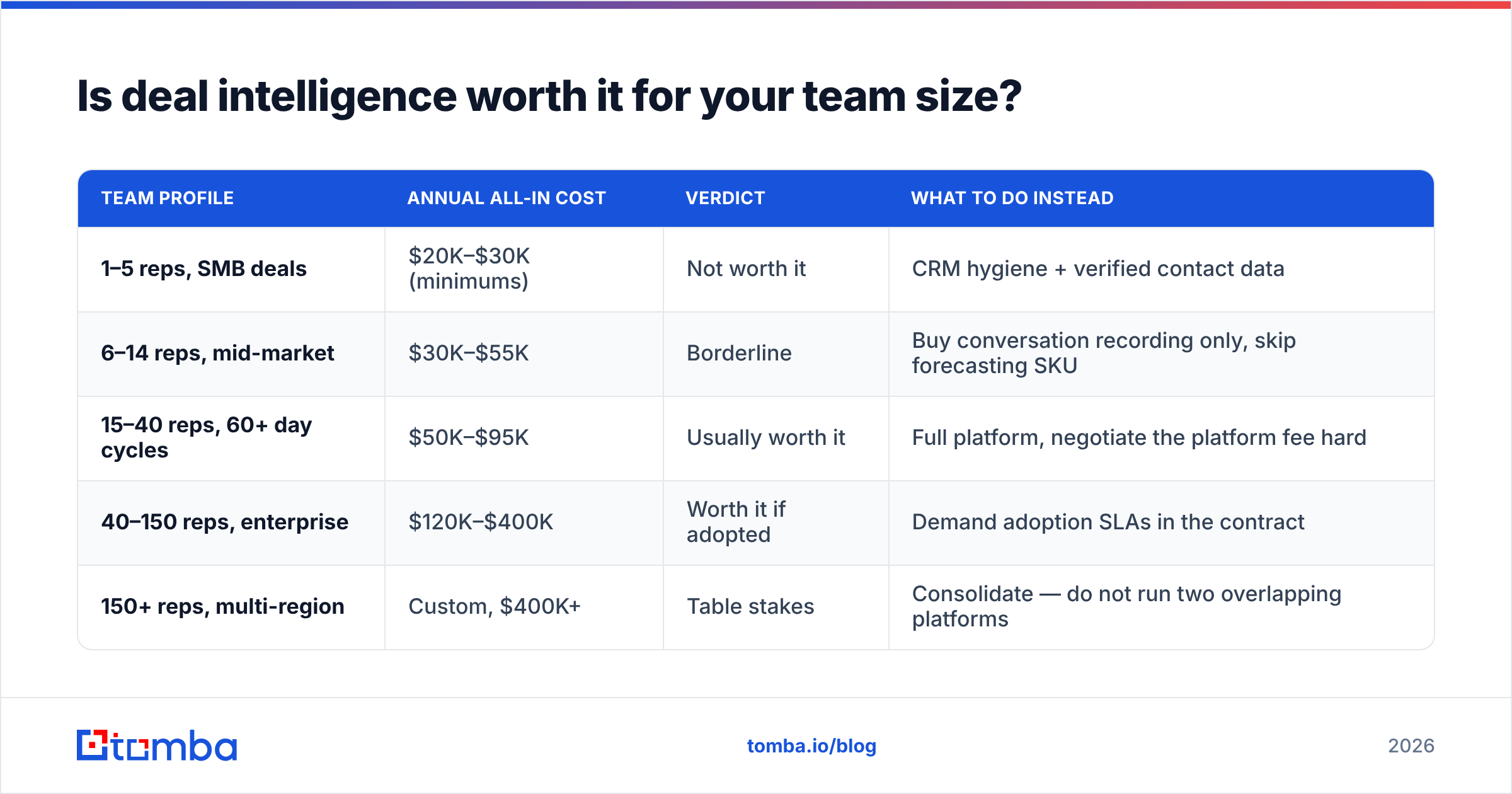
Here is the honest segmentation. The tool is not good or bad; it is a fit question with a hard floor.
| Team profile | Annual all-in cost | Verdict | What to do instead |
|---|---|---|---|
| 1–5 reps, SMB deals | $20K–$30K (minimums) | Not worth it | CRM hygiene + verified contact data |
| 6–14 reps, mid-market | $30K–$55K | Borderline | Buy conversation recording only, skip forecasting SKU |
| 15–40 reps, 60+ day cycles | $50K–$95K | Usually worth it | Full platform, negotiate the platform fee hard |
| 40–150 reps, enterprise | $120K–$400K | Worth it if adopted | Demand adoption SLAs in the contract |
| 150+ reps, multi-region | Custom, $400K+ | Table stakes | Consolidate — do not run two overlapping platforms |
The floor exists because of seat minimums, not because small teams do not benefit from insight. A seven-person team paying a 25-seat minimum is subsidizing eighteen empty licenses, and no amount of forecast accuracy makes that math work.
What should you fix before you buy deal intelligence?#
Fix the inputs. Deal intelligence is a magnifying glass — it makes whatever is in your CRM more visible, including the holes.
Three checks, in order:
- Contact coverage per opportunity. Pull your open pipeline and count contacts per deal. If your median is one or two, your problem is not prediction; it is that nobody knows who else is in the room. Filling those gaps with an email finder and a round of data enrichment costs a fraction of a deal intelligence contract and directly improves every model you later feed.
- Email validity across the database. A CRM where 18% of addresses bounce will drag every engagement score downward and misclassify healthy accounts as cold. Run the list through an email verifier before you let any AI score it.
- Stage definitions that mean something. If "Proposal" means five different things to five reps, no model can learn from your history. This is a free fix and the highest-leverage one on the list.
Teams that do these three things first consistently report faster time-to-value when they eventually do buy — because the model has real signal on day one instead of month six.
How does the cost compare to fixing your data first?#
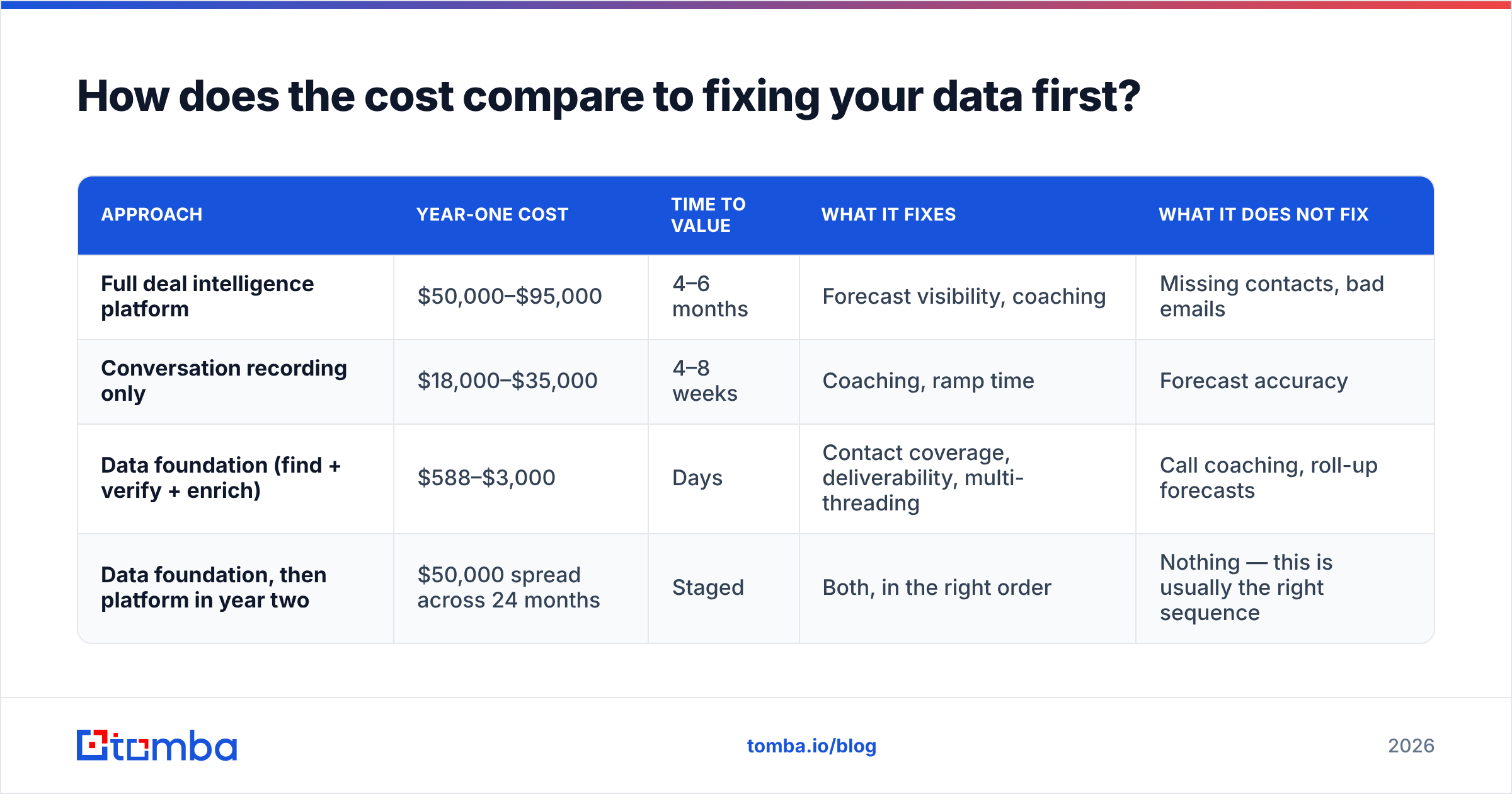
This is the comparison most vendors would rather you not run.
| Approach | Year-one cost | Time to value | What it fixes | What it does not fix |
|---|---|---|---|---|
| Full deal intelligence platform | $50,000–$95,000 | 4–6 months | Forecast visibility, coaching | Missing contacts, bad emails |
| Conversation recording only | $18,000–$35,000 | 4–8 weeks | Coaching, ramp time | Forecast accuracy |
| Data foundation (find + verify + enrich) | $588–$3,000 | Days | Contact coverage, deliverability, multi-threading | Call coaching, roll-up forecasts |
| Data foundation, then platform in year two | $50,000 spread across 24 months | Staged | Both, in the right order | Nothing — this is usually the right sequence |
At Tomba pricing, the Starter plan is $49/mo and Growth is $99/mo — roughly one to two percent of a mid-tier deal intelligence contract. That is not a claim that a contact-data tool replaces revenue intelligence. It does not. It is a claim about sequencing: the cheap fix goes first because it makes the expensive one work.
What questions should you ask before signing?#
Take these into the negotiation verbatim:
- What is the total year-one cost including platform fee, implementation, and connectors? Get one number, in writing.
- What is the seat minimum, and what happens if we shrink? Ask specifically about mid-term seat reduction.
- Is forecasting a separate SKU? If yes, get the bundled price now, not at renewal.
- What is the annual uplift clause? Anything above 5% should be challenged.
- How are AI credits metered, and what is our projected burn? Base it on your call volume, not their average.
- What adoption rate do comparable customers hit at month six? If they will not answer, that is the answer.
- What happens to our recordings and transcripts if we leave? Export format, retention window, cost.
Quarter-end and fiscal-year-end are real levers in this category. Implementation fees and platform fees are the first things to move; per-seat list price is the last.
The bottom line#
Deal intelligence pricing is opaque by design, and the sticker shock is not the per-seat number — it is the platform fee, the seat minimum, and the multi-year lock. For a 15-plus-rep team with long cycles and a forecast that keeps missing, the spend is defensible. Below that threshold, you are buying a well-designed report on data you have not cleaned yet.
Start with the layer that makes everything downstream work. Use Tomba Email Finder to close the contact gaps in your open pipeline — find the second and third stakeholder on every deal, verify the addresses you already have, and give whatever intelligence platform you buy next something real to learn from. The free tier covers 25 searches a month if you just want to audit how bad the gaps are before you spend anything.
Related guides#
Ready to find emails that actually work?
Join 150,000+ professionals who stopped guessing and started sending. Free credits on signup — no credit card required.
Get the Tomba newsletter
Practical outbound tactics and product updates — once every two weeks.
About the author