Deal Management: How to Move Pipeline From Stage to Close
Most pipelines are full of deals that will never close. Here is how disciplined deal management — exit criteria, deal reviews, and clean data — separates real forecast from wishful thinking.
TL;DR
- Deal management is the discipline of moving a specific opportunity through defined stages with evidence — not the act of updating a CRM record after the fact.
- The single highest-leverage change most teams can make is replacing activity-based stages ("Demo Done") with buyer-based exit criteria ("Buyer confirmed budget owner and timeline in writing").
- Stalled deals are the biggest hidden cost in B2B pipeline. A deal with no scheduled next step is not a deal; it is a note.
- Tooling matters less than process, but bad contact data quietly breaks every deal-management system — you cannot multithread an account when you only have one email address.
- Weekly deal reviews should interrogate three things per deal: the economic buyer, the compelling event, and the next committed step. Everything else is noise.
What is deal management, exactly?#
Deal management is the process of advancing an individual opportunity from qualified interest to signed contract using a repeatable set of stages, criteria, and reviews. It sits one level below pipeline management: pipeline management asks "do we have enough coverage to hit the number?", while deal management asks "what has to be true for this deal to close, and who is doing it by when?"
Think of it like a commercial kitchen. Pipeline management is checking whether you have enough orders on the rail to fill the dinner service. Deal management is making sure each individual ticket gets fired, plated, and delivered — and that nobody's steak has been sitting under the heat lamp for forty minutes.
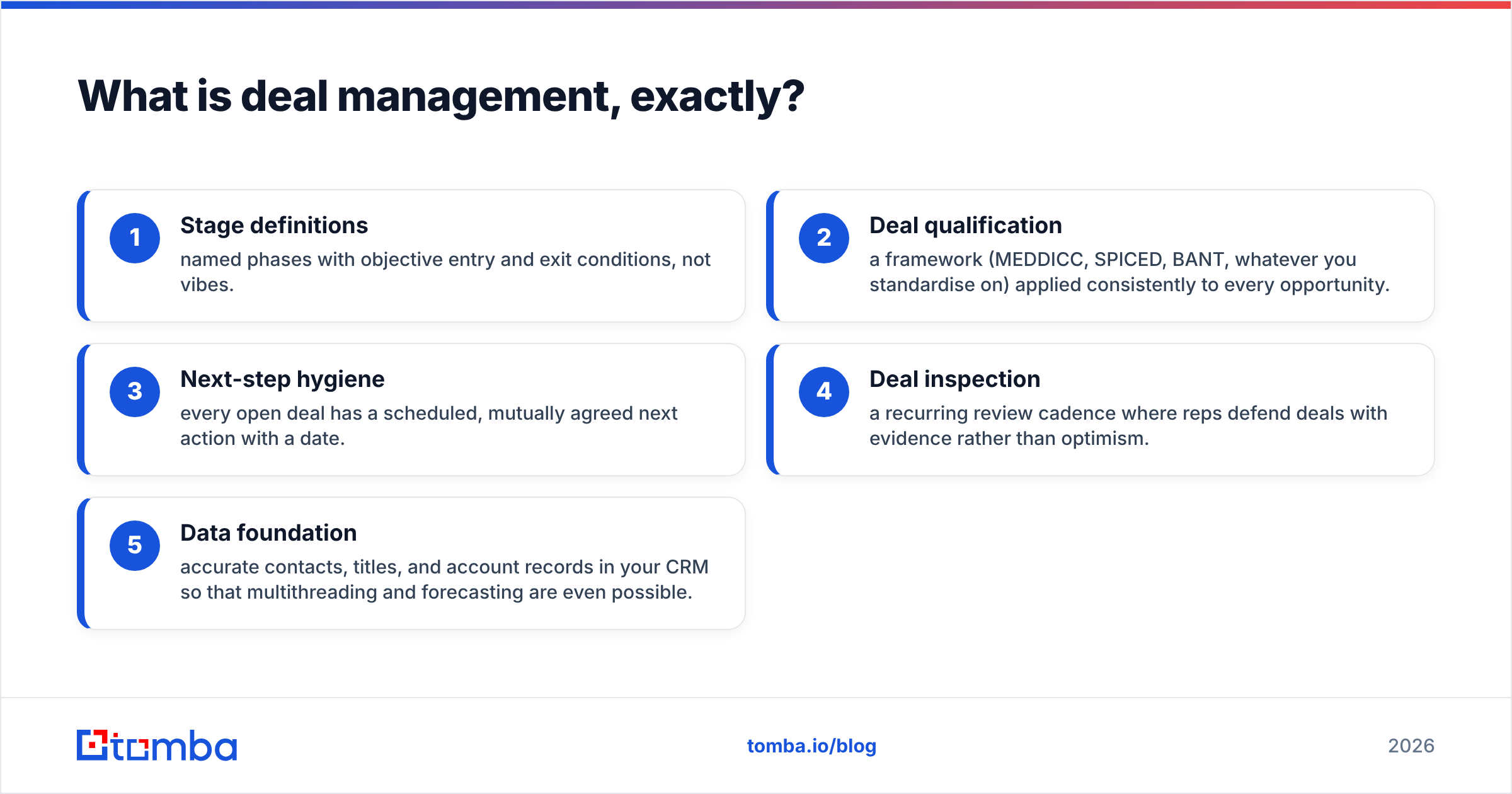
The technical definition matters less than the operational one. In practice, deal management is made up of five components:
- Stage definitions — named phases with objective entry and exit conditions, not vibes.
- Deal qualification — a framework (MEDDICC, SPICED, BANT, whatever you standardise on) applied consistently to every opportunity.
- Next-step hygiene — every open deal has a scheduled, mutually agreed next action with a date.
- Deal inspection — a recurring review cadence where reps defend deals with evidence rather than optimism.
- Data foundation — accurate contacts, titles, and account records in your CRM so that multithreading and forecasting are even possible.
Miss any one of those and the other four degrade. Miss the fifth and you will not notice until your forecast misses by 30%.
Why do most deal management systems fail?#
They fail because the stages describe what the seller did, not what the buyer did.
Look at a typical pipeline: Discovery → Demo → Proposal → Negotiation → Closed Won. Every one of those is a seller activity. A rep can run a demo to an intern with no budget and legitimately move the deal to Stage 3. The CRM says the pipeline grew. Nothing real happened.
Buyer-based stages fix this. "Demo" becomes "Buyer has confirmed the problem is a funded priority this quarter and has named the decision process." That is harder to fake, harder to self-deceive about, and dramatically more predictive.
The second failure mode is stage inflation without stage regression. Deals move forward eagerly and never move back. If your CRM has no mechanism for demoting a deal — or worse, demotion is culturally punished — your late-stage pipeline is a landfill.

The third failure mode is the one nobody wants to own: dead data. A deal in "Negotiation" where your only contact left the company two months ago is not in negotiation. Research consistently shows B2B contact data decays somewhere in the range of 20–30% per year through job changes alone, and that decay lands hardest on exactly the champion relationships your deals depend on. If you are not periodically re-verifying contacts on open opportunities, you are forecasting against ghosts.
What should each deal stage actually require?#
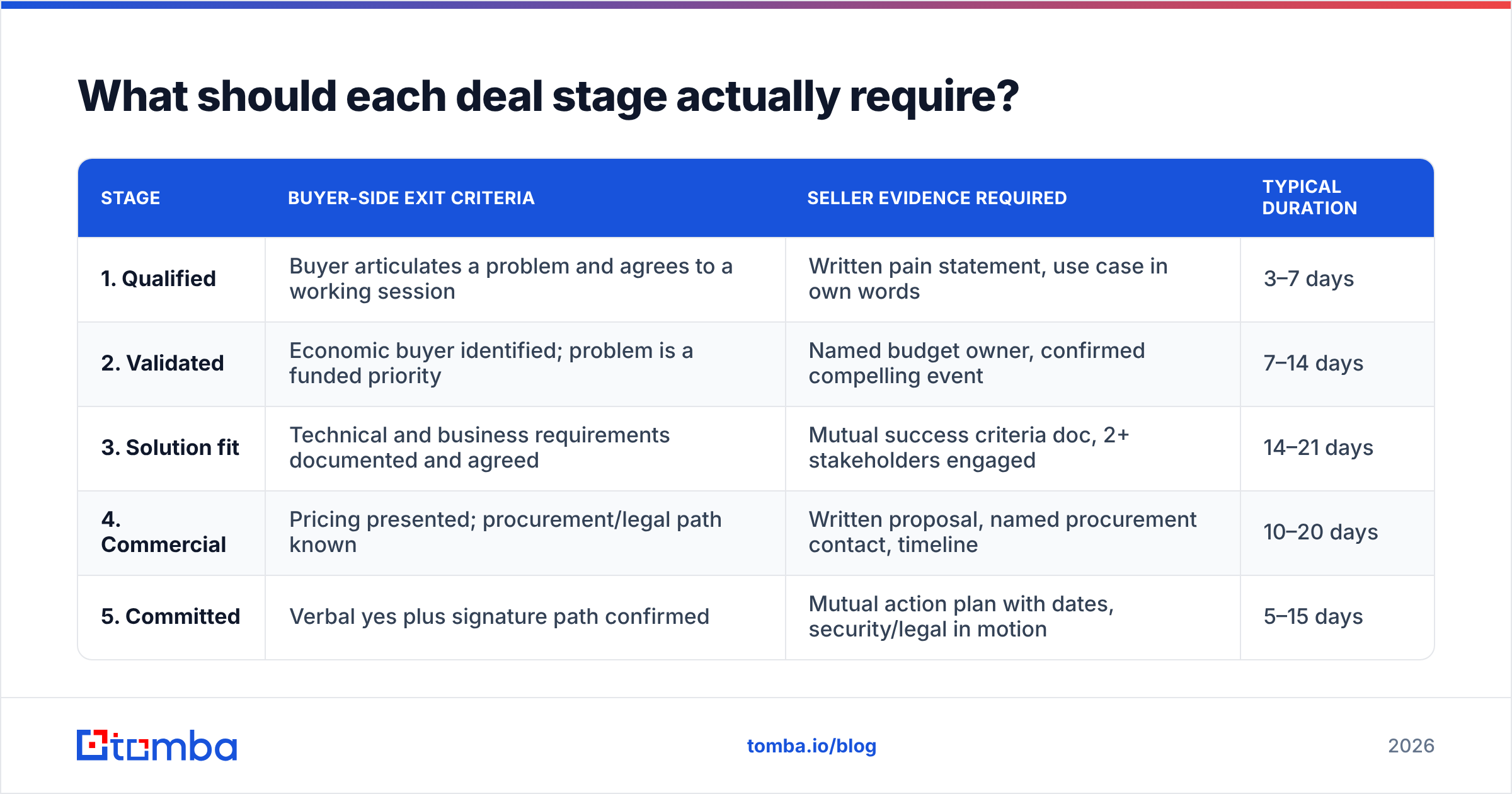
Here is a stage model that survives contact with reality. Adapt the names; keep the structure.
| Stage | Buyer-side exit criteria | Seller evidence required | Typical duration |
|---|---|---|---|
| 1. Qualified | Buyer articulates a problem and agrees to a working session | Written pain statement, use case in own words | 3–7 days |
| 2. Validated | Economic buyer identified; problem is a funded priority | Named budget owner, confirmed compelling event | 7–14 days |
| 3. Solution fit | Technical and business requirements documented and agreed | Mutual success criteria doc, 2+ stakeholders engaged | 14–21 days |
| 4. Commercial | Pricing presented; procurement/legal path known | Written proposal, named procurement contact, timeline | 10–20 days |
| 5. Committed | Verbal yes plus signature path confirmed | Mutual action plan with dates, security/legal in motion | 5–15 days |
Two rules make this table work.
Rule one: evidence lives in the CRM, not the rep's head. If the compelling event cannot be quoted from an email or call recording, it does not exist. The purpose is not bureaucracy — it is that a manager reviewing 40 deals needs to inspect claims without re-interviewing every rep.
Rule two: duration is a diagnostic, not a deadline. When a stage-3 deal hits 45 days against a 21-day benchmark, that is not a reason to pressure the rep. It is a signal that something in the buying process — usually an unmapped stakeholder — is unresolved.
How do you spot a stalled deal before the forecast breaks?#
Use a small set of leading indicators. Each is cheap to compute and hard to game.
- Days since last buyer-initiated contact. Seller activity is not engagement. If every email in the thread came from your rep, the deal is cold regardless of stage.
- Single-threaded risk. One contact on a five-figure deal is a coin flip. Two is a deal. Four-plus across functions is a forecast.
- No scheduled next step. The strongest single predictor of slippage. Track the percentage of open deals with a calendared next meeting; below 70% and your quarter is already in trouble.
- Stage age versus benchmark. Deals sitting at 2x median stage duration close at a fraction of the normal win rate.
- Champion silence after a pricing event. Post-proposal quiet is rarely "they're thinking about it." It is usually an internal objection you were never shown.
- Close date pushed more than twice. Two pushes is a pattern. Three is a no with better manners.
Build these into a simple weekly report. You do not need an AI forecasting product to compute "days since inbound reply" — you need someone to actually look at it.
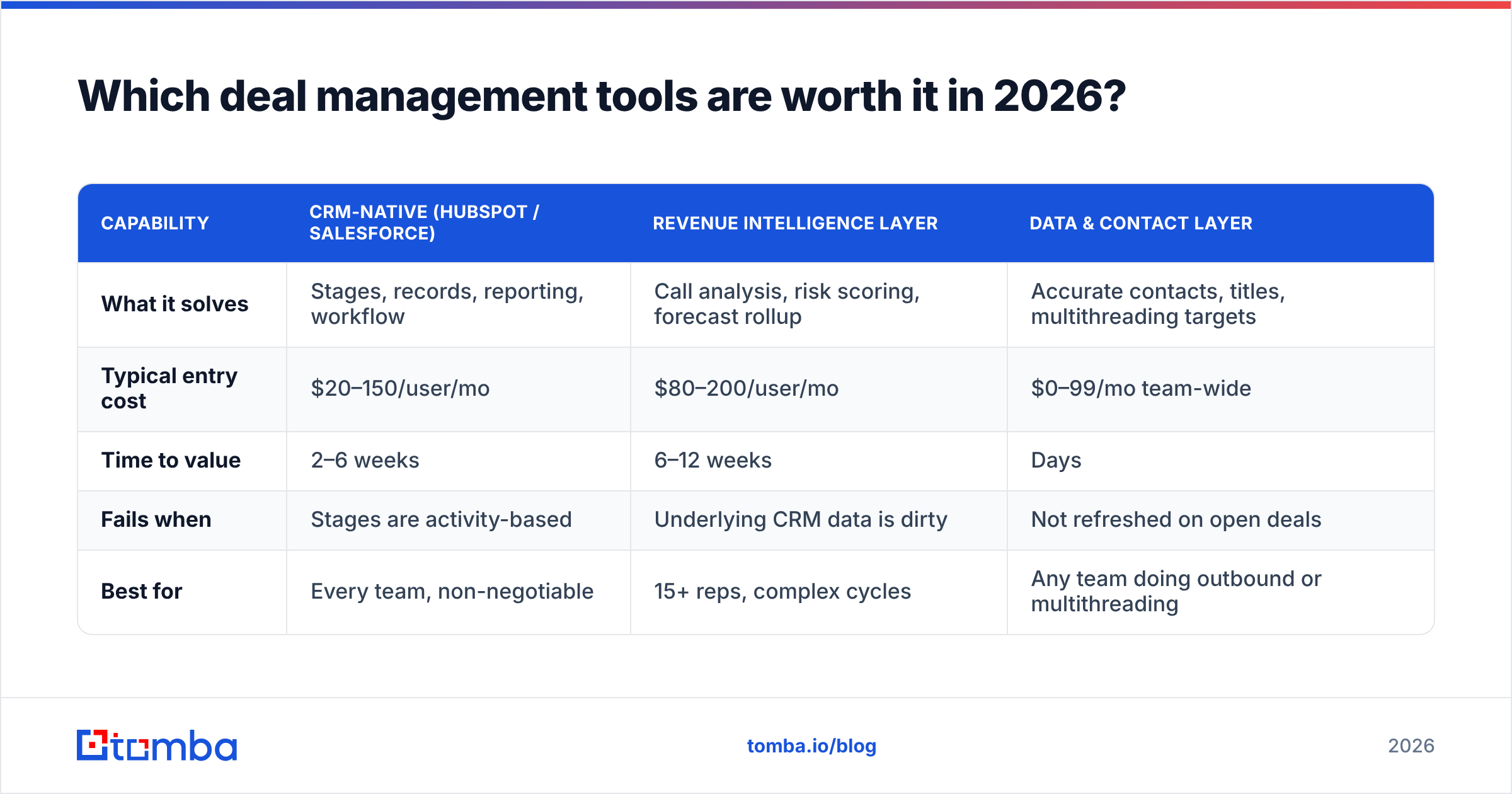
Which deal management tools are worth it in 2026?#
Tool choice depends on where your bottleneck is. Most teams over-invest in forecasting software and under-invest in the data layer that feeds it.
| Capability | CRM-native (HubSpot / Salesforce) | Revenue intelligence layer | Data & contact layer |
|---|---|---|---|
| What it solves | Stages, records, reporting, workflow | Call analysis, risk scoring, forecast rollup | Accurate contacts, titles, multithreading targets |
| Typical entry cost | $20–150/user/mo | $80–200/user/mo | $0–99/mo team-wide |
| Time to value | 2–6 weeks | 6–12 weeks | Days |
| Fails when | Stages are activity-based | Underlying CRM data is dirty | Not refreshed on open deals |
| Best for | Every team, non-negotiable | 15+ reps, complex cycles | Any team doing outbound or multithreading |
A few honest observations after watching a lot of these stacks get assembled:
Start with the CRM configuration, not the add-ons. HubSpot and Salesforce both let you enforce required fields per stage. Almost nobody turns it on. Doing so — with three fields, not fifteen — outperforms most six-figure tooling decisions.
Revenue intelligence is a magnifier, not a fix. Conversation-intelligence platforms score deals off signals extracted from calls and emails. If your reps run unstructured discovery, the tool will faithfully score unstructured discovery. Check current category reviews on G2 before assuming the leader in a quadrant fits your motion; enterprise-weighted rankings frequently mislead 10-person teams.
The data layer is the cheapest leverage. Multithreading is the most reliable deal-progression tactic in B2B, and it is bottlenecked entirely by whether you can reach the other four people in the buying committee. That is a contact-data problem, not a process problem. Tools like Tomba and peers such as BookYourData exist specifically to close that gap — pulling verified work emails for the VP of Ops you have never spoken to but who will ultimately sign off.
How should you run a deal review that is not a status meeting?#
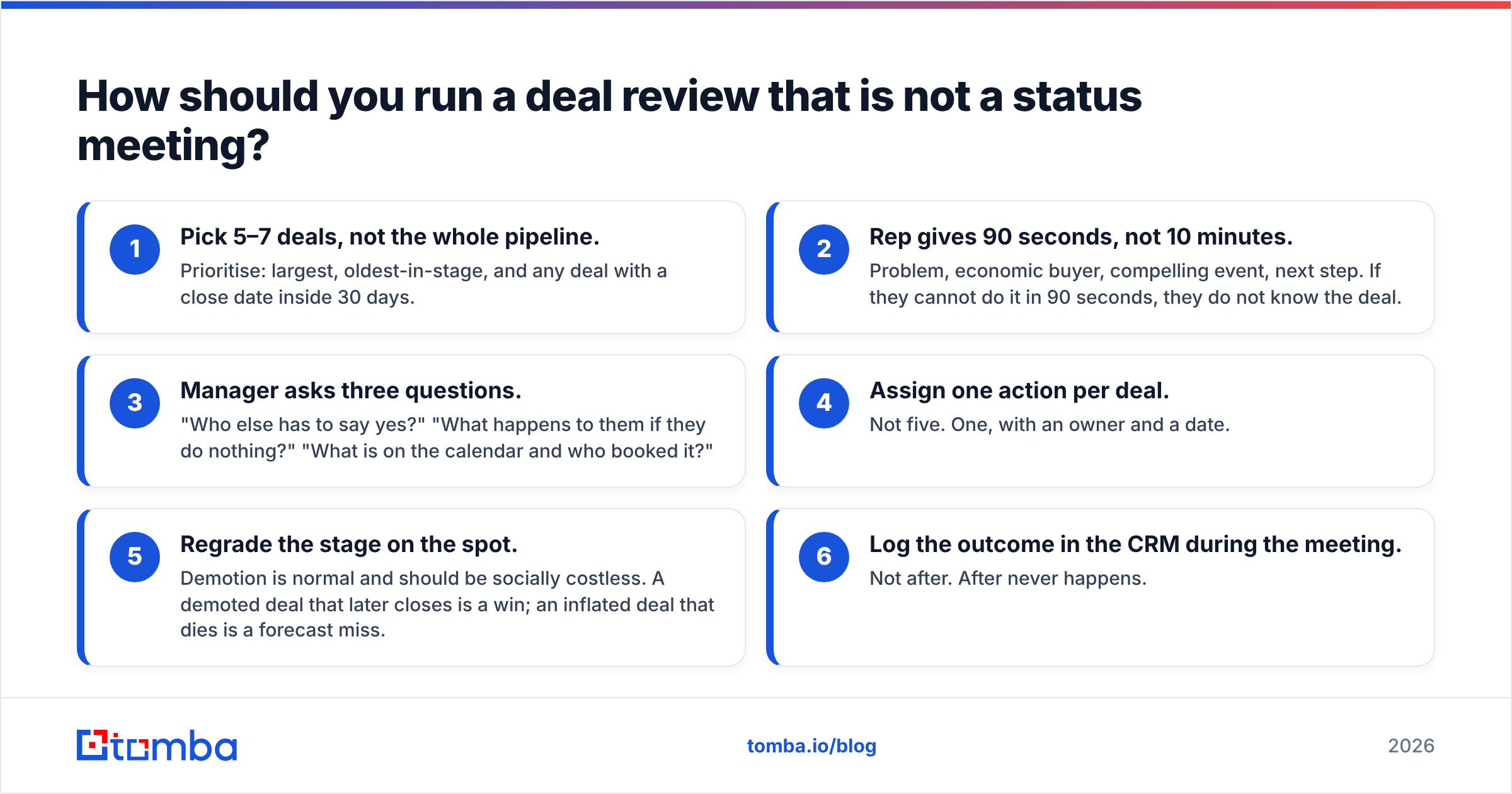
Most deal reviews are a rep reading the CRM aloud while a manager nods. That is a status meeting, and it is worth exactly nothing.
A real deal review is an inspection. Structure it like this:
- Pick 5–7 deals, not the whole pipeline. Prioritise: largest, oldest-in-stage, and any deal with a close date inside 30 days.
- Rep gives 90 seconds, not 10 minutes. Problem, economic buyer, compelling event, next step. If they cannot do it in 90 seconds, they do not know the deal.
- Manager asks three questions. "Who else has to say yes?" "What happens to them if they do nothing?" "What is on the calendar and who booked it?"
- Assign one action per deal. Not five. One, with an owner and a date.
- Regrade the stage on the spot. Demotion is normal and should be socially costless. A demoted deal that later closes is a win; an inflated deal that dies is a forecast miss.
- Log the outcome in the CRM during the meeting. Not after. After never happens.
Gartner's sales research has repeatedly found that buying groups in complex B2B purchases now involve six to ten decision-makers, each arriving with their own independently gathered information — see the ongoing coverage at Gartner. Any review process that inspects a single relationship per deal is structurally blind to most of the risk.
What role does contact data play in deal progression?#
Larger than it gets credit for. Three concrete places it bites:
Multithreading. You identify the CFO as the missing approver in a stage-4 deal. Your champion is slow to introduce you. The fastest path is a direct, well-researched approach — which requires a verified email address for a person who has never been in your CRM. If getting that address takes two days of manual LinkedIn archaeology, most reps simply will not do it, and the deal quietly slips a quarter.
Champion job changes. Your champion moving to a new company is simultaneously your biggest deal risk and your best pipeline source. Teams that track this systematically — re-verifying contacts on open opportunities monthly and running contact enrichment against their account list — catch both sides of it.
Handoff accuracy. When a deal moves from SDR to AE to CS, incomplete contact records cause the same person to be re-qualified, the same question to be asked twice, and the buyer to conclude your company does not talk internally. That perception costs deals at the exact moment trust matters most.
None of this requires a huge investment. Verifying a few hundred contacts a month sits comfortably inside a free or entry-level plan on most providers; Tomba's pricing starts with a free tier at 25 searches per month and a $49/mo Starter plan, which is the right order of magnitude for a small team fixing its data hygiene rather than buying a database.
What does good deal management look like in practice?#
A short list of behaviours you can audit this week:
- Every open deal has a next step with a date. Report it as a percentage. Manage to it.
- Every deal past stage 2 has at least three named contacts. Enforced as a required field.
- Stage regression happens weekly and nobody flinches. Track demotions as a health metric, not a failure metric.
- Close dates are set by the buyer's process, not the end of your quarter. If the security review takes six weeks, the deal does not close in three.
- Contacts on open deals are re-verified monthly. Bounced emails on a live opportunity are an unforced error.
- Deal notes are written for someone else to read. Assume the rep will be on holiday when the buyer calls.
Deal management is unglamorous. It is checklist work, calendar work, and the willingness to say a deal is worse than the CRM claims. But it is also the difference between a forecast you defend with evidence and one you defend with adjectives.
Where should you start?#
Pick the cheapest broken thing first. For most teams that is not the forecasting model or the stage taxonomy — it is that half the buying committee on their active deals has never been contacted, because nobody could find the email addresses.
Fix that layer and the rest of your deal management gets easier immediately: multithreading becomes a five-minute task, champion job changes stop being invisible, and your stage criteria start reflecting real buyer engagement instead of seller effort.
Start with the contact layer. Use the Tomba Email Finder to pull verified work emails for the stakeholders missing from your open opportunities — by name, company, or domain — so every deal in your pipeline has more than one thread holding it up. The free tier covers 25 searches a month if you just want to test it against your current stage-4 list; paid plans start at $49/mo when you are ready to run it across the whole pipeline.
Related guides#
Ready to find emails that actually work?
Join 150,000+ professionals who stopped guessing and started sending. Free credits on signup — no credit card required.
Get the Tomba newsletter
Practical outbound tactics and product updates — once every two weeks.
About the author