Deal Management and Team Selling: A 2026 Playbook for B2B
Buying groups now run 6-10 people deep, but most sales teams still manage deals like a solo sport. Here is how deal management and team selling fit together — roles, stage gates, data hygiene, and the metrics that prove it works.
TL;DR
- Team selling only pays off when deal management is strong enough to hold it together — otherwise you are adding headcount to a deal nobody actually owns.
- Gartner's research puts a typical B2B buying group at six to ten decision makers, which is why a single AE working a single champion loses winnable deals.
- The three things that make team selling work: a named deal owner with veto power, explicit stage-exit criteria, and shared contact data that everyone trusts.
- Use a RACI-style split (owner, technical, executive, commercial, customer-success) rather than "everyone joins the call."
- Track multi-threading depth, stage-conversion by deal team size, and slip rate — not just win rate — to prove the coordination cost is worth it.
What is deal management, and why does it break under team selling?#
Deal management is the discipline of moving a single opportunity from qualified to closed with a documented plan: who the buyers are, what they need to see at each stage, what could kill it, and who on your side is responsible for each of those answers.
Think of it like air traffic control. One plane in the sky needs almost no coordination — the pilot flies it. Twenty planes converging on one runway need a controller, a shared radio channel, and rules about who lands first. Solo selling is one plane. Team selling is twenty, and most orgs bolt on the extra planes without ever hiring the controller.
That is the failure mode. The moment you add a solutions engineer, a security specialist, an executive sponsor, and a customer success lead to a deal, three predictable things go wrong:
- Ownership dilutes. Everyone assumes the AE has the next step covered. The AE assumes the SE is chasing the security questionnaire. Nobody does it.
- The narrative fragments. Your SE tells the buyer one implementation timeline, your AE quotes another in the proposal, and the buyer starts discounting everything you say.
- Data drifts. Three people log three versions of the same contact, two of them with a guessed email format, and the follow-up sequence bounces.
Deal management is what stops those three things. Team selling without it is not collaboration — it is a group chat with a quota attached.
What is team selling, and when is it worth the coordination cost?#
Team selling means assigning more than one seller-side role to a single opportunity, with defined responsibilities, so you can match the buying group's structure person-for-person.
It is not free. Every extra person on a deal adds scheduling friction, internal syncs, and a risk of mixed messaging. So the honest question is not "should we team sell?" but "which deals justify it?"
A workable rule: team sell when at least two of these are true.
- Deal value sits above 3× your average contract value. The coordination overhead is fixed; the return scales with deal size.
- The buying group has four or more identified stakeholders. Below that, one strong rep multi-threading is usually faster.
- There is a technical or compliance gate — security review, integration proof, procurement/legal redlines.
- The account is strategic — a logo you want for reference, expansion potential, or a competitive displacement.
- The sales cycle already exceeds 60 days and has stalled at least once.
If none of those apply, adding a second body slows the deal down. That is the part most enablement decks skip.
Who does what on a team-selling deal?#
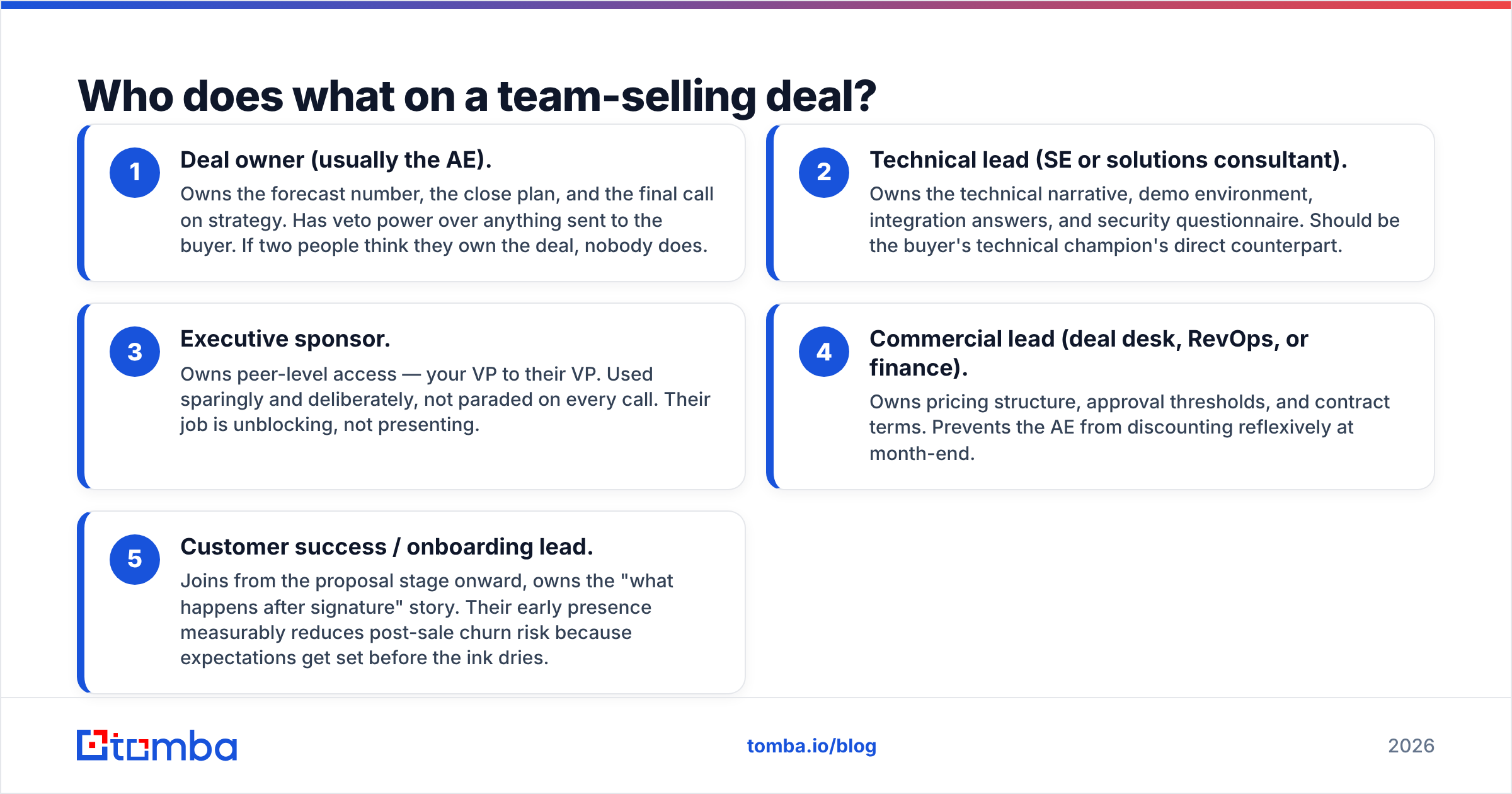
The single biggest upgrade you can make is replacing "who's free Thursday?" with fixed roles. Here is a five-role model that works for most mid-market and enterprise motions:
- Deal owner (usually the AE). Owns the forecast number, the close plan, and the final call on strategy. Has veto power over anything sent to the buyer. If two people think they own the deal, nobody does.
- Technical lead (SE or solutions consultant). Owns the technical narrative, demo environment, integration answers, and security questionnaire. Should be the buyer's technical champion's direct counterpart.
- Executive sponsor. Owns peer-level access — your VP to their VP. Used sparingly and deliberately, not paraded on every call. Their job is unblocking, not presenting.
- Commercial lead (deal desk, RevOps, or finance). Owns pricing structure, approval thresholds, and contract terms. Prevents the AE from discounting reflexively at month-end.
- Customer success / onboarding lead. Joins from the proposal stage onward, owns the "what happens after signature" story. Their early presence measurably reduces post-sale churn risk because expectations get set before the ink dries.
Optional sixth: the SDR or researcher who sourced the account and holds the original context on why the buyer engaged. Do not lose that context in the handoff.
Write these names into the opportunity record. Not in a Slack thread — in the CRM, on the deal, visible to everyone.
Is team selling actually better than solo selling?#
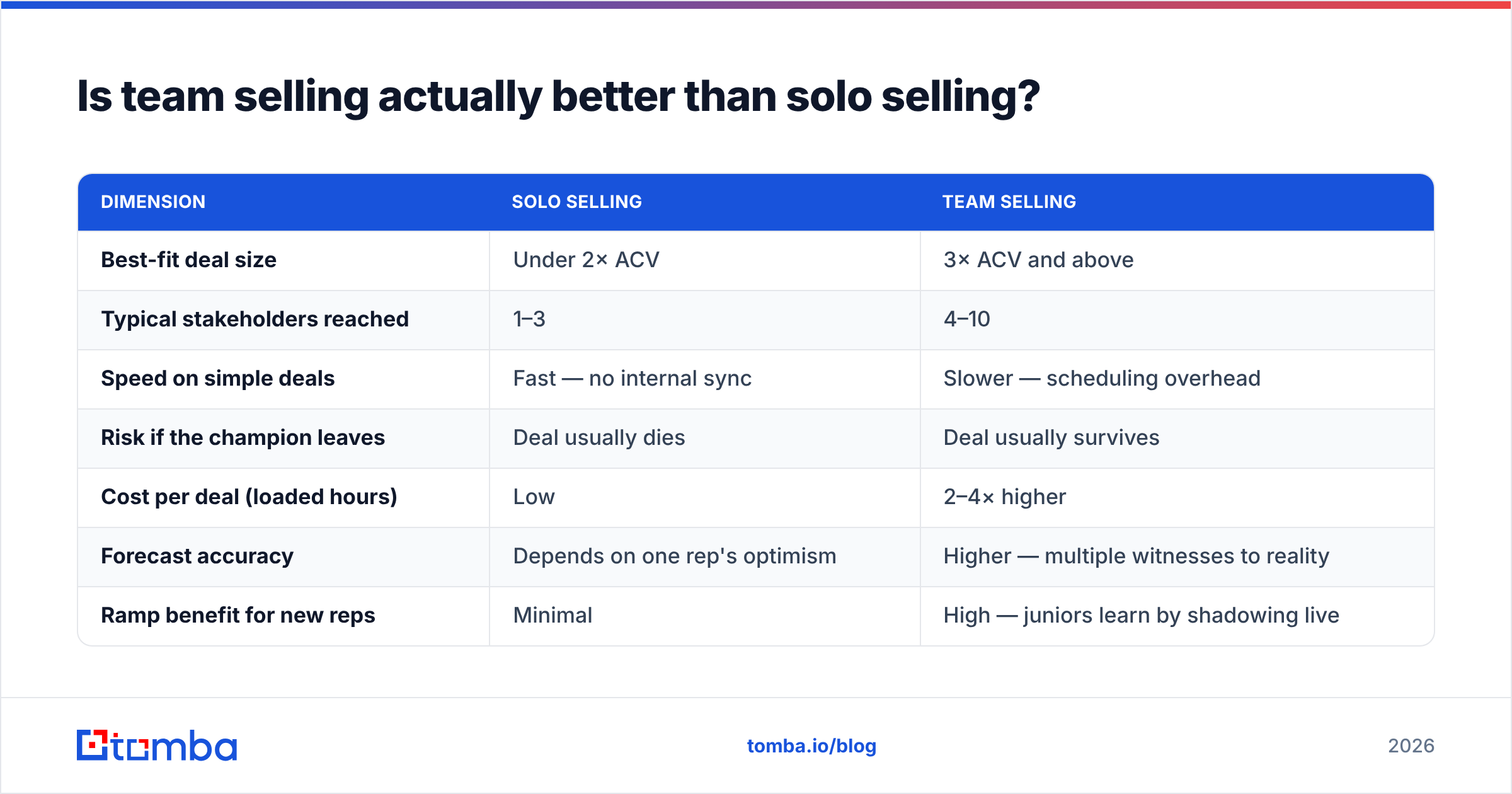
It depends entirely on deal shape. Here is the trade-off in concrete terms:
| Dimension | Solo selling | Team selling |
|---|---|---|
| Best-fit deal size | Under 2× ACV | 3× ACV and above |
| Typical stakeholders reached | 1–3 | 4–10 |
| Speed on simple deals | Fast — no internal sync | Slower — scheduling overhead |
| Risk if the champion leaves | Deal usually dies | Deal usually survives |
| Cost per deal (loaded hours) | Low | 2–4× higher |
| Forecast accuracy | Depends on one rep's optimism | Higher — multiple witnesses to reality |
| Ramp benefit for new reps | Minimal | High — juniors learn by shadowing live |
| Failure mode | Single-threading | Diffused ownership |
The pattern is consistent: team selling buys you resilience and accuracy, and it costs you speed and hours. On a $12k deal that is a bad trade. On a $250k deal with a security review, it is the only trade that makes sense.
What does a team-selling deal desk look like stage by stage?#
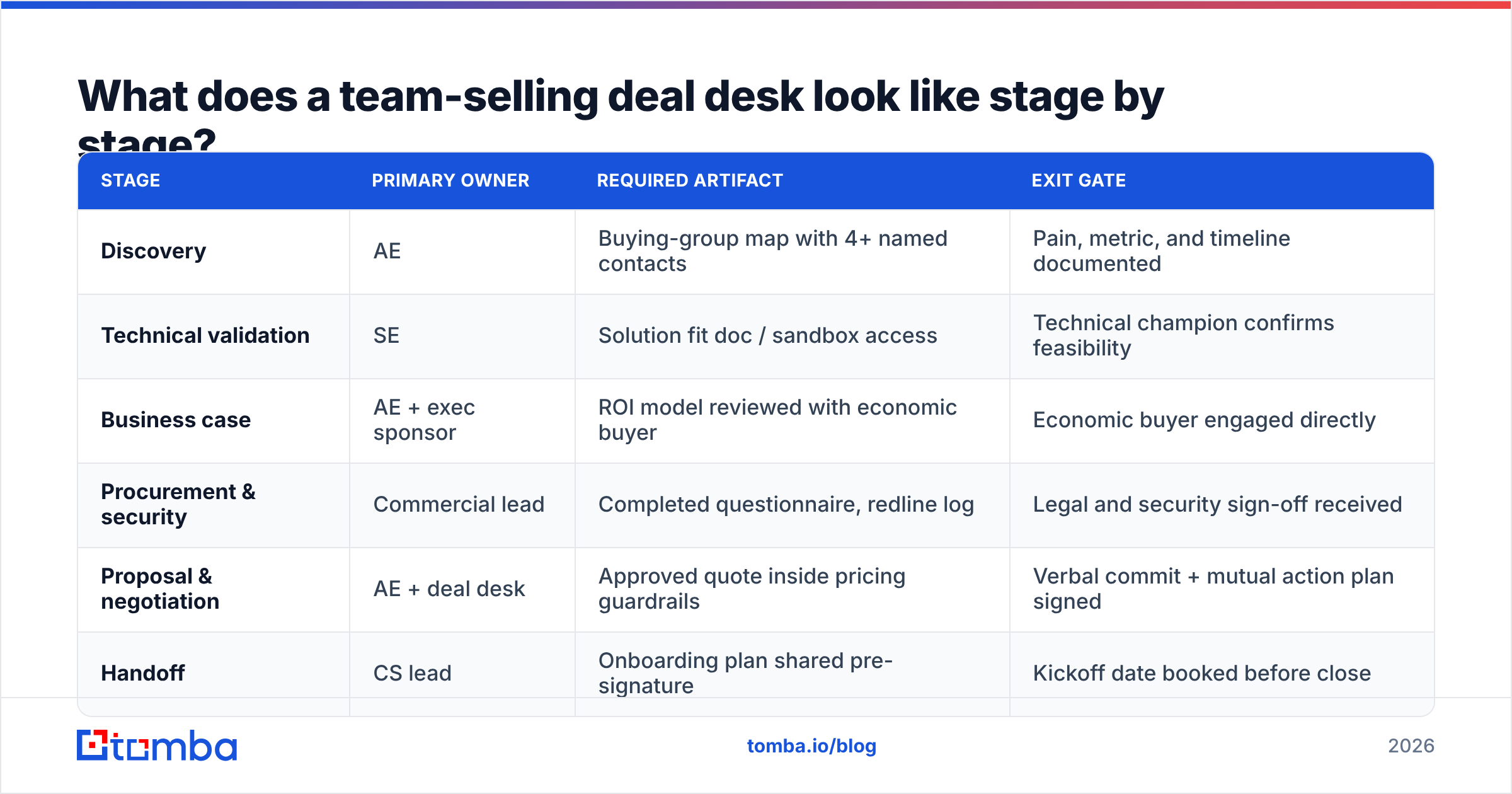
Stage-exit criteria are where deal management stops being a philosophy and becomes a process. Every stage should name an owner, a required artifact, and a gate that must be cleared before the deal advances.
| Stage | Primary owner | Required artifact | Exit gate |
|---|---|---|---|
| Discovery | AE | Buying-group map with 4+ named contacts | Pain, metric, and timeline documented |
| Technical validation | SE | Solution fit doc / sandbox access | Technical champion confirms feasibility |
| Business case | AE + exec sponsor | ROI model reviewed with economic buyer | Economic buyer engaged directly |
| Procurement & security | Commercial lead | Completed questionnaire, redline log | Legal and security sign-off received |
| Proposal & negotiation | AE + deal desk | Approved quote inside pricing guardrails | Verbal commit + mutual action plan signed |
| Handoff | CS lead | Onboarding plan shared pre-signature | Kickoff date booked before close |
Two rules make this stick. First, no stage advances on optimism — the artifact either exists or the deal stays put. Second, the mutual action plan is shared with the buyer. A close plan you never show the customer is a forecast fantasy; a close plan they co-edit is a commitment.
HubSpot's sales research and Salesforce's State of Sales both point the same direction: reps spend a minority of their week actually selling, and coordination overhead is a major reason. Stage gates cut that overhead by removing the "what's next?" conversation entirely.
How do you keep deal data clean enough for a team to trust it?#
This is the unglamorous part that decides whether team selling works. The moment five people share one opportunity, the contact record becomes shared infrastructure — and shared infrastructure fails loudly.
Three specific problems and how to handle them:
Problem 1 — the buying group is incomplete. Your AE has the champion and maybe the budget holder. The security reviewer, the ops manager who will actually use the product, and the CFO's analyst are invisible. You cannot multi-thread contacts you do not have. Map the org chart deliberately, then source the missing addresses with an email finder rather than guessing at firstname.lastname@ and hoping. Guessed patterns bounce, and bounces from a deal-team domain damage the sender reputation everyone else on the team relies on.
Problem 2 — the data rots mid-cycle. Enterprise cycles run 90 to 180 days. Over that window, roughly a quarter of B2B contact data goes stale through job changes alone. Re-verify key stakeholders before any major push — a proposal sent to a champion who left three weeks ago is a lost quarter. A quick pass through an email verifier before a multi-recipient send costs minutes and saves the deal.
Problem 3 — nobody agrees on the source of truth. Two AEs, one SE, and a CS lead each keep their own notes. Pick one system, enforce it, and enrich records automatically so people stop copying data by hand. Contact enrichment that writes titles, seniority, and department back to the opportunity means your stakeholder map stays accurate without anyone maintaining it manually.
Which tools support deal management and team selling in 2026?#
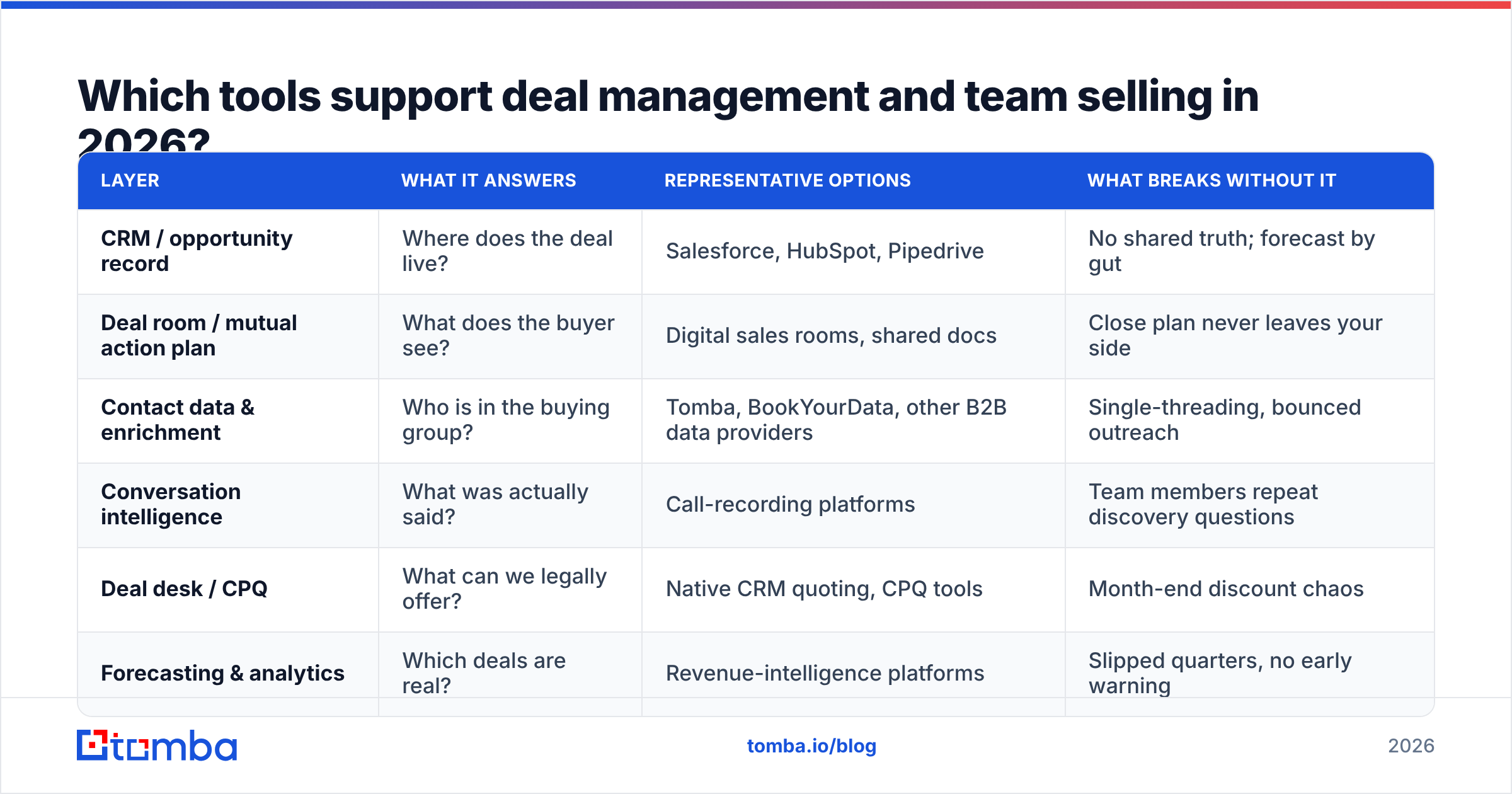
There is no single "team selling tool." There is a stack, and each layer answers a different question.
| Layer | What it answers | Representative options | What breaks without it |
|---|---|---|---|
| CRM / opportunity record | Where does the deal live? | Salesforce, HubSpot, Pipedrive | No shared truth; forecast by gut |
| Deal room / mutual action plan | What does the buyer see? | Digital sales rooms, shared docs | Close plan never leaves your side |
| Contact data & enrichment | Who is in the buying group? | Tomba, BookYourData, other B2B data providers | Single-threading, bounced outreach |
| Conversation intelligence | What was actually said? | Call-recording platforms | Team members repeat discovery questions |
| Deal desk / CPQ | What can we legally offer? | Native CRM quoting, CPQ tools | Month-end discount chaos |
| Forecasting & analytics | Which deals are real? | Revenue-intelligence platforms | Slipped quarters, no early warning |
You do not need all six on day one. If you are starting from spreadsheets, fix the CRM record and the contact data first — those two feed everything else. Vendor comparisons on G2 are useful for shortlisting the middle layers, but weigh reviews from companies with your deal shape, not your industry.
On cost: contact-data tooling is usually the cheapest line in the stack relative to its impact. Tomba's Free tier covers 25 searches per month for testing, Starter runs $49/mo, Growth $99/mo, and Pro $249/mo — see Tomba pricing for the current credit allocations. For a team running four-person deal squads on six-figure opportunities, that is rounding-error spend against a single recovered deal.
What metrics prove team selling is working?#
Win rate alone will not tell you. It moves too slowly and too many variables sit inside it. Track these instead:
- Multi-threading depth. Average number of engaged contacts per open opportunity. Engaged means they replied, attended, or downloaded — not that they exist in your CRM. Target four or more on team-sold deals.
- Stage conversion by deal-team size. Compare solo vs. team-sold deals at each stage. If team-sold deals convert worse at discovery, you are adding people too early.
- Slip rate. Percentage of forecasted deals that push to the next quarter. Team selling should reduce this because more people are testing the same assumptions.
- Time in stage. Watch technical validation and procurement specifically. Those are the stages team selling is supposed to shorten.
- Cost per closed-won. Loaded hours across everyone who touched the deal, divided by wins. This is the number that tells you when to stop team selling smaller deals.
- Post-sale churn at 12 months, split by whether CS joined pre-signature. This usually makes the strongest internal case for the CS role on deal teams.
Run this quarterly, not weekly. Deal-level changes take a full cycle to show up.
What are the most common team-selling failures?#
The parade. Five people join a 30-minute call, three of them say nothing, and the buyer concludes you are disorganized. Bring only the roles the meeting needs.
The silent handoff. The AE loops in an SE with a one-line Slack message and no context. The SE re-runs discovery, the buyer repeats themselves, and trust drops. Every handoff needs a written brief: what they want, what they fear, who decides.
Executive theater. A VP joins to "show commitment," adds nothing, and disappears. Executive sponsorship works when it is peer-to-peer and unblocks something specific.
Ownership by committee. The deal shows three owners in the CRM. When it slips, nobody is accountable. One name in the owner field. Always.
Data entropy. The stakeholder map was accurate in week two and fiction by week ten. Automate enrichment or accept that it will decay.
Where should you start if you are doing none of this?#
Pick one quarter and one motion. Take your ten largest open opportunities, assign the five roles explicitly, write stage-exit criteria on a single page, and require a shared mutual action plan on every deal above your threshold. Measure multi-threading depth and slip rate against the prior quarter. That is a complete pilot, and it takes about a week to set up.
The prerequisite for all of it is knowing who is in the buying group and being able to reach them. If your stakeholder map has three names on a ten-person committee, no amount of process fixes the outcome.
That is where Tomba's Email Finder fits into a team-selling motion: give it a company domain and the names your team surfaced from discovery, and it returns verified professional addresses with confidence scores — so the CFO's analyst, the security reviewer, and the ops lead all land in the deal record instead of the "we should probably find them" pile. Start on the free tier, map one real buying group end to end, and see how much of your stalled pipeline was just under-threaded rather than genuinely dead.
Related guides#
Ready to find emails that actually work?
Join 150,000+ professionals who stopped guessing and started sending. Free credits on signup — no credit card required.
Get the Tomba newsletter
Practical outbound tactics and product updates — once every two weeks.
About the author