Deal Pipelines in 2026: Stages, Metrics, and Real Fixes
Most deal pipelines look healthy right up to the moment the quarter misses. Here's how to build stages buyers actually validate, which metrics predict revenue, and how to keep the whole thing clean.
TL;DR
- Deal pipelines are the stages one specific deal moves through. They are not your marketing funnel, and they are not your forecast. Most teams still use all three words as if they meant the same thing.
- Stages that track what the seller did ("demo booked", "proposal sent") look full and forecast badly. Stages that track what the buyer proved ("the budget holder confirmed funding") forecast much better.
- Five metrics tell you almost everything: stage conversion, average deal size, sales cycle length, pipeline coverage, and slip rate. The rest is decoration.
- Coverage of 3x quota is the usual rule of thumb. It only holds if your stage conversion rates are honest. Inflated early stages make even 5x coverage worthless.
- Hygiene beats volume. Deal pipelines you trust close more than deal pipelines you doubt, even when they hold far fewer deals.
What is a deal pipeline?#
A deal pipeline is the ordered set of stages one opportunity passes through. It runs from qualified interest to closed-won or closed-lost. Each stage has an entry rule, an exit rule, and a past conversion rate.
Here is the everyday version. Deal pipelines are a hospital triage board, not a waiting room. A waiting room tells you how many people showed up. A triage board tells you the condition of each person, who is being treated, and who is about to go home. Most sales teams build a waiting room, then wonder why they cannot predict anything.
Technically, the pipeline lives as a record in your CRM. It has a stage field, an amount, a close date, and an owner. The pipeline "report" is just a sum of those records. So every pipeline problem is really a data problem in disguise.
How is a deal pipeline different from a funnel or a forecast?#
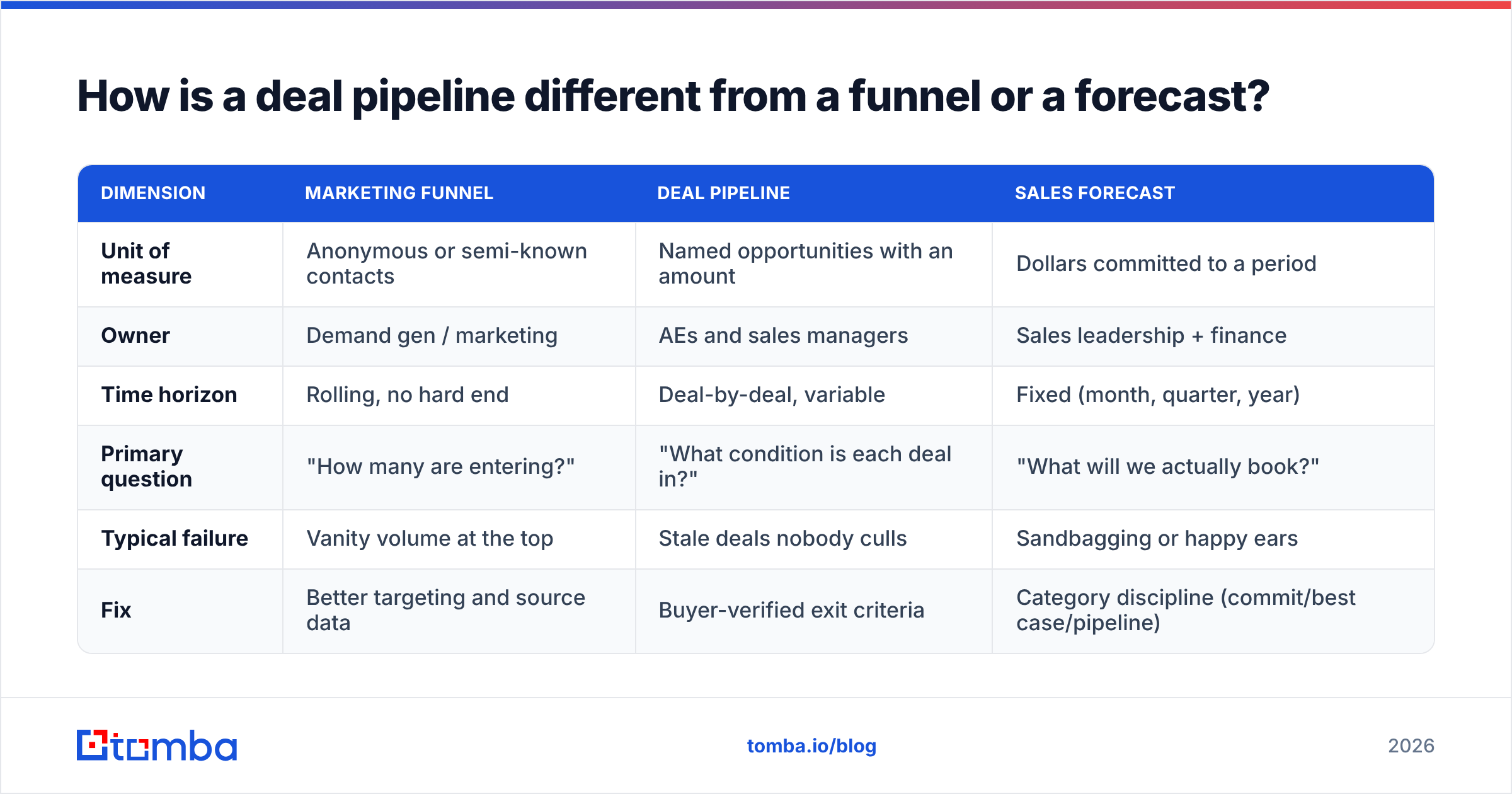
These three blur together in almost every sales meeting, and the blur is expensive. The funnel is a marketing idea about volume drop-off. Deal pipelines are an operating tool for single deals. The forecast is a money promise for a fixed period.
| Dimension | Marketing funnel | Deal pipeline | Sales forecast |
|---|---|---|---|
| Unit of measure | Anonymous or semi-known contacts | Named opportunities with an amount | Dollars committed to a period |
| Owner | Demand gen / marketing | AEs and sales managers | Sales leadership + finance |
| Time horizon | Rolling, no hard end | Deal-by-deal, variable | Fixed (month, quarter, year) |
| Primary question | "How many are entering?" | "What condition is each deal in?" | "What will we actually book?" |
| Typical failure | Vanity volume at the top | Stale deals nobody culls | Sandbagging or happy ears |
| Fix | Better targeting and source data | Buyer-verified exit criteria | Category discipline (commit/best case/pipeline) |
The practical result: you cannot fix a bad forecast by adding pipeline. You cannot fix a thin pipeline by tightening forecast categories. Diagnose at the right layer.
What stages should a deal pipeline have?#
Fewer than you think. Six is a good ceiling for most B2B teams. Every extra stage adds noise, and it gives reps one more place to park a deal that should be closed-lost.
Here is a stage set that works for a mid-market SaaS motion. Change the labels if you like. Keep the principle: every exit rule is something the buyer did, not something you did.
- Qualified (10%) — The buyer has confirmed a problem and a rough timeline, and says they are part of solving it. Exit rule: a discovery call happened, and the pain is written down in their words.
- Discovery validated (25%) — You have mapped how they work today. You have priced the cost of doing nothing. You have named a second stakeholder. Exit rule: that second stakeholder joins a call or an email thread.
- Solution fit (45%) — An evaluation has happened, and the buyer says the solution fixes the pain you documented. Exit rule: the buyer confirms it in writing. A rep's summary does not count.
- Economic buyer engaged (65%) — The person who owns the budget confirms the money exists and the project is funded this period. Exit rule: the actual signer says so. Second-hand word does not count.
- Negotiation / legal (80%) — Price is agreed in principle. The contract sits with procurement, security review, or legal. Exit rule: redlines came back, or the security questionnaire was returned.
- Closed won / closed lost — A signature, or a written loss reason from a fixed list.
Notice what is missing: "demo scheduled", "proposal sent", "following up". Those are activities. Activities belong in the task log, not in the stage field. Once "proposal sent" becomes a stage, deal pipelines fill up with deals where you sent something into a void and called it progress.
What makes an exit criterion good?#
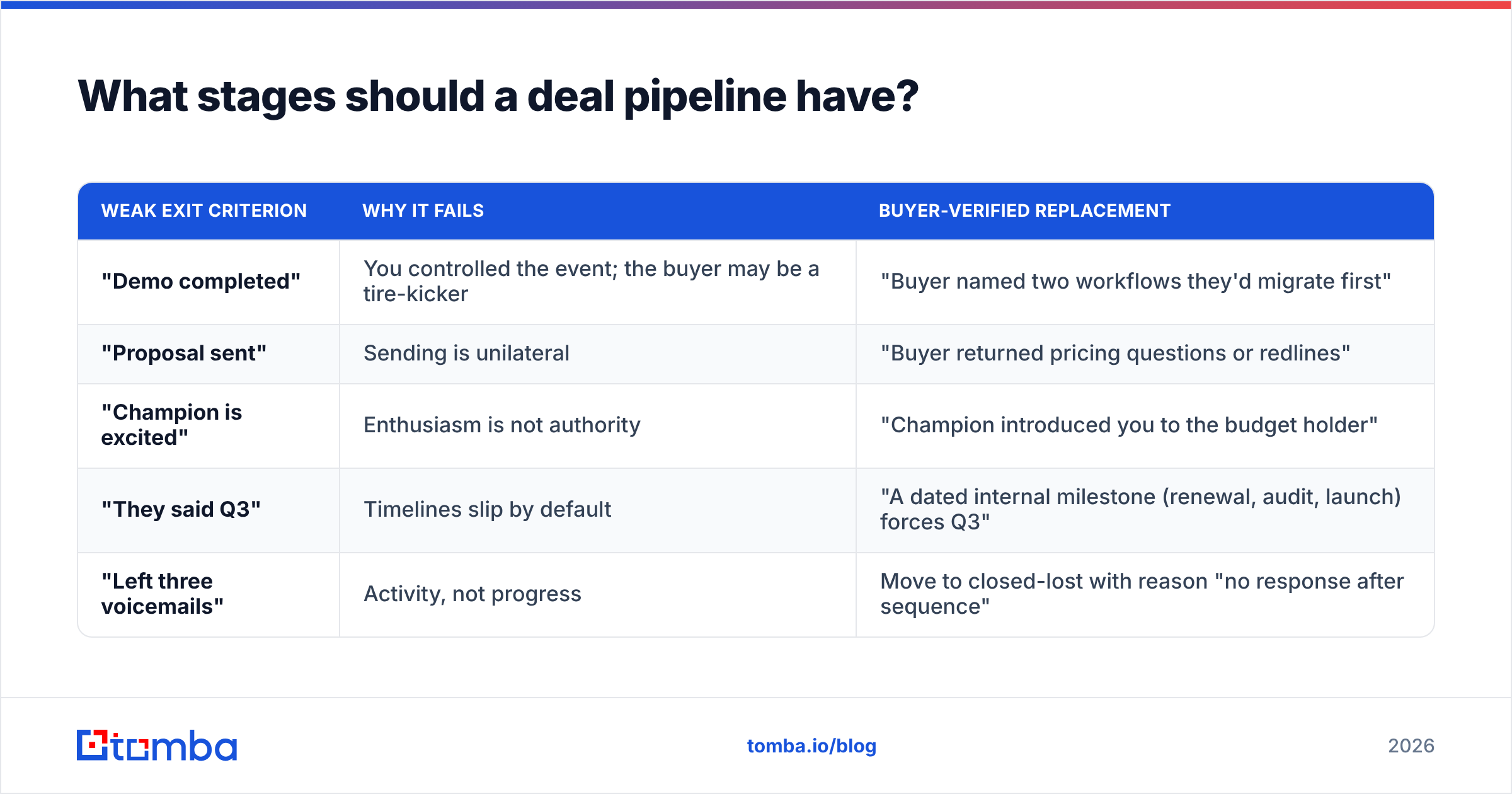
| Weak exit criterion | Why it fails | Buyer-verified replacement |
|---|---|---|
| "Demo completed" | You controlled the event; the buyer may be a tire-kicker | "Buyer named two workflows they'd migrate first" |
| "Proposal sent" | Sending is unilateral | "Buyer returned pricing questions or redlines" |
| "Champion is excited" | Enthusiasm is not authority | "Champion introduced you to the budget holder" |
| "They said Q3" | Timelines slip by default | "A dated internal milestone (renewal, audit, launch) forces Q3" |
| "Left three voicemails" | Activity, not progress | Move to closed-lost with reason "no response after sequence" |
Run this swap across your stage definitions once. Forecast accuracy usually improves before you change anything else.
Which pipeline metrics actually matter?#
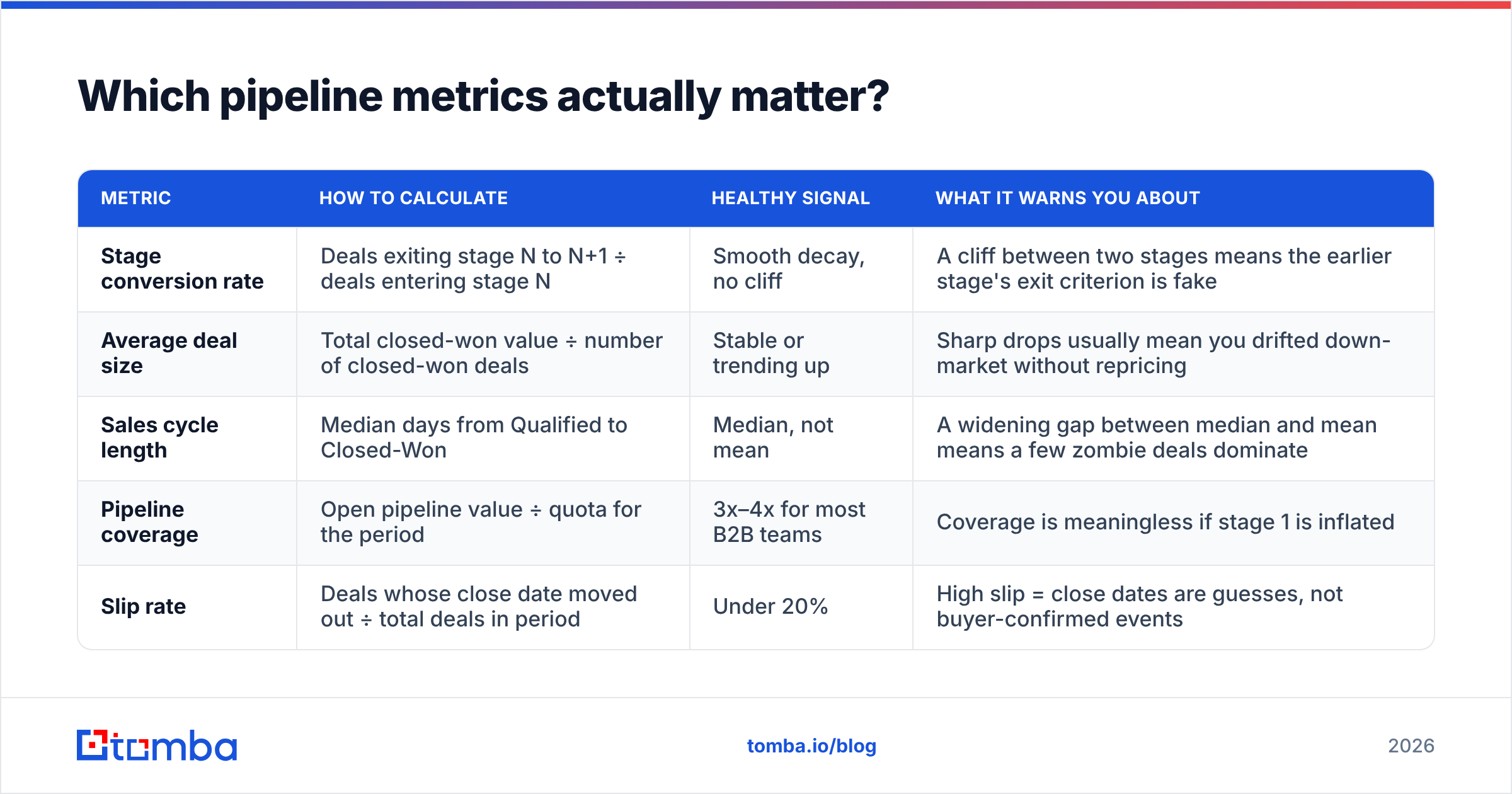
Five. You can work them all out from a clean opportunity table. Together they explain most of what happens inside deal pipelines, and most of why a quarter lands or misses.
| Metric | How to calculate | Healthy signal | What it warns you about |
|---|---|---|---|
| Stage conversion rate | Deals exiting stage N to N+1 ÷ deals entering stage N | Smooth decay, no cliff | A cliff between two stages means the earlier stage's exit criterion is fake |
| Average deal size | Total closed-won value ÷ number of closed-won deals | Stable or trending up | Sharp drops usually mean you drifted down-market without repricing |
| Sales cycle length | Median days from Qualified to Closed-Won | Median, not mean | A widening gap between median and mean means a few zombie deals dominate |
| Pipeline coverage | Open pipeline value ÷ quota for the period | 3x–4x for most B2B teams | Coverage is meaningless if stage 1 is inflated |
| Slip rate | Deals whose close date moved out ÷ total deals in period | Under 20% | High slip = close dates are guesses, not buyer-confirmed events |
Two notes, because both numbers get abused.
First, use the median cycle length, not the mean. One 400-day enterprise deal drags the mean into fantasy land. Then every rep's pipeline looks patient when it is really just stuck.
Second, coverage is a ratio, and a ratio is only as good as its top number. If reps can create deals with no documented pain and no named stakeholder, coverage inflates on demand. Teams that enforce a real entry gate often watch coverage fall from 6x to 2.5x. Forecast accuracy jumps at the same time. That is not a step backward. That is the fog lifting.
Your win rate sits on top of these as a summary number. It is useful for board slides and useless for diagnosis, because it folds five different problems into one figure.
Why do most deal pipelines lie?#
Four reasons, roughly in the order they do damage.
Stage definitions describe seller activity. Covered above. This is the root cause of most pipeline inflation, and it is the cheapest thing to fix.
Nobody is allowed to lose. In many teams, moving a deal to closed-lost feels like admitting failure. So reps park deals in stage 2 forever. A pipeline where the average deal has been open 140 days on a 45-day cycle is not a pipeline. It is an archive. Make closed-lost a normal, expected outcome with a fixed reason list, and reps will clean up on their own.
Close dates are wishes. If a rep picks a close date because it fits the quarter, the forecast is fiction from day one. Tie every close date to a buyer-side event: a contract expiry, a budget cycle, a compliance deadline, a launch. No event, no date. Push it to the next period.
The contact data underneath is wrong. Dashboards never show this one, and it hurts. A deal stalls. The rep emails the champion. The champion left the company three months ago. The deal then sits in stage 3 for six weeks and gives off no signal at all. According to HubSpot's sales research, a large share of CRM records go stale every year through job changes alone. Stage hygiene cannot save deal pipelines from dead contacts. Only data enrichment and regular re-checks can.

Which tool should manage your deal pipeline?#
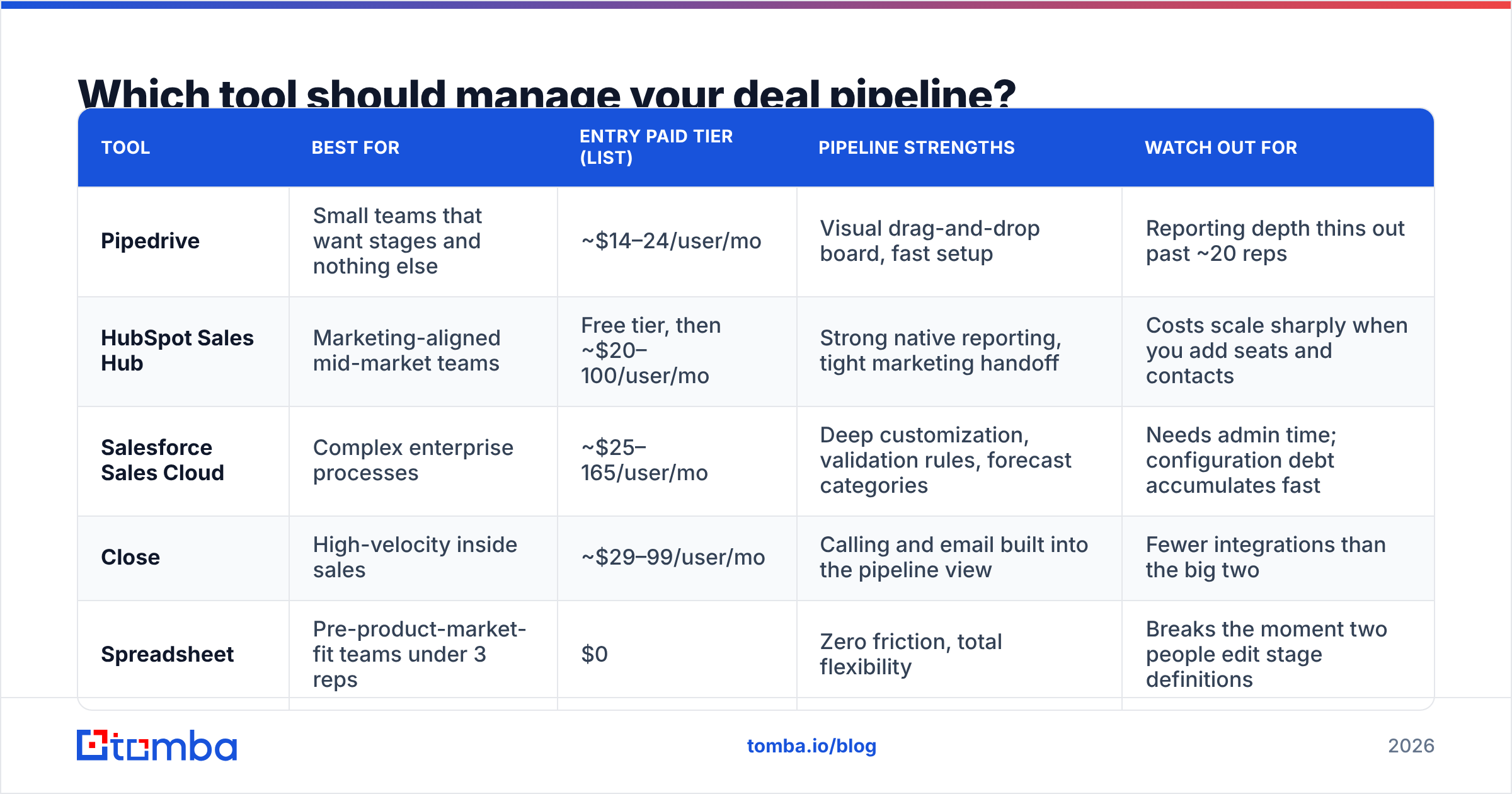
Almost any CRM can hold deal pipelines. What differs is how much process it enforces, how the price scales with seats, and whether the reporting can answer stage-conversion questions without a data team.
| Tool | Best for | Entry paid tier (list) | Pipeline strengths | Watch out for |
|---|---|---|---|---|
| Pipedrive | Small teams that want stages and nothing else | ~$14–24/user/mo | Visual drag-and-drop board, fast setup | Reporting depth thins out past ~20 reps |
| HubSpot Sales Hub | Marketing-aligned mid-market teams | Free tier, then ~$20–100/user/mo | Strong native reporting, tight marketing handoff | Costs scale sharply when you add seats and contacts |
| Salesforce Sales Cloud | Complex enterprise processes | ~$25–165/user/mo | Deep customization, validation rules, forecast categories | Needs admin time; configuration debt accumulates fast |
| Close | High-velocity inside sales | ~$29–99/user/mo | Calling and email built into the pipeline view | Fewer integrations than the big two |
| Spreadsheet | Pre-product-market-fit teams under 3 reps | $0 | Zero friction, total flexibility | Breaks the moment two people edit stage definitions |
List prices move all the time, and every vendor discounts annual deals. Treat those numbers as a starting point, and check the vendor page before you budget. Review data on G2 is a fair second opinion on how each tool lands with teams your size.
The honest answer for most teams: the CRM is not the bottleneck. Running deal pipelines well is a management habit. A better tool just renders a broken process in higher resolution.
How do you keep a deal pipeline clean?#
Deal pipelines get dirty fast, so make hygiene a schedule instead of a mood.
- Weekly, per rep: every deal with no activity for 14 days gets a decision. Advance it, push it with a new buyer-confirmed date, or close it lost. There is no fourth option.
- Weekly, per manager: check the top five deals by value against their exit rules, not against the rep's story. Ask "what did the buyer do?" and stop there.
- Monthly: re-check contact data on every open deal older than 60 days. Bounced or moved-on contacts quietly cause half your stalls.
- Quarterly: recompute stage conversion rates and reset the stage probabilities to match. If stage 3 converts at 38% and your CRM says 60%, the CRM builds a forecast error every week.
- Twice a year: review your closed-lost reasons. If "no decision" leads the list, your qualification gate is too loose. The pitch is not the problem.
Most teams skip the monthly re-check, and it has the highest return of the five. Run open-deal contacts through an email verifier before a re-engagement push. Refresh missing decision-maker addresses with domain search. That turns a campaign from a bounce machine into a real signal source.
How do you fill the top of the pipeline without inflating it?#
Coverage problems tempt teams into two bad habits. One is loosening the entry gate. The other is buying a huge list and hoping volume covers the quality gap. Both push junk downstream, where it burns an AE's time instead of an SDR's.
The better sequence is narrow and boring:
- Write down account fit first — industry, size band, tech stack, trigger event. Written down, not implied.
- Build the list against those rules. Then find the specific roles inside each account. Do not scrape everyone with a title.
- Verify before you send. A bounced first email hurts sender reputation. That costs the whole domain's future deliverability, not just one contact.
- Create an opportunity only after a two-way conversation confirms the pain. Interest is not an opportunity.
Steps 2 and 3 are where a dedicated contact-data layer earns its keep. Pull verified addresses for named decision-makers at fit accounts instead of exporting 50,000 rows. That keeps stage 1 honest. An honest stage 1 keeps coverage meaningful, and meaningful coverage keeps the forecast believable. It is a chain, and contact quality is the first link.
What should you do this week?#
Pick one. Rewrite your stage exit rules so each one describes something the buyer did. Or run a full 14-day-inactivity sweep and force a decision on every stale deal.
Both take a few hours. Both usually show that your real pipeline is 30–50% smaller than the dashboard claims. That stings for one quarter, and it clarifies every quarter after.
Then fix the layer underneath. Stale contacts are why deals stall for no visible reason, and no amount of stage discipline spots a champion who quit in March.
Use the Tomba Email Finder to pull verified, current addresses for the decision-makers on every open deal — by domain, by name, or in bulk. Your re-engagement emails then land in real inboxes, and stage movement starts to reflect real buyer behavior.
The free tier covers 25 searches a month, so you can test it on stalled deals first. Paid plans start at $49/mo. Compare the tiers on the Tomba pricing page, then start with your oldest open deals.
Related guides#
Ready to find emails that actually work?
Join 150,000+ professionals who stopped guessing and started sending. Free credits on signup — no credit card required.
Get the Tomba newsletter
Practical outbound tactics and product updates — once every two weeks.
About the author