Deal Qualification: The 2026 Framework Guide for B2B Sales
Most pipeline is fiction. Here's how deal qualification frameworks, disqualification discipline, and clean contact data turn a bloated forecast into deals that actually close.
TL;DR
- Deal qualification is the process of proving a deal is worth your time — that there is a real problem, real money, a real decision process, and a real timeline — before you invest cycles in it.
- Frameworks (BANT, MEDDPICC, SPICED, CHAMP) are not interchangeable. Pick one based on deal size and buying-committee complexity, not on what your last company used.
- The highest-ROI qualification skill is disqualification. Killing a bad deal in week one is worth more than a heroic save in week twelve.
- Qualification breaks before the first call if your contact data is wrong. You cannot qualify an economic buyer you never reached.
- Measure qualification with stage-conversion rates, slipped-deal rate, and no-decision loss rate — not with pipeline coverage alone.
What is deal qualification, and why does it decide your forecast?#
Deal qualification is the ongoing judgment call about whether an opportunity deserves more of your selling time. It is not a checkbox at the top of the funnel. It is a decision you re-make at every stage, with better information each time.
Think of it like triage in an emergency room. Everyone who walks through the door gets attention, but a nurse decides in ninety seconds who goes to surgery, who waits, and who should be somewhere else entirely. A rep who treats every inbound demo request as equally urgent is a nurse who takes patients in the order they arrived — and lets the serious case bleed out in the waiting room.
The cost of skipping this is not lost deals. It is lost time, which shows up later as a forecast nobody believes. When 40% of your pipeline is unqualified, your coverage ratio looks healthy right up until the quarter closes at 62% of plan. Gartner's sales research has consistently pointed at the same culprit: the biggest competitor in B2B is not another vendor, it is "no decision." No-decision losses are qualification failures wearing a competitive-loss costume.
Two definitions worth separating:
- Lead qualification happens before an opportunity exists. Is this person in our ICP? Do they have a job title that maps to our buyer? This is marketing and SDR territory, and it overlaps with lead scoring.
- Deal qualification happens after an opportunity is created. Is this specific buying process going to end in a signed contract this fiscal period?
Confusing the two is why so many CRMs are full of "opportunities" that are really just conversations.
Which deal qualification framework should you actually use?#
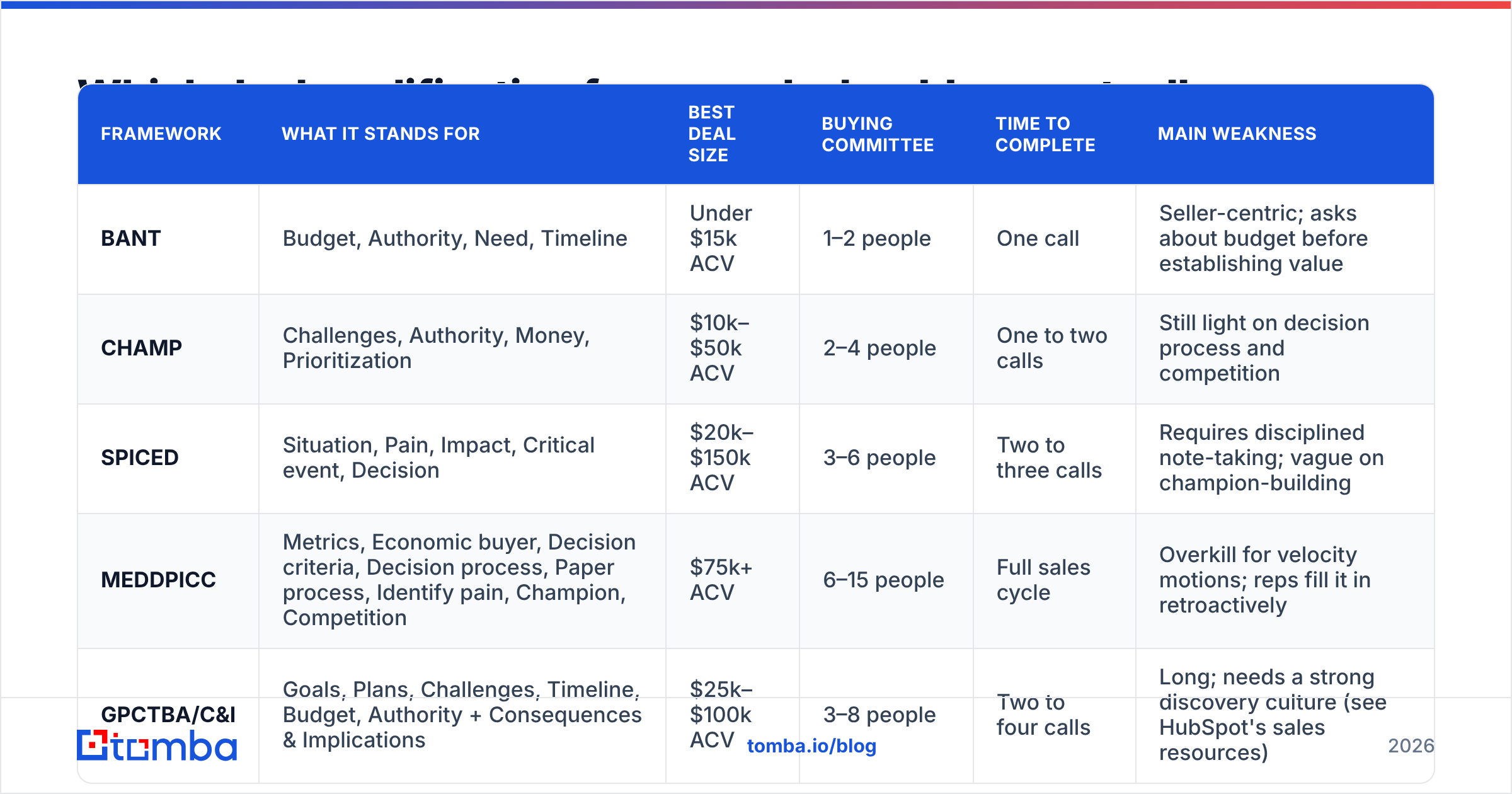
There are a dozen acronyms. Four of them matter, and they solve different problems. BANT is fast and shallow. MEDDPICC is thorough and slow. SPICED is built for modern consultative selling. CHAMP flips BANT to lead with pain instead of money.
| Framework | What it stands for | Best deal size | Buying committee | Time to complete | Main weakness |
|---|---|---|---|---|---|
| BANT | Budget, Authority, Need, Timeline | Under $15k ACV | 1–2 people | One call | Seller-centric; asks about budget before establishing value |
| CHAMP | Challenges, Authority, Money, Prioritization | $10k–$50k ACV | 2–4 people | One to two calls | Still light on decision process and competition |
| SPICED | Situation, Pain, Impact, Critical event, Decision | $20k–$150k ACV | 3–6 people | Two to three calls | Requires disciplined note-taking; vague on champion-building |
| MEDDPICC | Metrics, Economic buyer, Decision criteria, Decision process, Paper process, Identify pain, Champion, Competition | $75k+ ACV | 6–15 people | Full sales cycle | Overkill for velocity motions; reps fill it in retroactively |
| GPCTBA/C&I | Goals, Plans, Challenges, Timeline, Budget, Authority + Consequences & Implications | $25k–$100k ACV | 3–8 people | Two to four calls | Long; needs a strong discovery culture (see HubSpot's sales resources) |
The practical rule: match framework depth to buying-committee size. If one person can sign, BANT is enough and anything heavier is theater. If eleven people touch the contract, you need MEDDPICC's "paper process" field, because legal and procurement will kill more of your deals than your competitor will.

One more thing nobody tells you: frameworks are note structures, not scripts. If your discovery call sounds like you are reading fields off a form, you have already lost the champion you were trying to recruit.
What does a genuinely qualified deal look like?#
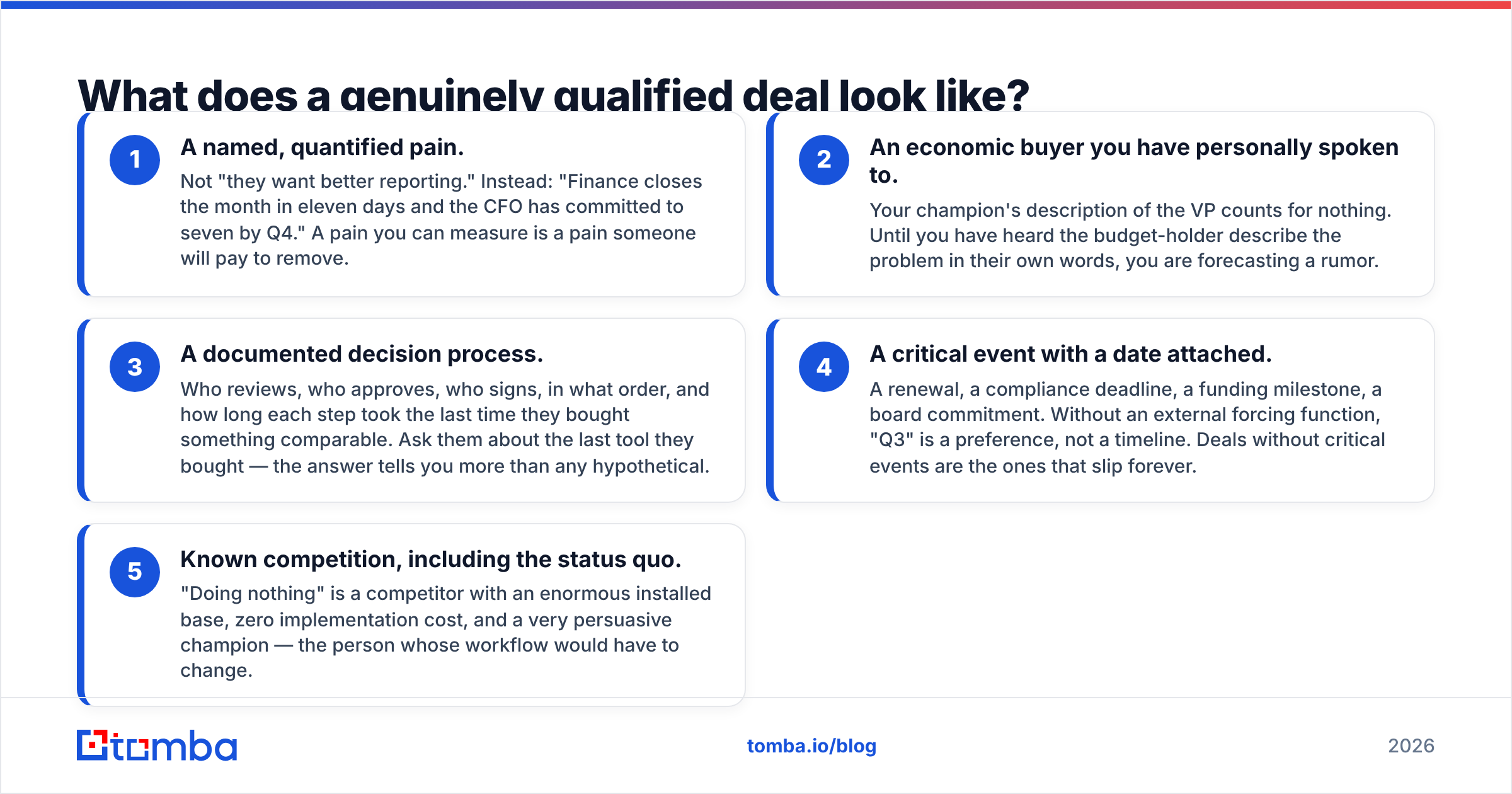
Strip away the acronyms and every framework is testing for the same five conditions. If you cannot write a sentence for each of these, the deal is not qualified — regardless of how good the last call felt.
- A named, quantified pain. Not "they want better reporting." Instead: "Finance closes the month in eleven days and the CFO has committed to seven by Q4." A pain you can measure is a pain someone will pay to remove.
- An economic buyer you have personally spoken to. Your champion's description of the VP counts for nothing. Until you have heard the budget-holder describe the problem in their own words, you are forecasting a rumor.
- A documented decision process. Who reviews, who approves, who signs, in what order, and how long each step took the last time they bought something comparable. Ask them about the last tool they bought — the answer tells you more than any hypothetical.
- A critical event with a date attached. A renewal, a compliance deadline, a funding milestone, a board commitment. Without an external forcing function, "Q3" is a preference, not a timeline. Deals without critical events are the ones that slip forever.
- Known competition, including the status quo. "Doing nothing" is a competitor with an enormous installed base, zero implementation cost, and a very persuasive champion — the person whose workflow would have to change.
Score each condition 0, 1, or 2 and you have a qualification score out of 10 that is far more honest than a probability percentage. Anything under 6 by the end of your second meeting should be pushed back to nurture or closed out.
When should you disqualify — and why is it your highest-ROI move?#
Disqualify the moment a deal fails two of the five conditions and shows no path to fixing them within one cycle.
This is the hardest habit to build because it feels like giving up. It is the opposite. A rep carrying 30 open opportunities gives each one roughly ninety minutes a month. A rep carrying 12 real opportunities gives each one four hours. The second rep closes more, and their win rate is not just higher — it is predictable, which is what your VP actually wants.
Concrete disqualification triggers worth writing into your playbook:
- No access to the economic buyer after two explicit asks. Your champion is either not a champion or is politically unable to help you. Both are fatal.
- The pain has no owner. Everyone agrees it is a problem; nobody's compensation depends on solving it.
- Budget exists but is allocated elsewhere. "We'll find money if the ROI is there" usually means "we will not find money."
- The timeline has slipped twice with the same reason. Slippage is information. Repeated slippage with an unchanged story means the priority is not real.
- Procurement requirements you cannot meet. SOC 2, data residency, a security review that takes 90 days when you have 45. Find this out in week two, not week ten.
Write the disqualification reason in the CRM. Six months of clean loss-reason data will tell you more about your go-to-market than any consultant will.
How does bad contact data sabotage qualification before it starts?#
You cannot qualify a decision-maker you never reached. This is the least discussed failure point in the whole process, and it happens upstream of every framework.
Here is the sequence that kills deals quietly. Your champion agrees to introduce you to the VP of Operations. You send a calendar invite to an address scraped from a data provider two years ago. It bounces silently — or worse, it lands in a catch-all domain that accepts everything and delivers nothing. You follow up, get no response, and conclude the VP is "not engaged." You are now forecasting on a data error.
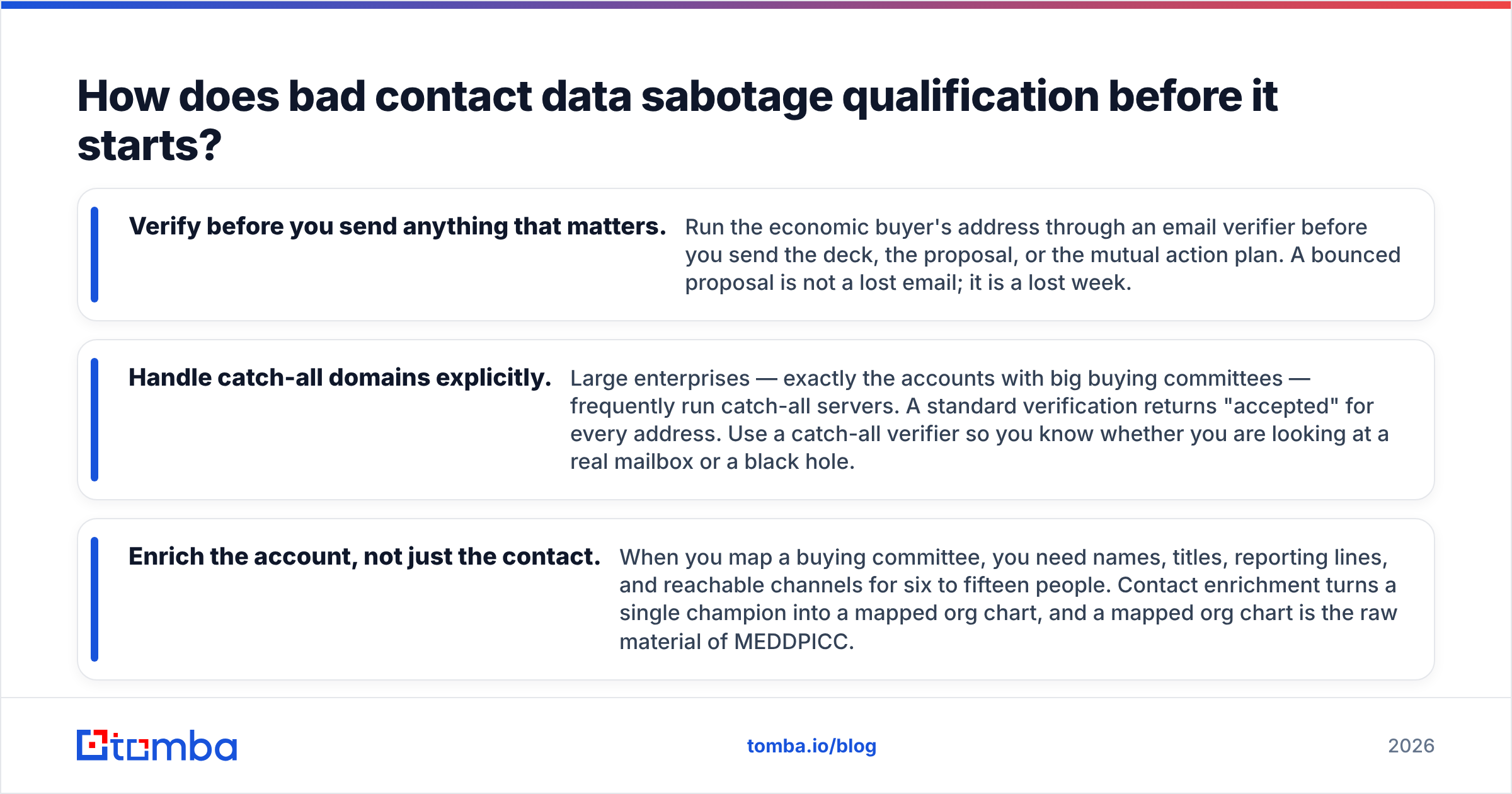
Three practical fixes:
- Verify before you send anything that matters. Run the economic buyer's address through an email verifier before you send the deck, the proposal, or the mutual action plan. A bounced proposal is not a lost email; it is a lost week.
- Handle catch-all domains explicitly. Large enterprises — exactly the accounts with big buying committees — frequently run catch-all servers. A standard verification returns "accepted" for every address. Use a catch-all verifier so you know whether you are looking at a real mailbox or a black hole.
- Enrich the account, not just the contact. When you map a buying committee, you need names, titles, reporting lines, and reachable channels for six to fifteen people. Contact enrichment turns a single champion into a mapped org chart, and a mapped org chart is the raw material of MEDDPICC.
When the deal stalls in email, escalate channel rather than volume. A B2B phone number for the economic buyer is worth more than four follow-up emails to an address you never confirmed.

How do you run a qualification call without interrogating the buyer?#
Trade information. Every question you ask should be preceded or followed by something the buyer did not know.
Bad: "What's your budget for this?" Better: "Companies your size usually land between $40k and $70k a year on this, depending on seat count. Does that range fit what you've set aside, or should we look at a narrower scope?"
You just gave them a benchmark, which is useful to them, and you extracted a budget signal, which is useful to you. Do that six times in a call and the buyer experiences it as consulting rather than screening.
A few mechanics that make this work:
- Ask about the last purchase, not the next one. "Walk me through how you bought your current CRM" produces an accurate decision process. "How will you decide?" produces an aspirational one.
- Use negative framing to test priority. "It sounds like this is important but not urgent — is that fair?" A real champion will push back hard. A polite non-buyer will agree with you and you have saved yourself two months.
- Get the mutual action plan in writing after the second call. The plan is a qualification instrument: a buyer who will not co-edit a timeline is telling you something.
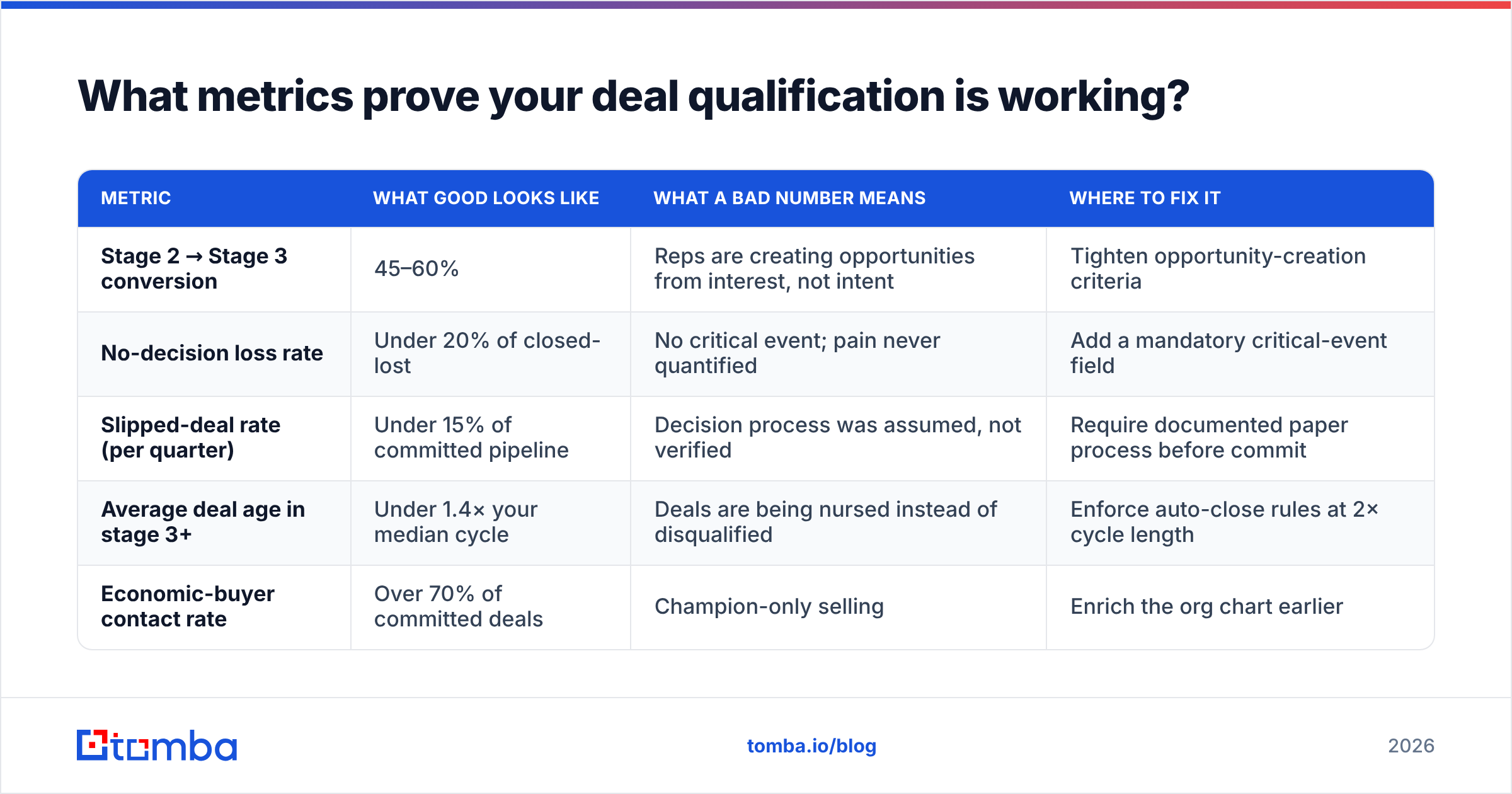
What metrics prove your deal qualification is working?#
Pipeline coverage is the metric everyone reports and the one that tells you least. These are the four that actually move.
| Metric | What good looks like | What a bad number means | Where to fix it |
|---|---|---|---|
| Stage 2 → Stage 3 conversion | 45–60% | Reps are creating opportunities from interest, not intent | Tighten opportunity-creation criteria |
| No-decision loss rate | Under 20% of closed-lost | No critical event; pain never quantified | Add a mandatory critical-event field |
| Slipped-deal rate (per quarter) | Under 15% of committed pipeline | Decision process was assumed, not verified | Require documented paper process before commit |
| Average deal age in stage 3+ | Under 1.4× your median cycle | Deals are being nursed instead of disqualified | Enforce auto-close rules at 2× cycle length |
| Economic-buyer contact rate | Over 70% of committed deals | Champion-only selling | Enrich the org chart earlier |
Track these by rep and by segment. Qualification problems are rarely uniform — they usually cluster in one segment where the buying process changed and the playbook did not.
For a broader view of how these roll up into forecasting hygiene, Salesforce's sales resources cover the reporting side well, and the same discipline applies whether you run Salesforce or HubSpot.
What are the most common deal qualification mistakes?#
- Qualifying once and never again. A deal qualified in January can be dead in March because the champion left. Re-qualify at every stage gate.
- Confusing enthusiasm with authority. The most excited person on the call is frequently the person with the least budget control.
- Treating the framework as a report card. Reps who fill in MEDDPICC fields the night before a pipeline review are producing fiction for their manager, not intelligence for themselves.
- Refusing to ask uncomfortable questions. "What happens if you do nothing?" feels rude. It is the single most diagnostic question in B2B sales.
- Building the committee map from LinkedIn alone. Titles on LinkedIn lag reality by months. Verify reachability before you build strategy on top of a name.
Where should you start this week?#
Pick your ten largest open opportunities. For each one, write a single sentence for the five conditions in the section above — quantified pain, economic buyer you have spoken to, documented decision process, dated critical event, known competition. You will not be able to complete the exercise for three or four of them. Those are your disqualification candidates, and the hours you recover from them are the cheapest capacity you will find all quarter.
Then fix the upstream half. If the reason you never reached an economic buyer is that you never had a reliable address for them, no framework will save the deal. The Tomba Email Finder resolves verified, deliverable addresses by name and company domain so your buying-committee map is built on contacts that actually receive mail — start on the free tier at 25 searches a month, or move to the $49/mo Starter plan when you are mapping committees at scale. Full Tomba pricing is straightforward, and the same data flows into your CRM through the standard integrations. Qualify with better information, and disqualify without guilt.
Related guides#
Ready to find emails that actually work?
Join 150,000+ professionals who stopped guessing and started sending. Free credits on signup — no credit card required.
Get the Tomba newsletter
Practical outbound tactics and product updates — once every two weeks.
About the author