Deal Qualification Framework: How to Score Pipeline in 2026
BANT, MEDDPICC, SPICED, or a custom scorecard? A neutral breakdown of every deal qualification framework, when each one breaks, and how to pick the right fit for your motion.
TL;DR
- A deal qualification framework is a repeatable scorecard that decides which opportunities get your time — not a form your reps fill in after the fact to keep the CRM tidy.
- BANT is fastest and weakest. MEDDPICC is strongest and slowest. SPICED sits in the middle and travels well for product-led and mid-market motions.
- Framework choice should follow deal size and buying-committee size, not team preference. Under $10K ACV with one decision maker, MEDDPICC is overhead. Over $100K with seven stakeholders, BANT is negligence.
- The failure mode is almost never the framework. It's unverified fields — a champion nobody confirmed, a budget nobody sourced, an economic buyer nobody has met.
- Qualification starts before the first call. If your contact data is wrong, you're qualifying a fictional account.
What is a deal qualification framework?#
A deal qualification framework is a fixed set of criteria you apply to every opportunity to decide whether it deserves continued investment, and what has to be true before it advances.
Think of it like a pre-flight checklist. A pilot doesn't skip the flap check because the weather looks fine. The checklist exists precisely because confidence is the least reliable signal in the cockpit. Sales works the same way: reps feel great about deals that die, and lukewarm about deals that close. The framework replaces feel with evidence.
Technically, a qualification framework does three jobs:
- Defines what "qualified" means in criteria a second person could verify independently.
- Attaches evidence requirements — not "budget: yes" but "CFO confirmed $80K allocated in Q3 budget line, per email dated May 4."
- Triggers a decision — advance, hold, or disqualify. A framework that never disqualifies anything is a data-entry ritual.
That third job is where most teams quietly fail. According to Gartner's B2B buying research, the typical enterprise buying group now involves six to ten decision makers, each carrying four or five independently gathered pieces of information. A framework that captures one contact's opinion is measuring a fraction of the actual decision.
Which deal qualification frameworks actually matter in 2026?#
Five frameworks cover roughly everything in use. The rest are rebrands.
BANT — Budget, Authority, Need, Timeline. Born at IBM in the 1960s. Fast, shallow, still the default in high-volume SMB motions.
MEDDPICC — Metrics, Economic buyer, Decision criteria, Decision process, Paper process, Identify pain, Champion, Competition. Built at PTC, popularized across enterprise SaaS. Eight fields, heavy, extremely effective on complex deals.
SPICED — Situation, Pain, Impact, Critical event, Decision. Developed by Winning by Design for recurring-revenue businesses. Customer-centric phrasing, works across the full lifecycle including renewal.
CHAMP — Challenges, Authority, Money, Prioritization. BANT reordered to lead with the problem rather than the wallet. A reasonable upgrade if your team refuses to abandon BANT.
GPCTBA/C&I — Goals, Plans, Challenges, Timeline, Budget, Authority, Consequences & Implications. HubSpot's inbound-era framework. Strong for consultative sales, verbose in practice.
How do the frameworks compare head to head?#
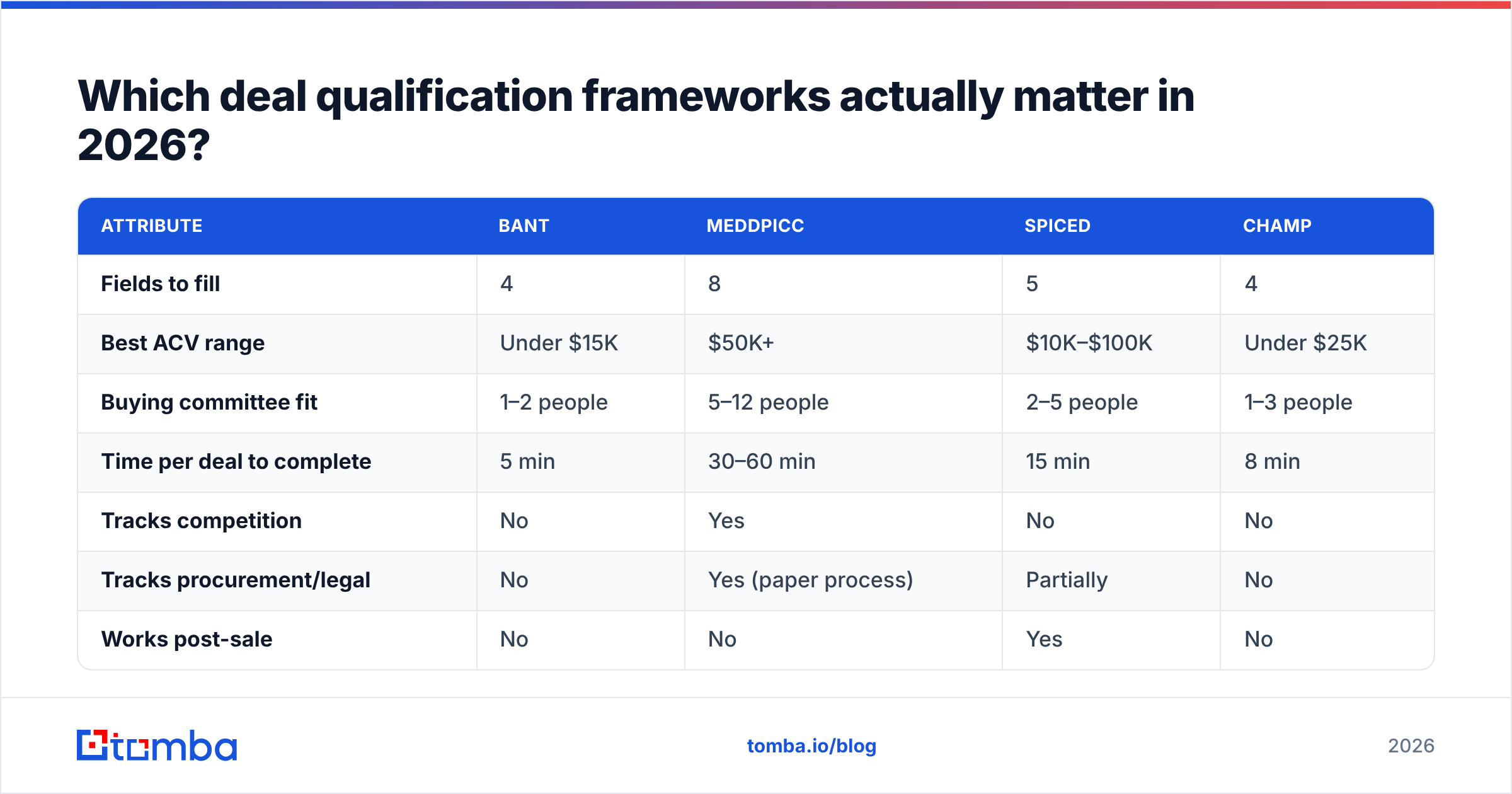
| Attribute | BANT | MEDDPICC | SPICED | CHAMP |
|---|---|---|---|---|
| Fields to fill | 4 | 8 | 5 | 4 |
| Best ACV range | Under $15K | $50K+ | $10K–$100K | Under $25K |
| Buying committee fit | 1–2 people | 5–12 people | 2–5 people | 1–3 people |
| Time per deal to complete | 5 min | 30–60 min | 15 min | 8 min |
| Tracks competition | No | Yes | No | No |
| Tracks procurement/legal | No | Yes (paper process) | Partially | No |
| Works post-sale | No | No | Yes | No |
| Rep adoption difficulty | Low | High | Medium | Low |
| Biggest weakness | Seller-centric, misses pain | Slows velocity, easily faked | Vague on budget | Still budget-first |
The table hides one thing worth stating directly: MEDDPICC's advantage is not the eight fields. It's that two of them — Champion and Economic Buyer — force you to name specific humans. Every other framework lets a rep write "VP of Ops" and move on. MEDDPICC makes that a person with a name, a motivation, and a documented conversation.
Is MEDDPICC better than BANT for your team?#
Only if your deals are complex enough to justify the cost. Here's the honest calculus.
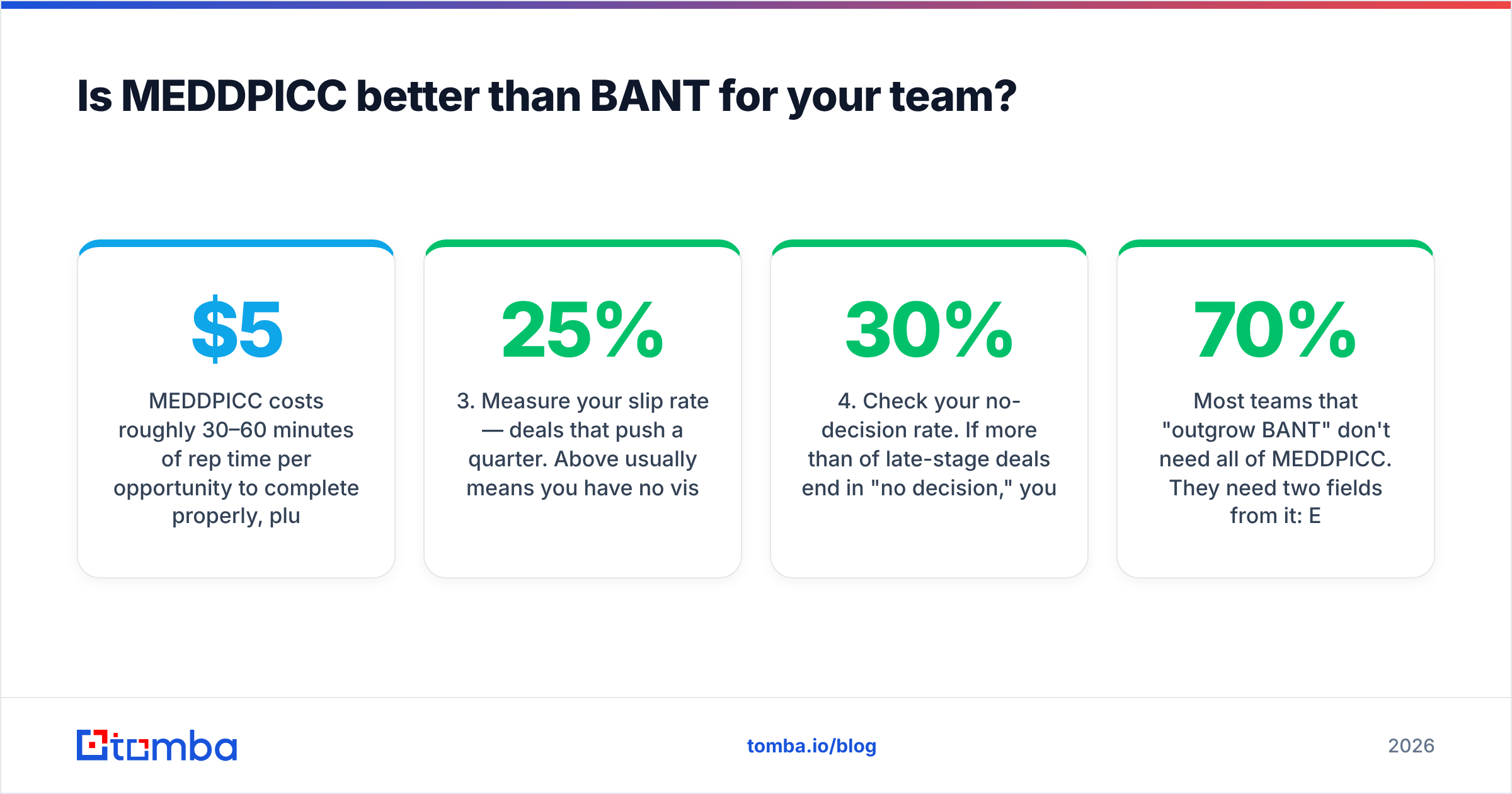
MEDDPICC costs roughly 30–60 minutes of rep time per opportunity to complete properly, plus ongoing updates. On a $5,000 deal with a 20% win rate, that's an absurd unit economic. On a $150,000 deal, it's the cheapest insurance you'll ever buy.
Run this test on your own numbers:
- Calculate your average sales cycle in days. Under 30 days, heavy frameworks create more drag than value.
- Count your average number of stakeholders per closed-won deal. Pull it from calendar invites and email threads, not from rep memory. Three or fewer means BANT or CHAMP is fine.
- Measure your slip rate — deals that push a quarter. Above 25% usually means you have no visibility into decision process or paper process, which is a MEDDPICC-shaped hole.
- Check your no-decision rate. If more than 30% of late-stage deals end in "no decision," you're qualifying interest, not pain. That's a SPICED-shaped hole.
- Look at your competitive loss rate. If you frequently discover competitors at the eleventh hour, the missing field is literally "C" in MEDDPICC.
- Audit ten closed-lost deals for which qualification field was blank or wrong at Stage 2. The pattern in those ten is your answer.
Most teams that "outgrow BANT" don't need all of MEDDPICC. They need two fields from it: Economic Buyer and Decision Process. Adding those to BANT gets you 70% of the benefit at 20% of the cost. Vendors selling MEDDPICC training won't tell you that.
What does a qualification scorecard look like in practice?#
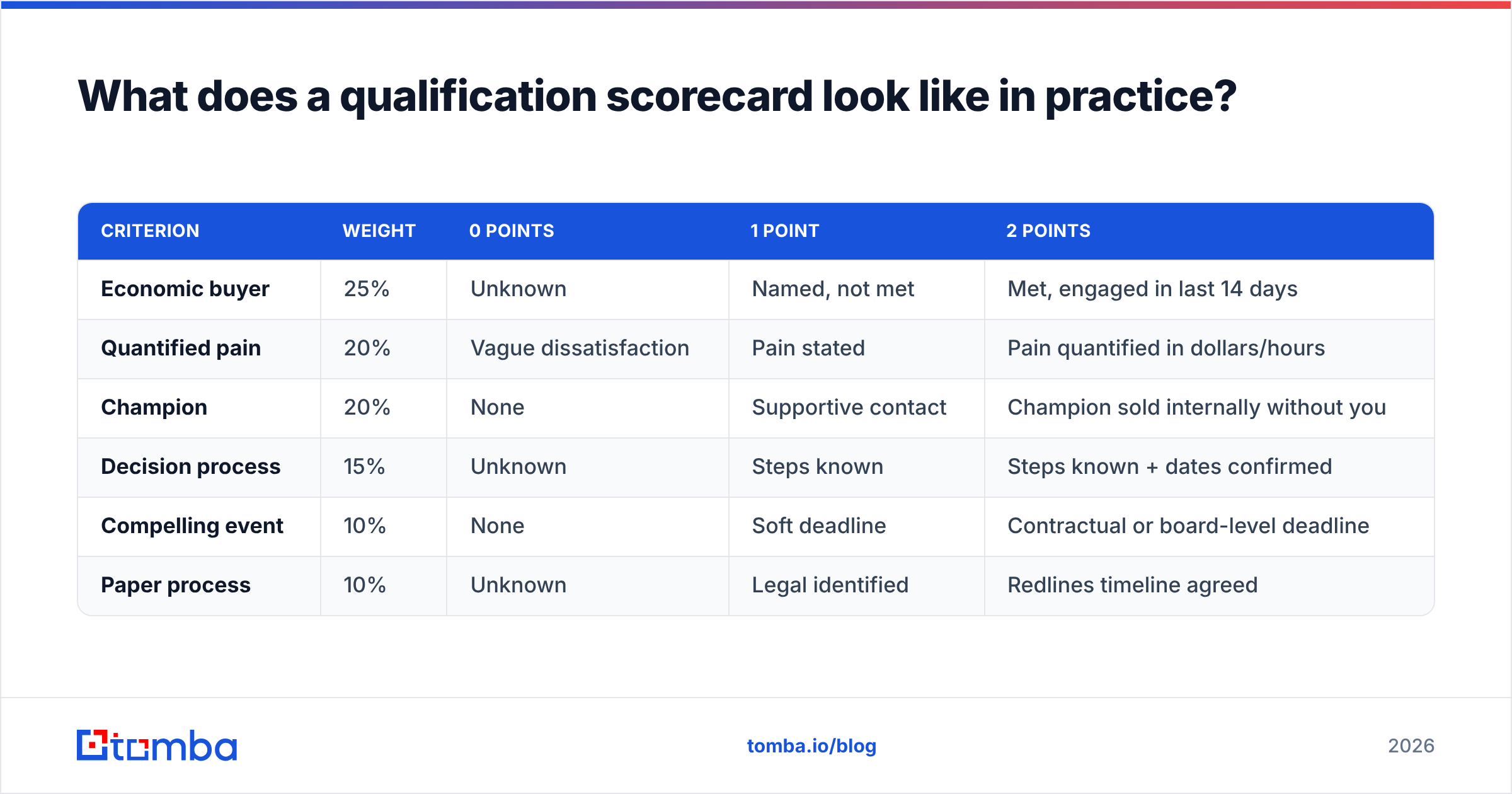
A framework without scoring is a checklist. A scorecard turns it into a forecast input.
| Criterion | Weight | 0 points | 1 point | 2 points |
|---|---|---|---|---|
| Economic buyer | 25% | Unknown | Named, not met | Met, engaged in last 14 days |
| Quantified pain | 20% | Vague dissatisfaction | Pain stated | Pain quantified in dollars/hours |
| Champion | 20% | None | Supportive contact | Champion sold internally without you |
| Decision process | 15% | Unknown | Steps known | Steps known + dates confirmed |
| Compelling event | 10% | None | Soft deadline | Contractual or board-level deadline |
| Paper process | 10% | Unknown | Legal identified | Redlines timeline agreed |
Score under 4 and the deal is unqualified regardless of how the call felt. Score 4–7 and it's a working opportunity. Score 8+ and it belongs in commit.
The weights matter less than the discipline of two-point criteria requiring evidence. "Met, engaged in the last 14 days" is checkable by a manager in the CRM activity log. "Buyer seems bought in" is not checkable by anyone.
Note the compelling-event row. Forrester's B2B buyer research has consistently shown that purchase decisions cluster around triggering events — funding, leadership change, compliance deadlines, system end-of-life. A deal with no compelling event isn't a slow deal. It's usually a no-decision deal that hasn't admitted it yet.
How do you qualify before the first conversation?#
This is the step most frameworks skip entirely, and it's where the most waste happens.
Every framework above assumes you're already on a call with a real person at a real company. Getting there is its own qualification layer, and it's mostly a data problem. If your prospect list is built from stale exports, half your "qualification" work is happening against contacts who left the company eight months ago.
Pre-call qualification has three checkpoints:
- Account fit. Does the company match your ICP on headcount, tech stack, funding stage, and geography? Firmographic mismatch is the cheapest disqualification available — it costs zero rep minutes.
- Contact validity. Is the person still there, and does the address route? A verified email before outreach protects deliverability and prevents you from building a pipeline of ghosts. Bounces don't just waste sends; they degrade sender reputation for every future campaign.
- Role relevance. Are you contacting someone who can plausibly be your champion, or someone three levels below the buying committee? This determines whether MEDDPICC's Champion field will ever get filled.
For that first checkpoint, a domain search across the target account tells you the shape of the org before you spend a discovery call learning it — who's in the function you sell to, what the email pattern is, and whether the company is big enough to have a procurement process at all. Layering in data enrichment on the accounts that pass gives you headcount, tech signals, and role titles to score against your ICP.
Why do qualification frameworks fail?#
They fail in four predictable ways, and none of them are the framework's fault.
1. Fields get filled, not verified. A rep writes "Budget: $75K approved." Nobody asks who approved it, when, or in which fiscal period. The field is green in the CRM and fictional in reality. Fix: every qualification field requires a source — a person, a date, and a quote or artifact.
2. The framework only runs once. Qualification happens at Stage 2 and never again. But an economic buyer can leave, a compelling event can slip, a competitor can appear in week six. Fix: re-score at every stage gate, and treat a score that drops as a forecast event, not an admin update.
3. Managers coach the score, not the deal. Pipeline review becomes an audit of field completeness. Reps learn to write whatever turns the field green. Fix: in reviews, ask for the evidence behind one field chosen at random, not for the whole scorecard.
4. Nothing ever gets disqualified. If your disqualification rate at Stage 2 is under 20%, your framework isn't filtering anything. A healthy qualification process kills deals early and loudly. That's the entire point — protecting rep capacity for winnable opportunities.
There's a fifth failure worth its own mention: qualifying against the wrong unit. Reps qualify a person when they should qualify an account. One enthusiastic manager does not equal an account with pain. This is why MQL scoring and deal qualification are different disciplines and shouldn't share a scorecard.
How do you roll out a framework without killing velocity?#
Roll it out narrow, then widen. A full-team MEDDPICC rollout with mandatory fields on day one produces the exact behavior you're trying to prevent: reps typing plausible fiction into required boxes.
A sequence that works:
- Week 1 — Pick two fields. Not eight. Whichever two your closed-lost audit flagged. Usually Economic Buyer and Compelling Event.
- Week 2–4 — Make them optional but reviewed. Managers ask about those two fields in every pipeline review. No CRM enforcement yet.
- Week 5 — Add evidence requirements. The field now needs a name and a date, not a yes.
- Week 6–8 — Score and rank. Publish a weekly list of deals sorted by qualification score. Let reps see their own deals ranked next to peers'.
- Week 9+ — Add fields one at a time, only when the prior field shows clean data for three consecutive weeks.
This takes a quarter. Teams that do it in a week end up with a compliance theater problem that takes two quarters to unwind.
Also worth deciding upfront: where the framework lives. If it's a separate spreadsheet, it's dead in six weeks. It needs to be fields on the opportunity record in your CRM, visible on the deal view, feeding the forecast rollup. Anything else is optional homework, and optional homework doesn't get done in a quarter-end scramble.
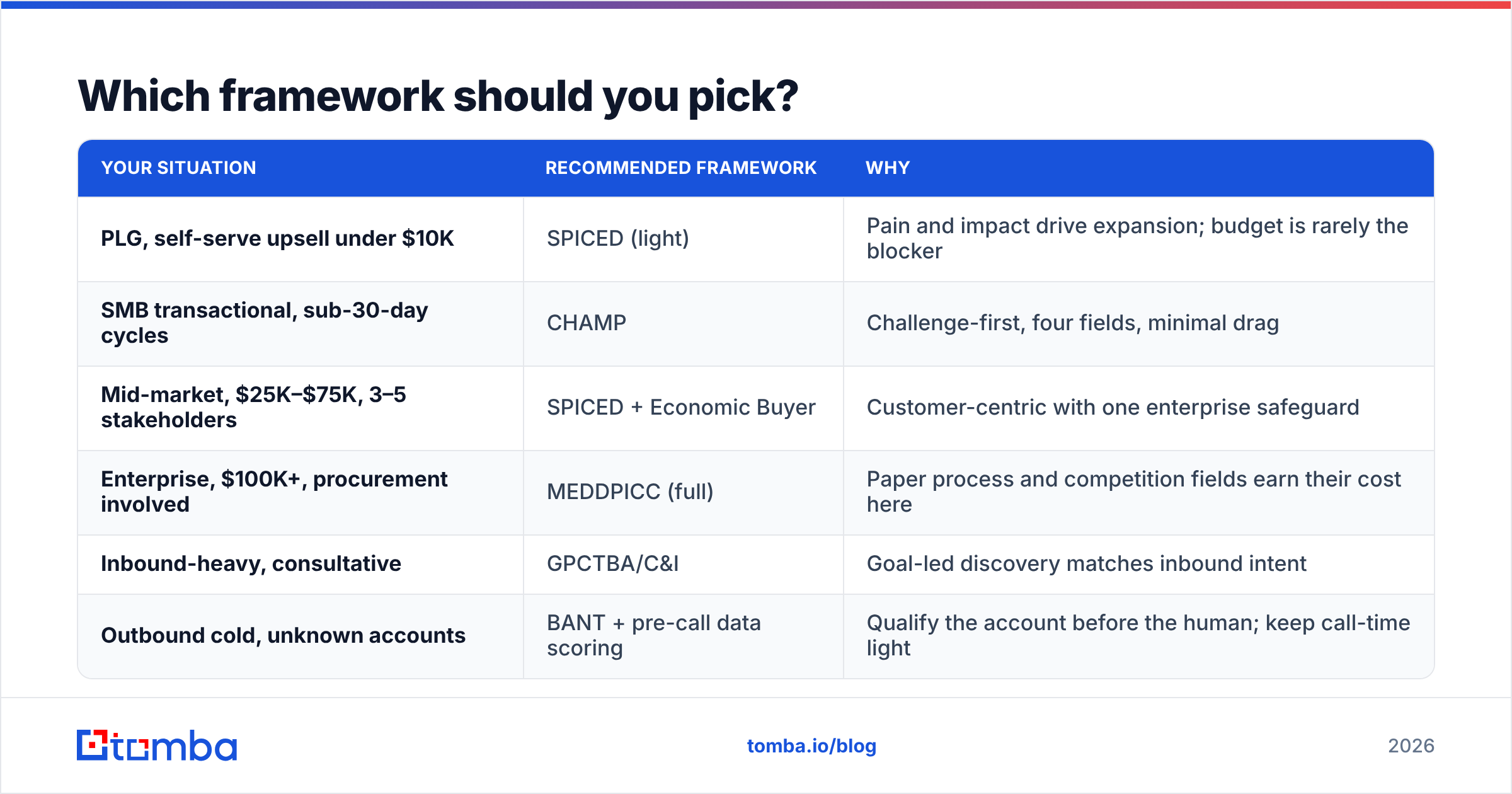
Which framework should you pick?#
Match it to your motion, not your ambition.
| Your situation | Recommended framework | Why |
|---|---|---|
| PLG, self-serve upsell under $10K | SPICED (light) | Pain and impact drive expansion; budget is rarely the blocker |
| SMB transactional, sub-30-day cycles | CHAMP | Challenge-first, four fields, minimal drag |
| Mid-market, $25K–$75K, 3–5 stakeholders | SPICED + Economic Buyer | Customer-centric with one enterprise safeguard |
| Enterprise, $100K+, procurement involved | MEDDPICC (full) | Paper process and competition fields earn their cost here |
| Inbound-heavy, consultative | GPCTBA/C&I | Goal-led discovery matches inbound intent |
| Outbound cold, unknown accounts | BANT + pre-call data scoring | Qualify the account before the human; keep call-time light |
Notice the last row. For pure outbound, the framework applied on the call matters less than the filtering applied before it. A rep working a well-scored account list with BANT will outperform a rep running full MEDDPICC against a list of stale contacts. Garbage in, MEDDPICC out.
One practical note on tooling: comparison shopping for qualification software is largely a waste. Check the sales intelligence and CRM categories on G2 if you must, but the framework is a process artifact. It runs fine in native Salesforce or HubSpot fields. Spend the budget on data quality instead — that's the input that actually moves win rate.
What should you measure to know it's working?#
Four metrics, tracked monthly:
- Stage 2 disqualification rate. Target 20–35%. Below that, you're not filtering. Above 50%, your top-of-funnel targeting is broken.
- Slip rate. Deals pushed past their forecast close date. A working framework with a Decision Process field should drop this by a third within two quarters.
- No-decision rate as a share of losses. If competitor losses go up and no-decision losses go down, your qualification is working — you're now losing to rivals instead of to inertia, which is a much better problem.
- Forecast accuracy at the 8+ score band. Deals your scorecard calls "commit" should close at 75%+ or your weights are wrong. Recalibrate quarterly.
Track win rate alongside these, but don't use it as the primary signal. Win rate moves for a dozen reasons. Disqualification rate and slip rate move almost exclusively because of qualification discipline, which makes them cleaner instruments.
Where does the data layer fit?#
Underneath every framework is one assumption: the people in your CRM are real, reachable, and currently employed at the account. When that assumption breaks, every downstream field is fiction — you can't verify an economic buyer at an address that bounces.
That's the layer worth investing in first. Tomba's Email Finder resolves verified work addresses for the specific roles your framework requires you to name — the economic buyer, the champion, the procurement contact — so your qualification fields point at people who exist rather than at job titles you assumed. Start on the free tier at 25 searches a month, or check Tomba pricing if you're running a full outbound motion; Starter runs $49/mo and Growth $99/mo with bulk and API access for teams enriching account lists at scale.
Pick your framework this week. Fix your contact data first.
Related guides#
Ready to find emails that actually work?
Join 150,000+ professionals who stopped guessing and started sending. Free credits on signup — no credit card required.
Get the Tomba newsletter
Practical outbound tactics and product updates — once every two weeks.
About the author