Deal Qualification Questions: 40 That Actually Predict Wins
Most reps ask qualification questions that confirm what they already hope is true. Here are 40 deal qualification questions that surface the budget, authority, and timeline truth early enough to act on.
TL;DR
- Most deal qualification questions fail because they ask for confirmation ("Is this a priority?") instead of evidence ("What did you deprioritize to fund this?").
- Your biggest competitor is not another vendor. It's no-decision, which eats 40–60% of forecasted pipeline in most B2B teams.
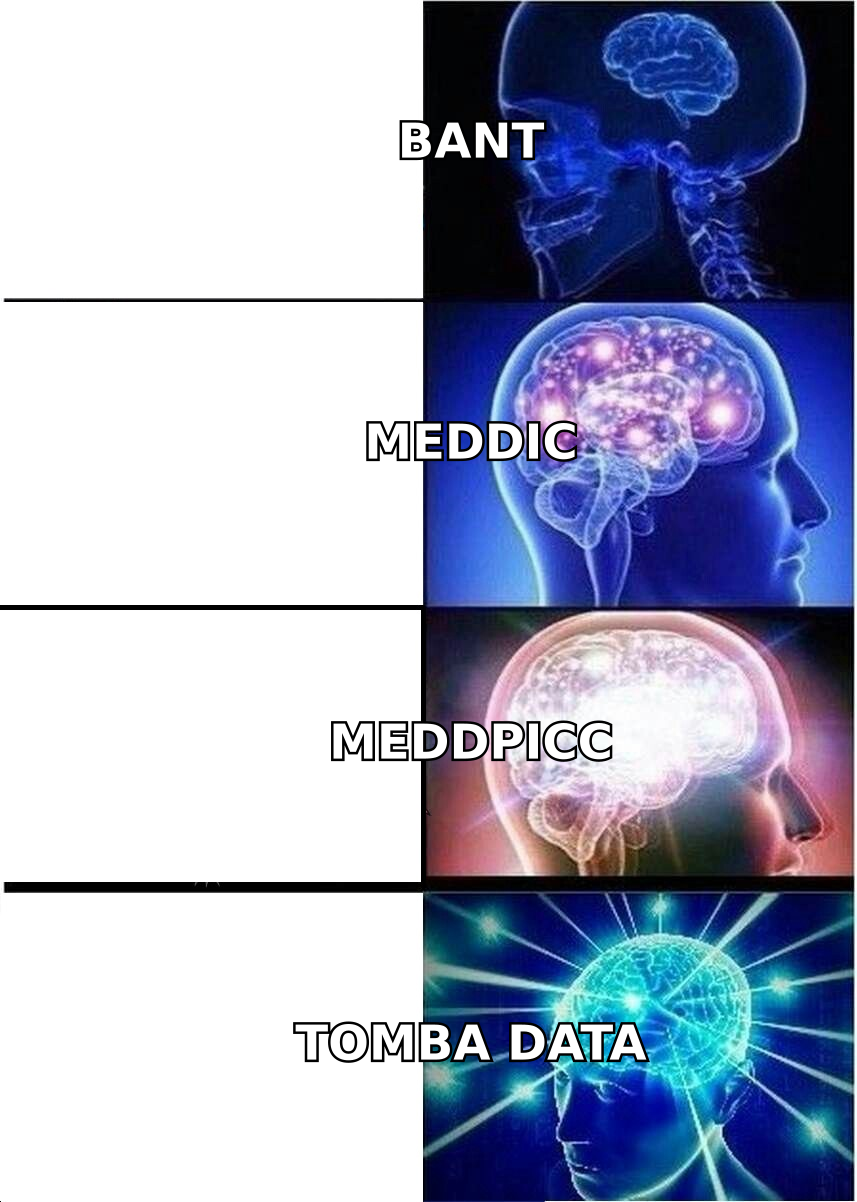
- BANT, MEDDPICC, SPICED, and Command of the Message all work — they just answer different questions. Pick one per motion, not one per rep.
- Qualification is a data problem before it's a conversation problem. If you're talking to the wrong contact at the wrong company, no question sequence saves you.
- Score every deal on five evidence-based dimensions and force a disqualification rate. A pipeline where nothing dies is a pipeline that lies.
Why do most deal qualification questions fail?#
Because they're written to be answered "yes."
Ask a prospect "Is solving this a priority for you this quarter?" and you'll get a yes roughly every time. People are polite. They're also on a call they agreed to, which means they've already decided to be agreeable for 30 minutes. That yes costs you nothing to collect and tells you nothing about whether money will move.
The pattern that separates useful deal qualification questions from theater is simple: useful questions request evidence that already exists in the world. Not opinions about the future.
Compare these two:
- Weak: "Do you have budget for this?"
- Strong: "Walk me through how the last tool in this category got funded — who signed, and how long from first call to signature?"
The second question can't be answered with a reflex. It either produces a specific story (great signal) or exposes that no such story exists (also great signal, just the opposite direction). Either way you learn something you can put in the CRM and defend in a forecast call.
The other structural failure: reps qualify the person, not the deal. Your champion can be enthusiastic, well-informed, and completely powerless. Qualification has to test the organization's ability to buy, not one human's willingness to like you.
What are the qualification frameworks, and which one should you use?#
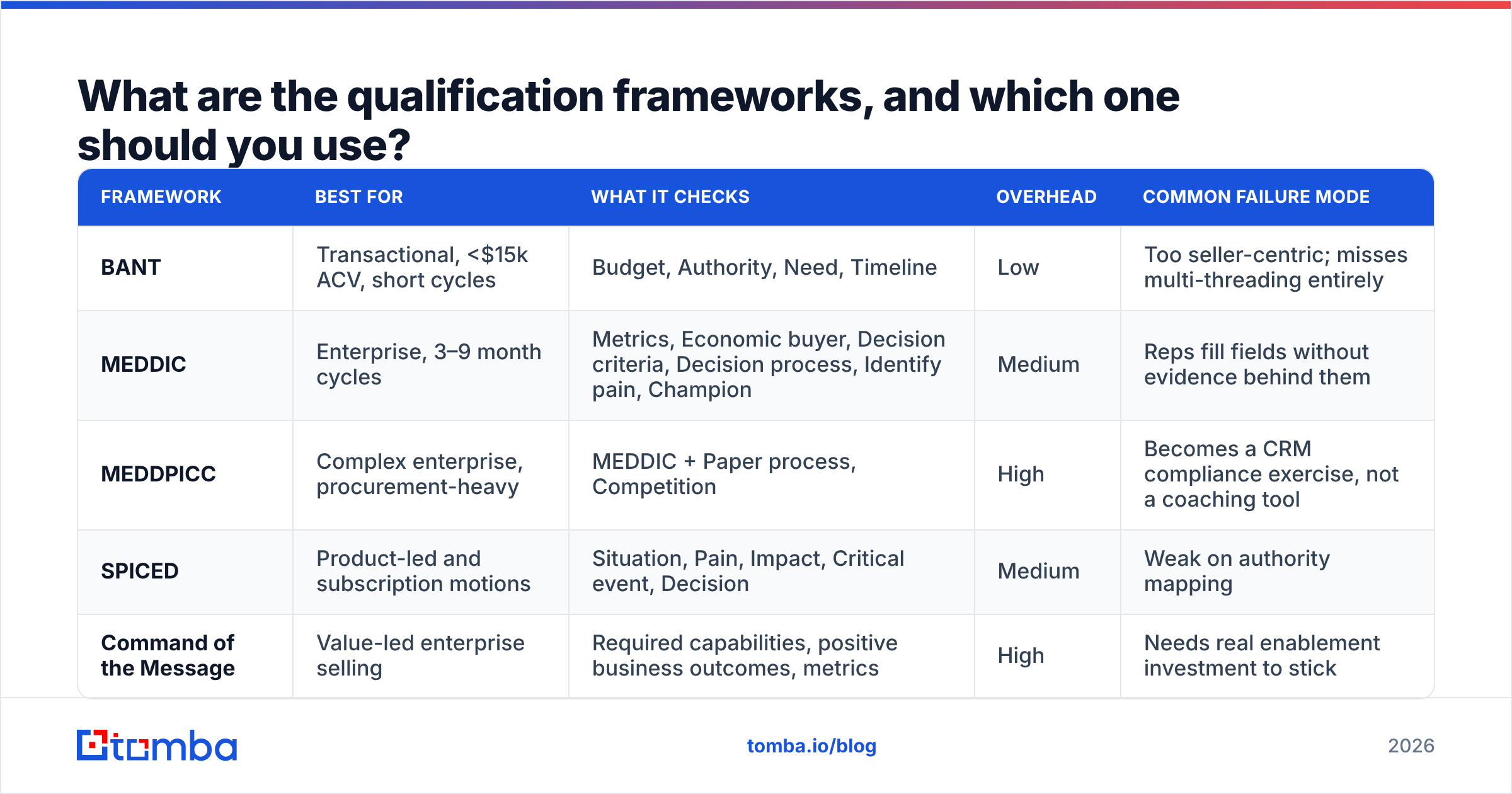
Every framework is a checklist of things that must be true before money moves. They differ in what they emphasize and how much overhead they add.
| Framework | Best for | What it checks | Overhead | Common failure mode |
|---|---|---|---|---|
| BANT | Transactional, <$15k ACV, short cycles | Budget, Authority, Need, Timeline | Low | Too seller-centric; misses multi-threading entirely |
| MEDDIC | Enterprise, 3–9 month cycles | Metrics, Economic buyer, Decision criteria, Decision process, Identify pain, Champion | Medium | Reps fill fields without evidence behind them |
| MEDDPICC | Complex enterprise, procurement-heavy | MEDDIC + Paper process, Competition | High | Becomes a CRM compliance exercise, not a coaching tool |
| SPICED | Product-led and subscription motions | Situation, Pain, Impact, Critical event, Decision | Medium | Weak on authority mapping |
| Command of the Message | Value-led enterprise selling | Required capabilities, positive business outcomes, metrics | High | Needs real enablement investment to stick |
The practical rule: match framework weight to deal weight. A $6k/year deal that closes in 21 days does not need eight MEDDPICC fields. A $400k platform deal with security review, legal redlines, and a procurement portal absolutely needs the paper-process field, because that's where those deals go to die quietly in week 11.
One framework per sales motion. If you run SMB self-serve and enterprise field sales out of the same CRM, use two. If your reps are using three because three managers each had a favorite, your data is garbage and your forecast is a vibe.
What are the best deal qualification questions by category?#
Here are the 40, organized by what they're actually testing. Use six to eight per call, not all forty.
Pain and impact (is anything actually broken?)#
- What does this problem cost you in a quarter — in dollars, headcount hours, or churned accounts?
- How are you handling it today, and what breaks about that approach?
- Who feels this pain most acutely, and what do they say about it internally?
- What happens if you do nothing for another six months?
- Has anyone tried to fix this before? What happened to that effort?
- What made you take this call now rather than three months ago?
- On a scale of your top ten priorities this year, where does this sit — and what's number one?
- If I could only fix one part of this, which part would justify the project on its own?
Question 5 is underrated. A failed prior attempt tells you there's real budget history, real internal frustration, and a specific set of objections you'll inherit. A prospect who says "we've never really looked into it" is describing a problem nobody is losing sleep over.
Metrics and business case (will anyone defend this number?)#
- What metric does your leadership review this against?
- What would a good outcome look like numerically at 90 days? At a year?
- Who owns that metric on the org chart?
- What's your current baseline — do you measure it today, or would we need to establish it?
- Has anyone modeled the ROI internally, or would we be building that together?
- What ROI threshold does a project need to clear to get approved here?
If a prospect can't name the metric or the person who owns it, you're selling a nice-to-have. That's not fatal — but it should change your forecast category immediately.
Authority and the buying group (who can actually say yes?)#
- Besides you, who else has to be comfortable with this before it moves?
- Who signs the contract — not who approves it, who signs it?
- Have you personally sponsored a purchase like this before? How did it go?
- What does your CFO or finance partner usually ask about deals in this range?
- Who inside the company would be most skeptical of this, and why?
- What's the best way to get 20 minutes with [economic buyer] — should I request it or would you?
- Is there anyone whose team would be negatively affected by this change?
Question 19 does more work than any other on this list. Every deal has an internal opponent. If your champion can't name one, they either haven't socialized the project or they aren't telling you the truth about their own standing.
Decision process and paper process (how does buying physically work here?)#
- Walk me through the steps between today and a signed agreement.
- What's your security review process, and how long does it typically take?
- Does legal need to review, and do you use your paper or ours?
- Is there a procurement team involved, and do they require competitive bids?
- What's the largest purchase your team made last year, and how long did it take end to end?
- Are there budget freeze periods or fiscal-year boundaries I should plan around?
- What could realistically delay this by a month, and what could delay it by a quarter?
Timeline and compelling event (why now, specifically?)#
- What's driving the timing — a contract renewal, a launch, a headcount change, a compliance deadline?
- What's the consequence of missing that date?
- When does the current contract or workaround expire?
- If we signed next month, when would you actually want to go live?
- Who else is competing for the same budget dollars this quarter?
A compelling event is a date with a consequence attached. "We'd like to have it sorted by Q3" is not a compelling event. "Our Salesforce contract renews October 1 and we need this migrated before then" is.
Competition and alternatives (what are you really up against?)#
- What other approaches are you evaluating, including building it internally?
- What do you like about the alternative you're leaning toward?
- What would have to be true for you to pick us over doing nothing?
- Have you used a tool in this category before? What made you leave it?
- If budget got cut in half, which parts of this would survive?
Champion validation (will this person fight for you?)#
- What would you need from me to make the internal case in your own words?
- If this stalls internally, will you tell me, and can we agree on how we'd restart it?
Question 40 is a commitment test. Champions who agree to it usually honor it. People who deflect are telling you they're gathering information, not building a business case.
How do you score a deal instead of just asking questions?#
Answers without a rubric are just notes. Convert them into a score your manager can challenge.
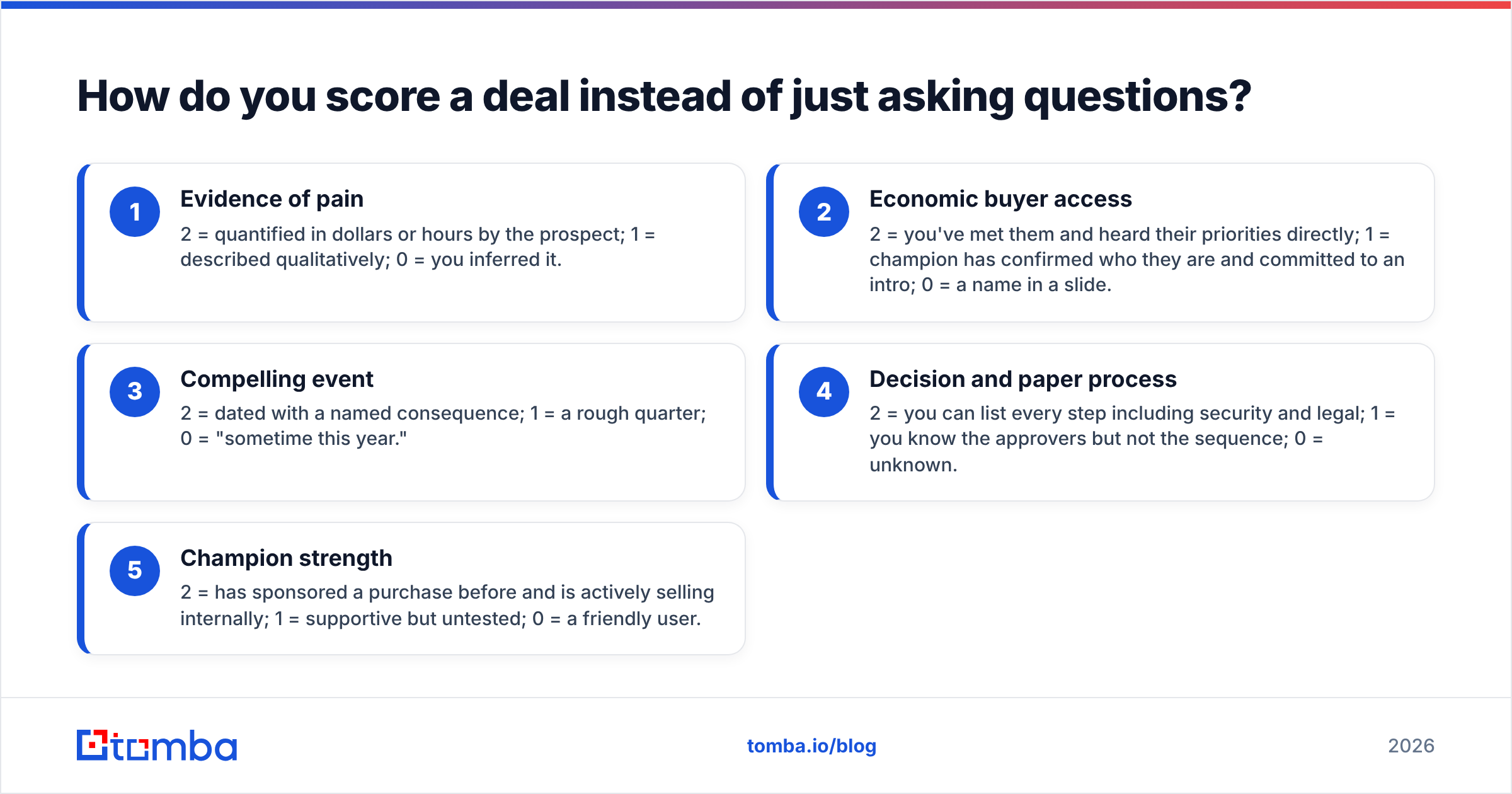
Use five dimensions, 0–2 points each, for a 10-point scale:
- Evidence of pain — 2 = quantified in dollars or hours by the prospect; 1 = described qualitatively; 0 = you inferred it.
- Economic buyer access — 2 = you've met them and heard their priorities directly; 1 = champion has confirmed who they are and committed to an intro; 0 = a name in a slide.
- Compelling event — 2 = dated with a named consequence; 1 = a rough quarter; 0 = "sometime this year."
- Decision and paper process — 2 = you can list every step including security and legal; 1 = you know the approvers but not the sequence; 0 = unknown.
- Champion strength — 2 = has sponsored a purchase before and is actively selling internally; 1 = supportive but untested; 0 = a friendly user.
Then set hard rules. Anything under 5 doesn't enter the forecast. Anything under 3 after two meetings gets disqualified or moved to nurture. Deals with a 0 on economic buyer access can't be called "commit" no matter how good the demo went.
The number that matters most isn't the average score. It's your disqualification rate. Healthy outbound teams disqualify 30–50% of first meetings. If yours is near zero, your reps are hoarding, your pipeline coverage is fictional, and your forecast accuracy is going to look like a random walk. Gartner's research on B2B buying has consistently found that buying groups now include 6–10 stakeholders — which means a single-threaded deal with one enthusiastic contact is a structurally weak deal regardless of how the questions went.
Where does data quality fit into qualification?#
Upstream of everything, and it's the part most teams skip.
Here's the failure sequence: a rep books 20 meetings, asks excellent deal qualification questions, and disqualifies 16 of them. Great discipline — except 11 of those 16 were companies that never fit the ICP, or contacts three levels below anyone who could sign. That rep burned three weeks learning something a data layer should have told them before the first email.
Qualification and prospecting data are the same job separated by time. The tighter your targeting, the fewer questions you need to ask, because more of the answers are already known:
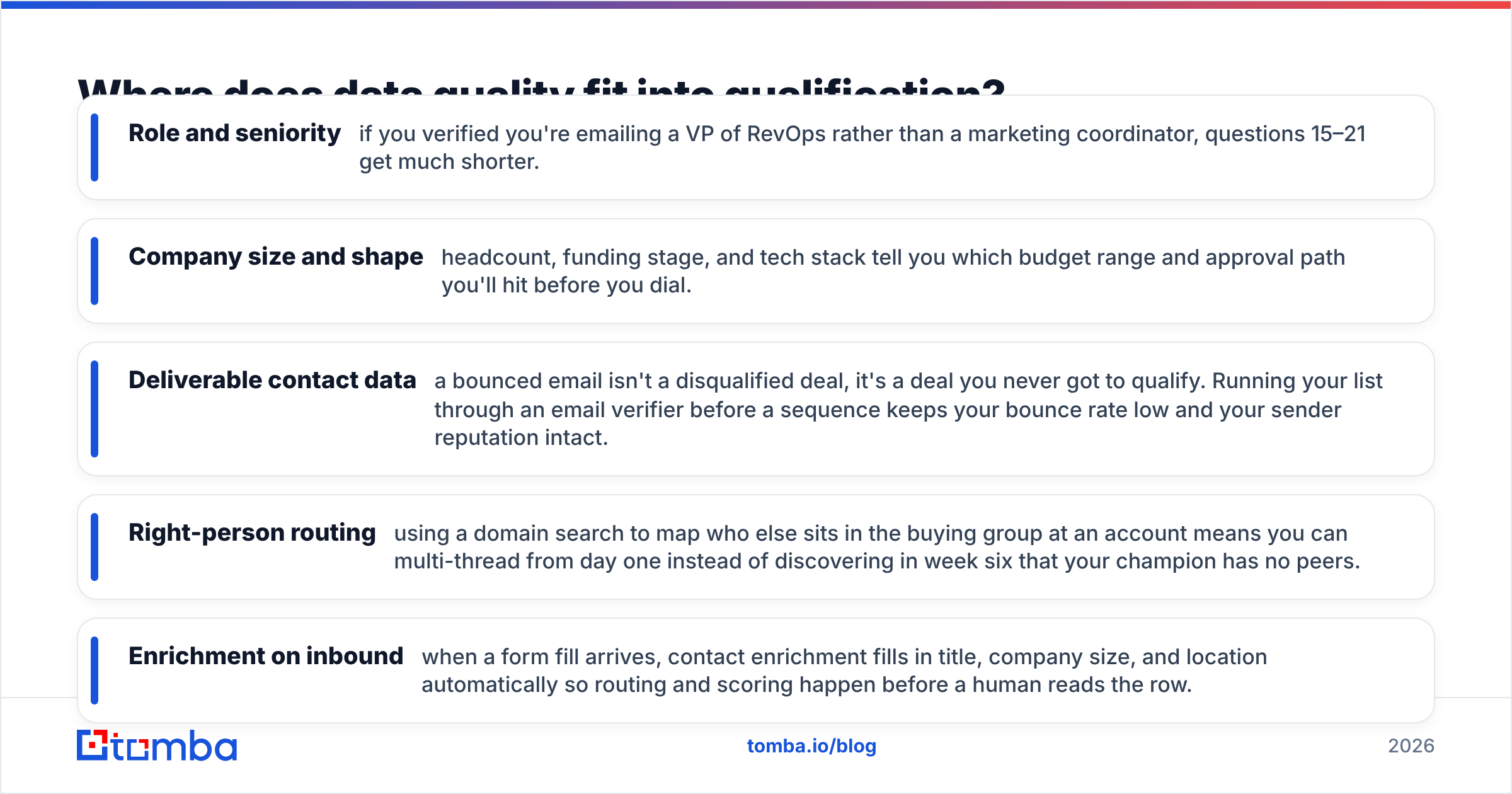
- Role and seniority — if you verified you're emailing a VP of RevOps rather than a marketing coordinator, questions 15–21 get much shorter.
- Company size and shape — headcount, funding stage, and tech stack tell you which budget range and approval path you'll hit before you dial.
- Deliverable contact data — a bounced email isn't a disqualified deal, it's a deal you never got to qualify. Running your list through an email verifier before a sequence keeps your bounce rate low and your sender reputation intact.
- Right-person routing — using a domain search to map who else sits in the buying group at an account means you can multi-thread from day one instead of discovering in week six that your champion has no peers.
- Enrichment on inbound — when a form fill arrives, contact enrichment fills in title, company size, and location automatically so routing and scoring happen before a human reads the row.

Think of it like a restaurant kitchen. Qualification questions are the cooking. Data quality is whether the ingredients that arrived at the back door are what you ordered. No amount of technique fixes a delivery of the wrong protein.
Peer tools in this space handle the ingredient problem differently. BookYourData leans on a large pre-built, pay-as-you-go contact database, which suits teams who want a bulk list they own outright; Tomba leans on live search and verification against source data, which suits teams building lists continuously per account. Both are legitimate approaches — the choice depends on whether your motion is list-first or account-first.
How should you run qualification across the deal cycle?#
Qualification is not a stage. It's a continuous test that gets re-run every meeting.
First call (discovery): questions 1–8 and 29–31. You're testing whether a real problem exists and whether anything forces a decision. Don't ask about budget yet — you haven't earned the answer and you'll get a defensive one.
Second call (business case): questions 9–14 and 34–38. Now you're building the number your champion will defend and finding out who you're really competing with, including inertia.
Third call (buying group): questions 15–21 and 22–28. This is where most deals silently break. If you can't get past your original contact by the third meeting, that's the finding — treat it as data, not as a scheduling problem.
Ongoing: re-ask questions 28 and 40 at every stage change. Timelines move, sponsors get reorganized, and priorities shift. A deal qualified in March on a Q2 compelling event is unqualified in May if that event slipped.
One coaching mechanic that works: in pipeline reviews, ask reps to quote the prospect's actual words for each rubric dimension. Not a summary — the quote. Reps who can't produce a quote didn't ask the question, and now everyone knows it without an argument. HubSpot's sales qualification resources make a similar point about documenting answers verbatim rather than paraphrasing them into optimism.
What are the most common qualification mistakes?#
- Interrogating instead of diagnosing. Forty questions in a row is a deposition. Six questions with real follow-ups is discovery. Follow-ups are where the truth lives: "You said it costs about 15 hours a week — whose hours?"
- Accepting the first answer on budget. "We have budget" means someone said a number out loud once. "The $80k is in the Q3 plan under Sarah's line item, approved in the March planning cycle" means budget.
- Confusing interest with intent. Downloading three whitepapers is interest. Assigning an internal project owner is intent. Score accordingly in your lead scoring model.
- Single-threading. One contact means one point of failure. When they change jobs — and roughly a fifth of B2B contacts change roles annually — the deal dies with their inbox.
- Never disqualifying. A pipeline that only grows is a pipeline nobody trusts. Set a target disqualification rate and review it like any other metric.
- Treating qualification as a rep skill only. If your RevOps layer doesn't enforce the rubric in the CRM, the discipline evaporates the first busy quarter.
What's the fastest way to improve qualification this quarter?#
Pick three changes, not ten:
- Add a compelling-event field to your CRM with a required date and a required consequence. Deals without both can't advance past your mid-stage.
- Institute a "quote the prospect" rule in pipeline review. One quarter of this changes rep behavior more than a training day.
- Fix the data upstream. Verify contacts before sequencing, enrich inbound leads on arrival, and map at least three contacts per target account before the first meeting.
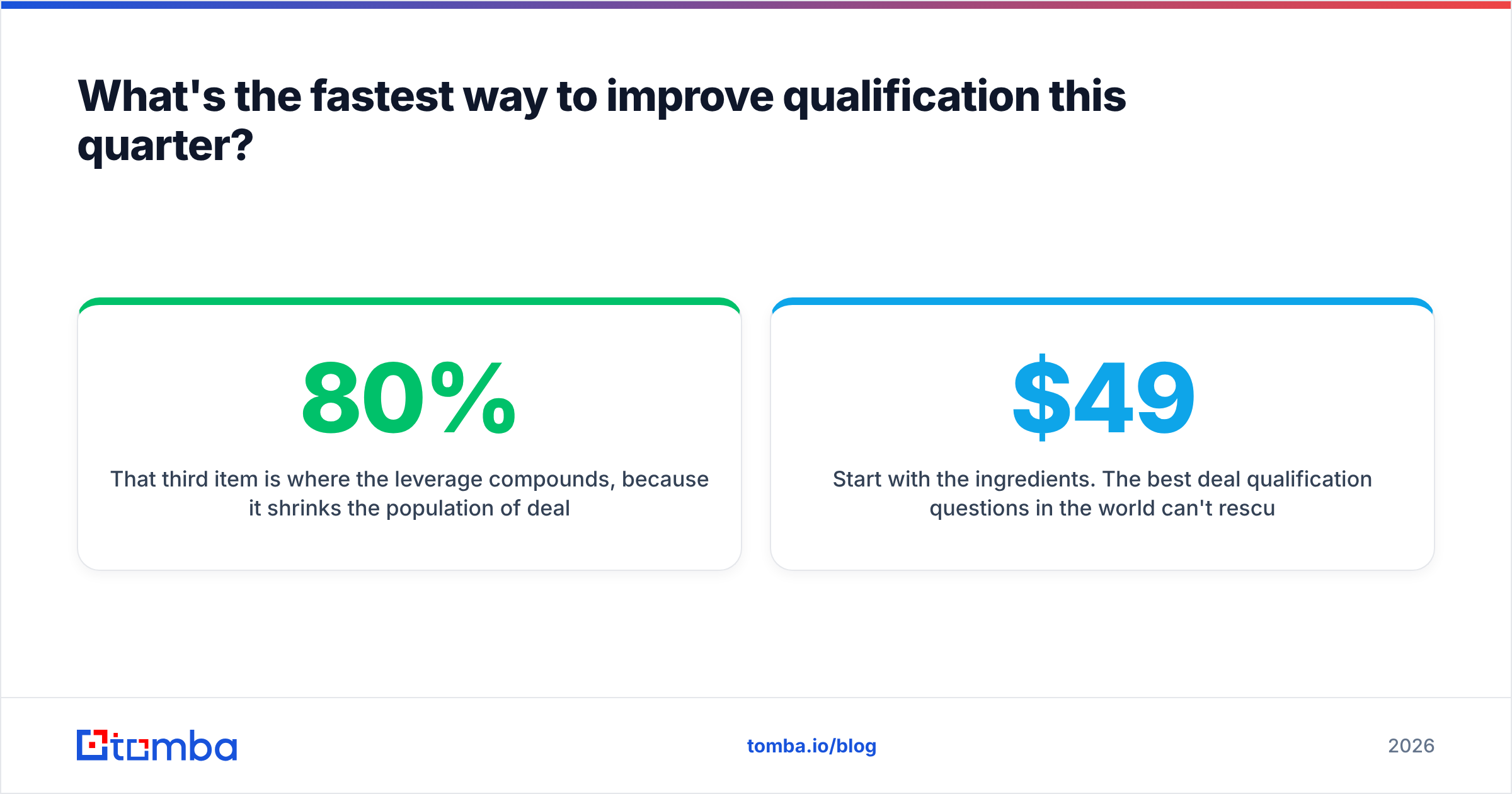
That third item is where the leverage compounds, because it shrinks the population of deals that need heavy qualification in the first place. If 80% of your meetings are with the right role at the right company size, your questions get easier and your disqualification rate drops for the right reason instead of the wrong one.
Start with the ingredients. The best deal qualification questions in the world can't rescue a meeting with someone who was never going to buy. Tomba's Email Finder helps you build accurate, role-targeted contact lists so your reps spend their discovery calls qualifying real opportunities instead of discovering they're talking to the wrong person. Start free with 25 searches a month, or check Tomba pricing — Starter is $49/mo, Growth $99/mo, Pro $249/mo — and pair it with the email verifier so every deal you qualify starts from data you can trust.
Related guides#
Ready to find emails that actually work?
Join 150,000+ professionals who stopped guessing and started sending. Free credits on signup — no credit card required.
Get the Tomba newsletter
Practical outbound tactics and product updates — once every two weeks.
About the author