Deal Risk Champion Leaves: What to Do in the First 72 Hours
Your champion just posted a new job on LinkedIn and your $80K deal went dark. Here's the 72-hour playbook for rebuilding access, re-qualifying the deal, and deciding whether to fight or fold.
Every pipeline has a line nobody wants to type: deal risk champion leaves. Your main contact is gone. The $80K opportunity is dark, and the clock started weeks before you noticed. Here is the 72-hour response, in order.
TL;DR
- Champion departure is the single most common cause of late-stage slippage, and it is almost always survivable — if you find out within days instead of weeks.
- The first 72 hours matter more than the next 30 days. Your job is access, not persuasion: get one warm intro before the org forgets you existed.
- Single-threaded deals die. Deals with three or more mapped contacts across two functions survive champion churn far more often.
- Re-qualify from zero. The new stakeholder did not sign off on your business case and owes you nothing. Treat the deal as a fresh opportunity that happens to have a paper trail.
- Build the early-warning system now: job-change alerts, quarterly contact re-verification, and a multi-threading rule enforced at stage gates.
Deal risk champion leaves: what actually happens mid-deal?#
Your deal does not die because the champion left. It dies because you found out six weeks late.
Think of a champion like the only person in a building who has your key card programmed. When they walk out, the door doesn't lock instantly — but nobody else knows you're supposed to be inside. The longer you wait to introduce yourself to reception, the more you look like a stranger who wandered in.
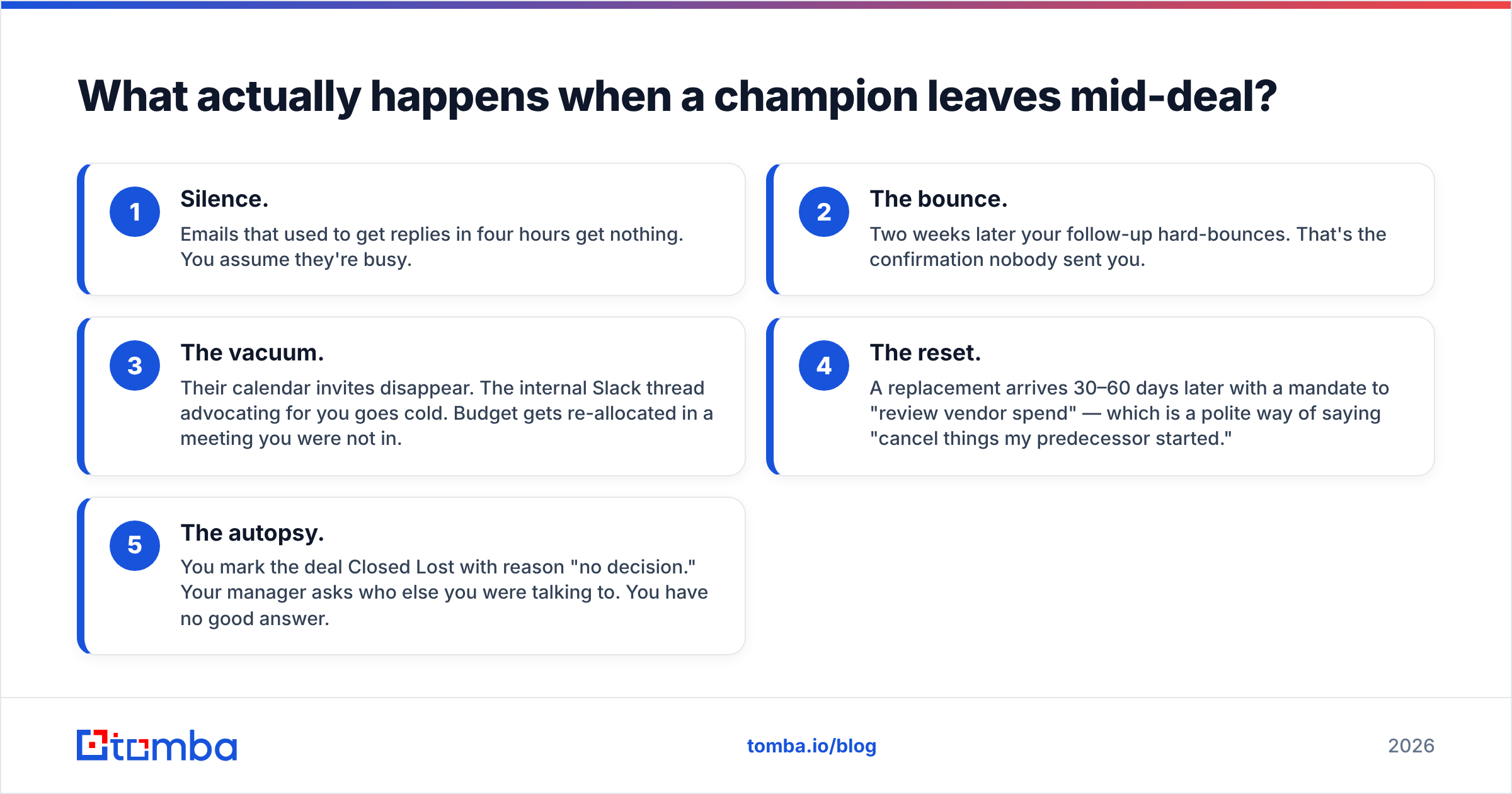
Here's the mechanical sequence most reps live through:
- Silence. Emails that used to get replies in four hours get nothing. You assume they're busy.
- The bounce. Two weeks later your follow-up hard-bounces. That's the confirmation nobody sent you.
- The vacuum. Their calendar invites disappear. The internal Slack thread advocating for you goes cold. Budget gets re-allocated in a meeting you were not in.
- The reset. A replacement arrives 30–60 days later with a mandate to "review vendor spend" — which is a polite way of saying "cancel things my predecessor started."
- The autopsy. You mark the deal Closed Lost with reason "no decision." Your manager asks who else you were talking to. You have no good answer.
The cost is measurable. Gartner's B2B buying research finds the same thing again and again: a typical enterprise purchase involves 6 to 10 decision-makers. Each one shows up with research they gathered on their own. If your whole deal rests on one of those ten people, you are betting a quarter on a coin flip you cannot see.

Why does a single champion make a deal so fragile?#
Because a champion is doing three jobs you cannot do yourself, and none of them transfer automatically.
- Internal selling. They defend your line item in budget meetings you never attend. A new stakeholder has no political capital invested in your outcome.
- Context storage. Your discovery notes, your ROI model, the reason your competitor was ruled out — much of that lives in their head, not in a document. When they leave, the institutional memory of your deal leaves with them.
- Access brokering. They routed you to procurement, security review, and the economic buyer. Without them, you are cold-calling a company that already thinks it knows you.
- Urgency manufacturing. The compelling event was often their compelling event — a personal OKR, a project they owned. New owner, new OKRs, no urgency.
Single-threading is not a personality flaw. It is a shortcut that works right up until it doesn't. The rep who owns four contacts across two departments is not more diligent — they are running a deal that can absorb one departure without collapsing.
How do you spot champion churn before the bounce?#
Three signal layers, ordered from fastest to slowest.
Layer 1 — Behavioral (0–14 days, free). Reply latency doubles. Meetings get rescheduled twice, then declined. Your champion stops using "we" and starts using "the team." Someone new is CC'd on a thread with no explanation. Any two of these in the same week is a flag worth acting on.
Layer 2 — Public signals (7–30 days). LinkedIn title changes, "open to work" banners, a new company logo in their header, or a farewell post. Set alerts on your top 20 open-opportunity contacts. This is the highest-ROI 20 minutes you will spend in a week.
Layer 3 — Data signals (immediate, if instrumented). Email status changes from valid to invalid, an out-of-office autoresponder naming a replacement, or a removed entry from the company directory. Run a monthly email verifier pass across your open-pipeline contacts. That turns a six-week blind spot into a 30-day one, and the autoresponder usually hands you the replacement's name for free.
The autoresponder is underrated. "I've left CompanyX — please contact sarah.chen@companyx.com" is a warm-ish introduction handed to you by the company's own mail server. Act on it the same day.
What is the 72-hour champion-departure playbook?#
Move in this order. Do not skip to persuasion.
Hour 0–4: Confirm and contain. Verify the departure — check LinkedIn, the company directory, and the email status. Freeze any automated sequence targeting that contact immediately. Nothing torches credibility faster than a cheerful "just circling back!" landing in a dead mailbox that forwards to their old boss.
Hour 4–24: Reach the person who left. This is counterintuitive and it works. Your former champion has no reason to help their old employer. They often have a personal reason to help you — they liked the product, or they'll want it at their new company. Message them on LinkedIn, not email. Ask two things: who inherited the project, and whether they'd introduce you. A warm handoff from the departing champion beats ten cold emails to their replacement. Then log their new company. A champion who moves is a warm lead at a brand-new logo, and most teams ignore that motion entirely.
Hour 24–48: Map the vacuum. Identify who absorbed the responsibilities. Usually it's the champion's direct manager (interim owner), a peer on the same team (day-to-day work), or the economic buyer (budget). Find all three. A domain search across the account surfaces the current org contacts and their email patterns in one pass, which beats guessing formats one address at a time.
Hour 48–72: Send the re-entry message. Not a pitch. A short, contextual, low-ask note to the interim owner. Three sentences: what was already agreed, what problem it was solving, and one specific question. Something like:
"Priya — I worked with Marcus on the data-quality project through Q2; we'd scoped a rollout for 40 seats and had security sign-off. I don't want to assume that's still a priority under you. Worth a 15-minute call to tell me whether to park it or pick it up?"
Giving them explicit permission to say "park it" raises reply rates because it removes the fear of being sold to. It also produces the single most useful outcome available to you: a fast, honest answer.

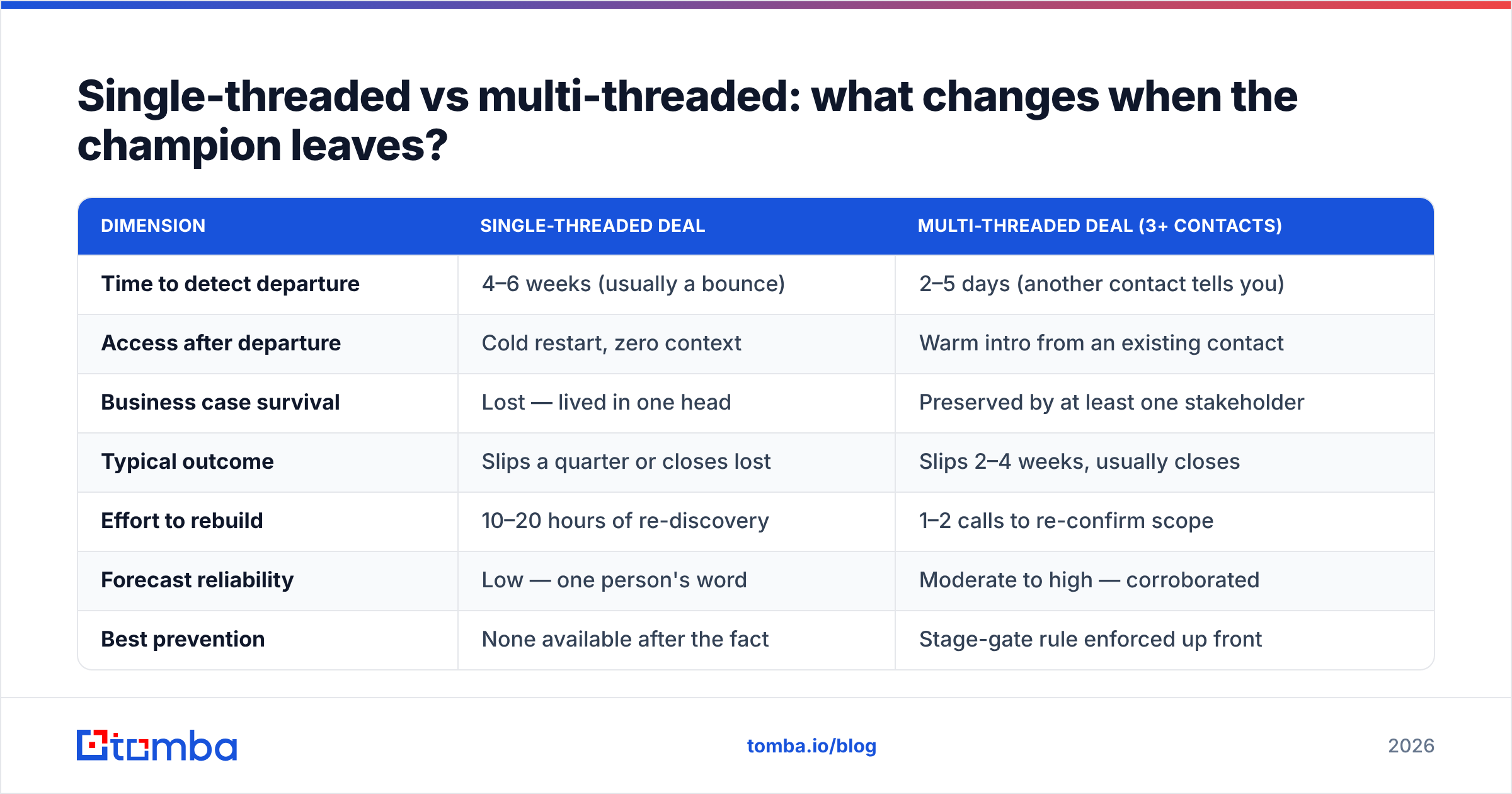
Single-threaded vs multi-threaded: what changes when the champion leaves?#
| Dimension | Single-threaded deal | Multi-threaded deal (3+ contacts) |
|---|---|---|
| Time to detect departure | 4–6 weeks (usually a bounce) | 2–5 days (another contact tells you) |
| Access after departure | Cold restart, zero context | Warm intro from an existing contact |
| Business case survival | Lost — lived in one head | Preserved by at least one stakeholder |
| Typical outcome | Slips a quarter or closes lost | Slips 2–4 weeks, usually closes |
| Effort to rebuild | 10–20 hours of re-discovery | 1–2 calls to re-confirm scope |
| Forecast reliability | Low — one person's word | Moderate to high — corroborated |
| Best prevention | None available after the fact | Stage-gate rule enforced up front |
The pattern is consistent: multi-threading does not prevent champion churn, it converts a deal-killer into a delay. That's the whole game.
How do you re-qualify a deal after the champion is gone?#
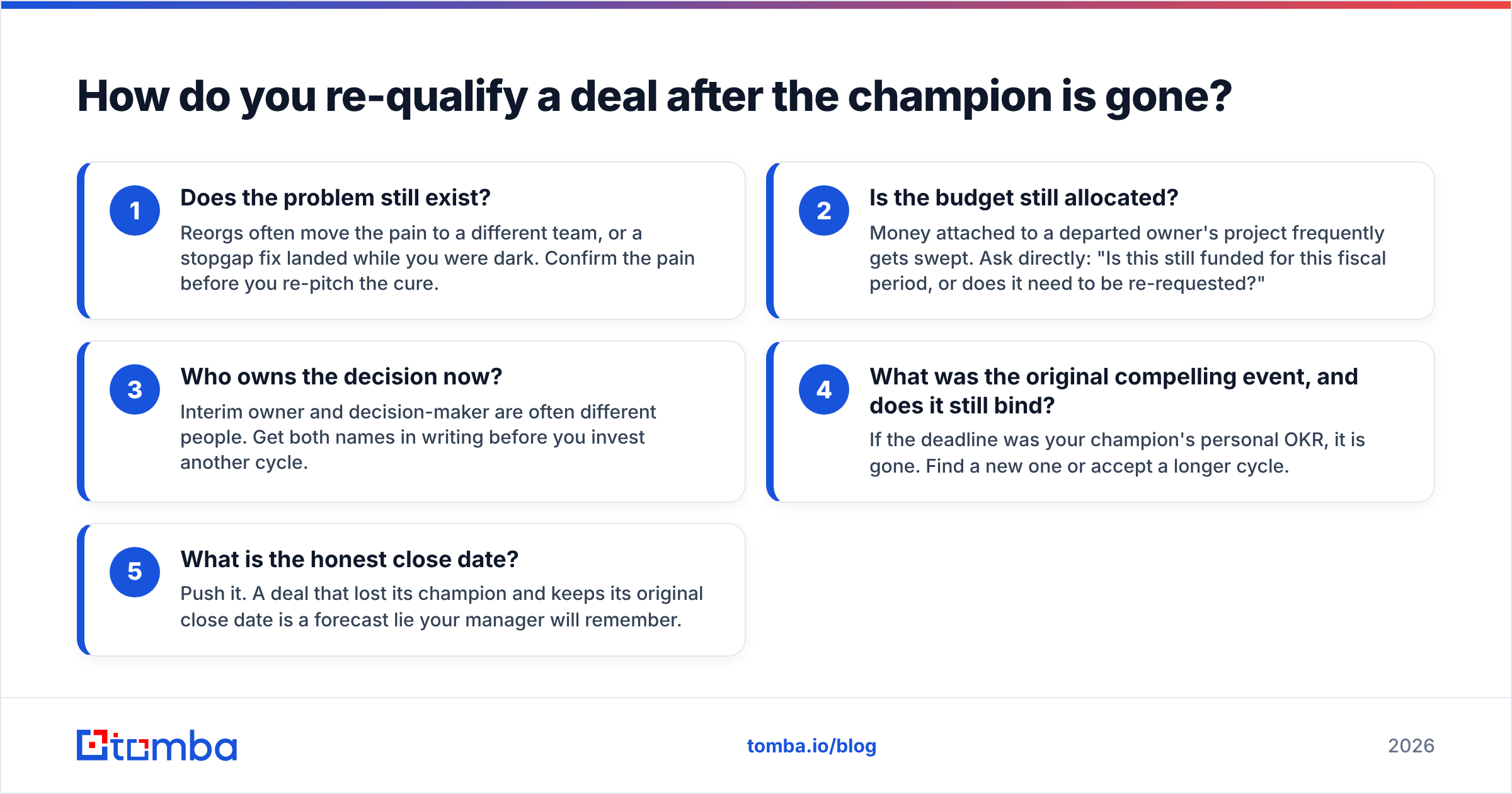
Assume nothing carries over. The new stakeholder inherited a spreadsheet row, not a conviction. Run a compressed qualification pass against five questions:
- Does the problem still exist? Reorgs often move the pain to a different team, or a stopgap fix landed while you were dark. Confirm the pain before you re-pitch the cure.
- Is the budget still allocated? Money attached to a departed owner's project frequently gets swept. Ask directly: "Is this still funded for this fiscal period, or does it need to be re-requested?"
- Who owns the decision now? Interim owner and decision-maker are often different people. Get both names in writing before you invest another cycle.
- What was the original compelling event, and does it still bind? If the deadline was your champion's personal OKR, it is gone. Find a new one or accept a longer cycle.
- What is the honest close date? Push it. A deal that lost its champion and keeps its original close date is a forecast lie your manager will remember.
If three or more answers come back weak, move the deal back a stage rather than nursing it in commit. Accurate pipeline beats optimistic pipeline. Your win rate improves faster by removing dead deals than by adding new ones.
What should you do when you cannot get back in at all?#
Sometimes the door stays shut. The replacement doesn't reply, the interim owner defers, procurement says "we've paused all new vendor evaluations." At that point you have three legitimate options:
- Park with a trigger. Close it lost with a documented reason, and set a revisit trigger — new hire in the role, funding round, or a leadership change. This is not giving up; it's refusing to burn cycles on a deal that cannot progress.
- Enter through a different function. If security or IT was involved in the evaluation, they still hold context and are usually easier to reach than a new VP. A technical contact who already reviewed you can restart the conversation internally.
- Follow the champion. Your best lead in this whole mess may be the person who left. They know your product, they had a good experience, and they may hold more budget at the new company. Track where they landed, verify their new work address, and open a fresh conversation there. Teams that work job-change signals see reply rates well above their cold baseline, because you are not cold — you are familiar.
What tooling actually reduces champion-departure risk?#
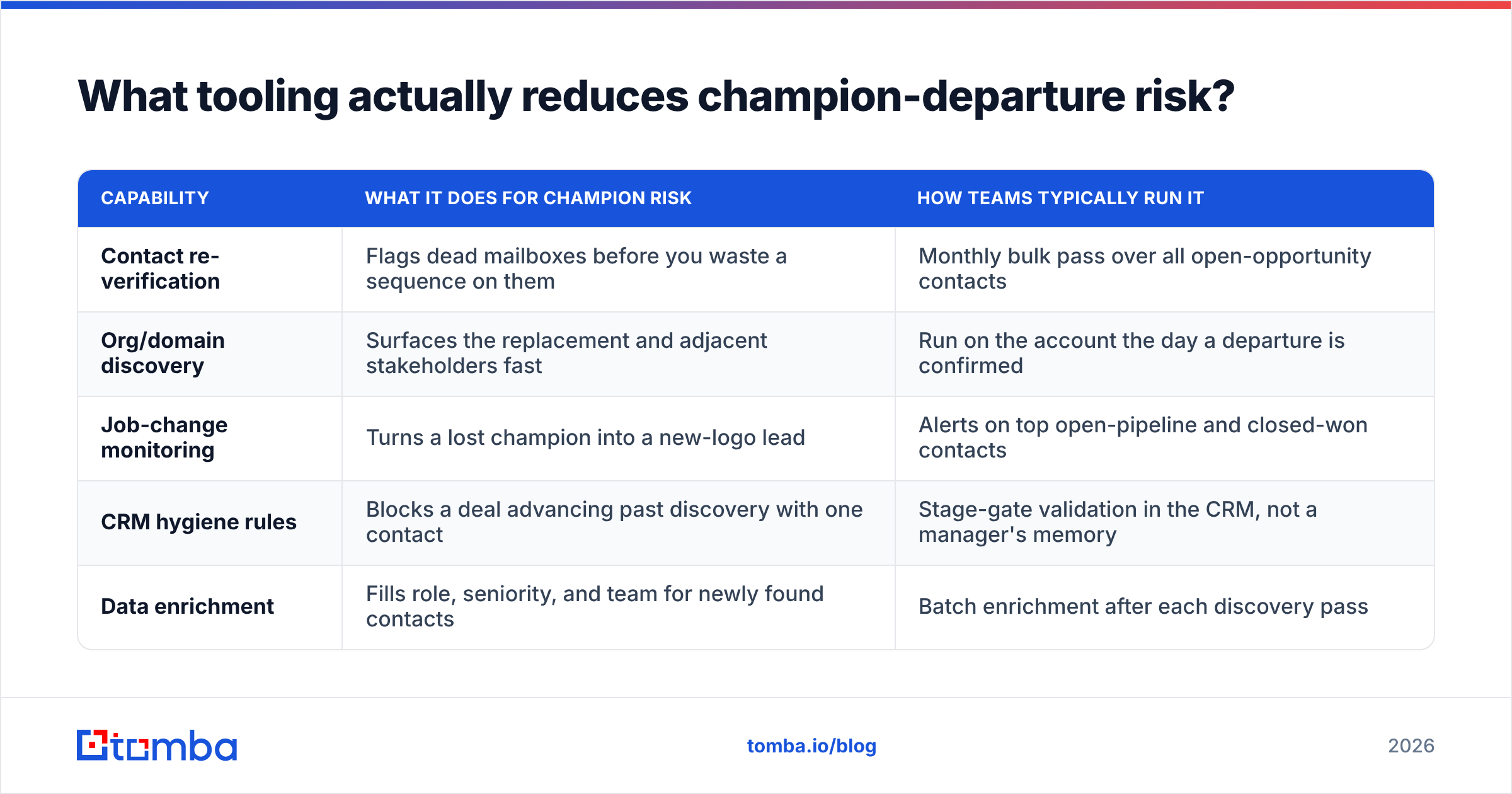
Nothing replaces multi-threading discipline. But three categories of tooling shorten your detection window, and shorter detection windows are the whole ballgame.
| Capability | What it does for champion risk | How teams typically run it |
|---|---|---|
| Contact re-verification | Flags dead mailboxes before you waste a sequence on them | Monthly bulk pass over all open-opportunity contacts |
| Org/domain discovery | Surfaces the replacement and adjacent stakeholders fast | Run on the account the day a departure is confirmed |
| Job-change monitoring | Turns a lost champion into a new-logo lead | Alerts on top open-pipeline and closed-won contacts |
| CRM hygiene rules | Blocks a deal advancing past discovery with one contact | Stage-gate validation in the CRM, not a manager's memory |
| Data enrichment | Fills role, seniority, and team for newly found contacts | Batch enrichment after each discovery pass |
The CRM rule is the cheapest and most effective item on that list, and almost nobody enforces it. Require two verified contacts to move a deal to proposal, three to move it to commit. It will make your pipeline look smaller in month one and considerably more real by month three.
For the discovery side, a bulk email finder lets you rebuild an account's contact map in minutes rather than an afternoon of manual guessing, and contact enrichment fills in the titles and seniority you need to figure out who actually inherited the budget. If your team runs this at scale, wiring it through the Tomba API into your CRM so verification happens automatically on a schedule removes the human step that always gets skipped when the quarter gets busy.
Worth reading alongside this: HubSpot's research library on buyer behavior and sales trends is a useful sanity check on how long modern B2B cycles actually run, and G2's sales intelligence category is the fastest way to compare contact-data vendors on verified user reviews rather than vendor claims. For a structured view of how buying groups form and dissolve, Gartner's B2B buying journey research remains the reference most enablement teams build their playbooks on.
How do you build a champion-churn early-warning system?#
Four steps, all of which you can implement this week.
- Set a multi-threading floor. No deal advances past discovery with one contact. Make it a CRM validation rule, not a coaching suggestion. Rules get followed; suggestions get forgotten in week two of the quarter.
- Run a monthly verification pass. Pull every contact attached to an open opportunity, verify the addresses in bulk, and treat any status change as a same-day investigation — not a data-cleanup ticket.
- Monitor job changes on two lists. Open-pipeline contacts (defensive: detect churn early) and closed-won contacts (offensive: a happy user at a new company is your warmest possible lead).
- Write a departure runbook. The 72-hour playbook above, saved where reps can find it, with the message template already written. When a champion leaves, nobody has the presence of mind to invent a process. They need a checklist.
Track one metric to know whether it's working: average contacts per open opportunity. If it climbs from 1.4 to 2.8 over a quarter, your champion-departure risk has structurally dropped and your forecast just got more honest — regardless of what happens to any individual deal.
Where does this leave you?#
When a forecast note reads deal risk champion leaves, treat it as a countdown, not a verdict. Champion departure is not an edge case. B2B tenure keeps shrinking, so assume every deal longer than 60 days will see at least one stakeholder change. The teams that handle it well are not luckier. They detect it in days, they already know three other names at the account, and they have a written response instead of a panic.
Start with the detection layer. It is the cheapest fix and it pays back fastest.
Use the Tomba Email Finder to rebuild an account's contact map the moment a departure signal lands. Give it a name and a domain, and verified addresses come back in seconds. It also surfaces the org's email pattern, so you can reach the interim owner and the economic buyer the same afternoon.
The free tier covers 25 searches a month, which is enough to test the workflow on your three riskiest deals. Paid plans start at $49/month, and full Tomba pricing is public if you need to size it for a team. Either way, audit your open pipeline for single-threaded deals this week. The deal you save will be one you didn't know was at risk.
Related guides#
Ready to find emails that actually work?
Join 150,000+ professionals who stopped guessing and started sending. Free credits on signup — no credit card required.
Get the Tomba newsletter
Practical outbound tactics and product updates — once every two weeks.
About the author