Deal Scoring in 2026: How to Rank Pipeline That Closes
Lead scoring tells you who to call. Deal scoring tells you which open opportunities will actually close — and which ones are quietly rotting in your pipeline.
TL;DR
- Deal scoring ranks open opportunities by likelihood to close. Lead scoring ranks people by likelihood to become an opportunity. They are different models with different inputs, and conflating them is why most forecasts miss.
- The signals that actually predict closure are behavioral and structural — multithreading depth, stage velocity, mutual action plan activity, economic buyer engagement — not firmographics you already used at the lead stage.
- Rule-based scoring is fine below ~200 closed-won deals per year. Above that, a fitted model beats your rep's intuition and your CRM's static stage percentages.
- The most common failure is scoring the deal without scoring the contact coverage inside it. A $200k deal with one champion and no verified economic-buyer email is not an 80% deal.
- Rebuild the model quarterly. Deal scores decay faster than lead scores because your ICP, pricing, and competitive set move.
What is deal scoring?#
Deal scoring is a numeric estimate of how likely an open opportunity is to close won, and often how soon and for how much. Think of it as a weather forecast for your pipeline: you're not predicting one deal with certainty, you're assigning probabilities across many so you know where to send resources.
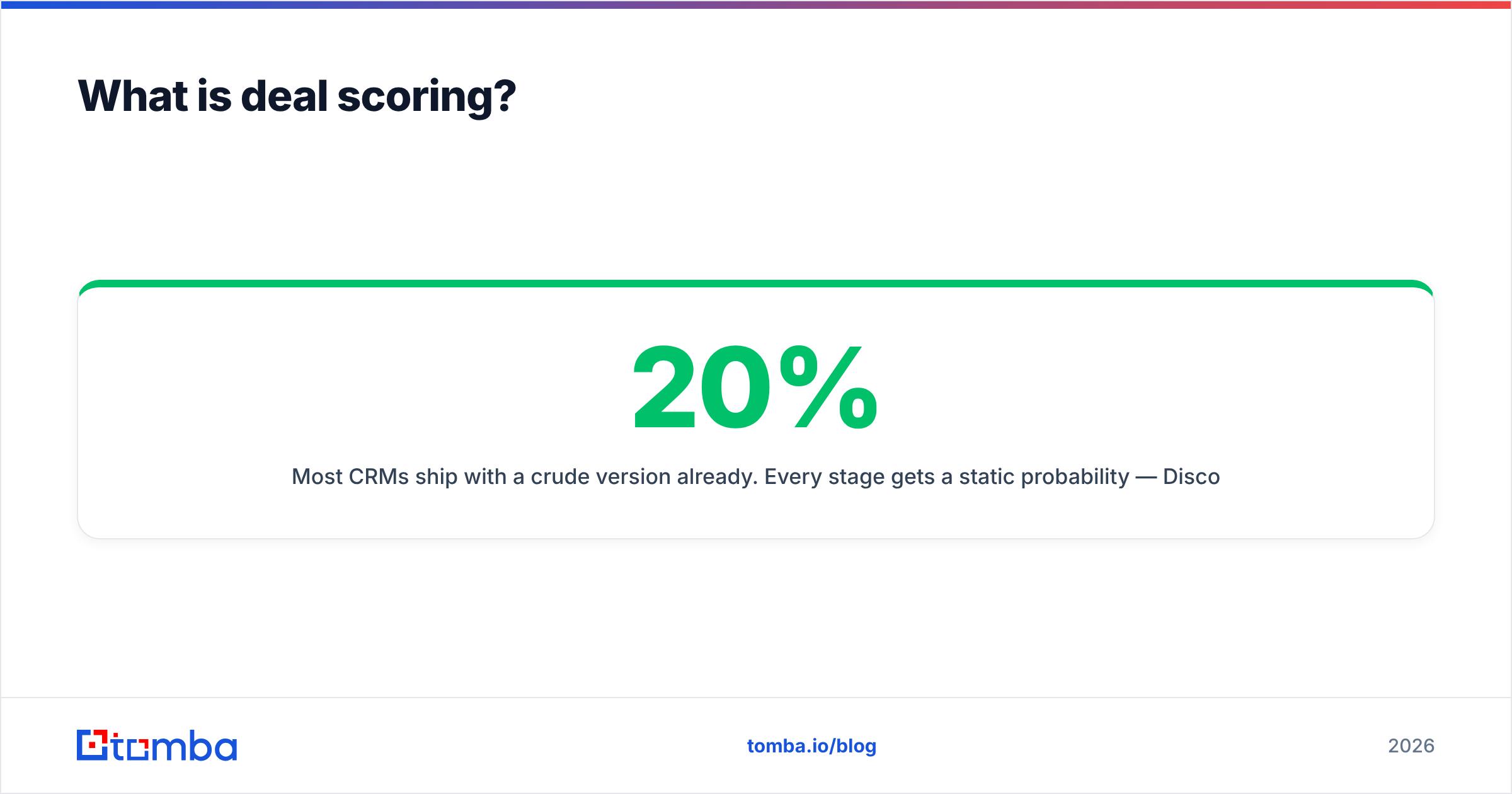
Most CRMs ship with a crude version already. Every stage gets a static probability — Discovery 20%, Demo 40%, Proposal 60%, Negotiation 80% — and the weighted forecast multiplies deal value by that number. The problem is obvious once you say it out loud: a deal that reached Negotiation in 14 days with four stakeholders engaged and a deal that limped there over nine months with one contact who stopped replying both read as 80%.
Real deal scoring replaces stage-as-proxy with observed behavior. It asks: given everything we know about this opportunity right now, what percentage of historically similar opportunities closed won?
The distinction from lead scoring matters:
- Different unit of analysis. Lead scoring scores a person or account pre-opportunity. Deal scoring scores an opportunity record with multiple contacts attached.
- Different predictive signals. Job title predicts whether someone books a meeting. It barely predicts whether a deal closes once the meeting happened.
- Different decay rate. A lead score is roughly stable for weeks. A deal score should move every time a stakeholder replies, goes silent, or a competitor is mentioned on a call.
- Different consumer. Marketing consumes lead scores. Sales managers and finance consume deal scores — which means accuracy gets audited against actual bookings every quarter.
- Different cost of error. A bad lead score wastes an SDR hour. A bad deal score wastes a quarter of forecast credibility.
Why do stage-based probabilities fail?#
Because stage is an output of rep behavior, not evidence of buyer intent. Reps advance deals when they feel momentum, and "feel" is exactly the thing you were trying to remove from the forecast.
Three specific failure modes show up in almost every pipeline review:
Stage inflation. Reps push deals to Proposal to look active in pipeline reviews. The stage distribution shifts right, weighted forecast rises, close rate doesn't. If your Proposal-stage conversion rate is below 45% but the CRM says 60%, you have inflation.
Single-threading blindness. Gartner's B2B buying research has consistently found that a typical enterprise purchase involves six to ten decision-makers. A stage percentage cannot see how many of them you've actually reached. A deal at Negotiation with one contact is structurally weaker than a deal at Demo with five.
Time-in-stage indifference. Deals decay. A Proposal-stage opportunity that has been in Proposal for 90 days has a materially lower close rate than one that entered last week — but the stage percentage treats them identically.
The fix isn't to delete stages. It's to treat stage as one feature among fifteen, and let the data decide its weight.
Which signals actually predict a closed-won deal?#
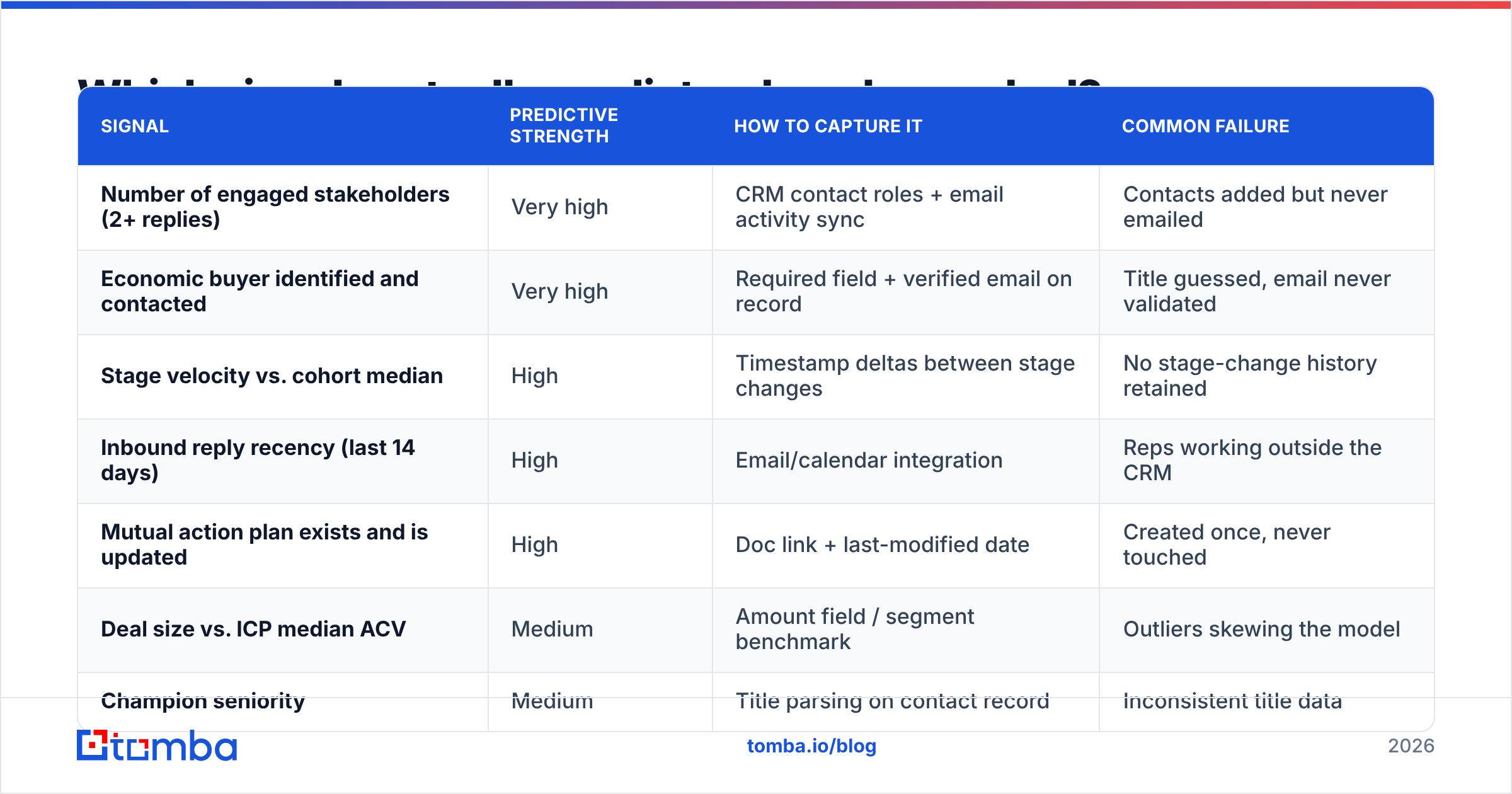
Here's the honest ranking based on what most B2B revenue teams find when they fit their first model. Your data will reorder some of these, but the top tier is remarkably consistent.
| Signal | Predictive strength | How to capture it | Common failure |
|---|---|---|---|
| Number of engaged stakeholders (2+ replies) | Very high | CRM contact roles + email activity sync | Contacts added but never emailed |
| Economic buyer identified and contacted | Very high | Required field + verified email on record | Title guessed, email never validated |
| Stage velocity vs. cohort median | High | Timestamp deltas between stage changes | No stage-change history retained |
| Inbound reply recency (last 14 days) | High | Email/calendar integration | Reps working outside the CRM |
| Mutual action plan exists and is updated | High | Doc link + last-modified date | Created once, never touched |
| Deal size vs. ICP median ACV | Medium | Amount field / segment benchmark | Outliers skewing the model |
| Champion seniority | Medium | Title parsing on contact record | Inconsistent title data |
| Competitor mentioned on call | Medium (negative) | Conversation intelligence keyword | Not logged at all |
| Source channel (inbound vs. outbound) | Low-medium | Lead source attribution | Overwritten on conversion |
| Firmographics (industry, headcount) | Low | Enrichment provider | Over-weighted from lead model |
The pattern: coverage and reciprocity beat description. Who inside the account has actually written back to you tells you far more than what the account looks like on paper. Firmographic data earned its keep at the lead stage; re-using it as a heavy deal-scoring feature double-counts information you already acted on.
That's also why contact data quality is a deal-scoring problem, not just a prospecting problem. If your model rewards "economic buyer contacted" but half those email addresses bounce, you're rewarding a field that means nothing. Running open-opportunity contacts through an email verifier before they feed the score is unglamorous and materially improves calibration.
How do you build a deal scoring model?#
Start simpler than you think you need to. The sequence below works whether you're a 6-rep team or a 60-rep org.
Step 1 — Define the outcome precisely. Closed won within the forecast period, not "closed won eventually." A model that predicts eventual wins is useless for a quarterly forecast.
Step 2 — Pull 12-24 months of closed opportunities. You need both wins and losses. Teams that only analyze wins build models that score everything highly. Aim for at least 150 closed deals; below that, stay rule-based.
Step 3 — Snapshot features at a fixed point. This is where most homegrown models break. If you record "number of stakeholders" as of close date, you've leaked the future into the model — won deals always have more stakeholders at the end. Snapshot features at day 14 of the opportunity, or at stage entry, and predict forward from there.
Step 4 — Fit something boring. Logistic regression or a gradient-boosted tree. Both are interpretable enough that a sales manager can ask "why is this deal a 34?" and get an answer. Skip deep learning; you don't have the data volume and you'd lose explainability, which is the thing that makes reps trust the score.
Step 5 — Calibrate, don't just rank. A score of 70 should mean roughly 70% of such deals closed. Check this with a calibration plot on held-out data. Ranking-only models are fine for prioritization but will wreck your forecast when finance multiplies score by amount.
Step 6 — Ship it as a field, not a verdict. Put the score and the top three contributing factors on the opportunity record. Reps ignore black-box numbers and act on reasons.
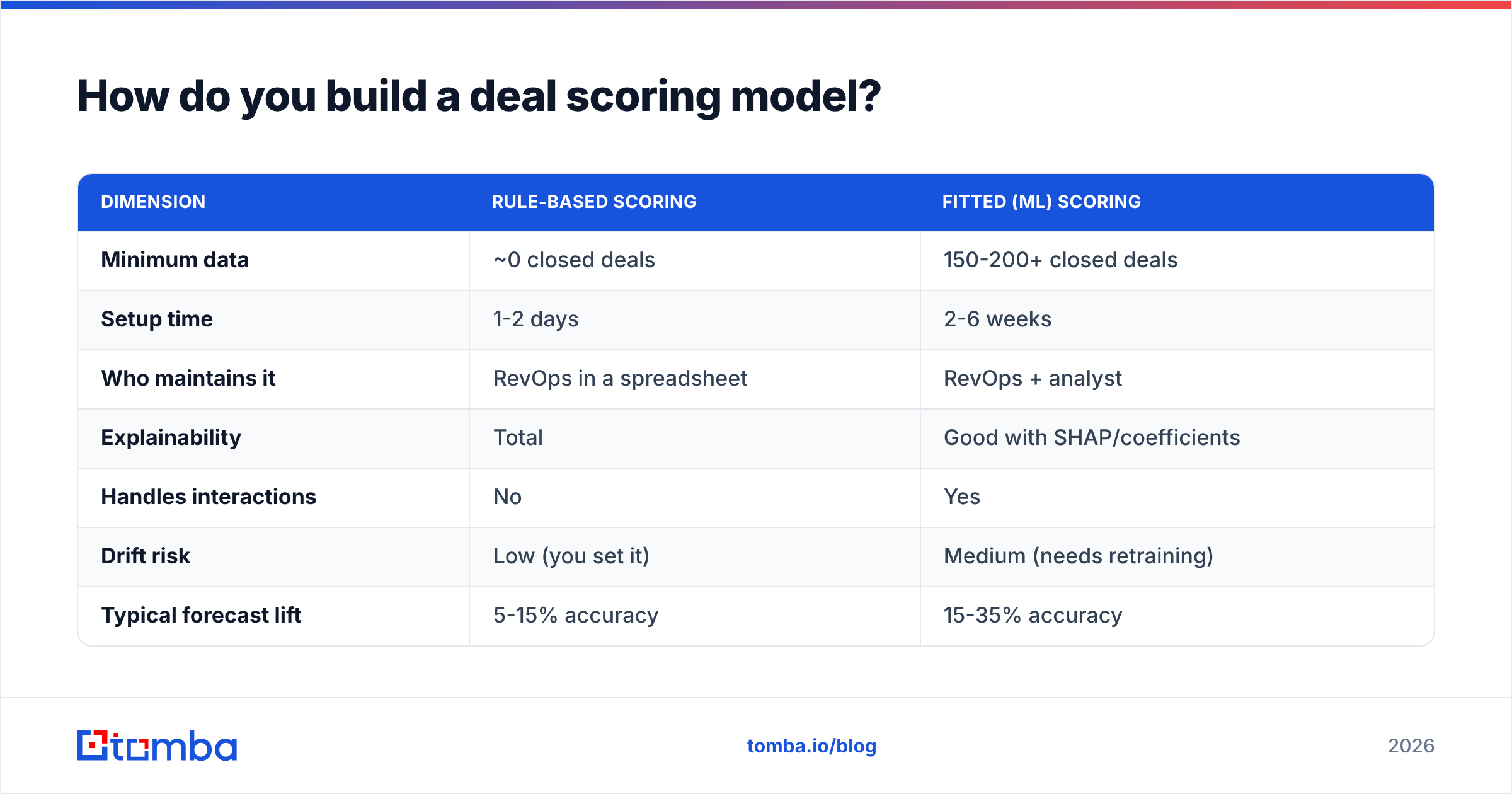
Rule-based vs. fitted models#
| Dimension | Rule-based scoring | Fitted (ML) scoring |
|---|---|---|
| Minimum data | ~0 closed deals | 150-200+ closed deals |
| Setup time | 1-2 days | 2-6 weeks |
| Who maintains it | RevOps in a spreadsheet | RevOps + analyst |
| Explainability | Total | Good with SHAP/coefficients |
| Handles interactions | No | Yes |
| Drift risk | Low (you set it) | Medium (needs retraining) |
| Typical forecast lift | 5-15% accuracy | 15-35% accuracy |
| Best for | Teams under ~$5M ARR | Teams with repeatable motion |
A rule-based model is not a consolation prize. If you're running a founder-led sales motion with 40 deals a year, a weighted checklist — economic buyer contacted (+25), three or more engaged stakeholders (+20), reply in last 14 days (+15), in-stage over 60 days (−20) — will outperform stage percentages immediately and cost you nothing.
What tools handle deal scoring in 2026?#
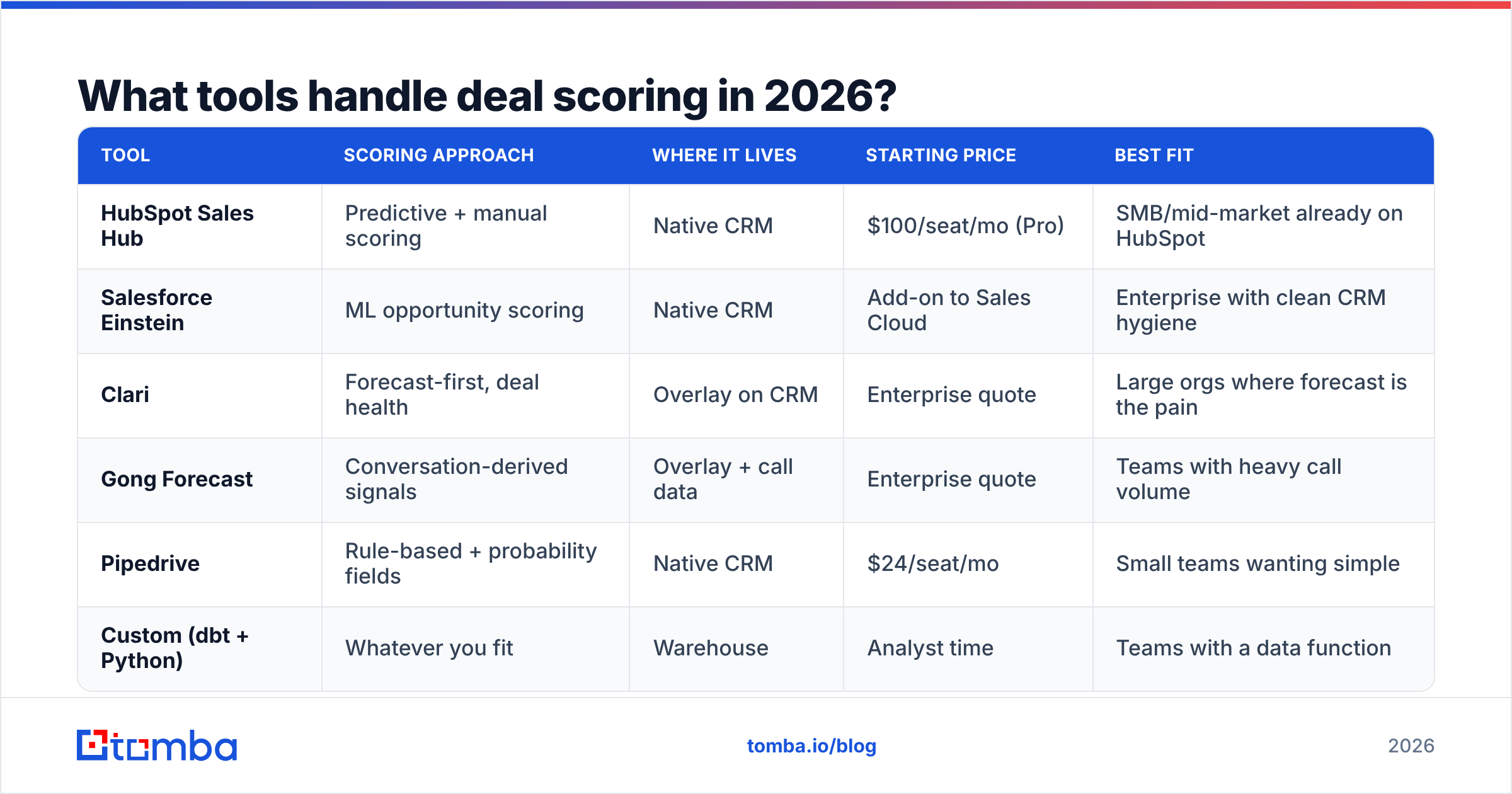
Most teams end up with a hybrid: CRM-native scoring for the baseline, plus something that fills a gap the CRM can't see. Here's the honest landscape.
| Tool | Scoring approach | Where it lives | Starting price | Best fit |
|---|---|---|---|---|
| HubSpot Sales Hub | Predictive + manual scoring | Native CRM | $100/seat/mo (Pro) | SMB/mid-market already on HubSpot |
| Salesforce Einstein | ML opportunity scoring | Native CRM | Add-on to Sales Cloud | Enterprise with clean CRM hygiene |
| Clari | Forecast-first, deal health | Overlay on CRM | Enterprise quote | Large orgs where forecast is the pain |
| Gong Forecast | Conversation-derived signals | Overlay + call data | Enterprise quote | Teams with heavy call volume |
| Pipedrive | Rule-based + probability fields | Native CRM | $24/seat/mo | Small teams wanting simple |
| Custom (dbt + Python) | Whatever you fit | Warehouse | Analyst time | Teams with a data function |
Two caveats worth stating plainly. First, every CRM-native model is only as good as your CRM data — Einstein cannot score a stakeholder relationship that was never logged. Second, overlay tools like Clari and Gong are strong at what they see (calls, emails, forecast rollups) and blind to what they don't (contacts you never reached).
That second blind spot is the one worth fixing cheaply. If your model penalizes single-threaded deals, you need a fast way to un-single-thread them, which means finding and verifying the other five people in the buying committee. A domain search across the account domain surfaces who else is reachable; enrichment fills in titles and departments so your stakeholder-coverage feature has something real to count. That's a $49/mo problem, not an enterprise-contract problem.
How do you score contact coverage inside a deal?#
This is the sub-model most teams skip, and it's the highest-leverage one because it's directly actionable. A stage percentage tells a rep nothing they can do today. A coverage score tells them exactly who to go find.
Score each open opportunity on four coverage dimensions:
- Breadth — how many distinct roles from the expected buying committee have a contact record? For a typical mid-market SaaS deal, expect economic buyer, technical evaluator, end-user champion, and often procurement or security.
- Verification — what share of those contact emails are deliverable? Unverified addresses inflate breadth without adding reach. Run them through email verification and count only the valid ones.
- Reciprocity — how many have replied at least once? A contact who has never written back is a name, not a stakeholder.
- Seniority spread — do you have both a senior sponsor and a working-level user? Deals with only executives stall on implementation reality; deals with only users stall on budget.
A simple composite — breadth × verification rate, weighted by reciprocity — produces a 0-100 coverage number that slots straight into the main deal score as a feature. In most pipelines it turns out to be the single strongest predictor after reply recency.
The operational loop: score the deal, see the coverage gap, close the gap. When the model flags "one engaged stakeholder, no economic buyer," the rep's next action is finding that person's contact details — which is what an email finder is for. For accounts where you've got a LinkedIn profile but no work email, a LinkedIn finder closes the loop without leaving the workflow.
How do you know if your deal scoring is working?#
Measure the model, not the enthusiasm for it. Four checks, run monthly:
Calibration error. Bucket deals by score decile at snapshot time, compare predicted close rate to actual. Gaps above 10 percentage points in any decile mean retraining.
Forecast variance. Compare start-of-quarter weighted forecast to actual bookings. A good model narrows this band quarter over quarter. If it doesn't, the score isn't feeding the forecast — it's decorating the CRM.
Rep adoption. What percentage of reps changed their next action based on a score in the last 30 days? Below 40% and you have a trust problem, usually caused by unexplained scores or stale data.
Lift over baseline. Compare against the dumbest possible model — stage percentage alone. If your fitted model isn't beating stage percentage by a clear margin on held-out data, the added complexity is costing you credibility for nothing.
One warning on drift. Deal scores decay faster than most teams expect. Pricing changes, a new competitor, an ICP shift, or a change in your outbound motion all break the historical relationship the model learned. Retrain quarterly and re-examine feature importance every retrain — when a feature's weight moves sharply, that's usually a real change in your market, and it's worth a conversation before you accept the new model.
What are the most common deal scoring mistakes?#
- Leaking the outcome. Using features recorded at or near close date. Every model built this way looks brilliant in backtest and useless in production.
- Scoring only wins. You need losses to learn what failure looks like. Closed-lost with reason codes is the most underrated dataset in your CRM.
- Reusing the lead model. Firmographics that predicted meeting-booking rarely predict closing. Fit a separate model.
- Ignoring data hygiene. Duplicate contacts, bounced emails, and unlogged activity poison every feature. Deduplicate and verify before you model, not after.
- Hiding the reasoning. A score without contributing factors gets ignored within two weeks.
- Letting reps override without a log. Overrides are fine and often correct — but log them. Systematic override patterns are free training data for your next model version.
Also worth naming: don't let deal scoring become a management surveillance tool. The moment reps believe the score exists to grade them rather than help them, they'll game the inputs — adding phantom stakeholders, back-dating activity — and your training data is permanently contaminated.
Where should you start this quarter?#
If you have no deal scoring today, spend one week building a rule-based model on five signals: economic buyer contacted, engaged stakeholder count, days since last inbound reply, days in current stage, and deal size vs. median. Weight them by argument, ship it as a CRM field, and check calibration after 90 days. You'll beat stage percentages.
If you already have a model, audit it for leakage first, then add a contact-coverage feature. In most pipelines that single addition produces the largest accuracy jump available for the effort.
Either way, the model is only as good as the contact data underneath it. Stakeholder coverage can't be a scoring feature if you can't reliably find and verify the people in the buying committee. The Tomba Email Finder gets you verified work emails by name and domain so your coverage score counts real, reachable stakeholders — with a free tier at 25 searches a month to test the workflow, and Tomba pricing starting at $49/mo when you're ready to run it across the whole pipeline. Start with your ten largest open deals, find the stakeholders you're missing, and watch what it does to your close rate.
Related guides#
Ready to find emails that actually work?
Join 150,000+ professionals who stopped guessing and started sending. Free credits on signup — no credit card required.
Get the Tomba newsletter
Practical outbound tactics and product updates — once every two weeks.
About the author