Deal Scoring AI in 2026: How Predictive Models Really Work
Deal scoring AI is sold as forecast insurance, but most models are only as good as the CRM data underneath them. Here is what the scores actually measure, which tools are worth evaluating, and how to roll one out without wasting a quarter.

TL;DR
- Deal scoring AI ranks open opportunities by their probability of closing, using CRM history, engagement signals, and buying-committee coverage — not the same job as lead scoring, which ranks people at the top of the funnel.
- The lift is real but modest: teams that run scoring well typically tighten forecast variance by 10-20%, mostly by killing zombie deals earlier, not by finding hidden winners.
- Model quality is capped by data quality. If half your opportunities have one contact and no verified email, no vendor can score them accurately.
- Tool choice depends on where your signal lives: Clari and Gong read conversations and activity, Salesforce Einstein and HubSpot score inside the CRM, and open-source models work if you have a data team.
- Fix contact coverage and record hygiene first. Enriching and verifying the buying committee is the cheapest way to make any scoring model less wrong.
What is deal scoring AI?#
Deal scoring AI is a model that looks at every open opportunity in your pipeline and returns a number — usually 0-100 — estimating how likely that deal is to close, and often when.
Think of it like a weather forecast for your pipeline. A meteorologist does not know whether it will rain on your street at 3pm. They know that when pressure, humidity, and wind patterns look a certain way, it rained 70% of the time in the historical record. Deal scoring works identically: when an opportunity has three engaged contacts, two multithreaded email chains, a demo in the last 14 days, and a stage age below your median, deals that looked like that closed 68% of the time last year. That is the score.
Technically, most vendors train a gradient-boosted tree or logistic regression on your closed-won and closed-lost history, then apply it to open records nightly. Some layer in a language model to read email and call transcripts for intent phrases ("we're getting budget approved", "let me loop in procurement"). The output lands as a field on the opportunity, a colored chip in a pipeline board, or a "deals at risk" digest in Slack.
The important framing: a deal score is a comparison to your own history, not an objective truth. If your team historically lost every deal that reached procurement in Q4, the model will punish Q4 procurement deals. That is useful right up until your product or ICP changes, at which point the model is confidently describing a company that no longer exists.
How is deal scoring different from lead scoring?#
They get conflated constantly, and the confusion causes bad tool purchases. Here is the split:
- Object. Lead scoring ranks people or accounts before an opportunity exists. Deal scoring ranks opportunities that are already in your pipeline with an amount and a close date attached.
- Owner. Lead scoring is usually a marketing/demand-gen asset, tuned around what makes a good marketing qualified lead. Deal scoring is a sales-leadership and RevOps asset, tuned around forecast calls.
- Signals. Lead scoring leans on firmographics and content behavior. Deal scoring leans on deal-level dynamics: stage velocity, number of engaged contacts, last-touch recency, discount requests, competitor mentions.
- Decision it drives. A lead score decides who to contact. A deal score decides where to spend the last three weeks of the quarter and what number to commit.
- Failure cost. A wrong lead score wastes an SDR hour. A wrong deal score wastes a quarter of forecast credibility with your board.
If your problem is "we don't know who to prospect", deal scoring solves nothing. If your problem is "our commit was 82% accurate and the misses surprised us", deal scoring is the right category.
What signals do deal scoring models actually use?#
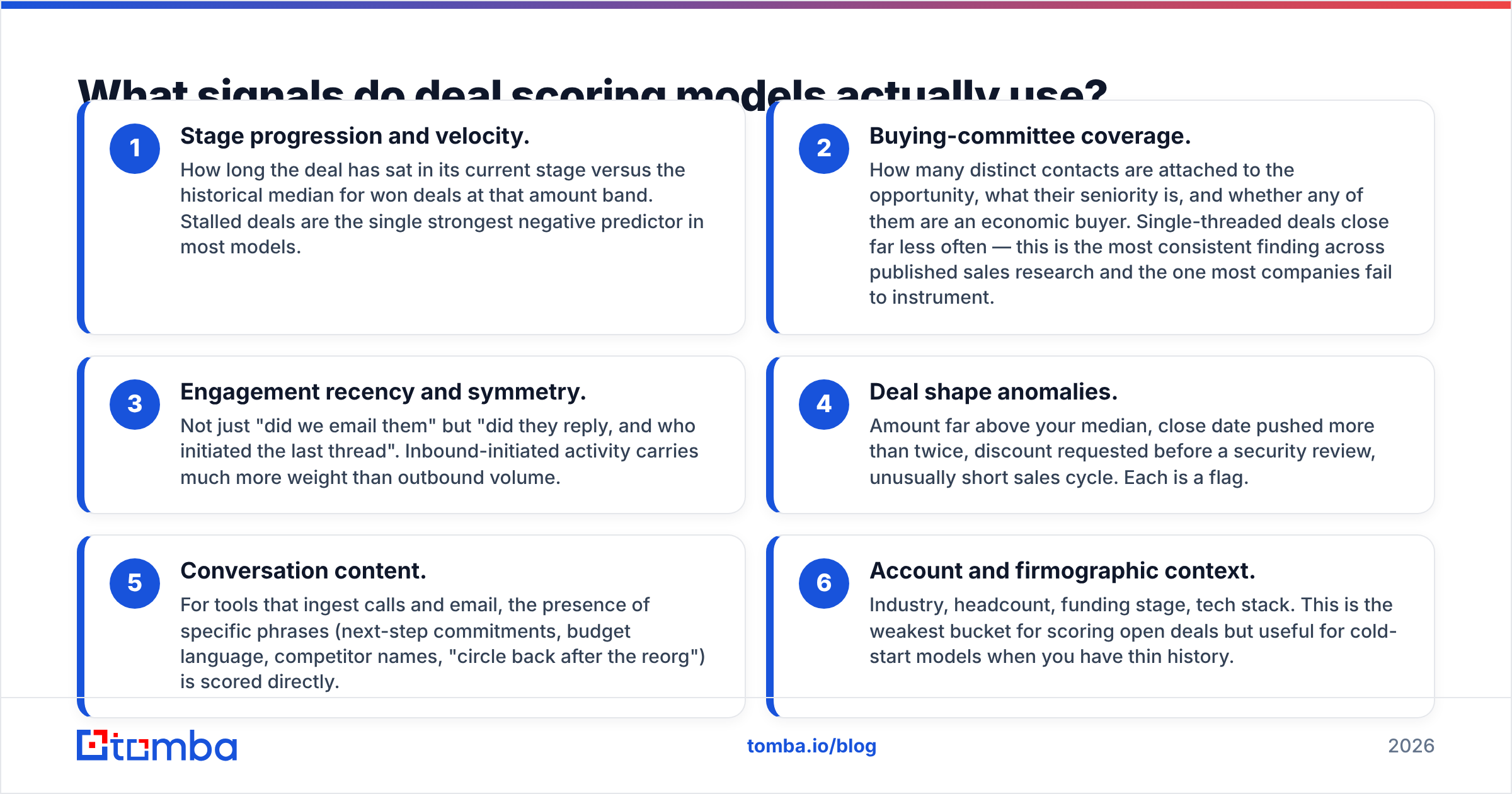
Vendors describe this vaguely on purpose. Under the hood, nearly every commercial model draws from the same six buckets, and knowing them tells you exactly which of your data gaps will hurt.
- Stage progression and velocity. How long the deal has sat in its current stage versus the historical median for won deals at that amount band. Stalled deals are the single strongest negative predictor in most models.
- Buying-committee coverage. How many distinct contacts are attached to the opportunity, what their seniority is, and whether any of them are an economic buyer. Single-threaded deals close far less often — this is the most consistent finding across published sales research and the one most companies fail to instrument.
- Engagement recency and symmetry. Not just "did we email them" but "did they reply, and who initiated the last thread". Inbound-initiated activity carries much more weight than outbound volume.
- Deal shape anomalies. Amount far above your median, close date pushed more than twice, discount requested before a security review, unusually short sales cycle. Each is a flag.
- Conversation content. For tools that ingest calls and email, the presence of specific phrases (next-step commitments, budget language, competitor names, "circle back after the reorg") is scored directly.
- Account and firmographic context. Industry, headcount, funding stage, tech stack. This is the weakest bucket for scoring open deals but useful for cold-start models when you have thin history.
Notice how many of these depend on contacts being in the CRM and reachable. Buying-committee coverage is not something a model can infer; it can only count what you logged. That is why data enrichment is upstream of scoring accuracy, not a nice-to-have next to it.
Which deal scoring tools should you compare in 2026?#
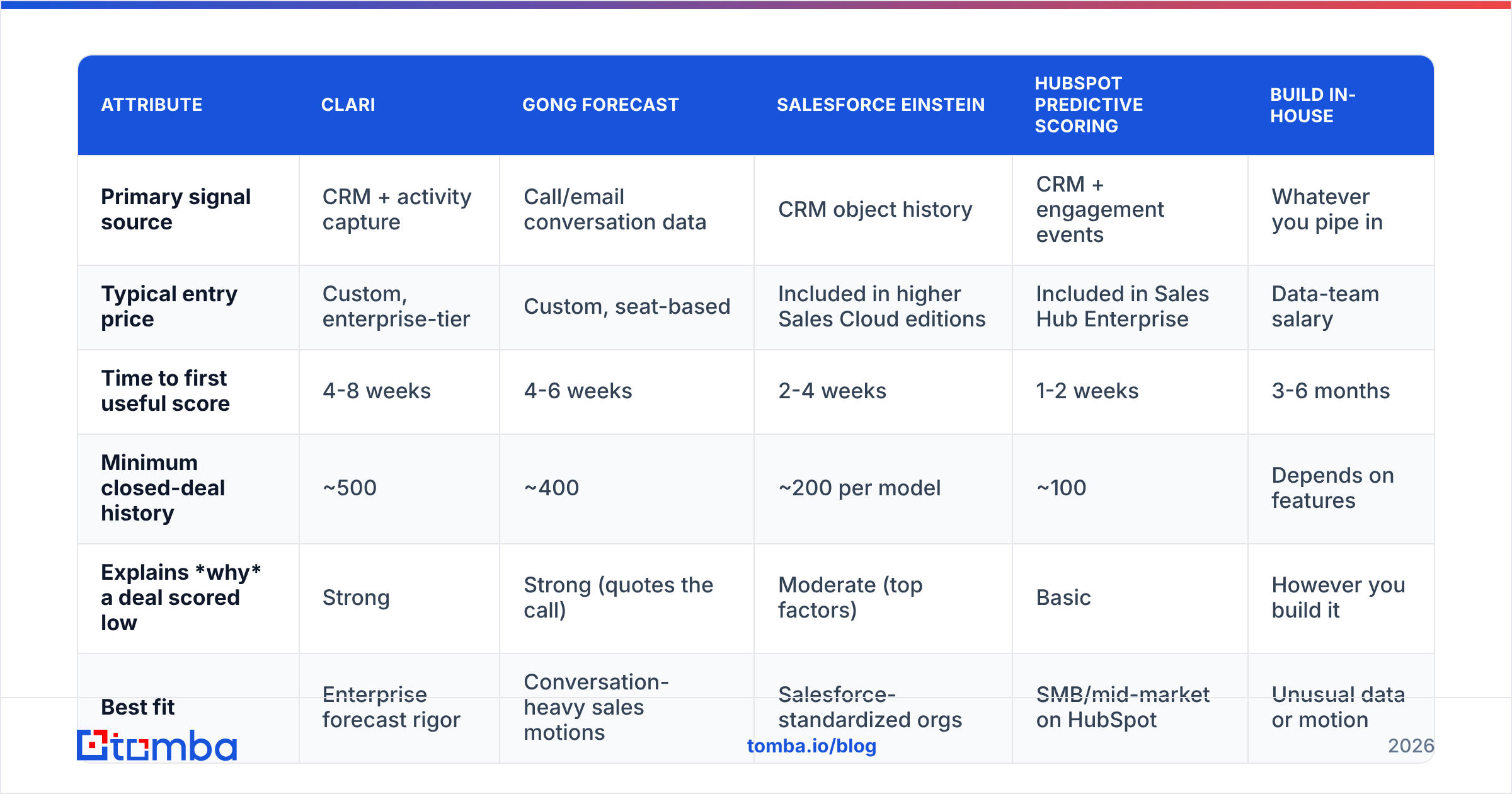
Four architectures dominate, and they suit very different teams. The table below compares them on the attributes that actually change the buying decision.
| Attribute | Clari | Gong Forecast | Salesforce Einstein | HubSpot Predictive Scoring | Build in-house |
|---|---|---|---|---|---|
| Primary signal source | CRM + activity capture | Call/email conversation data | CRM object history | CRM + engagement events | Whatever you pipe in |
| Typical entry price | Custom, enterprise-tier | Custom, seat-based | Included in higher Sales Cloud editions | Included in Sales Hub Enterprise | Data-team salary |
| Time to first useful score | 4-8 weeks | 4-6 weeks | 2-4 weeks | 1-2 weeks | 3-6 months |
| Minimum closed-deal history | ~500 | ~400 | ~200 per model | ~100 | Depends on features |
| Explains why a deal scored low | Strong | Strong (quotes the call) | Moderate (top factors) | Basic | However you build it |
| Best fit | Enterprise forecast rigor | Conversation-heavy sales motions | Salesforce-standardized orgs | SMB/mid-market on HubSpot | Unusual data or motion |
A few honest caveats on this table. Entry price for Clari and Gong is negotiated and rarely published, so treat "custom" as "expect a real budget line". Einstein scoring quality varies sharply by how disciplined your stage definitions are — orgs with 11 custom stages and no exit criteria get noise. HubSpot predictive scoring is the fastest to switch on and the least explainable, which is fine for a 6-person team and frustrating for a VP defending a number.
If you want peer signal before shortlisting, the revenue operations category on G2 is more useful than vendor case studies, because the one-star reviews consistently name the same failure: bad CRM inputs.
Does deal scoring AI actually improve forecast accuracy?#
Yes, but less dramatically than the pitch decks suggest, and the mechanism is not the one you expect.
The gain almost never comes from the model finding a secretly great deal your reps missed. Reps generally know which deals are hot. The gain comes from the model being unsentimental about deals that are already dead — the ones a rep keeps pushing to next month because they invested four calls in it and hate writing it off. A score that says "this looks like the 8% cohort" gives the manager a neutral third party to point at in a pipeline review.
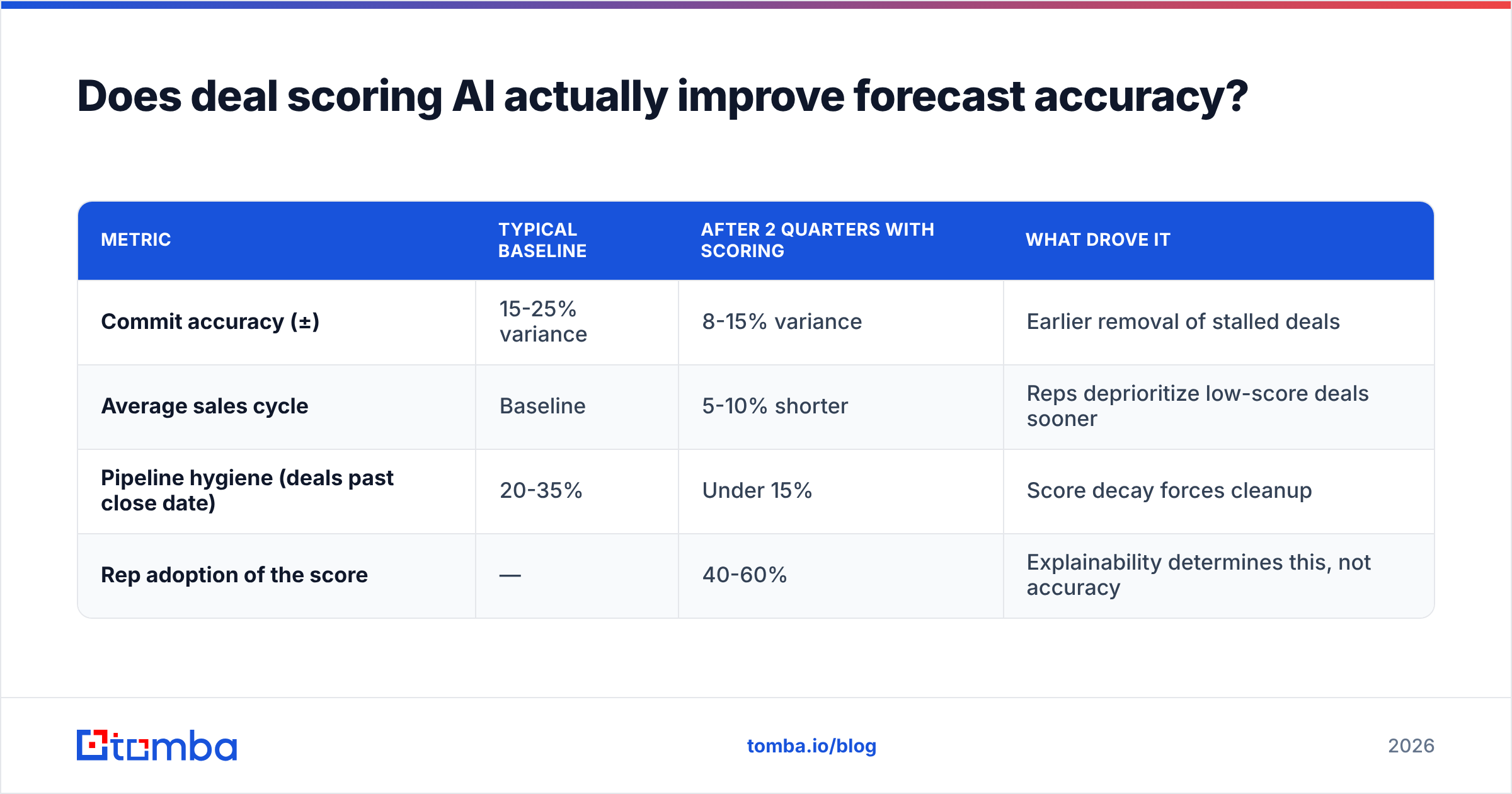
Realistic expectations from teams that have run this for more than two quarters:
| Metric | Typical baseline | After 2 quarters with scoring | What drove it |
|---|---|---|---|
| Commit accuracy (±) | 15-25% variance | 8-15% variance | Earlier removal of stalled deals |
| Average sales cycle | Baseline | 5-10% shorter | Reps deprioritize low-score deals sooner |
| Pipeline hygiene (deals past close date) | 20-35% | Under 15% | Score decay forces cleanup |
| Rep adoption of the score | — | 40-60% | Explainability determines this, not accuracy |
That last row is the one to watch. A model that is 80% accurate and shows its reasoning beats a model that is 88% accurate and shows a bare number, because reps only act on scores they can argue with. Any evaluation that ignores explainability is measuring the wrong thing. Gartner's ongoing coverage of sales technology adoption makes the same point repeatedly: adoption, not algorithmic quality, is the binding constraint on most revenue-tech ROI.
Why do most deal scoring rollouts fail?#
Four failure modes, in descending order of frequency.
1. The training data is your CRM, and your CRM is thin. If 60% of your opportunities have one contact attached, the model cannot learn anything about buying-committee coverage — the strongest signal available to it. It will overweight whatever it can see, usually stage age, and produce a glorified staleness counter. Fixing this means systematically attaching the real committee to every deal: find the VP of Ops, the security reviewer, the finance approver. A domain search pass across the account's domain plus email verification on the results turns a one-contact deal into a five-contact deal that the model can actually reason about.
2. Stage definitions have no exit criteria. If "Discovery" means whatever each rep decides, stage-based features are noise. Write exit criteria before you write a model.
3. Nobody owns the score. Deal scoring lives between sales leadership, RevOps, and data. When it belongs to all three it belongs to none. Assign one owner who reviews model drift monthly.
4. The score is treated as a verdict rather than a prompt. The correct use is "this deal scored 22, what does the rep know that the model doesn't?" The incorrect use is pulling forecast commit automatically. Teams that automate the second version lose rep trust in about six weeks.
There is a fifth, quieter failure: scoring a pipeline that is too small to matter. If you close 40 deals a year, a model trained on 40 outcomes is astrology. Spend that budget on generating more pipeline instead, and revisit scoring once you have a few hundred closed records.
How do you roll out deal scoring in 90 days?#
A sequence that works, assuming you already have a CRM with at least a year of closed history:
- Days 1-15 — Audit inputs. Measure contact coverage per opportunity, percentage of deals with a logged next step, stage definition clarity, and how many closed-lost records have a reason code. Anything below 70% completeness is a fix-first item.
- Days 16-35 — Enrich and verify. Backfill the buying committee on all open opportunities. Verify emails so activity capture actually logs against real people, and push enrichment through your Tomba API or CRM integration so it stays current rather than being a one-time cleanup.
- Days 36-50 — Pilot on one segment. Pick a single segment with enough volume, run the model in shadow mode, and do not show reps the score yet. Compare model predictions to actual outcomes weekly.
- Days 51-70 — Expose to managers only. Managers use scores in pipeline reviews. Collect every disagreement — those are your feature gaps.
- Days 71-90 — Open to reps with explanations on. Roll out only if managers found the score useful in at least half of reviews. Publish how the score is calculated. Track win rate by score band from day one so you can prove or disprove calibration in a quarter.
Shadow mode is the step most teams skip and the one that saves the project. Showing reps a miscalibrated score in week two is how you burn the initiative permanently.
What should you measure once it's live?#
Three numbers, reviewed monthly:
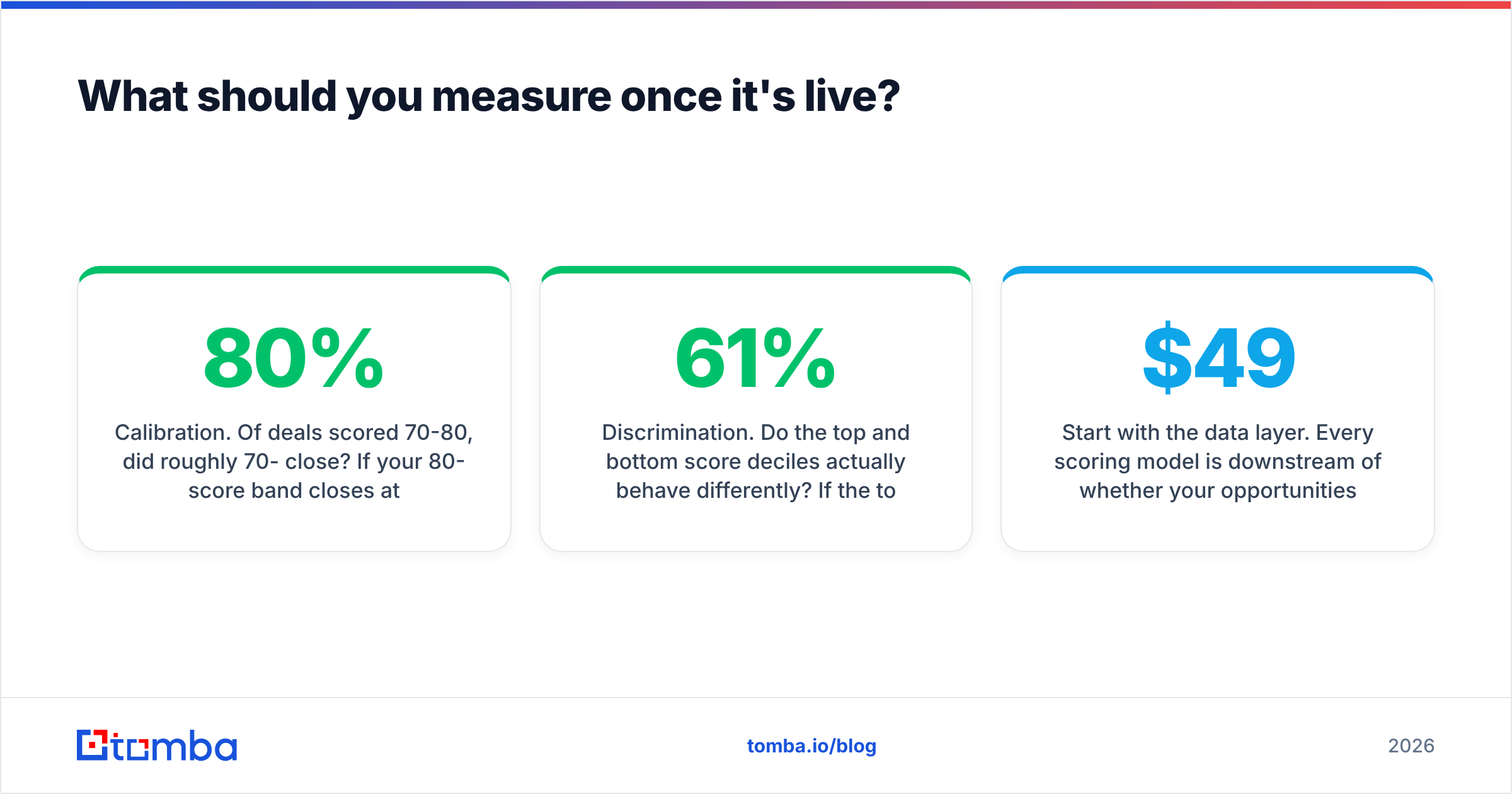
- Calibration. Of deals scored 70-80, did roughly 70-80% close? If your 80-score band closes at 45%, the model is overconfident and the forecast built on it is worse than a spreadsheet.
- Discrimination. Do the top and bottom score deciles actually behave differently? If the top decile closes at 61% and the bottom at 48%, the model is not separating anything useful.
- Action rate. What percentage of low-scored deals actually get closed out, reworked, or escalated within 14 days? If nothing changes, you bought a dashboard, not a system.
Deal scoring AI is a genuinely useful tool for teams with enough pipeline volume, clean stage definitions, and reasonably complete contact data. It is a very expensive placebo for teams without them. The order matters: data hygiene, then process clarity, then the model.
Start with the data layer. Every scoring model is downstream of whether your opportunities contain the real buying committee. If your deals are single-threaded because nobody could find the CFO's or the security lead's address, that's a data problem, not a modeling problem. Use the Tomba Email Finder to fill in the missing decision-makers on your open pipeline, verify them before they hit your CRM, and give whatever model you choose something honest to learn from. The free tier covers 25 searches a month; paid plans start at $49/mo, with full Tomba pricing available if you need bulk enrichment across a whole pipeline at once.
Related guides#
Ready to find emails that actually work?
Join 150,000+ professionals who stopped guessing and started sending. Free credits on signup — no credit card required.
Get the Tomba newsletter
Practical outbound tactics and product updates — once every two weeks.
About the author