Deal Sourcing for Private Equity Firms: A 2026 Playbook
Broker auctions are crowded and expensive. Here's how modern PE teams build proprietary deal flow in 2026 — channels, tech stack, outreach cadence, and the metrics that actually predict closed deals.
TL;DR
- Deal sourcing for private equity firms has split into two economies: crowded intermediated auctions where you pay a premium for access, and proprietary flow where you pay in time, data, and outbound discipline.
- Mid-market firms that build an in-house sourcing function typically screen 400–1,200 companies to close one platform deal. The funnel math, not the pitch, decides your hit rate.
- The modern sourcing stack is four layers: a target universe (databases + scrapers), a scoring layer, a contact layer (verified owner emails and mobiles), and a CRM that tracks touch history over years, not quarters.
- Contact data quality is the silent killer. A 25% bounce rate on founder emails does not just waste sends — it damages the sending domain you need for a five-year nurture cycle.
- Start narrow: one thesis, one geography, 300 named targets, and a 12-touch annual cadence. Breadth without depth produces noise that looks like activity.
What is deal sourcing for private equity firms?#
Deal sourcing is the process of identifying, qualifying, and building relationships with companies you might acquire — before a banker packages them into a competitive process. Think of it like a restaurant sourcing produce. You can buy at the wholesale market where every chef in the city is bidding on the same crates, or you can drive out to the farms, meet growers, and get first call when something exceptional comes up. The market is faster. The farms are cheaper and better.
In private equity terms, the wholesale market is the intermediated auction: a sell-side banker runs a process, sends a teaser to 80 sponsors, and price discovery does what price discovery does. The farm relationships are proprietary flow: founder-owned businesses you found yourself, cultivated for two years, and approached before the owner ever called an advisor.
Both matter. Almost no firm runs on 100% proprietary deals, and firms that claim to usually mean "limited process." But the mix determines your entry multiple, and entry multiple determines a large share of your returns. Bain's annual private equity research has tracked the same pressure for years: more dry powder chasing a finite universe of quality assets, which compresses returns for anyone who only shows up when the book arrives.
Why has sourcing become the bottleneck instead of capital?#
Capital is not scarce. Attention from good founders is.
Three things changed the math:
- Deal teams got bigger, target universes did not. More associates dialing the same lower-middle-market manufacturers means the average owner of a $12M EBITDA business now hears from dozens of sponsors a year. Response rates fall accordingly.
- Data commoditized. Everyone can pull a list of US companies with 50–500 employees in industrial services. The list is not the edge anymore. What you do in month four of a relationship is.
- Hold periods lengthened, so sourcing became a multi-year nurture problem. The company you email today may not transact for 36 months. That means your outreach infrastructure needs to survive three years of domain reputation, list decay, and staff turnover.
- Founders got sophisticated. Owners compare sponsors on Reddit, on operator Slacks, and with their peers who already exited. A generic "we'd love to learn about your business" email reads as exactly what it is.
What are the main deal sourcing channels, and how do they compare?#
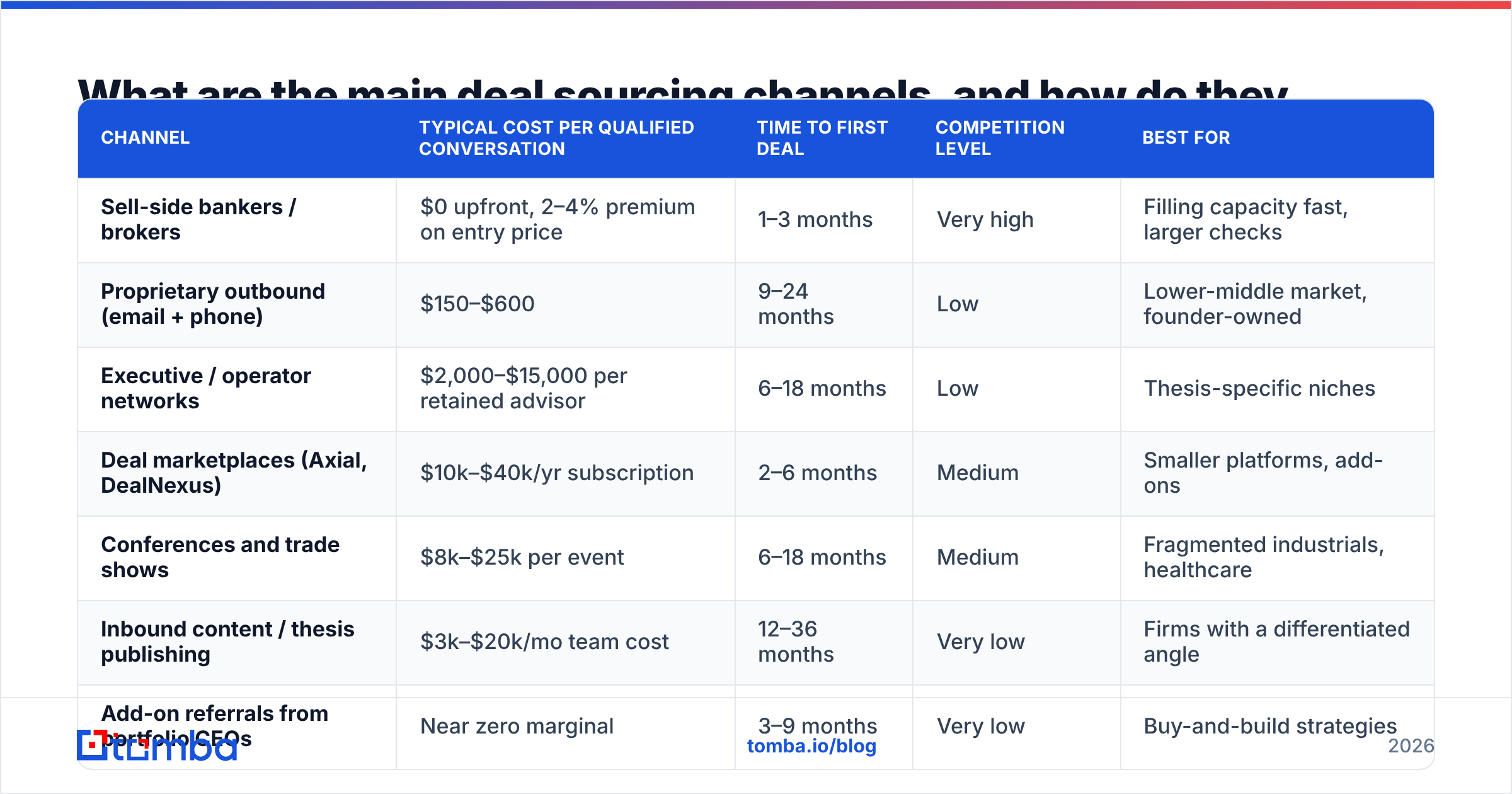
There is no single best channel. There is a portfolio, and the right allocation depends on fund size, thesis breadth, and how many bodies you can put on sourcing.
| Channel | Typical cost per qualified conversation | Time to first deal | Competition level | Best for |
|---|---|---|---|---|
| Sell-side bankers / brokers | $0 upfront, 2–4% premium on entry price | 1–3 months | Very high | Filling capacity fast, larger checks |
| Proprietary outbound (email + phone) | $150–$600 | 9–24 months | Low | Lower-middle market, founder-owned |
| Executive / operator networks | $2,000–$15,000 per retained advisor | 6–18 months | Low | Thesis-specific niches |
| Deal marketplaces (Axial, DealNexus) | $10k–$40k/yr subscription | 2–6 months | Medium | Smaller platforms, add-ons |
| Conferences and trade shows | $8k–$25k per event | 6–18 months | Medium | Fragmented industrials, healthcare |
| Inbound content / thesis publishing | $3k–$20k/mo team cost | 12–36 months | Very low | Firms with a differentiated angle |
| Add-on referrals from portfolio CEOs | Near zero marginal | 3–9 months | Very low | Buy-and-build strategies |
The numbers above are directional ranges from mid-market sponsors, not universal truths — your industry, geography, and check size move them considerably. What holds across firms is the shape: intermediated channels are fast and expensive at the point of purchase; proprietary channels are slow and cheap, and their cost is front-loaded into infrastructure.
The strategic read is simple. If your fund needs to deploy in 24 months, you cannot build a proprietary engine and expect it to carry you. If your fund wants to buy at 6.5x while your peers pay 9x, you had to start building it two years ago.
What does a modern deal sourcing stack actually look like?#
Four layers. Each one fails differently.
Layer 1 — Target universe. Where the raw list of companies comes from. PitchBook, Grata, Sourcescrub, SIC/NAICS pulls, state registration filings, trade association member directories, and industry-specific scrapes. Association directories are underrated: a 900-member roofing contractors association is a cleaner thesis universe than any generic database filter.
Layer 2 — Scoring and prioritization. Turning 8,000 companies into 300 you will actually work. Signals that matter for lower-middle-market PE: owner age and tenure, absence of prior institutional capital, headcount growth over 24 months, website tech-stack modernization (a proxy for reinvestment), hiring for a CFO or controller (a proxy for professionalization), and local news mentions of expansion or succession.
Layer 3 — Contact resolution. Getting from "Midwest Precision Components LLC" to "Dave Kowalski, owner, dave@midwestprecision.com, mobile 555-0148." This is where most in-house sourcing programs quietly break. Company data is abundant; verified, deliverable contact data for privately held businesses without marketing departments is not.
Layer 4 — Relationship system. A CRM configured for multi-year nurture, not quarterly pipeline. Fields for owner birthday, kids' names if they told you, the plant tour you took in 2024, the reason they said no last time. If your CRM cannot answer "what happened the last four times we touched this company," you are restarting the relationship every year.
Why does contact data quality decide whether outbound sourcing works?#
Because the private companies you most want to buy are the ones with the worst public contact footprint.
A $30M-revenue family-owned distributor does not have a marketing site with a team page. Its owner's email follows a pattern nobody published. Its info@ inbox is monitored by a receptionist who deletes anything that smells like a pitch. Meanwhile, the venture-backed SaaS company you don't want has a perfectly enriched profile in every database on the market.
That inversion has consequences:
- Bounce rates compound into deliverability damage. Send 500 emails at a 22% bounce rate and mailbox providers start treating your domain as a list-buyer. Your next campaign underperforms even with clean data. Run every list through an email verifier before the first send, not after the first complaint.
- Wrong-contact outreach burns the account permanently. Emailing a sales rep about acquiring the company is not a neutral event. It gets forwarded to the owner with a snide comment, and you have spent your one first impression.
- Stale data hides good targets. The owner who sold last year is still listed. The successor CEO who is actively looking for a partner is not.
For a target universe of a few hundred companies, resolve contacts one at a time and pay attention. Use a domain search to pull the email pattern and the named people at a company domain, then verify before you send. For a universe of several thousand — typical for buy-and-build add-on scans — run it through a bulk email finder and accept that you will triage.
If you are building this into your own scoring pipeline rather than working from spreadsheets, the Tomba API lets you resolve and verify contacts programmatically as new companies enter your universe, which keeps enrichment continuous instead of a quarterly cleanup project.
How do you compare data providers for private-company sourcing?#
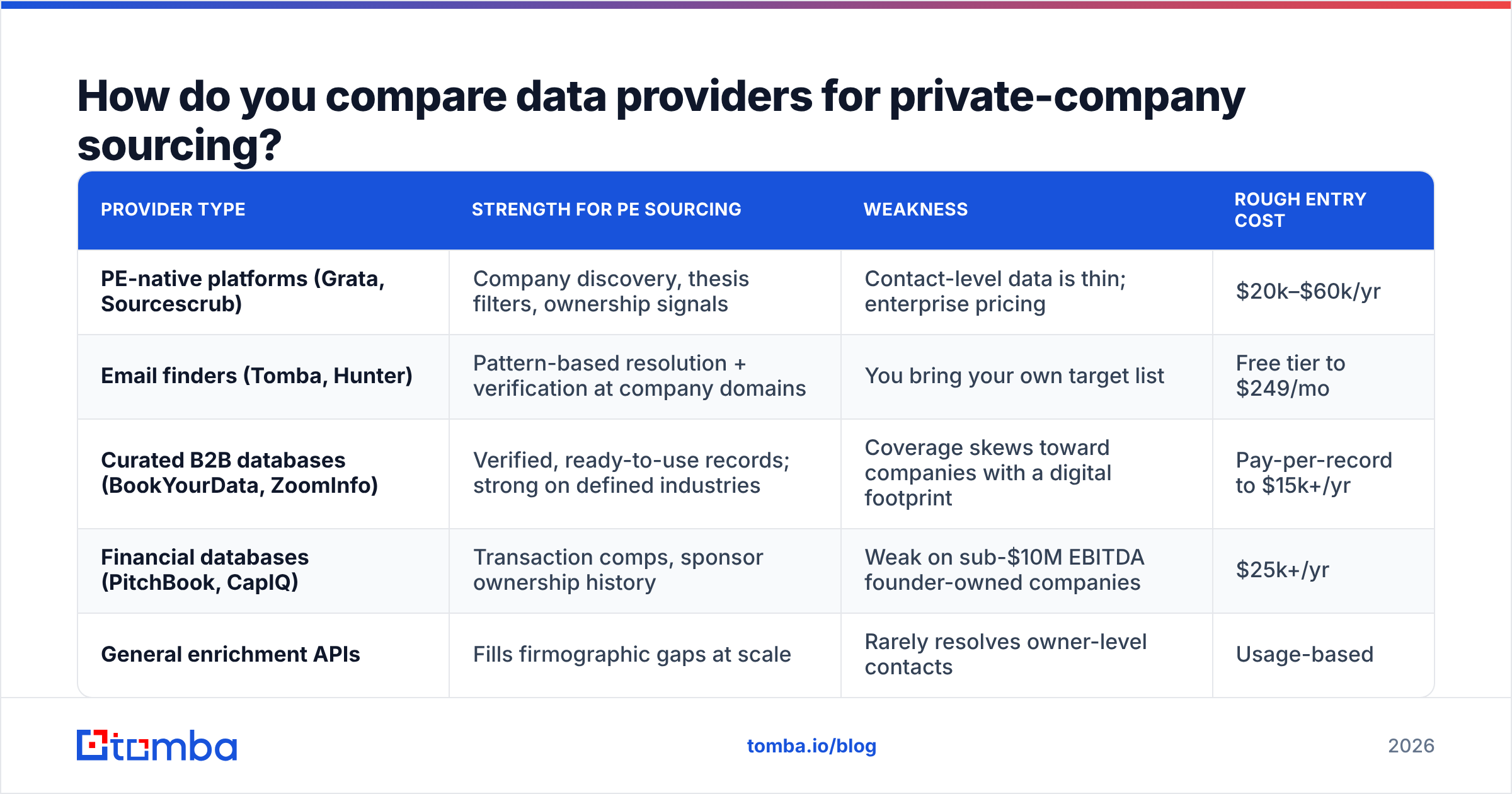
The vendor landscape splits by what they are actually good at. Comparing them on "number of contacts" is close to meaningless — coverage of your thesis universe is the only number that matters, and you can only learn it with a test list.
| Provider type | Strength for PE sourcing | Weakness | Rough entry cost |
|---|---|---|---|
| PE-native platforms (Grata, Sourcescrub) | Company discovery, thesis filters, ownership signals | Contact-level data is thin; enterprise pricing | $20k–$60k/yr |
| Email finders (Tomba, Hunter) | Pattern-based resolution + verification at company domains | You bring your own target list | Free tier to $249/mo |
| Curated B2B databases (BookYourData, ZoomInfo) | Verified, ready-to-use records; strong on defined industries | Coverage skews toward companies with a digital footprint | Pay-per-record to $15k+/yr |
| Financial databases (PitchBook, CapIQ) | Transaction comps, sponsor ownership history | Weak on sub-$10M EBITDA founder-owned companies | $25k+/yr |
| General enrichment APIs | Fills firmographic gaps at scale | Rarely resolves owner-level contacts | Usage-based |
Most firms end up with two or three of these, not one. A common mid-market pattern: a PE-native platform for discovery, a contact layer for resolution and verification, and a financial database for diligence and comps. Tomba pricing starts with a free tier at 25 searches per month, then $49/mo Starter, $99/mo Growth, and $249/mo Pro — which makes it cheap enough to run a coverage test against 100 of your real targets before committing to anything.
Run that test. Take 100 companies you already have owner contacts for, strip them, and see which provider reconstructs them correctly. Coverage claims in a sales deck are not evidence.
What outreach cadence actually gets a founder to reply?#
Not the four-email sequence you use for SaaS demos. Owner-operators are not buyers in a funnel; they are people making the largest financial decision of their lives, on their own timeline.
The cadences that work in lower-middle-market sourcing share a structure:
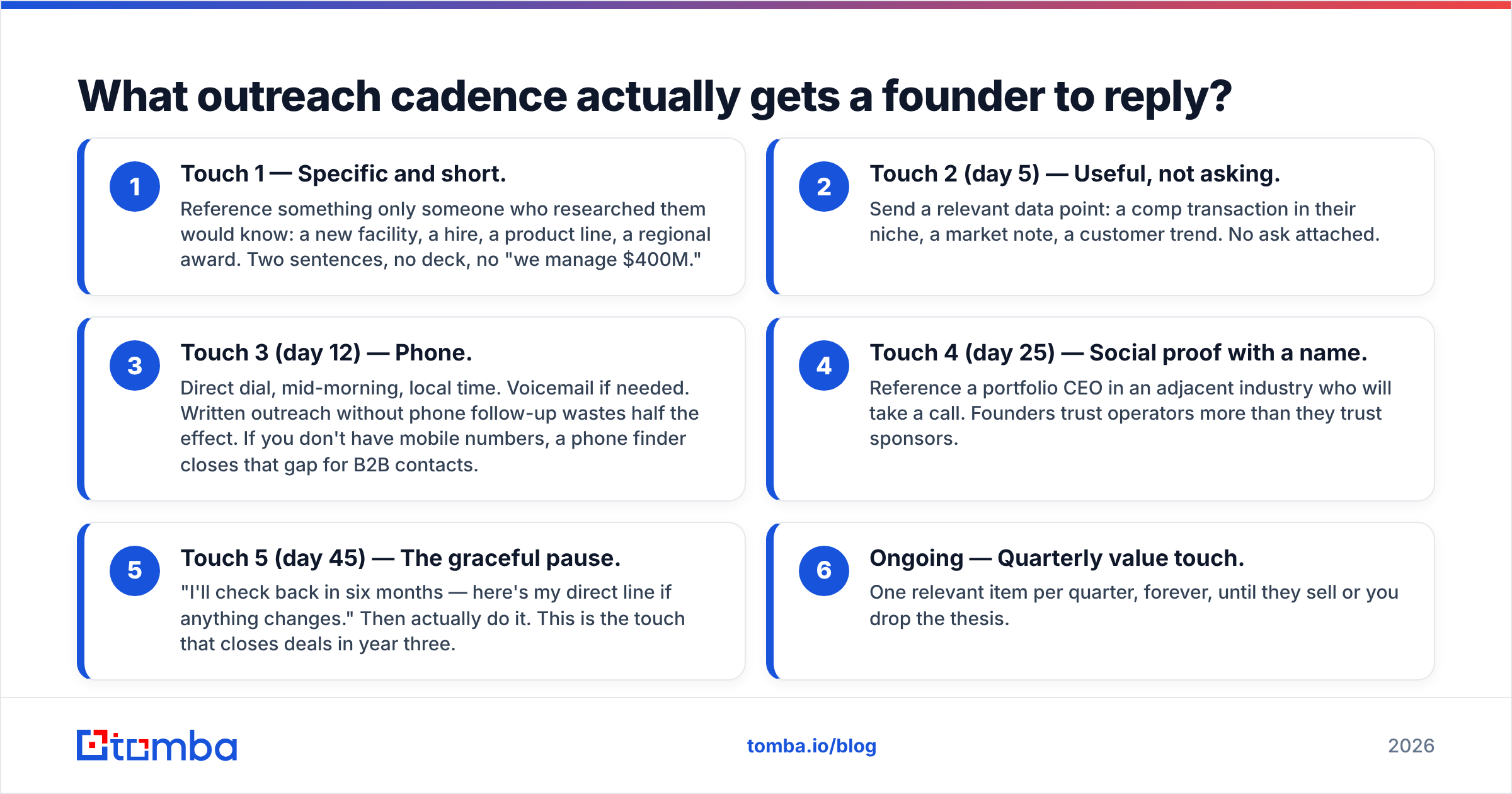
- Touch 1 — Specific and short. Reference something only someone who researched them would know: a new facility, a hire, a product line, a regional award. Two sentences, no deck, no "we manage $400M."
- Touch 2 (day 5) — Useful, not asking. Send a relevant data point: a comp transaction in their niche, a market note, a customer trend. No ask attached.
- Touch 3 (day 12) — Phone. Direct dial, mid-morning, local time. Voicemail if needed. Written outreach without phone follow-up wastes half the effect. If you don't have mobile numbers, a phone finder closes that gap for B2B contacts.
- Touch 4 (day 25) — Social proof with a name. Reference a portfolio CEO in an adjacent industry who will take a call. Founders trust operators more than they trust sponsors.
- Touch 5 (day 45) — The graceful pause. "I'll check back in six months — here's my direct line if anything changes." Then actually do it. This is the touch that closes deals in year three.
- Ongoing — Quarterly value touch. One relevant item per quarter, forever, until they sell or you drop the thesis.
The firms that win proprietary deals are usually the ones on touch 14 when the owner's accountant finally says "you should think about your options."
What metrics should you track for a sourcing program?#
Stop tracking emails sent. Track the conversion joints where the funnel actually leaks:
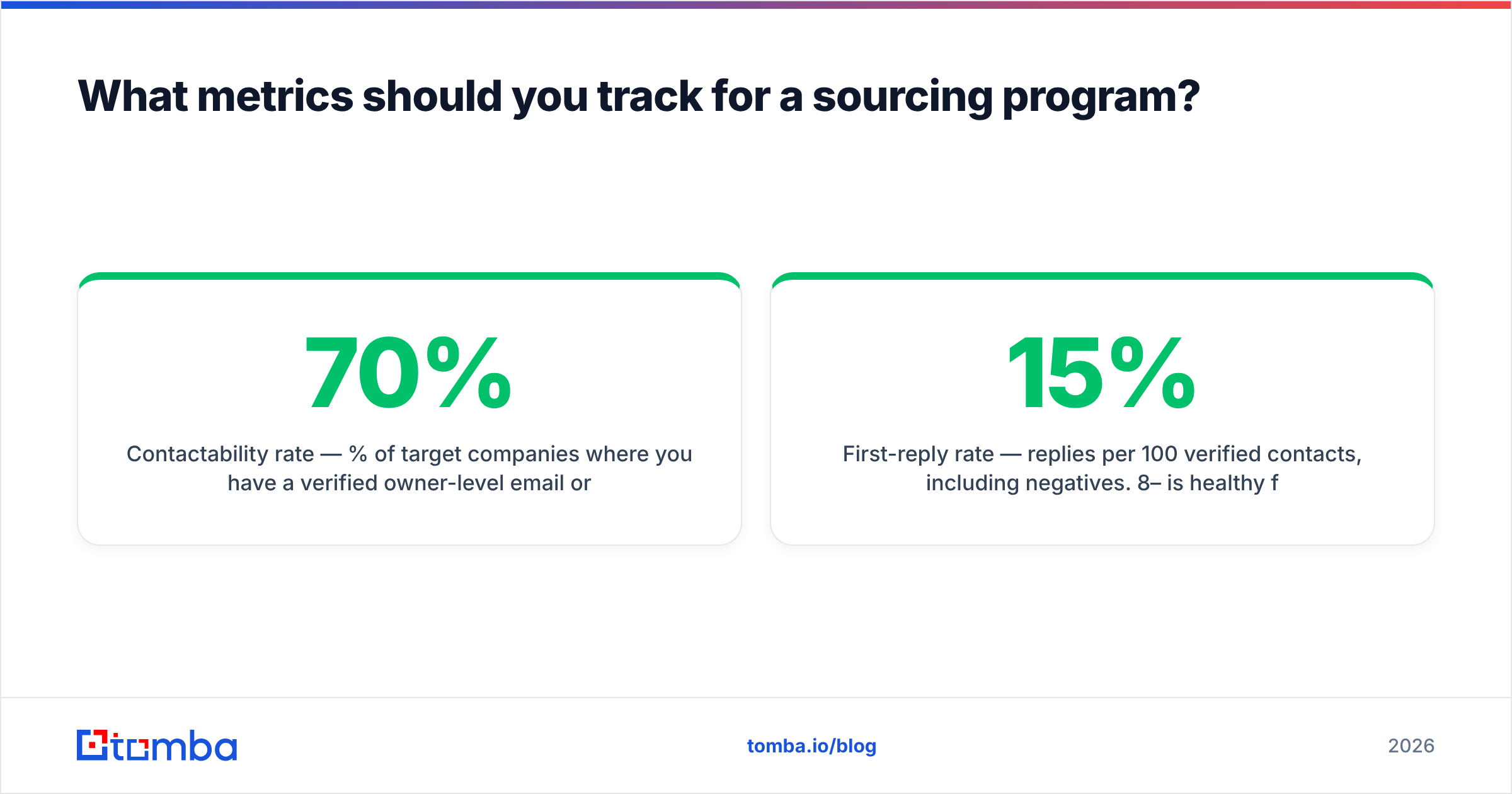
- Contactability rate — % of target companies where you have a verified owner-level email or mobile. Below 70%, your problem is data, not messaging.
- First-reply rate — replies per 100 verified contacts, including negatives. 8–15% is healthy for a well-researched owner-level campaign; 2% means your targeting or your first line is wrong.
- Conversation-to-meeting rate — how many replies turn into a real call.
- Meeting-to-NDA/IOI rate — the honest measure of thesis fit.
- Touches per closed deal — usually 20+ across 18–36 months for true proprietary deals. Knowing your number stops partners from killing the program in month nine.
- Cost per platform deal sourced — total sourcing headcount plus tooling, divided by platform closings. Compare it against the premium you'd pay in a banked process. This is the number that justifies the whole function to the investment committee.
If you want that funnel to be measurable at all, contact records need to stay current. Layer periodic data enrichment over your CRM so that title changes, domain migrations, and departures surface before an associate wastes a quarter emailing a person who left in 2024.
Is proprietary sourcing worth the investment for a smaller fund?#
Yes, but only if you narrow hard.
A three-person deal team cannot cover eight theses across North America. It can own one: "HVAC service businesses in the Southeast with $2–8M EBITDA and an owner over 58." That universe is maybe 400 companies. You can name every one of them, know who owns them, and touch each one quarterly with two people and a good stack.
The compounding is real. Year one produces awareness and a handful of conversations. Year two produces a couple of limited processes where you are one of two bidders. Year three produces the call that starts with "we've been getting letters for years but I kept your note." That is what a two- or three-turn discount on entry multiple actually looks like operationally — years of unglamorous follow-up, not a clever email.
The failure mode is always the same: a firm buys a database, blasts 5,000 companies, gets 11 replies and 4 bounced-domain warnings, declares outbound dead, and goes back to waiting for teasers. The channel didn't fail. The narrowness, data quality, and patience did.
Where should you start this quarter?#
Pick one thesis. Build a named list of 200–400 companies. Resolve and verify owner-level contacts for every one of them — that step alone will take longer than you expect and will determine everything downstream. Write a first touch you would not be embarrassed to have forwarded to the owner's spouse. Then commit to 12 touches a year for three years and instrument the funnel so you can prove what's working.
If you're at the contact-resolution step and staring at a list of privately held companies with no team pages and no published emails, the Tomba Email Finder is built for exactly that job: give it a company domain and an owner's name, get back a verified, deliverable address instead of a guess. Start on the free tier with 25 searches, test it against 25 targets you already have contacts for, and see how much of your list it recovers before you spend a dollar. The rest of the sourcing program only works if this layer does.
Related guides#
Ready to find emails that actually work?
Join 150,000+ professionals who stopped guessing and started sending. Free credits on signup — no credit card required.
Get the Tomba newsletter
Practical outbound tactics and product updates — once every two weeks.
About the author