Dealfront Pros and Cons: An Honest 2026 Review for B2B Teams
Dealfront merges Leadfeeder and Echobot into one European GTM platform. Here's what it actually does well, where it falls short, and when a cheaper email finder beats it.
Most Dealfront pros and cons come down to one trade-off. You get deep European company data. You also get quote-only pricing and thin contact data. Here's the short version.
TL;DR
- Dealfront is Leadfeeder plus Echobot, merged into one go-to-market platform. It aims at DACH and Nordic markets.
- Its best pro is European data depth. Trade register records, financial filings, and GDPR-safe processing beat most US-built databases.
- Its worst cons are quote-only pricing, a steep learning curve across five modules, and thin data outside Europe.
- Contact-level email data is the weakest layer. Teams that mainly need verified work emails add a dedicated email finder.
- Buy it if you sell into Germany, Austria, Switzerland, or the Nordics. Skip it if you need cheap contact data at global scale.
What is Dealfront and who is it actually for?#
Dealfront is a go-to-market platform. It was formed in 2022, when Finland's Leadfeeder merged with Germany's Echobot. Think of it as two halves of a funnel welded together. Echobot brought a deep European company database built from trade registers, news, and public filings. Leadfeeder brought reverse-IP website visitor tracking. The suite now sells as five modules — Target, Datacare, Connect, Promote, and Leadfeeder — under one contract.
The buyer it wants is a mid-market or enterprise B2B team selling into continental Europe. That focus matters more than any feature list. Dealfront's edge is not that it beats Apollo or ZoomInfo at their own game. Its edge is source documents. US vendors license that European data thinly, or skip it. Say your ICP is "German manufacturers with 50-500 staff and revenue above €10M." Dealfront can filter on data its American rivals simply don't hold.
If your ICP is "US SaaS companies," the math flips hard. You pay a European-data premium for a database that thins out fast in North America and Asia.

What are the main pros of Dealfront?#
Here's what genuinely works, based on how teams use it day to day.
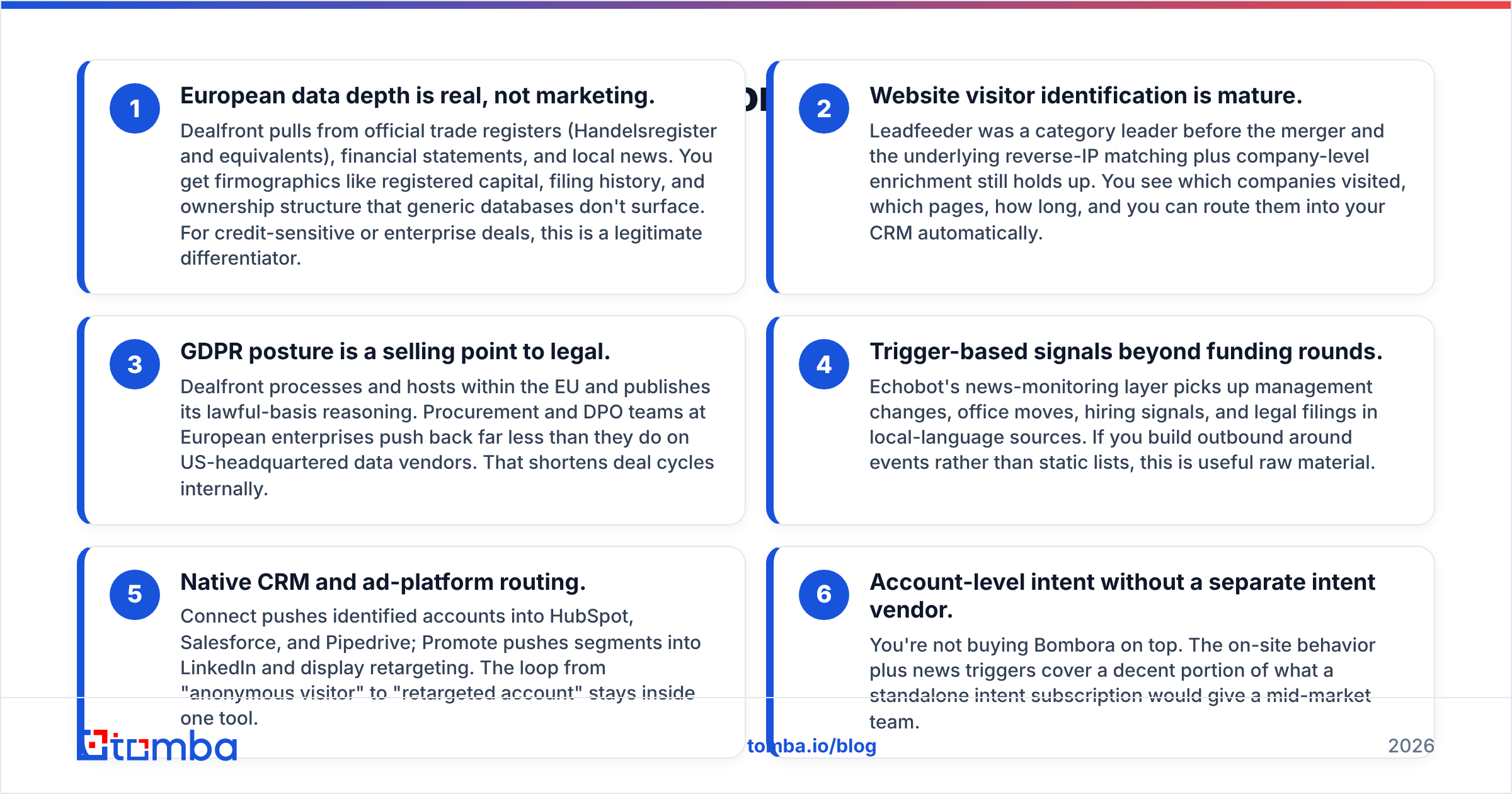
European data depth is real, not marketing. Dealfront pulls from official trade registers (Handelsregister and its local twins), financial statements, and local news. You get firm details like registered capital, filing history, and ownership. Generic databases don't surface that. For credit-sensitive or large deals, it's a real edge.
Website visitor ID is mature. Leadfeeder led the category before the merger. The reverse-IP matching still holds up. You see which firms visited, which pages, and how long they stayed. You can route them into your CRM automatically.
GDPR posture sells well to legal. Dealfront hosts and processes inside the EU. It also publishes its lawful-basis reasoning. Buying teams and DPOs at European firms push back far less than they do on US vendors. That shortens your internal deal cycle.
Triggers beyond funding rounds. Echobot's news layer picks up leadership changes, office moves, hiring, and court filings in local-language sources. If you build outbound around events rather than static lists, this is useful raw material.
Native CRM and ad routing. Connect pushes named accounts into HubSpot, Salesforce, and Pipedrive. Promote pushes segments into LinkedIn and display ads. The loop from anonymous visitor to retargeted account stays in one tool.
Account-level intent, no second vendor. You don't buy Bombora on top. On-site behavior plus news triggers cover much of what a standalone intent tool gives a mid-market team.
What are the biggest cons of Dealfront?#
The problems cluster in four areas. They are why a lot of evaluations stall.
Pricing is quote-only and lands high. Dealfront does not publish a price list for the full suite. Leadfeeder-only plans once started near €99/month. The merged platform sells as a yearly contract, with per-module and per-seat parts. Reviews on G2 flag sticker shock again and again. Buyers also struggle to forecast cost as usage grows. If you want a number before a sales call, you won't get one.
The suite feels like a merger, because it is. Target, Datacare, Connect, Promote, and Leadfeeder don't share one UX. Filters behave differently between modules. Users report re-learning the screens when they move from prospecting to visitor data. Onboarding takes real time, so budget for it.
Coverage outside Europe drops off. North American and Asian company records exist, but they run shallow. Contact data thins even further. Teams running global outbound buy a second data source anyway. That erodes the "one platform" pitch.
Contact data is the weak layer. Company intelligence is excellent. Work emails and direct dials are the part users top up most. This is where a dedicated email finder does more per dollar. You already know the account from Dealfront. You just need a verified inbox for the four people who matter.
Contracts don't flex. Annual terms, few month-to-month options, and credits that don't roll over are common gripes. If your outbound volume is seasonal, that mismatch costs money.
How does Dealfront compare to the alternatives?#
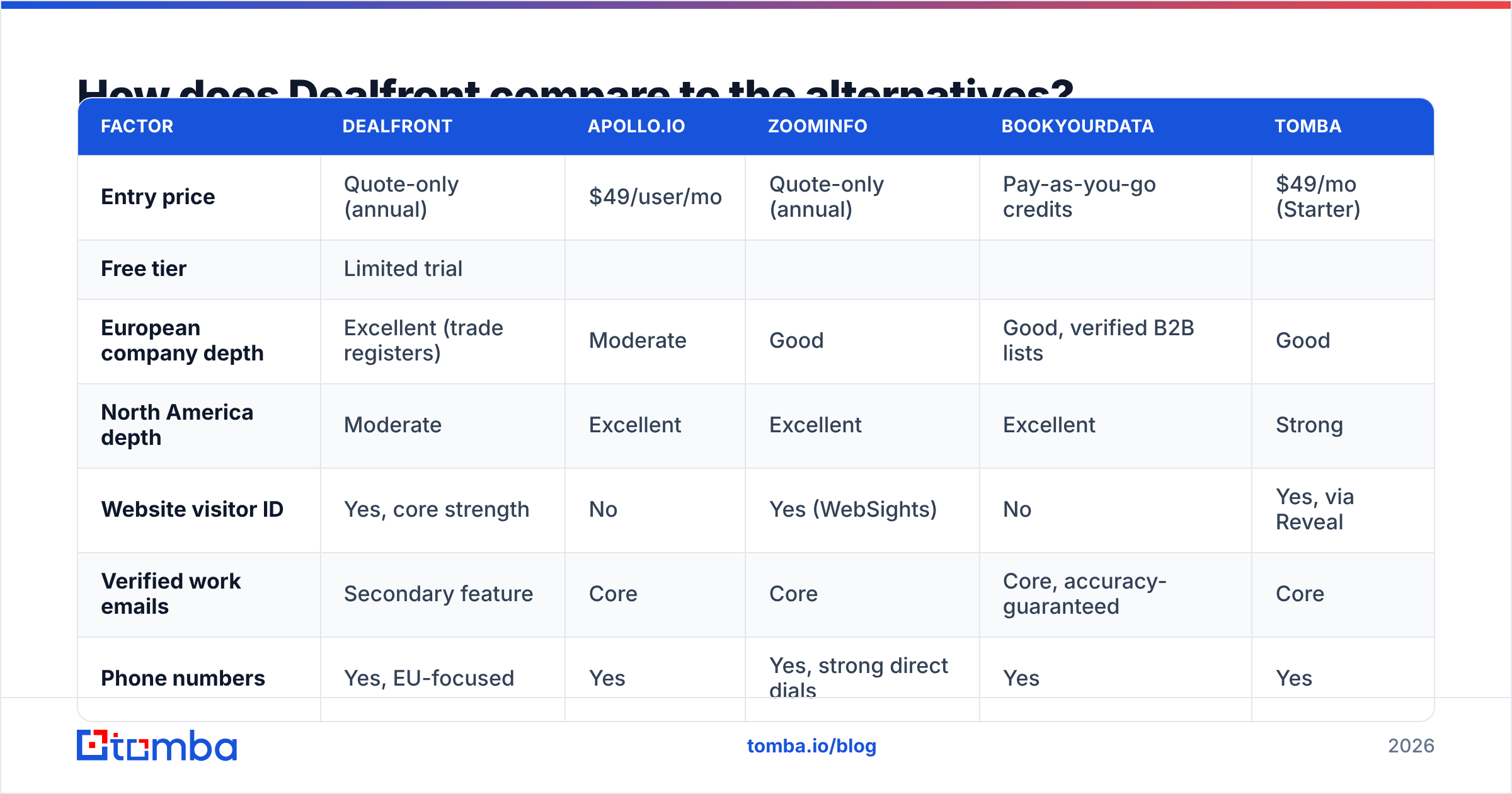
Different tools solve different slices of the same problem. Here's the honest layout.
| Factor | Dealfront | Apollo.io | ZoomInfo | BookYourData | Tomba |
|---|---|---|---|---|---|
| Entry price | Quote-only (annual) | $49/user/mo | Quote-only (annual) | Pay-as-you-go credits | $49/mo (Starter) |
| Free tier | Limited trial | ||||
| Yes, capped credits | No | Free sample credits | Yes, 25 searches/mo | ||
| European company depth | Excellent (trade registers) | Moderate | Good | Good, verified B2B lists | Good |
| --- | --- | --- | --- | --- | --- |
| North America depth | Moderate | Excellent | Excellent | Excellent | Strong |
| Website visitor ID | Yes, core strength | No | Yes (WebSights) | No | Yes, via Reveal |
| Verified work emails | Secondary feature | Core | Core | Core, accuracy-guaranteed | Core |
| Phone numbers | Yes, EU-focused | Yes | Yes, strong direct dials | Yes | Yes |
| GDPR hosting in EU | Yes | Partial | Partial | Compliant lists | Yes |
| API access | Yes, higher tiers | Yes | Yes, enterprise | Yes | Yes, all paid plans |
| Best fit | EU enterprise GTM | US SMB outbound | US enterprise | Clean prebuilt B2B lists | Accurate email discovery |
A few notes on that table. BookYourData works on a different model. You buy verified, prebuilt contact lists with an accuracy guarantee, rather than renting a search tool. That suits teams who want a clean list today, with no platform to learn. Apollo wins on North American breadth and self-serve pricing. ZoomInfo wins on direct dials and enterprise integrations, at enterprise cost. Tomba sits in the "find and verify the exact emails you need" lane, with published Tomba pricing instead of a quote process.
Is Dealfront worth the price in 2026?#
It depends on what you're really buying: the European data, or the visitor ID. The Dealfront pros and cons only settle once you name which one. Decide that before the first sales call.
If you're buying European company data, the value case holds. Trade register records, local-language news, and EU hosting are hard to copy by stacking cheaper tools. One closed enterprise deal in DACH usually pays for the year. The compliance cover alone saves weeks of legal review at large European accounts.
If you're buying visitor ID alone, you're likely overpaying. Several vendors sell that capability at a much lower entry price. That includes website visitor reveal tools, which name anonymous traffic and hand you contacts directly. Paying suite prices for one module is the most common regret in Dealfront reviews.
If you're buying contact data, look elsewhere or top it up. The math is simple. A verified work email costs cents from a specialist tool. Bundling it into a five-figure yearly contract does not make it more accurate.
Many European teams land on a middle path. Keep Dealfront for account ID and signals. Then run the shortlist through a domain search to pull the real decision-maker emails. Run an email verifier before anything hits your sequencer. You pay for the pricey tool where it's truly different, and the cheap tool where accuracy per dollar wins.
Dealfront pros and cons: what do real users say?#
Patterns across public review sites are consistent enough to be useful.
What users praise: the quality of German and Nordic company records, fast setup of visitor tracking, and responsive support. Marketing teams like that Promote closes the loop from named visitor to ad audience, with no extra integration.
What users complain about: cost transparency and the learning curve across modules. Most of all, they flag thin data outside core European markets. A recurring theme on Capterra and G2 is that the tool oversells breadth. Its depth in Europe is very real. The rest is not.
What reviews tend to miss: reverse-IP tracking has a hard ceiling. Remote staff on home IPs, VPN traffic, and phone visitors are much harder to match. Match rates of 20-40% of total traffic are normal for the whole category. That is not a Dealfront flaw. Still, buyers expect near-total ID, and they end up let down.
If you want to check the vendor's own claims, dealfront.com publishes module-level docs. During the trial, ask for match-rate benchmarks on your own domain. Don't settle for category averages.
How should you evaluate Dealfront against your stack?#
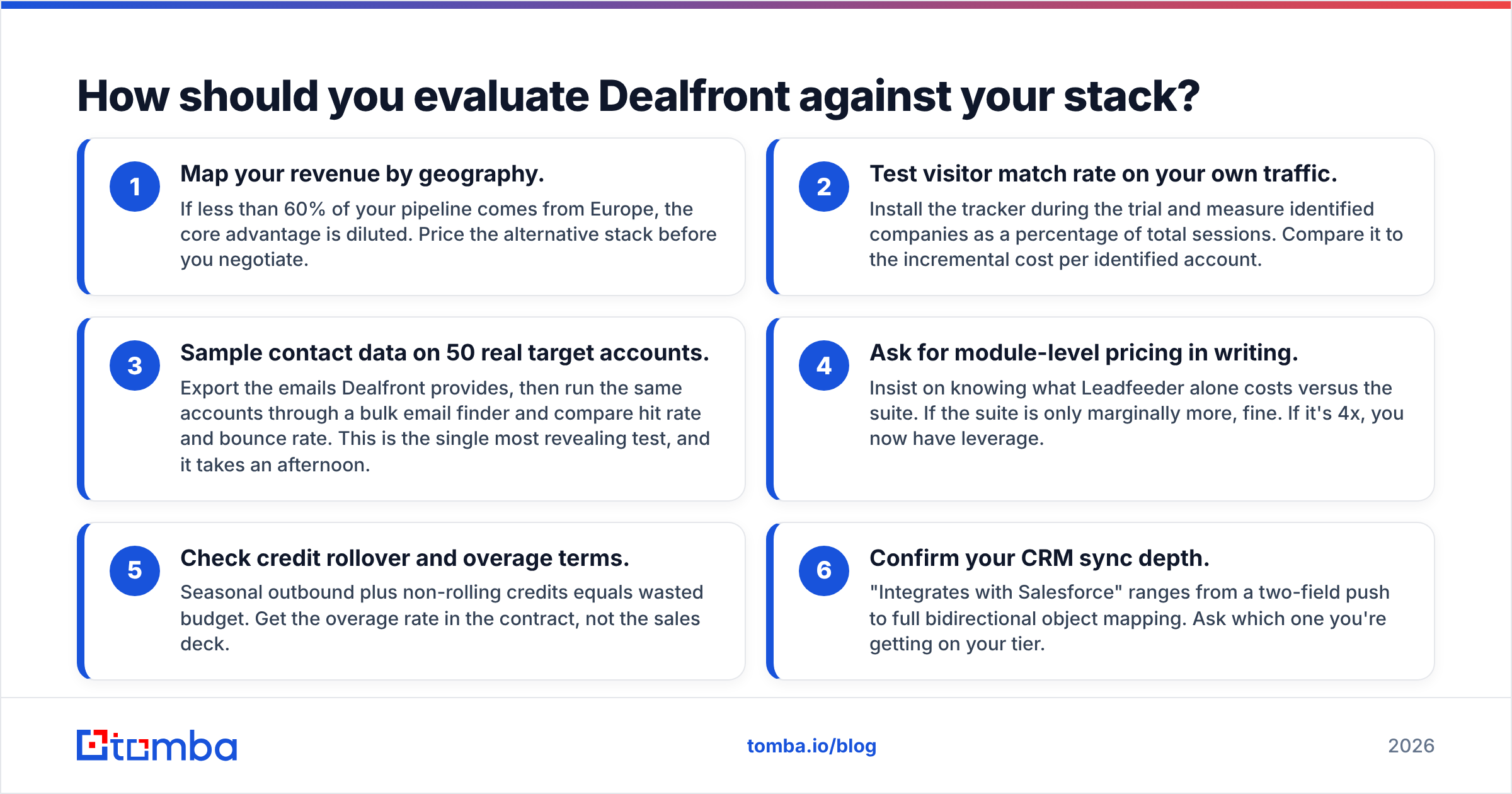
Run this checklist before you sign a yearly contract.
Map your revenue by geography. If less than 60% of your pipeline comes from Europe, the core edge is diluted. Price the other stack before you negotiate.
Test visitor match rate on your own traffic. Install the tracker during the trial. Measure named companies as a share of total sessions. Compare that to the extra cost per named account.
Sample contact data on 50 real target accounts. Export the emails Dealfront gives you. Run the same accounts through a bulk email finder. Compare hit rate and bounce rate. This one test takes an afternoon and tells you the most.
Ask for module-level pricing in writing. Insist on what Leadfeeder alone costs versus the suite. If the suite is barely more, fine. If it's 4x, you now have leverage.
Check credit rollover and overage terms. Seasonal outbound plus non-rolling credits equals wasted budget. Get the overage rate in the contract, not the sales deck.
Confirm your CRM sync depth. "Integrates with Salesforce" can mean a two-field push, or full two-way mapping. Ask which one your tier gets.
Which teams should choose Dealfront — and which shouldn't?#
Choose Dealfront if: you sell enterprise or upper-mid-market deals into DACH or the Nordics. Your legal team screens data vendors hard. You run inbound content and want to name anonymous account traffic. And you have budget for a yearly platform deal plus onboarding time.
Choose something else if: your market is mostly North America. Or you need self-serve pricing you can predict. Or your main gap is verified emails, not account discovery. Or you're a small team that must be productive in a week, not a quarter.
Here's the uncomfortable truth about most GTM platform buys. Teams buy the suite and use one module. Dealfront is no exception. Weigh the Dealfront pros and cons module by module. If you only need one of the five, buy the point solution and keep the difference.
Get accurate contact data without the annual contract#
Account data tells you which company to chase. It doesn't put your message in front of the person who signs. That last step turns a company name into a verified, deliverable work email. It's where most outbound loses its money. It's also the layer Dealfront handles least well.
Tomba's Email Finder does that one job properly. Enter a domain and a name. Get a verified work email with a confidence score, backed by live SMTP checks and open data sources. Pricing is published, not quoted: a free tier with 25 searches a month, Starter at $49/mo, Growth at $99/mo, and Pro at $249/mo. API access comes with every paid plan. Start free, run your Dealfront shortlist through it, and compare the bounce rates yourself.
Related guides#
Ready to find emails that actually work?
Join 150,000+ professionals who stopped guessing and started sending. Free credits on signup — no credit card required.
Get the Tomba newsletter
Practical outbound tactics and product updates — once every two weeks.
About the author