Dealfront Reviews 2026: Honest Pros, Cons, and Real Costs
An independent look at Dealfront in 2026: where its European B2B data and visitor identification actually deliver, where the pricing and contract terms bite, and which alternatives fit better.
Most Dealfront reviews are written long before the first renewal invoice lands. This one is not. Here is what Dealfront reviews on G2 and Capterra agree on, what they leave out, and who should skip the tool.
TL;DR
- Dealfront is the 2022 merger of Leadfeeder and Echobot. It is the strongest B2B data platform for DACH and Nordic markets. Its German, Austrian, and Swiss records come from commercial registers. Most US-built databases never touch those.
- The loudest complaint in Dealfront reviews is commercial, not technical. Pricing is not public. Contracts run for a year. Renewal quotes jump as your visitor volume grows.
- Visitor ID is company-level, not person-level. You will not get names or emails of single visitors. In the EU, that limit is deliberate, and it is legally sound.
- Contact coverage outside Europe is thin. Teams selling into North America add a dedicated email finder.
- Best fit: mid-market EU sales teams that need register-grade firmographics plus intent. Worst fit: small teams that need 500 verified emails this week for under $100.
What is Dealfront and who actually uses it?#
Dealfront is a European go-to-market platform. Two firms merged to build it in 2022. Leadfeeder, from Finland, did website visitor identification. Echobot, from Germany, did B2B company data. The product calls itself "the go-to-market platform for Europe." That claim is fair. It was built on European data sources and European privacy law, not retrofitted for them.
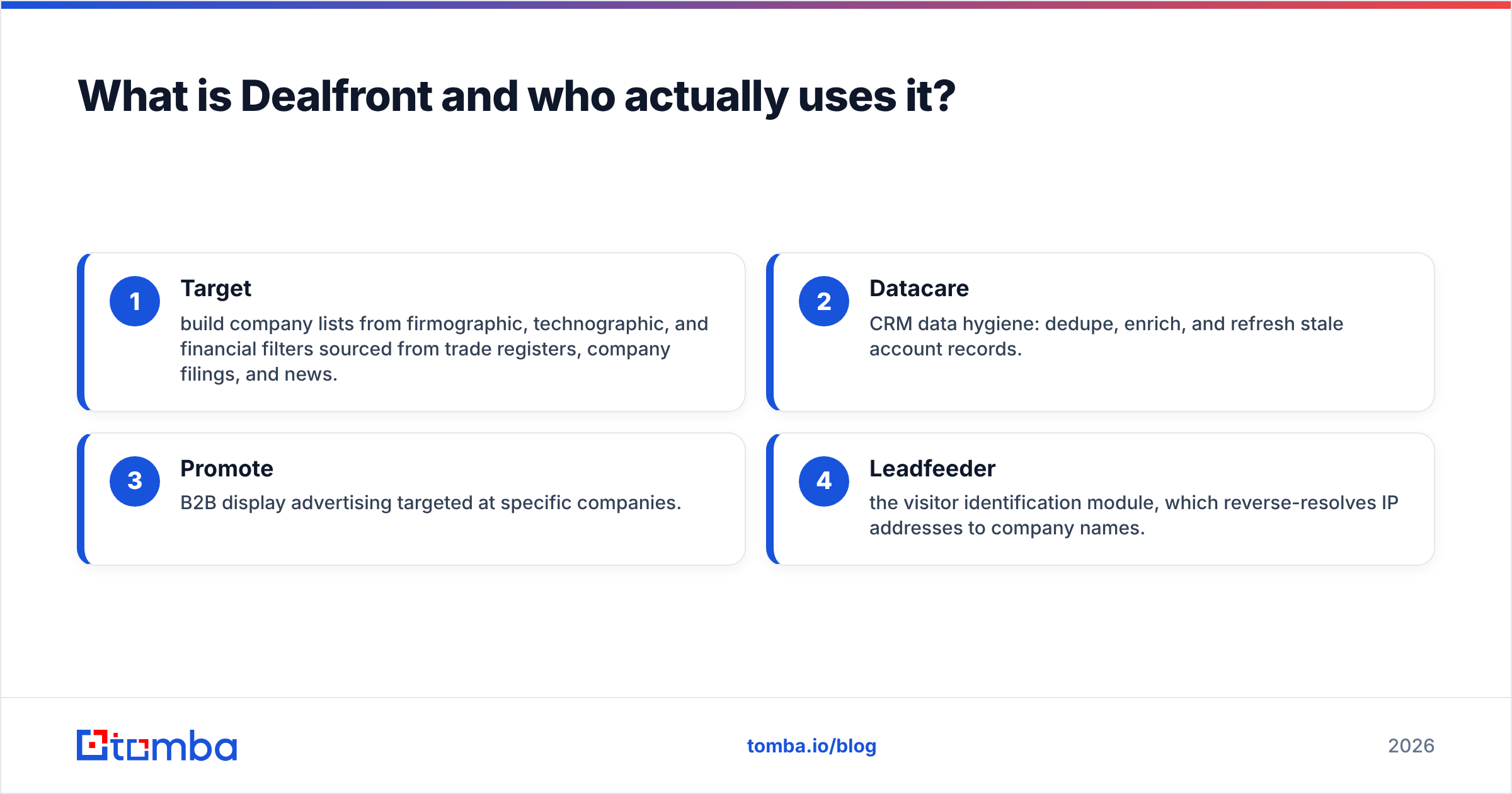
The platform has four modules. Most Dealfront reviews name all four:
- Target — build company lists from firmographic, technographic, and financial filters. The data comes from trade registers, filings, and news.
- Datacare — CRM data hygiene. It dedupes, enriches, and refreshes stale account records.
- Promote — B2B display ads aimed at named companies.
- Leadfeeder — visitor identification. It maps IP addresses back to company names.
Typical buyers are B2B firms of 20 to 200 people. They sell into Germany, Austria, Switzerland, the Nordics, and the UK. Agencies often use the Leadfeeder module on its own. Larger teams treat Dealfront as a European data layer. It feeds Salesforce or HubSpot rather than replacing them.

Is Dealfront's data actually accurate?#
For European company data, yes. It beats the US-centric tools by a clear margin. For contact data, it depends on the region.
Here is why the split matters. Dealfront pulls firmographics from official registers. That includes the German Handelsregister, the Austrian Firmenbuch, and Nordic business registries. So revenue, headcount, legal structure, and ownership changes are unusually solid for EU firms. Say Dealfront reports a Munich manufacturer with 340 staff and €62M in revenue. That number came from a filing, not a model estimate.
Contact data is a different story. Dealfront shows named people with roles. For many records it also shows direct business emails and phone numbers. Dealfront reviews agree that DACH coverage is strong. UK and Nordic coverage is decent. North American coverage drops off fast. If your ICP is a Chicago SaaS firm, this is not the tool that finds the VP of Engineering.
One more point. Dealfront does not verify emails in real time. Records refresh on a cycle instead. Deliverability matters, so run exports through a proper email verifier before you load them into a sequencer. Bouncing 8% of a four-month-old export is a self-inflicted sender reputation problem. It is not a Dealfront defect.
How does Dealfront's visitor identification work — and what are its limits?#
Leadfeeder matches visitor IP addresses against a database of company IP ranges. You install a tracking script. The dashboard then shows which companies visited. You also see pages viewed, session length, and return visits.
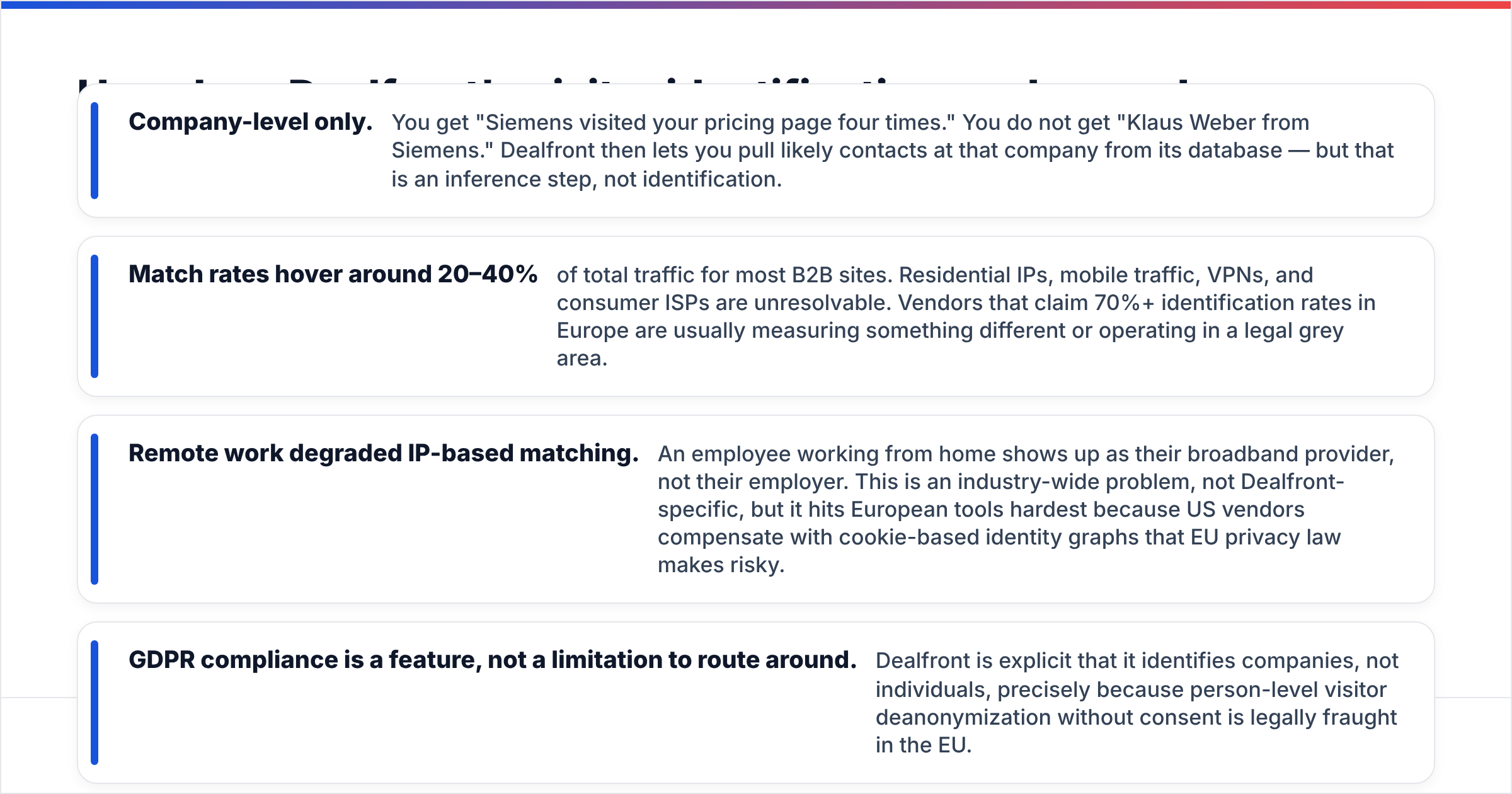
Dealfront reviews tend to gloss over four limits:
- Company-level only. You get "Siemens viewed your pricing page four times." You do not get "Klaus Weber from Siemens." Dealfront can then suggest likely contacts there. That is a guess, not an identification.
- Match rates run 20–40% of traffic on most B2B sites. Home IPs, mobile data, and VPNs cannot be resolved. Vendors that claim 70%+ in Europe are measuring something else.
- Remote work broke IP matching. A staffer at home shows up as their broadband provider. This hits every vendor. It hits EU tools hardest, since US rivals lean on cookie graphs that EU law makes risky.
- GDPR is a feature here, not a bug. Dealfront identifies companies, not people, on purpose. Naming EU visitors without consent is legally fraught.
So no compliant EU tool will tell you exactly who is browsing. What you get is a priority signal. This account is in-market. Go find the right person.
What does Dealfront cost in 2026?#
Dealfront does not publish full pricing. That is the top gripe in Dealfront reviews, and it is worth stating plainly. You book a demo. You describe your traffic and seat count. You get a custom quote.
Leadfeeder-only plans have started near €99/month. The free tier keeps only the last 7 days of visitor data. Full deals with Target and Datacare usually land between €500 and €2,000 per month. The exact figure depends on modules, seats, and data volume.
Four cost traps come up again and again:
- Annual contracts are the default. Monthly billing costs a premium, when it is offered at all.
- Price scales with identified companies. More traffic means a higher renewal quote, sometimes a steep one.
- Module bundling. The feature you wanted often sits one tier above the quote.
- Cancellation needs notice. Read the auto-renewal clause. Several G2 reviewers flag it.
None of this is odd for European enterprise SaaS. It is simply the opposite of the self-serve, credit-based model most small teams now expect.
How does Dealfront compare to the alternatives?#
It depends on what you are buying. EU account intelligence, visitor identification, and contact discovery are three different jobs. Few tools do all three well.
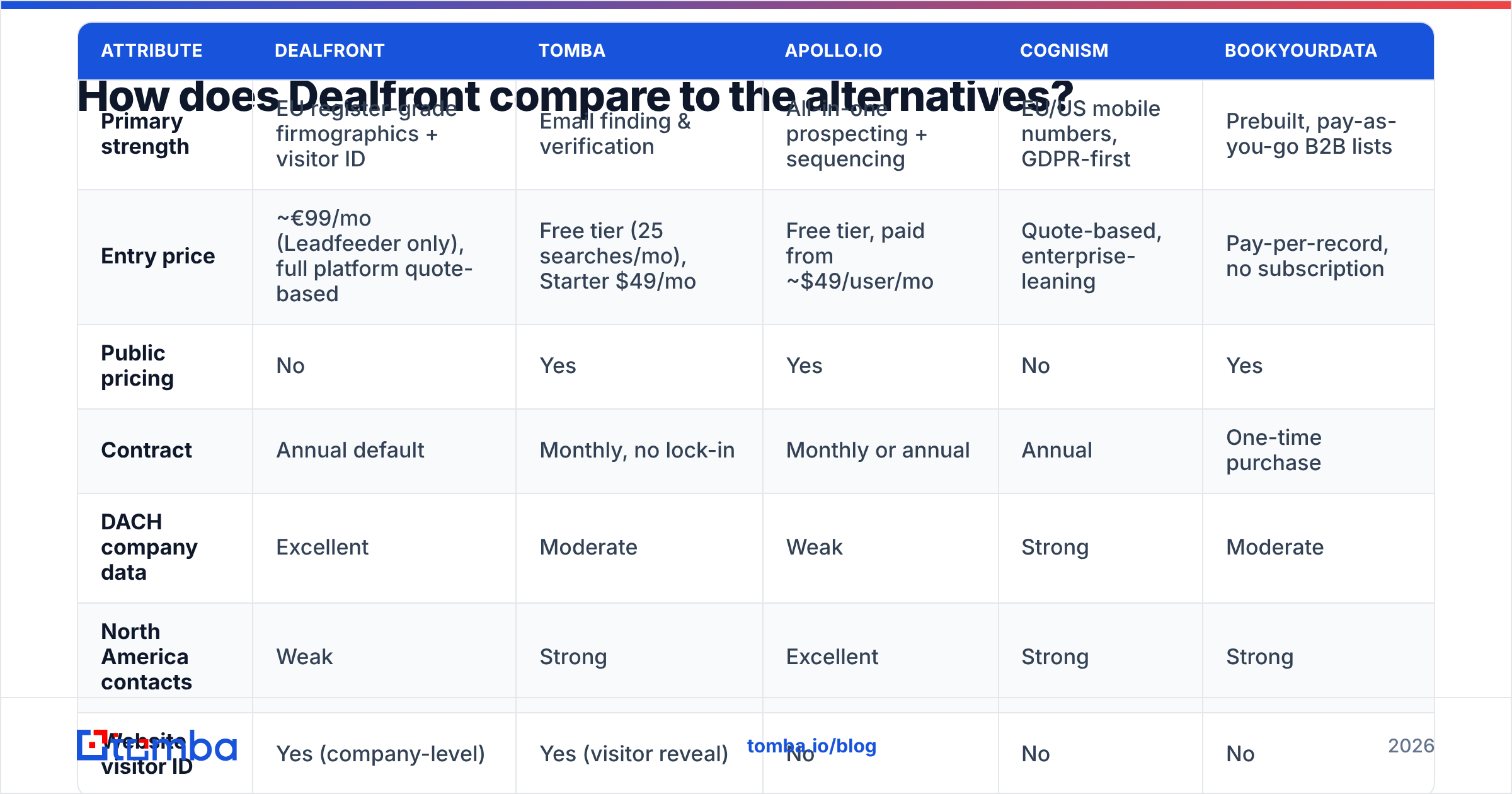
| Attribute | Dealfront | Tomba | Apollo.io | Cognism | BookYourData |
|---|---|---|---|---|---|
| Primary strength | EU register-grade firmographics + visitor ID | Email finding & verification | All-in-one prospecting + sequencing | EU/US mobile numbers, GDPR-first | Prebuilt, pay-as-you-go B2B lists |
| Entry price | ~€99/mo (Leadfeeder only), full platform quote-based | Free tier (25 searches/mo), Starter $49/mo | Free tier, paid from ~$49/user/mo | Quote-based, enterprise-leaning | Pay-per-record, no subscription |
| Public pricing | No | Yes | Yes | No | Yes |
| Contract | Annual default | Monthly, no lock-in | Monthly or annual | Annual | One-time purchase |
| DACH company data | Excellent | Moderate | Weak | Strong | Moderate |
| North America contacts | Weak | Strong | Excellent | Strong | Strong |
| Website visitor ID | Yes (company-level) | Yes (visitor reveal) | No | No | No |
| Email verification | Basic | Dedicated verifier + catch-all handling | Basic | Basic | Verified at purchase |
| API access | Yes, higher tiers | Yes, all paid tiers | Yes | Yes | Limited |
| Best for | EU mid-market ABM | Accurate contact discovery at any budget | US-heavy outbound at scale | Compliant EU calling motions | One-off list purchases |
The grid flattens some nuance, so here are the notes.
Cognism is the closest rival for European compliance-first data. It has better mobile phone coverage and the same quote-based annual model. Evaluate both or neither.
Apollo.io wins on breadth and self-serve access. It is much weaker on DACH firmographics. Teams leave Apollo for Dealfront over German data quality. They leave Dealfront for Apollo over price. Tomba keeps a detailed Apollo alternative breakdown if that is your comparison.
BookYourData solves a different problem. You buy a filtered, verified list outright, with no subscription. For a one-off campaign into a defined segment, that often beats an annual platform contract. Their verify-at-purchase guarantee is a real edge for teams with no ongoing data needs.
Tomba is not a full GTM platform and does not pretend to be. It handles the contact layer. Give it a domain or a name, and it finds and verifies the working email. Dealfront tells you Siemens is in-market. A domain search tells you the eleven people to contact there, and which addresses actually deliver.

What do Dealfront reviews complain about most?#
Read across G2 and Capterra and the same five themes repeat.
- Opaque pricing and renewal shock. By far the most common. Buyers report renewal quotes 30–60% above year one after traffic grows.
- A learning curve across four modules. Target, Datacare, Promote, and Leadfeeder each look different. Onboarding takes weeks, not hours.
- CRM sync quirks. HubSpot and Salesforce work, but field mapping needs care. Misconfigured Datacare can create duplicate accounts.
- Non-EU data gaps. Teams that expand to North America mid-contract need a second vendor. That undercuts the consolidation case for buying.
- Support varies by tier. Enterprise accounts praise their CSM. Smaller accounts wait longer on tickets.
The praise is just as consistent. The European company data really is better. The visitor identification screen is clean and fast. And the GDPR posture gives legal teams something they can approve without a three-month review.
Who should buy Dealfront — and who should not?#
Buy Dealfront if:
- Your ICP sits in DACH, the Nordics, or Benelux.
- You need register-sourced financials and legal entity data, not estimates.
- Your legal or DPO team wants provable GDPR compliance.
- You run account-based marketing and will act on company-level signals.
- You can absorb an annual contract and a multi-week onboarding.
Do not buy Dealfront if:
- Most of your pipeline is North American.
- You need per-person visitor identification. No compliant EU tool offers it.
- You are a small team that needs verified emails now, cheaply, without a sales call.
- You only need contact discovery. You would pay for three modules you never open.
For that last group the math is simple. A bulk email finder with clear per-credit pricing does the one job you need. Compare the Tomba pricing page with a Dealfront quote at the same monthly volume. The gap is rarely subtle.
How should you evaluate Dealfront before committing?#
Run a structured trial, not a demo-led one. Five steps:
- Test on your own ICP. Ask for 100 companies that match your exact filters. Then check 20 by hand against LinkedIn and company websites.
- Measure match rate on your traffic. Install the script for two weeks. Divide identified companies by total sessions. Compare that to the demo promise.
- Verify exported contacts yourself. Take 200 emails and run them through a third-party verifier. Note the bounce risk. Anything above 5% invalid belongs in your price talks.
- Get renewal terms in writing. What happens if traffic doubles? What is the notice period? Is there a cap on year-two increases?
- Price the unbundled stack. Add up a visitor-ID tool, a contact-data tool, and a verifier. Sometimes the bundle wins. Often it does not.
Step three is where most buyers get sloppy. Accuracy claims are easy to make and rarely audited. A sample verification pass costs almost nothing. It also hands you the strongest fact you will have at the negotiating table.
The verdict#
Dealfront is a good product sold in a way that annoys much of its market. Do you sell into Europe, need trustworthy company data, and have budget for an annual contract? Then it earns its place. The DACH register data alone is hard to replicate. Outside that profile, the pricing opacity and module bloat make it a poor fit. The alternatives are cheaper and simpler.
Most negative Dealfront reviews come from one mistake: buying it as a contact-discovery tool. That is not its strength. It is an expensive way to get email addresses.
Is contact discovery your real bottleneck? Start with the Tomba Email Finder. The free tier covers 25 searches a month. Benchmark it against any Dealfront export before you spend a cent. Paid plans start at $49/month with no annual lock-in. You also get full Tomba API access and a catch-all verifier for the domains that break other tools. Test both on the same 100 prospects and let the bounce rate decide.
Related guides#
Ready to find emails that actually work?
Join 150,000+ professionals who stopped guessing and started sending. Free credits on signup — no credit card required.
Get the Tomba newsletter
Practical outbound tactics and product updates — once every two weeks.
About the author