DealHub Pricing 2026: Reviews, Real Costs, Pros and Cons
DealHub never publishes a price list, so buyers go in blind. Here is what reviewers actually report paying, the implementation costs nobody quotes upfront, and when a lighter stack beats a full CPQ suite.
Most DealHub pricing reviews skip the part you care about: the number. DealHub does not publish one. This guide pulls together what buyers report paying, what the add-ons really cost, and when a full CPQ suite is the wrong buy.
TL;DR
- DealHub does not publish a public price list. Every number you find online comes from reviewers, resellers, or leaked quotes. Treat all of them as directional, not contractual.
- Reviewers describe DealHub as a per-seat, annual-contract, modular buy. CPQ is the base. DealRoom, subscription management, billing, and contract lifecycle are add-ons, and each one moves the number.
- The pros are real: guided selling that non-technical reps can actually use, a no-code rules engine, and DealRoom buyer portals that sales teams rate highly.
- The cons are real too: opaque pricing, a long setup window, admin dependency for complex catalogs, and a price floor that is hard to justify under 10–15 seats.
- CPQ fixes the bottom of your funnel. If your reps have nothing to quote, you need contact data and pipeline first. That is a different line item, and a much cheaper one.
What is DealHub and who actually buys it?#
DealHub is a quote-to-revenue platform. Think of it as the checkout counter of your sales process. The reps have done the selling. DealHub turns "yes, roughly" into a clean, correctly priced, approved document that a buyer can sign, with no two-week detour through legal and finance.
The platform bundles several modules that are usually sold separately elsewhere:
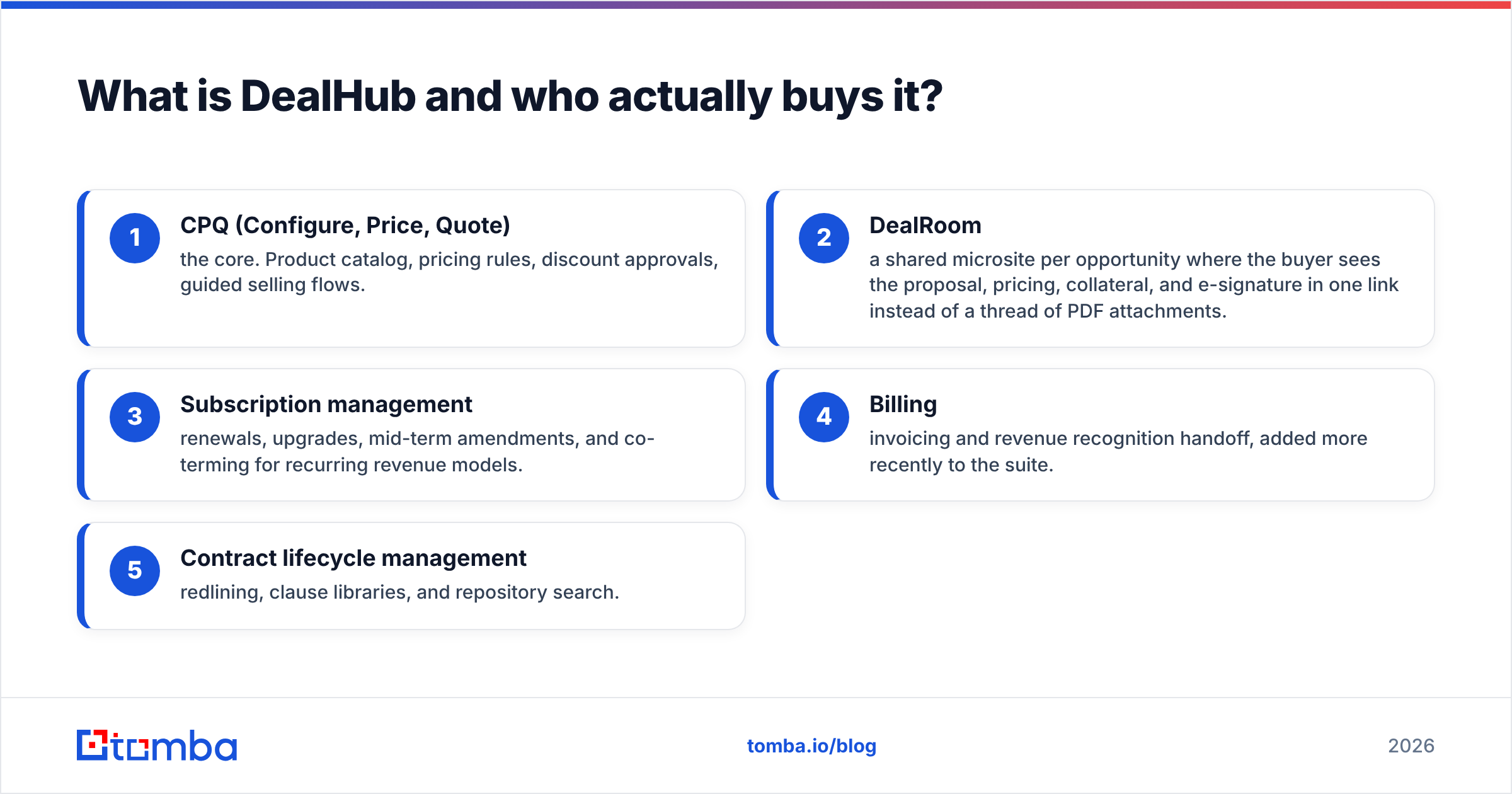
- CPQ (Configure, Price, Quote) — the core. Product catalog, pricing rules, discount approvals, guided selling flows.
- DealRoom — a shared microsite per opportunity where the buyer sees the proposal, pricing, collateral, and e-signature in one link instead of a thread of PDF attachments.
- Subscription management — renewals, upgrades, mid-term amendments, and co-terming for recurring revenue models.
- Billing — invoicing and revenue recognition handoff, added more recently to the suite.
- Contract lifecycle management — redlining, clause libraries, and repository search.
The typical buyer is a mid-market or enterprise B2B company. It has a configurable product, tiered or usage-based pricing, and a deal desk that has outgrown spreadsheets. If your sales motion is "one SKU, one price, credit card at checkout," you are not the customer. No CPQ tool will pay for itself.
You can read the vendor's own positioning on dealhub.io. Then cross-check it against buyer sentiment in the G2 CPQ category, where DealHub competes with Salesforce Revenue Cloud, PandaDoc, Conga, and Subskribe.
Why is DealHub pricing so hard to find?#
Most DealHub pricing reviews stop short of a real number, and the reason is simple. DealHub sells quote-only, through a demo-first motion. Your price depends on seat count, module mix, contract length, catalog complexity, and how much competitive pressure you bring into the room.
This is standard practice in CPQ. Conga, Salesforce, and Oracle all do it. But it creates a specific problem for buyers: you cannot budget before you commit to a sales cycle. Most teams spend two to four weeks in discovery calls before they see a figure. By then, walking away feels expensive.
Here is what the quote-only model means in practice:
- You cannot price-shop asynchronously. Comparing three CPQ vendors means three demo cycles, not three pricing pages.
- Your number is not the market number. Two companies with the same seat count can land 30–40% apart. Negotiation and timing decide it, and end-of-quarter quotes are cheaper.
- The list price is a starting position. Multi-year commitments, prepayment, and reference-customer agreements are all standard levers.
- Add-ons are where the budget goes. The CPQ base rarely blows up a budget. Billing plus CLM plus premium support does.
What does DealHub pricing actually look like in 2026?#
The honest answer: nobody outside DealHub's finance team can give you an exact list. Any blog quoting a precise per-seat figure is either repeating one customer's deal or making it up. What we can do is gather the ranges reviewers report on public review sites and reseller marketplaces, then label them as estimates.
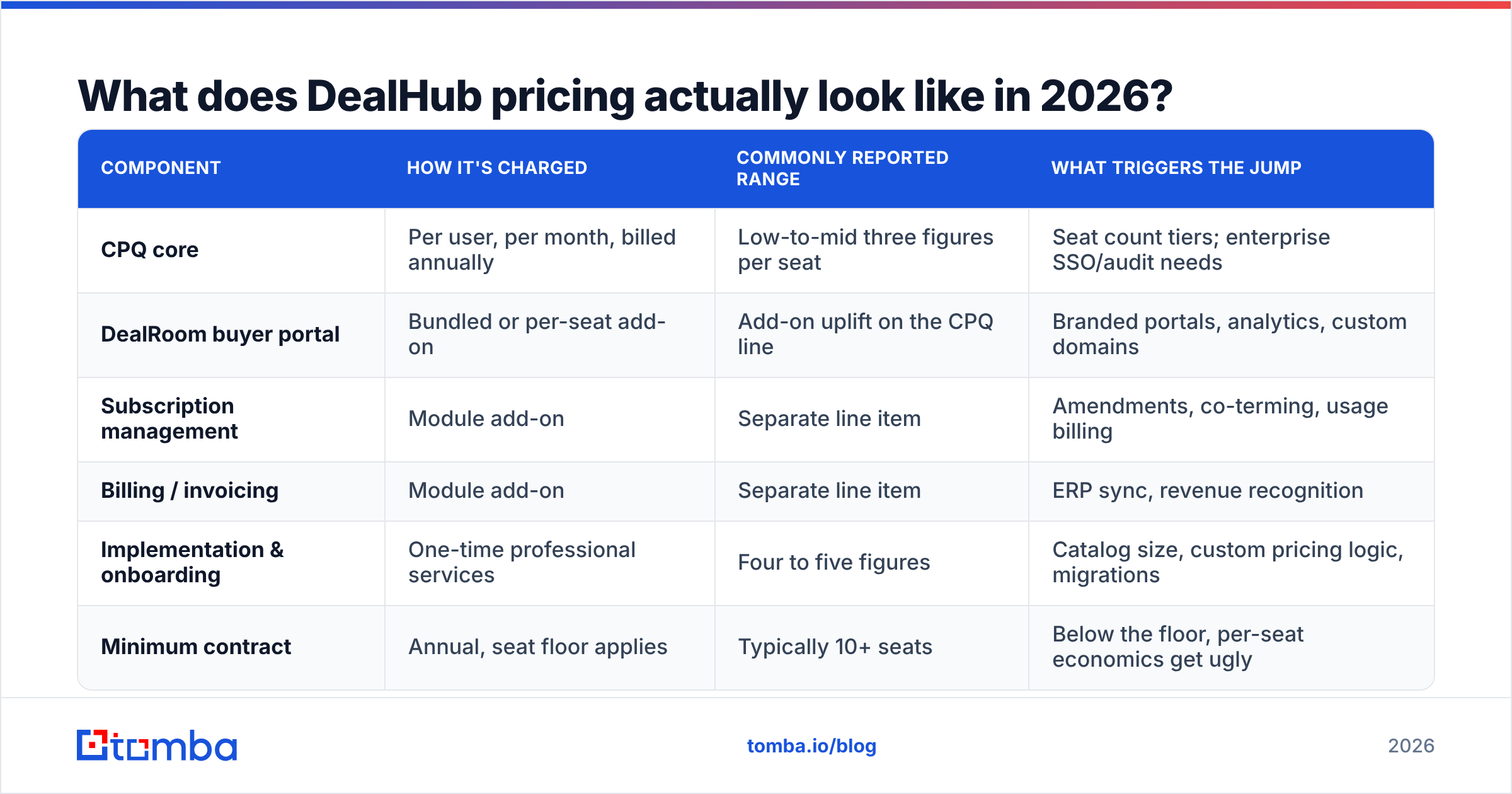
Based on patterns in public reviews on G2 and Capterra's CPQ category, plus vendor-published comparison data, DealHub quotes tend to cluster like this:
| Component | How it's charged | Commonly reported range | What triggers the jump |
|---|---|---|---|
| CPQ core | Per user, per month, billed annually | Low-to-mid three figures per seat | Seat count tiers; enterprise SSO/audit needs |
| DealRoom buyer portal | Bundled or per-seat add-on | Add-on uplift on the CPQ line | Branded portals, analytics, custom domains |
| Subscription management | Module add-on | Separate line item | Amendments, co-terming, usage billing |
| Billing / invoicing | Module add-on | Separate line item | ERP sync, revenue recognition |
| Implementation & onboarding | One-time professional services | Four to five figures | Catalog size, custom pricing logic, migrations |
| Minimum contract | Annual, seat floor applies | Typically 10+ seats | Below the floor, per-seat economics get ugly |
Two caveats before you paste that into a budget deck. First, these are reported ranges, not quotes. DealHub has never confirmed them publicly.
Second, the implementation line is the one that surprises people. CPQ is not a tool you switch on. It is a project. Your catalog, discount matrix, approval chains, and CRM field mappings all have to be modeled before a single quote goes out.
What are the hidden costs of a CPQ purchase?#
The subscription is the visible cost. The rest of the total cost of ownership is where deals go sideways.
- Implementation services. Whether you use DealHub's team or a partner, expect a scoped project measured in weeks, not days. Complex catalogs with usage tiers and regional pricing take longer.
- Admin ownership. Someone has to own the rules engine. DealHub markets itself as no-code, and reviewers agree the daily config is accessible. But no-code still means someone has to think in logic gates.
- CRM dependency. DealHub sits on top of your CRM. If your Salesforce or HubSpot data is dirty, CPQ inherits the mess and prints it on customer-facing documents.
- Change management. Reps who have quoted from a spreadsheet for five years will route around a new tool unless leadership enforces it. Budget for enablement time.
- Integration work. ERP, billing, e-signature, and data warehouse connections rarely come free of engineering hours.
- Renewal uplift. Multi-year deals often carry annual escalators. Ask what year two and year three look like before you sign year one.
None of this is unique to DealHub. It is the honest cost profile of every CPQ suite in the Gartner-covered market. The mistake is simple: comparing DealHub's subscription line against a point tool's subscription line and calling that a comparison.
What do DealHub pricing reviews say is good?#
Public sentiment for DealHub skews positive, and the praise is consistent enough to be credible:
- Guided selling that reps actually finish. The playbook-style flow asks questions and builds the quote. It does not dump a 400-line catalog on a new rep.
- DealRoom is a real differentiator. Buyers get one link with pricing, terms, collateral, and signature. Sellers get engagement analytics: who opened what, and how long they spent on the pricing page. Many reviewers say this feature won the evaluation.
- No-code configuration. Changing an approval threshold or adding a discount rule does not need a developer ticket. That is a real contrast with heavier enterprise CPQ platforms.
- Implementation support quality. Reviewers often call the onboarding team responsive and competent. That matters, because most CPQ horror stories start with a bad implementation.
- Quote consistency. Fewer pricing errors and fewer rogue discounts show up directly in gross margin.
What do reviewers complain about?#
The criticism is just as consistent, and most of it is structural rather than a bug list:
- Pricing opacity. The most common complaint is not the price. It is not being able to see it. Buyers dislike entering a demo cycle blind.
- Setup effort for complex catalogs. The more unusual your pricing model, the longer the modeling phase. This is true of all CPQ, but it undercuts the "fast to deploy" story.
- Reporting depth. Several reviewers want richer native analytics and end up exporting to a BI tool.
- Cost at small scale. Below roughly 10–15 seats, per-seat plus implementation rarely clears the ROI bar against a simpler proposal tool.
- Module sprawl. Buy CPQ, then subscriptions, then billing, then CLM, and your annual number climbs in steps you did not model on day one.
How does DealHub compare to other quote-to-revenue tools?#
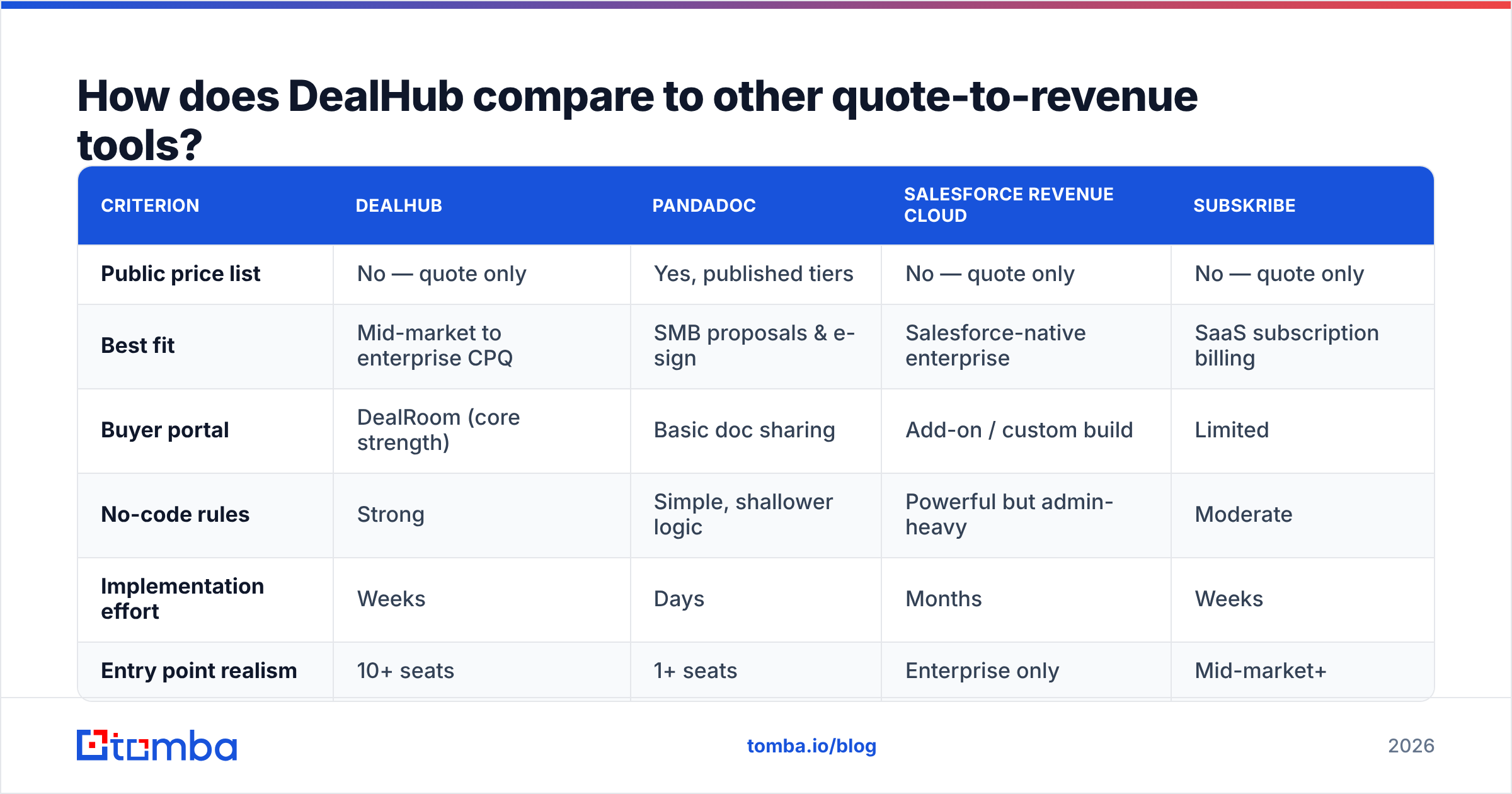
| Criterion | DealHub | PandaDoc | Salesforce Revenue Cloud | Subskribe |
|---|---|---|---|---|
| Public price list | No — quote only | Yes, published tiers | No — quote only | No — quote only |
| Best fit | Mid-market to enterprise CPQ | SMB proposals & e-sign | Salesforce-native enterprise | SaaS subscription billing |
| Buyer portal | DealRoom (core strength) | Basic doc sharing | Add-on / custom build | Limited |
| No-code rules | Strong | Simple, shallower logic | Powerful but admin-heavy | Moderate |
| Implementation effort | Weeks | Days | Months | Weeks |
| Entry point realism | 10+ seats | 1+ seats | Enterprise only | Mid-market+ |
The pattern is clear. Want published pricing and a fast start? PandaDoc wins on access and loses on configuration depth. Already deep in Salesforce with an admin team? The native path cuts integration work at the cost of agility. DealHub sits in the middle: more capable than a proposal tool, faster to deploy than enterprise CPQ, and priced to match.
Is DealHub worth it for your team?#
Run this test before you book the demo.
DealHub is likely worth it if: you have 15+ quota-carrying reps, a configurable product with real pricing logic, deal cycles where approval delays cost you deals, and a known problem with discount leakage or quote errors. In that case, a CPQ suite pays for itself on margin protection alone.
DealHub is probably not worth it if: your product has fewer than a dozen SKUs, one person approves discounts in Slack, or your real bottleneck is too few qualified opportunities. Buying CPQ to fix an empty pipeline is like buying a faster cash register for a store with no customers.
That last case is more common than vendors admit. Deal desk friction is visible and annoying, so it gets budget. Pipeline scarcity is quiet and constant, so it gets ignored. Before you sign an annual CPQ contract, check where deals actually die: top of funnel, or bottom.
What should you fix before you buy CPQ?#
If quote volume is the constraint, not the quote process, spend the money upstream. Here is the order that works:
- Fix contact data quality. Bad emails and stale titles waste more rep hours than any quoting bottleneck. A verified list beats a big list every time.
- Build repeatable sourcing. Know which companies match your ICP, find the right decision-maker, and get a valid work address. Do it reliably, not opportunistically.
- Enrich what you already have. Half the accounts in your CRM are missing the one field that would let a rep act on them. Contact enrichment is cheaper than net-new sourcing.
- Then optimize the close. Once reps are quoting enough deals that approval lag costs real revenue, CPQ becomes an obvious buy.
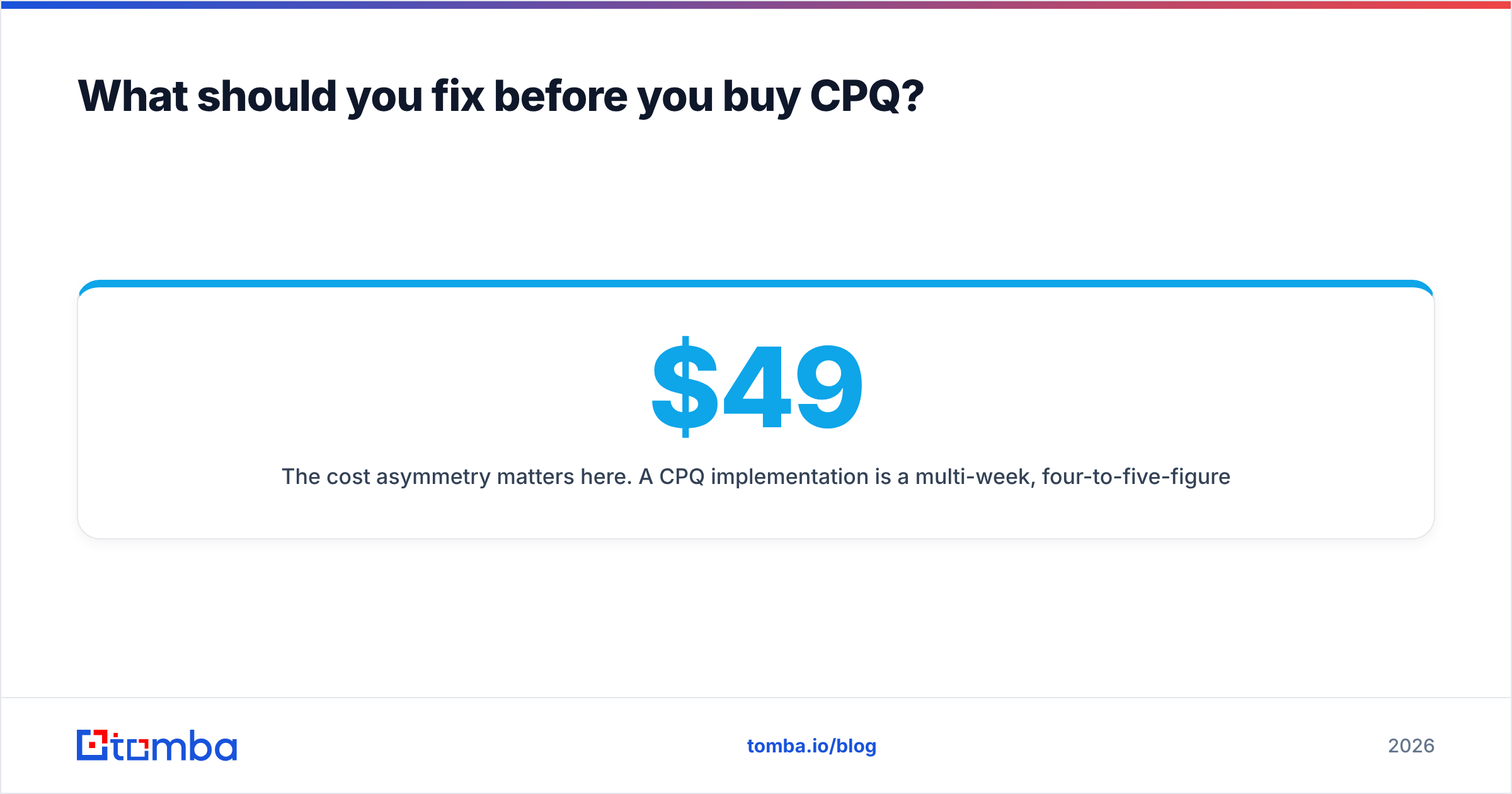
The cost gap matters here. A CPQ implementation is a multi-week commitment with a four-to-five-figure services bill. Prospecting data starts at a fraction of that. Tomba pricing runs from a free tier with 25 searches per month to $49/mo Starter, $99/mo Growth, and $249/mo Pro, with no implementation project attached. You can test whether more pipeline moves your number long before you commit to a quote-to-revenue platform.
The bottom line on DealHub pricing#
Read enough DealHub pricing reviews and the same picture forms. DealHub is a credible CPQ platform with a strong buyer-portal story and a no-code config layer that reviewers like. Its weakness as a purchase is not the product. It is the process: no public pricing, a demo-gated sales cycle, add-on modules that compound, and an implementation phase that belongs in your budget from day one. Go in with a seat count, a module shortlist, a competing quote, and a walk-away number.
And if the audit points upstream, start there. The problem may be that too few of the right conversations ever reach the quote stage. The Tomba Email Finder gets your reps verified, deliverable contacts for the accounts that match your ICP. Then the pipeline you run through CPQ is worth the license. Start on the free tier, measure whether more qualified opportunities move your close rate, and buy the quoting suite when the volume demands it.
Related guides#
Ready to find emails that actually work?
Join 150,000+ professionals who stopped guessing and started sending. Free credits on signup — no credit card required.
Get the Tomba newsletter
Practical outbound tactics and product updates — once every two weeks.
About the author