Dealmayker Pricing 2026: Reviews, Pros, Cons, and Real Costs
A neutral breakdown of Dealmayker pricing in 2026 — how the plans are structured, what reviewers praise and complain about, the real cost per usable contact, and when a cheaper stack makes more sense.
TL;DR
- Dealmayker sells itself as an all-in-one B2B deal-sourcing and outreach platform. The sticker price is rarely the number you end up paying — seats, credit overages, and annual commitments do most of the damage.
- The honest headline on Dealmayker pricing: it is quote-led at the upper tiers, which means your cost depends on how well you negotiate, not on a published table.
- Reviewers generally like the unified workflow (find, enrich, sequence in one tab) and dislike credit burn on unusable records, plus contract terms that are hard to unwind mid-year.
- The metric that matters is cost per usable contact, not cost per credit. A $99/mo tool that wastes 30% of credits on bounces is more expensive than a $99/mo tool that doesn't.
- If you mainly need accurate B2B emails rather than a full sales OS, an unbundled stack — a dedicated email finder plus your existing sequencer — usually costs 40–70% less.
What is Dealmayker, and who is it for?#
Dealmayker sits in the crowded "sales intelligence + engagement" category: a platform that promises to find companies worth selling to, surface contacts inside them, enrich those contacts, and push them into outreach without you touching three separate tools.
That bundle appeals to a specific buyer: a small-to-mid outbound team, usually 3–15 reps, that is tired of paying for a prospecting database, a verification tool, and a sequencer separately. The pitch is consolidation. One vendor, one invoice, one onboarding.
It is a legitimate pitch. It's also where the pricing complexity starts, because bundled tools price on two axes at once — seats and usage — and buyers habitually model only one of them.
If you're evaluating this category broadly, the B2B sales tools landscape splits into three camps:
- Databases — you pay for access to records (ZoomInfo, Apollo, BookYourData). Cost scales with volume.
- Finders/verifiers — you pay per lookup or verification. Cost scales with how targeted you are.
- Engagement platforms — you pay per seat. Cost scales with headcount.
Dealmayker straddles all three, which is exactly why its bill is hard to predict.
How does Dealmayker pricing actually work?#
Before you compare anything, understand the five levers that move the number on your invoice. This is true of Dealmayker and every tool shaped like it:
- Seat count is the floor, not the ceiling. Bundled platforms almost always require a minimum seat purchase. If your plan is quoted "per user per month," multiply by your real headcount — including the ops person who only logs in to export lists.
- Credits are consumed on attempts, not successes. This is the single biggest source of surprise spend. If a lookup returns a guess, a role-based address, or a catch-all domain you can't confirm, many platforms still debit the credit. Ask the rep this question in writing.
- Annual billing is the only sane price. Monthly rates on this class of tool typically run 20–30% above the annual equivalent. The catch is you're locked in before you know whether the data quality holds up for your ICP.
- Overage rates are punitive by design. Once you exceed your credit pool, top-ups are usually priced well above your blended per-credit rate. Teams that run campaigns in bursts get hit hardest.
- Feature gating sits above the entry tier. API access, CRM write-back, bulk export, and team analytics are commonly reserved for the mid or top plan. If any of those are non-negotiable for you, the entry price is irrelevant — model the tier that actually has them.
Dealmayker publishes tier names and entry pricing, but the useful numbers — export caps, overage rate, minimum seats, contract length — surface during the sales conversation. Treat any published figure as the beginning of the negotiation, not the end of it.
What does Dealmayker actually cost per usable contact?#
Here's the calculation almost nobody runs, and it's the only one that predicts your real spend.
Take your monthly credit pool. Subtract the records you can't use: bounced addresses, unconfirmed catch-alls, role accounts (info@, sales@), and contacts who left the company. What's left is your usable pool. Divide plan cost by that.
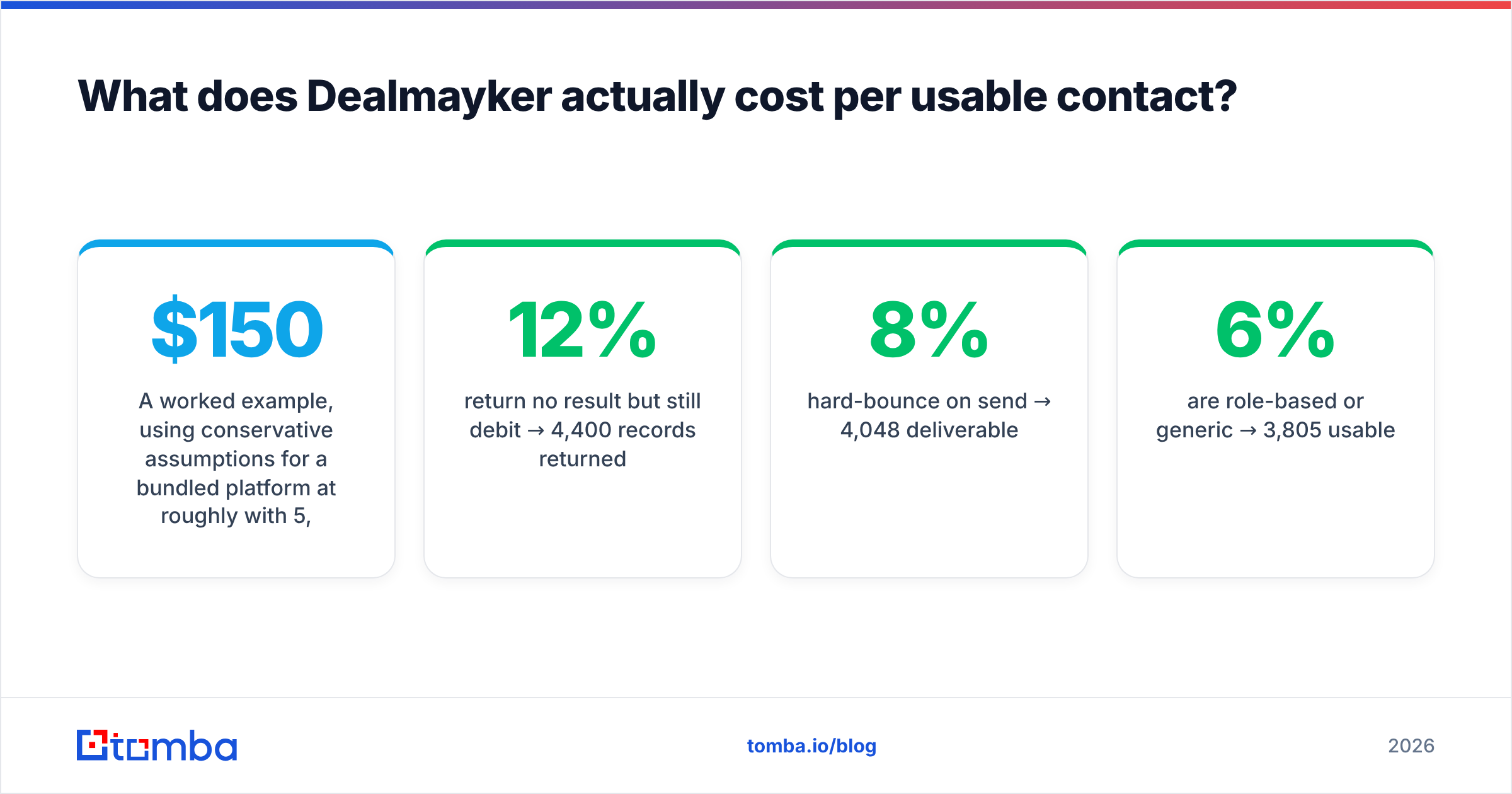
A worked example, using conservative assumptions for a bundled platform at roughly $150/month with 5,000 credits:
- 5,000 credits consumed
- 12% return no result but still debit → 4,400 records returned
- 8% hard-bounce on send → 4,048 deliverable
- 6% are role-based or generic → 3,805 usable
$150 ÷ 3,805 = $0.039 per usable contact. Not bad. Now run the same math with a 20% bounce rate and 15% no-result rate, which is well within the range reviewers report for bundled databases in niche verticals: you land nearer $0.055 — a 40% real price increase with zero change to the sticker price.
This is why email verification is not an optional add-on. Every percentage point of bounce you eliminate before send is a direct discount on your data spend, and it protects your sender reputation at the same time.

What do Dealmayker reviews say?#
Aggregate review sentiment for tools in this category — visible on G2 and Capterra — clusters into predictable themes. Dealmayker reviews follow the pattern closely.
What reviewers consistently praise:
- Workflow consolidation. Finding a company, pulling contacts, and starting a sequence without exporting a CSV genuinely saves reps time. This is the strongest and most repeated positive.
- Onboarding and support. Bundled vendors invest heavily here because churn is their existential risk. Expect a real human on implementation calls.
- Filtering depth. Good firmographic and technographic filters, which matter when your ICP is narrow.
What reviewers consistently complain about:
- Data freshness in non-US markets. Coverage thins outside North America and Western Europe. If you sell into APAC, LATAM, or smaller EU markets, run a sample test before signing.
- Credit burn on failed lookups. The most common billing complaint across this entire category.
- Contract rigidity. Mid-term downgrades are rarely permitted. Teams that scaled down headcount report paying for seats they weren't using.
- Deliverability isn't included. The platform finds and sends; it does not fix your domain reputation. That's still on you, and it's where most outbound programs actually fail.
None of this makes Dealmayker a bad tool. It makes it a tool with a specific shape: strong if you want consolidation and have predictable volume, weak if you want flexibility and buy in bursts.
What are the pros and cons of Dealmayker?#
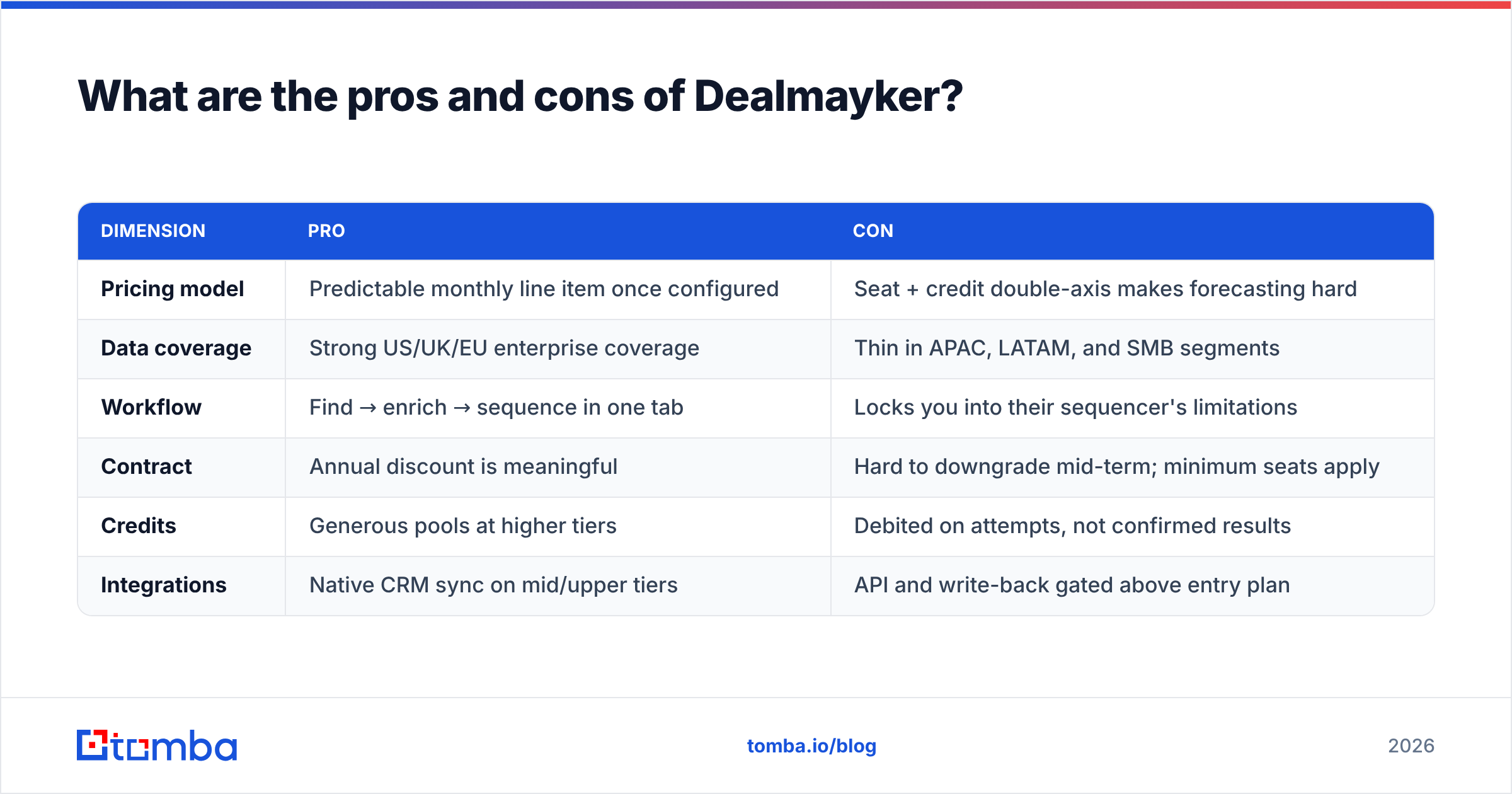
| Dimension | Pro | Con |
|---|---|---|
| Pricing model | Predictable monthly line item once configured | Seat + credit double-axis makes forecasting hard |
| Data coverage | Strong US/UK/EU enterprise coverage | Thin in APAC, LATAM, and SMB segments |
| Workflow | Find → enrich → sequence in one tab | Locks you into their sequencer's limitations |
| Contract | Annual discount is meaningful | Hard to downgrade mid-term; minimum seats apply |
| Credits | Generous pools at higher tiers | Debited on attempts, not confirmed results |
| Integrations | Native CRM sync on mid/upper tiers | API and write-back gated above entry plan |
How does Dealmayker compare to the alternatives?#
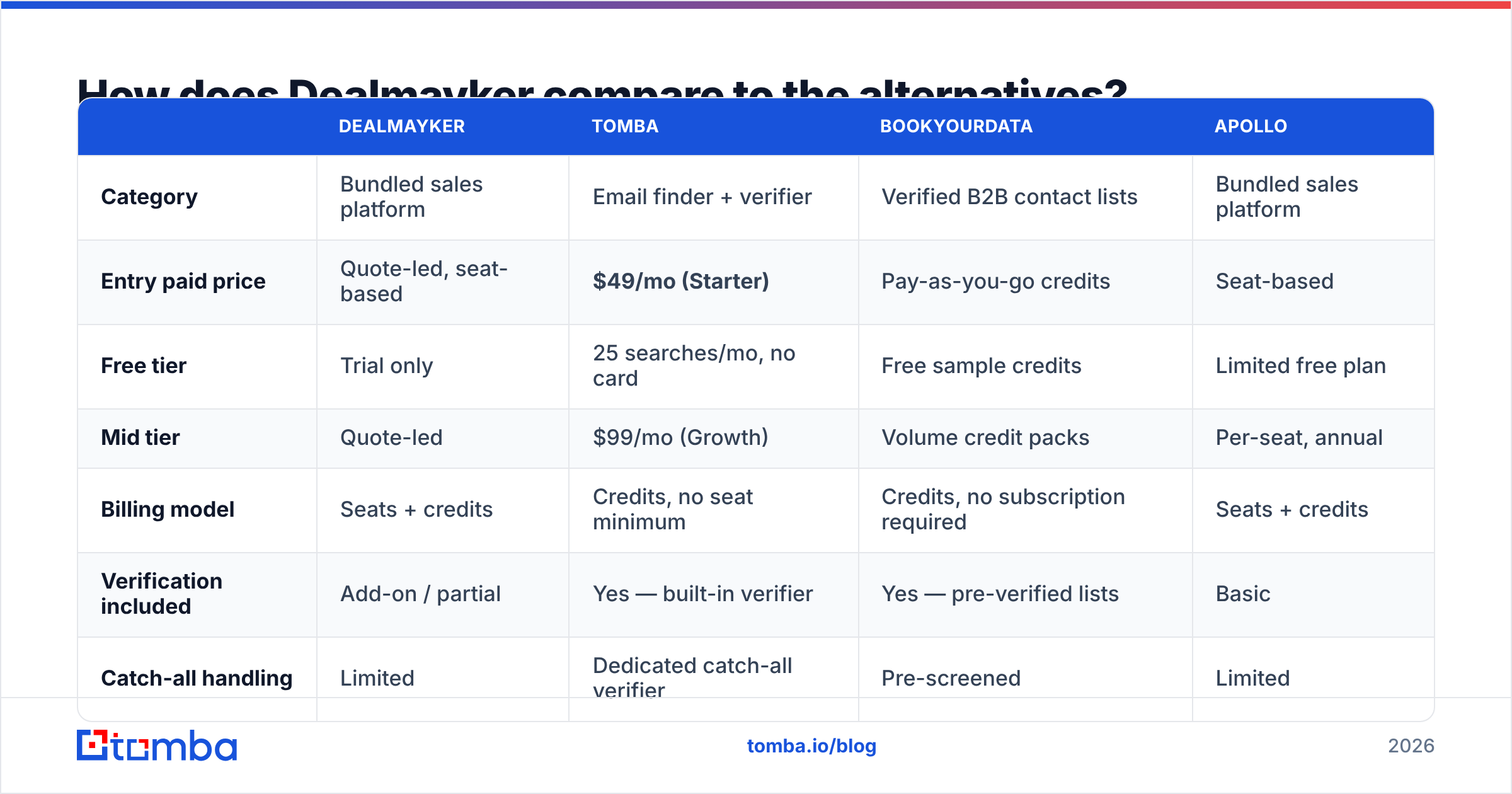
The right comparison depends on what you're actually buying. If you need a full sales operating system, compare Dealmayker to other bundles. If you mainly need accurate contact data, compare it to specialists — and the price gap gets large fast.
| Dealmayker | Tomba | BookYourData | Apollo | |
|---|---|---|---|---|
| Category | Bundled sales platform | Email finder + verifier | Verified B2B contact lists | Bundled sales platform |
| Entry paid price | Quote-led, seat-based | $49/mo (Starter) | Pay-as-you-go credits | Seat-based |
| Free tier | Trial only | 25 searches/mo, no card | Free sample credits | Limited free plan |
| Mid tier | Quote-led | $99/mo (Growth) | Volume credit packs | Per-seat, annual |
| Billing model | Seats + credits | Credits, no seat minimum | Credits, no subscription required | Seats + credits |
| Verification included | Add-on / partial | Yes — built-in verifier | Yes — pre-verified lists | Basic |
| Catch-all handling | Limited | Dedicated catch-all verifier | Pre-screened | Limited |
| API access | Upper tiers | All paid tiers | Available | Upper tiers |
| Best for | Teams wanting one vendor | Teams wanting accurate data cheaply | Teams buying targeted lists outright | Large outbound orgs |
Two honest notes on that table.
First, BookYourData deserves a serious look if your buying pattern is "I need 10,000 verified contacts in this vertical, once." Its pay-as-you-go model means you're not carrying a subscription between campaigns, and the lists arrive pre-verified. For burst buyers, that's structurally cheaper than any seat-based platform.
Second, Tomba is not a replacement for a sequencer. It's a replacement for the data layer of a bundle. If you already run Instantly, Smartlead, HubSpot, or Salesloft for sending, you don't need to buy sending again — you need contacts that don't bounce. That's a different purchase, and it's priced accordingly: see Tomba pricing for the full tier breakdown.

When is Dealmayker worth it — and when is it not?#
Buy it if:
- You have 5+ reps and consolidation genuinely reduces your admin load.
- Your volume is steady month over month, so a committed credit pool doesn't sit idle.
- Your ICP is US/UK/EU mid-market or enterprise, where coverage is strongest.
- You want one vendor to escalate to when something breaks.
Skip it if:
- You buy data in bursts around campaigns or events.
- You already own a sequencer you like — you'd be paying twice for sending.
- Your ICP sits outside the platform's coverage strongholds.
- You're under 5 people and seat minimums push your effective per-user cost up.
The clearest signal is this: if the only part of the bundle you'd use daily is the contact lookup, you're paying a platform tax for a feature you can buy standalone for a fraction of the price.
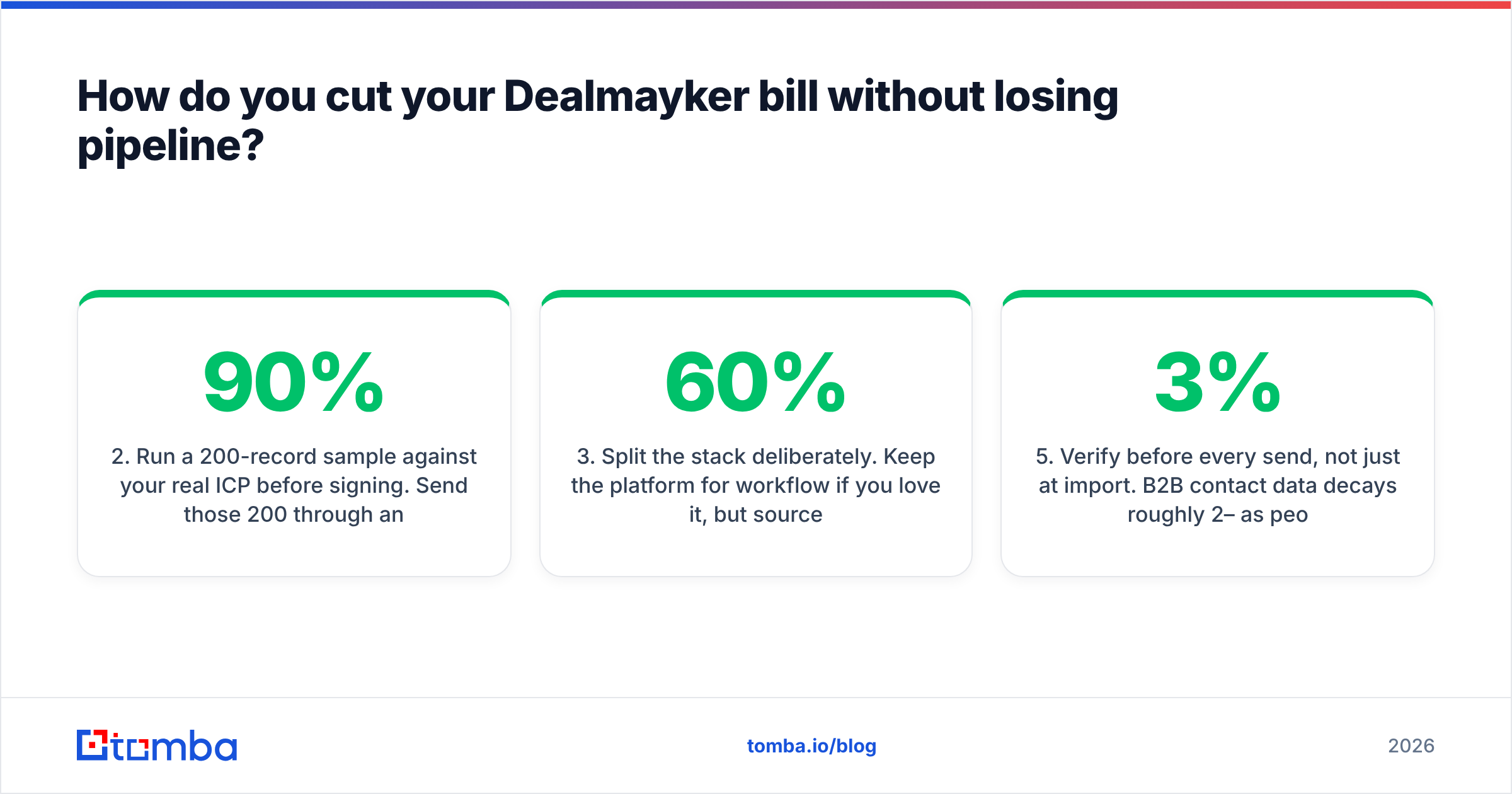
How do you cut your Dealmayker bill without losing pipeline?#
- Negotiate the overage rate, not the headline price. Vendors defend list price and concede on overages. Overages are where growing teams actually bleed.
- Run a 200-record sample against your real ICP before signing. Send those 200 through an independent email verifier and measure the true valid rate. If it's below 90%, adjust your cost-per-usable-contact model and re-open the negotiation.
- Split the stack deliberately. Keep the platform for workflow if you love it, but source contacts from a specialist. Many teams cut 40–60% off their data line by moving lookups to a dedicated bulk email finder while keeping their sequencer.
- Audit seats quarterly. Dormant seats are the most common form of waste in seat-based tools. Set a calendar reminder, not a vague intention.
- Verify before every send, not just at import. B2B contact data decays roughly 2–3% per month as people change jobs. A list verified in January is meaningfully worse by June. HubSpot's own sales research has documented this decay pattern for years.
- Request month-to-month for the first quarter. Vendors will often grant it to close the deal. If they refuse outright, that tells you something about their confidence in retention.
What's the verdict on Dealmayker pricing?#
Dealmayker is fairly priced for what it is — a bundle. The problem is that most teams don't need the whole bundle. They need contacts that are real, deliverable, and current, plumbed into tools they already run.
If your honest answer to "which part of this platform would I miss most?" is the data, unbundle. If it's the workflow, keep the platform but negotiate the credit terms hard and re-measure your cost per usable contact every quarter. And whatever you choose, never evaluate a data vendor on its pricing page alone — evaluate it on a sample of your own ICP, verified independently.
Test the data layer before you commit to a platform. Tomba's Email Finder gives you 25 free searches a month with no card required — enough to run a real sample against your ICP and compare valid rates side by side with whatever Dealmayker quotes you. Paid plans start at $49/mo with the verifier, domain search, and API included on every tier, so you can drop the data line of your stack without touching the tools your reps already know. Run the comparison on your own list, then decide.
Related guides#
Ready to find emails that actually work?
Join 150,000+ professionals who stopped guessing and started sending. Free credits on signup — no credit card required.
Get the Tomba newsletter
Practical outbound tactics and product updates — once every two weeks.
About the author