Dealroom Pricing Reviews Pros and Cons: 2026 Buyer Guide
Dealroom sells market intelligence on quote-only plans, which makes budgeting hard. Here is what buyers actually pay, what reviewers praise and complain about, and when a cheaper stack does the same job.
Everything below covers Dealroom pricing reviews pros and cons in plain English. You get the real cost ranges, what buyers like, what they gripe about, and who should walk away.
TL;DR
- Dealroom does not publish a price list. Every plan is quote-based.
- Small teams report low-to-mid four figures a year. Add API access, extra seats, or custom data and the quote jumps to five figures.
- The product is strong at its core job. Startup, funding, and ecosystem data are solid, and European coverage is excellent.
- The top complaint is not data quality. It is price secrecy, annual-only deals, and thin contact data.
- Dealroom maps markets. It is not a contact database. To reach people, you still need an email finder.
- Buy it if you are a VC, a corporate strategy team, or a public agency. Skip it if your team just needs verified emails at $49/mo.
What is Dealroom, and who buys it?#
Dealroom.co is an Amsterdam-based data platform for private markets. It tracks startups, funding rounds, investors, and whole startup ecosystems. That data feeds dashboards, custom datasets, and an API. The company launched in 2013. Today its numbers sit behind many European "state of the ecosystem" reports.
One warning before you compare pricing pages. Two firms share the name. Dealroom.co is the startup and VC data platform this post covers. DealRoom (dealroom.net) is a separate M&A and virtual data room tool. They serve different buyers and price in different ways. Mixing them up is the most common error in "Dealroom pricing" searches.
Dealroom.co buyers fall into four groups:
- VC and PE firms. They source deals, watch portfolio rivals, and check valuations against similar rounds.
- Corporate innovation and M&A teams. They scan a sector for targets and partners.
- Government and economic development bodies. They track the health of a city or national startup scene, often on a public dashboard.
- Consultants and research teams. They pull the data into reports they sell on.
Notice who is missing: high-volume sales teams. That gap explains most of the pros and cons below.
How much does Dealroom pricing cost in 2026?#
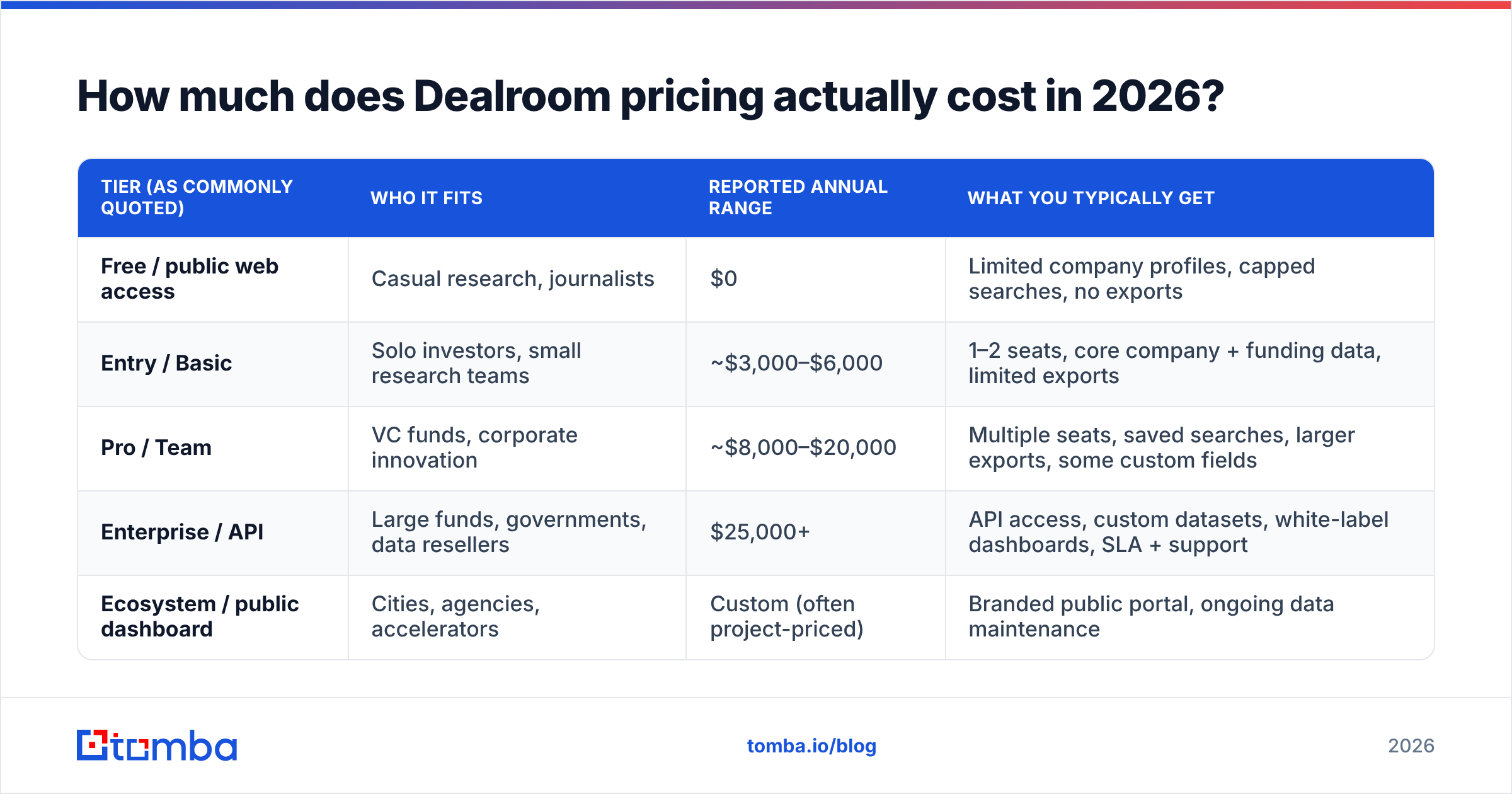
Short answer: there is no public number, and that is on purpose. Every buyer goes through a demo call. Price then depends on seats, data scope, API access, and white-label dashboards.
The ranges below come from buyer reports, review sites, and public tender papers. Treat them as reported ranges, not a rate card. Dealroom can quote outside them.
| Tier (as commonly quoted) | Who it fits | Reported annual range | What you typically get |
|---|---|---|---|
| Free / public web access | Casual research, journalists | $0 | Limited company profiles, capped searches, no exports |
| Entry / Basic | Solo investors, small research teams | ~$3,000–$6,000 | 1–2 seats, core company + funding data, limited exports |
| Pro / Team | VC funds, corporate innovation | ~$8,000–$20,000 | Multiple seats, saved searches, larger exports, some custom fields |
| Enterprise / API | Large funds, governments, data resellers | $25,000+ | API access, custom datasets, white-label dashboards, SLA + support |
| Ecosystem / public dashboard | Cities, agencies, accelerators | Custom (often project-priced) | Branded public portal, ongoing data maintenance |
Three pricing rules matter more than the headline number:
- Annual deals are the norm. Monthly billing is rare. A six-week research sprint still tends to cost you twelve months.
- API access is a separate line item. Buyers who wanted it report a clear step up in price.
- Export limits are the real lever. Viewing is generous. Pulling data out is not. Budget for the export tier you truly need.

What do Dealroom reviews actually say?#
Sentiment on G2 and similar sites lands in one zone: strong product, annoying commercials. Split the reviews by theme and the picture is clear.
What reviewers praise:
- European depth. This is the most repeated compliment. For Nordic, Benelux, DACH, and Southern European startups, Dealroom logs rounds that US-first databases miss.
- Tagging. The sector labels are more precise than most rivals. "Every seed-stage climate tech firm in Iberia" becomes a five-minute query.
- Ecosystem dashboards. Few rivals will build and run a branded regional dashboard for you.
- Fast fixes. Reviewers say flagged data errors get corrected quickly.
What reviewers complain about:
- Price secrecy. You cannot self-serve or check your quote against anyone else's. Renewals feel unpredictable.
- Thin US and APAC data. For North American mid-market SaaS, rivals often win on coverage.
- Weak contact data. Company records are rich. Named people and verified work emails are not. Many teams export lists, then find contacts elsewhere.
- Tight export caps for the price, above all on lower tiers.
- Annual lock-in, with little give if your team size changes.
Dealroom pricing reviews pros and cons: the scorecard#
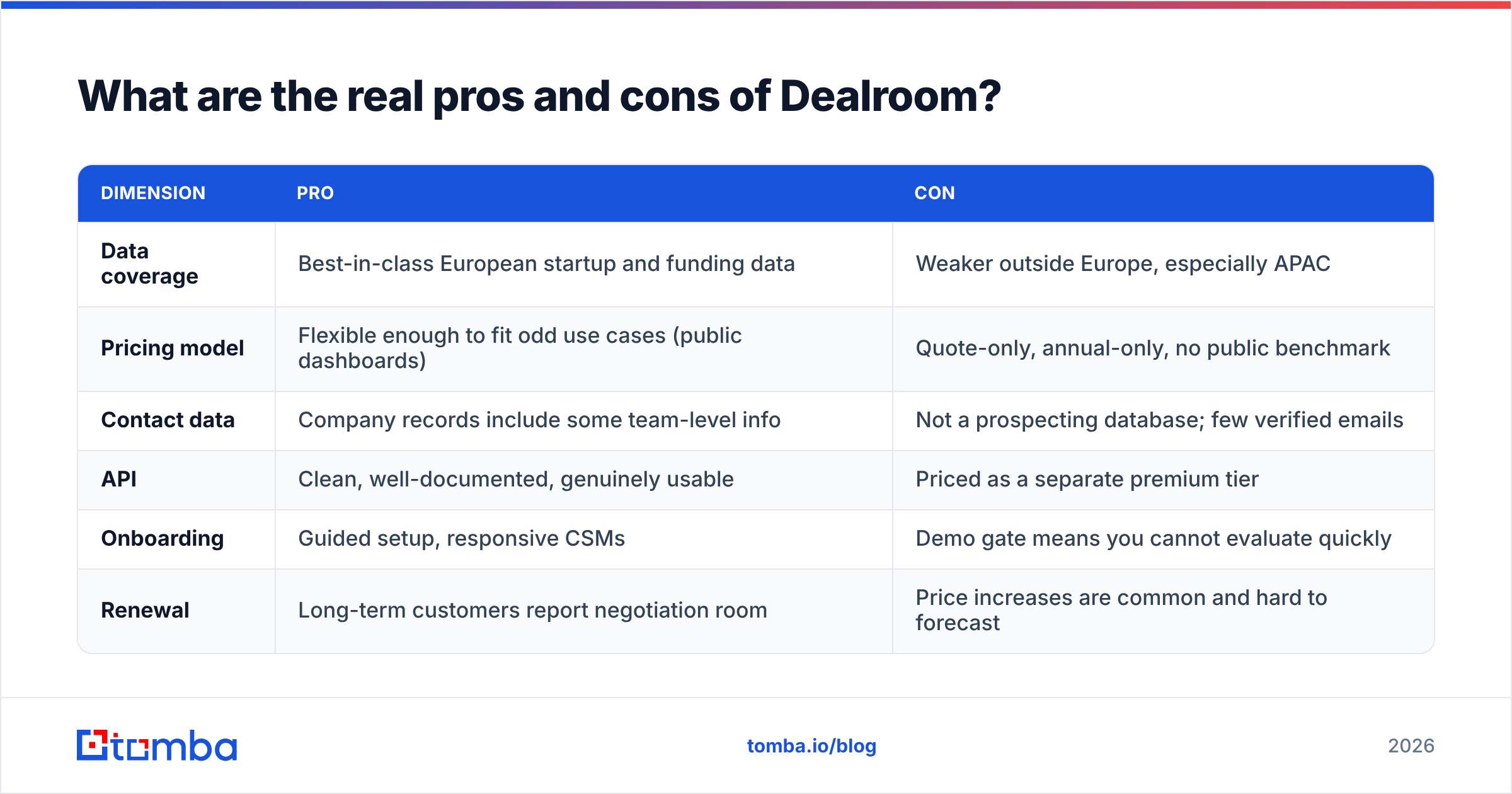
| Dimension | Pro | Con |
|---|---|---|
| Data coverage | Best-in-class European startup and funding data | Weaker outside Europe, especially APAC |
| Pricing model | Flexible enough to fit odd use cases (public dashboards) | Quote-only, annual-only, no public benchmark |
| Contact data | Company records include some team-level info | Not a prospecting database; few verified emails |
| API | Clean, well-documented, genuinely usable | Priced as a separate premium tier |
| Onboarding | Guided setup, responsive CSMs | Demo gate means you cannot evaluate quickly |
| Renewal | Long-term customers report negotiation room | Price increases are common and hard to forecast |
Here is the honest summary. Dealroom is priced like enterprise research software because that is what it is. If your job is to know a market, the money is well spent. If your job is to email 300 people this month, you are paying a lot to build a company list. You will still need a contact layer on top.
Is Dealroom better than PitchBook, Crunchbase, or a prospecting stack?#
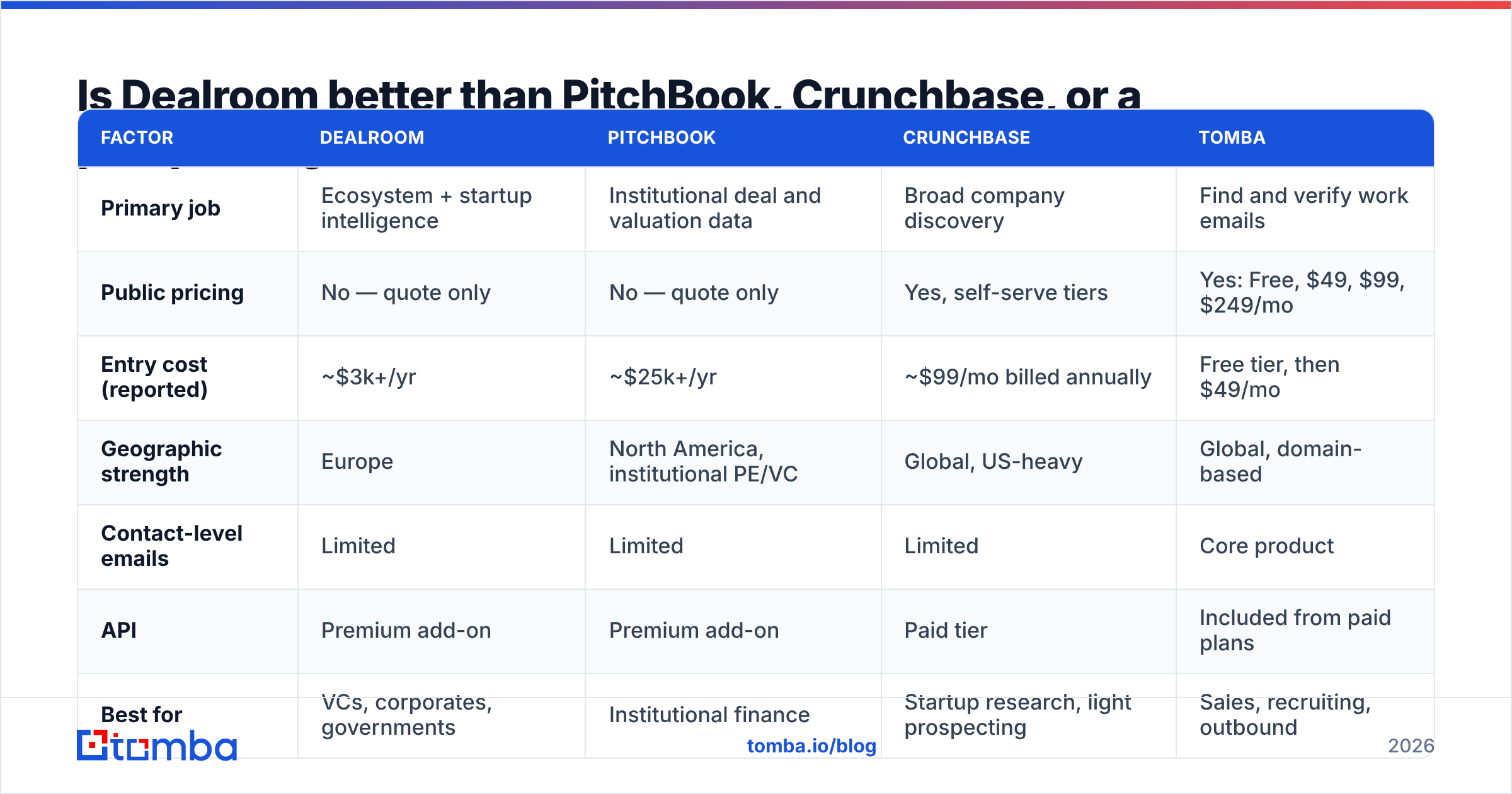
They overlap less than the ads suggest. Here is where each one wins.
| Factor | Dealroom | PitchBook | Crunchbase | Tomba |
|---|---|---|---|---|
| Primary job | Ecosystem + startup intelligence | Institutional deal and valuation data | Broad company discovery | Find and verify work emails |
| Public pricing | No — quote only | No — quote only | Yes, self-serve tiers | Yes: Free, $49, $99, $249/mo |
| Entry cost (reported) | ~$3k+/yr | ~$25k+/yr | ~$99/mo billed annually | Free tier, then $49/mo |
| Geographic strength | Europe | North America, institutional PE/VC | Global, US-heavy | Global, domain-based |
| Contact-level emails | Limited | Limited | Limited | Core product |
| API | Premium add-on | Premium add-on | Paid tier | Included from paid plans |
| Best for | VCs, corporates, governments | Institutional finance | Startup research, light prospecting | Sales, recruiting, outbound |
The practical read: Dealroom and PitchBook compete with each other. Crunchbase wins on breadth and clear pricing. None of them replace a contact data tool, because none of them try to. Most Dealroom buyers pair it with a tool that turns a company list into real people, through domain search or bulk enrichment.

Who should buy Dealroom, and who should not?#
Run these five filters before you take the demo call.
- Is Europe your main market? If yes, the coverage edge is real and worth paying for. If your pipeline is 80% North American, test PitchBook and Crunchbase first.
- Is your output a report or a campaign? Reports justify research pricing. Campaigns do not. You will burn the contract on data you cannot email.
- Do you need API access? Get that quote in writing on the first call. Learning it is a separate tier later is the classic budget shock.
Two more filters set the size of the deal:
- How many seats will log in? Seat pricing punishes teams that buy for a department and use it with three people. Start small and expand later.
- What is your export volume? Count the rows you need each quarter, then double it. Export caps bite before seat counts do.
If three or more answers point away from Dealroom, you are trying to fix a lead-gen problem with a research tool. That is a costly mismatch. A B2B database plus verification costs a fraction of a Dealroom contract. It also answers your real question: who do I contact, and will the email land?
How do you get more value from a Dealroom contract?#
If Dealroom fits, these moves cut your cost per useful record.
- Negotiate at the end of their quarter. Discounts loosen against a sales target. Ask what a multi-year deal looks like, even if you plan to sign one year.
- Bundle the API into the first negotiation. Added at renewal, it is an upsell. Added at signature, it is scope.
- Push for a pilot with export rights. A view-only trial tells you nothing about the export caps.
Two more habits protect the renewal:
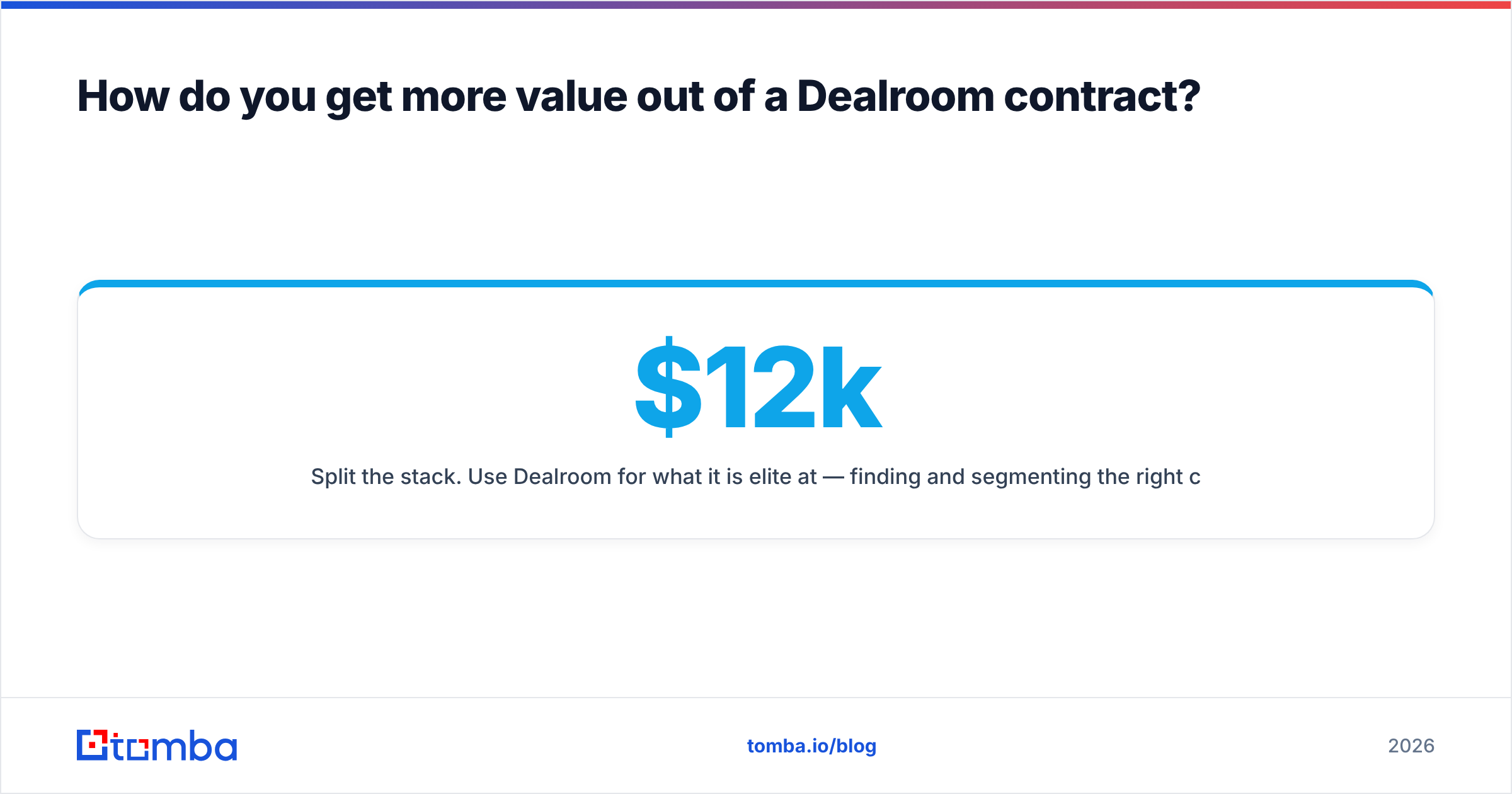
- Split the stack. Use Dealroom to find and sort the right companies. Use a contact tool to reach them. One $12k research contract plus a $99/mo contact tool usually beats a $30k all-in-one.
- Audit usage at month nine. Pull seat-level login data before renewal. Most teams can cut seats by a third and never feel it.
That split is where the savings live. Dealroom tells you a Series A fintech in Lisbon just raised €12M. It rarely gives you the verified email of their VP of Engineering. Feed that list into an email verifier and a finder, and the gap closes for pocket change. If you live in spreadsheets, the Google Sheets add-on turns the export into a contactable list with no data engineer.
What is the 2026 verdict?#
Dealroom is worth the price for one buyer. That is someone whose job depends on reading a private market, above all a European one, and who will use it weekly for a year. For them, a four or five figure contract beats the analyst hours it replaces.
It is not worth the price for a sales team. Weigh the Dealroom pricing reviews pros and cons and they all point one way. Quote-only deals, annual lock-in, export caps, and thin contact data make this research software in a database costume. Buying it to fill a pipeline is like buying a market report to get a phone number.
Be honest about which buyer you are before the demo call. That one choice is worth more than any haggling tactic here.
Need the contact layer, not the research layer? Start with the Tomba Email Finder. Drop in a domain and a name, and get a verified work email back. Check the confidence score before you send. The free tier includes 25 searches a month, so you can test it against your own known-good list. Paid plans start at $49/mo — see full Tomba pricing for bulk and API limits.
Related guides#
// get started
Find, verify and enrich your first contacts today
Start on the free plan with 25 searches a month, then scale when your team is ready.
Free plan · No credit card required · GDPR & CCPA
// about the author