Dealroom vs Generect: Which B2B Data Tool Wins in 2026?
Dealroom sells market intelligence. Generect sells outbound-ready leads. They get compared constantly, but they solve different problems — and picking the wrong one costs you a full quarter of pipeline.
Dealroom vs Generect shows up on almost every B2B data shortlist. The short answer: they do different jobs. Dealroom maps markets. Generect fills your outbound list. Here is how they compare, and when each one earns its price.
TL;DR
- Dealroom vs Generect is not a like-for-like fight. Dealroom tracks private markets: funding rounds, valuations, startup scenes. Generect sells lead data: firms, people, contacts, and an API.
- Need to know which firms to target? Pick Dealroom. It is not close.
- Need 3,000 people you can email this week? Pick Generect. Dealroom is not built for that.
- Both hide most of their pricing. Dealroom sells year-long deals. Generect sells credits, and it starts far cheaper.
- Neither tool is a full stack. You still need verified emails before you hit send. That is the job of an email finder.
Dealroom vs Generect: what does each tool do?#
Most Dealroom vs Generect posts treat the two as rivals. They are not.
Dealroom is a private-market research tool based in Amsterdam. It tracks startups, investors, funding rounds, valuations, and buyouts. Funds, corp dev teams, and public agencies are the core buyers. Some governments use it to score their own startup scenes. It answers questions like which Nordic fintechs raised a Series B in the last 18 months, and who led the round?
Generect is a lead-data tool for sales teams. It pulls company and people records. You filter by size, sector, and job title. Then you take a list, or you pull it through the API. That API-first setup makes it a favorite with agencies and growth engineers.
Same aisle, different job. One is a research tool. The other is a fuel line.
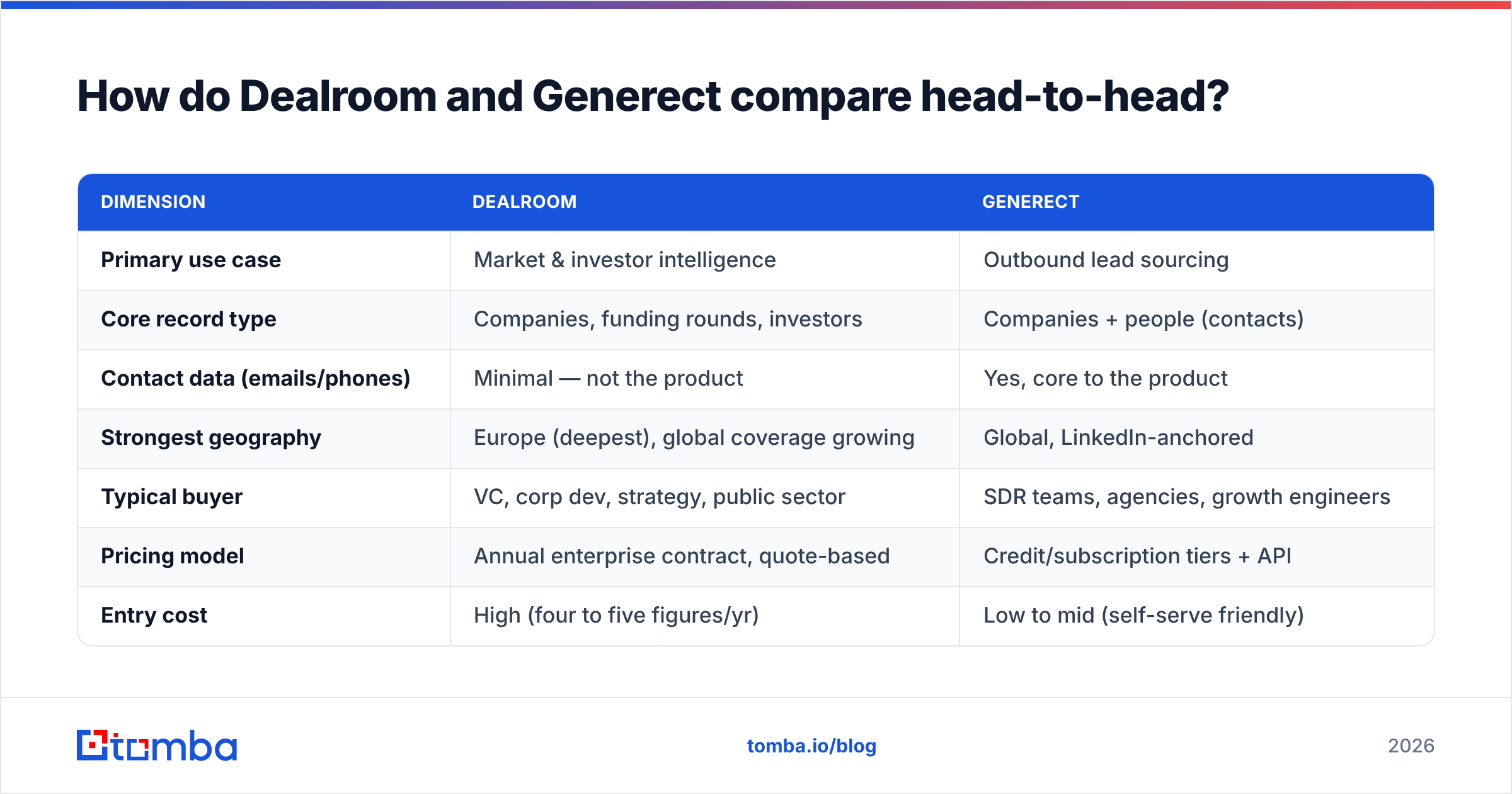
Dealroom vs Generect: the head-to-head table#
| Dimension | Dealroom | Generect |
|---|---|---|
| Main use case | Market and investor research | Outbound lead sourcing |
| Core record | Companies, funding rounds, investors | Companies plus people |
| Contact data (emails, phones) | Minimal — not the product | Yes, core to the product |
| Strongest region | Europe, with global reach growing | Global, LinkedIn-anchored |
| Typical buyer | VC, corp dev, strategy, public sector | SDR teams, agencies, growth engineers |
| Pricing model | Yearly contract, quote only | Credit tiers plus API |
| Entry cost | High (four to five figures a year) | Low to mid, self-serve |
| API | On higher tiers | Central to the product |
| Free option | Limited public profiles | Trial credits |
| Data freshness | Curated, edited, submitted | Live lookups |
| Best at | Who is worth targeting, and why | How to reach 5,000 of them |
| Weakest at | Bulk contact export | Market sizing and funding depth |
Judge the table against your own question. One blended score would be noise.
Which one has better data coverage?#
Coverage is not one number. Split it into four layers. Then Dealroom vs Generect gets much easier to call.
1. Company universe. Dealroom is deep on funded, fast-growing firms. Each record carries the funding history. Generect leans to the wider market: the small and mid-size firms that never raised a round. Is your ICP Series A to C SaaS? Dealroom sees more of them. Is it any 50 to 200 person logistics firm in DACH? Generect wins.
2. People and roles. Dealroom names founders, and sometimes the leadership team. It will not hand you 40 contacts across marketing, RevOps, and buying. Generect will. That one gap decides most deals.
3. Contact channels. Emails and phone numbers are Generect's turf. Dealroom does not sell itself as a contact source. Buying it as one is the classic mistake here.
4. Signal and context. Funding rounds, investor maps, and valuations are Dealroom's moat. Generect gives you firm data and role filters. That is useful, but it will not fill a board deck.

Skim the review sites before you buy. G2 carries user reviews for both, and the gripes are useful. For research tools, the theme is stale records on smaller firms. For lead tools, it is bounce rates and old job titles.
What does each one cost?#
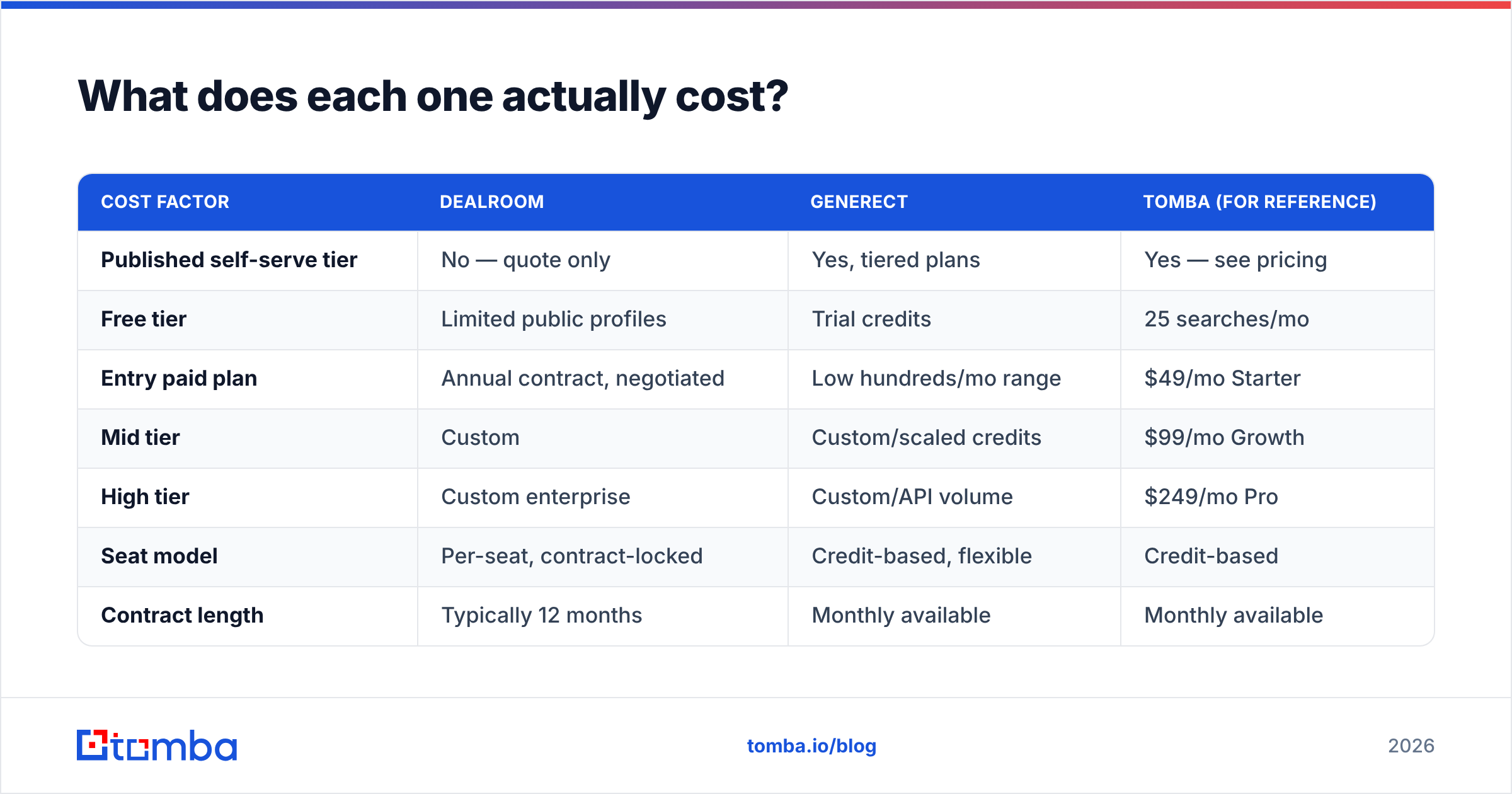
Both keep real numbers behind a form. Treat the table below as a guide. Check their own pages before you sign.
| Cost factor | Dealroom | Generect | Tomba (for reference) |
|---|---|---|---|
| Self-serve tier | No — quote only | Yes, tiered plans | Yes — see pricing |
| Free tier | Limited public profiles | Trial credits | 25 searches/mo |
| Entry paid plan | Yearly contract, negotiated | Low hundreds/mo | $49/mo Starter |
| Mid tier | Custom | Scaled credits | $99/mo Growth |
| High tier | Custom enterprise | API volume | $249/mo Pro |
| Seat model | Per seat, contract-locked | Credit-based, flexible | Credit-based |
| Contract length | Usually 12 months | Monthly available | Monthly available |
| API access | Higher tiers only | Included | All paid plans |
Two things matter more than the exact price.
Dealroom is a budget line, not a tool buy. You will pitch it to finance. You will sign for a year. You will get onboarding and a CSM. That is fair for a fund or a strategy team. It is a poor fit as an SDR utility.
Generect is a cost that moves with volume. Credit pricing is honest about what you buy: records. The risk is different. You pay for a record even when the contact inside it has moved on. So verify before you spend your sending reputation, not after.
Is Dealroom better than Generect for outbound?#
No. For outbound, Generect is the better pick. Dealroom was never built for that job.
Here is the test. Per account, an SDR needs four things: a reason to reach out, a named person, a title that maps to the buying group, and an email that lands. Dealroom nails the first one. A $40M Series B from six weeks ago is a real trigger. It gives you little on the other three.
The smart move is to use Dealroom to target and something else to activate:
- Step 1 — Set the trigger. Query Dealroom: fintechs, Series A or B, raised in the last 90 days, UK or Nordics, 50 to 250 staff.
- Step 2 — Export the accounts. You now have roughly 180 firms with real context.
- Step 3 — Find the people. Generect fills in named contacts and roles at those domains.
- Step 4 — Get and check the addresses. Run domain search for the email pattern. Then push every address through an email verifier.
- Step 5 — Add the hook. Merge the funding detail from step 1 into your first line.
That chain is the real answer to Dealroom vs Generect. Good teams run both roles, not one tool.
Where do both tools fall short?#
Every data vendor shares the same three flaws. The sales pages skip them.
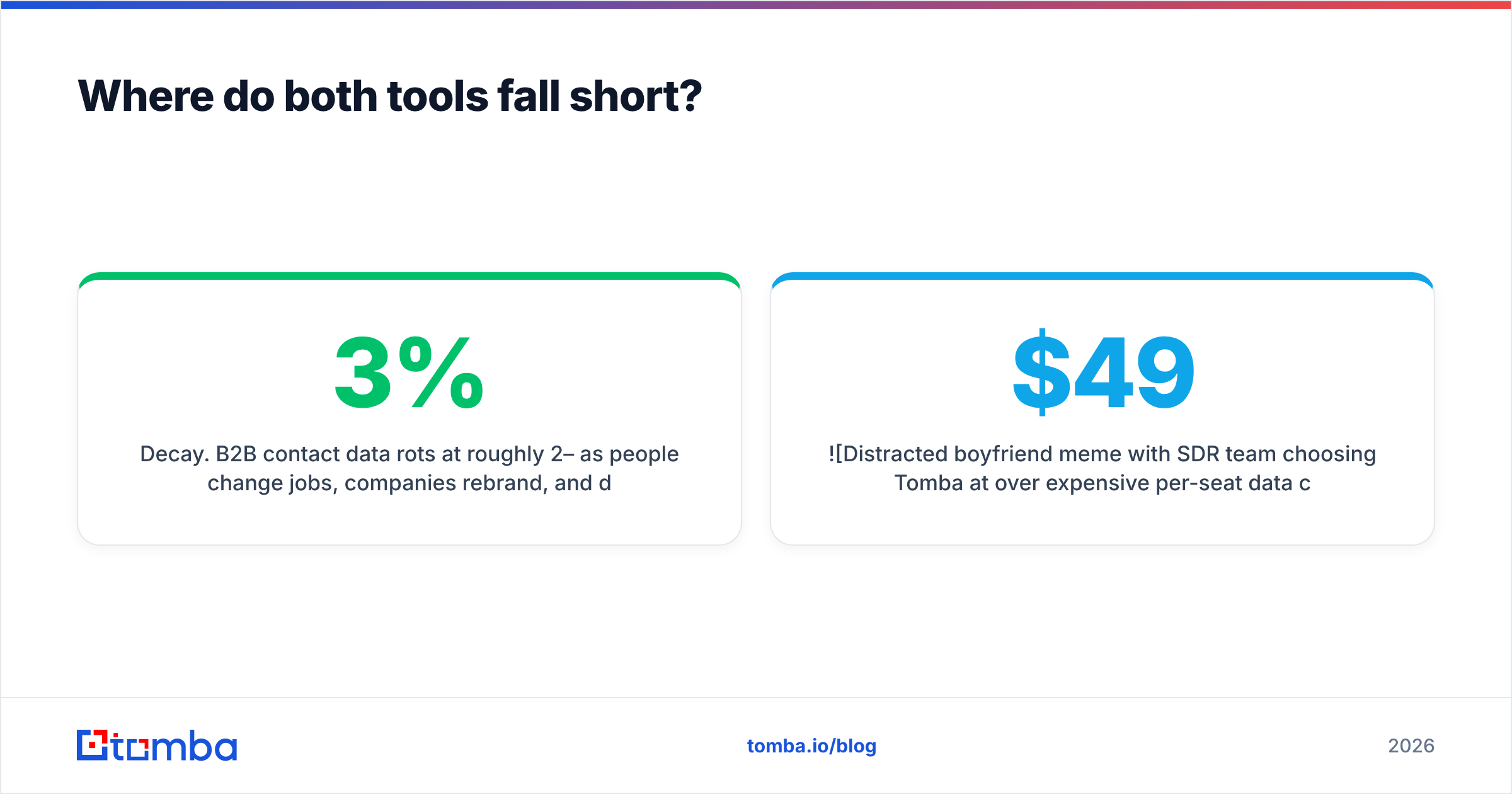
Decay. B2B contact data rots at 2% to 3% a month. People switch jobs. Firms rebrand. Domains move. A list that was 92% right in January is much worse by June. No vendor fixes that. Only repeat checks do.
Catch-all domains. Many large domains accept mail to any address. Naive checks then mark dead addresses as valid. That flat pass on a catch-all domain is a half-truth. A catch-all verifier exists because the normal SMTP handshake cannot settle these.
Gaps outside the core. Dealroom thins out on firms that never raised money. Generect thins out on tiny firms, and on regions where LinkedIn is quiet. Both can show a confident record built on one scraped page from 2023.

There is a pricing trap here too. Per-seat deals punish you for hiring. Credit plans punish you for volume. Neither is wrong. Just model 12 months before you sign. A team of six often pays more for seats than for data.
What are the alternatives?#
Most readers here are weighing a wider set. A quick map:
| Tool type | Examples | When it is the right call |
|---|---|---|
| Market research | Dealroom, PitchBook, Crunchbase | You need funding and valuation context |
| Lead-data platforms | Generect, Apollo, Cognism | You need volume contacts with role filters |
| Verified email finders | Tomba, Hunter, Findymail | You need addresses that land at known domains |
| Curated B2B lists | BookYourData | You want a checked list you can buy outright |
| All-in-one sequencers | Instantly, Smartlead | You need sending tools, not data |
BookYourData deserves its own line. You buy a checked list once, instead of renting a seat. If you run a few campaigns a year, that can beat both tools above.
For the data layer, an API beats a UI once you pass a few hundred records a month. The Tomba API lets you find and verify inside your own flow. The data is then fresh at send time, not at export time. That is worth more than any coverage claim on a landing page.
Which should you choose in 2026?#
Pick by role, not by feature count.
- VC fund, corp dev, or a public innovation body. Dealroom. The funding depth is the product.
- SDR lead who needs 2,000 contacts this month. Generect. Cheaper start, right records, clean API.
- Founder doing both jobs. Start with Generect. Add a Dealroom trial only if funding signals drive your targeting.
Those are the easy calls. Three more cases split the other way.
- Agency running outbound for clients. Generect plus a real verify step. Your margin lives in the bounce rate.
- You already have the account list. Skip both. You need an email finder, not another database.
- You run campaigns now and then. A one-off list from a vendor like BookYourData beats a plan you use four times a year.
One last filter for Dealroom vs Generect: check the handoff into your CRM and sequencer. Manual CSV shuffling costs more in SDR hours than in license fees. Look for native integrations or a clean API first.
The bottom line#
Dealroom and Generect are not rivals. They are two links in one chain. Dealroom tells you who is worth your time. Generect tells you who works there. Neither tells you which address will land. That last step decides inbox or spam folder.
Close that gap first. Run your target domains through the Tomba Email Finder to get verified addresses at any firm. The first 25 searches are free. Starter is $49/mo when you scale, and every paid plan includes the API. Get the addresses right, and the database you pick starts to pay for itself.
Related guides#
Ready to find emails that actually work?
Join 150,000+ professionals who stopped guessing and started sending. Free credits on signup — no credit card required.
Get the Tomba newsletter
Practical outbound tactics and product updates — once every two weeks.
About the author