DealSignal Pricing in 2026: Real Costs, Credits, and Limits
DealSignal quotes custom pricing and starts around $499/month with annual commitments. Here is what the credit model actually costs, where the hidden fees hide, and when a cheaper email finder wins.
TL;DR
- DealSignal does not publish a public price list. Deals typically start near $499/month billed annually, and mid-market contracts land in the $6,000–$15,000/year range depending on credit volume and seat count.
- You buy credits, not records. One credit is consumed per revealed contact, and credits generally expire at the end of the contract term — unused volume is money burned.
- The real cost drivers are annual commitment, seat minimums, CRM sync add-ons, and intent data bundles. The sticker price is rarely the invoice total.
- DealSignal is a fit if you need verified-on-demand contact records at scale with human-in-the-loop QA. It is overkill if you mainly need email addresses for a target account list.
- If your use case is "find and verify work emails for a defined list of companies," a per-search tool like Tomba starts at $49/month with a free tier and no annual lock-in.
What is DealSignal and who is it for?#
DealSignal is a B2B data platform that sells verified contact and company records — emails, direct dials, job titles, firmographics, technographics, and intent signals. Its differentiator is the verification model: rather than serving records from a static warehouse, DealSignal re-verifies contact data at the moment you request it, blending machine validation with human research.
That approach shapes both the product and the price. Static databases can sell you 100 million records cheaply because the marginal cost of a stale record is zero. On-demand verification costs real money per record, so DealSignal prices in credits and sells annually to make the economics work.
The typical buyer is a demand-gen or RevOps team at a company with 50–500 employees running account-based campaigns, feeding a marketing automation platform, and needing data hygiene at the record level. If that is you, the pricing conversation below is the one you will actually have with their sales team.
Think of it like bottled spring water versus a filtration system. A static database is a warehouse of bottles — cheap per bottle, but some have been sitting there two years. DealSignal is the filtration system: you pay more per liter, but it is filtered the moment you pour.

Wait — that image belongs elsewhere. Here is the correct one:

How does DealSignal pricing actually work?#
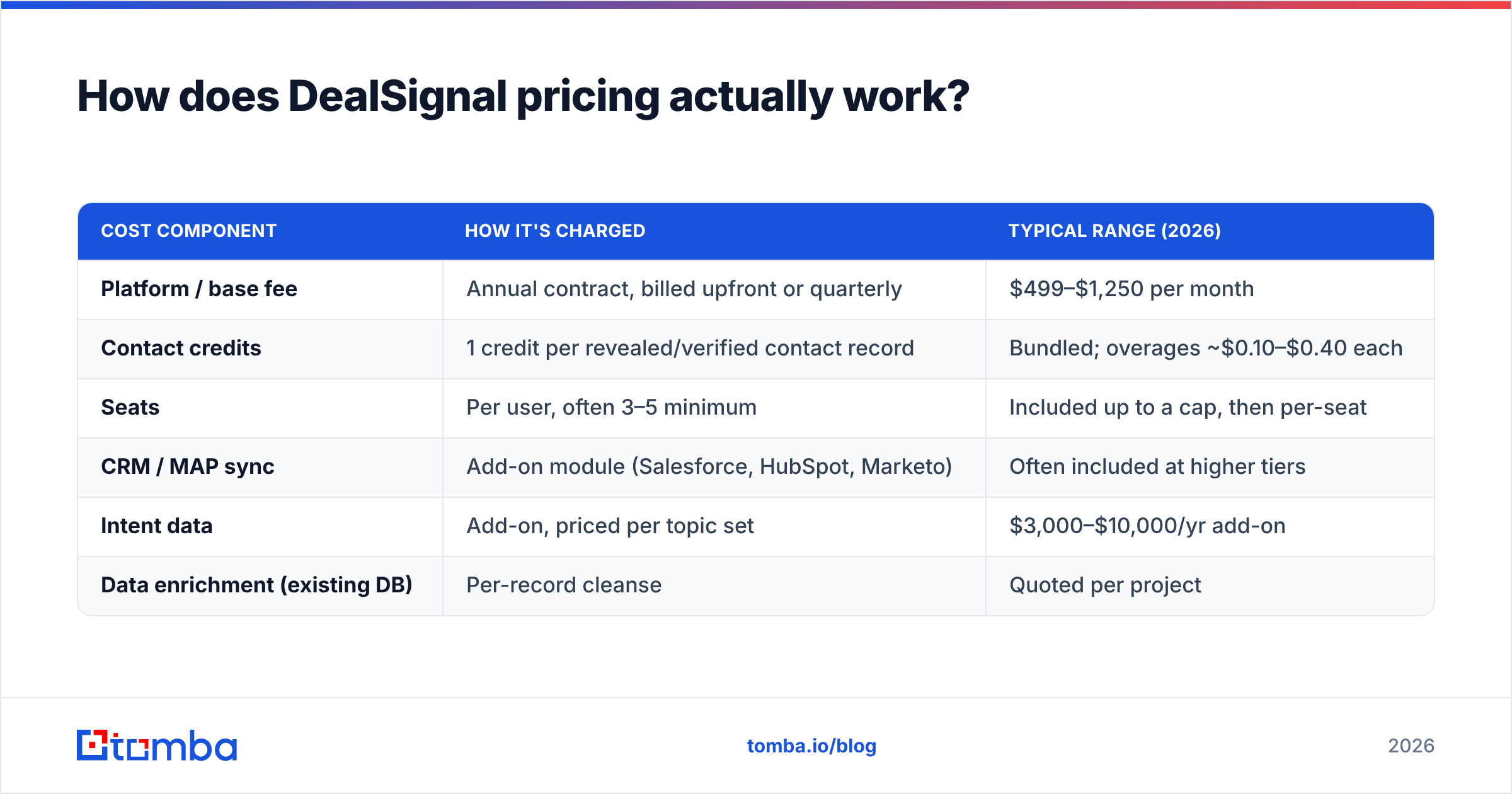
DealSignal uses custom quoted pricing. There is no self-serve checkout, no published tier table, and no month-to-month credit card option on the main platform. You book a demo, describe your volume, and receive a proposal.
Based on publicly reported deals, review-site data on G2, and buyer reports, the structure breaks down like this:
| Cost component | How it's charged | Typical range (2026) |
|---|---|---|
| Platform / base fee | Annual contract, billed upfront or quarterly | $499–$1,250 per month |
| Contact credits | 1 credit per revealed/verified contact record | Bundled; overages ~$0.10–$0.40 each |
| Seats | Per user, often 3–5 minimum | Included up to a cap, then per-seat |
| CRM / MAP sync | Add-on module (Salesforce, HubSpot, Marketo) | Often included at higher tiers |
| Intent data | Add-on, priced per topic set | $3,000–$10,000/yr add-on |
| Data enrichment (existing DB) | Per-record cleanse | Quoted per project |
The headline number people quote is around $499/month as an entry point, but that entry point almost always assumes an annual commitment. A true annual-minimum floor in the $6,000 range is realistic, and mid-market deals with intent data commonly clear $15,000.
What is a credit, exactly?#
This matters more than the monthly figure. In DealSignal's model:
- A credit is spent per contact record revealed — not per search, not per company. Searching costs nothing; exporting or revealing does.
- Verification is included in the credit, which is the core value proposition. You are not paying separately for a cleanse pass.
- Credits are term-scoped. Most annual contracts do not roll unused credits into the next term. If you buy 50,000 and use 31,000, you paid for 19,000 you never touched.
- Company records and contact records may draw from the same pool, so account research quietly eats into contact budget.
- Re-verifying a record you already own can cost another credit, depending on contract language. Ask about this explicitly.
- Overage pricing is negotiable but not cheap — it is the lever sales uses when you underestimate volume, so estimate high on the first year or negotiate a mid-term true-up.
Is DealSignal expensive compared to alternatives?#
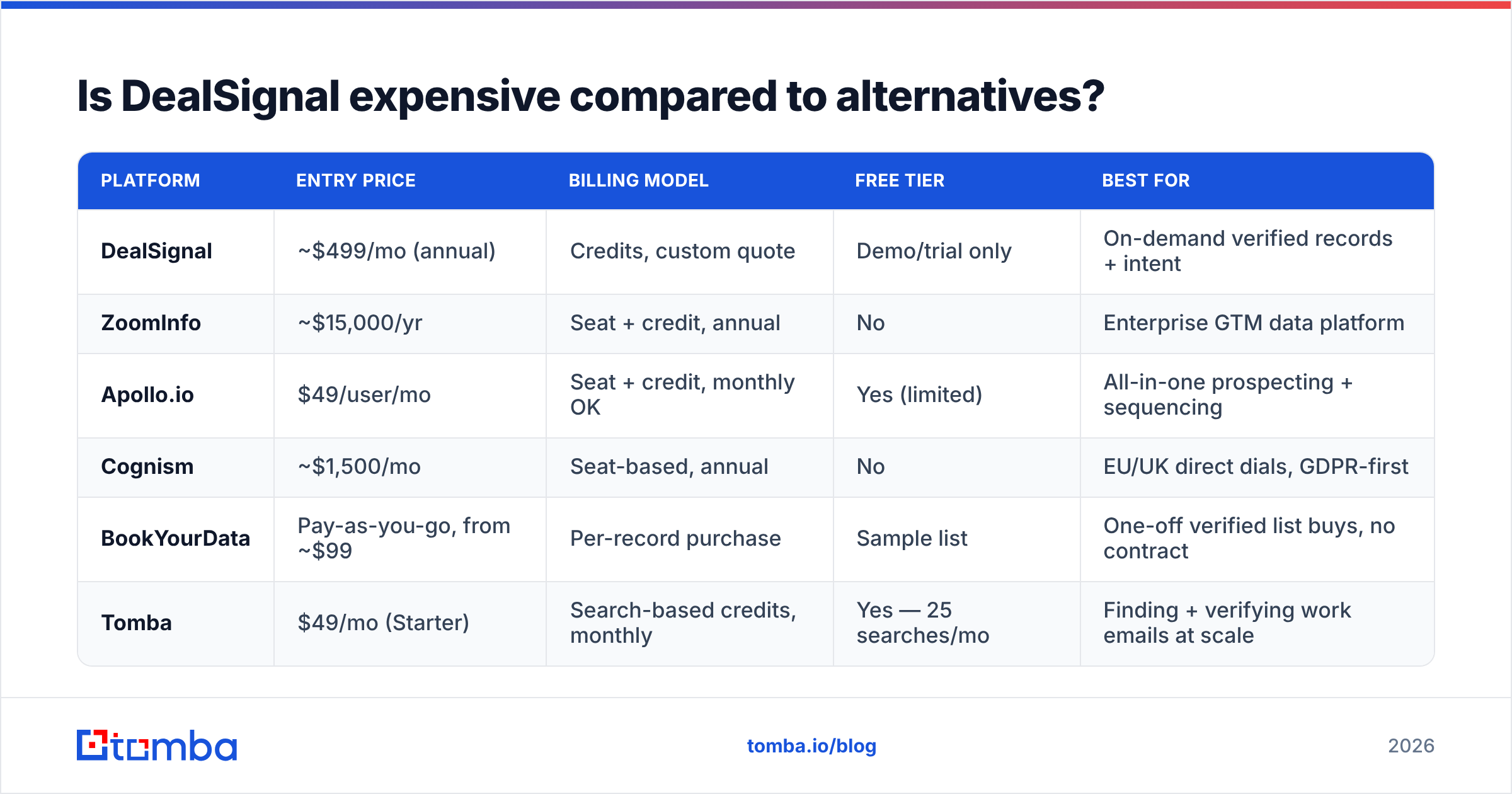
Depends on what you are buying. Compared to enterprise data platforms, DealSignal is mid-priced. Compared to a focused email finder, it is a different budget category entirely.
Here is how the landscape prices out in 2026:
| Platform | Entry price | Billing model | Free tier | Best for |
|---|---|---|---|---|
| DealSignal | ~$499/mo (annual) | Credits, custom quote | Demo/trial only | On-demand verified records + intent |
| ZoomInfo | ~$15,000/yr | Seat + credit, annual | No | Enterprise GTM data platform |
| Apollo.io | $49/user/mo | Seat + credit, monthly OK | Yes (limited) | All-in-one prospecting + sequencing |
| Cognism | ~$1,500/mo | Seat-based, annual | No | EU/UK direct dials, GDPR-first |
| BookYourData | Pay-as-you-go, from ~$99 | Per-record purchase | Sample list | One-off verified list buys, no contract |
| Tomba | $49/mo (Starter) | Search-based credits, monthly | Yes — 25 searches/mo | Finding + verifying work emails at scale |
Two things stand out. First, DealSignal sits above self-serve tools but well below ZoomInfo — that is deliberate positioning. Second, the billing model is the real differentiator, not the number. Apollo, BookYourData, and Tomba will all let you spend money in small increments. DealSignal wants a year.
BookYourData deserves a specific mention here because it solves a different problem well: if you need a clean, verified list once — not a subscription — buying records outright avoids the entire commitment question. It is a genuinely different purchase shape, and for one-off campaigns it often beats a platform contract.
What are the hidden costs in a DealSignal contract?#
The quote you get is not the total cost of ownership. Watch for these five:
- Annual commitment with upfront billing. Many proposals default to paying the full year at signature in exchange for a discount. That is a cash-flow decision, not just a pricing one.
- Credit expiry. Unused credits at term end are typically forfeited. Budget for realistic usage, not aspirational usage — teams routinely overbuy by 30–40% in year one.
- Seat minimums. If pricing includes 5 seats and you have 2 users, you are paying for 3 empty chairs.
- Intent data as an upsell. Intent is where the deal size grows. It can be worth it, but evaluate it as a separate purchase with its own ROI case, not a checkbox on the main contract.
- Integration and onboarding fees. Some contracts carry a one-time implementation charge for CRM mapping and field configuration. Ask for it in writing before signing.
One more: renewal uplift. Multi-year data contracts commonly carry a 5–10% annual increase clause. Negotiate a cap in year one, when you still have leverage.
Is the data accuracy worth the price?#
This is the honest crux of any b2b data buying decision. DealSignal advertises high accuracy on verified records, and the on-demand verification model is a legitimate technical advantage over static databases that refresh quarterly.
But accuracy claims across this category are self-reported and measured differently by every vendor. Some count "deliverable" as accurate. Some count "the person still works there." Some count both. There is no shared benchmark, which is why you should never buy on a stated percentage alone.
Run your own test before signing:
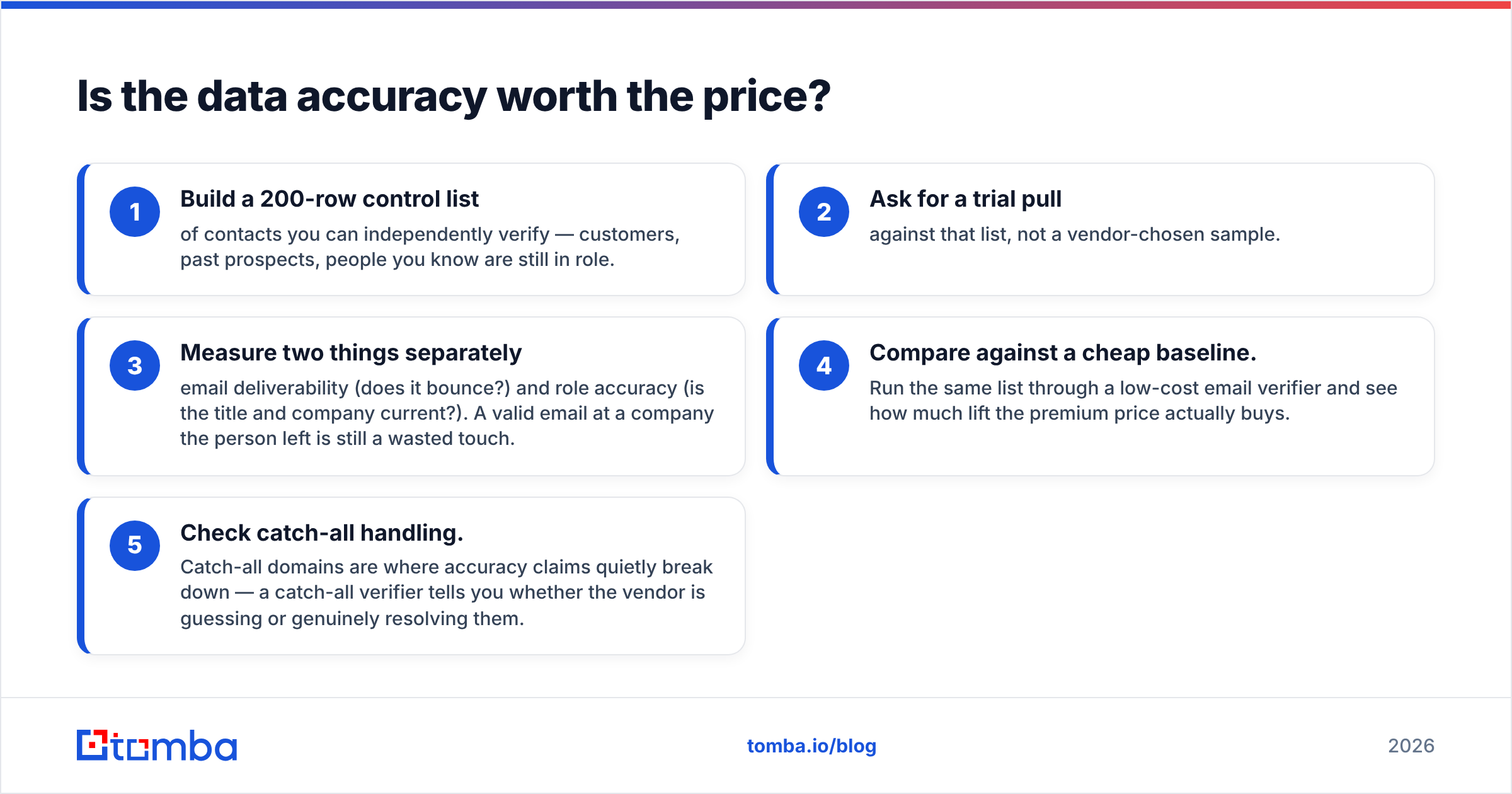
- Build a 200-row control list of contacts you can independently verify — customers, past prospects, people you know are still in role.
- Ask for a trial pull against that list, not a vendor-chosen sample.
- Measure two things separately: email deliverability (does it bounce?) and role accuracy (is the title and company current?). A valid email at a company the person left is still a wasted touch.
- Compare against a cheap baseline. Run the same list through a low-cost email verifier and see how much lift the premium price actually buys.
- Check catch-all handling. Catch-all domains are where accuracy claims quietly break down — a catch-all verifier tells you whether the vendor is guessing or genuinely resolving them.
If the lift over your baseline is 5 percentage points, the premium is hard to defend. If it is 25 points on your ICP specifically, it pays for itself in rep hours. Both outcomes are common — it depends heavily on your target geography and seniority.
When should you pick DealSignal — and when shouldn't you?#
Pick DealSignal when:
- You need contact and company and intent data from one contract, and consolidating vendors has real value to your ops team.
- Your campaigns run at volume — tens of thousands of records per year — where per-record price beats per-search tooling.
- Data hygiene on an existing database is a named project. The cleanse/enrichment side is a genuine strength.
- You have annual budget approved and a RevOps owner who will actually operationalize the integration. Unused platforms are the most expensive kind.
Skip it when:
- Your monthly need is a few hundred to a few thousand contacts. The annual floor makes the effective per-record cost absurd.
- You mostly need email addresses for known companies. That is a domain search problem, not a data-platform problem, and it costs an order of magnitude less to solve.
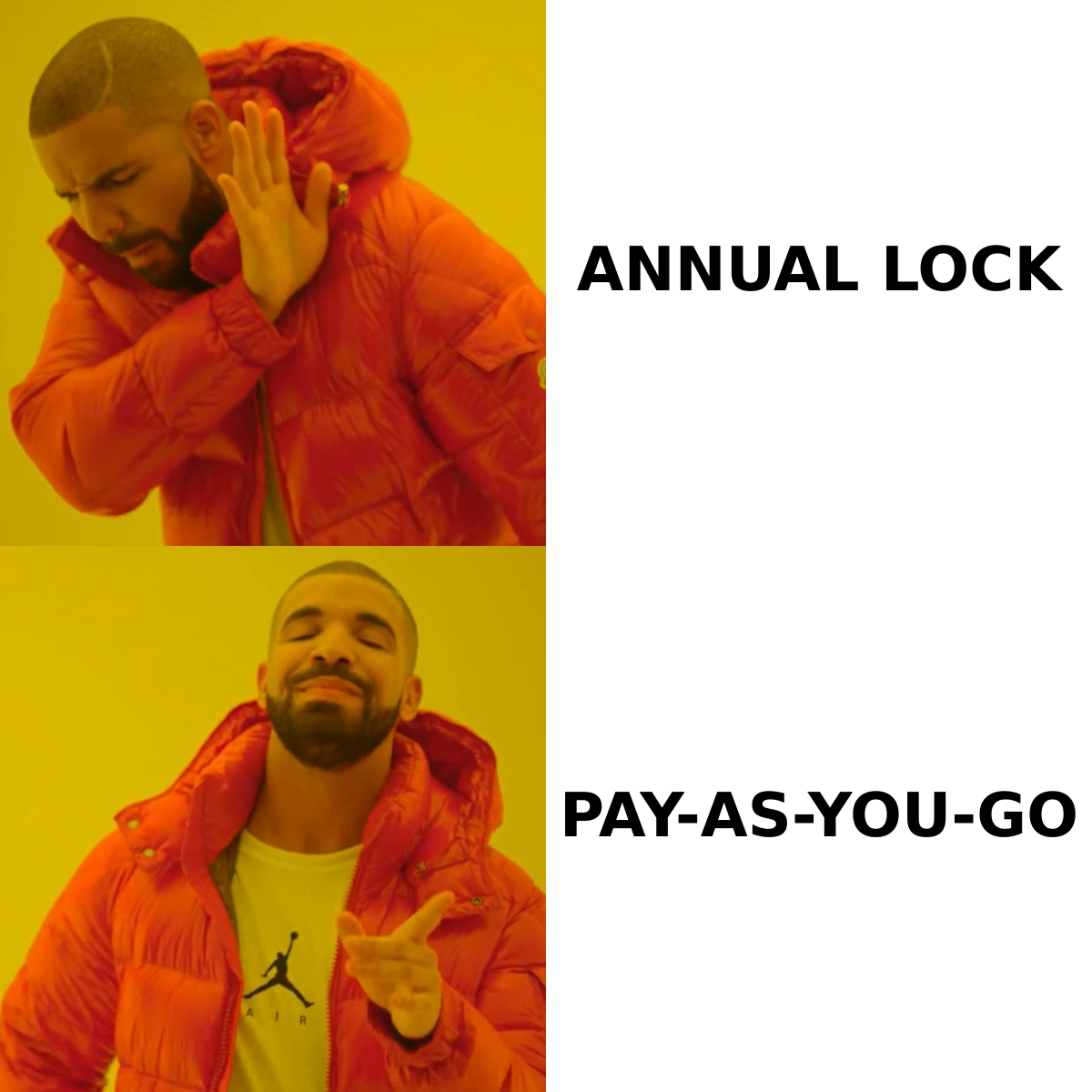
- You cannot commit to a year. Cash-constrained teams should not lock into annual data contracts — the market moves too fast and your ICP may shift in six months.
- You are still validating your ICP. Buy cheap and iterate first; buy expensive once you know exactly who you are targeting.
What is the cheaper alternative for email-focused teams?#
If your bottleneck is "I have a list of 500 target companies and I need the right person's work email," you do not need a $12,000 data platform. You need a fast, accurate finder with a verification layer.
That is the case where a search-based tool wins on pure math:
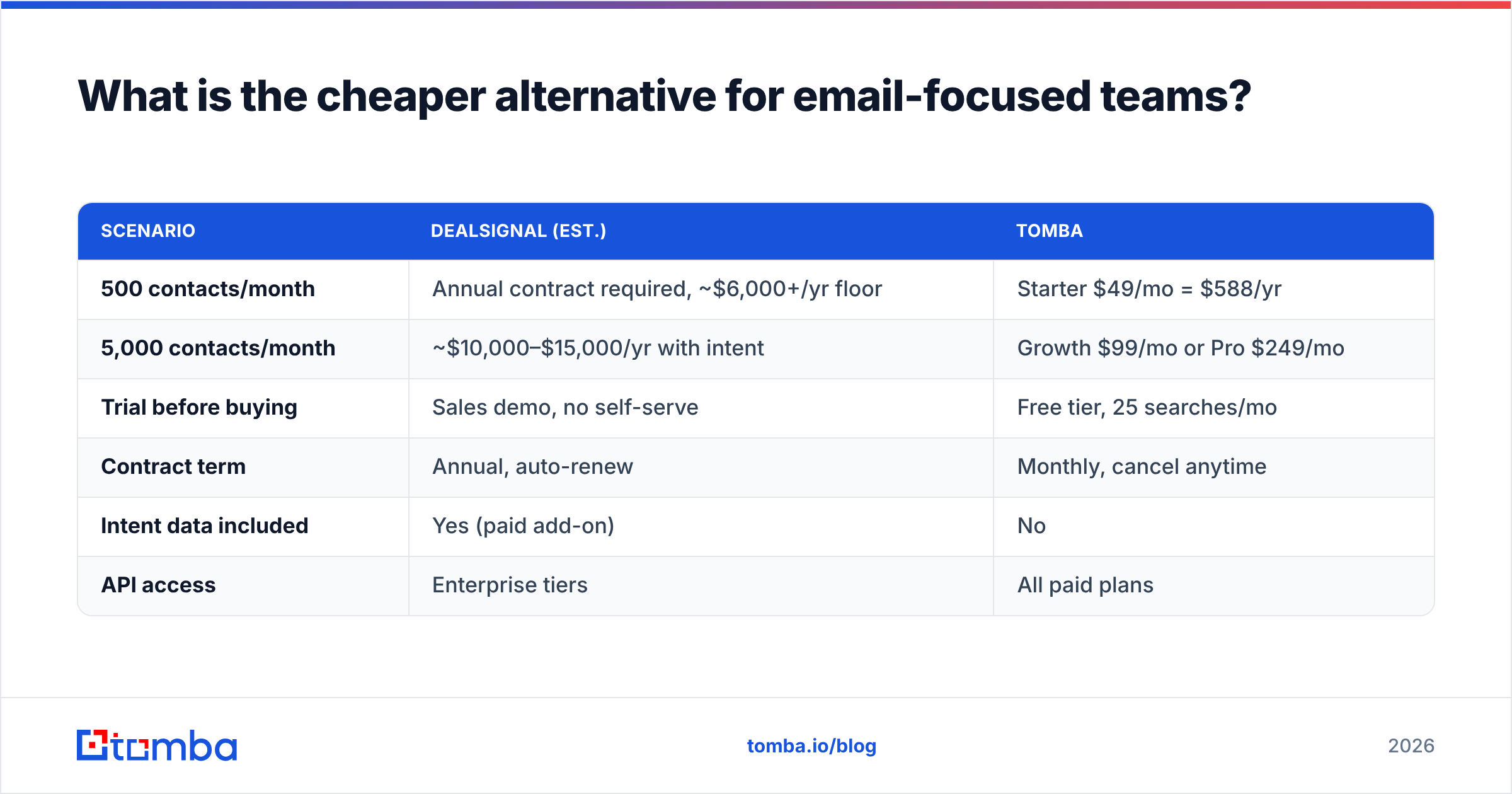
| Scenario | DealSignal (est.) | Tomba |
|---|---|---|
| 500 contacts/month | Annual contract required, ~$6,000+/yr floor | Starter $49/mo = $588/yr |
| 5,000 contacts/month | ~$10,000–$15,000/yr with intent | Growth $99/mo or Pro $249/mo |
| Trial before buying | Sales demo, no self-serve | Free tier, 25 searches/mo |
| Contract term | Annual, auto-renew | Monthly, cancel anytime |
| Intent data included | Yes (paid add-on) | No |
| API access | Enterprise tiers | All paid plans |
The tradeoff is real and worth stating plainly: you give up intent signals, direct dials at scale, and the managed enrichment service. If those are core to your motion, DealSignal earns its price. If they are not, you are buying capacity you will never use.
For teams somewhere in the middle, a hybrid works well — a lightweight finder for day-to-day prospecting, plus a one-time verified list purchase from a vendor like BookYourData when you need a specific segment fast. That combination often costs less than 20% of a platform contract.
How should you negotiate a DealSignal quote?#
Three levers actually move the number, based on how B2B data contracts are typically structured (see Gartner's guidance on software contract negotiation for the general framework):
Volume timing. Data vendors have quarterly quotas. Signing in the last two weeks of a quarter reliably produces better terms than signing in week three.
Credit rollover. This is the most valuable non-price concession and the one buyers forget to ask for. Getting 25% of unused credits to roll into the next term is worth more than a 5% discount for most teams.
Pilot structure. Ask for a 90-day paid pilot with a conversion credit rather than a full-year commitment. Vendors resist it, but they accept it more often than buyers assume — especially if you can articulate a clear success metric up front.
Avoid negotiating on the base fee alone. Sales reps have limited room there and plenty of room on term length, seat counts, and add-on bundling.
Frequently asked questions about DealSignal pricing#
Does DealSignal have a free trial? There is no self-serve free tier. Trials are granted through the sales process, usually as a sample data pull against your criteria. Ask for it against your control list, not their sample.
Can you buy DealSignal monthly? Month-to-month is not the standard offering. Annual is the default, and pricing assumes it. Some teams negotiate quarterly billing on an annual term.
What happens to unused credits? In most contracts they expire at term end. Rollover is negotiable but not automatic — get it in writing.
How does DealSignal compare to ZoomInfo on price? Roughly 40–60% cheaper at comparable volume, though ZoomInfo bundles more GTM tooling. Check current details on the DealSignal site since quoted terms change.
Is there a per-record option? Not from DealSignal directly. For per-record purchasing without a subscription, list vendors and pay-as-you-go providers are the right category.
The bottom line on DealSignal pricing#
DealSignal is fairly priced for what it is: a verified-on-demand data platform with real QA behind the records, positioned below the enterprise giants and above the self-serve tools. The pricing friction is not the number — it is the annual commitment and the credit-expiry model, which punish teams that overestimate volume.
Do the math on your actual monthly contact need before the demo. If it is under a few thousand records and you mainly need work emails, the platform tier is a mismatch and a focused tool will do the job for a fraction of the cost.
Start there and scale up if you outgrow it. The Tomba Email Finder gives you 25 free searches a month to test accuracy against your own control list, with paid plans from $49/month and no annual lock-in. Check the full Tomba pricing breakdown, run your 200-row test, and let the results — not the sales deck — decide what you should be paying for contact data.
Related guides#
Ready to find emails that actually work?
Join 150,000+ professionals who stopped guessing and started sending. Free credits on signup — no credit card required.
Get the Tomba newsletter
Practical outbound tactics and product updates — once every two weeks.
About the author