DealSignal Pros and Cons: An Honest 2026 Data Review
DealSignal promises 95%+ verified B2B contact data on demand. Here's where it delivers, where the credit model and pricing bite, and who should pick something else in 2026.
Weighing the DealSignal pros and cons before you book a demo? Here is the short version. The data is accurate and the filters are deep. The pricing is hidden and the contract is annual. The full breakdown is below, including who should buy something else.
TL;DR
- DealSignal is a B2B contact and account data platform built on on-demand verification. It re-checks each record when it ships, instead of handing you a stale database dump.
- Top pros: high stated accuracy (95%+), deep firmographic and technographic filters, custom-built lists, and CRM enrichment that works with Salesforce and HubSpot.
- Real cons: no public pricing, annual contracts, credits that drain when you browse, and far more platform than a small team needs.
- Best fit: mid-market and enterprise demand-gen teams running ABM. They want list-building and enrichment handled for them.
- Worst fit: solo founders, agencies, and dev teams who just need accurate email lookups by domain. That job is cheaper and faster with a focused email finder.
What is DealSignal, exactly?#
DealSignal is a B2B data platform. It sells verified contact and account records for demand generation, ABM, and sales prospecting. Most rivals lead with database size — "we have 700 million contacts." DealSignal leads with freshness at the moment of delivery.
The mechanism matters. Most vendors keep a warehouse, refresh part of it on a rolling schedule, and serve you the last crawl. DealSignal adds a check on top. When you build a list or ask for enrichment, each record is re-checked against several sources before it lands in your CRM. Think of a pre-packed sandwich in a cooler versus one made when you order. The second costs more and takes longer. It is also less likely to make you sick.
That one design choice drives almost every one of the DealSignal pros and cons below. On-demand checks are why accuracy is high. They are also why turnaround is not instant, and why you pay per record instead of a flat fee.
The company aims at ZoomInfo, Apollo, and Clearbit in the mid-market. Its typical buyer is a demand-gen or marketing-ops lead who needs whole-market lists. It is not built for a rep hunting one email at a time.
What are the main pros of DealSignal?#
Here is what genuinely works, based on how the platform is built and what buyers report.
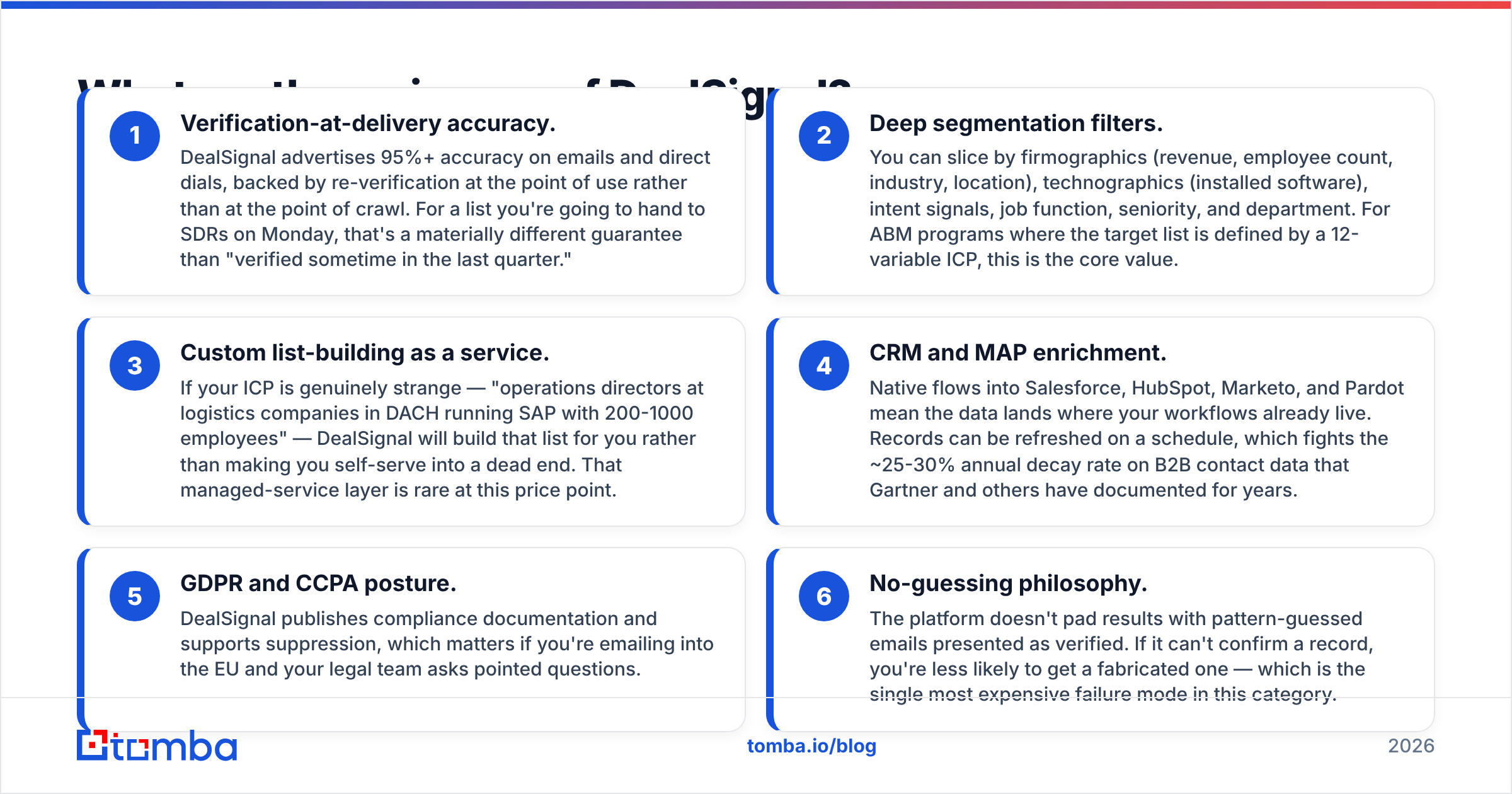
Verification-at-delivery accuracy. DealSignal claims 95%+ accuracy on emails and direct dials. Records are re-checked when you use them, not when they were crawled. For a list you hand to SDRs on Monday, that beats "verified sometime last quarter."
Deep segmentation filters. You can slice by firmographics (revenue, employee count, industry, location), technographics (installed software), intent signals, job function, seniority, and department. If your ICP has a dozen variables, this is the core value.
Custom list-building as a service. Say your ICP is odd: "ops directors at DACH logistics firms running SAP, 200-1000 staff." DealSignal will build that list for you. You do not self-serve into a dead end. That managed layer is rare at this price.
CRM and MAP enrichment. Native flows into Salesforce, HubSpot, Marketo, and Pardot drop the data where you already work. You can refresh records on a schedule. That matters: B2B contact data decays 25-30% a year, as Gartner and others have shown.
GDPR and CCPA posture. DealSignal publishes compliance docs and supports suppression lists. That matters when you email into the EU and your legal team asks hard questions.
No-guessing philosophy. The platform does not pad results with guessed emails dressed up as verified. If it cannot confirm a record, it tends to say so. Fake records are the costliest failure in this category.
What are the real cons of DealSignal?#
Now the parts the demo skips.
Pricing is not public. You will book a call. There is no self-serve checkout, no tier table, no "start free and see." Reported entry points start in the low four figures a year. Bigger seat and credit counts push that into five figures. For a team that wants to test 200 lookups first, that is a wall.
Annual contracts and credit expiry. Credits burn per record delivered. They also reset or expire on the contract cycle. If outbound pauses for a quarter — a hiring freeze, a pivot — you paid for records you never pulled. That is normal in enterprise data. It is still a con next to pay-as-you-go tools.
Coverage skews North American. Like most of this category, DealSignal is strongest in the US and Canada. Western Europe is decent. APAC, LATAM, and emerging markets are thinner. If half your ICP sits in Southeast Asia, test coverage on your own target list before you sign.
Turnaround on custom lists is not instant. The managed-service strength has a flip side. A custom list is a request, not a query. That works for a quarterly campaign plan. It fails when a rep needs contacts this afternoon.
Overkill for simple jobs. If your real need is "find the email for this person at this company," DealSignal is a platform where you wanted a lookup. You pay platform prices for utility work.
UI depth has a learning curve. Filter combinations that produce good lists take practice. New users often build over-broad segments and burn credits on records they never contact.
How does DealSignal compare to alternatives in 2026?#
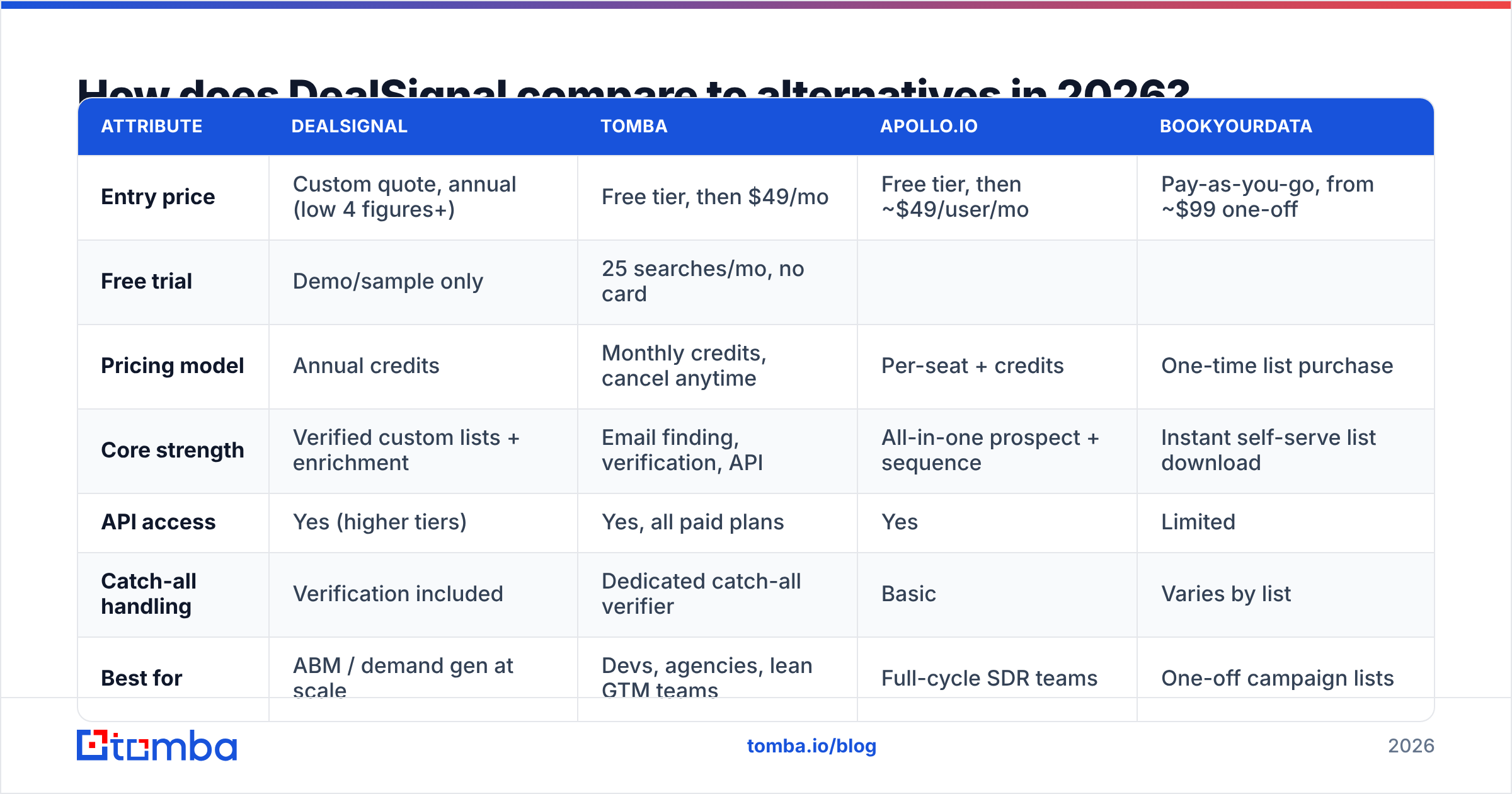
The honest framing: these tools solve overlapping but distinct problems. DealSignal is a data supply platform. Tomba is a lookup and verification engine. Apollo is a database plus a sequencer. BookYourData is a self-serve list marketplace with instant checkout. Picking the "best" one without naming your job is meaningless.
| Attribute | DealSignal | Tomba | Apollo.io | BookYourData |
|---|---|---|---|---|
| Entry price | Custom quote, annual (low 4 figures+) | Free tier, then $49/mo | Free tier, then ~$49/user/mo | Pay-as-you-go, from ~$99 one-off |
| Free trial | Demo/sample only | 25 searches/mo, no card | Free plan with limited credits | Sample records |
| Pricing model | Annual credits | Monthly credits, cancel anytime | Per-seat + credits | One-time list purchase |
| Core strength | Verified custom lists + enrichment | Email finding, verification, API | All-in-one prospect + sequence | Instant self-serve list download |
| API access | Yes (higher tiers) | Yes, all paid plans | Yes | Limited |
| Catch-all handling | Verification included | Dedicated catch-all verifier | Basic | Varies by list |
| Best for | ABM / demand gen at scale | Devs, agencies, lean GTM teams | Full-cycle SDR teams | One-off campaign lists |
| Self-serve signup | No | Yes | Yes | Yes |
Two things fall out of that table.
First, DealSignal and Tomba are not really competitors for most buyers. If you need 40,000 enriched account records mapped to your ICP for a Q3 ABM push, DealSignal's model fits. Need to resolve emails at 3,000 domains from a script instead? A domain search plus email verifier run costs a fraction and finishes in minutes.
Second, BookYourData sits in a middle ground both of the above miss. You buy one defined list, at a known price, with no contract. For campaign-scoped work with no ongoing subscription, that is the cleanest option on the table. Look at it before you sign any annual deal.
Is DealSignal's accuracy claim actually credible?#
Mostly yes — with a caveat about how accuracy is measured.
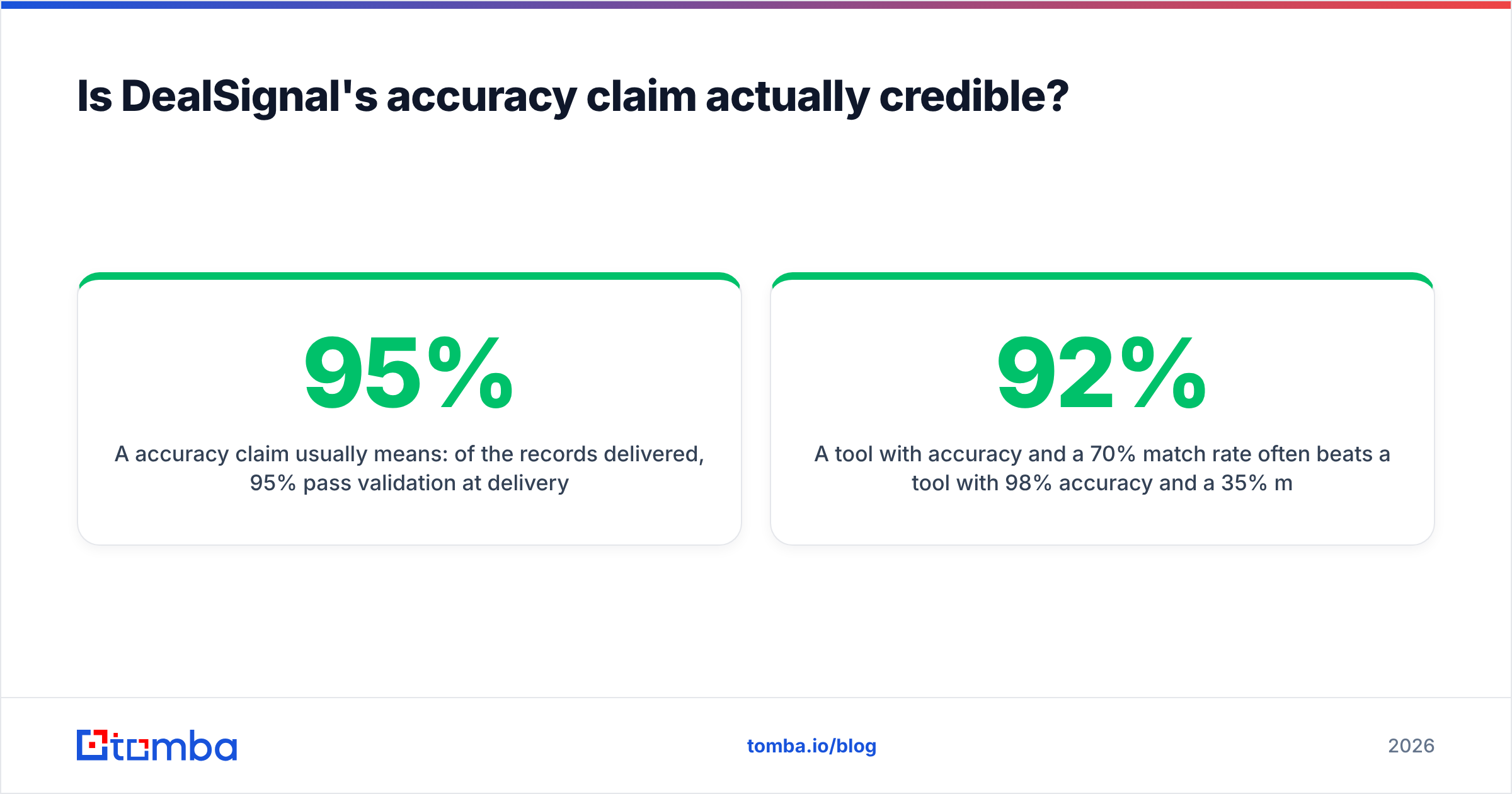
A 95% accuracy claim means one thing: 95% of delivered records pass a check at delivery. It does not mean 95% of the people you want are in the system. Those are two different numbers, and vendors rarely publish the second one — match rate. Any platform can hit 98% accuracy by refusing to return records it doubts. Great for bounce rates. Less great when the list comes back 40% short of your target account count.
So when you evaluate DealSignal — or any vendor here — measure two things on your own sample:
- Match rate: of 500 target contacts you actually want, how many does the tool return anything for?
- Bounce rate: of the records returned, how many bounce on a real send?
A tool at 92% accuracy and 70% match often beats one at 98% accuracy and 35% match. You can verify the extra volume yourself. That is what a standalone email verification pass is for. It is also why many teams pair a broad source with an outside verifier instead of trusting one vendor's own score.
Also insist on a sample from your ICP, not the vendor's demo segment. Demo data is curated. Your segment of Series-B fintech CTOs in the Nordics may look nothing like it.
Who should buy DealSignal — and who should not?#
Buy it if:
- You run ABM or demand gen at mid-market or enterprise scale, with named-account lists in the thousands.
- Your CRM data quality is a board-level complaint. You need scheduled re-enrichment, not one-time downloads.
- Your ICP needs filter combinations (technographic + intent + seniority + geo) that self-serve tools cannot express.
- You own the budget for an annual data line item. You also have a marketing-ops person to run the platform.
Skip it if:
- You are a founder, freelancer, or small agency doing outbound for a handful of clients. The contract minimum alone will exceed your annual tooling budget.
- Your workflow is developer-driven. You want to hit an endpoint from a script, a cron job, or a pipeline. That is an API problem, and a purpose-built email finder API solves it with no procurement cycle.
- You need one clean list, once, for one campaign. Buy a list outright instead of renting a platform.
- Your ICP is heavily non-North-American.
What does a smarter data stack look like in 2026?#
The single-vendor era is over. Good GTM teams now run a layered stack. No provider wins on coverage, accuracy, price, and geography at once.
A practical layout:
- Discovery layer — where you identify accounts and people. Could be DealSignal, Apollo, LinkedIn Sales Navigator, or your own scraping.
- Resolution layer — turning a name plus a company into a working email or phone. This is where a focused finder earns its place. It is cheap, fast, and API-first.
- Verification layer — an outside check before send, including catch-all domains that most finders mark "unknown." Bounce rate is a deliverability input, not a vanity metric — see how sender reputation compounds.
- Enrichment layer — appending firmographics, technographics, and intent onto records already in your CRM.
- Hygiene layer — scheduled re-verification of your database, because contact data decays whether you touch it or not.
DealSignal covers layers 1, 4, and 5 well. It is an expensive way to buy layers 2 and 3 alone. Split those out. Use contact enrichment for the append and a dedicated finder for resolution. That usually costs less and lands more accurate than one vendor doing everything.
One more thing teams miss: run a head-to-head test before renewal, not before purchase. Everyone tests vendors during the sales cycle, when they are motivated. Almost nobody re-tests at month 10, when the data has drifted and cheaper rivals have shipped new coverage. Put a 60-day bake-off on the calendar the day you sign.
Frequently asked questions#
Does DealSignal offer a free trial? There is no open self-serve free tier. You can request sample data and a demo. Hands-on access usually follows a sales conversation.
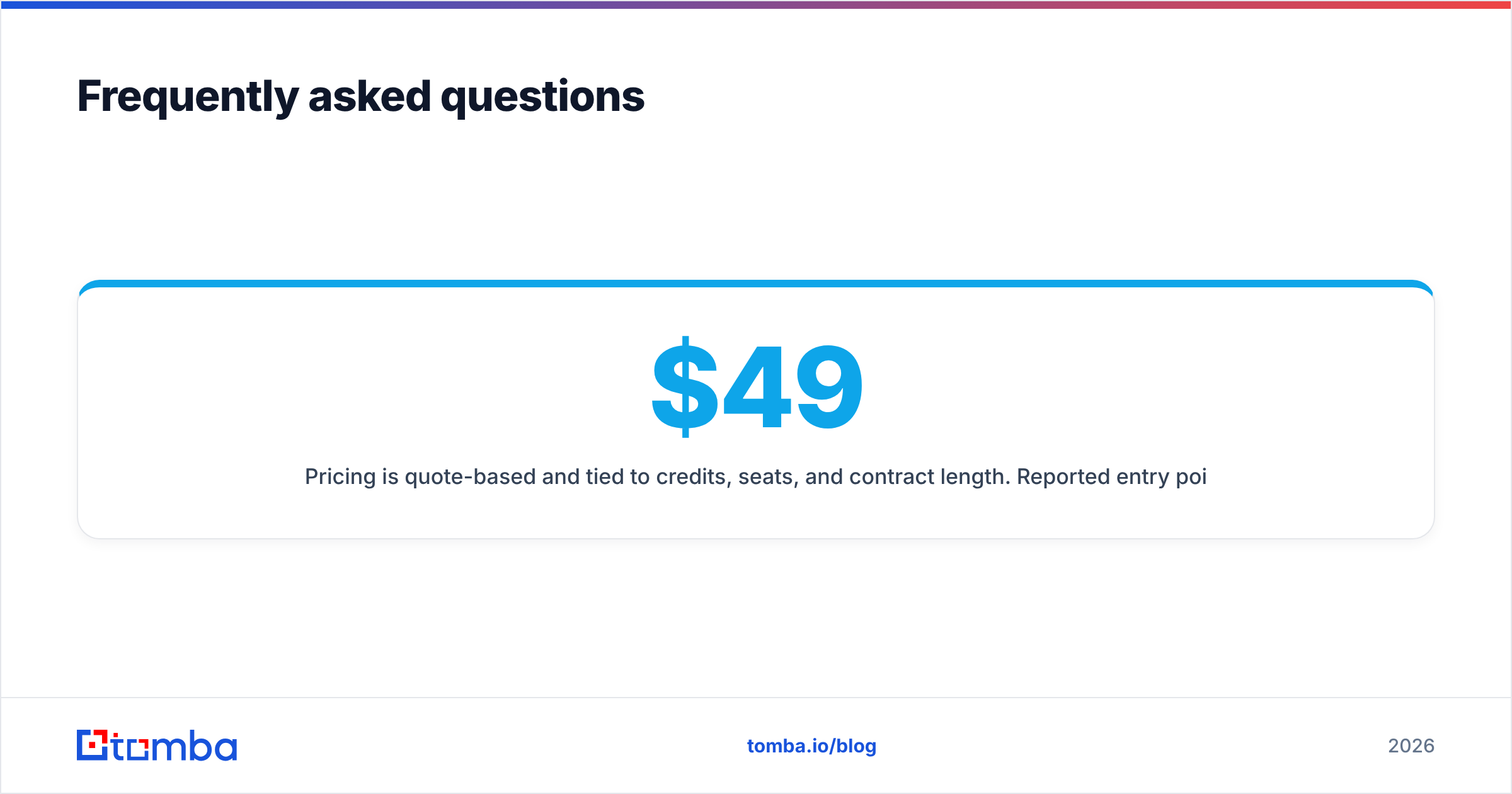
How much does DealSignal cost? Pricing is quote-based. It is tied to credits, seats, and contract length. Reported entry points start in the low four figures a year and scale from there. Compare that with open tiers like Tomba pricing — free, $49, $99, and $249/mo — when you model total cost.
Is DealSignal GDPR compliant? DealSignal publishes GDPR and CCPA compliance documentation and supports suppression requests. Compliance is still shared. Your consent basis and your outreach habits matter as much as the vendor's.
Can DealSignal replace ZoomInfo? For list-building and enrichment, often yes, at lower cost. For the full ZoomInfo suite (intent, conversation intelligence, workflow orchestration), it is a narrower product. Check the overlap against what you actually use. Most ZoomInfo seats touch a fraction of the platform.
DealSignal pros and cons: the bottom line#
DealSignal is a good product for one specific buyer. That buyer is a mid-market or enterprise team that needs verified, tightly segmented B2B data pushed into a CRM on a schedule. A managed-service safety net for odd ICPs comes with it. In that lane, the accuracy claim holds up and the filter depth is real.
The cons are structural, not fixable: hidden pricing, an annual commitment, credit expiry, and a platform footprint that dwarfs simple lookup needs. None of that makes it a bad tool. It makes it the wrong tool for a large share of the people who evaluate it. Weigh the DealSignal pros and cons against the job you actually have, not the job the demo shows you.
If your job is finding and verifying work email addresses — by domain, by name, by company, in bulk or through an API — start with the Tomba Email Finder. The free tier gives you 25 searches a month with no card. Paid plans start at $49/mo. You can test your real ICP today instead of booking a demo for next Thursday. Run 100 of your hardest lookups, measure match rate and bounce rate yourself, and let the numbers pick your stack.
Related guides#
Ready to find emails that actually work?
Join 150,000+ professionals who stopped guessing and started sending. Free credits on signup — no credit card required.
Get the Tomba newsletter
Practical outbound tactics and product updates — once every two weeks.
About the author