DealSignal Reviews 2026: Pricing, Accuracy, and Verdict
Most DealSignal reviews skip the quote-only pricing, so this one starts there: how on-demand verification works, where the data holds up, and which cheaper alternatives cover the same job.
TL;DR
Most DealSignal reviews stop at the feature list. This one starts with the price tag.
- DealSignal is a B2B contact and account data platform. It verifies records the moment you request them, instead of serving a pre-built static database.
- The pitch is accuracy and depth: emails, direct dials, firmographics, intent signals. For enterprise list-building, it largely delivers.
- Pricing is quote-only. There is no self-serve tier and no free plan. Most buyers land on an annual contract, and that is the main reason teams walk.
- Need full enriched account lists with human-verified direct dials? DealSignal is a real contender. Need emails for people you already know? You are overbuying.
- The best alternative depends on the job. Tomba handles per-lookup email finding and verification. BookYourData sells prepaid self-serve lists. ZoomInfo and Apollo sell full sales-intelligence suites.
What is DealSignal, exactly?#
DealSignal (dealsignal.com) sells B2B contact and account data. Its buyers are demand-gen, marketing ops, and outbound teams. The differentiator it leans on hardest is freshness by design. Other vendors ship you a slice of a database built six months ago. DealSignal checks each record at request time, using machine validation plus human research.
Here is the analogy. Most data vendors run a warehouse. You walk in, grab what is on the shelf, and hope the milk has not expired. DealSignal runs a made-to-order kitchen. You place the order, they assemble and check it, and it arrives fresher but slower and pricier.
What you can actually buy:
- Contact records — verified work emails, direct dial and mobile numbers, titles, seniority, department, and LinkedIn URLs.
- Account records — firmographics, revenue and headcount bands, tech stack signals, and parent/child company structure.
- List building — you describe the ICP and they build the list. Hard-to-find personas get a research pass.
- Enrichment and hygiene — fill missing fields in your CRM and clear out stale ones on a schedule.
- Intent and scoring layers — buying signals and lead scores, sold as add-ons rather than core product.
That fifth bullet matters. DealSignal sits in the sales intelligence category next to much larger suites. But it is a data company, not a sequencer, dialer, or CRM. It feeds your stack. It does not replace it.
Who is DealSignal actually built for?#
Three profiles get real value:
- Demand-gen teams running high volume. If you burn 50,000+ records a year, and bad data costs you MQL targets, on-demand verification pays for itself.
- Marketing ops teams with a decaying CRM. B2B contact data goes stale at roughly 2-2.5% a month from job changes alone. Re-verifying a 200k-record database on a schedule is exactly this tool's job.
- ABM programs that need account hierarchy. Mapping subsidiaries to parent accounts is genuinely hard. DealSignal does it better than most mid-market tools.
Three profiles should walk away, and most DealSignal reviews gloss over them:
- Solo founders and small agencies. No free tier. No $49 entry point. A sales call before you see a number.
- Teams that already know their targets. Say you have 400 companies and need the VP of Engineering at each. You need an email finder, not a data platform with an annual contract.
- Anyone who wants to test first. With no self-serve trial, evaluation drags.

How accurate is DealSignal's data in practice?#
Every vendor claims 95%+ accuracy, so the claim itself is worthless. The useful questions are how that accuracy is produced, and what happens when it fails.
DealSignal's method is multi-source triangulation plus a verification pass before delivery. In practice:
- Emails are checked against SMTP response, syntax, domain records, and pattern confidence. Records that fail get suppressed, not shipped with a shrug.
- Phone numbers get a human research layer for direct dials. That is why turnaround takes hours or days, not milliseconds.
- Catch-all domains stay the honest weak spot for every vendor here, DealSignal included. If a domain accepts all mail, no SMTP check can prove a single mailbox exists. You are left with pattern confidence and second sources. A dedicated catch-all verifier still belongs in your workflow, whichever database you buy from.
Across G2 and Capterra, DealSignal reviews praise two things: coverage of hard-to-find personas, and the quality of direct dials. The repeated complaint is not accuracy. It is slow turnaround on custom lists and rigid contracts. That pattern tells you a lot. People like what arrives. They dislike how they had to buy it.

One nuance most DealSignal reviews miss. Verification happens at request time, so your accuracy is stamped to the delivery date, not to the day you use the data. A list verified in January and mailed in April has already decayed. Add a re-verification step with an email verifier before every send, no matter how fresh the source claimed to be.
What does DealSignal cost in 2026?#
The honest answer: DealSignal does not publish pricing. Any figure you read on a comparison blog is outdated or guessed. The structure is verifiable, though:
- Credit- or record-based, with volume tiers. Cost per record drops as you commit to more.
- Annual contracts are the norm. Monthly is the exception.
- Add-ons priced separately. Intent data, scoring, and premium research passes are not in the base number.
- Quote-gated. You talk to sales before you see a price.
That model is standard for enterprise data vendors. It is not a scandal. It does cost you evaluation time. And it is a hard blocker if your first question is "can I test 200 records this week?"
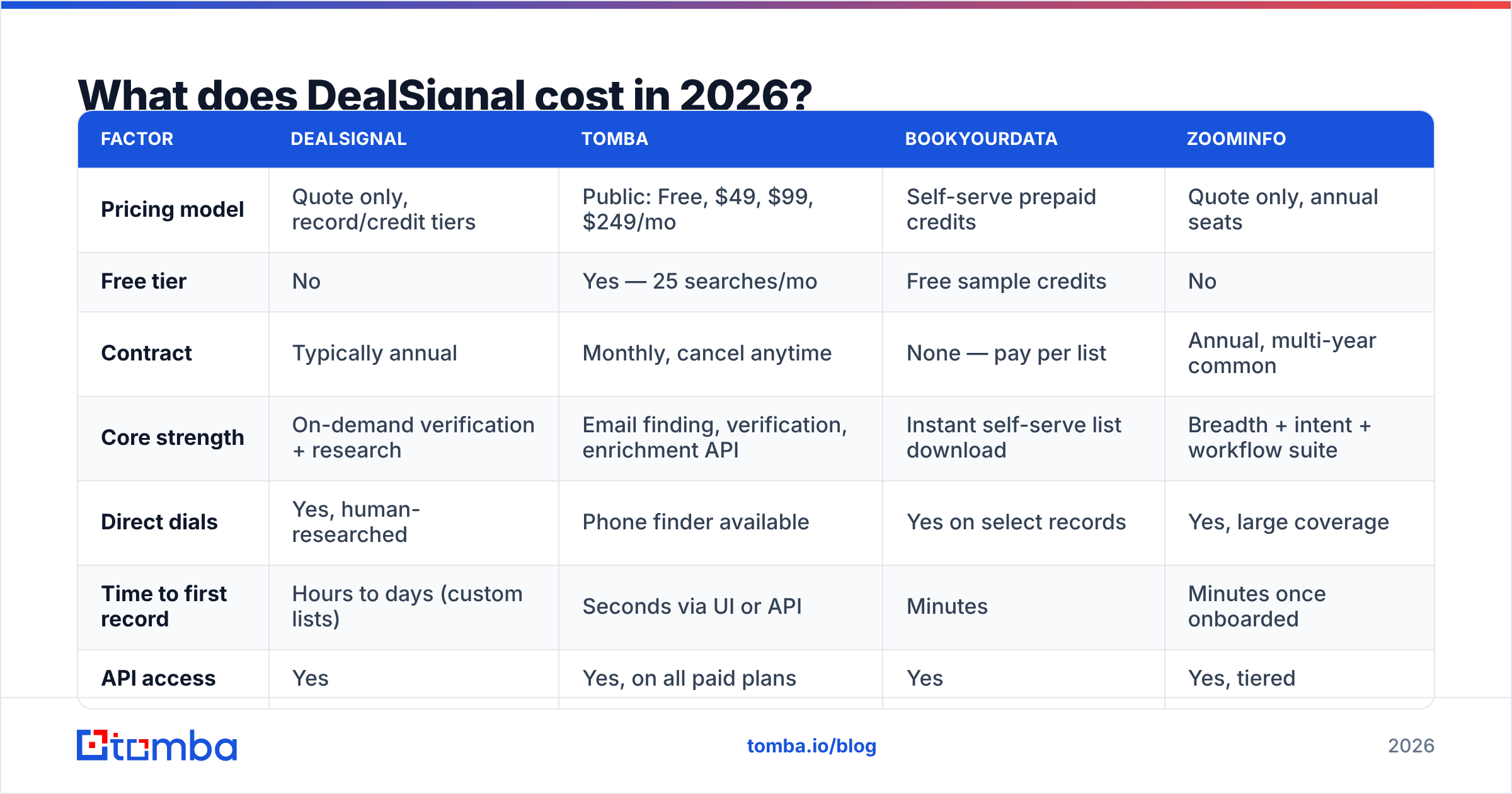
The table below sets DealSignal against the tools buyers shortlist alongside it. Prices are mid-2026. Re-check them before you commit.

| Factor | DealSignal | Tomba | BookYourData | ZoomInfo |
|---|---|---|---|---|
| Pricing model | Quote only, record/credit tiers | Public: Free, $49, $99, $249/mo | Self-serve prepaid credits | Quote only, annual seats |
| Free tier | No | Yes — 25 searches/mo | Free sample credits | No |
| Contract | Typically annual | Monthly, cancel anytime | None — pay per list | Annual, multi-year common |
| Core strength | On-demand verification + research | Email finding, verification, enrichment API | Instant self-serve list download | Breadth + intent + workflow suite |
| Direct dials | Yes, human-researched | Phone finder available | Yes on select records | Yes, large coverage |
| Time to first record | Hours to days (custom lists) | Seconds via UI or API | Minutes | Minutes once onboarded |
| API access | Yes | Yes, on all paid plans | Yes | Yes, tiered |
| Best for | Enterprise list-building and CRM hygiene | Targeted finding at known domains | One-off list purchases without a contract | Large sales orgs wanting one vendor |
BookYourData deserves a note, because it removes the exact friction DealSignal creates. Say your blocker is "no sales call, no year-long commitment." A prepaid self-serve list vendor solves that. Cost per record is predictable and there is no procurement cycle. Different philosophy, same underlying need.
Is DealSignal better than an email finder?#
Wrong question. They solve different problems. Confusing the two is how teams pay enterprise rates for a job that costs cents.
Use a data platform like DealSignal when you do not know who your targets are. You describe an ICP — VP Finance at US manufacturers, 500-2,000 employees, running NetSuite — and the platform builds the list. Discovery is the value.
Use an email finder when you already know your targets. You have a company list, names from LinkedIn, or a batch of domains, and you need working addresses. Retrieval is the value.
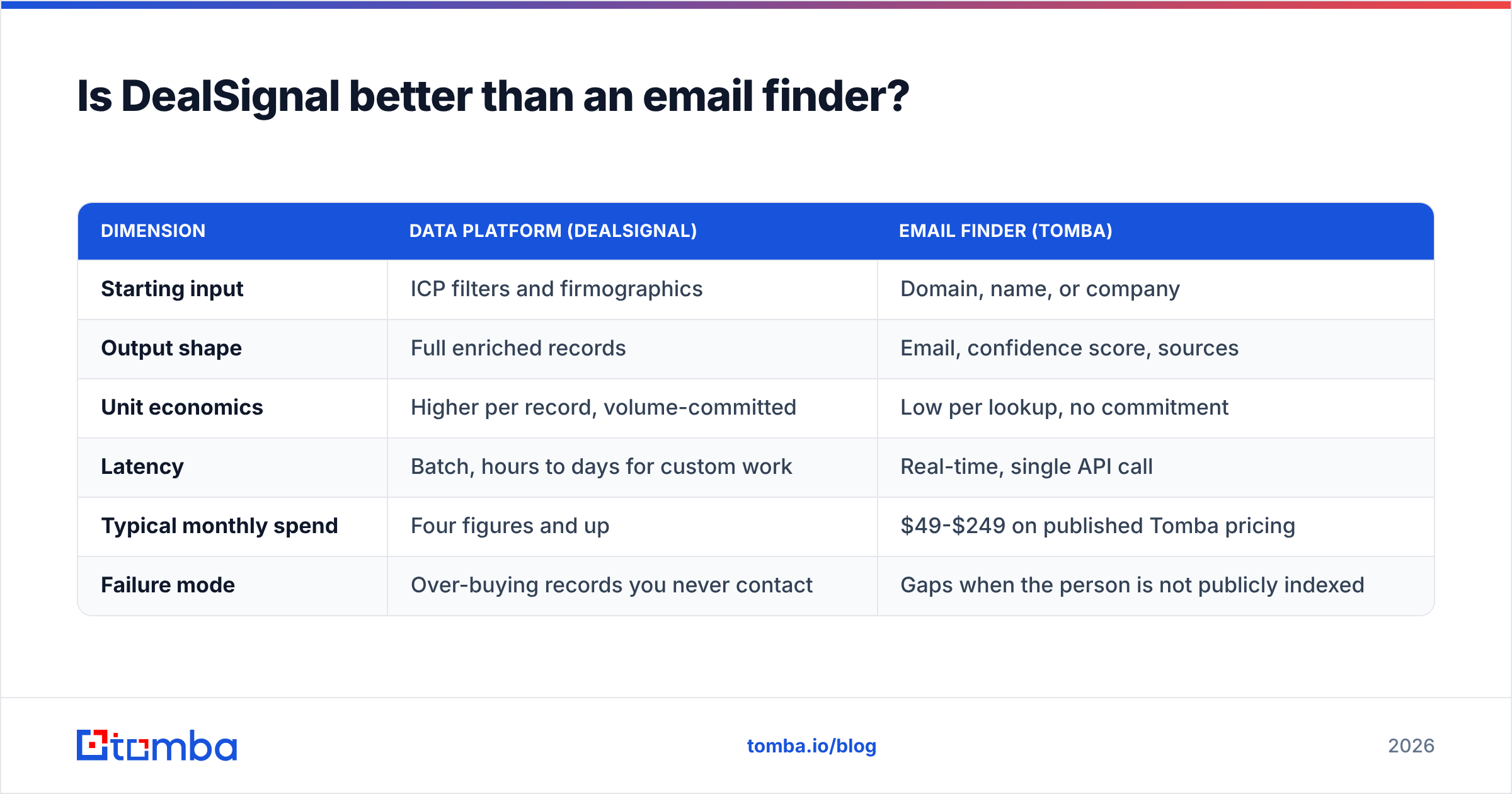
Most outbound teams need both, at very different volumes. Here is how the two compare on the things that drive cost:
| Dimension | Data platform (DealSignal) | Email finder (Tomba) |
|---|---|---|
| Starting input | ICP filters and firmographics | Domain, name, or company |
| Output shape | Full enriched records | Email, confidence score, sources |
| Unit economics | Higher per record, volume-committed | Low per lookup, no commitment |
| Latency | Batch, hours to days for custom work | Real-time, single API call |
| Typical monthly spend | Four figures and up | $49-$249 on published Tomba pricing |
| Failure mode | Over-buying records you never contact | Gaps when the person is not publicly indexed |
Most teams settle on a hybrid. Buy discovery data in bulk once or twice a year. Then run retrieval and verification in-house all year. A domain search pass over your target accounts, plus scheduled re-verification, covers the daily work. Save the expensive vendor for genuinely new territory.
What do real DealSignal reviews complain about?#
Read enough public DealSignal reviews and buyer forums and the criticism clusters into four themes. None of them is "the data is fake," which is worth noting in this category.
- Opaque pricing. The most repeated frustration. Buyers cannot qualify themselves, so evaluation drags and small teams drop out.
- Slow turnaround on custom lists. The human research that produces good direct dials is also what makes delivery slow. Plan for it if your calendar is tight.
- Coverage outside North America. US and Canada coverage is strong. EMEA and APAC are thinner and more variable, especially for direct dials. GDPR explains part of it. The effect on a European ICP is still real.
- Onboarding and integration effort. Clean two-way sync with Salesforce or Marketo takes ops time. Budget for it rather than assuming a plug-and-play afternoon.
The praise is specific and credible: responsive account management, willingness to build custom segments, and low bounce rates versus static-database rivals. When data quality is the whole product, being boringly reliable is the compliment that counts.
How should you evaluate DealSignal before you buy?#
Run a structured test, not a demo. The demo always looks good. No set of DealSignal reviews, including this one, beats a sample run against your own data.
- Ask for a sample against your ICP, not theirs. Give them 100 accounts you already know something about. Then measure fill rate and correctness against the truth.
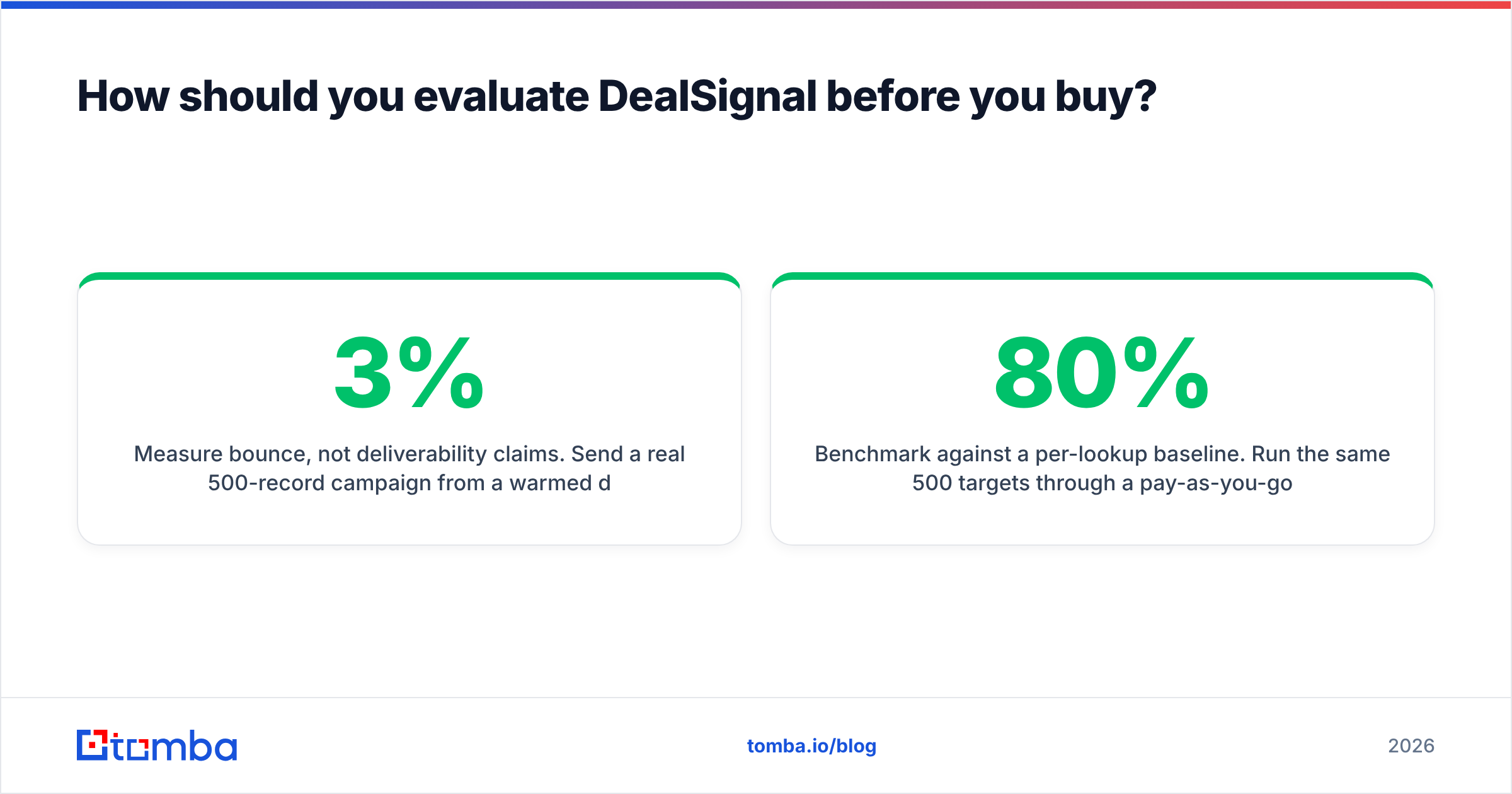
- Measure bounces, not deliverability claims. Send a real 500-record campaign from a warmed domain. Count hard bounces. Anything above 3% on fresh data is a problem.
- Test the personas that matter. Every vendor covers VP Sales at a 5,000-person SaaS company. Test the mid-market operations manager in your odd vertical.
- Price the total, not the record. Add integration hours, the intent add-on, and the credits you will waste on records nobody contacts.
- Check the churn clause. Ask what happens to your enriched records and re-verification schedule if you do not renew.
- Benchmark against a per-lookup baseline. Run the same 500 targets through a pay-as-you-go tool and a bulk data enrichment pass. If the cheap route covers 80% of the need, the contract has to earn the other 20%.
What is the final verdict on DealSignal in 2026?#
DealSignal is a solid B2B data platform, priced and packaged for buyers who already know they have an enterprise-scale data problem. On-demand verification is a real engineering choice, not a marketing angle. It shows up in lower bounce rates and better direct dials than static databases deliver.
It is a poor fit if you are early, price-sensitive, or mostly need retrieval rather than discovery. The missing self-serve entry point is a deliberate filter. If you fall outside it, no feature comparison changes the outcome.
Score it this way. Excellent for enterprise list-building and CRM hygiene in North America. Average for global coverage. Weak for anyone who wants to try before they buy. That is where most honest DealSignal reviews land.
If your job is finding and verifying email addresses at companies you already know, start with the tool built for that. Tomba Email Finder returns verified work emails from a domain, name, or company in seconds. Pricing is published: free at 25 searches a month, $49/mo for Starter. No sales call. No annual commitment. Test it on your next 50 targets, then compare the fill rate to whatever quote lands in your inbox.
Related guides#
Ready to find emails that actually work?
Join 150,000+ professionals who stopped guessing and started sending. Free credits on signup — no credit card required.
Get the Tomba newsletter
Practical outbound tactics and product updates — once every two weeks.
About the author