DealSignal vs DiscoverOrg: B2B Data Compared for 2026
DiscoverOrg no longer exists as a standalone product, and that changes the whole comparison. Here is how DealSignal stacks up against what DiscoverOrg became, on accuracy, coverage, contracts, and cost.
TL;DR
- DiscoverOrg is not a product you can buy anymore. It acquired ZoomInfo in 2019, took the ZoomInfo name, and the DiscoverOrg brand was retired. When you compare "DealSignal vs DiscoverOrg" today, you are really comparing DealSignal against ZoomInfo.
- DealSignal's pitch is verify-on-demand: records are re-verified at the moment you request them, with a published accuracy guarantee in the high 90s. Coverage is built to order rather than browsed.
- ZoomInfo's pitch is scale plus signal: a very large pre-built database, intent data, conversation intelligence, and workflow tooling — sold on annual contracts that routinely land in five figures.
- The honest split: pick DealSignal if you need clean, narrow, high-accuracy lists and hate paying for a database you barely touch. Pick ZoomInfo if you have a large team that lives inside one platform and will actually use intent, org charts, and sequencing.
- If your real need is just accurate work emails on named prospects, both are overbuilt. A dedicated email finder starting at $49/mo covers that job without a procurement cycle.
Why does "DealSignal vs DiscoverOrg" not mean what it used to?#
Start with the fact that reshapes the whole question: DiscoverOrg bought ZoomInfo in February 2019 and then adopted the ZoomInfo name for the combined company. The DiscoverOrg product line was folded into the ZoomInfo platform, and by 2021 the standalone DiscoverOrg brand had effectively disappeared from the market. If you are being sold "DiscoverOrg" in 2026, you are being sold ZoomInfo — or an old reseller listing that nobody updated.
That matters for your evaluation in three concrete ways.
- Old reviews are describing a different product. G2 and Capterra pages that still carry the DiscoverOrg name mostly hold reviews written before the merger. The tech-stack depth and human-researched org charts people praised are still in ZoomInfo's DNA, but the pricing model, the packaging, and the sales motion changed.
- Pricing comparisons from the DiscoverOrg era are stale. DiscoverOrg historically sold department-scoped datasets (IT, marketing, finance) at mid-four-figure to low-five-figure annual prices. ZoomInfo today bundles seats, credits, and modules, and published third-party estimates put typical annual spend far higher.
- The competitive set widened. DealSignal was originally positioned against DiscoverOrg's researched-data quality. Against ZoomInfo, it is now positioned against sheer volume — a different argument entirely.
So the fair 2026 framing is: DealSignal (verify-on-demand, built-to-order data) vs ZoomInfo (formerly DiscoverOrg — scale, intent, and a full GTM suite).

What is DealSignal and who is it actually for?#
DealSignal is a B2B data platform whose core differentiator is when verification happens. Most vendors verify records on a periodic refresh cycle — every 30, 60, or 90 days — and serve you whatever is in the index at request time. DealSignal's model is to verify records at the point of delivery, using a mix of machine verification and human research, and it advertises accuracy in the 97%+ range with a coverage-and-accuracy guarantee.
The practical shape of that model:
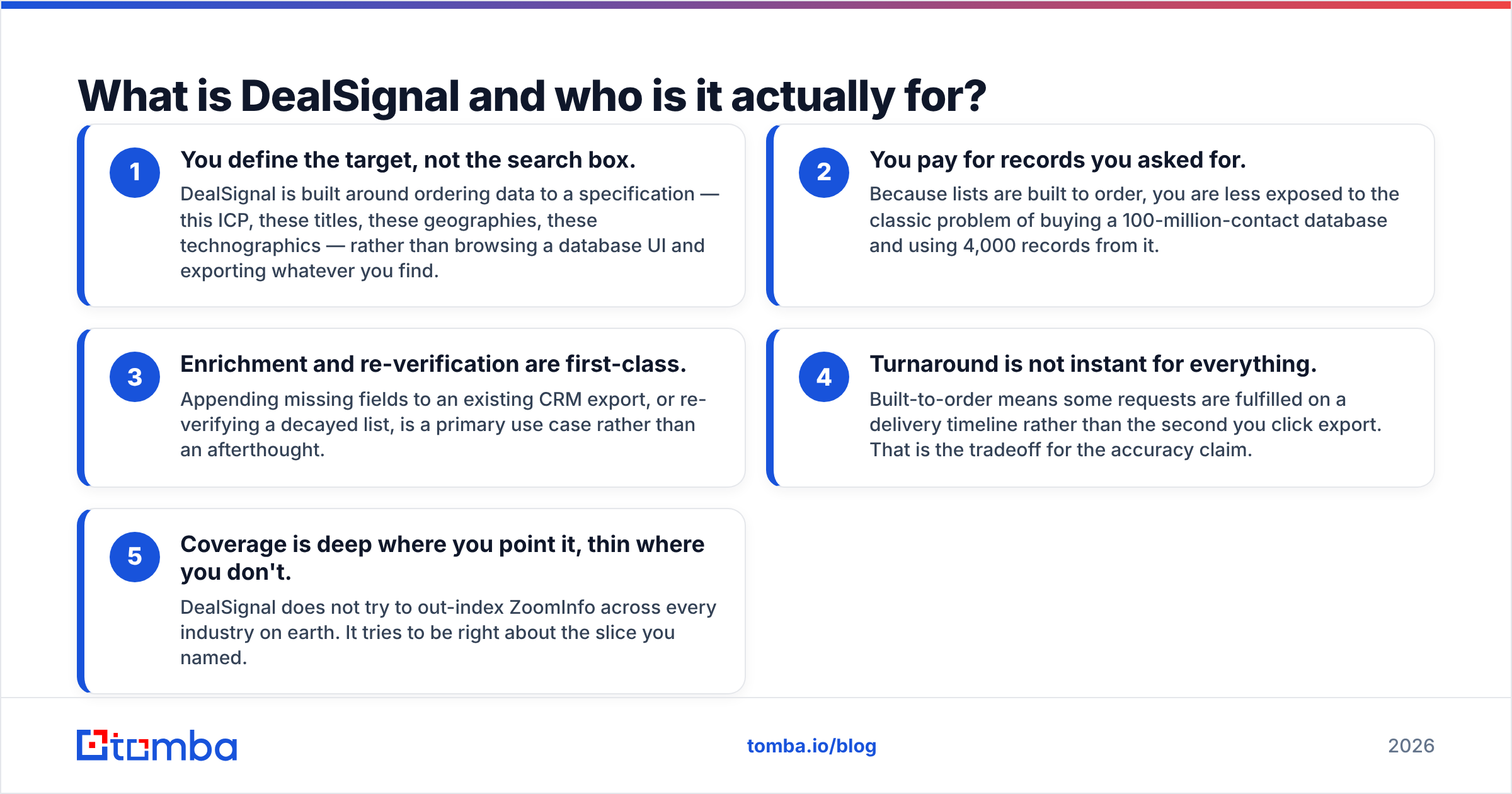
- You define the target, not the search box. DealSignal is built around ordering data to a specification — this ICP, these titles, these geographies, these technographics — rather than browsing a database UI and exporting whatever you find.
- You pay for records you asked for. Because lists are built to order, you are less exposed to the classic problem of buying a 100-million-contact database and using 4,000 records from it.
- Enrichment and re-verification are first-class. Appending missing fields to an existing CRM export, or re-verifying a decayed list, is a primary use case rather than an afterthought.
- Turnaround is not instant for everything. Built-to-order means some requests are fulfilled on a delivery timeline rather than the second you click export. That is the tradeoff for the accuracy claim.
- Coverage is deep where you point it, thin where you don't. DealSignal does not try to out-index ZoomInfo across every industry on earth. It tries to be right about the slice you named.
Who that fits: demand-gen teams running precise ABM lists, RevOps teams doing scheduled CRM hygiene, and anyone whose bounce rate is a board-level metric. Who it does not fit: a rep who wants to open a tab, type a company name, and get 40 contacts in ten seconds.
What does ZoomInfo (formerly DiscoverOrg) give you that DealSignal doesn't?#
ZoomInfo is the largest player in the category by revenue, and it sells a platform rather than a dataset. The inherited DiscoverOrg strengths — human-verified org charts, deep IT and technology install data, reporting-structure detail — sit inside a much bigger product.
What you get on top of contact records:
- Scale. Hundreds of millions of contacts and tens of millions of companies. If you are searching a long-tail vertical, ZoomInfo will usually return something where narrower vendors return nothing.
- Intent data. Topic-level buyer intent signals, which for many buyers is the actual reason they sign the contract.
- Websites visitor identification and scoops. Funding rounds, exec changes, project signals, and de-anonymized traffic sit alongside the contact record.
- Workflow. Sequencing, conversation intelligence, and native CRM sync mean the data does not need to be exported to be useful.
- Ecosystem gravity. Salesforce, HubSpot, Outreach, Salesloft integrations are mature and heavily documented.
What you also get: annual contracts, seat minimums, credit caps, and an upsell surface. Publicly available buyer reports and G2 pricing discussions consistently describe entry packages in the low five figures per year and enterprise deals well beyond that. There is no meaningful free tier and no month-to-month escape hatch. Budget accordingly — and get the renewal uplift in writing before you sign.

How do DealSignal and ZoomInfo compare head to head?#
Numbers below reflect publicly reported ranges as of mid-2026. Both vendors quote custom, so treat these as an orientation, not a quote.
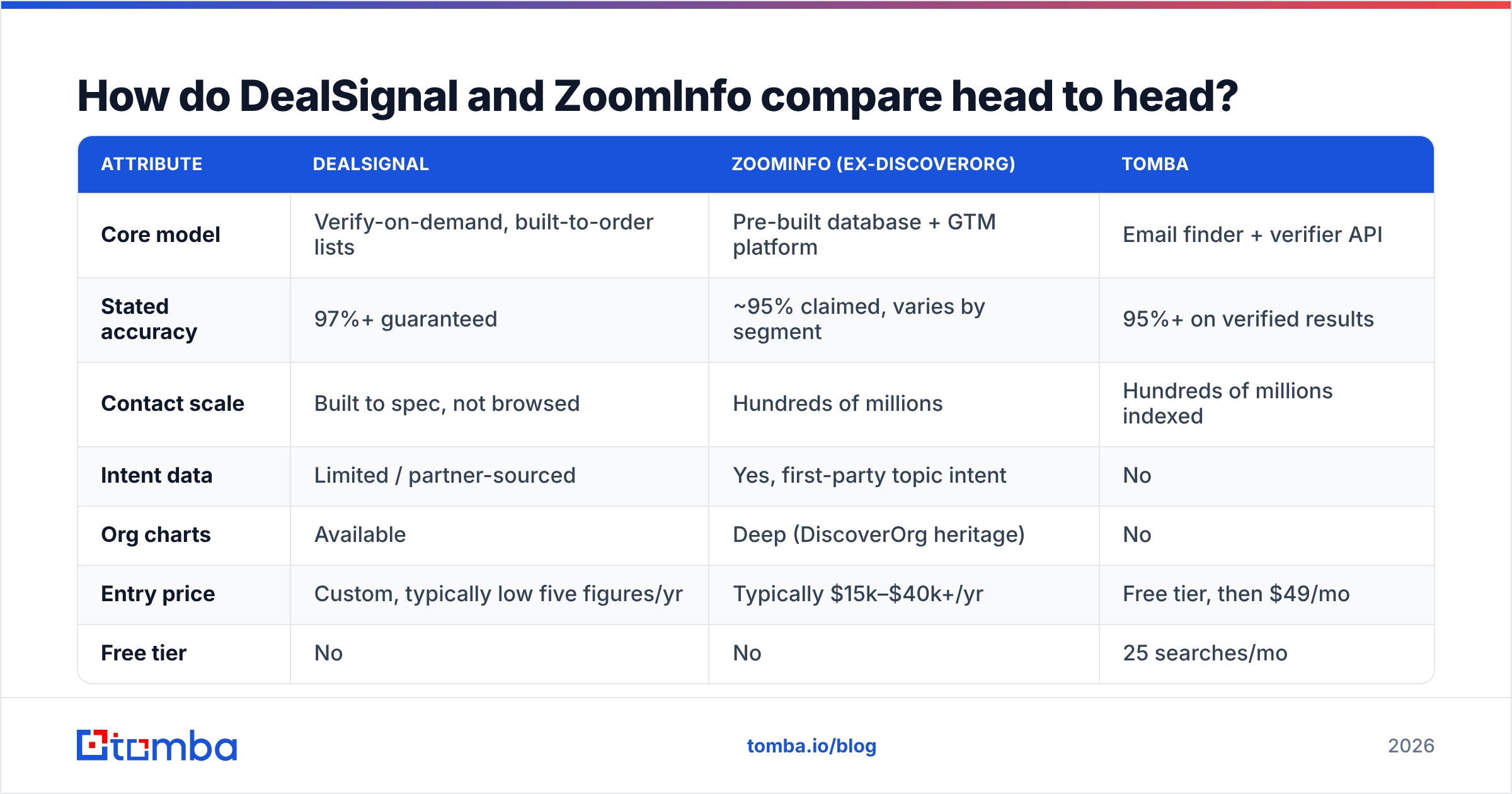
| Attribute | DealSignal | ZoomInfo (ex-DiscoverOrg) | Tomba |
|---|---|---|---|
| Core model | Verify-on-demand, built-to-order lists | Pre-built database + GTM platform | Email finder + verifier API |
| Stated accuracy | 97%+ guaranteed | ~95% claimed, varies by segment | 95%+ on verified results |
| Contact scale | Built to spec, not browsed | Hundreds of millions | Hundreds of millions indexed |
| Intent data | Limited / partner-sourced | Yes, first-party topic intent | No |
| Org charts | Available | Deep (DiscoverOrg heritage) | No |
| Entry price | Custom, typically low five figures/yr | Typically $15k–$40k+/yr | Free tier, then $49/mo |
| Free tier | No | No | 25 searches/mo |
| Contract | Annual | Annual, seat + credit minimums | Monthly, cancel anytime |
| Buy motion | Sales-assisted | Sales-led, multi-call cycle | Self-serve, instant |
| Best for | Precise ABM lists, CRM hygiene | Large teams needing one GTM suite | Targeted email discovery at scale |
| Weakness | Not built for instant self-serve lookups | Cost, contract rigidity, data noise in long tail | No intent, no org charts |

The table makes the real decision visible: these are not two versions of the same product. DealSignal sells correctness. ZoomInfo sells coverage plus workflow. And a focused tool sells speed and price on one specific job.
Which one has better data accuracy in practice?#
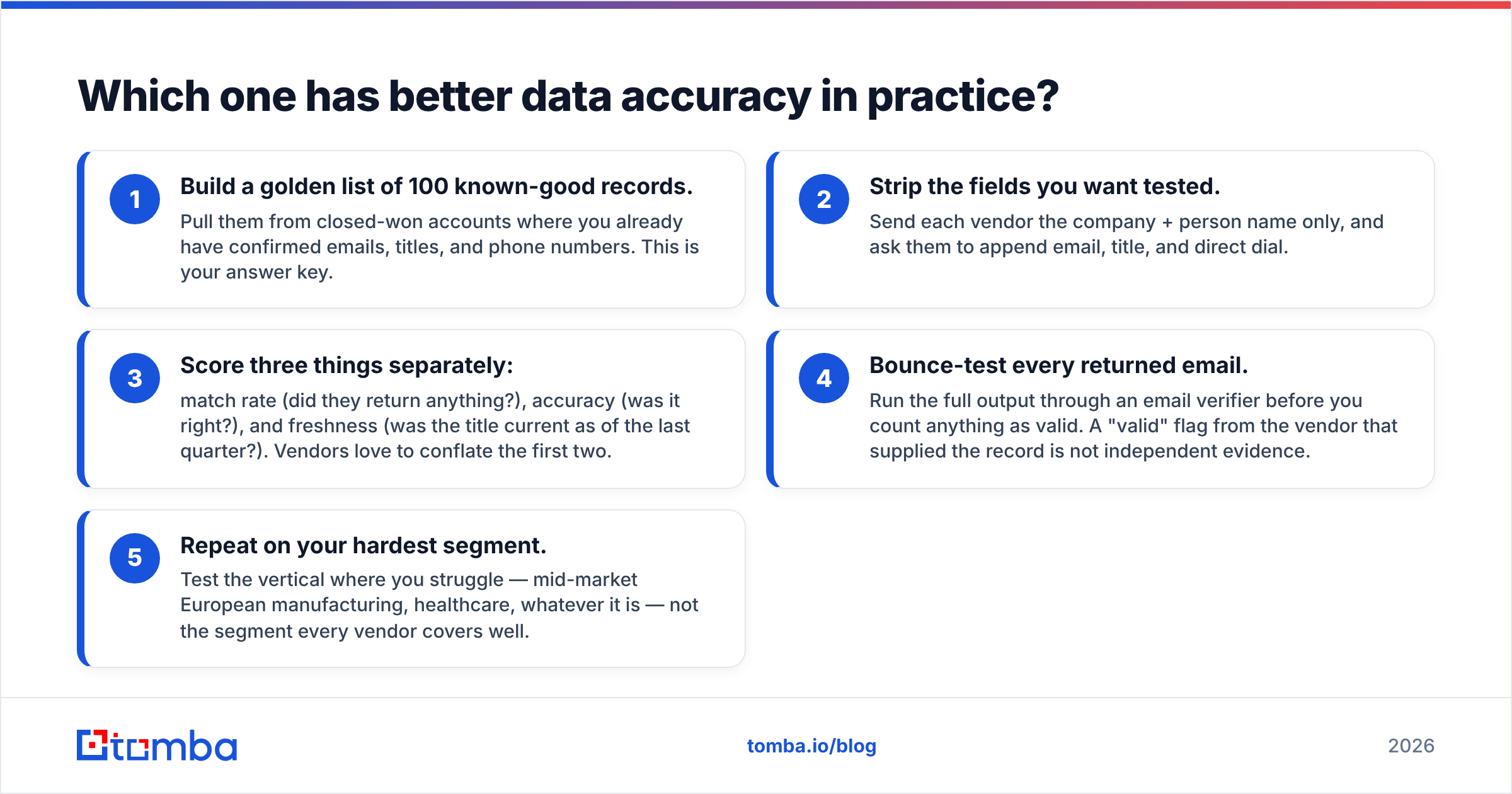
Accuracy claims from vendors are marketing until you test them. Here is how to run a test that actually settles the argument for your ICP.
- Build a golden list of 100 known-good records. Pull them from closed-won accounts where you already have confirmed emails, titles, and phone numbers. This is your answer key.
- Strip the fields you want tested. Send each vendor the company + person name only, and ask them to append email, title, and direct dial.
- Score three things separately: match rate (did they return anything?), accuracy (was it right?), and freshness (was the title current as of the last quarter?). Vendors love to conflate the first two.
- Bounce-test every returned email. Run the full output through an email verifier before you count anything as valid. A "valid" flag from the vendor that supplied the record is not independent evidence.
- Repeat on your hardest segment. Test the vertical where you struggle — mid-market European manufacturing, healthcare, whatever it is — not the segment every vendor covers well.
In most head-to-head trials reported by buyers, the pattern is consistent: DealSignal wins on precision within a defined ICP, ZoomInfo wins on raw match rate across a broad or unusual target list. Neither is a lie. They are optimizing different metrics.
One more accuracy trap: catch-all domains. A large share of enterprise mail servers accept everything, so both vendors will report those addresses as deliverable when nobody can actually prove it. Run suspected catch-alls through a dedicated catch-all verifier before you sequence them, or your bounce rate will tell the story for you.
What does each one actually cost?#
Neither vendor publishes a price list, which is itself a data point about the buying experience.
DealSignal is sold on custom annual agreements, generally scaled to record volume and the depth of fields you need. Publicly discussed deals tend to start in the low five figures per year for meaningful volume, with per-record economics improving at scale. Because you are ordering to spec, cost tracks usage more closely than it does with a seat-based database.
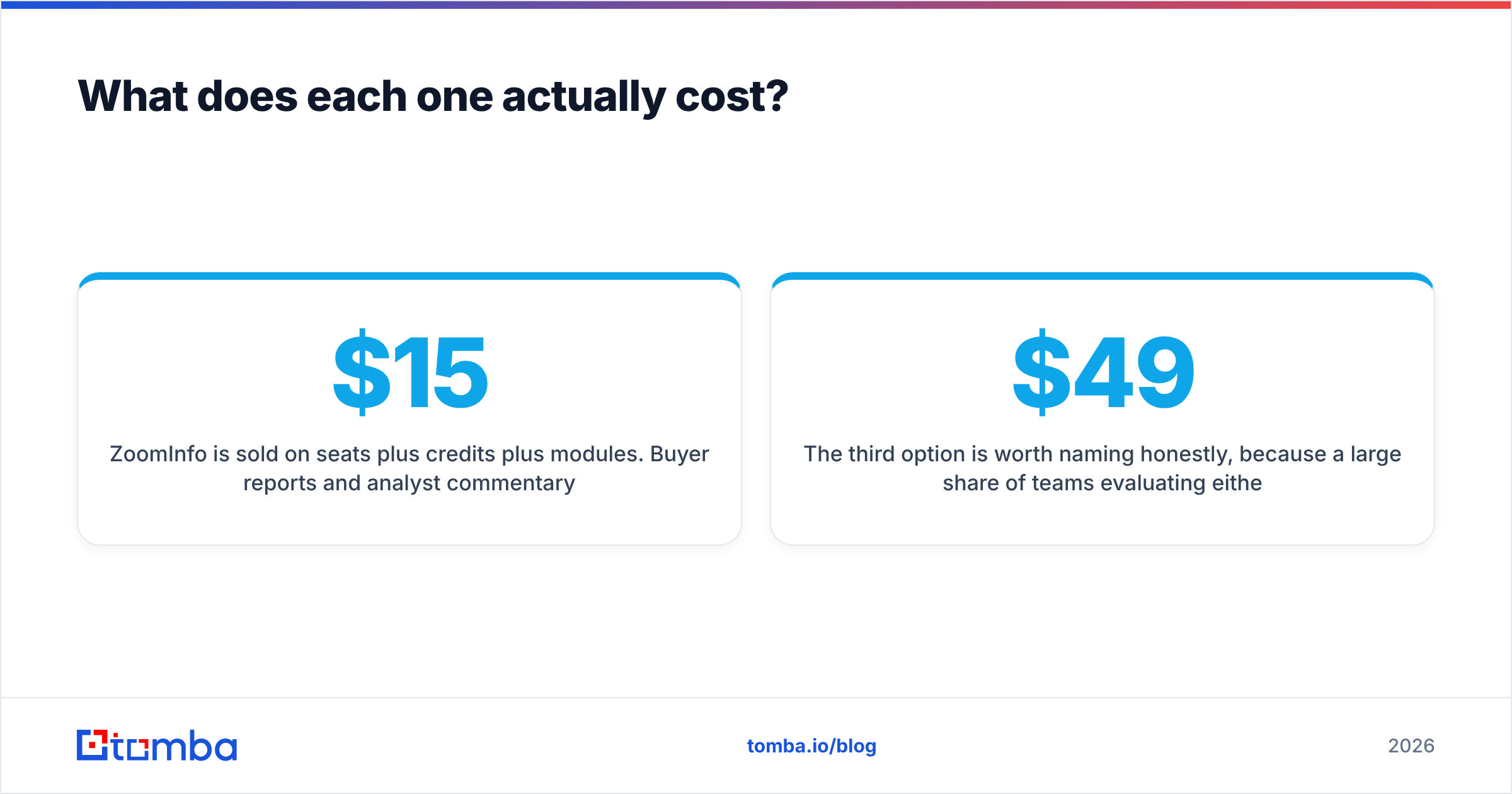
ZoomInfo is sold on seats plus credits plus modules. Buyer reports and analyst commentary put a realistic floor around $15,000/year for a small team on a basic package, with intent data, additional seats, and premium modules pushing mature deployments into the six figures. Credit overages and annual uplifts are the two line items buyers most often say surprised them.
The third option is worth naming honestly, because a large share of teams evaluating either vendor only need one thing: verified work emails for people they can already name. If that describes you, platform pricing is a bad trade. Tomba pricing starts with a free tier at 25 searches/month, then $49/mo (Starter), $99/mo (Growth), and $249/mo (Pro), with monthly billing and no seat minimums. That is not the same product as ZoomInfo — there is no intent data, no org charts, no sequencer. It is the right product when the job is email discovery and enrichment rather than full GTM orchestration.
When should you choose something other than either?#
Skip both if any of the following is true.
- Your list is under a few thousand contacts a month. An annual data contract for that volume is a rounding error in value and a real number in cost. A self-serve domain search plus verification handles it.
- You need data inside code, not inside a UI. If enrichment happens in your app or your warehouse, an email finder API with predictable per-call pricing beats a platform seat you will never log into.
- You cannot commit to twelve months. Startups and agencies with lumpy pipeline should not be signing annual data contracts. Monthly beats annual when your ICP is still moving.
- You already own intent from another vendor. If you have 6sense, Demandbase, or Bombora, ZoomInfo's biggest differentiator is a duplicate purchase.
- Your primary channel is LinkedIn, not email. In that case a LinkedIn finder plus a verifier covers the workflow at a fraction of platform cost.
Also worth evaluating alongside these two: BookYourData for straightforward pay-as-you-go list purchase without an annual commitment, and Clearbit-style enrichment layers if your need is firmographic append rather than net-new contact discovery.
What is the verdict?#
Choose DealSignal if data quality is the constraint on your pipeline, your ICP is well-defined, and you would rather buy 20,000 correct records than browse 200 million uncertain ones. The verify-on-demand model earns its price when bounces cost you domain reputation.
Choose ZoomInfo (what DiscoverOrg became) if you are equipping a team of ten or more reps who need search, org charts, intent, and sequencing in one login — and you have the budget and the discipline to negotiate the renewal hard.
Choose neither if what you actually needed all along was accurate email addresses for named prospects, delivered fast, without a procurement cycle. That is the most common case, and it is the one both platforms overcharge for.
If that last paragraph describes your team, start with the Tomba Email Finder. Find professional email addresses by domain, name, or company, verify them before they ever hit a sequence, and run the whole thing from a browser extension, a spreadsheet, or the API. The free tier gives you 25 searches a month to test against your own golden list — run that test before you take a single vendor demo call.
Related guides#
Ready to find emails that actually work?
Join 150,000+ professionals who stopped guessing and started sending. Free credits on signup — no credit card required.
Get the Tomba newsletter
Practical outbound tactics and product updates — once every two weeks.
About the author