DealSignal vs Extruct AI (2026): Which B2B Data Wins?
DealSignal sells verified contact records. Extruct AI sells an agent that researches companies for you. They solve different halves of the same problem — here is which one your pipeline actually needs, and what it costs.
DealSignal vs Extruct AI is a choice between two different jobs. DealSignal sells verified contact records. Extruct AI runs an AI agent that researches companies for you. Below we compare data quality, pricing, and fit, then name a pick.
TL;DR
- They are not the same product. DealSignal is a verified B2B contact database: people, emails, phones, firmographics. Extruct AI is an AI agent that builds and enriches company lists from live web sources.
- Pick DealSignal when you need a large, deduped, CRM-ready list of verified decision-makers and have the budget for an annual contract.
- Pick Extruct AI when your bottleneck is qualification, not contacts. Think: "does this company use Kubernetes, run a physical clinic, or employ a Head of RevOps?" across thousands of accounts.
And on the money side:
- Neither is cheap at entry. Both lean toward quote-based or seat-plus-credit pricing. That is awkward for a two-person team testing an ICP for the first time.
- Most teams run two layers. One layer decides who to target. The other finds the emails. For that second layer, a per-search tool like Tomba Email Finder at $49/mo does the job for a fraction of a seat license.
What is DealSignal?#
DealSignal is a B2B data platform. It sells verified contact and account records. Most static databases decay 25–30% a year. DealSignal works the other way around: you request the records you want, and the team verifies them on demand before delivery.
The mechanics matter. DealSignal blends aggregated data sources with a verification layer. Machines check each record first. Human researchers check it again. Records are then re-checked on a schedule. That is why the company markets accuracy in the 95%+ range and offers bounce-rate guarantees. You can see the current positioning on dealsignal.com.
What you actually get:
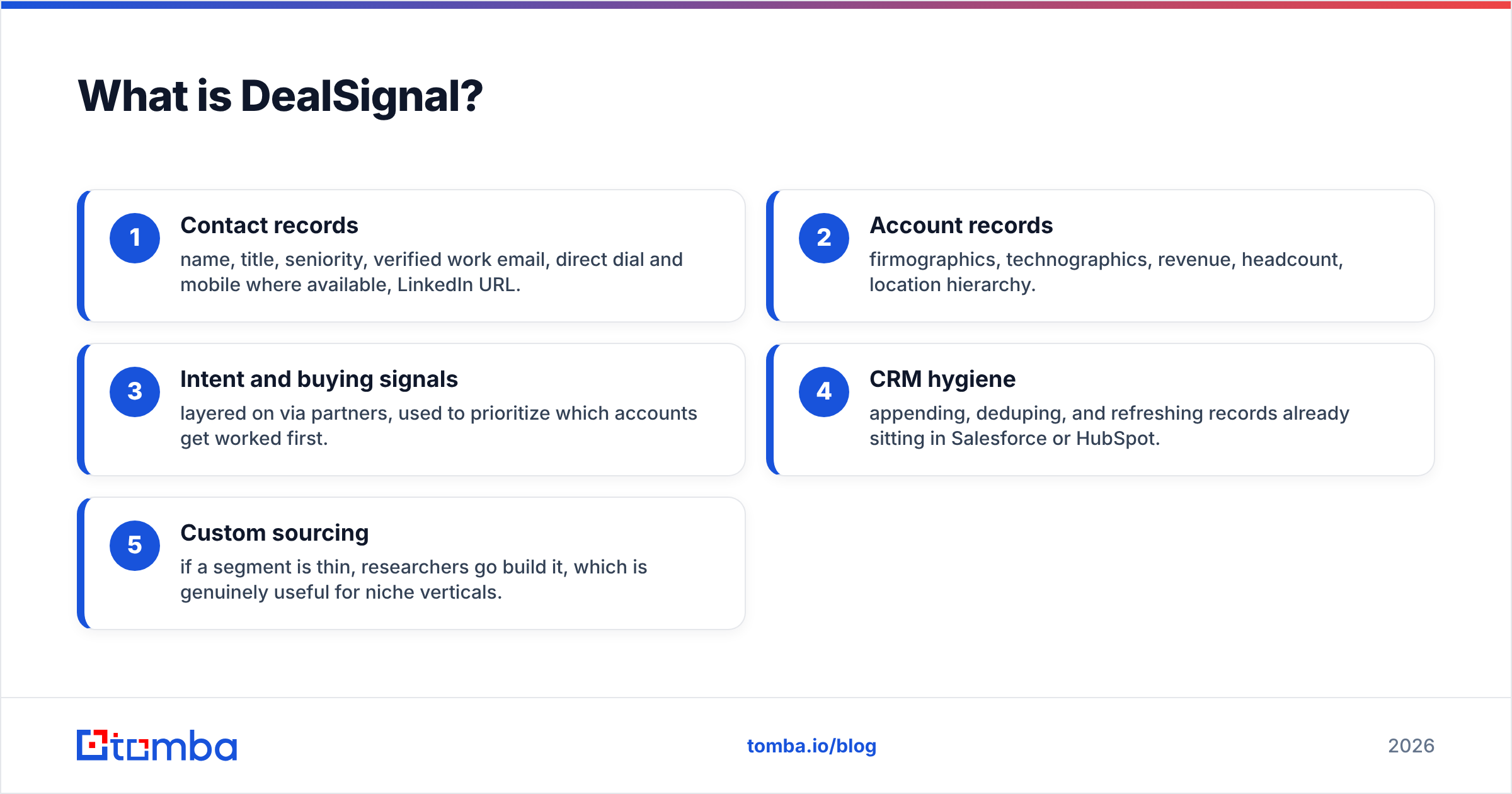
- Contact records — name, title, seniority, verified work email, direct dial and mobile where available, LinkedIn URL.
- Account records — firmographics, technographics, revenue, headcount, location hierarchy.
- Intent and buying signals — layered on via partners, used to prioritize which accounts get worked first.
- CRM hygiene — appending, deduping, and refreshing records already sitting in Salesforce or HubSpot.
- Custom sourcing — if a segment is thin, researchers go build it. That is genuinely useful for niche verticals.
The typical buyer is a mid-market or enterprise demand-gen team. They need a solid list for a webinar campaign, an ABM program, or a database refresh. They also need someone to blame if bounce rates spike.
What is Extruct AI?#
Extruct AI attacks a different problem. It is an AI agent for company research. You describe the kind of company you want. It builds the list. Then it fills custom columns by reading the live web: websites, job boards, filings, directories, and news.
Think of it like hiring a research intern who never sleeps. You do not ask the intern for "500 emails." You ask: "Find every US-based medical device maker with 50–500 staff that posted a quality-assurance role in the last 90 days, and tell me whether their site mentions FDA 510(k) clearance." Extruct runs that as columns across your list. Their product pages at extruct.ai frame this as agentic GTM research rather than a database.
The key difference: Extruct is strongest at the account layer. Contact-level coverage is thinner than a dedicated contact database. You get fewer verified emails and direct dials. That is by design. It is a qualification engine, not a rolodex.

DealSignal vs Extruct AI: how do they compare head-to-head?#
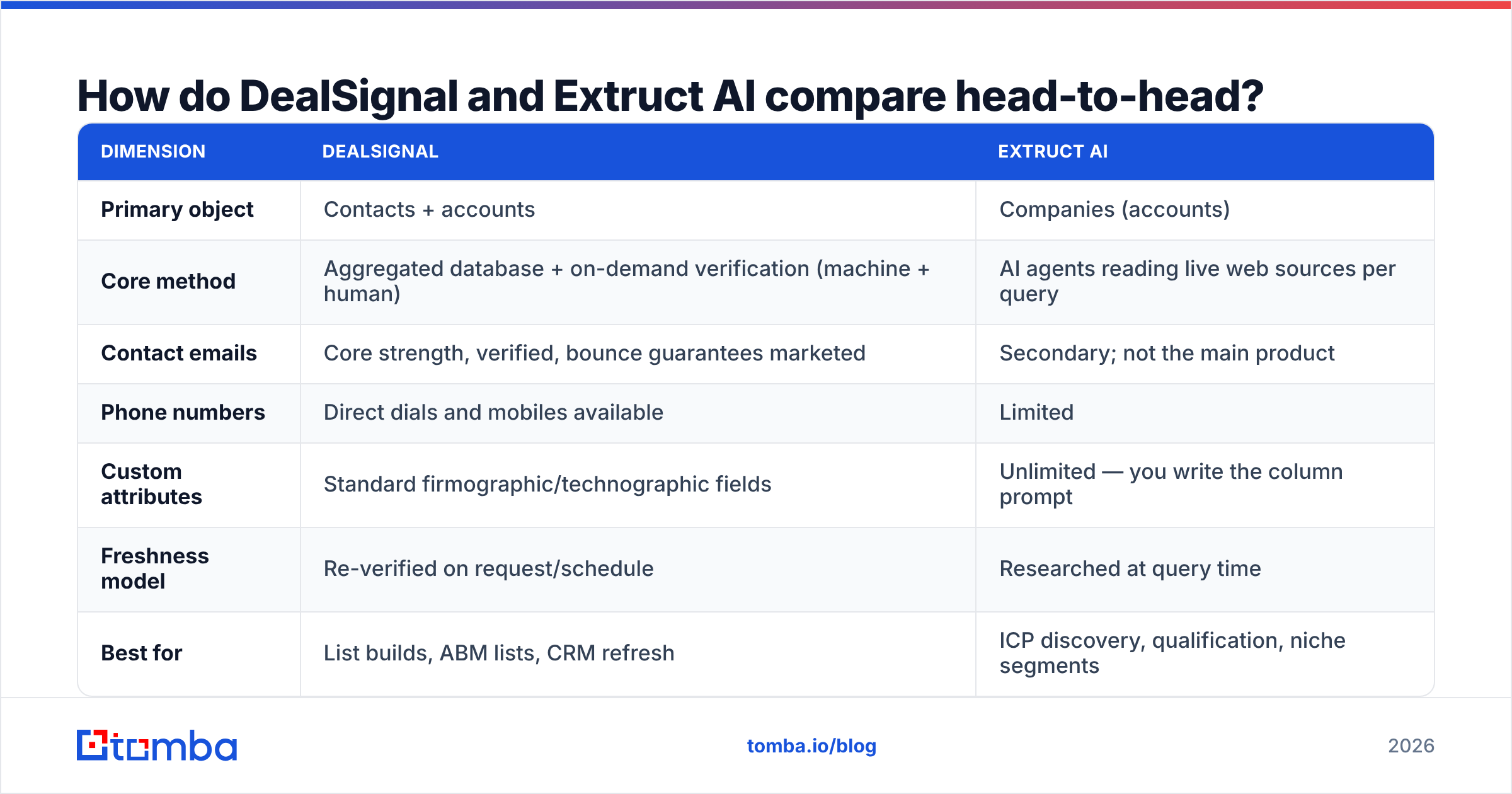
| Dimension | DealSignal | Extruct AI |
|---|---|---|
| Primary object | Contacts + accounts | Companies (accounts) |
| Core method | Aggregated database + on-demand verification (machine + human) | AI agents reading live web sources per query |
| Contact emails | Core strength, verified, bounce guarantees marketed | Secondary; not the main product |
| Phone numbers | Direct dials and mobiles available | Limited |
| Custom attributes | Standard firmographic/technographic fields | Unlimited — you write the column prompt |
| Freshness model | Re-verified on request/schedule | Researched at query time |
| Best for | List builds, ABM lists, CRM refresh | ICP discovery, qualification, niche segments |
| Typical buyer | Demand gen / marketing ops, mid-market to enterprise | Founders, GTM engineers, RevOps experimenters |
| Contract shape | Quote-based, commonly annual | Self-serve tiers + credits, quote at scale |
| Learning curve | Low — it's a list you receive | Medium — you're writing research prompts |
| Weak spot | Cost floor, slower for one-off exploration | Contact-level depth, verification of emails |
Read that table twice. It explains almost every complaint you will find in review threads on G2. Buyers who want cheap experiments get frustrated by DealSignal's contract. Buyers who want a contact database get frustrated by Extruct's missing emails. Both groups picked the wrong tool for the job. Neither product failed.
Which one has better data accuracy?#
Wrong question. They measure accuracy on different objects.
DealSignal's accuracy claim is about contact validity. Does this email land? Is this person still in this role? Is this number a direct dial or a switchboard? That is a yes-or-no test, and DealSignal built its whole pipeline around passing it. If you send 10,000 emails and 350 bounce, you know exactly who failed.
Extruct's accuracy claim is about research judgment. Did the agent correctly work out that this company sells into hospitals? Did it read a careers page and rightly conclude they are hiring SDRs? That is fuzzier. It is also far more valuable when the answer is right. No static database has a "mentions FDA 510(k) clearance on their homepage" field.
Here is the failure mode nobody warns you about: AI research agents are confident about companies and hazy about people. An agent can tell you a company is a 200-person logistics SaaS in Rotterdam and be right. Ask it for the VP of Operations' email and you often get a pattern guess — firstname.lastname@ — dressed up as a fact. That guess is right maybe 60–70% of the time. Fine for a spreadsheet. Bad for a sending domain.
So the accuracy talk should end the same way for both vendors: verify. Run the final list through an email verifier before it touches your sequencer. It is the cheapest insurance in outbound. Catch-all domains need their own step. A catch-all verifier tells you whether "valid" means anything on that domain.
How does pricing compare in 2026?#
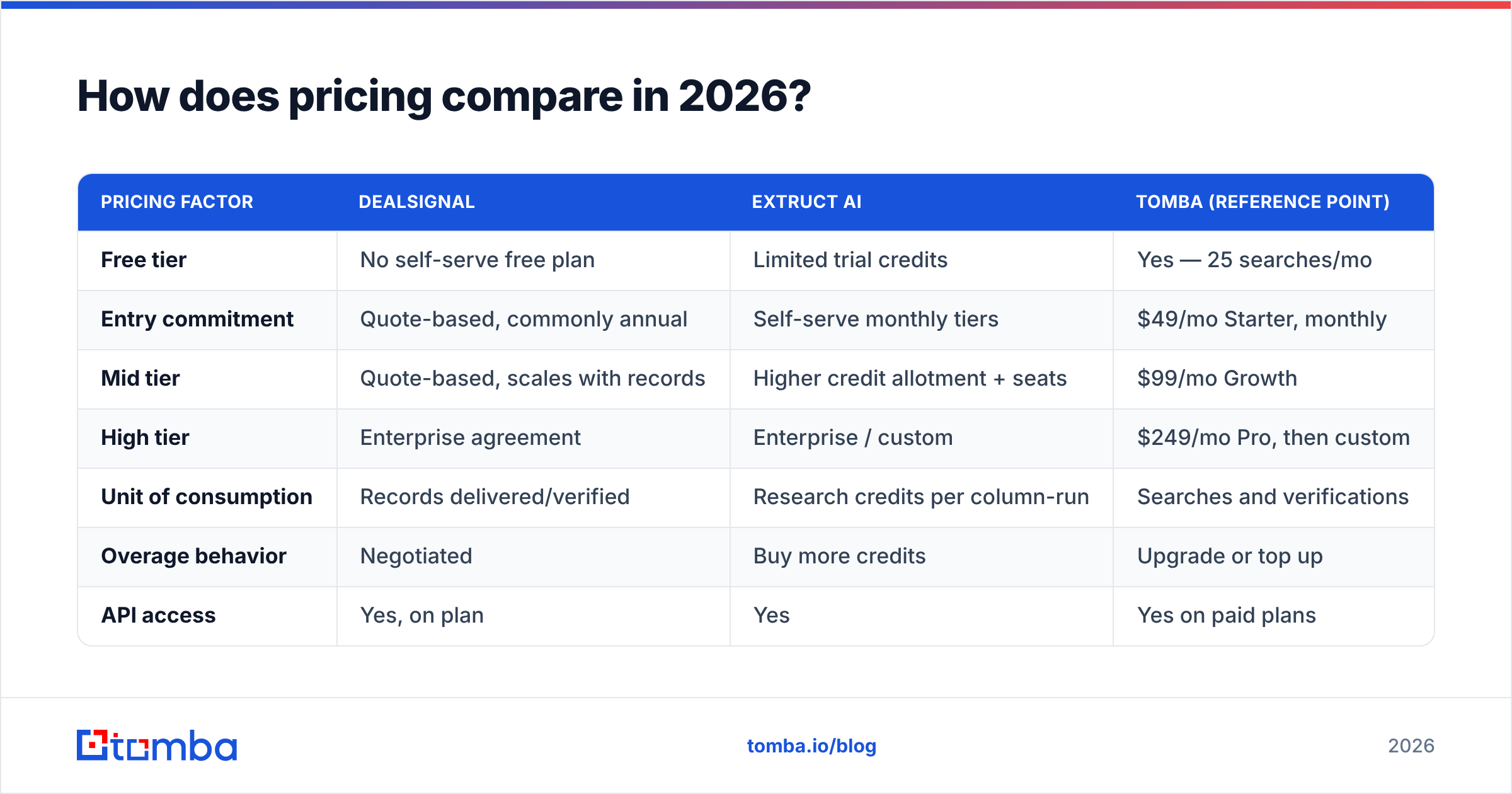
Both vendors move pricing around. Both gate part of it behind a call. So treat the numbers below as shape, not as a quote. Always confirm on the vendor's own pricing page.
| Pricing factor | DealSignal | Extruct AI | Tomba (reference point) |
|---|---|---|---|
| Free tier | No self-serve free plan | Limited trial credits | Yes — 25 searches/mo |
| Entry commitment | Quote-based, commonly annual | Self-serve monthly tiers | $49/mo Starter, monthly |
| Mid tier | Quote-based, scales with records | Higher credit allotment + seats | $99/mo Growth |
| High tier | Enterprise agreement | Enterprise / custom | $249/mo Pro, then custom |
| Unit of consumption | Records delivered/verified | Research credits per column-run | Searches and verifications |
| Overage behavior | Negotiated | Buy more credits | Upgrade or top up |
| API access | Yes, on plan | Yes | Yes on paid plans |
| Time to first record | Days (scoping call) | Minutes | Minutes |
Two honest observations.
First, the cost floor is the real difference. Say you are a seed-stage team testing three ICPs in a quarter. An annual quote-based contract is not a pricing objection. It is a workflow objection. You cannot iterate on a list you had to book a call to receive.
Second, credits are not comparable across vendors. One Extruct credit spent on a nine-column question is not one DealSignal verified record. Neither is one email-finder search. Compare on cost per usable contact in sequence, not cost per credit. Do that math and the AI-research spend usually looks fair. The contact-data spend is where you renegotiate, because contact discovery is the most commoditized layer of the stack. A clear pricing page beats a quote there.
Who should choose DealSignal?#
Choose DealSignal if three or more of these are true:
- You need contacts, not context. Your ICP is already set; the job is volume with low bounce.
- You have a bounce-rate SLA to defend. Marketing ops owns deliverability, and someone will ask who signed off on the list.
- Your segment is well covered by traditional data — software, financial services, mid-to-large enterprise, standard titles.
- You need phones as well as emails. Direct dials are a real strength and hard to replicate with scraping.
- You have an annual budget line for data and the procurement process to match.
Who should choose Extruct AI?#
Choose Extruct AI if three or more of these are true:
- Your ICP is a sentence, not a filter. "Companies running a franchise model with 10+ locations that recently rebranded" is not a dropdown in any database.
- You are a GTM engineer or founder who is happy writing prompts and tuning column definitions.
- Your market is under-covered — local services, industrial niches, non-US SMB, brand-new companies.
- Qualification is your bottleneck, and your reps waste hours reading websites before a call.
- You already have a contact-finding layer and only need the account decision solved.

Where do both tools fall short?#
DealSignal's gap is agility. You get a great list of the thing you asked for. You do not get a cheap way to ask a weird question. Your ICP hypothesis will change mid-quarter, and then you are back in a scoping call.
Extruct's gap is the last mile. A perfectly qualified company list with no verified contact is a research artifact, not a pipeline. You still have to turn "Acme Logistics, 180 employees, hiring a Head of Fleet" into an email address that lands in an inbox.
Both share a third gap: they are not sending tools. Neither fixes SPF alignment, warms a domain, or stops your subdomain from getting throttled. If your email deliverability is broken, better data just means better contacts watching your mail hit spam. Analysts at firms like Gartner have said this for years. Data quality and channel health are separate investments. Buyers keep treating them as one.
What does a sane combined stack look like?#
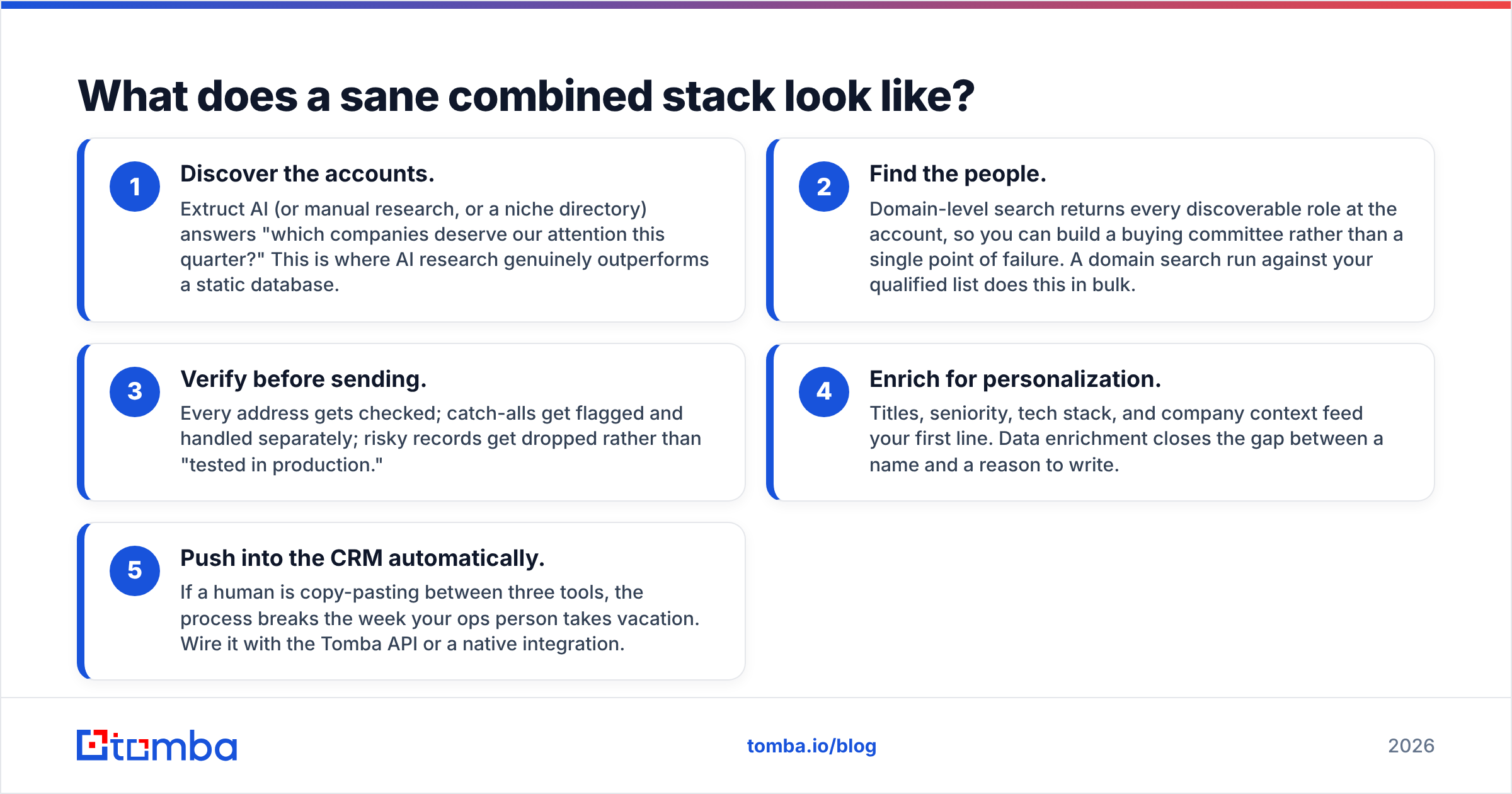
Teams that get this right run three separate layers. The alternative is buying one platform that does everything badly.
- Discover the accounts. Extruct AI, manual research, or a niche directory answers one question: which companies deserve our attention this quarter? AI research beats a static database here.
- Find the people. Domain-level search returns every discoverable role at an account. That way you build a buying committee, not a single point of failure. A domain search run against your qualified list does this in bulk.
- Verify before sending. Every address gets checked. Catch-alls get flagged and handled on their own. Risky records get dropped, not "tested in production."
- Enrich for personalization. Titles, seniority, tech stack, and company context feed your first line. Data enrichment closes the gap between a name and a reason to write.
- Push into the CRM automatically. If a human copy-pastes between three tools, the process breaks the week your ops person takes vacation. Wire it with the Tomba API or a native integration.
Layer 1 is where you should spend on intelligence. Layers 2 and 3 are where you should refuse to overpay. Email discovery and verification are mature, measurable, and cheap to compare.
Is there a cheaper path for small teams?#
Yes, and it is worth saying plainly. If you send fewer than a few thousand contacts a month, neither DealSignal's contract shape nor a full AI-research seat is the right first purchase.
The cheaper path looks like this. Build your account list by hand or with a light research tool. Run domain search across those accounts to get the contacts. Verify everything. Send small, tight batches. Measure reply rate per segment. Then decide whether the bottleneck is account discovery (buy Extruct) or contact volume and phone coverage (buy DealSignal).
Buying the expensive layer before you know which layer is broken is the most common data-budget mistake in B2B. A free tier and a $49/mo plan will teach you more about your ICP in three weeks than a scoping call will.
Frequently asked questions#
Is Extruct AI a DealSignal competitor? Only partly. They overlap on account-level firmographics. They split completely on contact records. DealSignal sells verified people. Extruct researches companies.
Can Extruct AI find email addresses? It can surface and infer some. Email discovery and verification are not its core job. Treat any email it returns as a guess until you verify it.
Does DealSignal cover non-US markets? Coverage exists worldwide but is strongest in North America, as with most contact databases. Test your geography with a sample before you commit.
Which is better for ABM? DealSignal for the target-account contact map. Extruct for building the target-account list in the first place. Serious ABM programs need both functions, though not always both vendors.
What about bounce rates? DealSignal markets verification guarantees. Extruct makes no such claim, because it does not sell verified contacts. Either way, verify right before you send. Data ages between delivery and use.
The bottom line#
DealSignal vs Extruct AI comes down to one line. DealSignal wins on verified contact depth and phone coverage. Extruct AI wins on flexible, prompt-driven company qualification. Neither replaces the other, and neither is priced for a team still figuring out its ICP.
Maybe your real blocker is the last mile. You know which companies to hit, and you need verified email addresses at a price that scales with usage. Start with the Tomba Email Finder. The free tier gives you 25 searches to test accuracy on your own domains before you spend anything. Starter is $49/mo, and every result can be verified in the same workflow. Prove your ICP with cheap, honest data first. Buy the enterprise layer once you know which one you need.
Related guides#
Ready to find emails that actually work?
Join 150,000+ professionals who stopped guessing and started sending. Free credits on signup — no credit card required.
Get the Tomba newsletter
Practical outbound tactics and product updates — once every two weeks.
About the author