DealSignal vs FinalScout: Which B2B Data Tool Wins in 2026?
One is an enterprise data platform sold on annual contracts. The other is a LinkedIn email finder you can start using for free in ten minutes. Here's how DealSignal and FinalScout actually compare on accuracy, cost, and workflow fit.
TL;DR
- DealSignal is an enterprise B2B contact database sold on annual contracts with human-verified records. It is built for RevOps teams enriching thousands of accounts, not for a rep who needs 40 emails today.
- FinalScout is a LinkedIn-first email finder with a ChatGPT-powered writing layer. It is cheap, fast, and browser-based — but its coverage is only as good as the LinkedIn profiles you can surface.
- The two tools barely overlap on buyer profile. Comparing them is really a question of budget tier and data source, not feature checkboxes.
- Neither is a great fit if you want per-lookup pricing, a real API, and verification you can audit. That is the gap most teams end up filling with a dedicated email finder.
- Our pick: FinalScout for solo founders and LinkedIn-heavy prospecting under $50/mo; DealSignal if you already have a six-figure data budget and a CRM to feed. If neither describes you, skip to the middle-ground section.
What are DealSignal and FinalScout?#
They solve the same end problem — get a verified work email for a person you want to reach — from opposite directions.
DealSignal is a B2B data platform. You define an ideal customer profile (industry, headcount, title, tech stack, intent signals), and DealSignal returns a list of contacts with emails, direct dials, and firmographics. Its differentiator is on-demand verification: rather than serving records from a static warehouse, DealSignal re-verifies contacts at delivery time, often with a human research layer for hard-to-find roles. That is genuinely valuable, and it is priced accordingly.
FinalScout comes at it from the browser. Install the Chrome extension, browse LinkedIn or Sales Navigator, and pull emails from profiles, search results, group members, event attendees, or post engagers. It then bolts on an AI writer that drafts outreach based on the scraped profile. The whole thing is designed for one person working a list, not a data pipeline.
So the real question behind "DealSignal vs FinalScout" is: do you need a data supplier, or a prospecting tool? Those are different budget lines and different buyers.

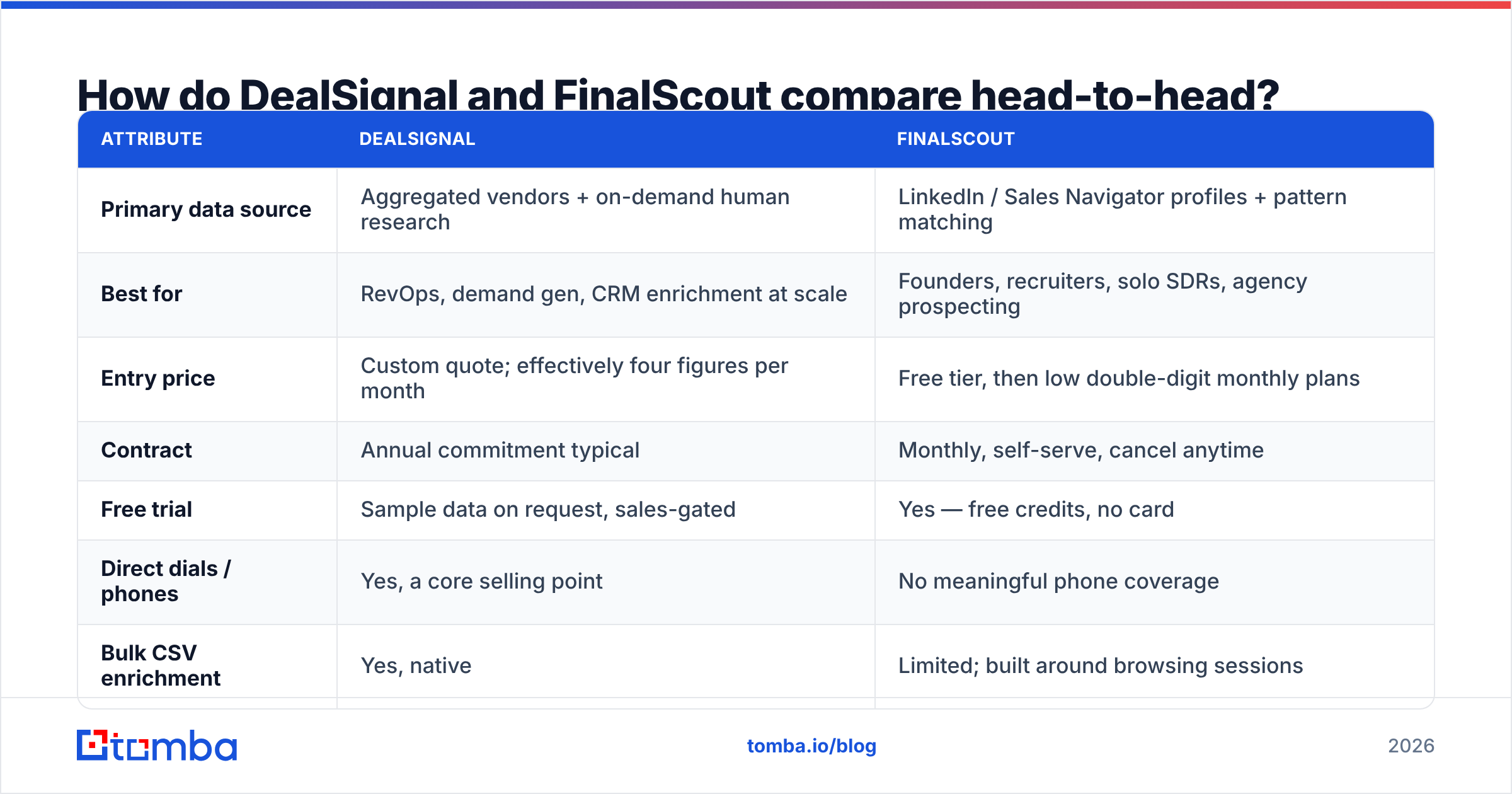
How do DealSignal and FinalScout compare head-to-head?#
Here is the honest side-by-side. Pricing figures reflect publicly posted or commonly quoted numbers at time of writing — both vendors change terms, and DealSignal in particular quotes per deal, so treat the cost row as a range, not a receipt.
| Attribute | DealSignal | FinalScout |
|---|---|---|
| Primary data source | Aggregated vendors + on-demand human research | LinkedIn / Sales Navigator profiles + pattern matching |
| Best for | RevOps, demand gen, CRM enrichment at scale | Founders, recruiters, solo SDRs, agency prospecting |
| Entry price | Custom quote; effectively four figures per month | Free tier, then low double-digit monthly plans |
| Contract | Annual commitment typical | Monthly, self-serve, cancel anytime |
| Free trial | Sample data on request, sales-gated | Yes — free credits, no card |
| Direct dials / phones | Yes, a core selling point | No meaningful phone coverage |
| Bulk CSV enrichment | Yes, native | Limited; built around browsing sessions |
| API access | Yes, enterprise tier | Minimal / not the product focus |
| AI email writing | No | Yes, ChatGPT-based sequences |
| Verification model | Multi-step, re-verified at delivery | SMTP-style checks, weaker on catch-all domains |
| Time to first email | Days (scoping call, list build) | Under 10 minutes |
| Typical complaint | Cost, procurement friction, minimums | Coverage gaps outside LinkedIn, credit burn on misses |
Read that table as two products for two org sizes. If your objection to DealSignal is price, you are not their buyer. If your objection to FinalScout is coverage, you are not theirs.
Which one has more accurate data?#
DealSignal wins on stated accuracy — with an asterisk about what "accuracy" means.
DealSignal's pitch is a verification pass close to delivery, so the record you receive was checked recently rather than in a quarterly refresh. For senior titles at mid-market and enterprise accounts, that shows. Vendors in this tier typically publish accuracy guarantees in the 95%+ range, and reviews on G2 generally back up that the data is clean, if expensive.
FinalScout publishes a high validity number too, but it is measuring something narrower: of the emails it returns, how many pass a syntax and mailbox check. That is not the same as coverage. The metric that actually determines your campaign volume is hit rate — what percentage of the 500 LinkedIn profiles you targeted produced any email at all. LinkedIn-derived tools tend to do well on tech, SaaS, and marketing roles and much worse on manufacturing, healthcare ops, government, and anyone with a thin profile.
Two accuracy traps to check before you commit to either:
- Catch-all domains. Roughly a fifth of business domains accept mail for any address, so a simple SMTP check returns "valid" for a fabricated inbox. If a tool marks these green without labelling them, your bounce rate lies to you until it doesn't. A dedicated catch-all verifier is the only honest way to handle these.
- Guessed patterns served as verified. Some tools infer
first.last@domain.comand ship it with a confidence score. That is fine if labelled. It is a problem when it silently consumes a credit and lands in your sequence.

Ask both vendors for the same 100-row test list from your ICP, then run the returned addresses through an independent email verifier before you sign anything. Every vendor's benchmark looks great on the vendor's own sample.
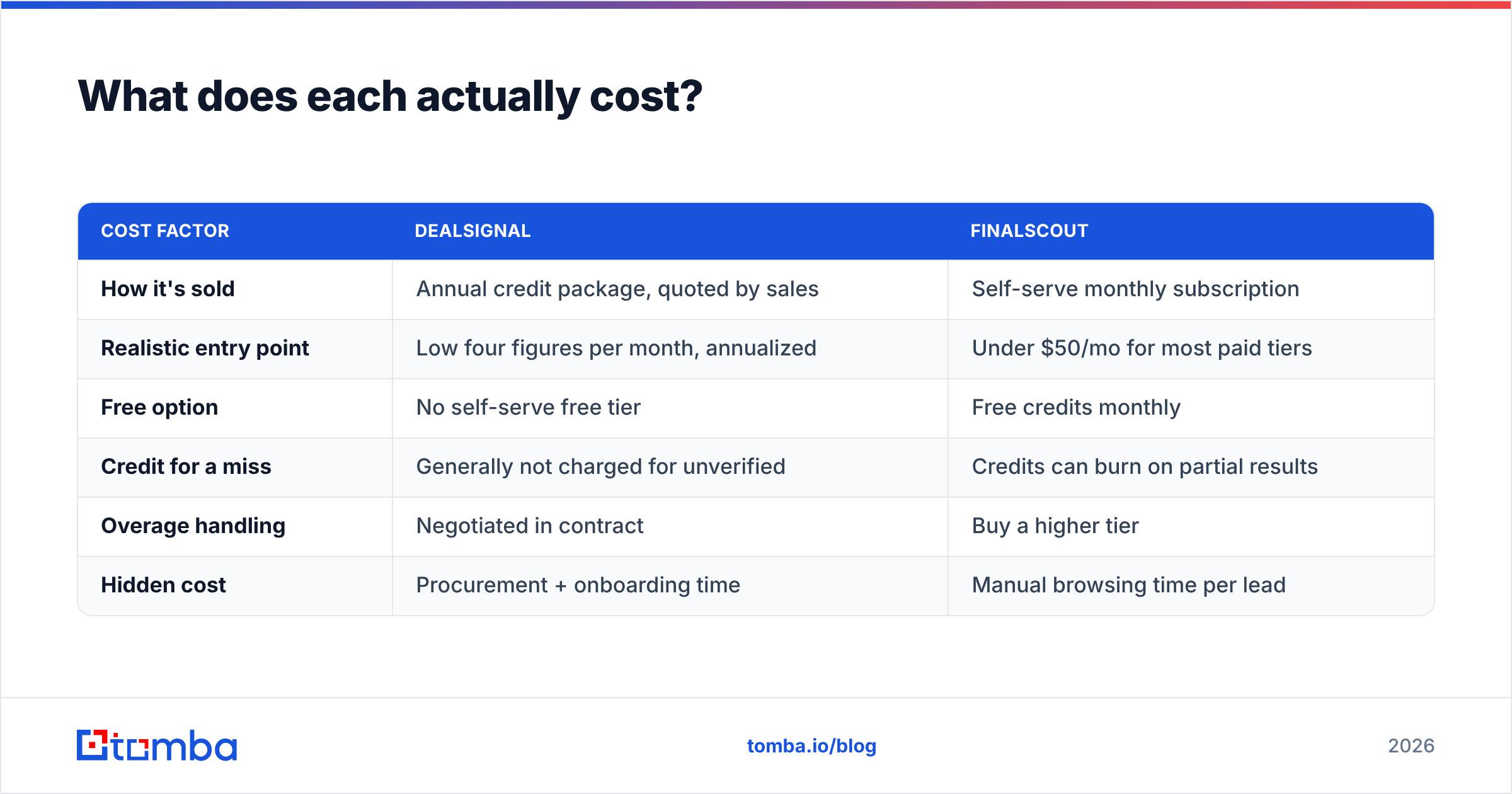
What does each actually cost?#
This is where most DealSignal vs FinalScout evaluations end, because the gap is an order of magnitude.
| Cost factor | DealSignal | FinalScout |
|---|---|---|
| How it's sold | Annual credit package, quoted by sales | Self-serve monthly subscription |
| Realistic entry point | Low four figures per month, annualized | Under $50/mo for most paid tiers |
| Free option | No self-serve free tier | Free credits monthly |
| Credit for a miss | Generally not charged for unverified | Credits can burn on partial results |
| Overage handling | Negotiated in contract | Buy a higher tier |
| Hidden cost | Procurement + onboarding time | Manual browsing time per lead |
The hidden cost row matters more than the sticker. DealSignal's real price includes a scoping call, a list-build turnaround, and usually an annual commitment you cannot exit mid-year if hit rates disappoint. FinalScout's real price includes your hours — someone has to sit in Sales Navigator, run searches, and click through. At 200 leads a week that is fine. At 2,000, the $40 subscription is the cheapest part of a very expensive process.
There is a third cost nobody quotes: bounce damage. A 6% bounce rate on a new sending domain will throttle your email deliverability for weeks. Whatever you save on data, you lose on inbox placement. Budget for verification as a line item regardless of which vendor you pick.
Which fits your workflow?#
Match the tool to how your team actually works, not to the feature grid.
- You're a solo founder doing 50–200 touches a month. FinalScout. The free tier alone will tell you whether your ICP is findable on LinkedIn, and the AI writer removes the blank-page problem. DealSignal will not even take your call at this volume.
- You're a recruiter or agency working candidate/prospect lists off LinkedIn. FinalScout. Its group, event, and post-engager extraction is genuinely the strongest part of the product, and it maps cleanly to how recruiters already source.
- You're RevOps enriching a CRM of 20,000+ accounts. DealSignal. Bulk enrichment, firmographics, direct dials, and a contract with an accuracy SLA are worth the price when the alternative is 20,000 manual lookups.
- You're running outbound at 1,000–5,000 emails a month with a real but finite budget. Neither, cleanly. You need per-lookup economics, an API, and verification in the same tool — see the next section.
- You need phone numbers as well as email. DealSignal, or a dedicated phone finder. FinalScout is email-only in practice.
- You're building an internal tool or automation. DealSignal's API is enterprise-gated and FinalScout's is thin. If your workflow is
webhook → find email → verify → push to CRM, pick a vendor whose API is the front door rather than an upsell.
Where do both tools fall short?#
DealSignal's weakness is access. Everything is sales-gated. You cannot test it on a Tuesday afternoon, you cannot scale down in a slow quarter, and if your ICP turns out to be poorly covered you learn that after signing. For companies under roughly 50 employees, the procurement overhead alone kills the ROI.
FinalScout's weakness is dependency. It is a LinkedIn-shaped tool. When LinkedIn tightens scraping limits — which it does, repeatedly — extension-based tools take the hit. If someone is not on LinkedIn, or their profile is sparse, FinalScout has little to work with. It also has no meaningful answer for enriching a list you already own: give it 5,000 rows of company + name and there is no clean bulk path.
Both share a structural gap: verification is a feature, not a discipline. Neither gives you a standalone verification workflow you can point at lists from other sources — your CRM, a webinar export, a partner list, an old newsletter file. That data decays at roughly 2–3% per month, and it is usually the dirtiest data you own.

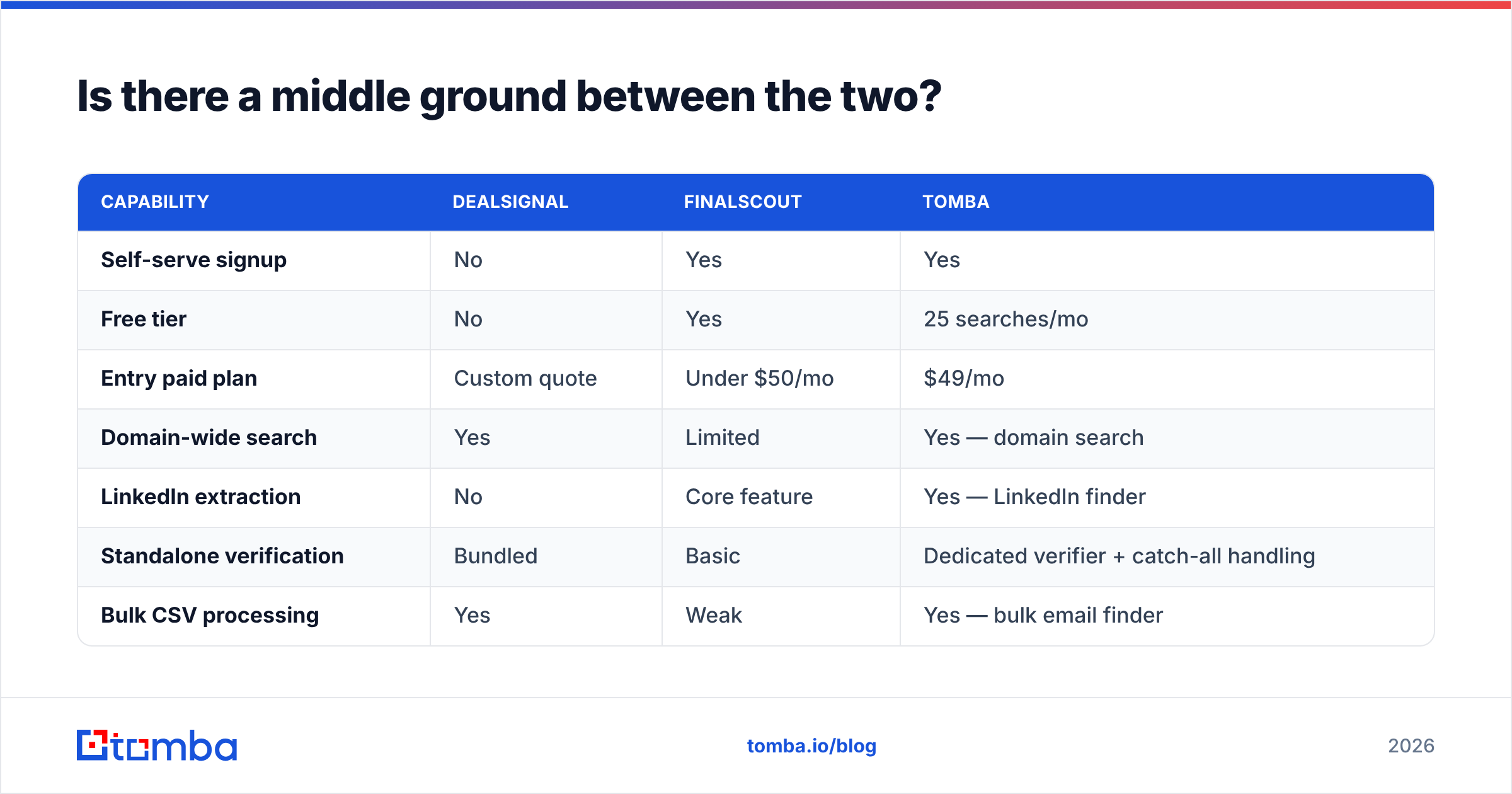
Is there a middle ground between the two?#
Yes — and it is where most teams between "solo founder" and "enterprise RevOps" actually land: a dedicated email finder with transparent per-credit pricing, a real API, and verification built into the same product.
That is the slot Tomba occupies. The pricing is public — free tier at 25 searches/mo, Starter at $49/mo, Growth at $99/mo, Pro at $249/mo, Enterprise custom — so you can model cost before you talk to anyone. Full Tomba pricing is on the site, not behind a discovery call.
| Capability | DealSignal | FinalScout | Tomba |
|---|---|---|---|
| Self-serve signup | No | Yes | Yes |
| Free tier | No | Yes | 25 searches/mo |
| Entry paid plan | Custom quote | Under $50/mo | $49/mo |
| Domain-wide search | Yes | Limited | Yes — domain search |
| LinkedIn extraction | No | Core feature | Yes — LinkedIn finder |
| Standalone verification | Bundled | Basic | Dedicated verifier + catch-all handling |
| Bulk CSV processing | Yes | Weak | Yes — bulk email finder |
| Public API | Enterprise tier | Minimal | Yes, all paid plans |
| Phone numbers | Yes | No | Yes |
| Annual lock-in | Typical | No | No |

The practical difference is composability. With a documented email finder API, the same lookup runs from a spreadsheet, a Chrome extension, a Zapier step, or your own backend — so you are not choosing between "buy a list" and "click through LinkedIn." You wire the lookup into wherever the trigger already lives.
Worth saying plainly: for genuine enterprise data programs with intent signals, account hierarchies, and human research on obscure titles, DealSignal does things a pure email finder does not. If that is the requirement, buy the requirement. Just be honest about whether it is.
How should you run the evaluation?#
Do not trust anyone's benchmark, including ours. Run this in an afternoon:
- Build a 100-contact test list from your real pipeline. Names and companies you already know, ideally including 20 accounts where you already have the correct email. Those are your answer key.
- Run the list through each tool. Record hit rate (emails returned ÷ contacts submitted), not just the vendor's accuracy claim.
- Verify every returned address in a neutral third tool. Count how many come back risky, catch-all, or invalid. Use a free email checker for spot checks.
- Check the answer key. How many known-correct emails did each tool return exactly right? This catches pattern-guessing dressed up as verification.
- Calculate cost per usable email. Total spend ÷ verified-deliverable results. This is the only number that matters, and it frequently reorders the ranking.
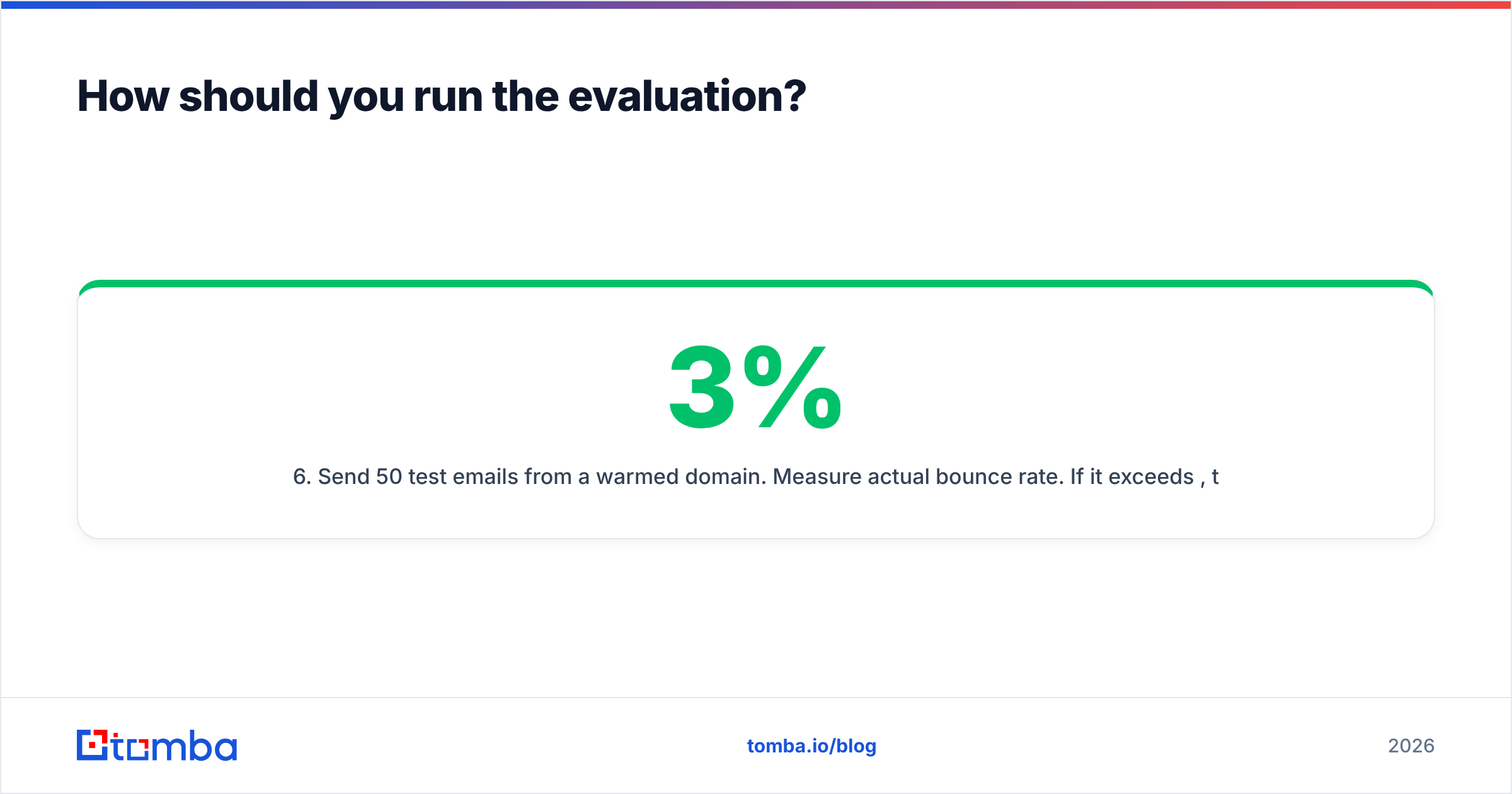
- Send 50 test emails from a warmed domain. Measure actual bounce rate. If it exceeds 3%, the data failed regardless of what the dashboard said.
Teams that run this test usually find the expensive tool is not 10x better, and the cheap tool is not 10x worse — they are differently shaped. The winner is whichever one clears your hit-rate floor at a cost per usable email you can defend.
Which should you choose?#
Choose FinalScout if LinkedIn is your prospecting surface, you are working in the hundreds of leads per month, and you want to start today for free. Its AI writer is a real time-saver for people who hate first drafts.
Choose DealSignal if you have an annual data budget, a CRM that needs continuous enrichment, and a requirement for direct dials plus firmographic depth. Its verification model is legitimately strong, and at enterprise scale the price per record stops looking absurd.
Choose neither if you are in the wide middle: 1,000–10,000 lookups a month, you need an API, you want verification you can audit, and you refuse to sign an annual contract to find out whether the data works. That is the most common outbound profile in 2026 and it is served badly by both ends of this comparison.
Ready to test the middle option? Start with the Tomba Email Finder — 25 free searches a month, no card, no discovery call. Run the same 100-contact test list you'd give any vendor, verify the results, and compare cost per usable email against whatever quote is sitting in your inbox. If Tomba doesn't clear your hit-rate floor on your own ICP, you will have lost an afternoon instead of a fiscal year.
Related guides#
Ready to find emails that actually work?
Join 150,000+ professionals who stopped guessing and started sending. Free credits on signup — no credit card required.
Get the Tomba newsletter
Practical outbound tactics and product updates — once every two weeks.
About the author