DealSignal vs Findymail: Which B2B Data Tool Wins in 2026?
DealSignal sells enterprise-grade, on-demand verified data. Findymail sells lean, high-hit-rate email finding for outbound teams. Here is where each one actually wins — and where a third option makes more sense.
DealSignal vs Findymail is a choice between two different products, not two versions of the same one. One is a managed data platform. The other is a lean email finder. Price, contract, and support all follow from that split.
TL;DR
- DealSignal is a managed B2B data platform: a large contact universe, on-demand verification, deep CRM/MAP integrations, and pricing set by a sales call.
- Findymail is a lean email finder for outbound teams: strong hit rates on hard domains, a bounce guarantee, list imports, and self-serve monthly plans.
- Pick DealSignal if you enrich thousands of records inside Salesforce or Marketo. Pick Findymail if you are an SDR team or agency that needs clean emails, fast.
- Neither is the cheapest per verified contact. If cost-per-valid-email and API access are your limits, a self-serve finder like Tomba ($49/mo Starter, free tier included) usually wins.
- The real question in DealSignal vs Findymail is simple. Are you buying a data platform or a data utility? The two are priced, sold, and supported differently.
What are DealSignal and Findymail, exactly?#
They solve overlapping problems from opposite ends of the market.
DealSignal sells a B2B data platform for demand generation. Its pitch is breadth plus freshness. You get a large contact and account universe, verification run on demand instead of served from a stale cache, and deep pushes into CRM and marketing automation. The buyer is usually marketing ops, RevOps, or a demand-gen lead. That person owns database health and needs enrichment to run on a schedule.
Findymail is the opposite shape. It is a focused email finder built around one job: turn a name and a company into a deliverable inbox. It grew popular with outbound agencies for two reasons. First, a strong hit rate on domains where generic finders fail. Second, a bounce guarantee that puts the vendor's credits at risk instead of your sender reputation. The buyer is usually a founder, an SDR manager, or an agency operator.
That difference in buyer explains almost every other difference between them.
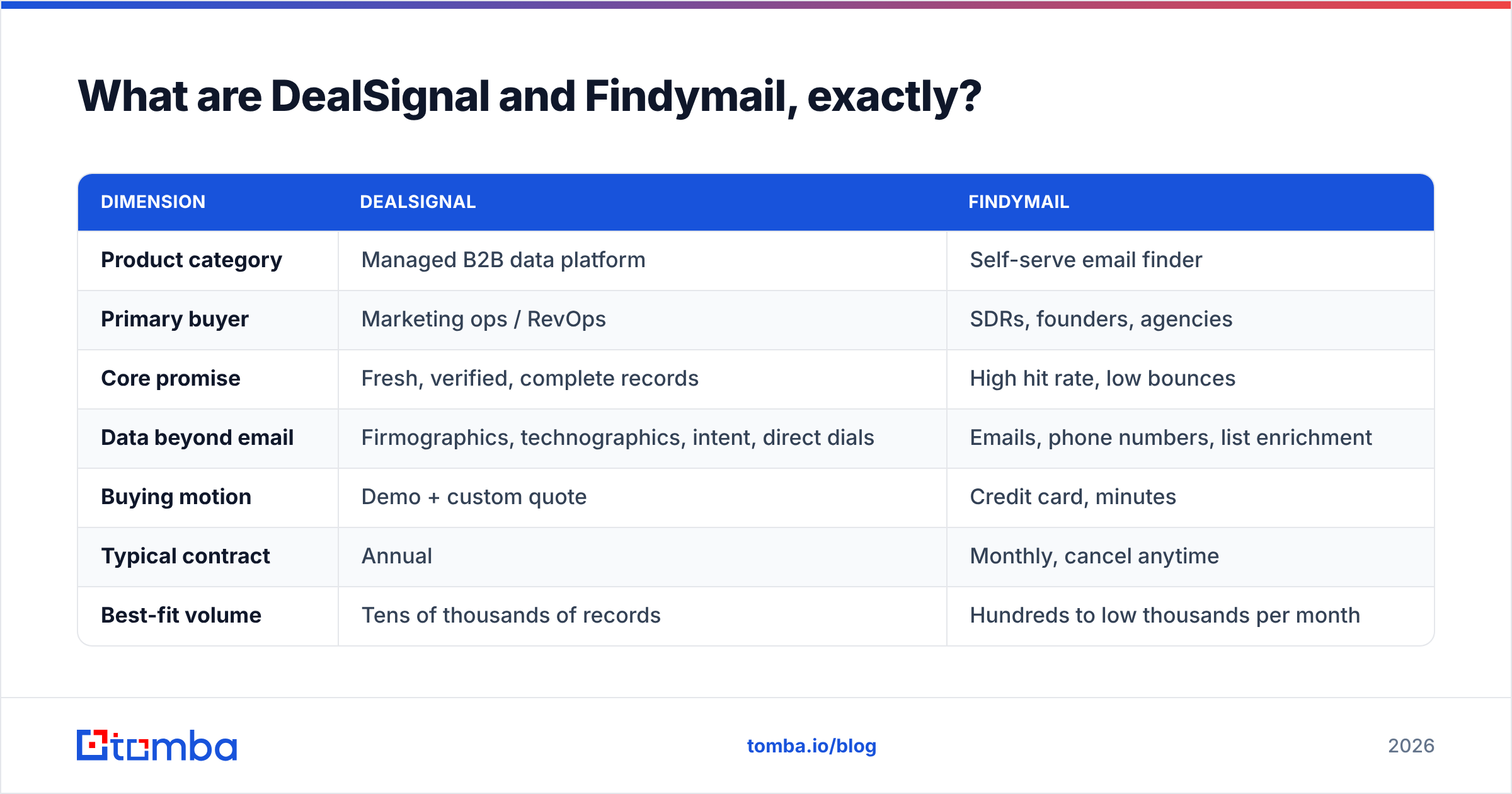
| Dimension | DealSignal | Findymail |
|---|---|---|
| Product category | Managed B2B data platform | Self-serve email finder |
| Primary buyer | Marketing ops / RevOps | SDRs, founders, agencies |
| Core promise | Fresh, verified, complete records | High hit rate, low bounces |
| Data beyond email | Firmographics, technographics, intent, direct dials | Emails, phone numbers, list enrichment |
| Buying motion | Demo + custom quote | Credit card, minutes |
| Typical contract | Annual | Monthly, cancel anytime |
| Best-fit volume | Tens of thousands of records | Hundreds to low thousands per month |

How do they compare on data accuracy?#
Accuracy is where these two tools really differ. It is not just packaging.
DealSignal's model is verification on request. It re-checks records when you pull them, instead of shipping whatever sat in the index last quarter. Automated validation does most of the work, with human review on higher-value fields. In practice you get fewer dead records on large enrichment jobs. That is the main reason enterprise teams accept the price. The tradeoff is latency, because on-demand checks on a big list are not instant.
Findymail's model is find-then-guarantee. It runs its own discovery waterfall, validates the result, and refuses to charge you for emails it cannot stand behind. Users report strong results on domains that block standard SMTP probing. Those are the exact cases where cheap finders return a confident guess that bounces two days later. User reviews on G2 show the same split: DealSignal earns praise for record completeness, Findymail for deliverability.
Hold a few things in mind before you trust any accuracy claim:
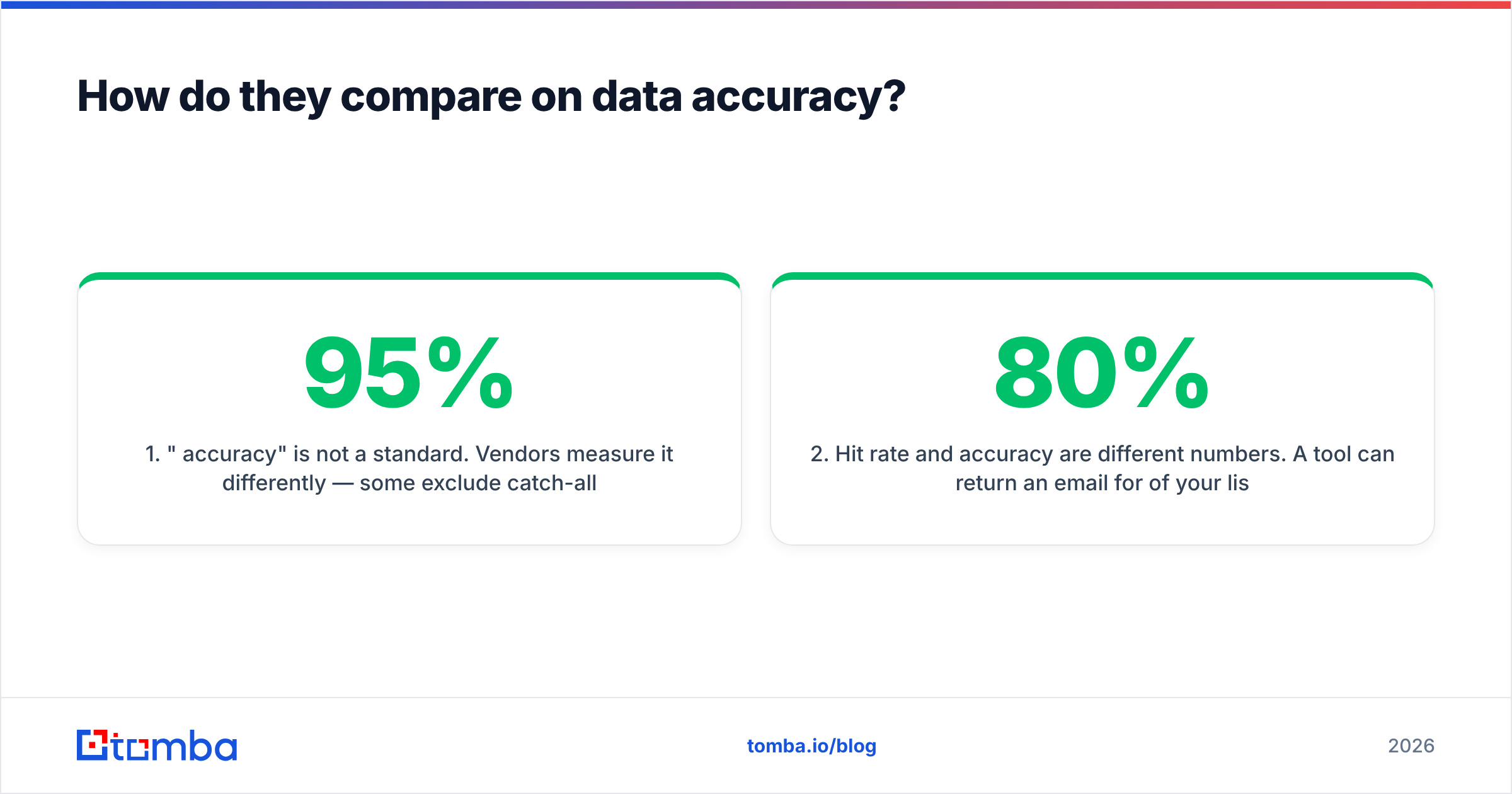
- "95% accuracy" is not a standard. Vendors measure it differently. Some drop catch-all domains from the denominator, some count "risky" as a pass, and some count only the emails they chose to return.
- Hit rate and accuracy are different numbers. A tool can return an email for 80% of your list and still see 12% of those bounce. Ask for both.
- Catch-all domains break naive benchmarks. Roughly a fifth of B2B domains accept everything at the SMTP layer. A tool that marks them all "valid" looks great in a test and terrible in your inbox. This is where a dedicated catch-all verifier earns its keep.
- Your ICP decides the winner. Mid-market SaaS in North America is well covered by everyone. The spread shows up in European mid-market, healthcare, manufacturing, and sub-50-employee companies.
- Freshness beats size. A 700M-record database that is 18 months stale performs worse than a 200M-record database re-verified last week.
The only benchmark that counts is the one you run on 200 rows of your own ICP, with the same list, on the same day.

Is DealSignal or Findymail cheaper?#
Findymail is cheaper to start. DealSignal is cheaper per record, but only at volumes most teams never reach.
Findymail publishes self-serve monthly tiers that scale with the number of emails you pull. They start in the double digits per month and climb to mid-hundreds on high-volume plans. You can sign up, run a list, and cancel in the same week.
DealSignal quotes instead. Its published entry points sit well above typical self-serve tooling, and most real deals are custom. Price depends on credits, seats, data fields, and contract length. That is not a knock; it is how managed data platforms work. But you cannot compare the two on a pricing page, and procurement gets involved.
Here is the honest comparison, with a self-serve reference point for context:
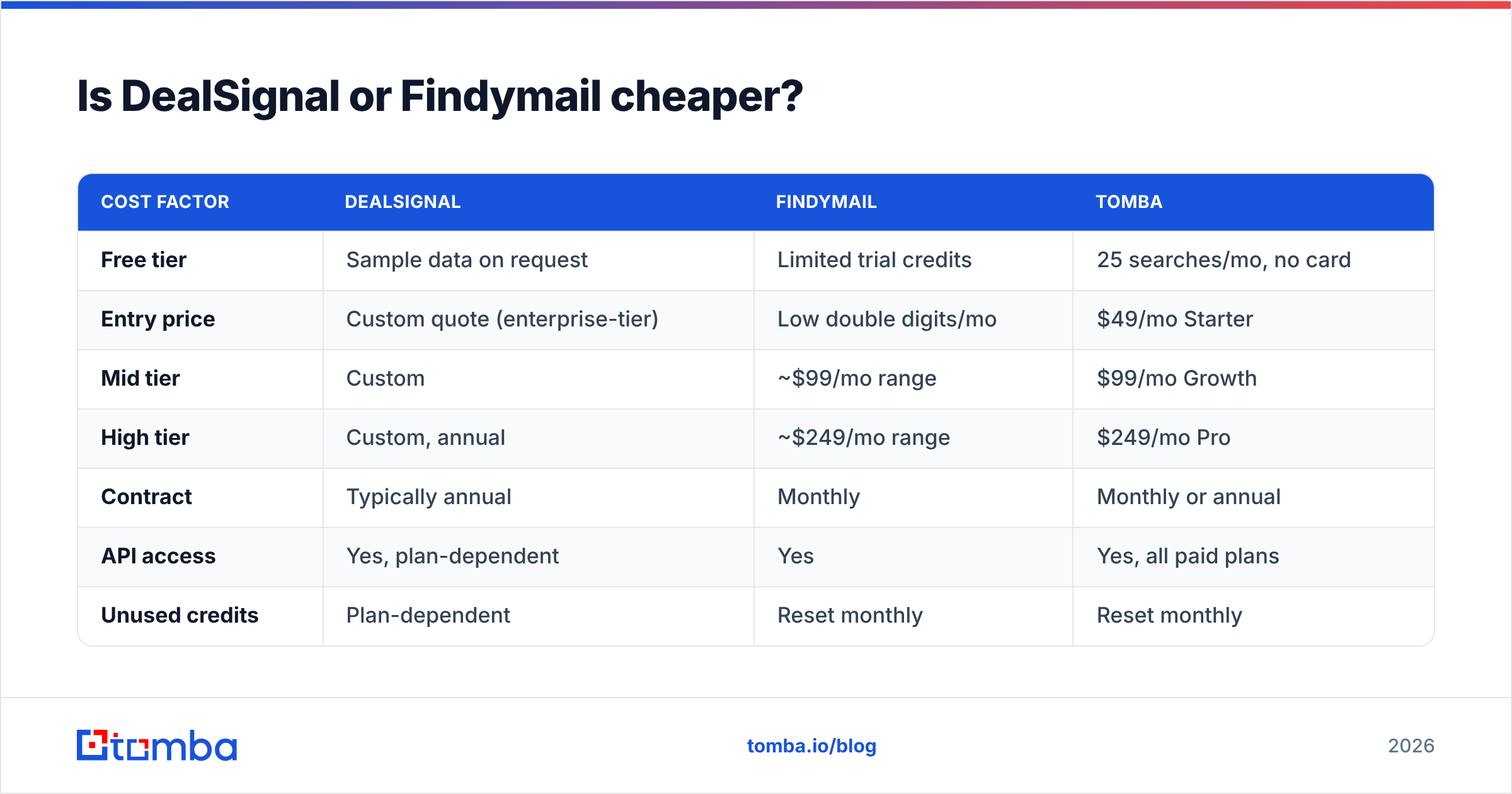
| Cost factor | DealSignal | Findymail | Tomba |
|---|---|---|---|
| Free tier | Sample data on request | Limited trial credits | 25 searches/mo, no card |
| Entry price | Custom quote (enterprise-tier) | Low double digits/mo | $49/mo Starter |
| Mid tier | Custom | ~$99/mo range | $99/mo Growth |
| High tier | Custom, annual | ~$249/mo range | $249/mo Pro |
| Contract | Typically annual | Monthly | Monthly or annual |
| API access | Yes, plan-dependent | Yes | Yes, all paid plans |
| Unused credits | Plan-dependent | Reset monthly | Reset monthly |
Prices move. Check DealSignal's site, Findymail's pricing page, and Tomba pricing before you budget anything.
Notice the pattern. DealSignal's cost is driven by platform access, Findymail's by volume, and self-serve finders by credits consumed. If you pull 800 emails a month, the platform model is poor value. If you enrich 40,000 CRM records a quarter with 15 fields each, it starts to make sense.

Which one fits your workflow better?#
Workflow fit kills more data deals than accuracy does.
DealSignal fits when:
- Your source of truth is Salesforce, HubSpot, or Marketo, and enrichment must write back cleanly with field-level mapping.
- You need more than email — direct dials, install data, org charts, buying signals.
- You have a defined database-hygiene program with someone accountable for it.
- Legal wants a named vendor with a DPA, SOC-style controls, and a support SLA.
Findymail fits when:
- Your list starts as a LinkedIn Sales Navigator search or a scraped account list.
- You care about one metric: emails that land.
- You want to test the tool this afternoon, not next quarter.
- Your sequencer (Instantly, Smartlead, Lemlist) is the destination, not a CRM.
Neither fits well when:
- You want a programmatic pipeline. DealSignal's API sits behind a commercial conversation, and Findymail's is built around its own app-first flow. If you are wiring enrichment into a product or an internal service, a documented, self-serve email finder API removes a lot of friction.
- You need find and verify as separate, chainable steps. Bundled tools decide for you what "valid" means. A standalone email verifier lets you set your own risk threshold.

What do you lose by picking the wrong one?#
Three specific costs, all larger than the subscription.
Sender reputation. Bounce rates above 3% start attracting filtering. Above 5% you are in real trouble with Gmail and Microsoft. A finder that returns confident guesses burns your domains. That damage takes weeks of warmup to undo, and it never shows up on an invoice. Read up on email deliverability before you optimize for hit rate alone.
Rep time. An SDR who checks 40 questionable contacts a week loses about half a selling day. At any reasonable loaded cost, that dwarfs the gap between a $99 and a $249 plan.
Lock-in. Annual data contracts are hard to unwind mid-year when your ICP shifts. If you are pre-product-market-fit, or testing new segments each quarter, monthly billing is a feature.
DealSignal vs Findymail: are there better alternatives?#
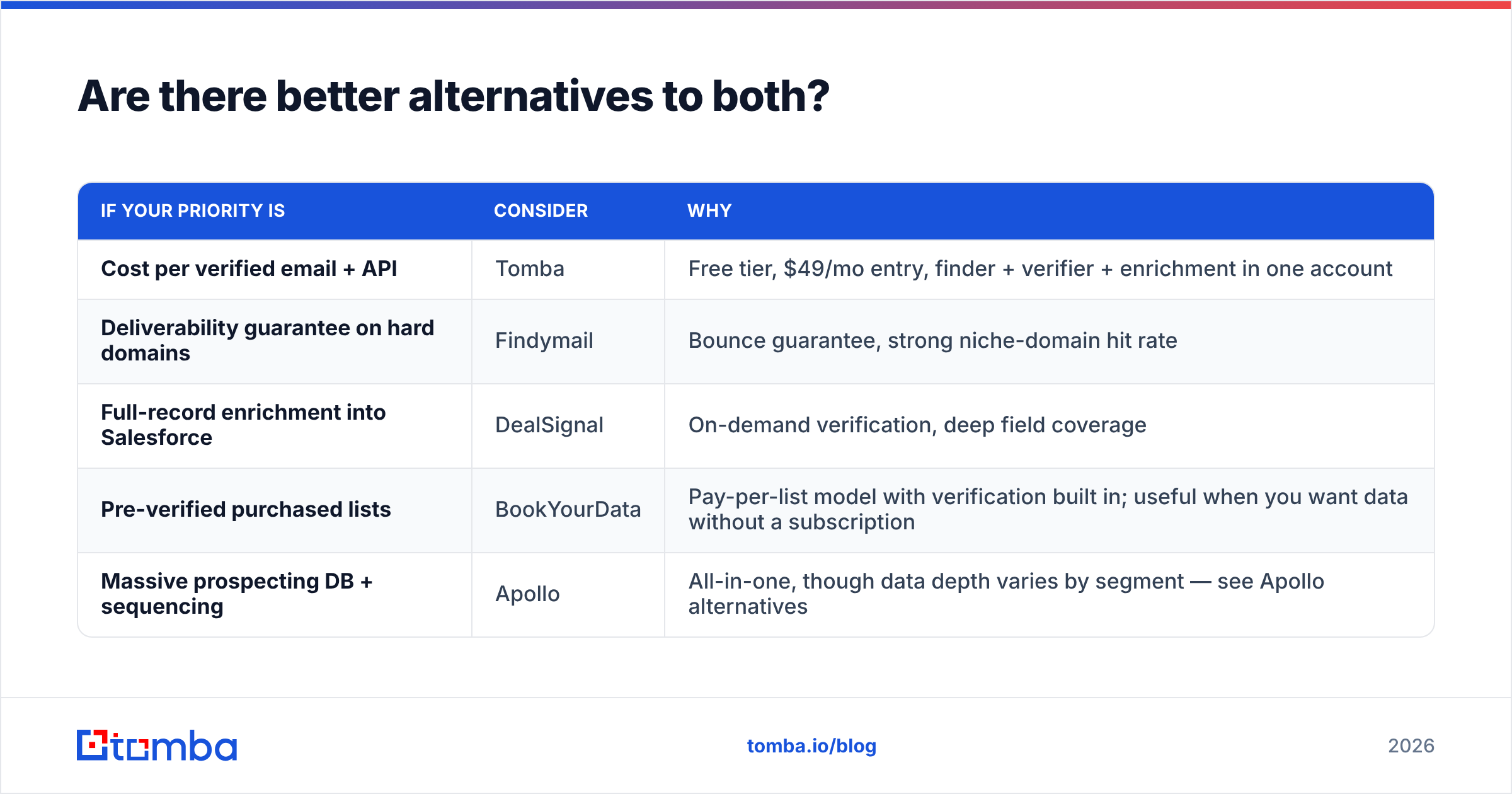
It depends on what you are optimizing for. A short, honest map:
| If your priority is | Consider | Why |
|---|---|---|
| Cost per verified email + API | Tomba | Free tier, $49/mo entry, finder + verifier + enrichment in one account |
| Deliverability guarantee on hard domains | Findymail | Bounce guarantee, strong niche-domain hit rate |
| Full-record enrichment into Salesforce | DealSignal | On-demand verification, deep field coverage |
| Pre-verified purchased lists | BookYourData | Pay-per-list model with verification built in; useful when you want data without a subscription |
| Massive prospecting DB + sequencing | Apollo | All-in-one, though data depth varies by segment — see Apollo alternatives |
Most teams over-buy. A boring, effective stack looks like this: a self-serve finder for discovery, a separate verifier as the gate before anything enters your sequencer, and a CRM enrichment job that runs monthly rather than continuously. That covers 90% of what a platform sells you, at a fraction of the cost, and every part stays replaceable.
Already own a data platform and only unhappy with email accuracy? Do not rip it out. Add a verification step. Already own a finder and short on firmographics? Do not jump to an enterprise contract. Add enrichment on the records that reached a real conversation.
How should you run the comparison yourself?#
Do not trust this post, or any vendor page. Run your own DealSignal vs Findymail test in 90 minutes.
- Build one control list. Take 200 contacts from your real ICP — names, companies, domains. Include at least 40 hard ones: small companies, non-US, catch-all domains.
- Run it through every candidate. Same list, same day, no cherry-picking.
- Record three numbers per tool: hit rate (rows returned), verified rate (rows the tool calls valid), and cost for that run.
- Send a real, low-volume campaign from a warmed secondary domain. Measure actual bounces after 48 hours. This is the only number that matters.
- Divide. Cost of the run ÷ emails that did not bounce = your true cost per usable contact. Rank on that.
Teams that run this test often get a surprise. The ranking rarely matches the one they expected. The pricier tool may win on one segment and lose badly on another. That is fine. Buy per segment if you have to.
DealSignal vs Findymail: the bottom line#
DealSignal and Findymail are not chasing the same dollar. DealSignal wins when data completeness inside a CRM is the job, and when budget is a line item someone else approves. Findymail wins when deliverable emails are the job and speed beats field depth. Both are legitimate. Both will disappoint the wrong buyer.
If your real constraint is cost per valid email plus clean API access — where most outbound teams sit — start with the cheapest credible option. Upgrade only when a measured gap forces you to.
Try it on your own list. The Tomba Email Finder gives you 25 free searches a month with no card, $49/mo when you need more, and the same finder, bulk processing, and verification through one API key. Run your 200-row control list through it alongside DealSignal and Findymail, compare the bounce numbers after 48 hours, and let the data pick.
Related guides#
Ready to find emails that actually work?
Join 150,000+ professionals who stopped guessing and started sending. Free credits on signup — no credit card required.
Get the Tomba newsletter
Practical outbound tactics and product updates — once every two weeks.
About the author