DealSignal vs Gamalogic: Which B2B Data Tool Wins in 2026
DealSignal sells enterprise-grade, human-verified B2B records. Gamalogic sells cheap, fast email lookups. They are not the same product — here is which one fits your motion, and where a third option beats both on cost per usable contact.
TL;DR
- DealSignal and Gamalogic are not competitors in the normal sense. DealSignal is a managed, quote-priced B2B data platform built for enterprise RevOps. Gamalogic is a low-cost email finder and verifier built for solo operators and small outbound teams.
- Pick DealSignal if you need 100+ enrichment attributes, custom-built lists, intent signals, and a CRM data-hygiene program — and you have budget approval and a procurement cycle.
- Pick Gamalogic if you need email addresses cheaply, right now, with pay-as-you-go credits and no sales call.
- Neither is optimal if what you actually want is high-accuracy email discovery plus verification at a self-serve price with a real API. That middle lane is where tools like Tomba, Hunter, and Findymail live.
- The metric that matters is cost per usable contact, not cost per credit. A $0.02 record that bounces 18% of the time is more expensive than a $0.08 record that bounces 2%.
What is DealSignal, and who actually buys it?#
DealSignal is a B2B data platform that sells researched contact and account data rather than a static database dump. The pitch on dealsignal.com is on-demand verification: instead of querying a warehouse of records collected months ago, you specify an ICP, and records are assembled and verified close to the moment you request them.
That model shapes everything about the product:
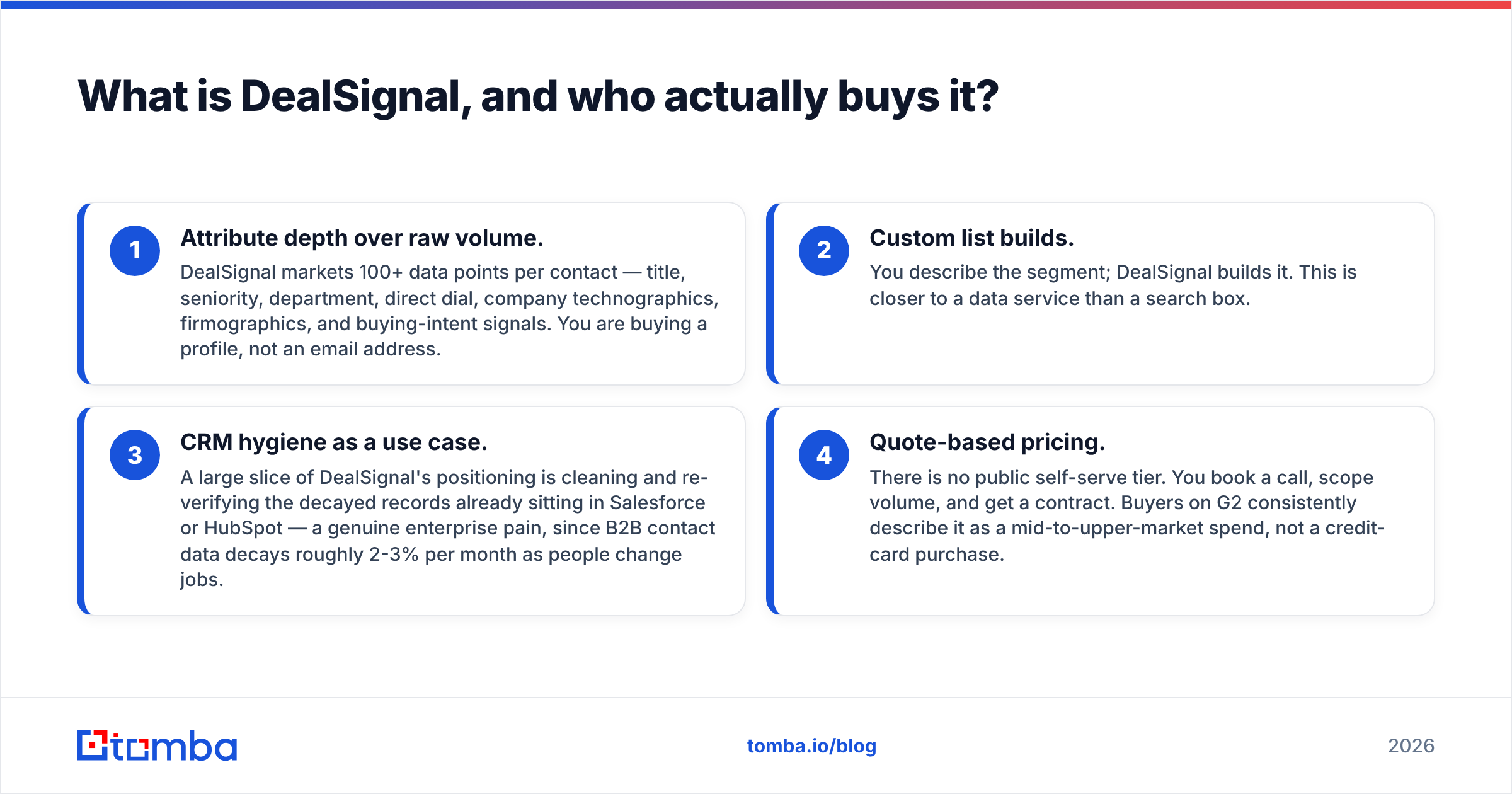
- Attribute depth over raw volume. DealSignal markets 100+ data points per contact — title, seniority, department, direct dial, company technographics, firmographics, and buying-intent signals. You are buying a profile, not an email address.
- Custom list builds. You describe the segment; DealSignal builds it. This is closer to a data service than a search box.
- CRM hygiene as a use case. A large slice of DealSignal's positioning is cleaning and re-verifying the decayed records already sitting in Salesforce or HubSpot — a genuine enterprise pain, since B2B contact data decays roughly 2-3% per month as people change jobs.
- Quote-based pricing. There is no public self-serve tier. You book a call, scope volume, and get a contract. Buyers on G2 consistently describe it as a mid-to-upper-market spend, not a credit-card purchase.
Who buys it: RevOps and demand-gen leaders at companies running ABM programs, where a bad record costs more than the data itself because it pollutes scoring, routing, and attribution.
Who should not buy it: a two-person agency that needs 400 emails this week.
What is Gamalogic, and where does it fit?#
Gamalogic sits at the opposite end. It is an email finder and email verification tool — gamalogic.com leads with bulk email finding, single and bulk verification, domain-based search, and an API for developers. Pricing is credit-based and self-serve, with entry tiers priced for individuals rather than departments.
The value proposition is simple: give it a name and a domain, get an email; give it a list, get validity flags back. No onboarding call, no annual commitment, no data-services team assembling a segment for you.
The tradeoff is equally simple. You get identifiers, not intelligence. There is no intent layer, no technographic enrichment, no managed list build, and no data-steward relationship. If your workflow is "scrape or export a list of names and companies, then find their emails," that gap does not matter. If your workflow is "define an ICP from scratch and route enriched records into a scoring model," that gap is the entire job.

How do DealSignal vs Gamalogic compare head to head?#
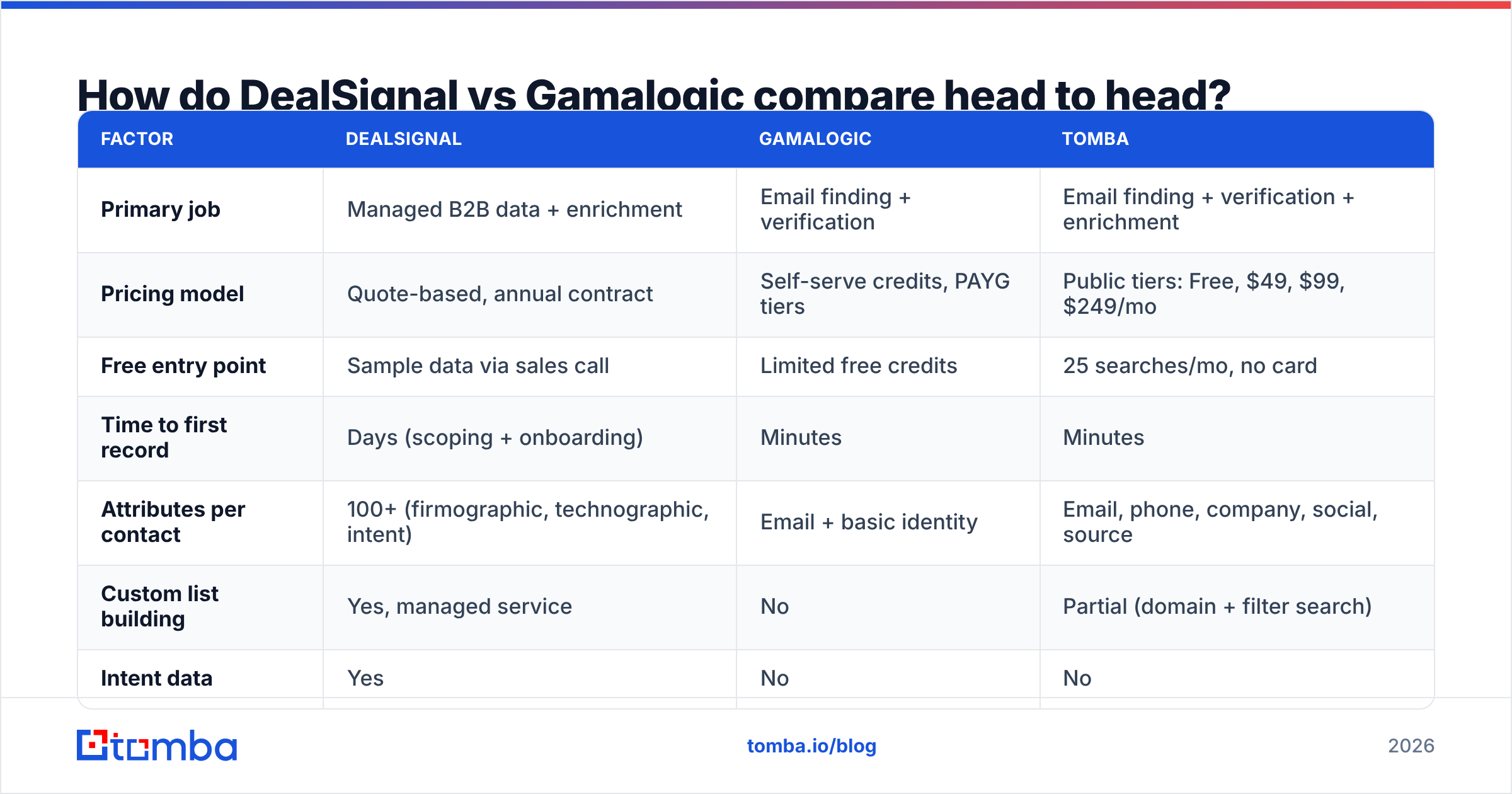
Here is the honest side-by-side. Pricing for both vendors moves; treat these as directional and confirm on the vendor pages before you sign anything.
| Factor | DealSignal | Gamalogic | Tomba |
|---|---|---|---|
| Primary job | Managed B2B data + enrichment | Email finding + verification | Email finding + verification + enrichment |
| Pricing model | Quote-based, annual contract | Self-serve credits, PAYG tiers | Public tiers: Free, $49, $99, $249/mo |
| Free entry point | Sample data via sales call | Limited free credits | 25 searches/mo, no card |
| Time to first record | Days (scoping + onboarding) | Minutes | Minutes |
| Attributes per contact | 100+ (firmographic, technographic, intent) | Email + basic identity | Email, phone, company, social, source |
| Custom list building | Yes, managed service | No | Partial (domain + filter search) |
| Intent data | Yes | No | No |
| Bulk processing | Yes, managed | Yes, credit-based | Yes, bulk email finder |
| Public API | Yes | Yes | Yes, documented REST API |
| Catch-all handling | Handled in verification service | Basic | Dedicated catch-all verifier |
| Best fit | Enterprise RevOps, ABM | Solo founders, small agencies | SMB to mid-market outbound teams |

The table makes the real decision visible: this is not a feature race between two similar tools. It is a choice between three different purchasing behaviors — procurement, credit card, and subscription.
Which one has better data accuracy?#
Accuracy claims from any data vendor deserve skepticism, because "accuracy" is measured at least four different ways and vendors pick whichever number flatters them.
The four definitions you will encounter:
- Match rate — of the contacts you asked for, how many did the tool return anything for? High match rates are easy to fake by returning guessed patterns.
- Deliverability rate — of the emails returned, how many actually accept mail? This is the number that governs your bounce rate.
- Freshness — how recently was the record confirmed? A 97% accurate record verified 14 months ago is not 97% accurate today.
- Attribute correctness — is the job title, seniority, and company actually right? This is the one almost nobody audits, and the one that quietly breaks lead scoring.
DealSignal's architecture is designed to win on freshness and attribute correctness, because records are verified close to delivery and layered with multiple sources. That is genuinely valuable if you are feeding a scoring model. Gamalogic optimizes for match rate and price, which is genuinely valuable if you are feeding a sequencer.

Run your own test before you buy either. The method takes an afternoon:
- Build a 100-contact control list from people whose emails you already know are valid (past customers, webinar attendees, inbound demo requests).
- Strip the emails. Keep only first name, last name, and company domain.
- Run the stripped list through each tool's email finder or equivalent.
- Score three numbers per vendor: how many returned a result, how many matched the known-good email exactly, and how many returned something different.
- Divide the plan cost by the count of exact matches — not by the count of returned rows. That is your true cost per usable contact.
Vendors will not love this test. Buy from the ones that survive it.
What does each one actually cost?#
DealSignal does not publish rates. Expect a scoped annual agreement sized to record volume and attribute depth, with the usual enterprise mechanics: minimum commitments, overage rates, and a renewal negotiation. If your organization already buys ZoomInfo, Clearbit, or Demandbase, DealSignal will feel procurement-normal. If it does not, the sales cycle alone may cost you more in calendar time than the data is worth this quarter.
Gamalogic publishes credit tiers and sells them self-serve. The cost per lookup is low by design. What you should model is not the sticker price but the waste rate: credits consumed on lookups that return nothing, return a guess, or return a catch-all address you cannot safely mail. Ask specifically whether failed lookups are charged. Some finders charge only for results; others charge for attempts, which silently doubles the effective price.
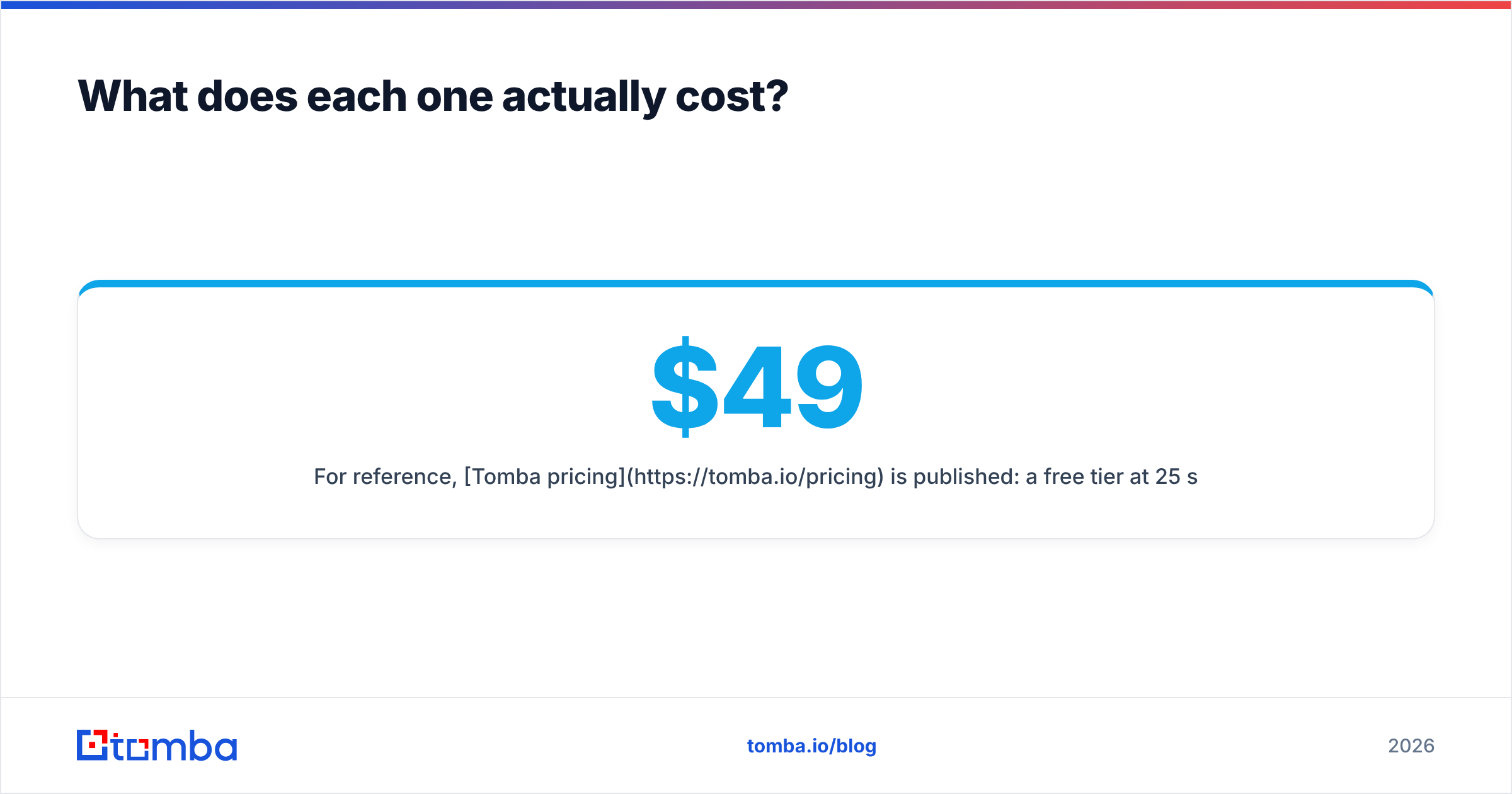
For reference, Tomba pricing is published: a free tier at 25 searches per month, Starter at $49/mo, Growth at $99/mo, Pro at $249/mo, and custom enterprise. The point of citing it here is not that cheaper is better — it is that published, comparable, per-credit math is something you should demand from every vendor on your shortlist.
Is there a better option than either DealSignal or Gamalogic?#
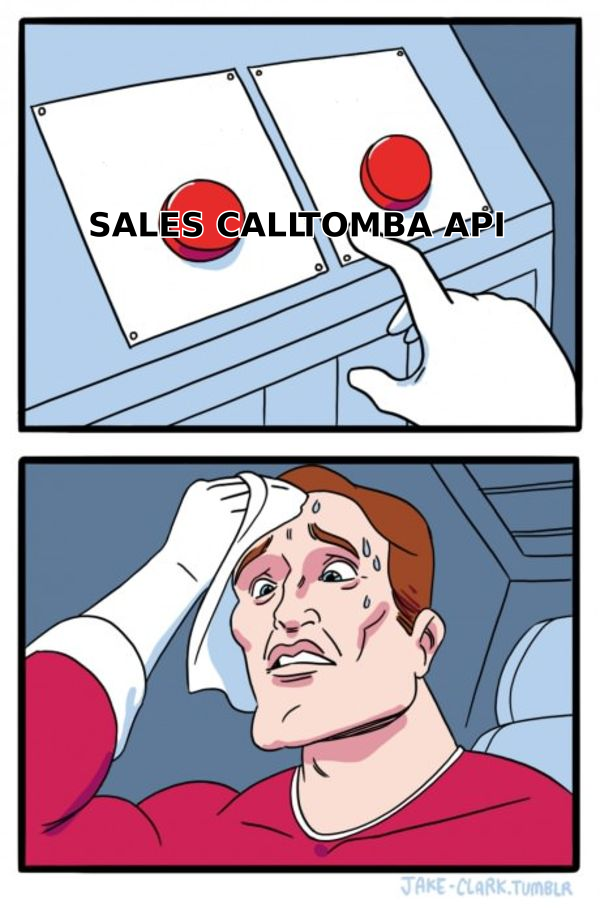
Often, yes — because most teams evaluating this pair are actually stuck between two extremes and need the middle.
Ask yourself which of these three sentences describes your next 90 days:
- "I need a data partner to rebuild my ICP and clean 200,000 CRM records." → DealSignal, or a peer platform like Demandbase or Clearbit. This is a services purchase and self-serve tools will not do it.
- "I need 2,000 emails for a campaign and I do not care about anything else." → Gamalogic or any low-cost finder. Do not overpay for attributes you will not use.
- "I need reliable emails, verification I trust, phone numbers sometimes, and an API my engineer can wire into our stack — on a predictable monthly bill." → This is the majority case, and it is where neither of the two tools above is the natural answer.
For that third case, look at tools that bundle discovery and verification in one subscription. A workflow that works well: run domain search to map every reachable contact at a target company, pass the results through an email verifier before they touch your sequencer, and use a catch-all finder to decide which risky domains are actually safe to mail. Hunter, Findymail, and BookYourData all solve adjacent versions of this problem well — BookYourData in particular is worth a look if you prefer buying a verified list outright rather than running lookups yourself.
What should you check before signing with either vendor?#
Six questions that change the answer more than any feature list:
- Do you charge for failed lookups? If yes, your real cost per contact is your sticker price divided by your match rate.
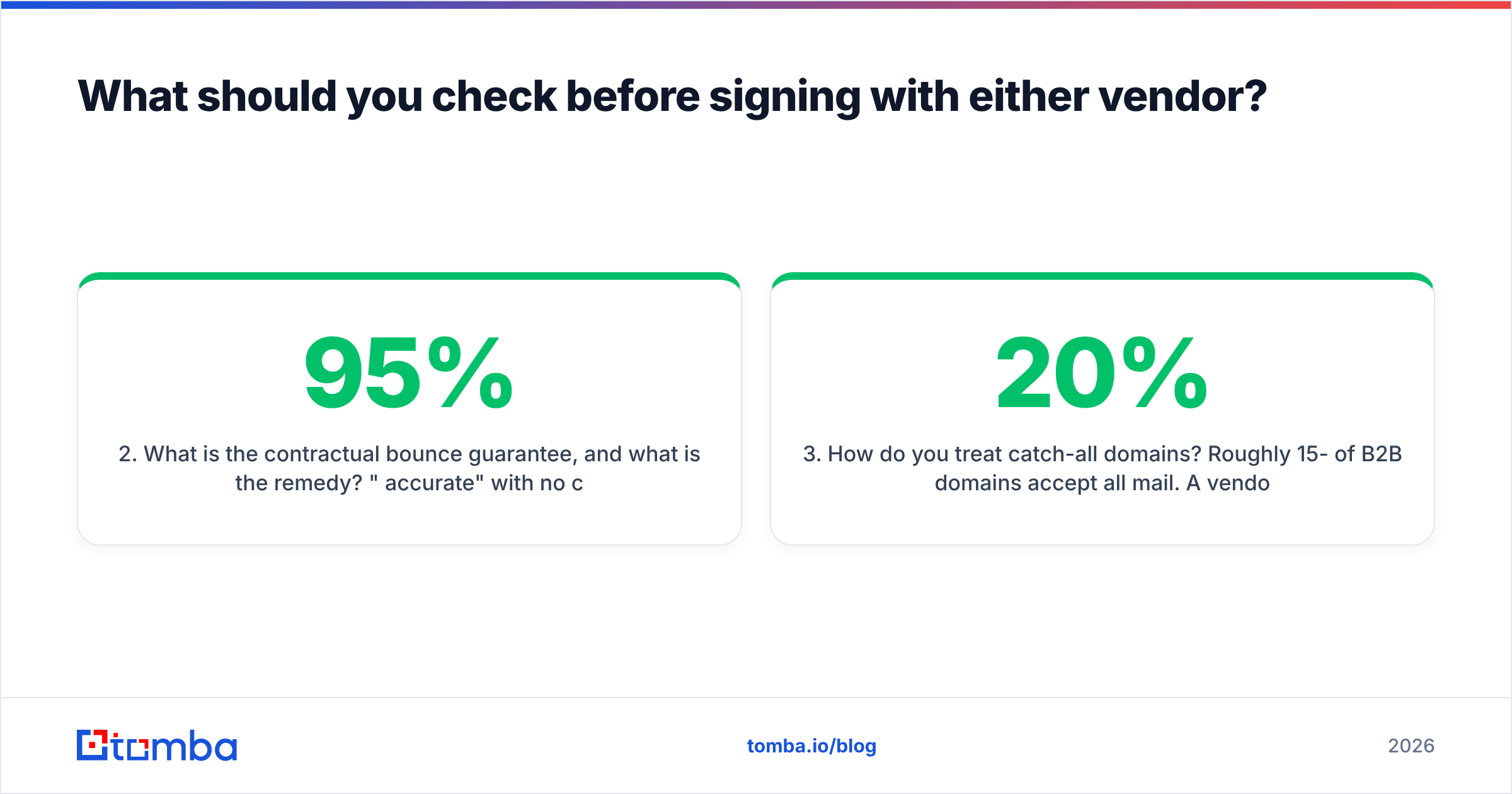
- What is the contractual bounce guarantee, and what is the remedy? "95% accurate" with no credit policy is marketing. "Under 5% bounce or we refund the credits" is a commitment.
- How do you treat catch-all domains? Roughly 15-20% of B2B domains accept all mail. A vendor that silently marks these "valid" is inflating its own accuracy number and handing you the bounce risk.
- Where does the data come from, and is it GDPR/CCPA defensible? Ask for the actual answer, not the trust-badge page. If you sell into the EU, your legal team will eventually ask you this and you need a real response. Tomba publishes its data sources for this reason.
- Can I export and leave? Some enterprise data contracts restrict retention of records after termination. Read that clause before you build your CRM on it.
- How fast is the API, and is it rate-limited in a way that breaks my workflow? Batch enrichment jobs die on 5 req/sec limits.
The verdict on DealSignal vs Gamalogic#
DealSignal wins on depth; Gamalogic wins on speed and price; most teams need neither extreme.
If you are an enterprise RevOps leader with an ABM program, a scoring model, and a CRM full of decayed records, DealSignal's managed, on-demand verification model is a legitimate fit and worth the procurement cycle. If you are a founder or small agency whose entire need is "turn names into emails without a sales call," Gamalogic does that job at a price that does not require a budget conversation.
But if you are between those poles — a growing outbound team that needs accurate emails, real verification, occasional B2B phone numbers, and an API that does not require an account manager — the honest answer is that both tools are the wrong shape. Run the 100-contact control test against all three shortlisted vendors, measure cost per exact match, and buy the number, not the pitch.
Start with the free tier before you talk to anyone's sales team. Tomba's Email Finder gives you 25 searches per month at no cost and no card — enough to run the control-list test described above and get a real accuracy number for your own ICP. If it wins your test, plans start at $49/mo with verification, domain search, and API access included. If it loses, you will at least have a benchmark to negotiate against.
Related guides#
Ready to find emails that actually work?
Join 150,000+ professionals who stopped guessing and started sending. Free credits on signup — no credit card required.
Get the Tomba newsletter
Practical outbound tactics and product updates — once every two weeks.
About the author