DealSignal vs Generect: Which B2B Data Tool Wins in 2026?
DealSignal sells enterprise-grade, human-verified records on annual contracts. Generect sells fast, LinkedIn-native lead data through an API. Here is which one actually fits your outbound motion — and when neither does.
TL;DR
- DealSignal is an enterprise B2B data platform built around on-demand verification and CRM hygiene. It sells to RevOps teams on annual contracts, and you almost always talk to sales before you see a number.
- Generect is a LinkedIn-native lead data tool with a developer-first API. It is faster to start, cheaper to test, and aimed at agencies and outbound teams who want raw contacts pushed into a sequencer.
- The real split is not "who has more records" — it is verified-at-request depth vs. speed-and-volume. Pick based on whether a bad record costs you a meeting or costs you a compliance headache.
- Both are overkill if what you actually need is accurate work emails at a known cost per lookup. That is where a focused email finder plus a email verifier beats a full data suite on price.
- Run the same 200-contact test list through every candidate before you sign anything. Vendor accuracy claims are marketing; your bounce rate is data.
What are DealSignal and Generect?#
DealSignal positions itself as a B2B data platform for demand generation and RevOps. Its pitch centers on on-demand verification: instead of serving you a record that was scraped 14 months ago and cached, it re-verifies contact details when you request them, blending machine validation with human research passes on higher-value fields. It leans hard into CRM enrichment, TAM building, and list hygiene for teams running large databases inside Salesforce or HubSpot.
Generect comes at the same problem from the opposite end. It is built around live LinkedIn-sourced search — you define a filter set (title, company size, geography, technology), and it returns matching people with contact details, either through a web app or an API. Developers like it because you can wire it into your own stack without waiting on a solutions engineer. Growth agencies like it because they can spin up lists for a new client in an afternoon.
Neither is a household name at the scale of ZoomInfo or Apollo, and that is precisely why people compare them: both are the "smart middle" choice for teams that outgrew a Chrome extension but do not want a six-figure contract.
How do DealSignal and Generect compare head-to-head?#
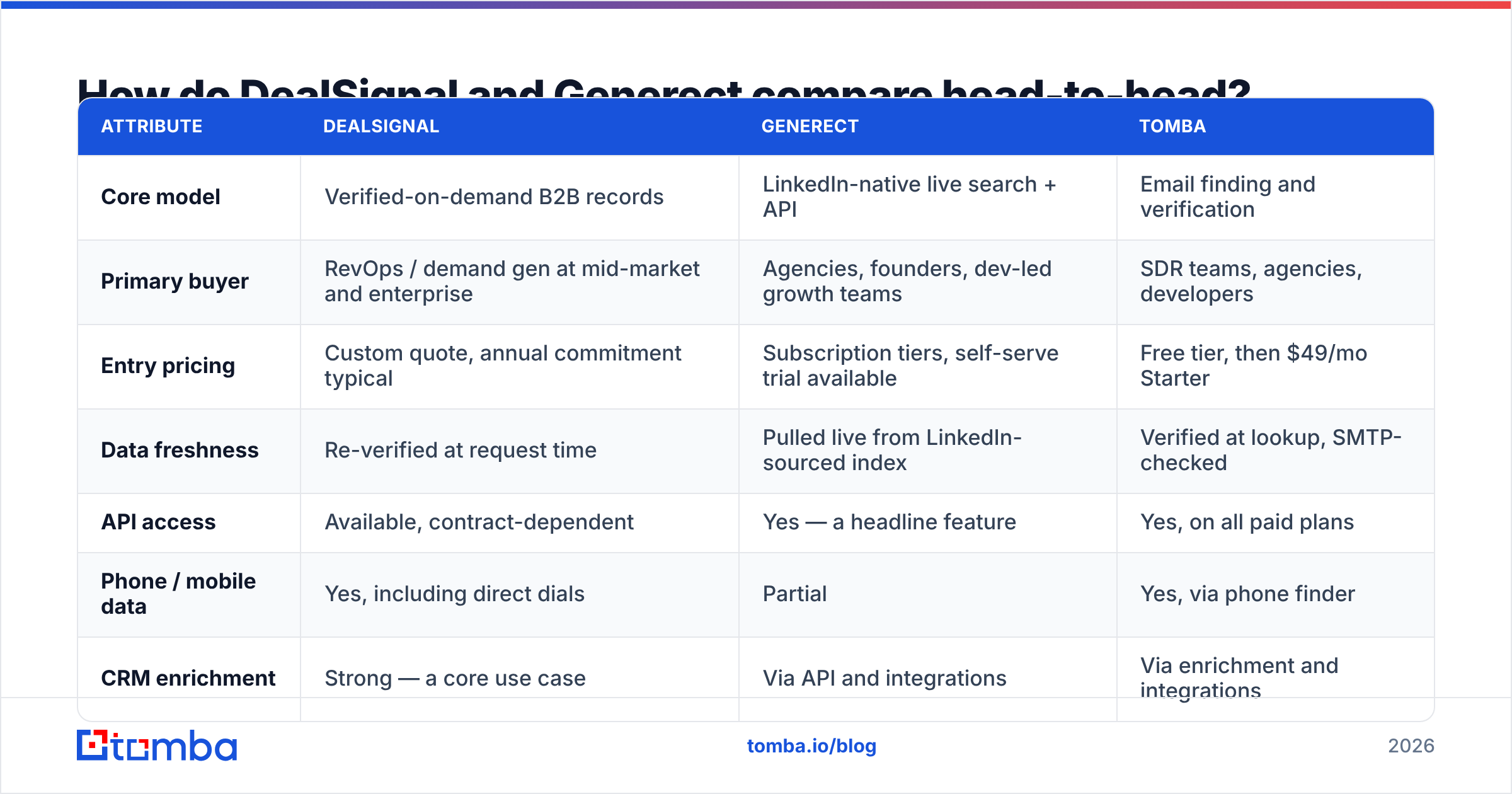
| Attribute | DealSignal | Generect | Tomba |
|---|---|---|---|
| Core model | Verified-on-demand B2B records | LinkedIn-native live search + API | Email finding and verification |
| Primary buyer | RevOps / demand gen at mid-market and enterprise | Agencies, founders, dev-led growth teams | SDR teams, agencies, developers |
| Entry pricing | Custom quote, annual commitment typical | Subscription tiers, self-serve trial available | Free tier, then $49/mo Starter |
| Data freshness | Re-verified at request time | Pulled live from LinkedIn-sourced index | Verified at lookup, SMTP-checked |
| API access | Available, contract-dependent | Yes — a headline feature | Yes, on all paid plans |
| Phone / mobile data | Yes, including direct dials | Partial | Yes, via phone finder |
| CRM enrichment | Strong — a core use case | Via API and integrations | Via enrichment and integrations |
| Free entry point | No public free tier | Trial / limited free credits | 25 searches/mo, no card |
| Best at | Cleaning and expanding an existing database | Building fresh lists fast | Cost-controlled email discovery at volume |
Read that table as three different products that happen to overlap, not three versions of the same one. DealSignal wants to be the system of record for your contact data. Generect wants to be the pipe that fills your sequencer. A dedicated finder wants to answer one question — what is this person's work email, and is it deliverable? — for the lowest cost per correct answer.

Which one has better data accuracy?#
DealSignal wins on paper, and probably in practice, for depth of a single record. On-demand verification is genuinely different from cache-and-serve. If you request 5,000 contacts and the platform re-checks each one at the moment of delivery, you get a cleaner file than a provider handing you a slice of a static database. That is the argument for the premium.
Generect's accuracy story is different: because it works off live LinkedIn-derived signals, job-change staleness is lower than a legacy database — people update LinkedIn before anyone updates a data vendor. But the email layer on top of that is inferred and pattern-matched, and inferred emails are exactly where bounce rates come from. If you push Generect output straight into a cold sequence without a verification pass, you will feel it in your sender reputation within two weeks.

Three accuracy realities that vendor pages skip:
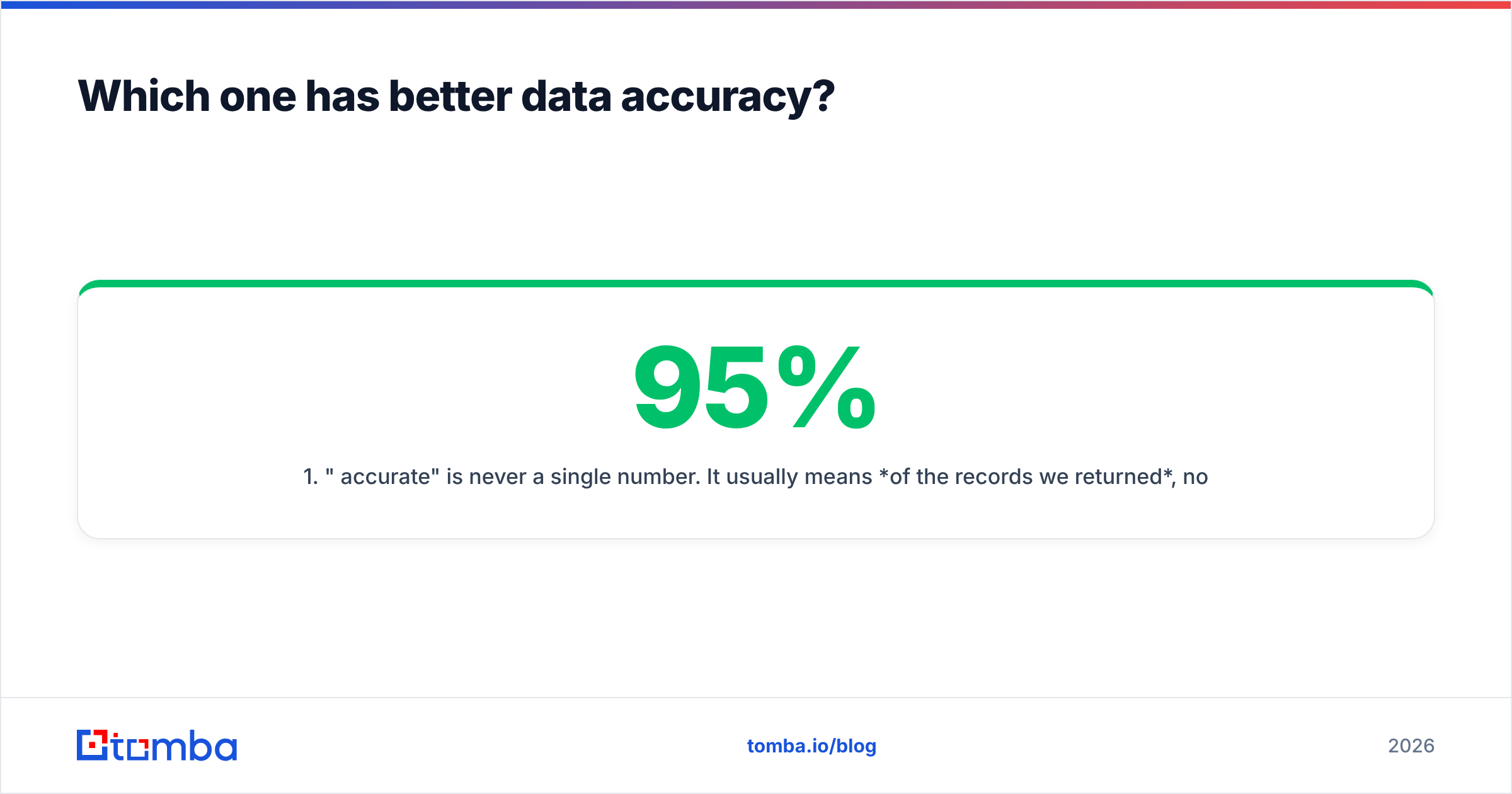
- "95% accurate" is never a single number. It usually means of the records we returned, not of the contacts you asked for. A provider that returns 40% of your list at 95% accuracy is worse than one returning 80% at 90%.
- Catch-all domains break every scoreboard. Roughly a third of mid-market domains accept everything at the SMTP layer, so a naive verifier marks them "valid" and your bounce shows up anyway. Check whether the tool has a real catch-all verifier or just shrugs.
- Coverage varies wildly by region and segment. US SaaS is oversupplied. EU manufacturing, LATAM, and APAC mid-market are where providers diverge by 30+ percentage points. Test on your ICP, not a generic sample.
- Freshness beats volume after 90 days. A 600M-record database with 24-month-old titles is a liability. Ask each vendor when the record you are looking at was last touched — and whether they will show you that timestamp in the export.
How does pricing compare?#
This is where the two diverge hardest, and where most evaluations actually get decided.
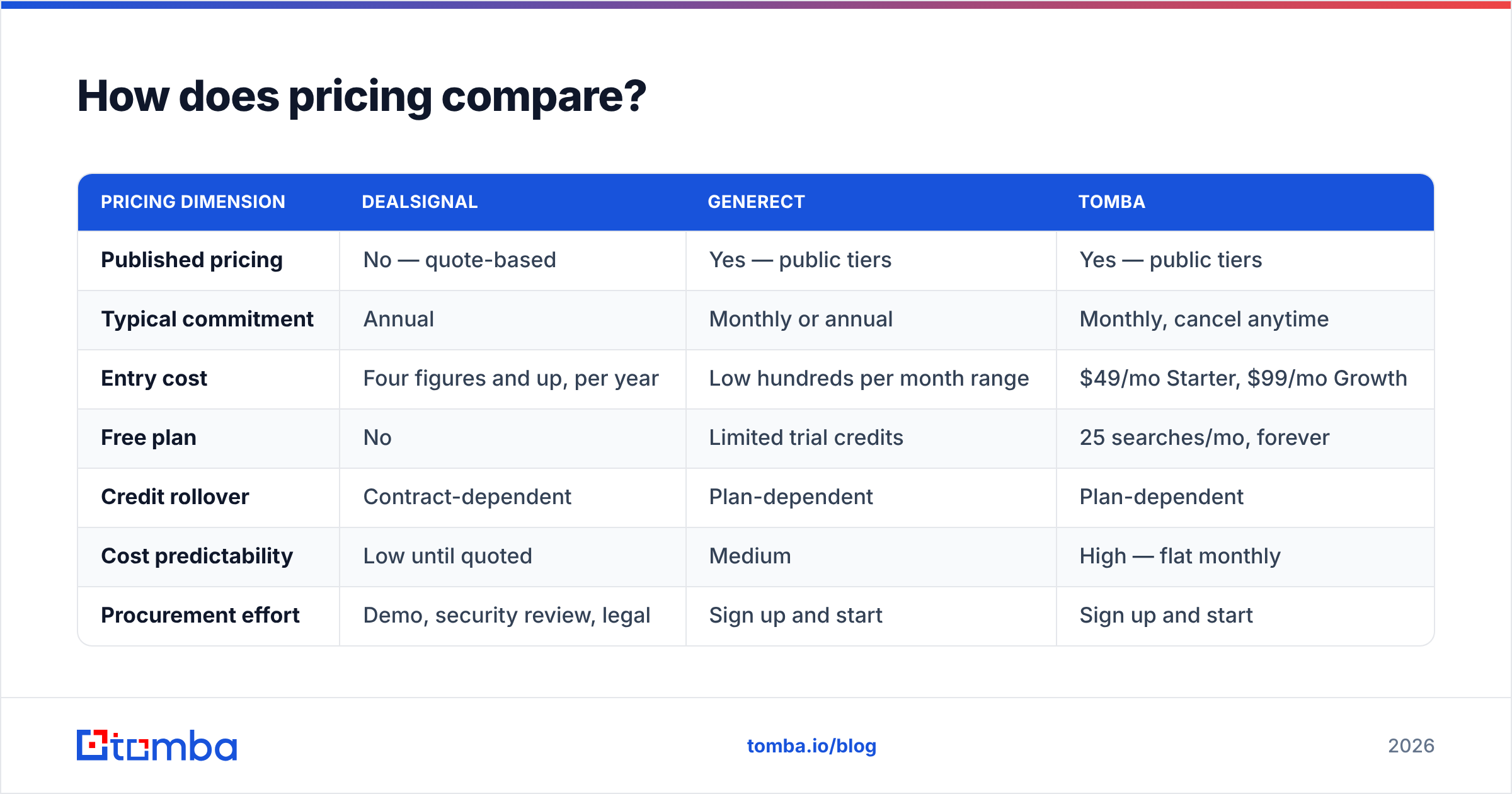
| Pricing dimension | DealSignal | Generect | Tomba |
|---|---|---|---|
| Published pricing | No — quote-based | Yes — public tiers | Yes — public tiers |
| Typical commitment | Annual | Monthly or annual | Monthly, cancel anytime |
| Entry cost | Four figures and up, per year | Low hundreds per month range | $49/mo Starter, $99/mo Growth |
| Free plan | No | Limited trial credits | 25 searches/mo, forever |
| Credit rollover | Contract-dependent | Plan-dependent | Plan-dependent |
| Cost predictability | Low until quoted | Medium | High — flat monthly |
| Procurement effort | Demo, security review, legal | Sign up and start | Sign up and start |
The hidden cost with quote-based enterprise data is not the sticker — it is the shape. You commit for twelve months against a credit pool sized by a salesperson who has an incentive to size it generously. Teams routinely finish year one having used 40-60% of what they bought. That unused half is real money, and it never rolls over on standard terms.
The hidden cost on the cheap end is different: you underestimate how many credits burn on failed lookups, duplicates, and re-runs. Always ask whether a no-result search consumes a credit. Some tools charge you for the miss. If you are running bulk lead generation at 50k rows a month, that single policy difference can be a third of your bill.

Who should choose DealSignal?#
Pick DealSignal when the data is the project.
- You are cleaning a rotting CRM. 200,000 records, unknown provenance, 30% bounced last quarter. DealSignal's enrichment-and-verify motion is built for exactly this, and it will outperform a lookup tool you have to script around.
- You need defensible sourcing. Regulated industries, EU-heavy targeting, or a legal team that asks where each field came from. Enterprise vendors document this; scrapers often cannot.
- You have a budget line item, not a card. If the purchase already needs procurement approval, the annual-contract friction costs you nothing extra.
- Direct dials matter. If your motion is cold calling as much as email, phone coverage justifies the premium in a way email-only coverage does not.
Skip it if you are a two-person team that needs 500 good contacts this week. The sales cycle alone will outlast your sprint.
Who should choose Generect?#
Pick Generect when speed and API access matter more than record depth.
- You build your own tooling. If your growth engineer would rather call an endpoint than log into a dashboard, Generect's API-first design is the whole value proposition.
- You run multi-client agency work. New ICP every week, no appetite for a locked annual pool.
- Your targeting logic lives on LinkedIn. Filters that map cleanly to LinkedIn's own taxonomy save you translation work.
- You are testing a market. Fresh list, fast, cheap enough to throw away if the segment does not respond.
Skip it if your compliance posture cannot tolerate LinkedIn-derived sourcing, or if you need direct dials at scale. And do not skip verification — treat Generect output as candidate emails, not confirmed ones, and run them through a verification pass before they touch your primary sending domain.
Where does a dedicated email finder fit?#
Here is the uncomfortable part of most DealSignal vs Generect evaluations: a lot of teams are comparing two data suites when their actual bottleneck is one field. They have the company list. They have the names, often from LinkedIn or a conference roster or an existing CRM. What they are missing is a deliverable work email — and they are about to pay platform prices for it.

That is the gap a focused tool fills. Tomba resolves name + domain to a verified work email, runs domain search to pull every published address at a company, and handles the catch-all problem explicitly rather than hiding it behind a "valid" label. Pricing is public: free tier at 25 searches/month, Starter at $49/mo, Growth at $99/mo, Pro at $249/mo — see Tomba pricing for the current credit allocations. No quote, no annual lock.
It is also the honest answer for a hybrid stack. Plenty of teams run Generect (or any LinkedIn scraper) for discovery and a separate finder-plus-verifier for the email layer, because the tool that is best at finding people is rarely the tool that is best at confirming addresses. Two specialists beat one generalist more often than vendors would like you to believe.
Worth noting for completeness: if your requirement is a pre-built, purchase-once contact list rather than an ongoing lookup subscription, providers like BookYourData occupy that niche well and are a legitimate third path — different buying model, different accounting treatment, same underlying goal.
How should you actually run the evaluation?#
Do not decide from feature grids, including the ones above. Run this instead — it takes about a week and costs almost nothing.
- Build a 200-row golden list. Real accounts in your ICP, with names and domains you already have. Include at least 40 rows from your hardest segment (non-US, sub-50-employee, or non-tech).
- Include 20 known-good and 10 known-bad emails. You already know the answers. Any tool that marks a known-bad address as valid just told you how it handles catch-alls.
- Run the identical list through every candidate. Same day, same file. Record match rate, cost per match, and time to result — three separate numbers, never averaged into one.
- Send to a burner domain first. Never validate a new data source on your primary sending domain. Measure hard bounces at 24 and 72 hours; a clean email deliverability baseline is worth more than any accuracy claim on a pricing page.
- Score cost per usable contact. Divide total spend by the count of contacts that were matched, verified, and did not bounce. This is the only number that survives contact with reality, and it frequently reorders the leaderboard.
- Check the exit. Can you export your data? Does the contract auto-renew? Are unused credits forfeited? Ask before signing, in writing.
Cross-check whatever you learn against third-party reviews on G2 — filtering for reviewers at your company size, not the overall score. A tool that delights 500-person RevOps teams frequently frustrates six-person startups, and the aggregate rating hides that completely.
What is the verdict?#
DealSignal if data quality is a board-level concern, you have an existing database to fix, and procurement is a solved problem at your company. You are buying verification depth and accountability, and those are real things to buy.
Generect if you are building fast, you want an API, and you would rather own the workflow than rent a platform. You are buying speed and flexibility, and you accept that you own the verification step.
Neither, if you are honest about the fact that your gap is email discovery and deliverability rather than a full data platform. In that case you are paying platform pricing for a lookup problem — and a purpose-built tool with published pricing solves it for a fraction of the cost.
Start with the Tomba Email Finder free tier: 25 searches a month, no card, no demo call. Run your golden list through it alongside whatever quote DealSignal sends and whatever trial Generect gives you, then compare cost per usable contact. If a $49/mo plan clears your bounce threshold on the same list an annual contract does, you just saved your team a year of committed spend — and you can wire the same results into your stack through the Tomba API the same afternoon.
Related guides#
Ready to find emails that actually work?
Join 150,000+ professionals who stopped guessing and started sending. Free credits on signup — no credit card required.
Get the Tomba newsletter
Practical outbound tactics and product updates — once every two weeks.
About the author