DealSignal vs Hunter: Which B2B Data Tool Wins in 2026?
DealSignal sells managed, on-demand B2B records. Hunter sells fast self-serve email lookups. They solve different problems at very different prices — here's how to pick, and where a cheaper third option beats both.
TL;DR
- DealSignal is a managed B2B data platform: you define an ideal customer profile, its team assembles and re-verifies records on demand, and you pay enterprise-style pricing with a sales call attached.
- Hunter is a self-serve email finder: type a domain or a name, get an address in seconds, pay a published monthly price with no contract.
- They are not really competitors. DealSignal competes with ZoomInfo and Clearbit; Hunter competes with Tomba, Findymail, and Snov.
- Pick DealSignal if you need enriched account lists with firmographics and intent signals for a full RevOps stack. Pick Hunter if you need addresses fast for a small-to-mid outbound motion.
- If your real problem is "I need accurate, verified emails at a predictable cost with an API," a dedicated email finder at $49/mo will out-economize both.
What is DealSignal, and what is Hunter?#
They sound like alternatives because both end with an email address in your CRM. The path there is completely different.
DealSignal is a demand-generation data provider. You hand it an account definition — industry, size, tech stack, geography, job titles — and it returns a contact list built and verified on request rather than pulled off a static shelf. Its pitch, on dealsignal.com, centers on data freshness: records are re-verified on a schedule rather than aging silently in a database. It layers on firmographics, technographics, and intent, and it integrates with Salesforce, HubSpot, Marketo, and Outreach. Buying is a quote-based process with a sales conversation and, typically, an annual commitment.
Hunter is a point tool that does one job well. On hunter.io, you enter a domain and get the company's email pattern plus known addresses; you enter a first name, last name, and domain and get the likely address with a confidence score and public sources. It bundles a verifier, a Chrome extension, a Google Sheets add-on, a lightweight campaign sender, and a clean API. You sign up with a credit card in two minutes.
The analogy: DealSignal is hiring a research firm to build your target list. Hunter is buying a very good pair of binoculars. Both are legitimate purchases. Confusing them costs you either money or momentum.

How do DealSignal and Hunter compare on pricing?#
This is where the two products stop pretending to be in the same category.
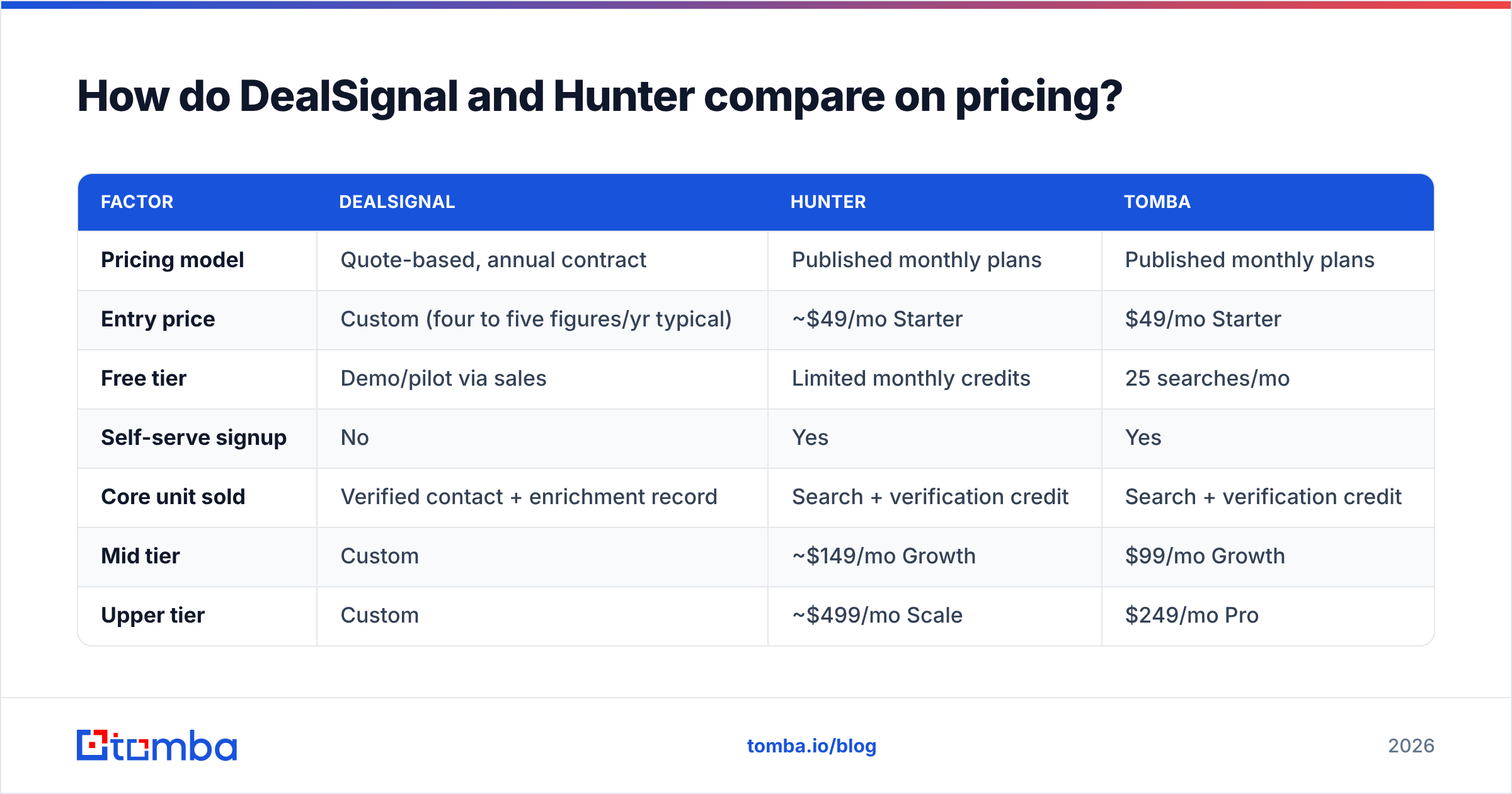
Hunter publishes its plans. At the time of writing, the free tier gives you a small monthly allowance of searches and verifications, Starter sits around $49/mo, Growth around $149/mo, and Scale around $499/mo, with credits scaling at each step and roughly 30% off for annual billing. You can leave whenever you want.
DealSignal does not publish rates. Pricing is quoted per deployment and depends on record volume, the enrichment fields you want, and contract length. Reported deals typically land in the low-to-mid five figures annually for a full deployment, with smaller pilots available. Treat any specific number you read online — including here — as a directional estimate, and get a written quote.
| Factor | DealSignal | Hunter | Tomba |
|---|---|---|---|
| Pricing model | Quote-based, annual contract | Published monthly plans | Published monthly plans |
| Entry price | Custom (four to five figures/yr typical) | ~$49/mo Starter | $49/mo Starter |
| Free tier | Demo/pilot via sales | Limited monthly credits | 25 searches/mo |
| Self-serve signup | No | Yes | Yes |
| Core unit sold | Verified contact + enrichment record | Search + verification credit | Search + verification credit |
| Mid tier | Custom | ~$149/mo Growth | $99/mo Growth |
| Upper tier | Custom | ~$499/mo Scale | $249/mo Pro |
| Contract exit | Annual term | Cancel anytime | Cancel anytime |
The pattern is consistent across the market: managed data providers charge for the research labor and the enrichment graph; self-serve finders charge for lookups. If you only need lookups, you are paying for a research department you will not use. Compare that against Tomba pricing before you sign anything with a term attached.
Which one gives you more accurate emails?#
Accuracy is the only metric that matters, and it is the one most vendors describe most vaguely. "95% accurate" is meaningless unless you know the denominator: accurate on which records, measured how, and does the number include catch-all domains?
Here is how the two approaches actually behave.
DealSignal's accuracy comes from process. Records are verified at request time and re-verified periodically, which means a list you pull in March should not be rotting by June. That is genuinely valuable for account-based marketing, where a stale VP record silently kills a campaign nobody audits. The trade-off is latency and cost: on-demand research is slower than a database lookup, and you pay for the labor.
Hunter's accuracy comes from pattern inference plus public sources. It maps a company's email format from crawled and submitted data, applies it to the name you supply, and returns a confidence score with citations. When the pattern is well-attested and the person is publicly visible, results are strong. When the domain uses inconsistent formats, or the person has no public footprint, confidence drops and you get a guess dressed as a result.

Both approaches share one blind spot: catch-all domains. A catch-all mail server accepts every address at the domain, so a standard SMTP check returns "valid" for ceo@, asdfgh@, and everything in between. Roughly a fifth of B2B domains behave this way, and it is where most "verified" lists quietly break. If your provider cannot tell you how it handles catch-alls, its accuracy claim is unfalsifiable. A dedicated catch-all verifier that scores these domains separately is worth more than three percentage points on a headline stat.
Practical test before you buy either tool: take 100 contacts you already know are valid, run them through the trial, and measure three things — match rate (how many returned anything), precision (how many were right), and catch-all share (how many came back as "accept-all"). Any vendor that refuses a sample test is telling you something.
What does the feature-by-feature comparison look like?#

| Capability | DealSignal | Hunter |
|---|---|---|
| Email finding | Yes, within managed lists | Yes, core product |
| Email verification | Built into the record pipeline | Yes, standalone verifier |
| Domain / company search | Yes, ICP-driven list building | Yes, domain search |
| Phone numbers | Yes, including some direct dials | No |
| Firmographic enrichment | Yes, deep | Minimal |
| Intent / technographic data | Yes | No |
| Browser extension | Limited | Yes, widely used |
| Spreadsheet add-on | Via export/integration | Yes, Google Sheets |
| Cold email sending | No, integrates with sequencers | Yes, basic campaigns |
| Public API | Yes | Yes, well documented |
| Setup time | Days to weeks (onboarding) | Minutes |
| Buyer profile | RevOps, demand gen, enterprise marketing | Founders, SDRs, agencies, recruiters |
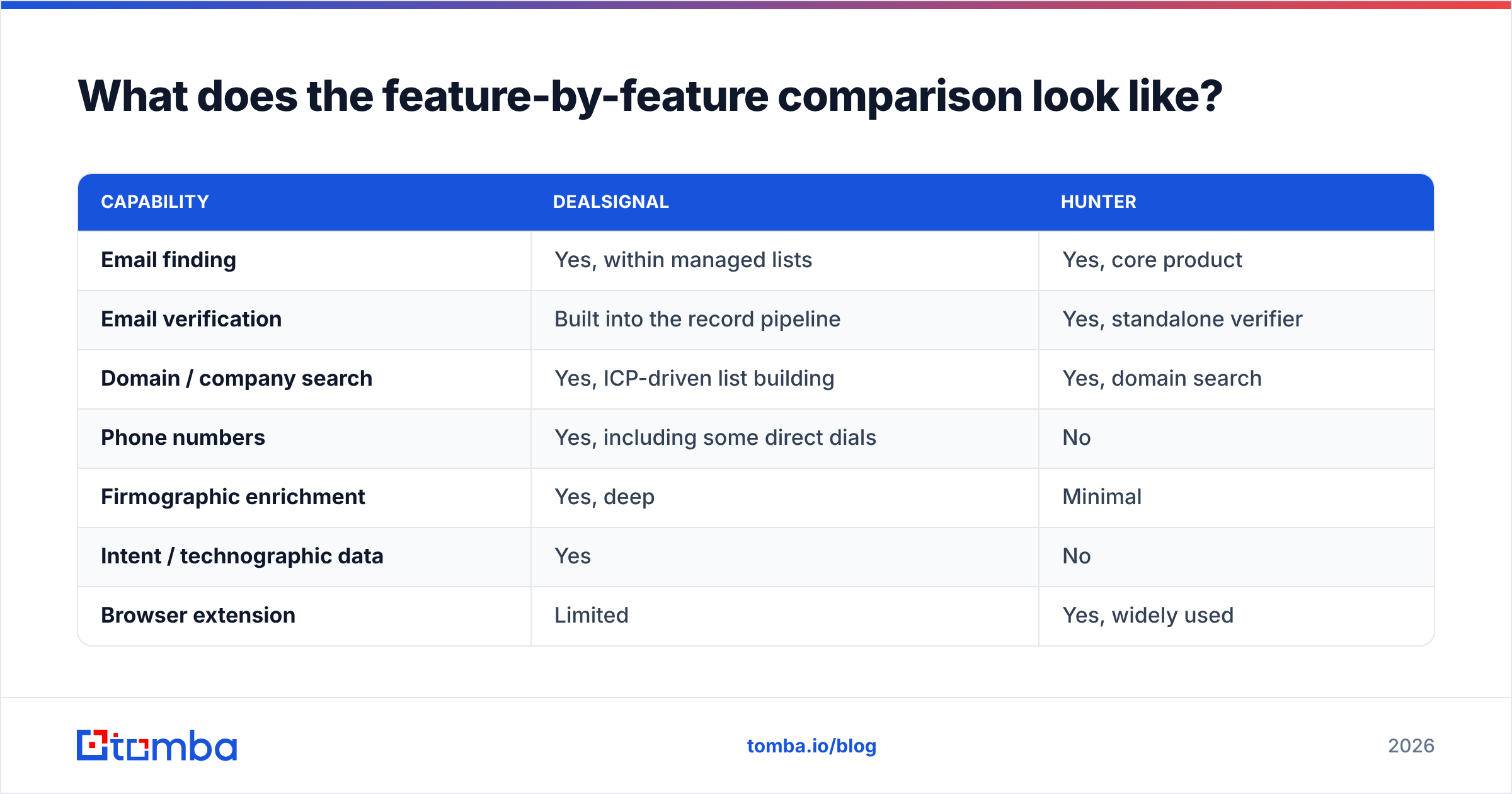
Read that table as two different job descriptions. DealSignal's column describes an operating system for a marketing data function: enrichment, intent, CRM hygiene, list building at account scale. Hunter's column describes a fast, cheap, dependable tool for a person doing outreach today.
If you are cross-shopping these two, you probably have not decided which problem you have. Decide that first, because the wrong answer is expensive in both directions — an enterprise contract you use at 10% capacity, or a $49 tool bolted onto a workflow that actually needed enrichment and routing.
Who should choose DealSignal?#
Choose DealSignal when all of these are true:
- You buy data as a program, not a purchase. There is a named owner for data quality — RevOps, marketing ops, a data steward — who will actually run the enrichment cadence.
- Your ICP is defined by attributes, not names. You need "SaaS companies, 200–1000 employees, running Snowflake, hiring for data roles," not "the email for this specific person."
- You need more than an email. Direct dials, install base, funding, headcount trend, and intent signals feed your scoring model. Losing those breaks downstream routing.
- CRM hygiene is a recurring cost. You are already paying, in wasted rep hours, for records that decay. Scheduled re-verification has measurable ROI at your volume.
- Procurement is normal for you. A security review, a DPA, and an annual term are not obstacles.
If two or more of those are false, the enterprise motion is overhead you are absorbing for no return. Independent review sites like G2 are useful here mainly for reading the one-star reviews — the recurring complaints about any data vendor tell you more than the aggregate score.
Who should choose Hunter?#
Choose Hunter when your bottleneck is speed, not depth:
- You are prospecting by name. You already know who you want to reach; you need the address.
- You work in the browser. LinkedIn, a company site, a Sheets tab — the extension and add-on fit that rhythm.
- Volumes are modest. A few hundred to a few thousand lookups a month.
- You want one bill and no call. Card in, credits out.
- You need light sending. The built-in campaign feature covers small sequences without a separate sequencer.
Where Hunter runs out of road: no phone numbers, thin enrichment, credit costs that climb steeply once you are running real outbound volume, and pattern-guess results that look confident on domains where they should not.

Where does Tomba fit between them?#
Honestly: Tomba sits on Hunter's side of the line, not DealSignal's. It is a self-serve contact-data platform, and it does not pretend to replace an intent-data vendor.
What it changes is the economics and the surface area of that side. The email finder and email verifier are the core, but the same subscription includes domain search, a phone finder, data enrichment, catch-all handling, and bulk lead generation — the enrichment fields that usually force teams into an enterprise contract, at self-serve pricing.
The stack matters as much as the features. There is a Tomba API with SDKs, a CLI, an MCP server for AI agents, a Chrome extension, and native integrations with HubSpot, Salesforce, Pipedrive, Zapier, Make, Airtable, and Google Sheets. That means the same credits serve a rep clicking through LinkedIn and a nightly enrichment job hitting the API — no second vendor, no second bill.
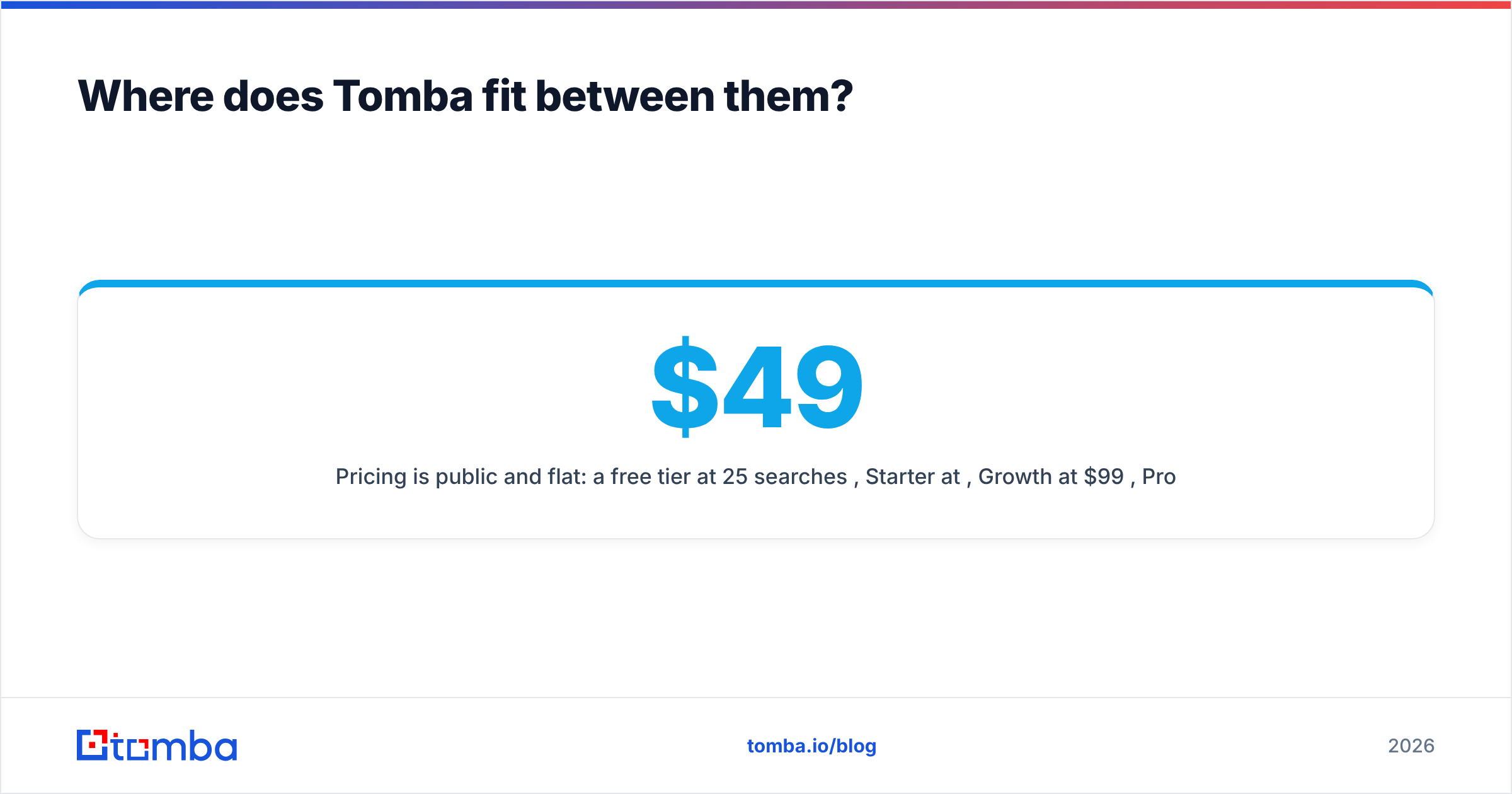
Pricing is public and flat: a free tier at 25 searches/month, Starter at $49/mo, Growth at $99/mo, Pro at $249/mo, Enterprise on request. Compare the Growth tier against Hunter's mid tier and DealSignal's quote and the gap is not subtle.
How should you actually decide?#
Run this sequence instead of comparing feature grids:
- Write down the record you need. Email only? Email plus direct dial? Email plus install base plus funding stage? The answer eliminates one vendor immediately.
- Estimate monthly volume honestly. Not aspirational volume — what your team sent last month. Multiply by 1.5 for verification overhead and re-checks.
- Trial all three on the same 100 rows. Same input list, same day. Record match rate, precision against known-good addresses, and catch-all share. Ten minutes of setup, and it settles arguments no demo will.
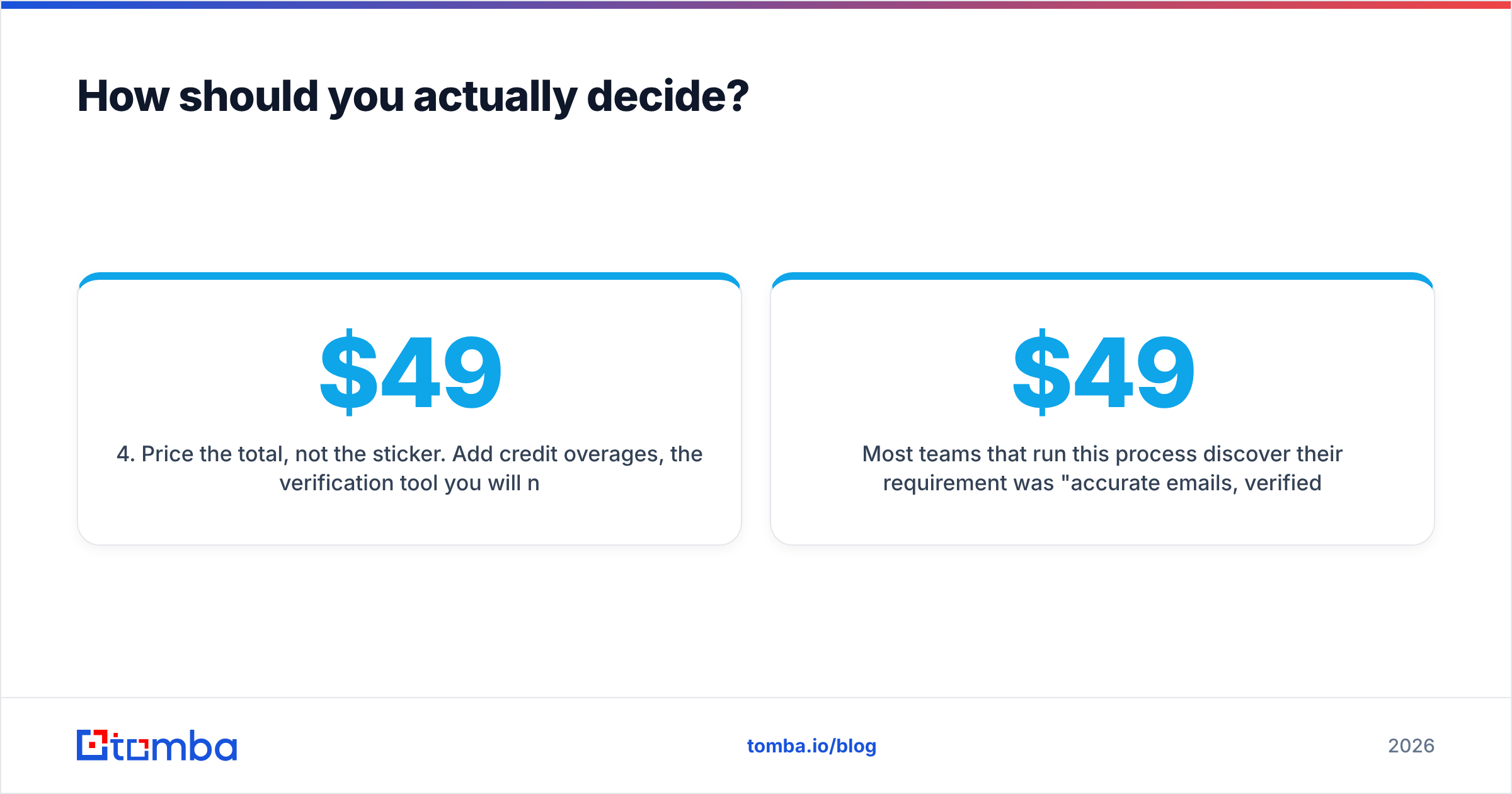
- Price the total, not the sticker. Add credit overages, the verification tool you will need anyway, and the seat count. A $49 plan that forces a $99 verifier is a $148 plan.
- Check the exit. Annual contracts are fine when the fit is proven and expensive when it is not. If you have not run step 3, you have not proven fit.
- Test the API before the UI. If any part of your motion is automated, the API's documentation quality predicts your next six months better than the dashboard does.
Most teams that run this process discover their requirement was "accurate emails, verified, at predictable cost, callable from code" — which is a $49 problem, not a $30,000 one. The teams that genuinely need intent scoring and account-level enrichment discover that too, and they buy DealSignal without hesitation. Both outcomes are wins; the loss is buying on a demo and finding out in month seven.
Ready to test it on your own list?#
Skip the sales call and check the data first. Run 25 free searches through the Tomba Email Finder using the same contacts you would hand a vendor in a trial, then compare match rate and bounce rate against whatever you are paying for now. If Tomba wins on your list, Starter is $49/mo with the verifier, domain search, phone finder, enrichment, and full API access included — no contract, no minimum, no quote required. If it loses, you have a benchmark to hold the other vendor to. Either way, you will be arguing about numbers instead of adjectives.
Related guides#
Ready to find emails that actually work?
Join 150,000+ professionals who stopped guessing and started sending. Free credits on signup — no credit card required.
Get the Tomba newsletter
Practical outbound tactics and product updates — once every two weeks.
About the author