DealSignal vs Lead Kahuna: Which B2B Data Tool Wins in 2026?
One is an enterprise data platform with quote-based contracts. The other is a one-time-license desktop scraper. Here's how DealSignal and Lead Kahuna compare on accuracy, price, and workflow — and when neither is the right buy.
DealSignal vs Lead Kahuna is an odd match-up. One is an enterprise data platform. The other is a desktop scraper you buy once. This guide weighs them on accuracy, price, and fit. It also names the option most teams pick instead.
TL;DR — DealSignal vs Lead Kahuna in 60 seconds
- DealSignal sells verified B2B contact and account data. Expect a custom quote and a yearly contract.
- Lead Kahuna is a Windows desktop scraper. You pay once, install it, and pull local-business leads yourself.
- They are not real rivals. One is an enterprise data feed. The other is software you run on your own PC.
- Data quality is the widest gap. DealSignal checks records when you ask. Scraped data starts to rot on day one.
- Want per-lookup pricing with no contract? An API-first email finder is often the cheaper path. Tomba starts free, then moves to $49/mo.
What is DealSignal and who is it for?#
DealSignal is a B2B data platform. It sells verified contact and account records. You buy it as a subscription with a custom quote. The pitch is freshness. You do not get a stale database dump. Each record is checked when you ask for it. So emails, direct dials, and job titles should match today, not last year.
The typical buyer is a demand-gen or marketing-ops lead who needs:
- New list builds against a set ICP — industry, headcount, tech stack, or region
- CRM clean-up — filling gaps and fixing stale rows in Salesforce or HubSpot
- Account-based targeting with company and tech filters
- GDPR and CCPA cover that a scraper cannot offer
That profile explains the price model. DealSignal suits teams with a yearly data budget. It is not a tool an SDR puts on a card. You talk to sales, you scope volume, you sign.
What is Lead Kahuna and what does it actually do?#
Lead Kahuna sits at the other end of the market. It is desktop software. You install it and run it on your own PC. It pulls business listings from public sources. Think search engines, directories, and company sites.
It has long been sold on a one-time license, not a monthly plan. That one fact is why it keeps a loyal user base.
The classic use case is agency prospecting for local firms. Say you want 500 dentists in Phoenix. You need a site, a phone number, and any email the page shows. Tools like this do that job cheaply, with no data contract.
What it is not: a verified B2B database with role-level filters. Scraping a plumber's contact page gets you info@. It does not get you the owner's inbox. That gap matters if you sell six-figure software to VPs. It matters much less if you sell web design to restaurants. In short, DealSignal vs Lead Kahuna is depth against cheap breadth.

How do DealSignal and Lead Kahuna compare head to head?#
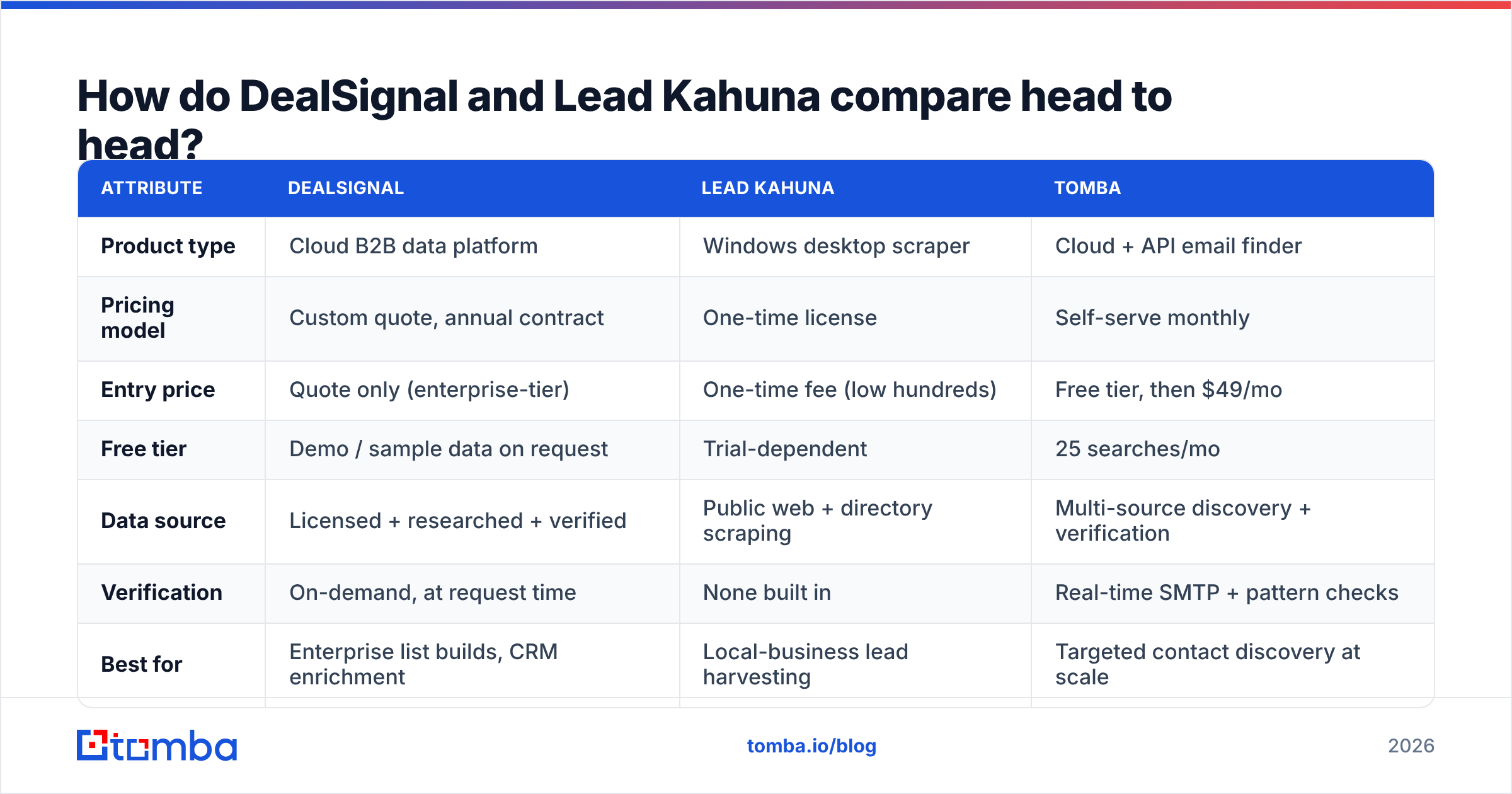
Here is the honest side-by-side for DealSignal vs Lead Kahuna. Prices reflect public info at the time of writing. Both vendors change terms, so check before you buy.
| Attribute | DealSignal | Lead Kahuna | Tomba |
|---|---|---|---|
| Product type | Cloud B2B data platform | Windows desktop scraper | Cloud + API email finder |
| Pricing model | Custom quote, annual contract | One-time license | Self-serve monthly |
| Entry price | Quote only (enterprise-tier) | One-time fee (low hundreds) | Free tier, then $49/mo |
| Free tier | Demo / sample data on request | Trial-dependent | 25 searches/mo |
| Data source | Licensed + researched + verified | Public web + directory scraping | Multi-source discovery + verification |
| Verification | On-demand, at request time | None built in | Real-time SMTP + pattern checks |
| Best for | Enterprise list builds, CRM enrichment | Local-business lead harvesting | Targeted contact discovery at scale |
| API access | Yes (enterprise) | No | Yes, on all paid plans |
| Contract required | Typically yes | No | No |
| Setup time | Days (onboarding + scoping) | Minutes (install) | Minutes (signup) |
Read that table as three jobs, not three versions of one job.
- DealSignal solves "I need 40,000 accurate records for a complex ICP." That is a supply problem with a buying process attached.
- Lead Kahuna solves "I need cheap local leads and no subscription." That is a cost problem for small teams.
- An email finder solves "I know who to reach — get me their verified address." That is a precision problem.
Most teams who shortlist DealSignal vs Lead Kahuna really have problem #3. They just do not know it yet.
How accurate is the data from each tool?#
Accuracy should decide your purchase. Email deliverability rests on data quality. Nothing else in outbound makes up for a dirty list. This is where DealSignal vs Lead Kahuna splits the furthest.

DealSignal's accuracy story is structural. Records are checked when you pull them. That leaves decay less time to set in. B2B contact data rots at 25–30% a year. People switch jobs. Firms merge. Domains move. A tool that re-checks on request removes most of that risk. The trade-off is cost, and it lands in your quote.
Lead Kahuna's accuracy story is "whatever the web says." Scraped data mirrors the source page. Say a listing has not changed since 2022. You get 2022 data with a 2026 date on your CSV. There is no SMTP check. There is no catch-all test. There is no role-account flag. Go this route and budget for an email verifier pass. Skip it and you bet your sender score on directory hygiene.
Watch for three failure modes with either tool:
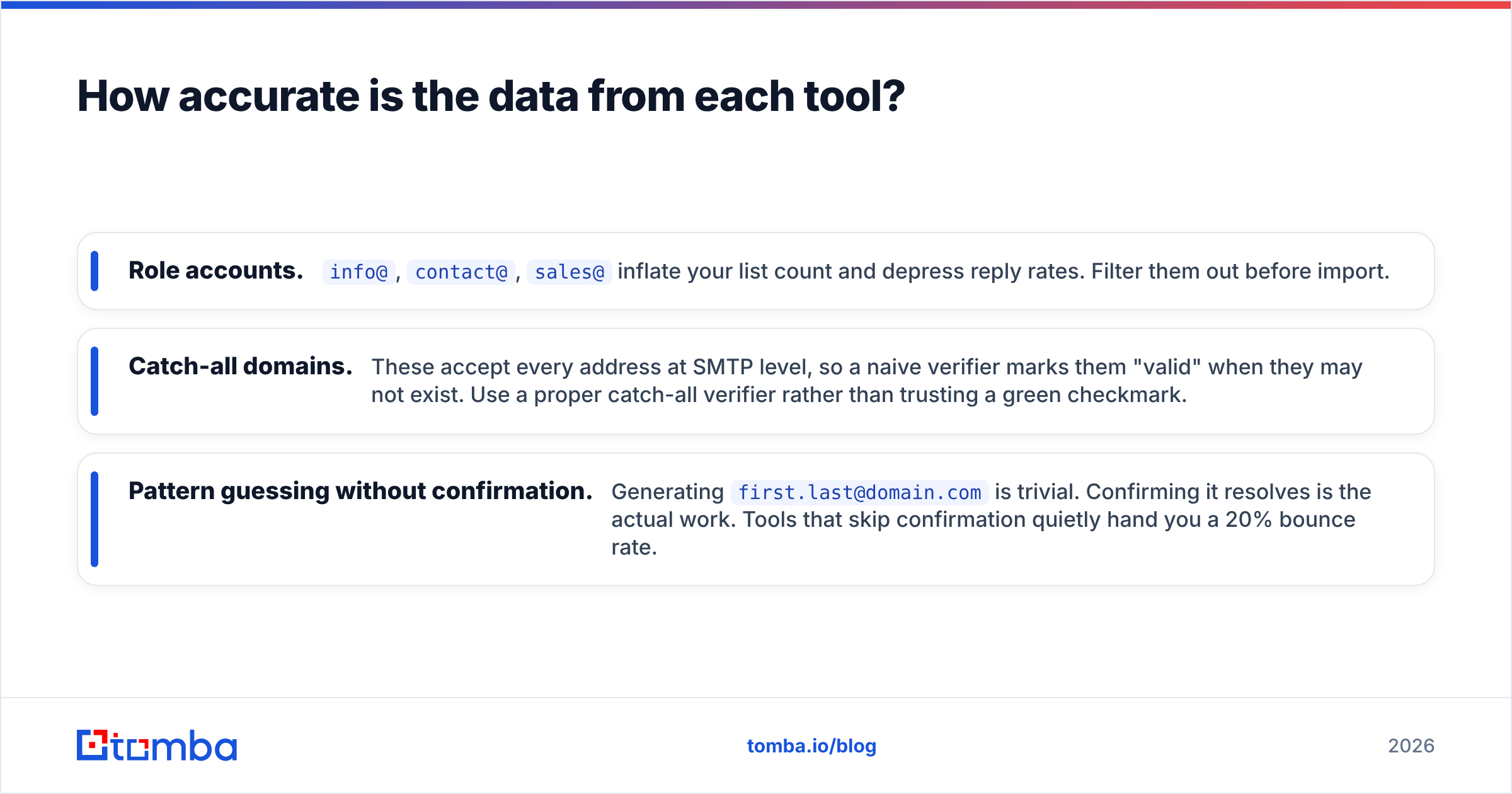
- Role accounts.
info@,contact@, andsales@pad your list and drag down replies. Strip them before import. - Catch-all domains. These accept every address. A weak checker calls them "valid" when the inbox may not exist. Use a real catch-all verifier instead.
- Guessed patterns. Building
first.last@domain.comis easy. Proving it resolves is the real work. Tools that skip that step hand you a 20% bounce rate.
What does each one really cost?#
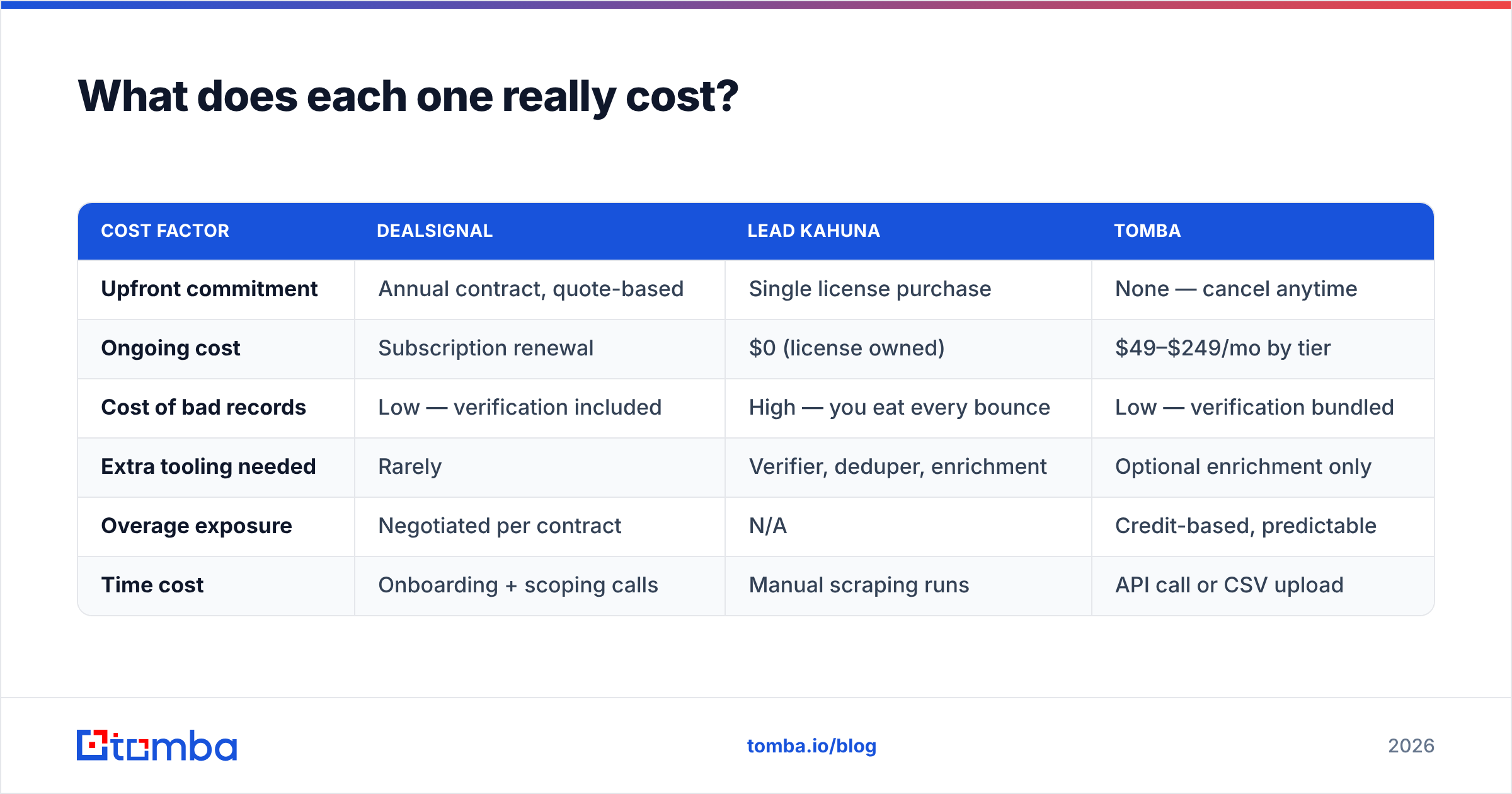
Sticker price is the least useful number here. In DealSignal vs Lead Kahuna, what counts is cost per usable contact. That number decides if outbound pays for itself.
| Cost factor | DealSignal | Lead Kahuna | Tomba |
|---|---|---|---|
| Upfront commitment | Annual contract, quote-based | Single license purchase | None — cancel anytime |
| Ongoing cost | Subscription renewal | $0 (license owned) | $49–$249/mo by tier |
| Cost of bad records | Low — verification included | High — you eat every bounce | Low — verification bundled |
| Extra tooling needed | Rarely | Verifier, deduper, enrichment | Optional enrichment only |
| Overage exposure | Negotiated per contract | N/A | Credit-based, predictable |
| Time cost | Onboarding + scoping calls | Manual scraping runs | API call or CSV upload |
Run the math on a real case. Say you need 5,000 contacts this quarter.
A scraper pulls 5,000 rows for close to $0. But say 35% are role accounts. Say another 20% bounce. Now you have about 2,250 usable contacts. Add checker fees. Add the hours you spend cleaning.
A verified source at $49–$99/mo costs real money for a shorter list. Almost every row lands, though. That list books more meetings. Reply rate is measured on the emails that arrive.
Big data platforms carry one more hidden cost: shelf-ware risk. Size a yearly deal for your best case. Then use 40% of the credits. Your true cost per contact doubles. Ask for a ramped or usage-based deal if your volume is unclear.

Which tool should you choose for your situation?#
Pick by the shape of your motion, not by feature count. The DealSignal vs Lead Kahuna call looks different for each team below.
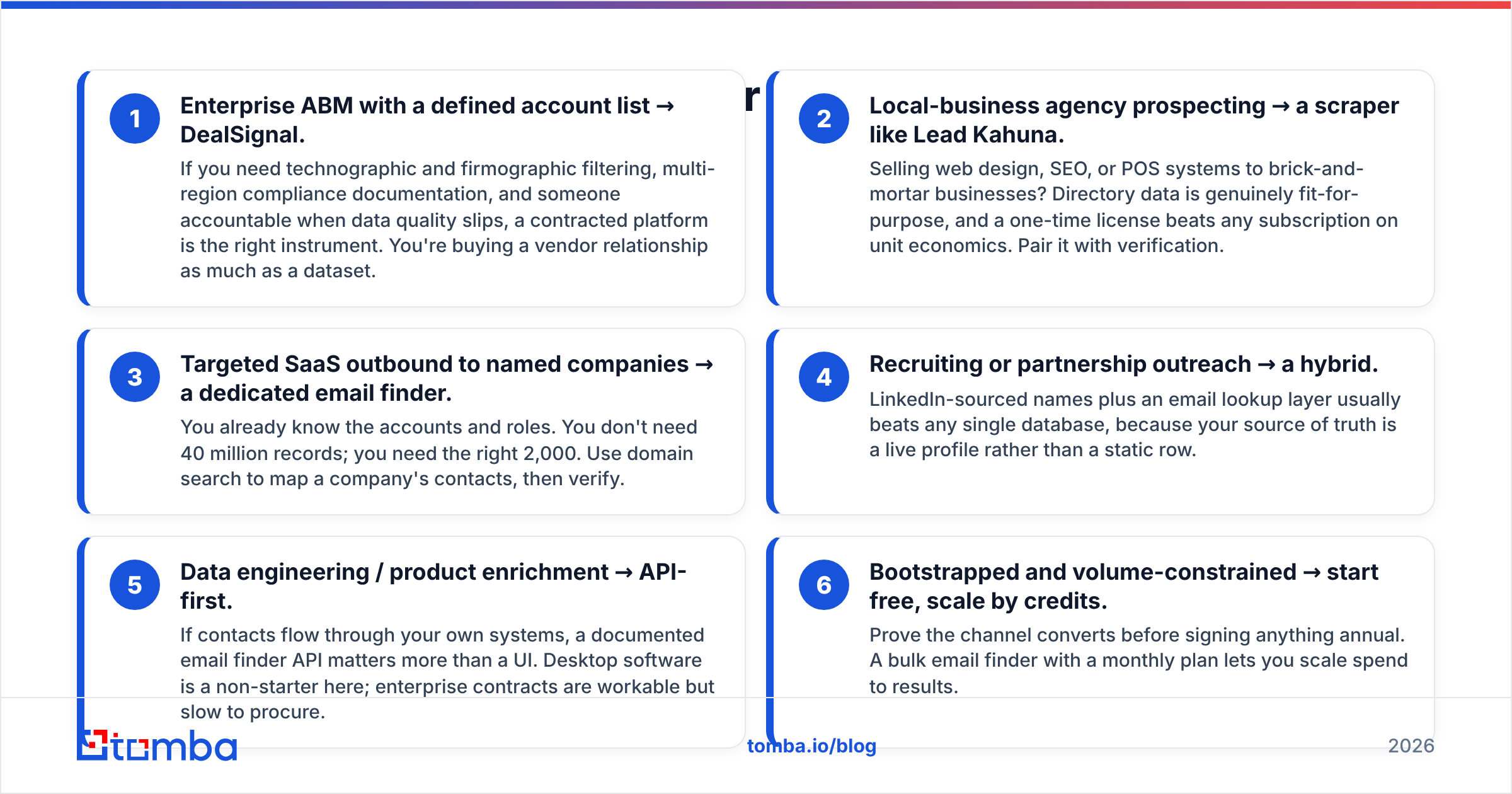
- Enterprise ABM with a set account list → DealSignal. You need tech and firm filters, region rules on paper, and a vendor to call when quality slips.
- Local agency prospecting → a scraper like Lead Kahuna. Selling web design or POS systems to shops? Directory data fits the job. A one-time license beats any plan on unit cost. Pair it with a verifier.
- Targeted SaaS outbound → a dedicated email finder. You know the accounts. You need the right 2,000 people, not 40 million rows. Use domain search to map a firm, then verify.
Three more motions, and what fits each:
- Recruiting or partner outreach → a hybrid. LinkedIn names plus an email lookup layer beat any single database. Your source of truth is a live profile.
- Product or data work → API-first. If contacts flow through your own systems, a clear email finder API beats a UI. Desktop software is a non-starter here.
- Bootstrapped and cash-tight → start free, scale by credits. Prove the channel works before you sign a yearly deal. A bulk email finder lets you match spend to results.

What are the strongest alternatives to both?#
Neither tool is the default pick for a modern outbound team. So it helps to know the field. If DealSignal vs Lead Kahuna both feel wrong, start here. G2's B2B data category is a fair place to test vendor claims against real reviews.
- BookYourData — prepaid lists with an accuracy guarantee and no yearly lock-in. A good middle ground for teams that buy in bursts.
- Apollo — database plus sequencing in one seat. Handy, but you buy the whole stack. See the Apollo alternative breakdown if you only want data.
- Clearbit — strong for inbound enrichment, weak for net-new prospecting. Compare it with a focused Clearbit alternative.
- Tomba — finder, verifier, domain search, catch-all checks, and enrichment in one place. Tomba pricing runs from free to $249/mo, with no sales call.
Try this test. Write down the three questions you ask every week. Who works in RevOps at these 200 accounts? Is this email safe to send to? Which CRM rows are stale? Then see which tool answers all three without a second purchase. Most shortlists shrink in ten minutes.
What's the verdict on DealSignal vs Lead Kahuna?#
DealSignal wins on data quality, rules cover, and scale — and charges for it. Is your ICP enterprise? Are your lists large? Do you have budget sign-off? Then it is a fair choice. Push for ramped volume, not a peak-usage number in year one.
Lead Kahuna wins on price and freedom for one job: pulling local-business details with no subscription. It is not a rival to a verified database. Treat it like one and your bounce rate will hurt your sending domain.
For most B2B teams, the answer to DealSignal vs Lead Kahuna is neither. The common need sits between them. You want the right person's verified work email. You want a set per-lookup cost. You want it through an API or a sheet.
That gap is what Tomba's Email Finder fills. Search by domain, name, or company. Get an address with a confidence score and a live check behind it. Use the web app, a Google Sheets add-on, or the API. Start free with 25 searches a month. Test it on contacts you already know. Move to Starter at $49/mo once the channel proves out. No quote, no yearly contract, no install.
Related guides#
Ready to find emails that actually work?
Join 150,000+ professionals who stopped guessing and started sending. Free credits on signup — no credit card required.
Get the Tomba newsletter
Practical outbound tactics and product updates — once every two weeks.
About the author