DealSignal vs LeadsForge 2026: Data, Pricing, Verdict
DealSignal sells verified-on-demand B2B records. LeadsForge sells speed and self-serve AI list building. Here is how they actually differ on accuracy, contracts, and cost per usable contact.
TL;DR
- DealSignal is an enterprise-leaning B2B contact and account data platform built around on-demand verification — records are re-checked at delivery rather than pulled from a stale warehouse. It sells through annual contracts and quoted pricing.
- LeadsForge is a self-serve, AI-native list builder. You describe your ICP in plain language, it returns a list. Fast, cheap to start, thinner on firmographic depth and enterprise controls.
- The real decision is not "which database is bigger." It is how much you pay per contact that actually converts to a delivered, replied-to email — and both vendors count that differently.
- If you buy in bulk, DealSignal's verification model protects your sender reputation. If you prospect in small, targeted batches, a per-lookup email finder costs a fraction of either annual contract.
- Neither tool replaces a verification step you control. Whatever you buy, re-verify before you send.
What are DealSignal and LeadsForge?#
DealSignal positions itself as a B2B data platform for demand-gen and RevOps teams that are tired of decayed CRM records. Its core pitch is verification-at-delivery: instead of shipping you a slice of a database that was last refreshed months ago, it validates contact and company attributes when you request them. That model shows up in the product as data enrichment for existing CRM records, list building against ICP filters, and scheduled hygiene runs against your database. You can see the vendor's own framing on dealsignal.com.
LeadsForge comes from the newer wave of AI-native prospecting tools. The interface is conversational — you type something like "Series A fintech companies in the UK, heads of engineering, 50-200 employees" and it assembles a list rather than making you build a filter stack. Buyers pick it for speed and low entry cost. It is a self-serve product, not a procurement-cycle product.
That framing matters more than any feature grid. DealSignal is sold to a team that already has a CRM full of records and a data-quality problem. LeadsForge is sold to a founder or SDR who has an empty spreadsheet and a quota next month. Comparing them head to head only makes sense once you know which of those two people you are.
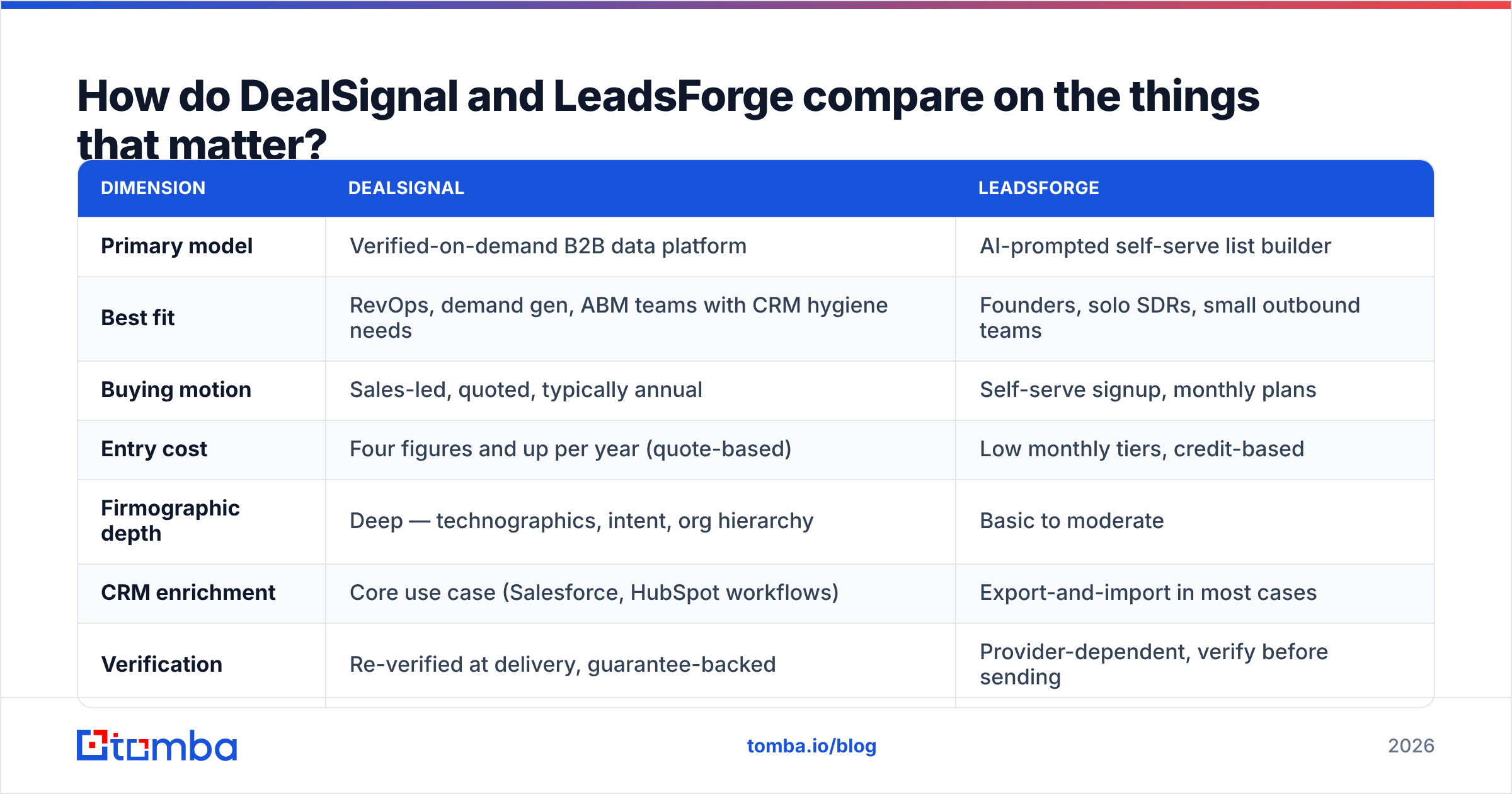
How do DealSignal and LeadsForge compare on the things that matter?#
| Dimension | DealSignal | LeadsForge |
|---|---|---|
| Primary model | Verified-on-demand B2B data platform | AI-prompted self-serve list builder |
| Best fit | RevOps, demand gen, ABM teams with CRM hygiene needs | Founders, solo SDRs, small outbound teams |
| Buying motion | Sales-led, quoted, typically annual | Self-serve signup, monthly plans |
| Entry cost | Four figures and up per year (quote-based) | Low monthly tiers, credit-based |
| Firmographic depth | Deep — technographics, intent, org hierarchy | Basic to moderate |
| CRM enrichment | Core use case (Salesforce, HubSpot workflows) | Export-and-import in most cases |
| Verification | Re-verified at delivery, guarantee-backed | Provider-dependent, verify before sending |
| Phone / direct dials | Yes, a core selling point | Limited |
| API access | Yes, enterprise tier | Limited or roadmap-dependent |
| Contract flexibility | Low — annual commitments common | High — cancel monthly |
| Time to first list | Days (onboarding, scoping) | Minutes |
Read that table as two different products that happen to sell the same raw material. DealSignal wins every column that a data governance lead cares about. LeadsForge wins every column that someone with a credit card and an afternoon cares about.

Which one actually has better data accuracy?#
DealSignal, on the merits of its model — with a caveat.
Here is the mechanic that separates them. Most B2B data vendors maintain a warehouse and refresh it on a cycle. Between refreshes, records rot. B2B contact data decays at roughly 2–3% per month as people change jobs, companies rebrand, and mail servers get reconfigured; over a year that compounds into a meaningful chunk of any list you bought in January. DealSignal's on-demand verification is a direct answer to that: the record is checked when you pull it, not when it was first ingested.
LeadsForge's accuracy depends heavily on which underlying data sources it stitches together for a given query, and AI-assembled lists have a specific failure mode worth naming: plausible-but-wrong entries. A model that infers "this person is probably the VP of Engineering" produces a row that looks correct in a spreadsheet and bounces on send. Volume of rows is not evidence of quality of rows.

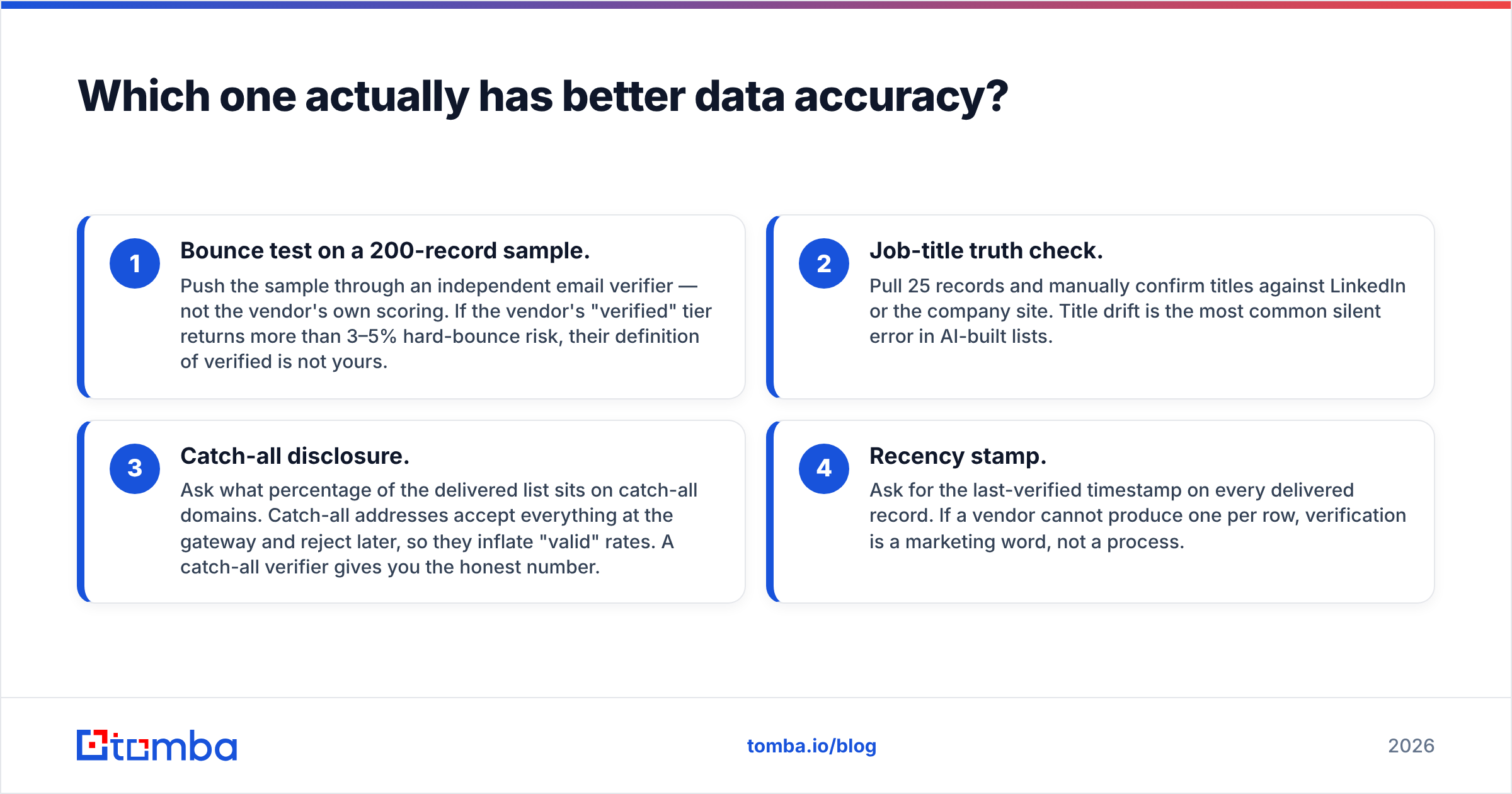
Three practical accuracy checks you should run on either vendor before signing anything:
- Bounce test on a 200-record sample. Push the sample through an independent email verifier — not the vendor's own scoring. If the vendor's "verified" tier returns more than 3–5% hard-bounce risk, their definition of verified is not yours.
- Job-title truth check. Pull 25 records and manually confirm titles against LinkedIn or the company site. Title drift is the most common silent error in AI-built lists.
- Catch-all disclosure. Ask what percentage of the delivered list sits on catch-all domains. Catch-all addresses accept everything at the gateway and reject later, so they inflate "valid" rates. A catch-all verifier gives you the honest number.
- Recency stamp. Ask for the last-verified timestamp on every delivered record. If a vendor cannot produce one per row, verification is a marketing word, not a process.
Run those four on both tools with the same ICP and you will have a better answer than any review site can give you.
What do DealSignal and LeadsForge actually cost?#
DealSignal does not publish list pricing. Expect a scoping call, a quote based on record volume and enrichment fields, and an annual commitment. Teams evaluating it typically land in the four-to-five-figure annual range depending on seats and credits. That is normal for the enterprise data category and it is not, by itself, a red flag — but it does mean you are committing budget before you have tested the data at your own volume.
LeadsForge publishes self-serve tiers with credit allowances. The entry price is low enough to expense without approval, which is exactly the point.
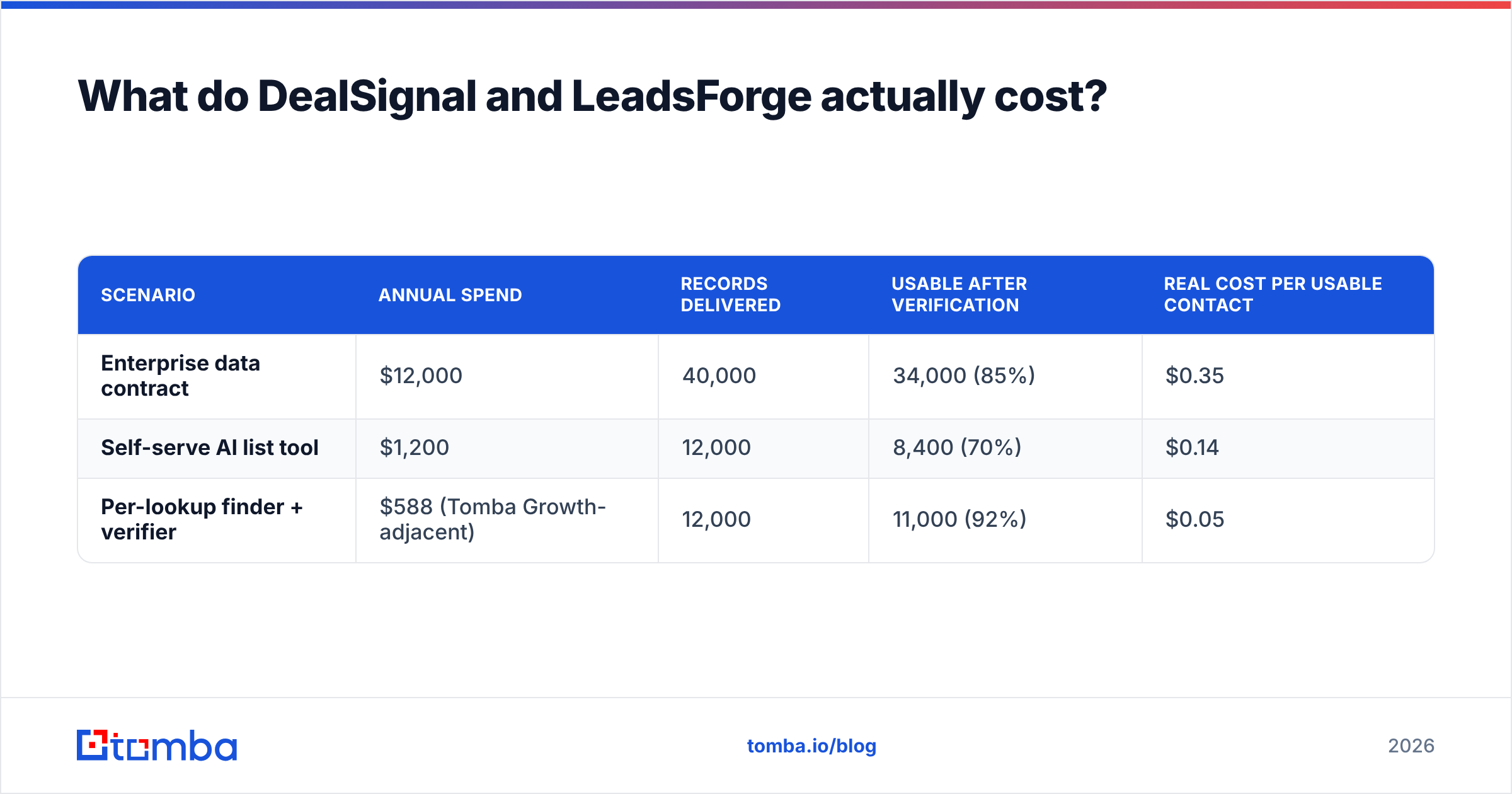
The number neither vendor puts on a slide is cost per usable contact. Work it out like this:
| Scenario | Annual spend | Records delivered | Usable after verification | Real cost per usable contact |
|---|---|---|---|---|
| Enterprise data contract | $12,000 | 40,000 | 34,000 (85%) | $0.35 |
| Self-serve AI list tool | $1,200 | 12,000 | 8,400 (70%) | $0.14 |
| Per-lookup finder + verifier | $588 (Tomba Growth-adjacent) | 12,000 | 11,000 (92%) | $0.05 |
Those percentages are illustrative — plug in your own bounce data. The point stands regardless of the exact figures: a cheap list with a 30% failure rate is not cheap, because the failures cost you domain reputation, not just credits. Compare that against transparent published tiers like Tomba pricing, where the free tier gives you 25 searches a month, Starter is $49/mo, Growth is $99/mo, and Pro is $249/mo — no quote call, no annual lock.
Who should choose DealSignal?#
Choose DealSignal if three or more of these describe you:
- You have a CRM hygiene problem, not a list problem. You already own 200,000 records and half of them are wrong. Enrichment and re-verification against an existing database is DealSignal's strongest use case.
- You run ABM and need account-level depth. Org hierarchy, technographics, and intent signals matter more to you than raw contact count.
- You need direct dials. Phone coverage is a genuine differentiator here and a common reason teams pay enterprise prices.
- Procurement is a feature, not a bug. You need a DPA, a security review, an SLA, and a named CSM. Self-serve tools cannot give you these.
- Your ACV justifies it. At a $50k average deal size, a $12k data contract that produces four extra opportunities has paid for itself.
If you are evaluating this tier, also look at neighbouring options rather than assuming a two-horse race. BookYourData is worth a look for teams that want pay-as-you-go access to enterprise-grade B2B records without an annual commitment — it occupies a genuinely useful middle ground between quoted contracts and lightweight self-serve tools, with a bounce guarantee attached.
Who should choose LeadsForge?#
Choose LeadsForge if:
- You are pre-process. No RevOps function, no data governance policy, no CRM schema to protect. You need names this week.
- Your ICP is easy to describe in a sentence. Conversational search shines when the filter logic is simple. It gets vague fast on complex, multi-condition targeting.
- Budget approval is you. Monthly cancellation beats a better product you cannot buy.
- You will verify separately anyway. If a verification step is already in your workflow, the marginal accuracy gap narrows considerably.
Where LeadsForge struggles is scale and repeatability. Conversational list building is hard to version, hard to audit, and hard to hand to a new SDR with the expectation of identical output. If your outbound motion needs to be reproducible — same ICP definition, same fields, same cadence, every month — a filter-based or API-driven approach ages better.
Is there a middle path between enterprise contracts and AI guesswork?#
Yes, and most teams land there once they have burned a quarter on one of the extremes.
The middle path is buy narrow, verify hard, enrich only what you need. Instead of licensing a database, you resolve contacts on demand: find the company, pull the people who match the role, verify the addresses, enrich the ones that clear. You pay for the contacts you actually touch rather than for access to millions you never will.
Tactically that looks like:
- Start from accounts, not contacts. Build a target account list from your own signals — closed-won lookalikes, website visitors, funding events — then resolve the humans. Domain search turns a company domain into the people and email patterns behind it, which is a cheaper first move than buying a pre-built list.
- Verify before the record ever enters your CRM. Bad data that reaches Salesforce becomes everyone's problem. Gate it at ingest.
- Batch what is repeatable, API what is continuous. One-off campaigns suit a bulk email finder; ongoing enrichment inside a product or workflow suits an API call at the point of need.
- Keep a single source of truth for verification status. Two vendors with two different definitions of "valid" is how you end up on a blocklist.

This is not an argument that enterprise data platforms are wasteful. It is an argument about sequencing. Prove your ICP converts with a few thousand precisely-targeted, well-verified contacts. Then buy the platform that scales it. Doing it in the other order is how teams end up with a six-figure data stack pointed at the wrong segment.
How should you run the evaluation?#
Give both vendors the same test and refuse to grade on anything else.
Week 1 — define the sample. Pick one narrow ICP: one industry, one country, one seniority band, 250 target accounts. Narrow beats broad, because broad hides failure inside averages.
Week 2 — pull from both. Request the same fields from each vendor: work email, direct dial, title, company size, last-verified date. Note how long each took and how much manual cleanup the export needed.
Week 3 — verify independently. Run both files through the same third-party verification. Record hard bounces, catch-alls, role accounts (info@, sales@), and duplicates. Deduplicate across the two files to see genuine unique coverage — overlap is the number vendors never volunteer.
Week 4 — send and measure. Same sequence, same sender, same offer, split by source. Track delivered rate, reply rate, and meetings booked per 100 contacts. This is the only metric with a dollar sign attached.
At the end you will have a defensible cost-per-meeting figure per vendor. That beats a feature checklist, and it beats a review-site star rating — though G2 and similar sites are still useful for spotting recurring complaints about support and billing that no demo will surface. For background on how the broader category is structured, lead generation on Wikipedia is a reasonable neutral primer.
What is the verdict on DealSignal vs LeadsForge?#
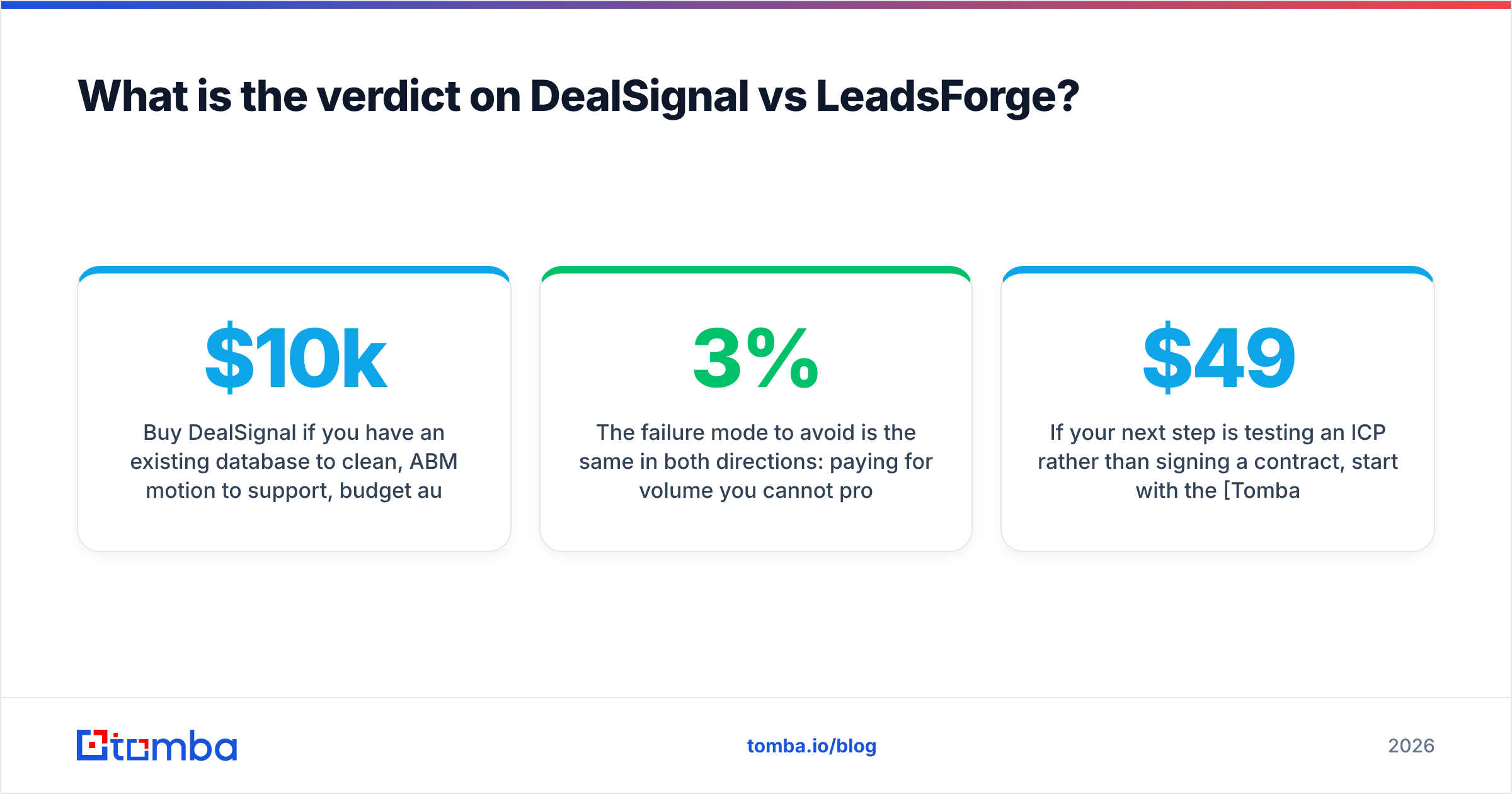
DealSignal wins on data integrity, account depth, and phone coverage. LeadsForge wins on speed, price, and zero-friction adoption. Neither is a general-purpose answer.
- Buy DealSignal if you have an existing database to clean, ABM motion to support, budget authority above $10k, and a need for direct dials.
- Buy LeadsForge if you are early, moving fast, testing ICPs, and willing to own verification yourself.
- Buy neither yet if you have not proven that your current ICP converts. In that case, the cheapest correct move is a per-lookup finder plus a verifier, run against a hand-built account list.
The failure mode to avoid is the same in both directions: paying for volume you cannot process, or paying nothing for data you cannot send to. Bounce rates above 3% put your sending domain at risk regardless of which logo is on the invoice, and no vendor guarantee refunds a damaged sender reputation.
If your next step is testing an ICP rather than signing a contract, start with the Tomba Email Finder. Free tier gives you 25 searches a month to sanity-check coverage on your own target accounts, Starter is $49/mo, and everything runs through the same verification layer — so the contacts that reach your sequence are the ones that arrive. Prove the segment first. Buy the platform second.
Related guides#
Ready to find emails that actually work?
Join 150,000+ professionals who stopped guessing and started sending. Free credits on signup — no credit card required.
Get the Tomba newsletter
Practical outbound tactics and product updates — once every two weeks.
About the author