DealSignal vs LFBBD Lead For Business: 2026 Data Showdown
DealSignal vs LFBBD Lead For Business is a choice between two models. One sells on-demand records, verified when you ask. The other sells lead lists you download and own. Here is how they differ on accuracy, pricing, and workflow fit in 2026.
DealSignal vs LFBBD Lead For Business comes down to one question: do you rent fresh data, or buy a file you keep? Here is how the two stack up in 2026.
TL;DR
- DealSignal is an on-demand B2B data platform. You define an audience. It builds and re-verifies the records when you ask. You pay for a managed service, not a static file.
- LFBBD Lead For Business sits at the list end of the market. You get pre-built or custom B2B contact lists. You download them, own them, and load them into your CRM or sequencer.
- The real choice is workflow, not record count. If your target market shifts every month, on-demand wins. If you work one fixed vertical and want a cheap file you keep, buy the list.
- Neither vendor posts full self-serve pricing at every tier, so budget work needs a quote. Expect DealSignal to price like a managed service and LFBBD to price per list or per record.
- Whatever you buy, verify before you send. An email verifier and a per-contact email finder cost far less than a database seat. They also protect your sending domain from the 15-30% decay that hits every B2B list within a year.
What is DealSignal?#
DealSignal is a B2B data platform with a simple premise. Contact data should be verified when you ask for it, not when it was scraped 14 months ago. You hand over your ideal customer profile: company size, tech stack, job titles, seniority, and location. The platform then assembles matching records on demand and runs verification passes before delivery.
That model has three practical consequences.
First, freshness is the product. A static warehouse decays. About a quarter of B2B contacts change something important every year — title, employer, or email. On-demand assembly moves the check closer to your send date.
Second, you are buying a service, not a file. Enrichment, CRM sync, and custom audience builds come with the deal. That suits RevOps teams who want one vendor accountable for match rates.
Third, it is not an impulse buy. Expect a scoping call, a sample file, and an annual contract. You can review the current feature set on the DealSignal site and read buyer reviews on G2 first.
What is LFBBD Lead For Business?#
LFBBD Lead For Business runs on the older list-provider model, which is still huge. You browse or request a segment by industry, country, role, or company size. You then receive a downloadable contact file. Some segments are pre-built and priced off the shelf. Others are compiled to your spec.
The appeal is blunt and fair: cost per record and ownership. A downloaded list has no seat licence, no credit expiry, and no API rate limit. Once the CSV is on your machine you can dedupe it, enrich it, split it across three sequencers, and use it again next quarter. For agencies working the same vertical over and over, that math is hard to beat.
The tradeoff is just as blunt: the file starts ageing the moment it is built. List vendors differ a lot in how recently each record was checked, and buyers rarely get a verification date per row. That is not a knock on LFBBD alone. It is how the whole category works. Ask about the verification guarantee, the refund policy, and the bounce threshold before you buy. Always run a test batch first. Their catalogue and terms sit on the LFBBD site.
DealSignal vs LFBBD Lead For Business: head-to-head comparison#
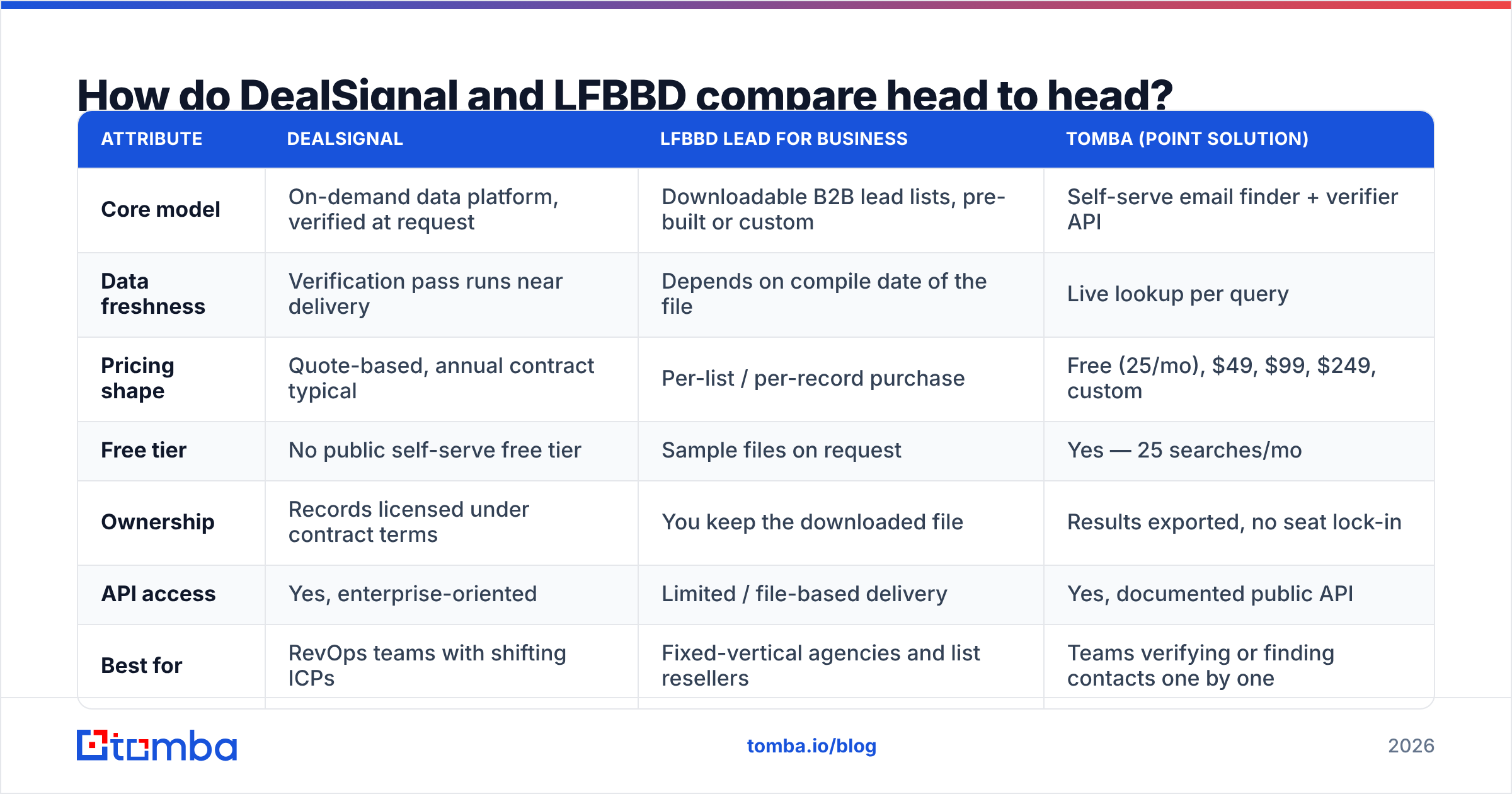
Here is the practical view. Where a vendor does not publish a number, the row says so instead of inventing one. Check every figure against a live quote before you sign.
| Attribute | DealSignal | LFBBD Lead For Business | Tomba (point solution) |
|---|---|---|---|
| Core model | On-demand data platform, verified at request | Downloadable B2B lead lists, pre-built or custom | Self-serve email finder + verifier API |
| Data freshness | Verification pass runs near delivery | Depends on compile date of the file | Live lookup per query |
| Pricing shape | Quote-based, annual contract typical | Per-list / per-record purchase | Free (25/mo), $49, $99, $249, custom |
| Free tier | No public self-serve free tier | Sample files on request | Yes — 25 searches/mo |
| Ownership | Records licensed under contract terms | You keep the downloaded file | Results exported, no seat lock-in |
| API access | Yes, enterprise-oriented | Limited / file-based delivery | Yes, documented public API |
| Best for | RevOps teams with shifting ICPs | Fixed-vertical agencies and list resellers | Teams verifying or finding contacts one by one |
| Onboarding time | Days to weeks (scoping, samples) | Same-day download | Minutes |
| Bounce risk control | Vendor-managed verification | Buyer must verify post-purchase | Verification is the product |
The table shows the real fork. DealSignal sells process. LFBBD sells inventory. Point tools like Tomba sell precision on demand. Teams get this wrong in two ways. They buy inventory when they needed process. Or they buy process when they needed thirty accurate emails this week.
Which one has better data accuracy?#
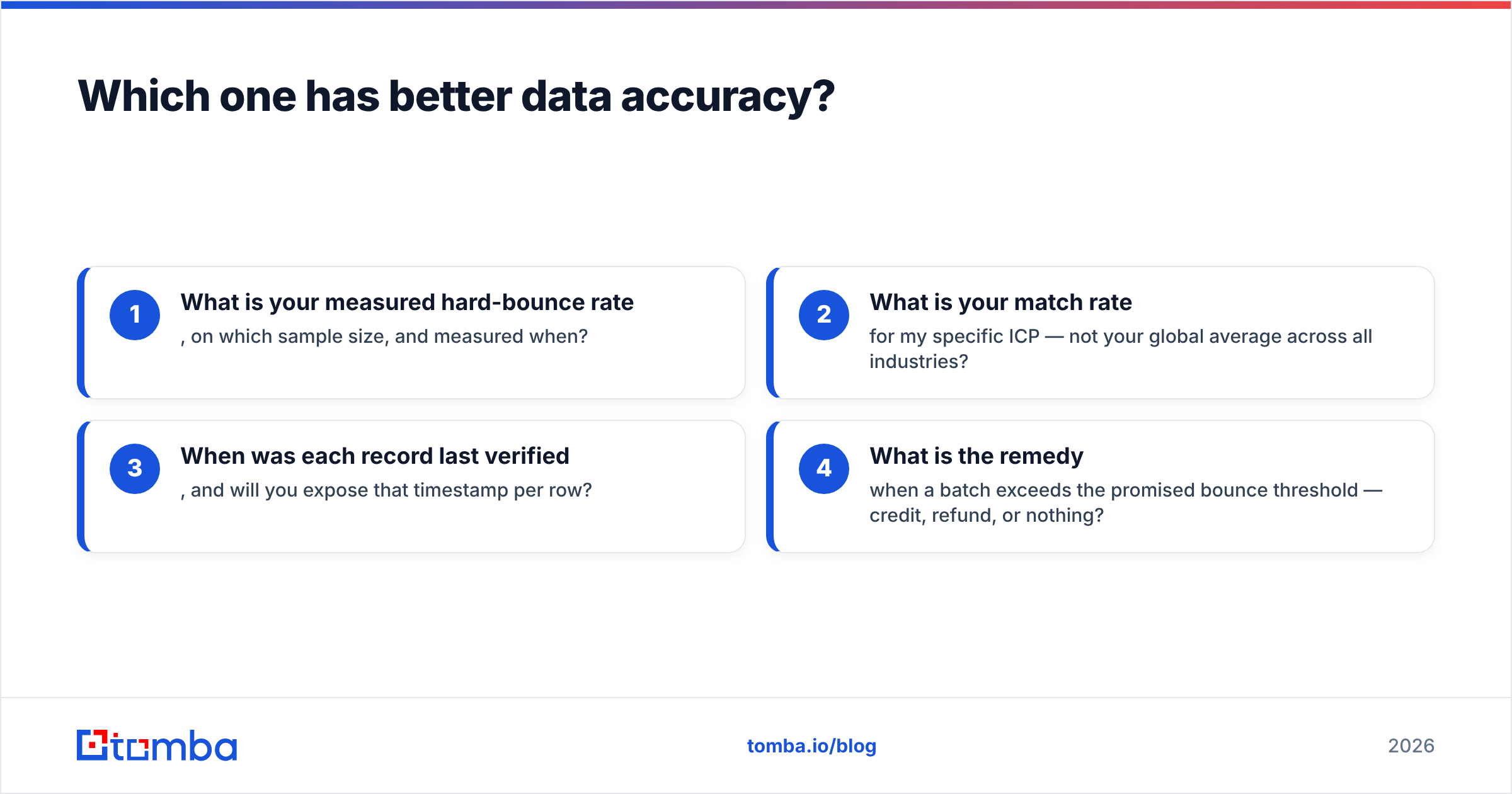
Accuracy is the heart of the DealSignal vs LFBBD Lead For Business debate. Accuracy claims also mean very little without a definition. Pin it down before you compare quotes. Ask every vendor these four questions in writing:
- What is your measured hard-bounce rate? On what sample size, and measured when?
- What is your match rate for my target list — not your global average across all industries?
- When was each record last verified? Will you show that date per row?
- What happens when a batch blows past the promised bounce rate — credit, refund, or nothing?
An on-demand platform like DealSignal wins question three by design, because the check sits close to delivery. A list vendor wins on cost per record. Neither edge settles the deal. It depends on whether your bottleneck is deliverability or budget.

Here is the part every honest data buyer learns the hard way. No vendor's verification survives contact with your sending reputation. Even a fresh file picks up bounces between purchase and send. People resign. Domains move to catch-all. Companies get bought.
So mature outbound teams treat vendor verification as step one. Step two is their own check, run right before load-in. A pass through a catch-all verifier often re-labels 5-15% of a purchased file. Those are the exact addresses that would have wrecked your email deliverability.
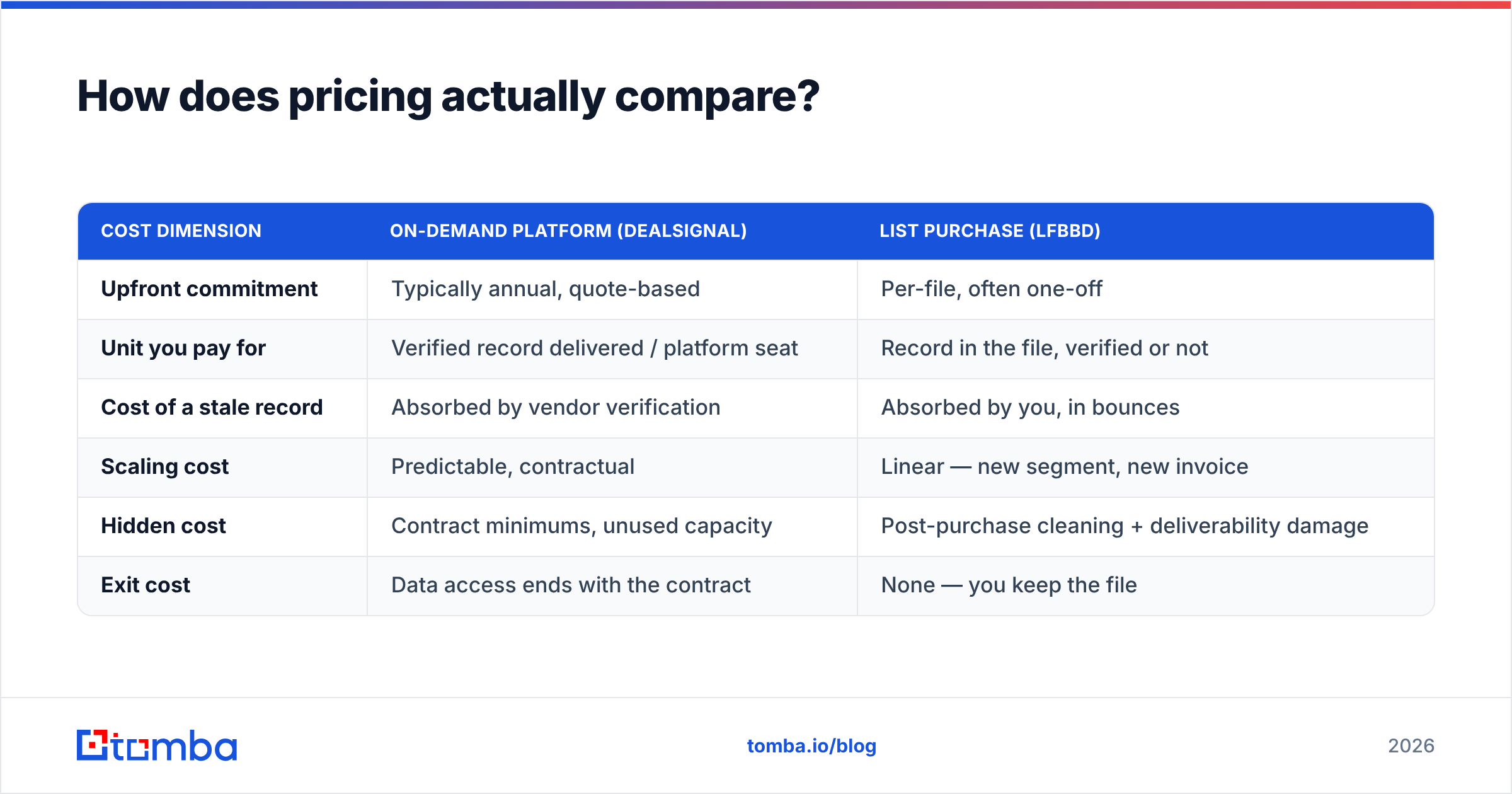
How does pricing actually compare?#
Pricing is where DealSignal vs LFBBD Lead For Business splits the hardest. It is also where buyers compare the wrong units.
| Cost dimension | On-demand platform (DealSignal) | List purchase (LFBBD) |
|---|---|---|
| Upfront commitment | Typically annual, quote-based | Per-file, often one-off |
| Unit you pay for | Verified record delivered / platform seat | Record in the file, verified or not |
| Cost of a stale record | Absorbed by vendor verification | Absorbed by you, in bounces |
| Scaling cost | Predictable, contractual | Linear — new segment, new invoice |
| Hidden cost | Contract minimums, unused capacity | Post-purchase cleaning + deliverability damage |
| Exit cost | Data access ends with the contract | None — you keep the file |
The line that decides most deals is cost of a stale record. A $0.05 contact that bounces is not cheap. It is a small deposit against your domain reputation, and that damage compounds. Cross a mailbox provider's bounce threshold once, and every later campaign underperforms — including the ones sent to perfectly good addresses.
Run the math on your own numbers. Say a purchased file loses 20% of its records after your own verification. The true cost per usable record is then 25% higher than the sticker price. That may still beat a platform contract. For small teams it often does. Just make the comparison on usable records, not delivered rows.
For the point-solution end of the market, Tomba pricing starts free at 25 searches a month. Paid plans run $49/mo Starter, $99/mo Growth, $249/mo Pro, and custom Enterprise. That bracket keeps independent verification affordable no matter which database you buy.

Which vendor fits your use case?#
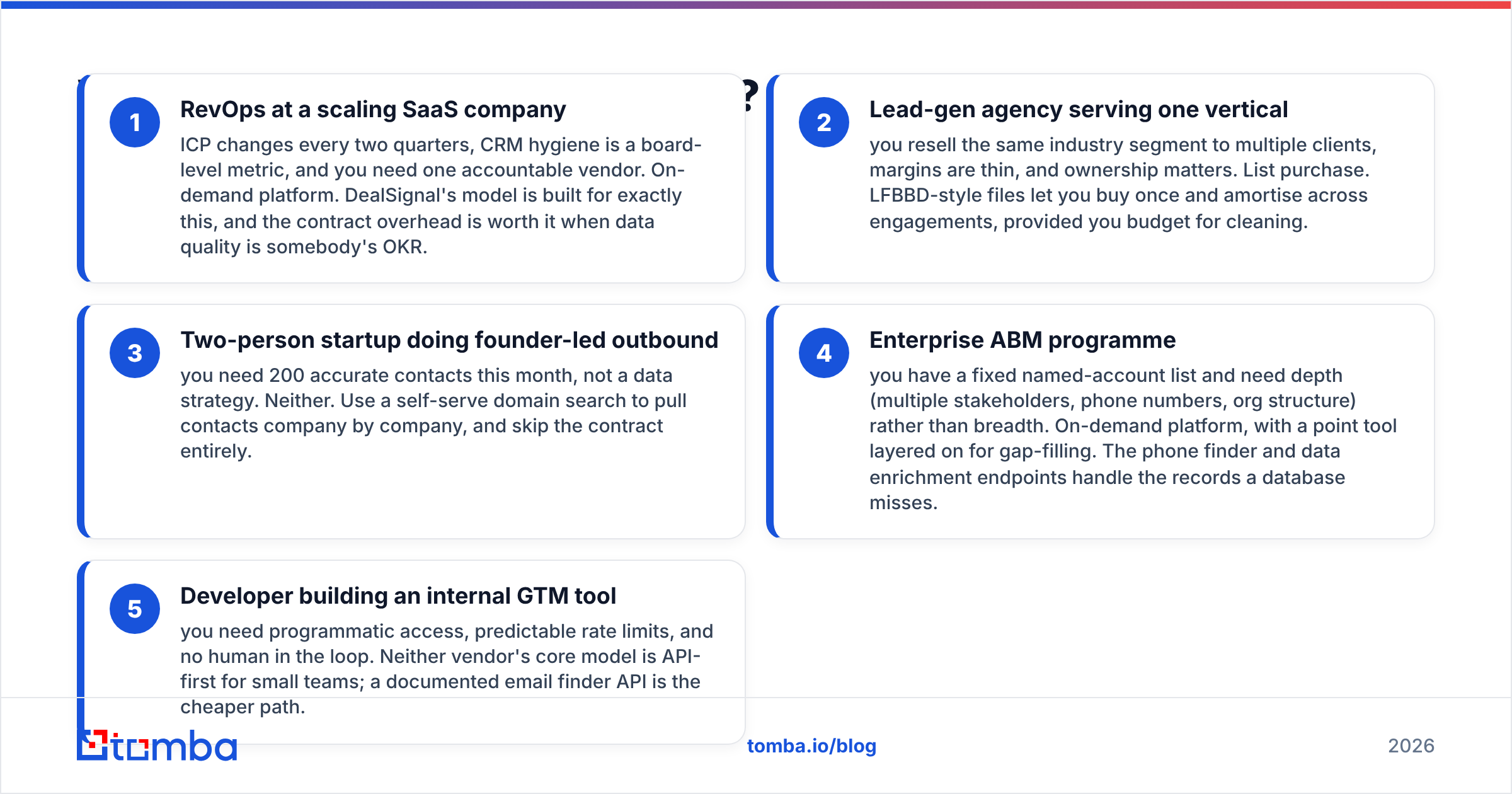
Pick by workflow shape, not by feature checklist. The DealSignal vs LFBBD Lead For Business answer changes with your team. Five common profiles:
RevOps at a scaling SaaS company. Your target market shifts every two quarters. CRM hygiene is a board-level metric. You want one vendor to hold accountable. Go on-demand. DealSignal is built for this, and the contract overhead pays off when data quality is somebody's OKR.
Lead-gen agency serving one vertical. You resell the same segment to several clients, and margins are thin. Ownership matters. Buy the list. LFBBD-style files let you buy once and spread the cost, as long as you budget for cleaning.
Two-person startup doing founder-led outbound. You need 200 accurate contacts this month, not a data strategy. Neither vendor. Use a self-serve domain search company by company and skip the contract.
Enterprise ABM programme. Your named-account list is fixed. You need depth — several stakeholders, phone numbers, org structure — more than breadth. Go on-demand, with a point tool for gaps. The phone finder and data enrichment endpoints cover the records a database misses.
Developer building an internal GTM tool. You need API access, steady rate limits, and no human in the loop. Neither core model is API-first for small teams. A documented email finder API is the cheaper path.
Where does a dedicated email finder fit alongside either vendor?#
It fits in the gap both models leave open. That gap is bigger than most buyers expect.
Every database has holes, on-demand or downloadable. Small companies, non-English domains, new startups, and people who joined last month are all under-covered. Your rep finds a perfect-fit prospect on LinkedIn, neither vendor returns an email, and the choice is guess or look it up properly.
That is a per-contact problem, so it wants a per-contact tool. Three places a finder and verifier layer earns its keep:
- Pre-send verification of any purchased file. Non-negotiable. Run the list through bulk verify before it reaches your sequencer. Quarantine anything risky or catch-all.
- Gap-filling during live prospecting. A rep should resolve one missing contact in seconds, not file a data request ticket.
- Ongoing CRM decay control. Records rot at about 2% a month. A quarterly re-check on your active pipeline costs less than one lost deal and keeps your sender reputation intact.
None of this replaces a database. It makes the database you bought perform closer to its brochure.
What should you actually do next?#
Run a bake-off before you sign anything. It takes a week, and it settles the argument with evidence instead of vendor decks:
- Pull the same 500-record segment from each vendor. Same filters, same geography, same seniority.
- Run both through an independent verifier. Record the valid, risky, and invalid split. That is your true match rate, not theirs.
- Send a small live batch of 100 records each from a warmed domain. Log real bounces and replies.
- Work out cost per usable record and cost per reply, then compare. The winner is rarely the vendor with the bigger database.
Do that, and the DealSignal vs LFBBD Lead For Business question answers itself in your own numbers rather than in somebody's comparison chart — including this one.
Ready to make either dataset actually deliverable?#
Whichever side of DealSignal vs LFBBD Lead For Business you land on, the last mile is the same. Confirm every address before it costs you a sender reputation. Start with the Tomba Email Finder. It is free for 25 searches a month, and $49/mo when you outgrow it. Use it to fill the gaps your database leaves and to check the records it hands you. It is the cheapest insurance in the outbound stack, and it works alongside any provider you choose.
Related guides#
Ready to find emails that actually work?
Join 150,000+ professionals who stopped guessing and started sending. Free credits on signup — no credit card required.
Get the Tomba newsletter
Practical outbound tactics and product updates — once every two weeks.
About the author