DealSignal vs ZoomInfo: B2B Data Accuracy and Pricing
DealSignal sells on-demand verified records. ZoomInfo sells a giant static database plus a GTM platform. Here is how the two actually compare on accuracy, coverage, contracts, and real 2026 cost.
DealSignal vs ZoomInfo is a choice between two very different products. One builds a fresh list for each request. The other sells a big database wrapped in a full sales platform. This guide compares DealSignal vs ZoomInfo on data quality, price, contracts, and fit — and names a cheaper option if you only need work emails.
TL;DR
- DealSignal builds records on demand. You give it a target profile. It finds the people, checks each record, and bills you per record.
- ZoomInfo works the other way. It sells a huge ready-made database plus a full sales platform: intent data, email sequences, call analysis, and workflows.
- Price is the real split. ZoomInfo asks for a yearly deal, often in the five figures. DealSignal quotes by record or by project.
- Neither is cheap for a small team. If you just need verified work emails, a per-lookup tool like Tomba does most of the job for far less.
- Pick by workflow, not by database size. Want a platform with intent data? Take ZoomInfo. Want a fresh list for one campaign? Take DealSignal. Just need emails inside your own stack? Use a finder and verifier.
What are DealSignal and ZoomInfo?#
Both tools answer the same question: who do I contact, and how do I reach them? They build the answer in very different ways.
DealSignal builds each list to order. You describe your ideal buyer — industry, size, region, job title, tech stack. DealSignal then assembles matching records and checks them again right before delivery. The pitch is freshness. A record checked this week beats one gathered eighteen months ago, even if the older file is ten times bigger.
ZoomInfo is data plus software. The database is huge: hundreds of millions of contacts and tens of millions of companies. But the product sold today is a whole sales system. It tracks buyer intent, names the firms visiting your site, sends email sequences (Engage), scores calls (Chorus), and cleans your CRM. Contact data is one part inside a much larger tool.
That one difference drives the rest of the DealSignal vs ZoomInfo debate: how they price, how long you sign for, what they promise on quality, and who is happy after ninety days.
How do DealSignal vs ZoomInfo compare head-to-head?#
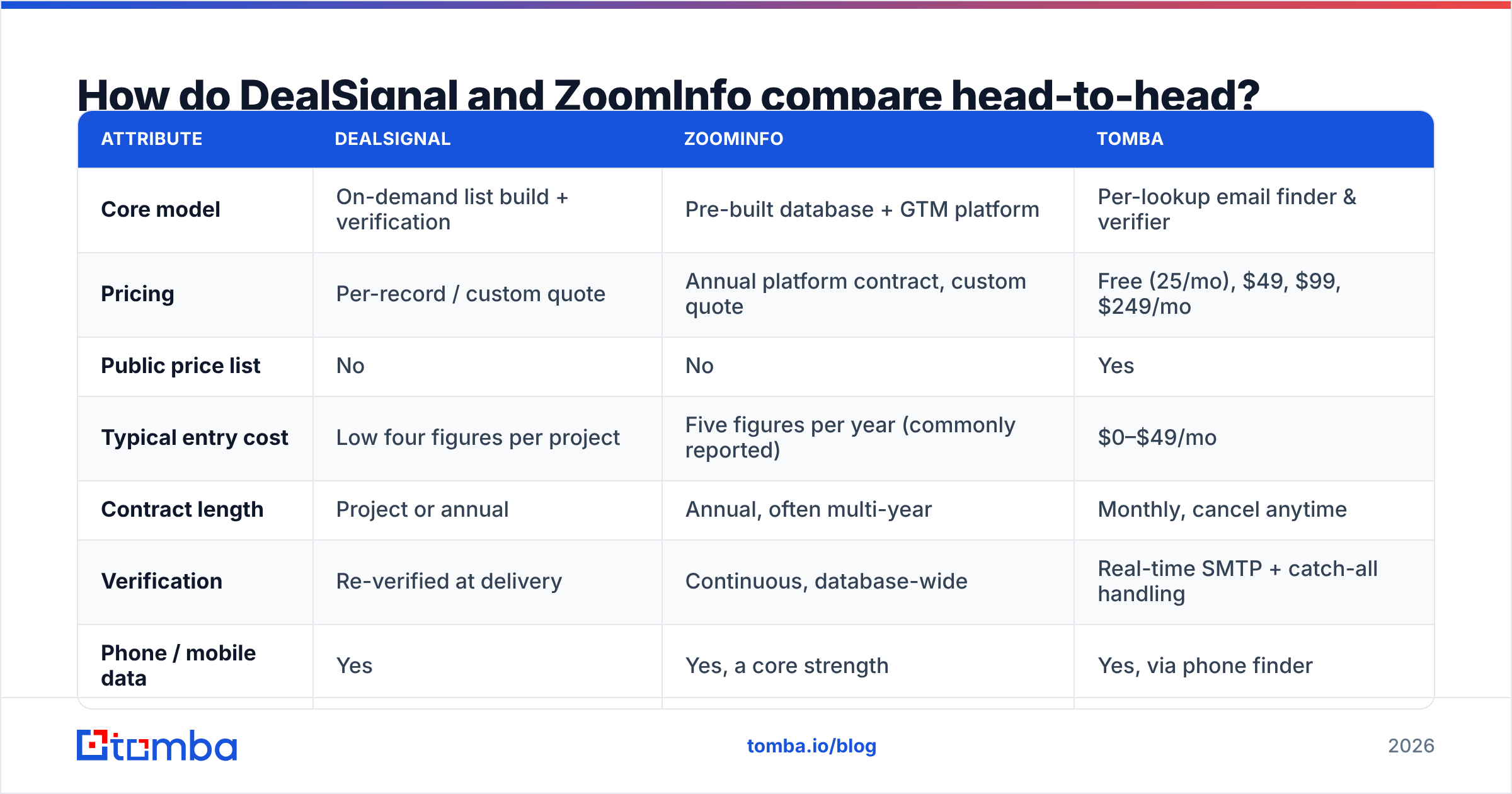
| Attribute | DealSignal | ZoomInfo | Tomba |
|---|---|---|---|
| Core model | On-demand list build + verification | Pre-built database + GTM platform | Per-lookup email finder & verifier |
| Pricing | Per-record / custom quote | Annual platform contract, custom quote | Free (25/mo), $49, $99, $249/mo |
| Public price list | No | No | Yes |
| Typical entry cost | Low four figures per project | Five figures per year (commonly reported) | $0–$49/mo |
| Contract length | Project or annual | Annual, often multi-year | Monthly, cancel anytime |
| Verification | Re-verified at delivery | Continuous, database-wide | Real-time SMTP + catch-all handling |
| Phone / mobile data | Yes | Yes, a core strength | Yes, via phone finder |
| Buyer intent | Limited | Yes (major differentiator) | No |
| Sequencing / dialer | No | Yes (Engage) | No |
| API access | Yes | Yes, higher tiers | Yes, all paid tiers |
| Best for | Custom campaign lists | Enterprise GTM teams | Lean outbound, agencies, developers |
The table hides one point. These three tools are not really in the same race. ZoomInfo competes with Apollo, Clearbit, and 6sense on platform breadth. DealSignal competes with list vendors and managed data services. Email finders compete on cost per verified address. Buying the wrong category costs more than picking the wrong vendor inside the right one.
Which has better data quality: DealSignal vs ZoomInfo?#
Neither vendor's headline number should decide this. The two measure different things.
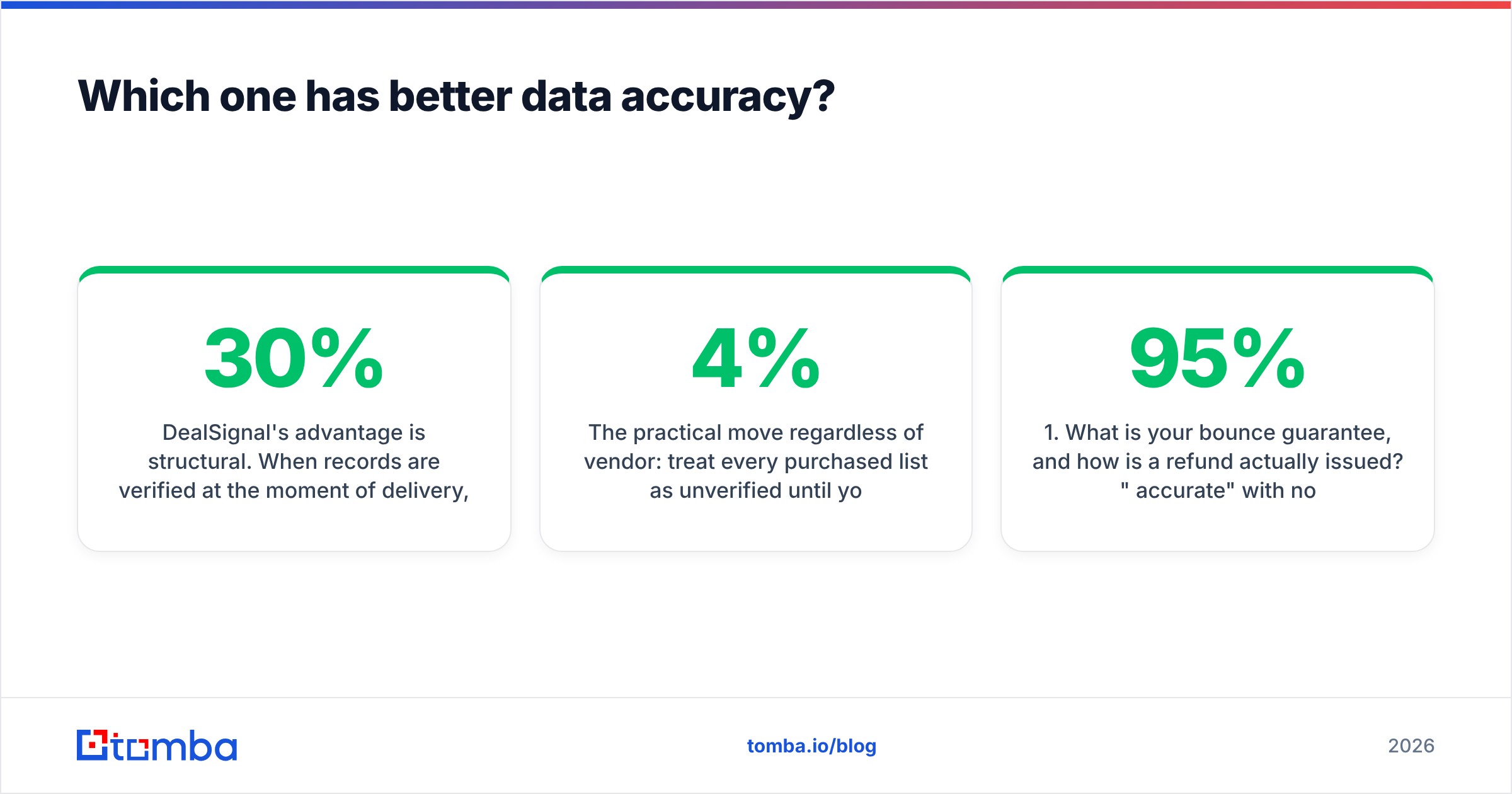
DealSignal wins on structure. Records get checked at the moment they ship, so they have no time to go stale. B2B contact data decays about 25–30% a year. People switch jobs. Firms rebrand. Mailboxes get shut off. Age is the best single predictor of a bounce. A list built and checked last Tuesday will beat an old warehouse record almost every time.
ZoomInfo wins on scale. It re-checks records all the time and pulls from a very large user network. Well-covered segments are dense and current, above all US mid-market and enterprise tech. The gaps show up in the long tail: small firms, non-US SMBs, and fields where staff keep no public profile. There you will find records that exist but are old.

One rule holds for both vendors: treat every list you buy as unchecked until you test it. Run the file through an outside email verifier before you send. A 4% bounce rate on 5,000 records is 200 hard bounces. That is enough to hurt sender reputation on a young domain. Re-checking costs cents per record. It is the cheapest insurance in outbound.
Ask two questions on any demo call:
- What is the bounce guarantee, and how do I get money back? A 95% accuracy claim with no credit is a slogan. A written SLA with credits is a feature.
- How do you treat catch-all domains? Catch-all servers accept every address, so many vendors mark them valid and let you eat the bounce. Ask whether they are flagged, dropped, or scored. Use a catch-all verifier if the answer is vague.
What do DealSignal vs ZoomInfo cost in 2026?#
Both hide prices behind a sales call. That alone tells you the deal size.
ZoomInfo posts no price list. Buyer reports on G2 and public contract records point to yearly deals in the mid to high five figures for the full platform with several seats. Single-module deals land lower. Credits are metered. Exports, enrichment, and intent lookups all draw down your allowance, and overage rates get negotiated on the side. Deals are yearly, they auto-renew, and they are firm on early exit. Budget for the platform, not for the data.
DealSignal also quotes case by case, yet the shape suits uneven demand. You buy records or projects, not seats. A one-off 3,000-record ABM list is a single line item, not a year-long deal. If your needs arrive in bursts — a quarterly campaign, a market study, a CRM cleanup — that shape matters more than the price per record.
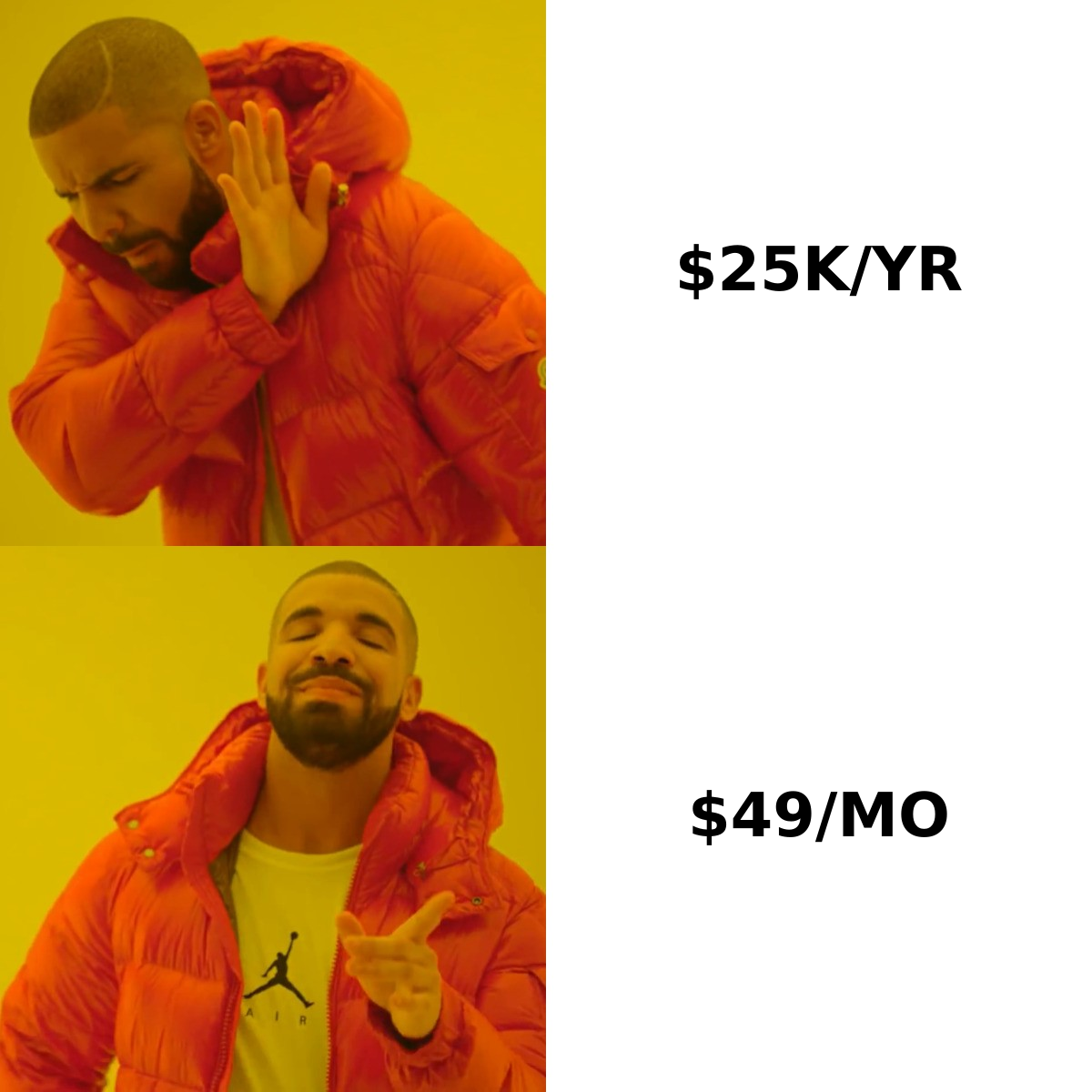
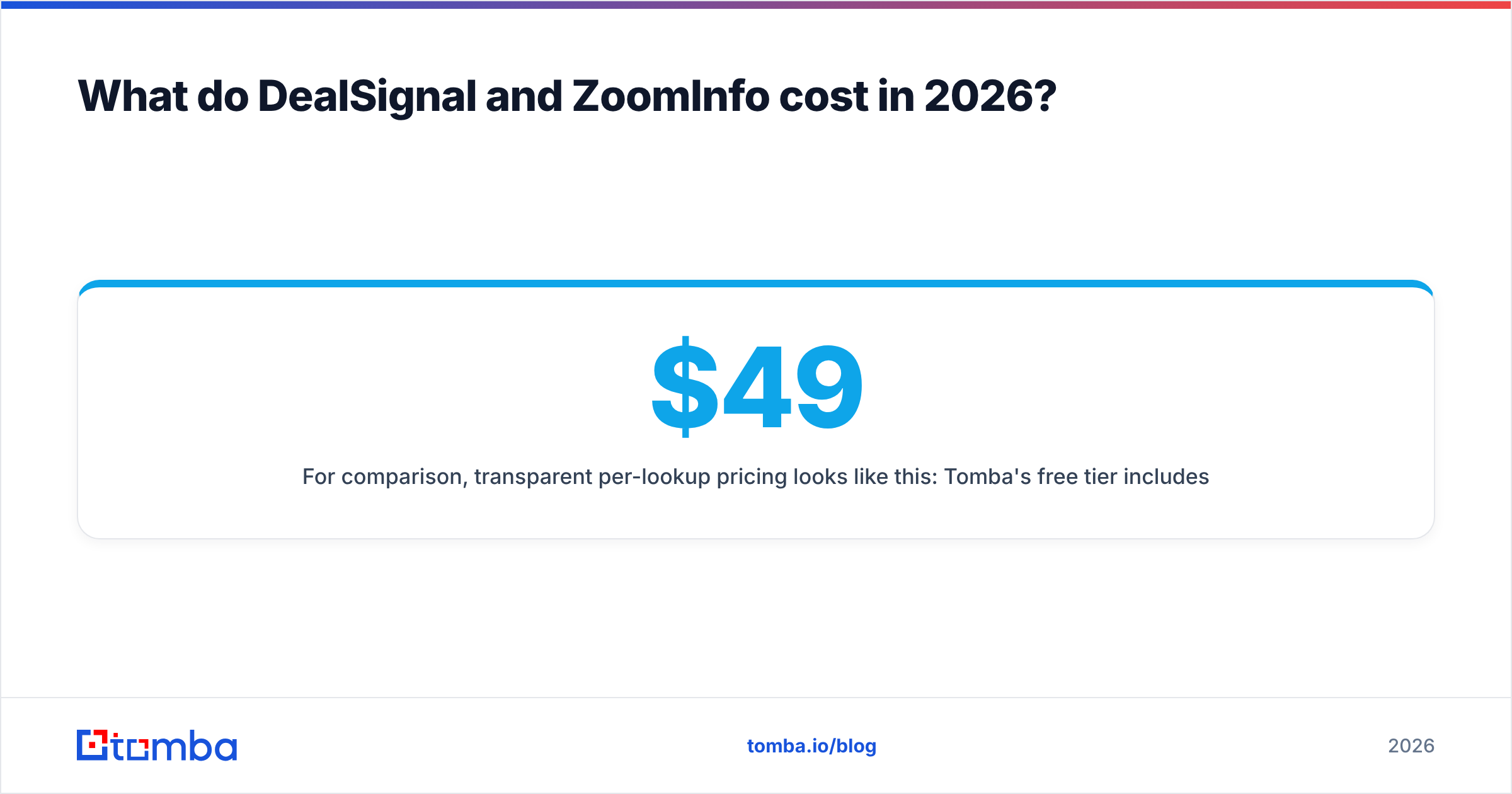
Open pricing looks different. Tomba's free tier covers 25 searches a month. Starter is $49/mo, Growth is $99/mo, Pro is $249/mo, and Enterprise is custom. All of it sits on the Tomba pricing page, and you can cancel each month. It is not a swap for a full GTM platform. It is a swap for the find and verify a work email job most teams are really buying.

One cost nobody quotes: seat sprawl. Platform prices scale with users. A 12-rep team pays for 12 seats even if four reps log in twice a month. Per-lookup tools charge for lookups, not logins. One ops person can run the searches and share the results.
Who should choose DealSignal?#
DealSignal fits when the list is the deliverable and freshness matters most.
- ABM programs with fixed account lists. You know the 400 accounts. You need every buyer at each one, current this month.
- Marketing teams that run campaigns in waves. A quarterly push does not justify a yearly platform that sits idle for ten weeks.
- Data teams cleaning a CRM. A one-time re-check and top-up of your own records is exactly what DealSignal sells.
- Non-US or long-tail targets. Records are built to order, so coverage is not capped by what already sits in a warehouse.
Where DealSignal falls short: speed. Building to order takes time. If a rep wants an address in eight seconds while viewing a profile, use a LinkedIn finder or a browser extension instead.
Who should choose ZoomInfo?#
ZoomInfo earns its price when you use more than the database.
- Large sales teams with an ops owner. Someone has to run the platform, build the workflows, and watch the credits. Without that person, usage drops and renewal gets hard to defend.
- Teams that need intent data. Knowing which firms are shopping your category right now is hard to copy elsewhere. It is ZoomInfo's strongest card.
- Heavy phone outbound. Direct-dial and mobile coverage is a real strength, and few rivals match it at scale.
- Firms cutting vendor count. If ZoomInfo replaces a data vendor, a sequencer, a call tool, and a visitor-ID tool, the yearly number stops looking wild.
Where ZoomInfo falls short: small teams that bought it for emails. If you export contacts and paste them into a sequencer, you pay platform rates for a lookup. That is the most common regret in the review corpus. It is a buying mistake, not a product flaw.
Are there cheaper alternatives to DealSignal and ZoomInfo?#
Yes. For most teams under 20 reps, a mix of smaller tools beats either platform on cost per meeting booked.
Per-lookup email finders. Tomba, Hunter, and Findymail charge per search, not per seat. Give them a name and a domain — or just a domain — and you get a verified address back. The email finder and domain search pair covers most prospecting: pull every public address at a target firm, verify, export. Tomba's API ships on every paid tier, so the work can run inside your own workflow.
Pay-as-you-go databases. BookYourData is a strong pick here. It sells verified B2B contacts with no yearly deal and posts a bounce guarantee. That makes it a useful middle ground between a per-lookup tool and a big platform. If you want a list today with no procurement cycle, look at it next to DealSignal.
Cheaper platform bundles. Apollo pairs a database with sequencing at a much lower entry price than ZoomInfo. The trade-off is thinner coverage in some segments. If you like the platform idea but not the number, spend an evening on the Apollo alternative landscape before you sign.
Enrichment-first stacks. Already have the accounts? Then data enrichment on your own CRM records costs less than buying a new database and deduping it against what you own.
How should you decide between DealSignal vs ZoomInfo?#
Work through these in order. The first one with a clear answer is your answer.
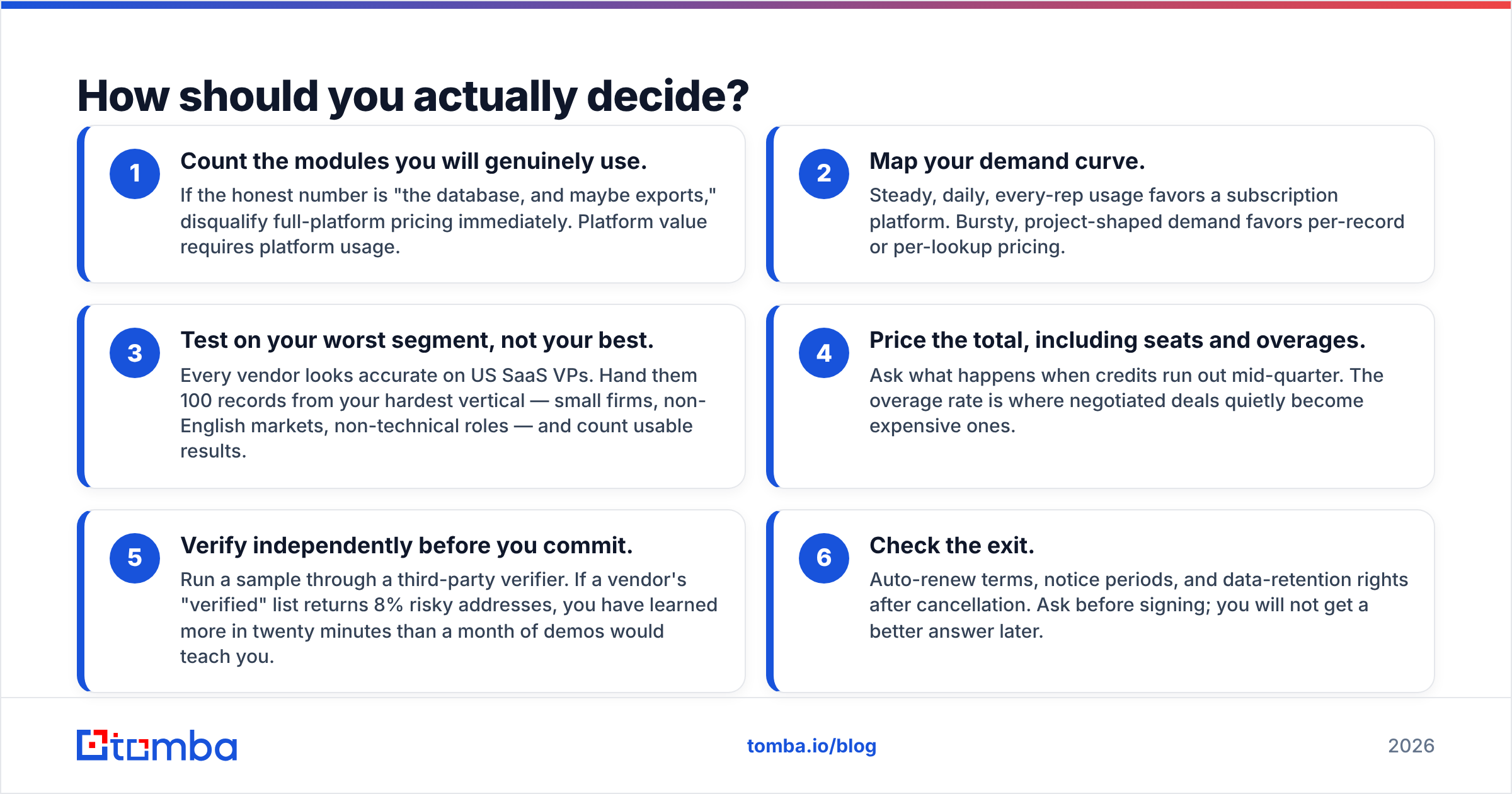
- Count the modules you will really use. If the honest list is the database plus exports, rule out platform pricing now. Platform value needs platform use.
- Map your demand curve. Steady daily use by every rep favors a subscription. Bursty, project-shaped demand favors per-record or per-lookup pricing.
- Test your worst segment, not your best. Every vendor looks accurate on US SaaS VPs. Hand them 100 records from your hardest market and count what you can use.
Then price the deal itself.
- Add up the total, seats and overages included. Ask what happens when credits run out mid-quarter. Overage rates are where a good deal turns costly.
- Verify before you commit. Run a sample through an outside checker. If a list labelled verified returns 8% risky addresses, twenty minutes just taught you more than a month of demos.
- Read the exit terms. Check auto-renew clauses, notice periods, and what happens to your data after you cancel. Ask now; the answer gets worse later.
What is the verdict on DealSignal vs ZoomInfo?#
ZoomInfo wins if you are buying a platform. Intent data, a dialer, sequences, and call analysis in one contract is a real story, and the phone coverage is hard to match. It holds up for a funded sales team with ops staff to run it.
DealSignal wins if you are buying lists. Building to order with a check at delivery gives fresher records than any static warehouse. The commercial shape fits campaign work, so you skip a year-long deal for four weeks of use.
Neither wins if you just need a verified work email for someone you already named. That job is solved at a far lower price. Paying platform rates for it is the most common way B2B teams overspend on data.
So start narrow and move up only when you hit a wall you can name. Run a free email checker test, or use the 25 free searches. Point Tomba Email Finder at twenty accounts you care about. Count how many verified addresses come back. If that covers your pipeline at $49/mo, you just cut a five-figure line item. If it does not, you now know the exact gap a DealSignal vs ZoomInfo contract has to fill — and you will negotiate better for knowing it.
Related guides#
Ready to find emails that actually work?
Join 150,000+ professionals who stopped guessing and started sending. Free credits on signup — no credit card required.
Get the Tomba newsletter
Practical outbound tactics and product updates — once every two weeks.
About the author