Debounce vs Apolloio 2026: Which Email Tool Do You Need?
Debounce vs Apolloio is a strange matchup: one tool cleans lists, the other builds them. Here's how they compare on accuracy, cost, and the workflow gap both leave open.
Debounce vs Apolloio is a strange matchup. One tool cleans email lists. The other builds them. Here is how they differ, and which one your stack actually needs.
TL;DR
- Debounce and Apolloio are not real competitors. Debounce checks whether an address is valid. Apollo.io is a contact database, a sequencer, and a light CRM. Buyers compare them because both promise to fix a high bounce rate.
- Already have a list and it bounces? Debounce is the cheap fix. Credits start near $0.0009 per email. No seats, no contract.
- Have no list at all? Debounce cannot help. Apollo.io gives you contacts, filters, sequences, and a dialer in one seat. Export credits and stale data are the real costs.
- Neither tool nails the step in the middle. Most teams need one verified email for one person at one company, on demand, through an API. That is what a dedicated email finder does.
- A simple 2026 stack has three layers: discovery, verification, and sending. Buying one vendor for all three usually means overpaying for the two you barely use.
What exactly is Debounce?#
Debounce does one job: it validates email addresses. Upload a CSV, use an integration, or call the API. You get a verdict per address: valid, invalid, accept-all, disposable, role-based, or unknown.
The checks run in a chain. It looks at syntax. It checks the domain and MX records. It matches disposable domains and spots role accounts. Then it opens an SMTP handshake and asks the mail server if the mailbox exists. No mail is ever sent. It also adds its own scoring for catch-all domains, which is where many verifiers give up.
What Debounce does not do:
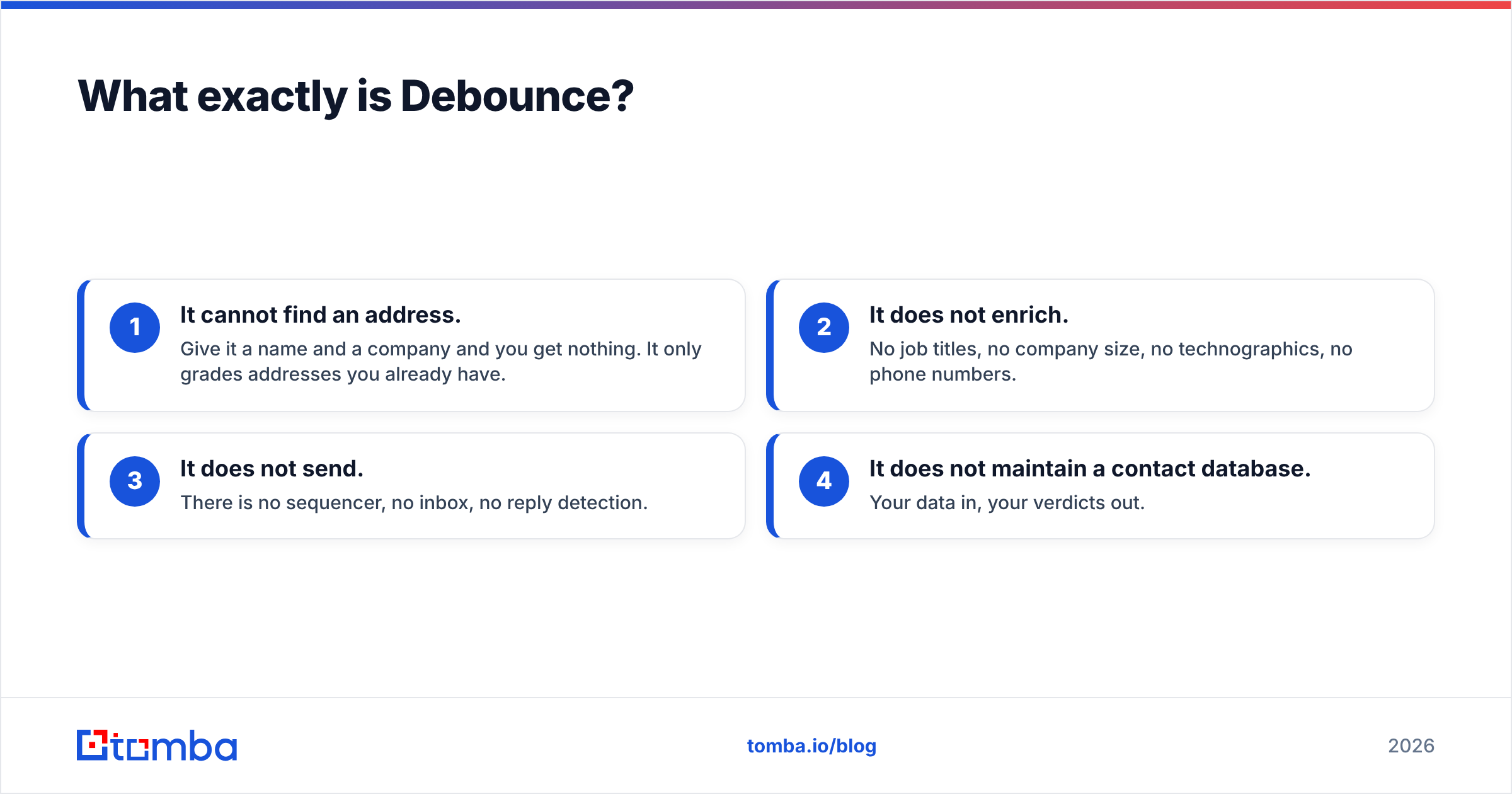
- It cannot find an address. Give it a name and a company and you get nothing back. It only grades what you already have.
- It does not enrich. No job titles, no company size, no tech stack, no phone numbers.
- It does not send. No sequencer, no inbox, no reply tracking.
- It does not store contacts. Your data goes in. Verdicts come out.
That narrow scope is the point. Verification is a utility, and Debounce prices it like one. Credits never expire. There is no monthly minimum. You can clean 100,000 addresses once a quarter and pay nothing in between.

What exactly is Apollo.io?#
Apollo.io is a go-to-market platform. The core asset is a contact database, often cited at 200M+ contacts and 30M+ companies. On top sit search filters, a Chrome extension, email sequences, a dialer, a meeting scheduler, deal tracking, and AI writing help.
The pitch is simple: one seat replaces ZoomInfo, Outreach, and a verifier. For a five-person SDR team, that pitch often holds. Three things create friction.
First, export credits. Each plan caps how many contacts you can pull out per month. A cheap seat price adds up fast when a team exports 10,000 records a month.
Second, data freshness. Apollo leans on crawled and community-shared data. Roughly 20% of B2B contacts change jobs each year. No database that large stays evenly fresh. US tech and mid-market SaaS look great. EU mid-market, non-English regions, and firms under 50 staff fade fast.
Third, verification depth. Apollo marks emails as verified. That status comes from the database, not from a live check at the moment you export. So teams run Apollo exports through a separate verifier before sending. That habit is why people search "Debounce vs Apolloio" in the first place. The tools are not rivals. Plenty of teams pay for both.
Debounce vs Apolloio: how do they compare?#
Here is the honest side-by-side. Few rows have a true head-to-head winner. That is the finding, not a dodge.
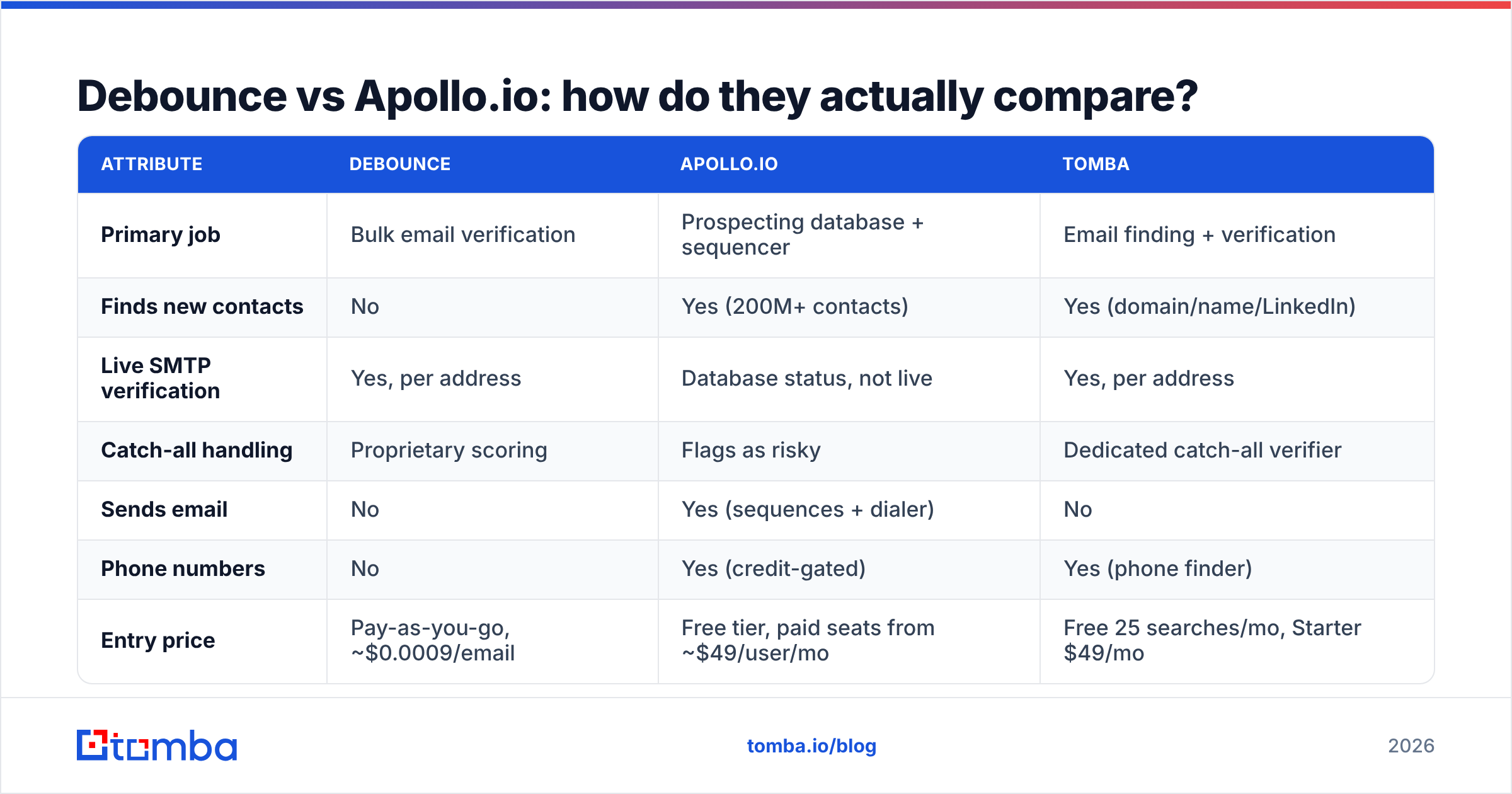
| Attribute | Debounce | Apollo.io | Tomba |
|---|---|---|---|
| Primary job | Bulk email verification | Prospecting database + sequencer | Email finding + verification |
| Finds new contacts | No | Yes (200M+ contacts) | Yes (domain/name/LinkedIn) |
| Live SMTP verification | Yes, per address | Database status, not live | Yes, per address |
| Catch-all handling | Proprietary scoring | Flags as risky | Dedicated catch-all verifier |
| Sends email | No | Yes (sequences + dialer) | No |
| Phone numbers | No | Yes (credit-gated) | Yes (phone finder) |
| Entry price | Pay-as-you-go, ~$0.0009/email | Free tier, paid seats from ~$49/user/mo | Free 25 searches/mo, Starter $49/mo |
| Pricing model | Credits, never expire | Per-seat + credit caps | Plan-based credits |
| API | Yes | Yes (higher tiers) | Yes, on every paid plan |
| Contract | None | Annual discount pushed hard | Monthly or annual |
| Best for | Cleaning a list you own | Team-wide outbound in one tool | Targeted, verified contact discovery |
Read that table as three different tools, not three ranks of the same tool. The question is not "which one is better." It is "which layer of my stack is broken?"
Which one fixes a high bounce rate?#
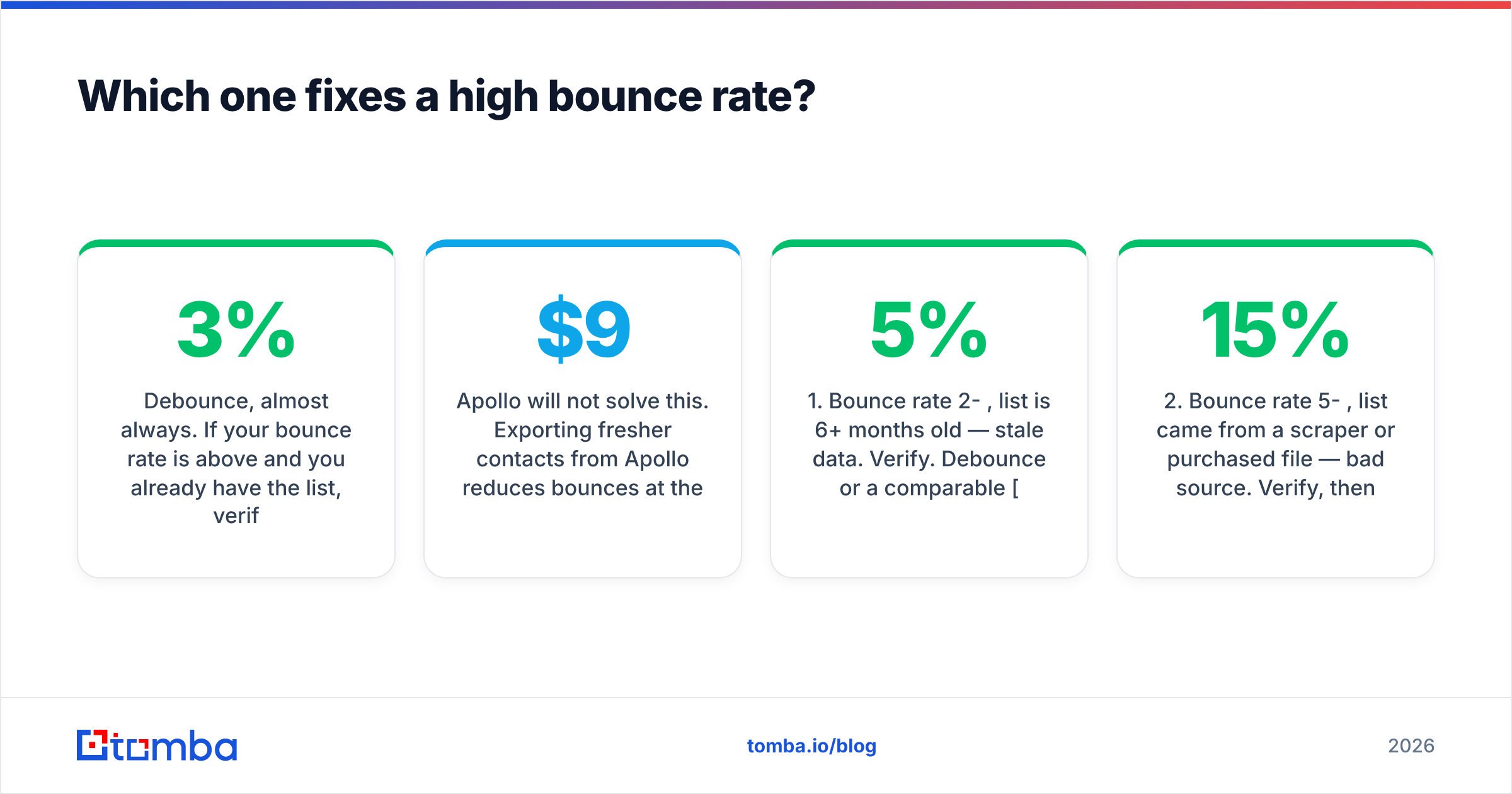
Debounce, almost always. Bounce rate over 3% with a list already in hand? Verification is the direct fix, and it costs a few dollars.
Apollo will not solve this. Fresher Apollo exports trim bounces a little. But you pay seat and credit costs to replace a $9 cleaning run. Apollo exports often need verification too, so you may end up buying both.
Run this quick check before you spend anything:
- Bounce rate 2-5%, list is 6+ months old. The data is stale. Verify it. Debounce or a comparable email verifier clears it in minutes.
- Bounce rate 5-15%, list came from a scraper or a purchased file. The source is bad. Verify, then drop that source.
- Bounce rate above 15%. The list was guessed, not sourced. Verification will delete most of it. Rebuild it with a real finder.
- Bounce rate under 2% but no replies. This is not a data problem. Your targeting or your copy is off. Neither tool fixes that.
- Bounces spike on a few domains. Those are catch-all servers. A normal check returns "unknown." You need a catch-all verifier that resolves them.
That last case separates good verifiers from weak ones. About 15-20% of B2B domains are catch-all. The server accepts every address, real or not. A verifier that dumps them all into "unknown" has refused to answer on a fifth of your list.

Which one fixes an empty pipeline?#
Apollo, or a dedicated finder. It depends on how you prospect.
Apollo fits a filter-driven motion. You want every VP of Engineering at Series B SaaS firms in North America with 50-200 staff. You want breadth. You want to browse, then push straight into a sequence. Apollo is genuinely good at that.
A dedicated finder fits a target-driven motion. You already know the 300 accounts that matter. You have names from LinkedIn, a conference, or your CRM. You just need working addresses for those people. Buying a full platform to answer 300 lookups is expensive theater.
The workflows look nothing alike:
- Filter-driven (Apollo) — search filters → save list → export (costs credits) → verify elsewhere → sequence.
- Target-driven (finder) — account list → domain search to pull the company pattern and known contacts → name lookup for your targets → verified output → your own sender.
- Inbound-driven — a form fill or a site visit → data enrichment to add firmographics and contact detail → route to the right rep.
- Content-driven — an article or a paper → author lookup → verified address → personal outreach.
Most teams run two of these at once. Most buy tooling for only one. That gap is the real budget leak.

What does each one really cost in 2026?#
Sticker prices mislead here, in opposite directions.
Debounce is cheap and stays cheap. At volume it lands under a tenth of a cent per check. Credits do not expire. There is no seat multiplier. Cleaning 50,000 addresses costs less than one Apollo seat for one month. The hidden cost is time, not money. Someone has to remember to run it, and CSV round-trips eat analyst hours.
Apollo.io looks cheap but may not be. The free tier and the low entry seat price are real. The parts that matter sit on higher tiers: export credits, API access, advanced filters, dialer minutes. Put five reps on a mid tier, add credit top-ups, and you are in four-figure months.
One more thing to know. Apollo's data model is partly reciprocal. Contact data flows from connected mailboxes into the shared pool. That is a fair business model. It is also a procurement conversation at companies with strict data rules. Read the terms on apollo.io and the G2 reviews about credit resets before you sign an annual deal.
A dedicated finder sits between them. Tomba pricing starts free at 25 searches per month. Starter is $49/mo, Growth $99/mo, and Pro $249/mo. API access is included on every paid plan, not locked behind an enterprise tier. You pay for lookups and verification. You do not pay for a sequencer you already replaced.
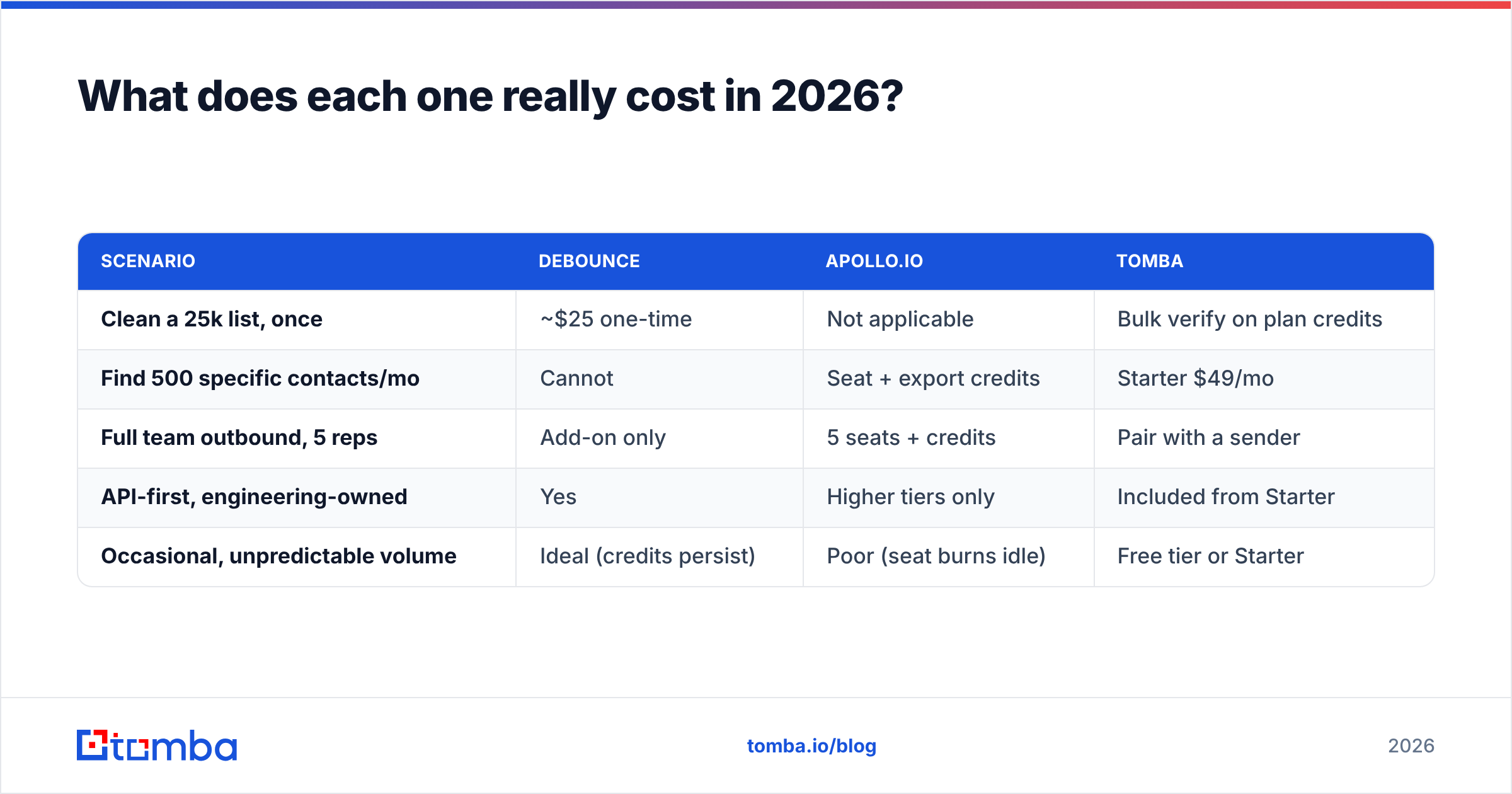
A cost comparison that reflects real usage:
| Scenario | Debounce | Apollo.io | Tomba |
|---|---|---|---|
| Clean a 25k list, once | ~$25 one-time | Not applicable | Bulk verify on plan credits |
| Find 500 specific contacts/mo | Cannot | Seat + export credits | Starter $49/mo |
| Full team outbound, 5 reps | Add-on only | 5 seats + credits | Pair with a sender |
| API-first, engineering-owned | Yes | Higher tiers only | Included from Starter |
| Occasional, unpredictable volume | Ideal (credits persist) | Poor (seat burns idle) | Free tier or Starter |
Where does BookYourData fit in this comparison?#
It answers a third question. BookYourData sells ready-made B2B contact lists, pay as you go, with an accuracy guarantee. You filter, you pay per contact, and you own the file. No subscription. No seat. No shared data pool.
That model suits teams who want a list handed over, not a platform to run. Say you need 5,000 verified contacts in one vertical by Friday, and you do not want to learn another tool. A list vendor beats Debounce, which has nothing to verify yet. It also beats Apollo, which makes you run the search and the export. It is a fair third path, not a lesser one.
Can you skip both and use one tool?#
Sometimes. It depends on which of the three layers you need: discovery, verification, and sending.
- Discovery layer — where contacts come from. Apollo, a list vendor, LinkedIn exports, or a LinkedIn finder that turns profiles into working addresses.
- Verification layer — the gate before you send. Debounce, or a check built into the discovery tool so there is no CSV round-trip. Catch-all handling and live SMTP checks earn their keep here.
- Sending layer — Instantly, Smartlead, Lemlist, or Apollo's own sequencer. Deliverability lives here: warmup, domain rotation, SPF and DKIM. Google and Yahoo now enforce bulk-sender rules, so this layer is not optional. Check the sender guidelines if you have not audited your setup.
Does your discovery tool verify at lookup time? Then two layers collapse into one, and Debounce becomes redundant. If it does not verify, you need a verifier. That is the whole decision.
Engineering-led teams gain more from the collapse than from the license savings. One email finder API call returns a verified address and a confidence score. That removes a full export-import-export cycle from the pipeline. Which vendor you call matters less than killing the manual hop.
What should you actually buy?#
Match the tool to the broken layer, not to a review-site ranking:
- You have a list and it bounces → Debounce. Cheapest right answer. Do not overthink it.
- You have no list and reps who live in one tool → Apollo.io. The bundle really does save time at team scale.
- You have target accounts and need specific people → a finder with built-in verification. Neither Debounce nor Apollo is shaped for that.
- You want a file, not a platform → a pay-as-you-go list vendor like BookYourData.
- You are building this into a product or an internal system → whichever tool ships a clean, documented API at a price you can afford.
One note on testing. Do not trust any accuracy claim, including the ones in this post. Take 100 contacts you can confirm yourself: your own customers, closed-won records, or people you have emailed. Run them through each tool as a blind test. Measure the match rate and the false-positive rate. Vendors benchmark on friendly samples. Only your sample predicts your results.
Budget for decay too. A list is verified only on the day you verify it. At roughly 20% annual churn, a list you cleaned in January is worse by July. So re-verification is not a one-time buy. Put bulk verify runs on a schedule instead of reacting to a deliverability fire.
The bottom line#
Debounce vs Apolloio comes down to one question. Is your problem dirty data, or no data? Debounce is a cheap, precise utility. It grades addresses you already own. Apollo.io is a broad platform. It finds contacts and sends to them, priced per seat, with credit caps that set your real cost.
If neither fits, you are stuck in the gap in the middle. You know who to reach. You just need their working email, verified, without a database subscription or a separate cleaning step. Tomba Email Finder fills that gap. Search by domain, name, or company. Get verified results with confidence scores. Call it from the API, a spreadsheet, or your browser. Start free with 25 searches a month, and upgrade only when the volume justifies it.
Related guides#
Ready to find emails that actually work?
Join 150,000+ professionals who stopped guessing and started sending. Free credits on signup — no credit card required.
Get the Tomba newsletter
Practical outbound tactics and product updates — once every two weeks.
About the author