Debounce vs LeadzenAI (2026): Which Tool Do You Need?
Debounce cleans the list you already have. LeadzenAI builds a list from scratch. Here is an honest 2026 breakdown of accuracy, pricing, and which one your outbound motion actually needs.
TL;DR
- They are not the same category. Debounce is an email verification service. LeadzenAI is a lead intelligence and prospecting platform. Comparing them straight across is like comparing a water filter to a well.
- Pick Debounce if you already have contact lists (CRM exports, webinar signups, purchased data) and your only problem is bounce rate.
- Pick LeadzenAI if you have zero contacts and need to build target lists from company and role filters, mostly for India-heavy and APAC-heavy territories.
- Neither one covers the full loop of find → verify → enrich → export in one credit pool without workarounds, which is where a combined tool like Tomba changes the math.
- Cost reality: verification is cheap per record (fractions of a cent); prospecting data is expensive per record. Budget them separately or you will blow through credits in week two.
What are Debounce and LeadzenAI, actually?#
Debounce is a bulk email validation service. You upload a list, it runs syntax checks, domain and MX record checks, SMTP handshakes, role-account detection, disposable-domain detection, and spam-trap heuristics, then hands you back a scored file. It also exposes a real-time API for form validation and an integration layer for the usual ESPs. What it does not do is find a single new contact for you. It has no prospecting database.
LeadzenAI sits on the other side of the workflow. It is a B2B lead intelligence platform: search a database of companies and people, filter by industry, headcount, location, designation, and technology, then pull contact details including emails and phone numbers. It ships a browser extension for LinkedIn-style prospecting and a dashboard for building and managing lists. Verification exists, but as a supporting feature rather than the product's reason to exist.
So the real question behind "debounce vs leadzenai" is almost never "which is better." It is which stage of the pipeline is currently broken for you. If your bounce rate is 9% and climbing, that is a Debounce problem. If your SDR has 40 target accounts and no contacts inside them, that is a LeadzenAI problem.

How do Debounce and LeadzenAI compare head-to-head?#
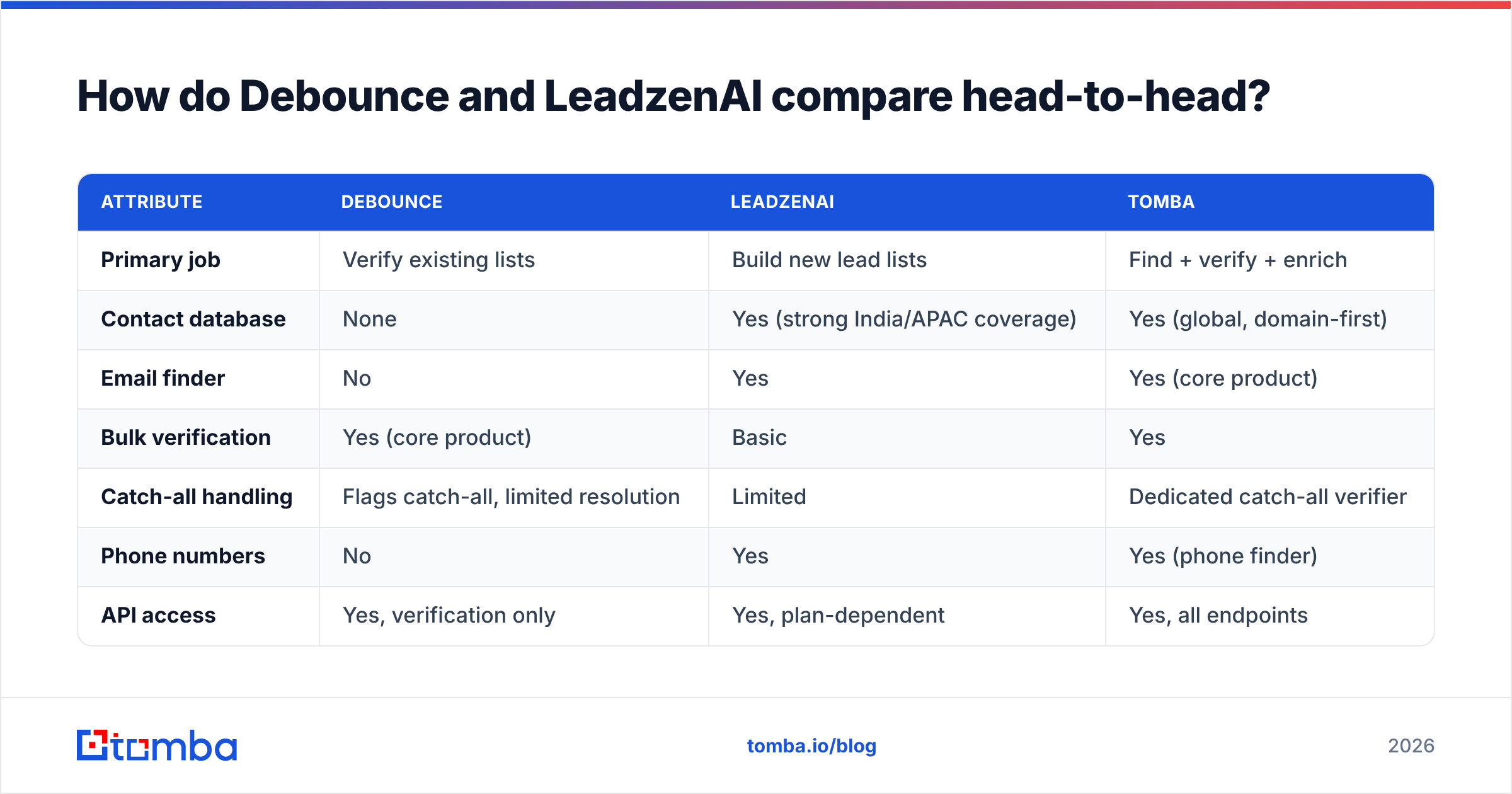
Here is the honest side-by-side. Read the row labels carefully — several rows are "not applicable" rather than "worse," and that distinction matters more than any score.
| Attribute | Debounce | LeadzenAI | Tomba |
|---|---|---|---|
| Primary job | Verify existing lists | Build new lead lists | Find + verify + enrich |
| Contact database | None | Yes (strong India/APAC coverage) | Yes (global, domain-first) |
| Email finder | No | Yes | Yes (core product) |
| Bulk verification | Yes (core product) | Basic | Yes |
| Catch-all handling | Flags catch-all, limited resolution | Limited | Dedicated catch-all verifier |
| Phone numbers | No | Yes | Yes (phone finder) |
| API access | Yes, verification only | Yes, plan-dependent | Yes, all endpoints |
| Free tier | Trial credits | Trial credits | 25 searches/mo, no card |
| Entry paid price | Pay-as-you-go, roughly $10 for 5,000 verifications | Credit-based subscription, varies by region | $49/mo Starter |
| Best fit | Deliverability cleanup | APAC list building | End-to-end outbound data |
Two things jump out. First, Debounce is priced like a utility — you pay per record and per-record cost drops at volume, which is exactly how a commodity check should be priced. Second, LeadzenAI is priced like a data subscription, because you are renting access to a database, not paying for a computation. Never compare their headline prices directly; compare cost-per-usable-contact at the end of your pipeline.

How accurate is each one in practice?#
Accuracy means two different things here, and vendors love the ambiguity.
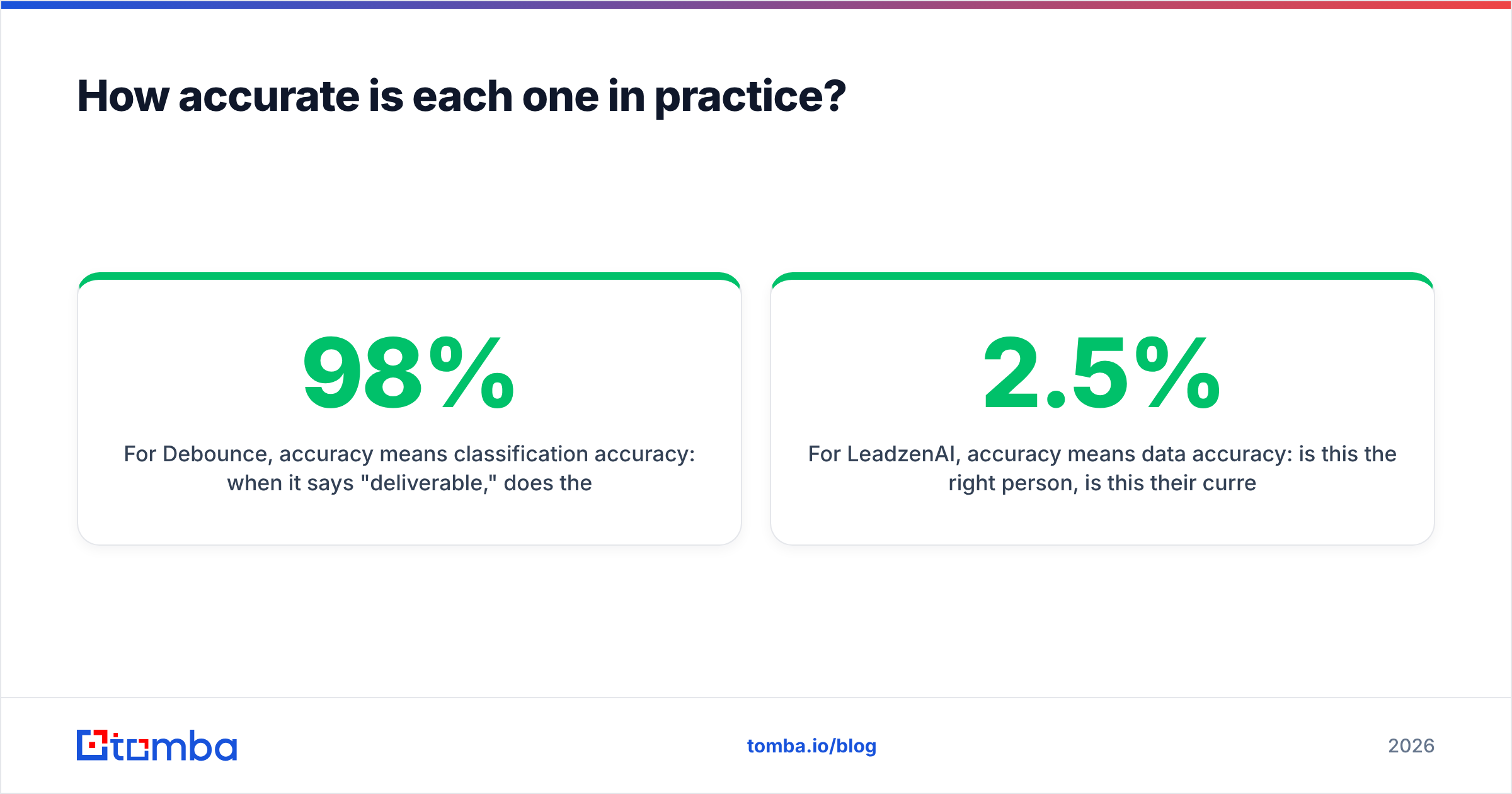
For Debounce, accuracy means classification accuracy: when it says "deliverable," does the message actually land? Independent reviews on G2 and similar directories generally put mature SMTP-based verifiers in the 95–98% range on standard mailboxes. That number is real, and it is also the easy part. The hard part is catch-all domains, where the receiving server accepts everything at the SMTP layer and tells you nothing. Most verifiers, Debounce included, return "unknown" or "accept-all" and leave the decision to you. If 30% of your list is catch-all — normal for enterprise targets — a 97% headline accuracy still leaves you guessing on a third of your file. A dedicated catch-all verifier exists precisely because that bucket is where deliverability quietly dies.
For LeadzenAI, accuracy means data accuracy: is this the right person, is this their current employer, is this their working email? Prospecting databases decay fast. B2B contact data is widely estimated to go stale at roughly 2–2.5% per month through job changes alone, which compounds to a quarter of a database per year. Platforms with strong regional coverage often trade breadth for freshness in other regions — LeadzenAI's India and APAC records tend to be denser than its North American or EU coverage, which is a genuine strength if that is your market and a genuine gap if it is not.

The practical takeaway: a verifier cannot fix a sourcing problem. If LeadzenAI hands you an email for someone who left the company in March, Debounce will happily mark it deliverable — because the mailbox still exists, forwarded to a colleague or a black hole. Verification confirms the box is alive. It does not confirm the human is right. That single sentence explains more failed outbound campaigns than any subject-line advice.
What does each one cost, and where do the costs hide?#
Break the budget into the four things you actually pay for:
- Verification credits. Cheap and predictable. At pay-as-you-go rates, cleaning a 20,000-record list is a two-digit expense, not a three-digit one. Buy these in bulk; they rarely expire.
- Prospecting credits. Expensive and unpredictable. Every search, reveal, and export burns credits, and failed lookups often burn them too. Read the refund policy for "no result found" before you commit — this is the single biggest hidden cost in lead data.
- Seat costs. Prospecting platforms usually charge per user. Verification services usually do not. A five-person SDR team changes the LeadzenAI math far more than the Debounce math.
- The double-payment tax. If you buy a prospecting tool and a separate verifier, you pay once to find the email and again to confirm it. On a 10,000-contact quarter, that is two invoices, two integrations, and two support queues for one outcome.
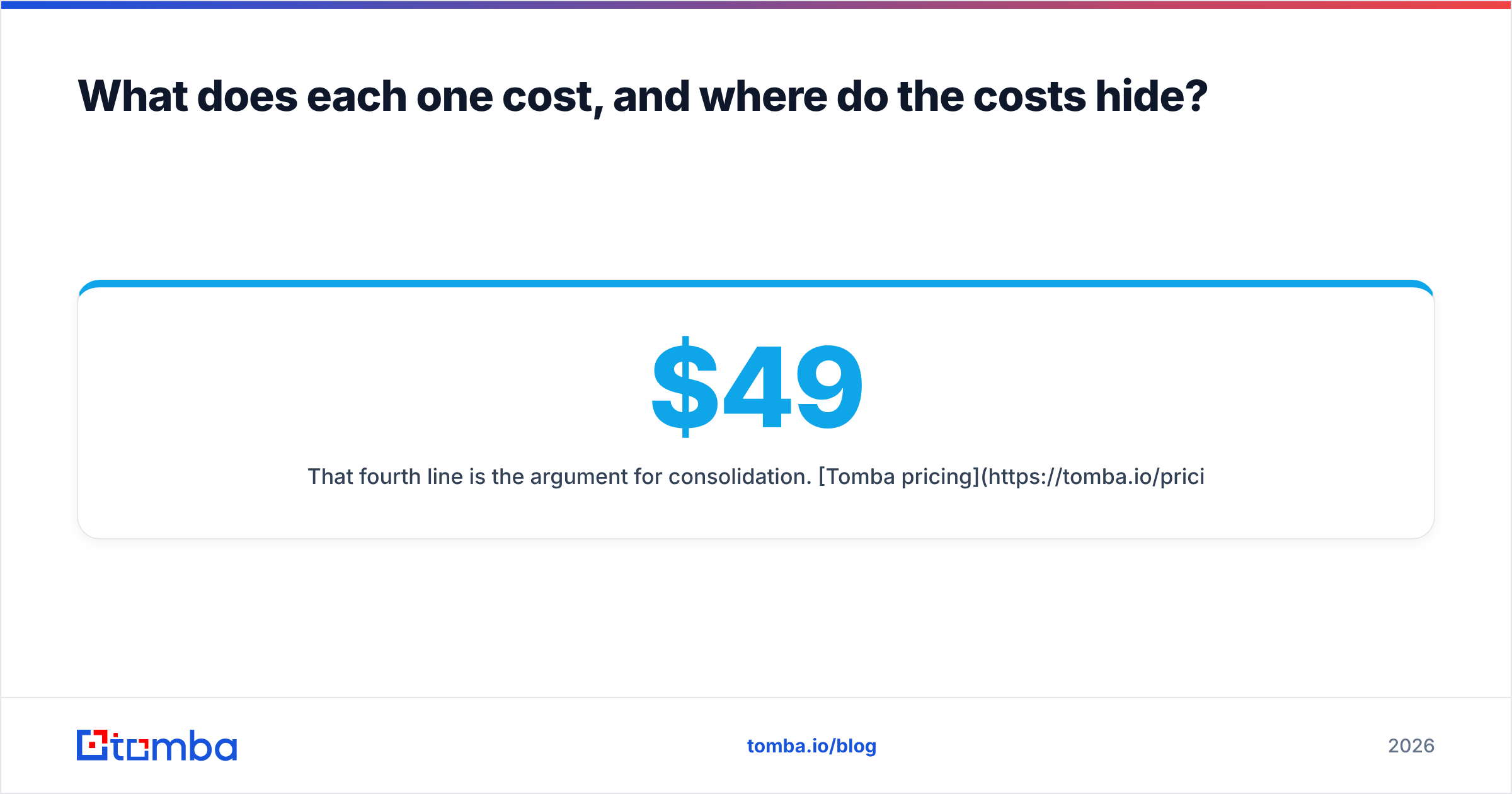
That fourth line is the argument for consolidation. Tomba pricing runs a single credit pool across finding, verifying, and enriching: Free (25 searches/mo), Starter $49/mo, Growth $99/mo, Pro $249/mo, Enterprise custom. One subscription instead of two is not automatically cheaper — but it is almost always simpler to forecast, and forecastable beats cheap when finance asks why credits ran out on the 14th.
Who should pick Debounce?#
Choose Debounce when all of these are true:
- You already own the data. CRM records, event lists, form signups, inherited spreadsheets from a previous rep.
- Bounce rate is the symptom. You are above 3% hard bounces and your ESP has started sending warning emails.
- You need real-time validation. Signup forms, checkout flows, and gated content pages benefit hugely from an API call that blocks typos and disposables at entry.
- You do not need new contacts this quarter. Adding a prospecting tool to solve a hygiene problem is overbuying.
Debounce does one job and does it competently. That focus is a feature. If your problem is genuinely list hygiene, a specialist verifier — Debounce, or any of the mature Debounce alternatives — will fix it faster and cheaper than a platform that treats verification as a side dish.
Who should pick LeadzenAI?#
Choose LeadzenAI when:
- Your ICP is concentrated in India or wider APAC. This is where its coverage advantage is most visible, and regional depth is genuinely hard to replicate.
- You prospect account-first. You have a target account list and need to find the right people inside it.
- You want phone numbers alongside emails. Multi-channel outbound needs both, and buying them separately is painful.
- Your team lives in the browser extension. If reps source contacts while browsing profiles, an extension-led workflow beats a CSV-led one.
Where it gets harder to justify: heavy North America or EU territories, or teams that need a deep, well-documented API for programmatic enrichment inside their own systems. Evaluate coverage on your accounts before signing, not on the vendor's sample list. Pull 50 real target companies, run them through a trial, and count usable contacts. That test takes an afternoon and saves an annual contract.

Do you actually need both tools?#
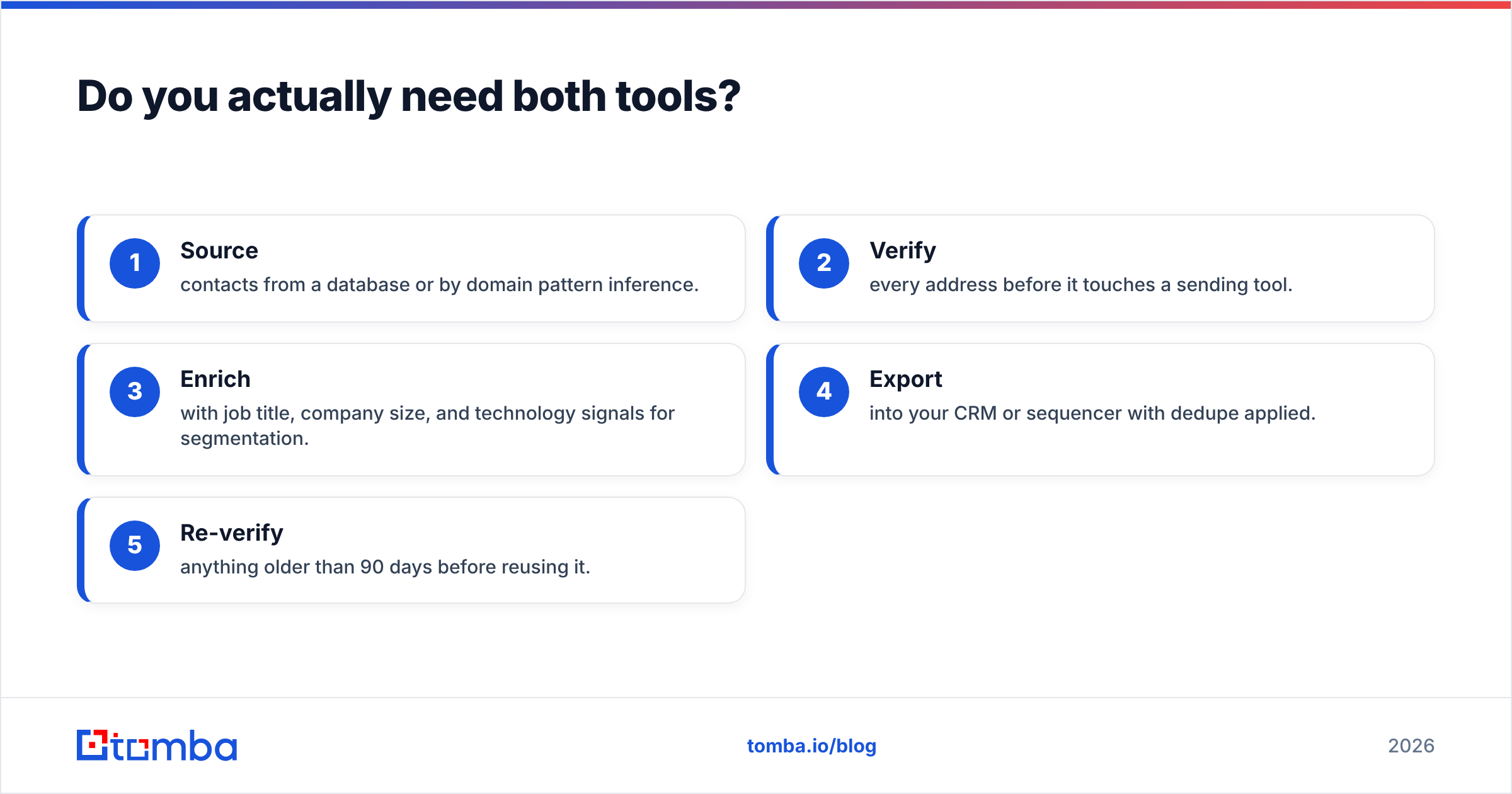
Frequently, yes — and that is the uncomfortable answer. A prospecting platform without verification ships bad addresses to your ESP. A verifier without a source has nothing to clean. The standard two-tool stack looks like this:
- Source contacts from a database or by domain pattern inference.
- Verify every address before it touches a sending tool.
- Enrich with job title, company size, and technology signals for segmentation.
- Export into your CRM or sequencer with dedupe applied.
- Re-verify anything older than 90 days before reusing it.
The friction is not the number of steps — it is the number of vendors across those steps. Every handoff between tools is a CSV export, a column mapping, a dedupe pass, and a place where records go missing. Teams running find-in-one-tool and verify-in-another routinely lose 5–10% of records to mapping errors alone, which is worse than any accuracy gap between the vendors themselves.
This is the practical case for a consolidated platform. Tomba's email finder locates addresses by domain, name, or company; the email verifier validates them in the same workspace; bulk email finder handles list-scale jobs; and every endpoint is available through the Tomba API so enrichment can run inside your own systems instead of inside a spreadsheet. Same credits, same dashboard, no export-import round trip between step 1 and step 2.
To be clear about the trade-off: a consolidated tool will rarely beat a dedicated verifier on pure classification edge cases, and it will rarely beat a regional specialist on that specialist's home turf. What it wins on is throughput and operational sanity. Pick your axis honestly.
What's the verdict on Debounce vs LeadzenAI?#
If you must choose one:
- Choose Debounce if your lists exist and your deliverability is broken. It is the cheaper, more focused fix, and it will show results within one sending cycle.
- Choose LeadzenAI if your lists do not exist and your market is APAC-weighted. Verification is a solvable downstream problem; empty pipeline is not.
- Choose neither exclusively if you are running consistent outbound in global markets. The two-vendor stack costs more in subscriptions, integration time, and lost records than a single find-and-verify platform, and the gap widens as volume grows.
The comparison people search for is "which tool is better." The comparison that actually matters is "which stage of my pipeline leaks the most." Measure that first: pull your last 1,000 sent emails, count hard bounces, count wrong-person replies, count contacts you never found at all. Whichever number is largest tells you exactly which tool to buy — and quite often, it tells you to stop paying for the other one.
Ready to stop running two subscriptions for one outcome? Tomba Email Finder finds professional email addresses by domain, name, or company — then verifies them in the same workspace, from the same credit pool, with full API access on every plan. Start on the free tier with 25 searches a month, no card required, and test it against your own target accounts before you renew anything else.
Related guides#
Ready to find emails that actually work?
Join 150,000+ professionals who stopped guessing and started sending. Free credits on signup — no credit card required.
Get the Tomba newsletter
Practical outbound tactics and product updates — once every two weeks.
About the author