Decision Maker Job Titles: The 2026 B2B Targeting Guide
Most reps target the wrong person. Here's a practical breakdown of decision maker job titles by company size, department, and region — plus how to find their contact details without guessing.
TL;DR
- "Decision maker" is not a title — it's a role in a buying group. The same title can sign at a 40-person startup and be a pure user at a 4,000-person enterprise.
- Company size is the single strongest predictor of which title holds budget. Under ~50 employees, the founder signs. Over ~1,000, a director or VP owns the budget line and legal/procurement own the paperwork.
- Titles inflate. "VP" at a 25-person seed-stage company often means individual contributor. "Head of" and "Lead" are the fastest-growing ambiguous titles in B2B.
- Target two people per account, not one: the economic buyer (budget) and the champion (pain). Sending to only the C-suite is a common and expensive mistake.
- Once you've decided who, finding the email is the mechanical part — pattern matching on the domain plus verification gets you there in seconds.
What are decision maker job titles?#
A decision maker job title is the title held by the person who can say yes and release money — not just the person who likes your product. Those are frequently different humans, and confusing them is why so much outbound dies in "we're evaluating internally."
Think of a B2B purchase like renovating a kitchen in a shared house. The roommate who cooks every night wants the new oven (the user). The one who found the contractor did the research (the champion). But only the person whose name is on the mortgage can approve the spend (the economic buyer). Pitching the oven's features to the mortgage holder, or the financing terms to the cook, wastes both conversations.
Gartner's research on B2B buying puts the typical enterprise buying group at six to ten people, each arriving with four or five independently gathered pieces of information. That's why "find the decision maker" as a singular noun is misleading. You're mapping a committee, and job titles are your only scalable proxy for who sits where in it.

Who actually holds budget authority in a B2B deal?#
Five distinct roles show up in nearly every deal. Learn to spot them by title and your reply rates change before you touch a single word of copy.
- Economic buyer — controls the budget line and signs. Titles: CEO, CFO, COO, CRO, VP of [Function], Head of [Function] at mid-market. This person cares about cost of inaction, payback period, and risk.
- Champion — feels the pain daily and will sell internally for you. Titles: Manager, Senior Manager, Team Lead, Director. Cares about hitting their number and looking competent.
- Technical/functional evaluator — vets whether it works. Titles: IT Manager, Solutions Architect, RevOps Manager, Security Engineer. Cares about integrations, SOC 2, data residency.
- Gatekeeper/blocker — procurement, legal, InfoSec. Titles: Procurement Manager, Vendor Manager, Counsel, CISO. Cares about contract terms and vendor consolidation.
- End user — lives in the tool. Titles: SDR, Analyst, Coordinator, Specialist. Rarely signs, frequently determines renewal.
The practical rule: your first email should go to the champion, your second thread to the economic buyer, and you should never cold-open with procurement.
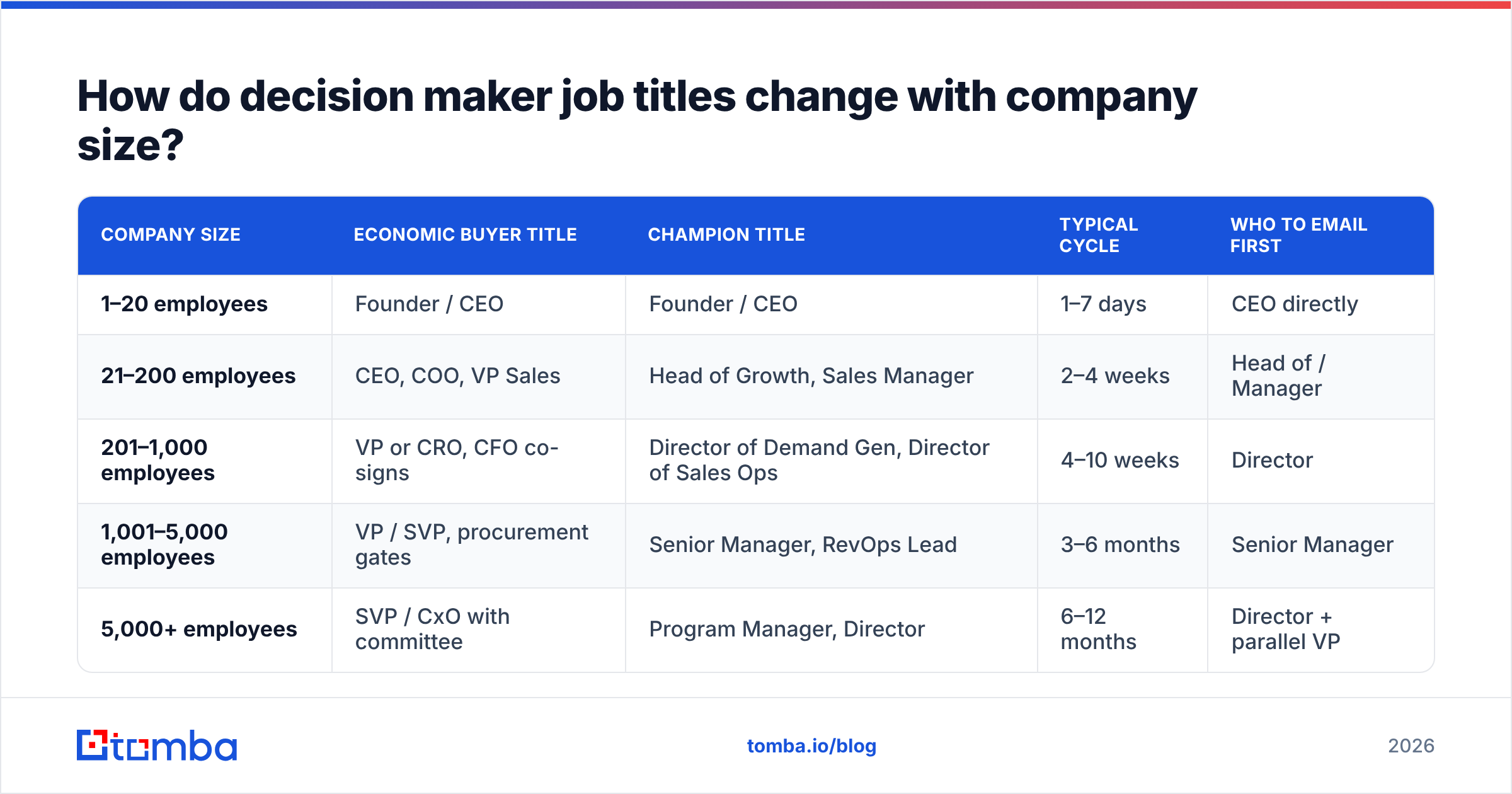
How do decision maker job titles change with company size?#
This is the variable most prospecting lists ignore. The same product sold to a 30-person agency and a 3,000-person insurer requires two entirely different title lists.
| Company size | Economic buyer title | Champion title | Typical cycle | Who to email first |
|---|---|---|---|---|
| 1–20 employees | Founder / CEO | Founder / CEO | 1–7 days | CEO directly |
| 21–200 employees | CEO, COO, VP Sales | Head of Growth, Sales Manager | 2–4 weeks | Head of / Manager |
| 201–1,000 employees | VP or CRO, CFO co-signs | Director of Demand Gen, Director of Sales Ops | 4–10 weeks | Director |
| 1,001–5,000 employees | VP / SVP, procurement gates | Senior Manager, RevOps Lead | 3–6 months | Senior Manager |
| 5,000+ employees | SVP / CxO with committee | Program Manager, Director | 6–12 months | Director + parallel VP |
Two takeaways. First, emailing a CEO works brilliantly below 200 headcount and almost never above 2,000 — at that scale the message gets routed to an EA and dies. Second, the director layer is the sweet spot for most B2B SaaS between $10k and $100k ACV: senior enough to have discretionary budget, close enough to the work to feel the pain.
What do decision maker titles look like by department?#
Titles vary wildly by function, and the naming conventions drift every couple of years. Here's a current map of who owns budget in each department in 2026.
| Department | Senior decision maker titles | Common champion titles | Buys |
|---|---|---|---|
| Sales | CRO, VP Sales, SVP Revenue | Director of Sales, Sales Manager, Head of SDRs | Prospecting data, dialers, CRM add-ons |
| Marketing | CMO, VP Marketing, VP Demand Gen | Director of Growth, Demand Gen Manager | ABM, content, ad tooling |
| Revenue Ops | VP RevOps, Head of GTM Ops | RevOps Manager, Sales Ops Analyst | Enrichment, routing, attribution |
| Finance | CFO, VP Finance, Controller | FP&A Manager, Accounting Manager | Billing, spend management |
| IT / Security | CTO, CIO, CISO, VP Engineering | IT Manager, Security Engineer | Infrastructure, compliance, SSO |
| HR / People | CHRO, VP People, Head of Talent | Talent Acquisition Manager, HRBP | ATS, engagement, payroll |
| Operations | COO, VP Operations | Operations Manager, Program Manager | Workflow, logistics, PM tools |
Notice how "Head of X" appears in both columns depending on department. In marketing and growth, "Head of" typically signals a functional owner with real budget. In engineering, it's often equivalent to a senior manager reporting into a VP. Never treat "Head of" as automatically senior — check headcount and reporting structure.
Is a C-level title always the best target?#
No, and the data on this is fairly blunt. C-suite inboxes at companies above 500 employees are triaged, delegated, or ignored. Response rates from VP and Director-level contacts consistently outperform CxO contacts for tactical, sub-$50k purchases — because the CxO's honest answer is "why are you telling me and not my VP of Sales?"
Go C-level when:
- Headcount is under 200. The CEO is still the buyer, and often the only buyer.
- You're selling a category change, not a tool. Replacing a CRM or restructuring the GTM motion is a CxO decision.
- The deal is over ~$100k ACV. At that price the signature climbs regardless of who champions it.
- You have a warm path — mutual investor, portfolio intro, prior colleague. Warm C-level beats cold VP every time.
Go director/manager level when the purchase fits inside an existing budget line, the ROI is provable in a quarter, and adoption is departmental rather than company-wide.
How do you handle title inflation and regional variations?#
Title inflation is real and getting worse. A "VP of Sales" at a 15-person seed-stage startup may manage nobody. Meanwhile a "Senior Manager" at a Fortune 500 may control a $4M budget. Always calibrate title against company size before you rank a lead.
Regional differences matter just as much:
- UK/Ireland: "Managing Director" is often the equivalent of a US CEO or country GM, not a mid-level manager. "Director" alone is more senior than in the US.
- Germany/DACH: "Geschäftsführer" is the legal managing director — a genuine signer. "Prokurist" holds formal signing authority delegated by the company.
- France: "Directeur Général" (DG) maps to CEO; "Responsable" maps roughly to Manager or Head of.
- Japan: "Bucho" (department head) and "Kacho" (section head) carry more authority than the literal English translation suggests; consensus (ringi) means the committee is larger than it looks.
- Nordics: Flat structures mean fewer VPs and more "Lead" titles with real authority.
If you run outbound across regions, build separate title lists per market. Translating a US title list literally into German or Japanese produces a list of the wrong people.

How do you find the right decision maker at a specific company?#
Once you know the shape of the title you want, the workflow is mechanical. Here's the sequence that holds up at volume.
- Start from the account, not the person. Pull the company domain first. Run a domain search to see every discoverable email at that company grouped by department and seniority — this alone tells you whether the org has a VP RevOps or just a Sales Ops analyst.
- Cross-check on LinkedIn. Filter by company plus title keyword, then sort by tenure. Someone six months into a VP role is usually still buying; someone eight years in is usually defending the status quo.
- Confirm reporting lines. Look at who they list as their manager, who reposts their content, and who is tagged in team announcements. Two minutes here prevents pitching a peer instead of a boss.
- Resolve the email. Use an email finder against first name, last name, and domain rather than guessing patterns manually. Guessed addresses are the leading cause of bounce-driven domain damage.
- Verify before sending. Run every address through an email verifier. A 2% bounce rate is the practical ceiling before mailbox providers start throttling you.
- Enrich for context. Pull headcount, funding stage, and tech stack via data enrichment so your first line references something real instead of "I noticed you're in sales."
Steps 1, 4, and 5 are the ones people skip, and they're the ones that determine whether the campaign lands in the inbox at all.
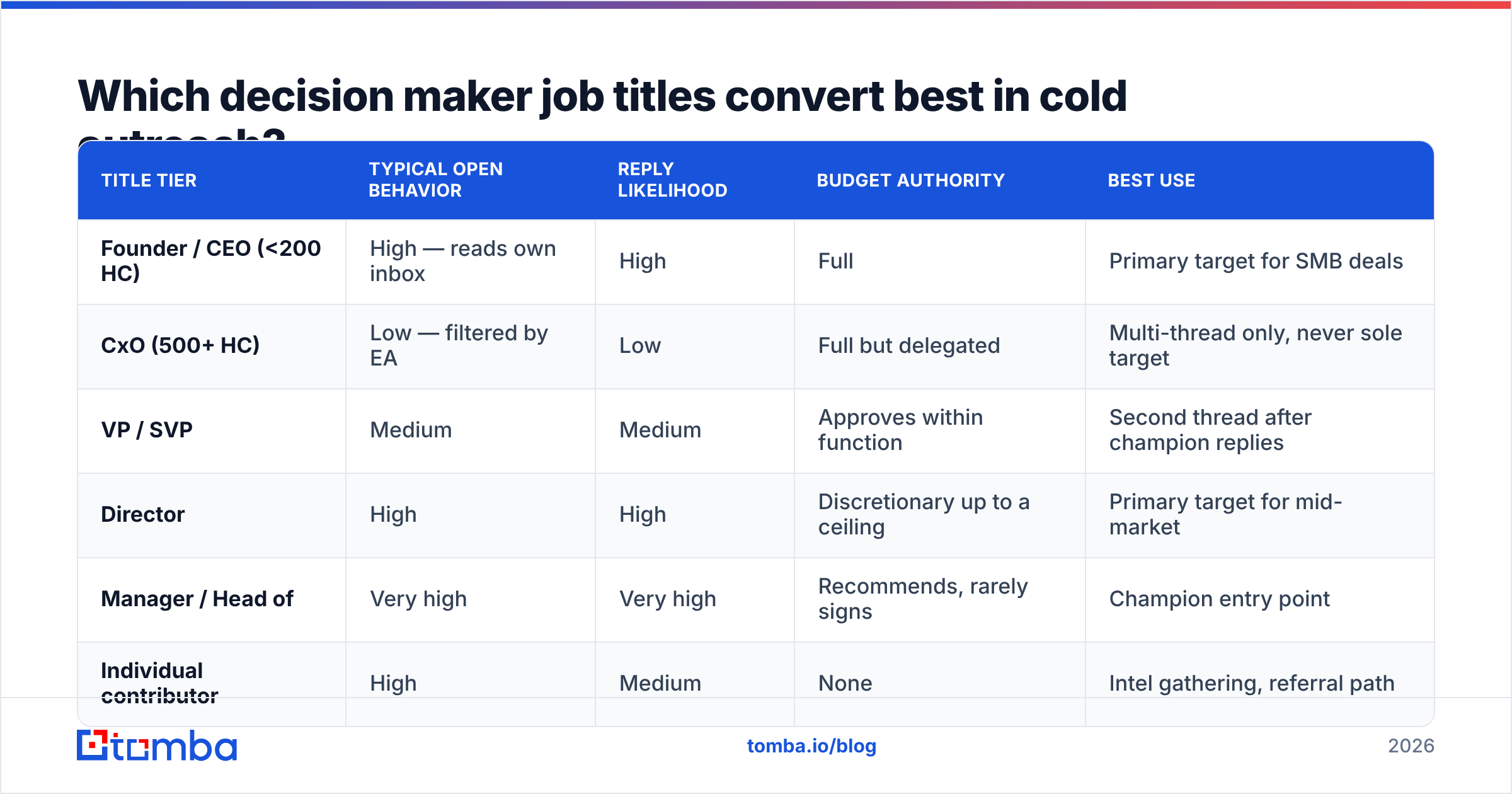
Which decision maker job titles convert best in cold outreach?#
Conversion depends on deal size and category, but the pattern below shows up consistently across B2B SaaS outbound programs.
| Title tier | Typical open behavior | Reply likelihood | Budget authority | Best use |
|---|---|---|---|---|
| Founder / CEO (<200 HC) | High — reads own inbox | High | Full | Primary target for SMB deals |
| CxO (500+ HC) | Low — filtered by EA | Low | Full but delegated | Multi-thread only, never sole target |
| VP / SVP | Medium | Medium | Approves within function | Second thread after champion replies |
| Director | High | High | Discretionary up to a ceiling | Primary target for mid-market |
| Manager / Head of | Very high | Very high | Recommends, rarely signs | Champion entry point |
| Individual contributor | High | Medium | None | Intel gathering, referral path |
The strategy most teams land on: open with the Director or Manager, get the pain confirmed, then loop in the VP with a message that references the internal conversation. Multi-threading two to three titles per account roughly doubles the chance you survive a champion leaving mid-cycle.
How do you build a decision maker title list that scales?#
Manual research works for twenty accounts and collapses at two hundred. Turn your title logic into a repeatable filter:
- Write a tiered title string per segment. For mid-market SaaS sales tools that might be:
("VP Sales" OR "Director of Sales" OR "Head of Revenue Operations" OR "Sales Operations Manager")paired with a 200–1,000 headcount band. - Exclude noise titles explicitly. "Sales Associate," "Retail Sales," "Sales Assistant," and "Insurance Agent" pollute nearly every unfiltered sales-title search.
- Score by title-to-size fit, not title alone. A simple rubric — does the seniority match the headcount band? — filters out inflated titles automatically.
- Refresh quarterly. B2B contact data decays at roughly 25–30% per year, and it's worse in sales and marketing roles where tenure is shortest. Re-verify anything older than 90 days.
- Buy or build deliberately. Providers differ in coverage: some, like BookYourData, sell pre-verified list downloads by title and geography, while API-first tools resolve contacts on demand from a domain. Both are legitimate approaches — list purchase suits one-off campaigns, API resolution suits continuous inbound-to-outbound routing.
- Push it into your CRM automatically. A title map that lives in a spreadsheet gets stale; one that runs through your enrichment step on every new account stays current. HubSpot's sales resources and peer reviews on G2 are useful sanity checks when you're comparing vendors for that layer.
One more discipline worth adopting: log the title of every person who actually signed your last fifty closed-won deals. Most teams discover their real ICP title is one level below what their outbound list targets. That single audit is usually worth more than any title guide, including this one.
What's the fastest way to go from a title to a real contact?#
You've picked the segment, you've picked the titles, and you have a list of company domains. The remaining gap is turning "VP of Revenue Operations at these 300 companies" into 300 verified, deliverable addresses without burning a week on manual lookups.
That's exactly what the Tomba Email Finder is built for: give it a name and domain (or just the domain and a department filter) and it returns the professional address with a confidence score and verification status attached. The free tier includes 25 searches per month so you can test your title list against real accounts before committing; paid plans start at $49/mo for Starter, $99/mo for Growth, and $249/mo for Pro — full Tomba pricing is public if you want to size it against your list volume. Get the title right first, then let the tooling handle the rest.
Related guides#
Ready to find emails that actually work?
Join 150,000+ professionals who stopped guessing and started sending. Free credits on signup — no credit card required.
Get the Tomba newsletter
Practical outbound tactics and product updates — once every two weeks.
About the author