Decision Maker vs Influencer: Who Actually Closes the Deal?
Most reps pitch the person who replies fastest — usually an influencer with no budget. Here's how to tell decision makers and influencers apart before you send the first email, and how to work both without stalling the deal.
TL;DR
- Decision maker vs influencer, in one line: a decision maker owns budget and can sign. An influencer shapes requirements, runs evaluations, and can veto — but cannot authorize spend.
- Most B2B deals now involve 6–10 people. Pitching only one of them is why "great call, then silence" happens.
- Influencers reply faster; decision makers reply shorter. Reply speed is not authority.
- The fastest way to tell them apart before outreach: check reporting depth, budget language in the job title, and whether the person's name appears on vendor/procurement pages.
- Build the contact list for the whole buying group first — then sequence the influencer and the decision maker with different messages, not the same one copy-pasted.
Decision maker vs influencer: what is the difference?#
A decision maker can spend money without asking anyone. An influencer can stop you from getting the money.
That's the whole distinction in one line, and it beats any org chart. Think of buying software like renovating a kitchen. The homeowner signs the check — decision maker. The spouse who will actually cook in it has no checkbook but absolute veto power over the layout — influencer. Pitch only the spouse and nothing gets funded. Pitch only the homeowner and you get funded, then blocked at install because nobody asked the person who has to live with it.
In B2B, the roles map to the classic buying center model: initiators, users, influencers, deciders, buyers, and gatekeepers. The buying center framework is decades old. It survived because it describes what actually happens in a purchase committee.
Here's the practical version:
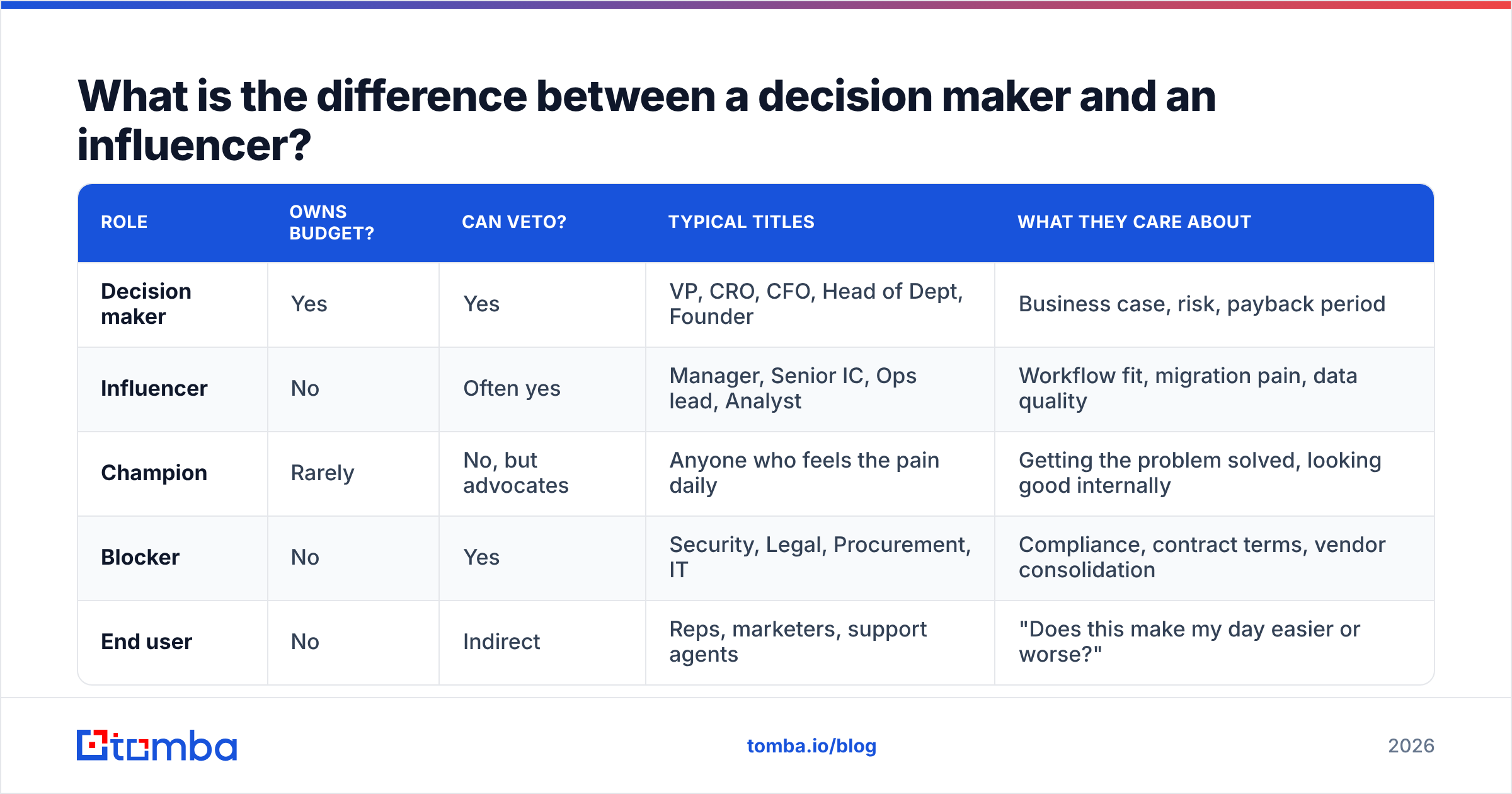
| Role | Owns budget? | Can veto? | Typical titles | What they care about |
|---|---|---|---|---|
| Decision maker | Yes | Yes | VP, CRO, CFO, Head of Dept, Founder | Business case, risk, payback period |
| Influencer | No | Often yes | Manager, Senior IC, Ops lead, Analyst | Workflow fit, migration pain, data quality |
| Champion | Rarely | No, but advocates | Anyone who feels the pain daily | Getting the problem solved, looking good internally |
| Blocker | No | Yes | Security, Legal, Procurement, IT | Compliance, contract terms, vendor consolidation |
| End user | No | Indirect | Reps, marketers, support agents | "Does this make my day easier or worse?" |
Notice the column that matters: Can veto? Three of five roles can kill a deal. Only one can fund it. That gap is why single-threading fails.

Why do most reps pitch the wrong person?#
Because influencers reply and decision makers don't.
An influencer has time, curiosity, and a mandate to research tools. A VP has 40 unread threads and a board deck due Thursday. So your reply-rate feedback loop quietly trains you to over-invest in people who cannot buy. You get a demo booked, a great conversation, enthusiastic notes — and then the deal enters a "we're discussing internally" fog that never lifts.
Gartner's research on the B2B buying journey has consistently found that buying groups for complex solutions run to roughly six to ten people. Each one arrives with their own information, gathered on their own. Those people spend most of the buying cycle talking to each other, not to you. So your job is not to convince one person. Arm the person who will argue for you when you're not in the room. Then make sure the person who signs already knows your name by the time that argument reaches them.
Three signals that you're talking to an influencer and mistaking them for a decision maker:
- They ask for a trial before they ask about price. People with budget authority price-anchor early because they're building a business case. People without it want to check that the tool works.
- They use "we" for decisions and "I" for evaluations. "I've been testing three vendors, we'll decide in Q3" is influencer language, verbatim.
- They can't name a timeline, only a process. "There's a review committee" means someone above them owns the outcome.
- They ask you to send a deck they can forward. Forwarding is what influencers do. It's not a bad sign — it's a signal to give them ammunition, not a closing push.
How do you identify a decision maker before the first email?#
The decision maker vs influencer call gets easy once you look at three things. You can classify most contacts in under two minutes, before you spend a single credit on outreach.
Check 1 — Reporting depth. Count the levels between the title and the CEO. In a 200-person company, a "Director of Revenue Operations" is usually two hops from the CEO and controls a real tooling budget. In a 5,000-person company, the same title sits five hops down and approves under $10K. Same words, very different authority. Always read titles relative to headcount.
Check 2 — Budget language. Titles containing Head of, VP, Chief, Owner, Founder, Managing, or Director of
Check 3 — Public procurement footprint. Search the company's site and press releases for the person's name next to words like "selected," "partnership," "implementation," or vendor case studies. Someone quoted in a vendor case study almost always signed or co-signed that purchase. This one check beats title-guessing.
Then enrich. Once you have a hypothesis about who's who, you need real contact data — verified work emails for the decision maker, and often a second channel for the influencer. A domain search pulls the full addressable roster at the target company, so you see the structure instead of guessing at one name. Then data enrichment fills in seniority, department, and role signals. Your CRM stores authority as a field instead of a hunch.
Should you email the decision maker or the influencer first?#
Both. Two days apart. With different messages.
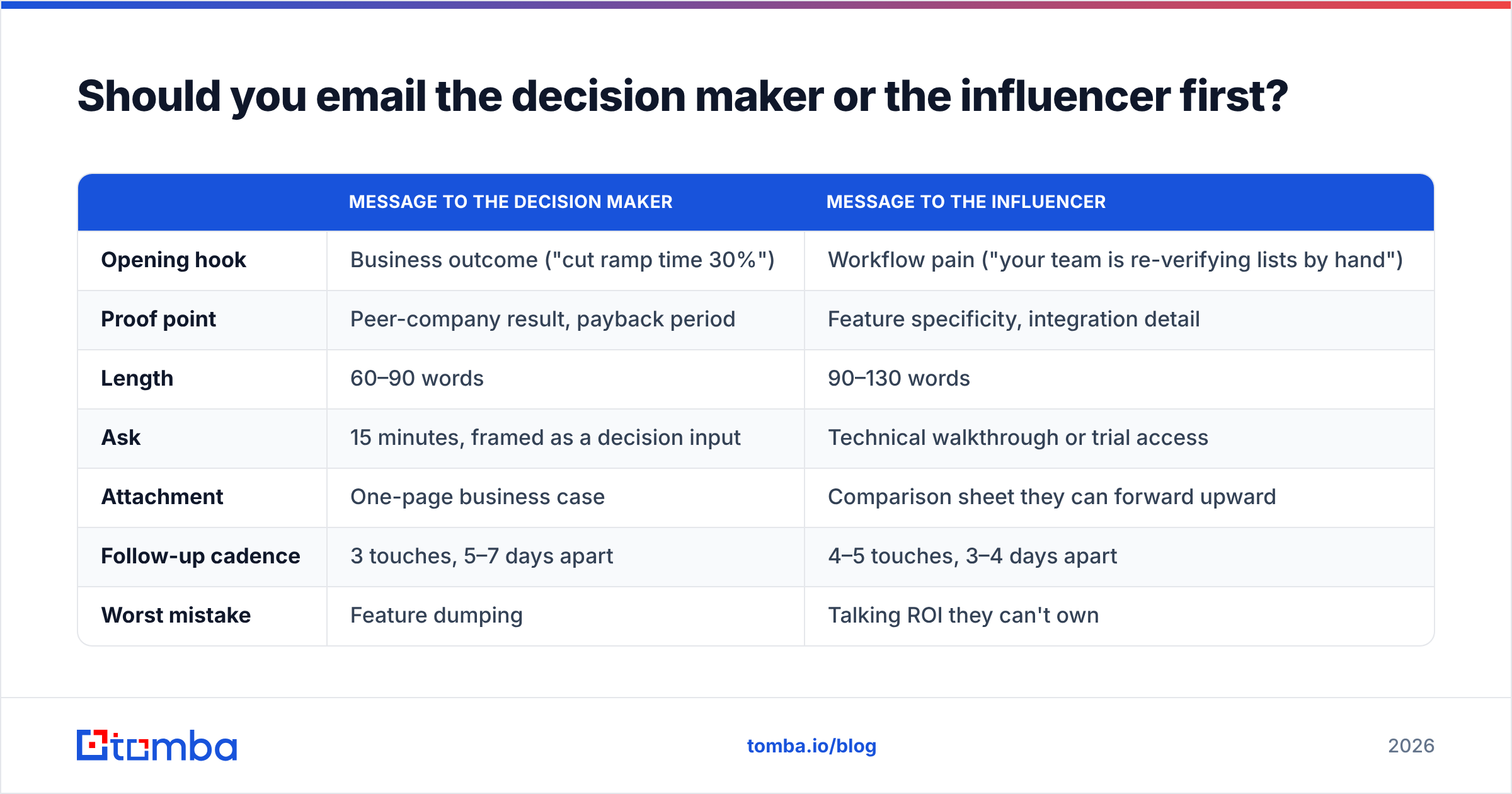
Decision maker vs influencer is not an either/or choice. The mistake is not picking wrong — it's sending the same email to both. The two roles respond to opposite value propositions. And if the influencer sees a forwarded copy of the exact email you sent their VP, you look like a mail merge.
| Message to the decision maker | Message to the influencer | |
|---|---|---|
| Opening hook | Business outcome ("cut ramp time 30%") | Workflow pain ("your team is re-verifying lists by hand") |
| Proof point | Peer-company result, payback period | Feature specificity, integration detail |
| Length | 60–90 words | 90–130 words |
| Ask | 15 minutes, framed as a decision input | Technical walkthrough or trial access |
| Attachment | One-page business case | Comparison sheet they can forward upward |
| Follow-up cadence | 3 touches, 5–7 days apart | 4–5 touches, 3–4 days apart |
| Worst mistake | Feature dumping | Talking ROI they can't own |
Sequence matters as much as content. The pattern that works most reliably in outbound:
- Day 0 — email the decision maker. Short, outcome-first, no attachment. Even if they don't reply, your name is now familiar.
- Day 2 — email the influencer. Reference the operational problem, not the exec. Never say "I reached out to your VP" — it reads as pressure.
- Day 5 — follow up with the influencer. Give them the forwardable asset: comparison table, migration checklist, security summary.
- Day 9 — re-touch the decision maker with one new proof point, ideally something the influencer would find credible too.
- Day 14 — bring in a third thread (end user, adjacent department head) if neither has moved.
If you're running this at volume, the constraint is data, not copy. Every one of those contacts needs a valid address. Bounces to a VP's inbox damage domain reputation faster than bounces anywhere else. Run the list through an email verifier before the first send, and treat catch-all domains as a separate, slower track.

What titles are decision makers vs influencers by department?#
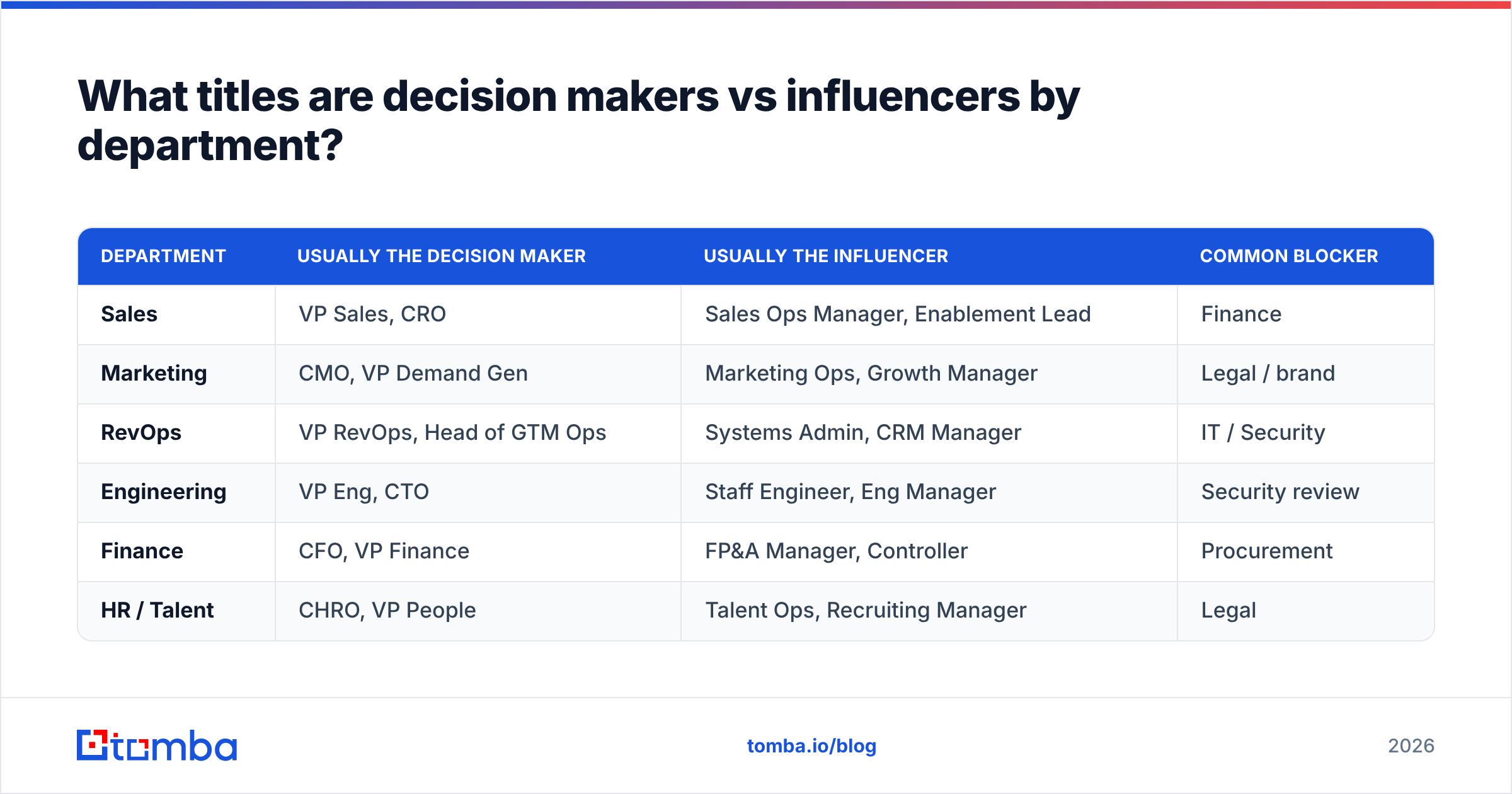
Title-to-authority mapping depends on company size. These defaults hold in most mid-market B2B orgs (100–1,000 employees):
| Department | Usually the decision maker | Usually the influencer | Common blocker |
|---|---|---|---|
| Sales | VP Sales, CRO | Sales Ops Manager, Enablement Lead | Finance |
| Marketing | CMO, VP Demand Gen | Marketing Ops, Growth Manager | Legal / brand |
| RevOps | VP RevOps, Head of GTM Ops | Systems Admin, CRM Manager | IT / Security |
| Engineering | VP Eng, CTO | Staff Engineer, Eng Manager | Security review |
| Finance | CFO, VP Finance | FP&A Manager, Controller | Procurement |
| HR / Talent | CHRO, VP People | Talent Ops, Recruiting Manager | Legal |
Two caveats that save deals:
In companies under 50 people, the founder is the decision maker for everything. Don't build a multi-threaded campaign into a 30-person startup. You'll just annoy the same person from four directions. One thread, direct, outcome-first.
In companies over 2,000 people, procurement is a real decision maker, not a blocker. They can override a VP's preference to consolidate vendors. If you sell upmarket, ask early: "Is there a preferred-vendor list I should know about?" The answer reshapes your whole strategy.
How do you build a contact list that covers the whole buying group?#
Work backwards from the committee, not forwards from one name.
The standard workflow that scales:
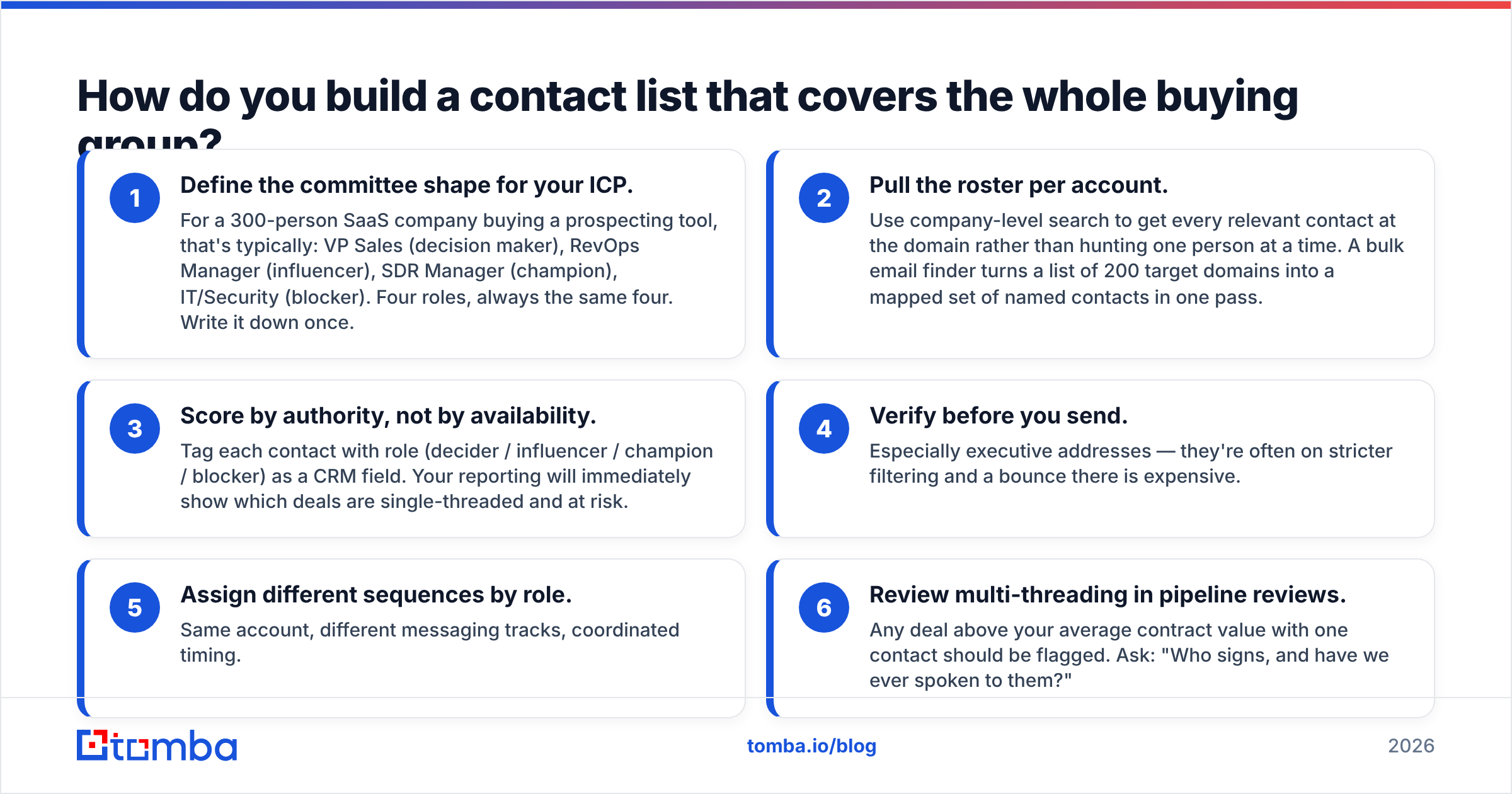
- Define the committee shape for your ICP. For a 300-person SaaS company buying a prospecting tool, that's typically: VP Sales (decision maker), RevOps Manager (influencer), SDR Manager (champion), IT/Security (blocker). Four roles, always the same four. Write it down once.
- Pull the roster per account. Use company-level search to get every relevant contact at the domain rather than hunting one person at a time. A bulk email finder turns a list of 200 target domains into a mapped set of named contacts in one pass.
- Score by authority, not by availability. Tag each contact with role (decider / influencer / champion / blocker) as a CRM field. Your reporting will then show which deals are single-threaded and at risk.
Those three steps give you the map. The next three turn it into pipeline:
- Verify before you send. Especially executive addresses — they're often on stricter filtering, and a bounce there is expensive.
- Assign different sequences by role. Same account, different messaging tracks, coordinated timing.
- Review multi-threading in pipeline reviews. Flag any deal above your average contract value that has one contact. Ask: "Who signs, and have we ever spoken to them?"
Vendor review sites are also underrated for step 1. Read recent buyer reviews on G2 for your category. They tell you which job titles actually write the reviews — and reviewers are almost always the influencer. That tells you who to arm. HubSpot's sales blog has solid tactical material on structuring multi-threaded outreach if you want a deeper playbook on sequencing.
What mistakes kill deals when you misread the roles?#
Going over the influencer's head without warning. You email the VP after two weeks of good conversation with the manager. The manager hears it from the VP. You just turned an ally into an opponent. The fix is one sentence: "Would it help if I sent a short summary your VP could read directly, or would you rather bring it to them yourself?" Both answers are useful.
Treating a champion as a decision maker. Champions are the most seductive contact type: enthusiastic, responsive, genuinely sold on your product. They also often have zero purchasing authority and an inflated sense of their own influence. Ask directly: "Walk me through how a purchase like this gets approved here." Anyone who can't answer that in specifics isn't the buyer.
Assuming the highest title is the real power. In technical purchases, a staff engineer's veto beats a VP's enthusiasm almost every time. Authority to spend and authority to reject live in different chairs.
Sending identical follow-ups to every thread. Contacts inside a company talk. Three people get the same "just bumping this to the top of your inbox" on the same morning. That reads as automation, not persistence.
Not recording role on the contact record. If your CRM doesn't store buying role, you can't report on multi-threading, and you can't coach it. This is a five-minute field addition with an outsized effect on forecast accuracy.
How do you know when you've reached the real decision maker?#
Four tells, in order of reliability:
- They negotiate terms, not features. Talk moves to contract length, payment schedule, or seat counts.
- They introduce a constraint you didn't know about. "We renew our current contract in October" is information only someone accountable for the spend volunteers.
- They bring someone else onto the call. Deciders pull in legal, finance, or security. Influencers ask you to send documentation.
- They give you a decision date, not a check-in date. "Let's reconvene in two weeks" is soft. "I want this signed before end of quarter" is authority.
If you're three calls deep and none of these have appeared, you're still talking to an influencer. That's fine — as long as you know it and are working the second thread.
Where to start#
Pick your ten largest open opportunities. For each, write down who signs. If you can't name that person for more than three of them, the problem isn't your pitch. It's your contact coverage.
Fix the coverage first. The Tomba Email Finder gets you verified work emails for every role in the buying group, not just the one name you found on LinkedIn. So you can thread the decision maker and the influencer in the same week — instead of learning, a quarter later, that you were pitching someone who could never say yes. Start on the free tier at 25 searches a month, or see Tomba pricing if you're mapping committees at volume.
Related guides#
Ready to find emails that actually work?
Join 150,000+ professionals who stopped guessing and started sending. Free credits on signup — no credit card required.
Get the Tomba newsletter
Practical outbound tactics and product updates — once every two weeks.
About the author