Decision Making in Sales: How B2B Buying Committees Really Decide
Most B2B deals stall because nobody maps who actually decides. Here's how buying committees work in 2026, the frameworks that survive contact with real deals, and how to sell to all 11 people instead of one.
TL;DR
- Decision making in sales is no longer one person saying yes. Gartner puts the typical B2B buying group at 6–10 stakeholders, each arriving with their own research and veto power.
- The most common cause of a slipped deal is not price. It's a single-threaded relationship with someone who was never authorized to sign.
- Frameworks like MEDDICC, BANT, and the Challenger model each solve a different failure. Pick by deal size and cycle length, not by which one your last VP liked.
- Consensus buying means your job shifts from persuading to enabling — you arm your champion to sell internally when you're not in the room.
- Multithreading requires contact data you actually have. Mapping seven stakeholders is useless if you can only email two of them.
What does decision making in sales actually mean in 2026?#
Decision making in sales describes how a buying organization moves from "we have a problem" to "we signed the contract" — and, critically, who gets a say at each step. It is a group process, not an individual one.
The old model assumed one economic buyer with a budget and authority. That person still exists on the org chart. But by the time they see your proposal, four to nine other people have already shaped, narrowed, or quietly killed the shortlist. Gartner's B2B buying research has consistently found buying groups of six to ten people for a typical complex solution, each bringing four or five independently gathered pieces of information to the table.
That changes what "selling" means. You are not convincing a person. You are helping a group reach enough internal agreement to survive a procurement review.
Three shifts define the current environment:
- Buyers self-educate before they talk to you. By the time a rep gets a meeting, the group has usually formed a rough vendor shortlist from peer reviews, communities, and vendor sites.
- Veto power is distributed. Security, legal, finance, and IT each hold a kill switch. None of them is your champion.
- The champion sells internally, not you. You get maybe two meetings with the full group. Your champion has forty internal conversations you never see.
Who is actually in a B2B buying committee?#
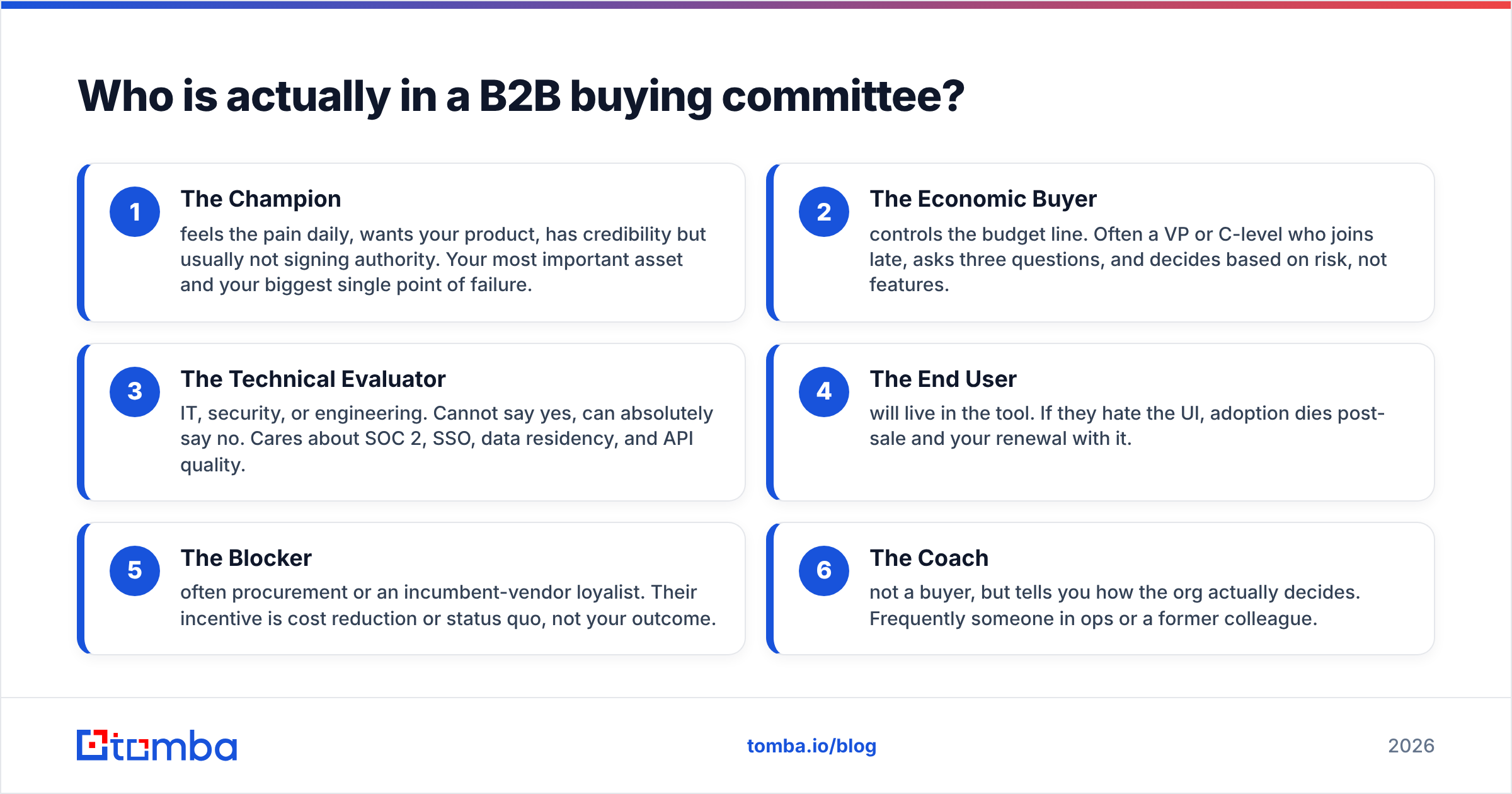
Most reps can name the economic buyer and the end user. The deals that die are killed by the roles nobody mapped.
Here's the working taxonomy that holds up across mid-market and enterprise deals:
- The Champion — feels the pain daily, wants your product, has credibility but usually not signing authority. Your most important asset and your biggest single point of failure.
- The Economic Buyer — controls the budget line. Often a VP or C-level who joins late, asks three questions, and decides based on risk, not features.
- The Technical Evaluator — IT, security, or engineering. Cannot say yes, can absolutely say no. Cares about SOC 2, SSO, data residency, and API quality.
- The End User — will live in the tool. If they hate the UI, adoption dies post-sale and your renewal with it.
- The Blocker — often procurement or an incumbent-vendor loyalist. Their incentive is cost reduction or status quo, not your outcome.
- The Coach — not a buyer, but tells you how the org actually decides. Frequently someone in ops or a former colleague.
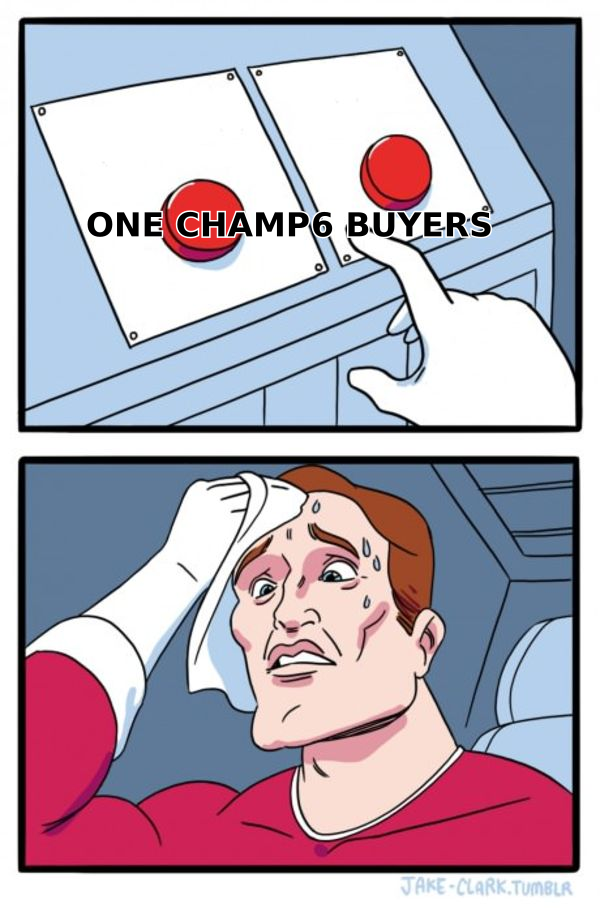
The practical test: can you name a real human for each of these six roles in your top three open deals? If you can name fewer than four, that deal is not forecastable — it's a hope with a close date attached.
How do the major sales decision frameworks compare?#
Frameworks are not religion. They're checklists that force you to ask uncomfortable questions before the quarter ends. Different frameworks catch different failures.
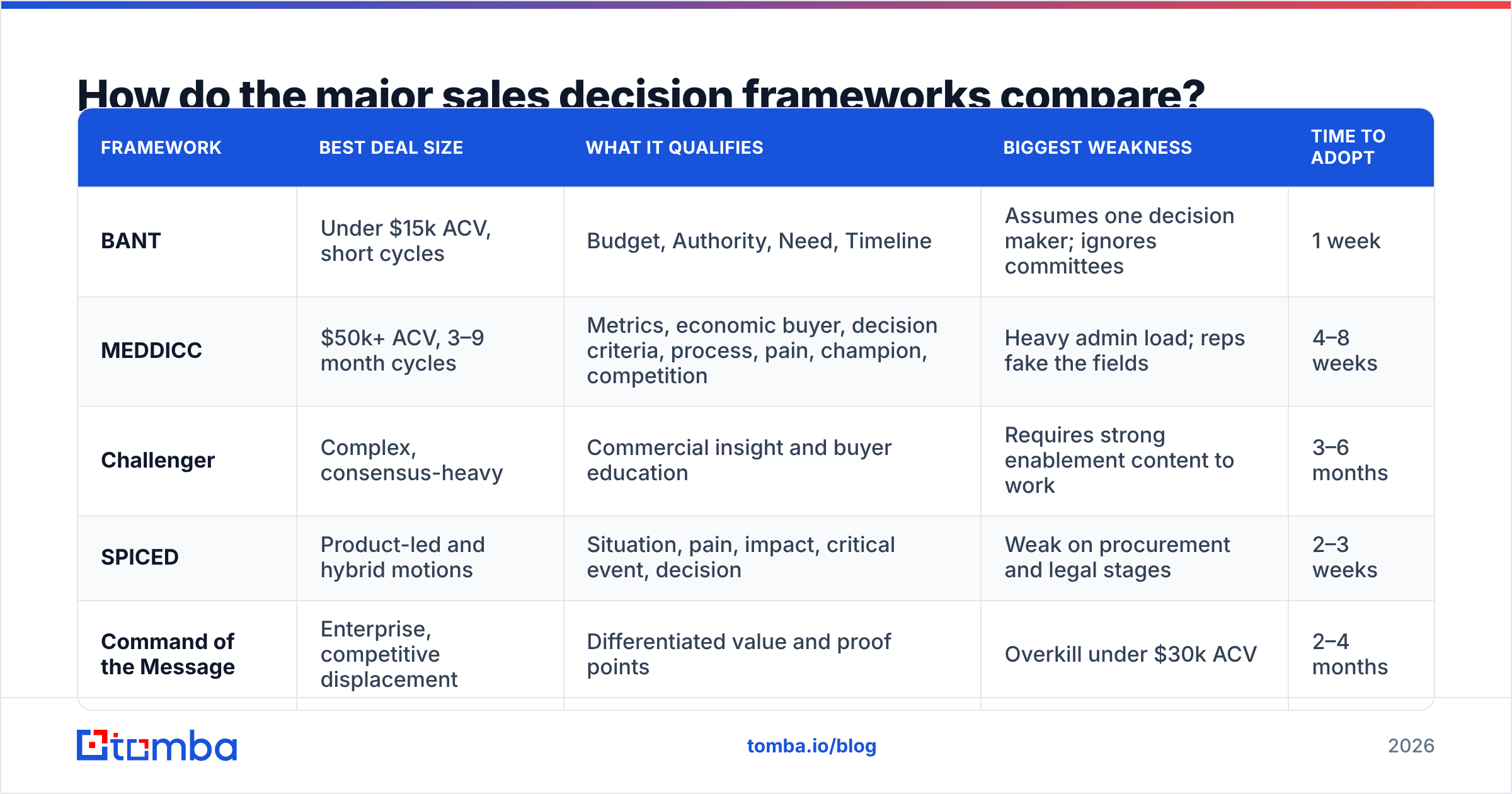
| Framework | Best deal size | What it qualifies | Biggest weakness | Time to adopt |
|---|---|---|---|---|
| BANT | Under $15k ACV, short cycles | Budget, Authority, Need, Timeline | Assumes one decision maker; ignores committees | 1 week |
| MEDDICC | $50k+ ACV, 3–9 month cycles | Metrics, economic buyer, decision criteria, process, pain, champion, competition | Heavy admin load; reps fake the fields | 4–8 weeks |
| Challenger | Complex, consensus-heavy | Commercial insight and buyer education | Requires strong enablement content to work | 3–6 months |
| SPICED | Product-led and hybrid motions | Situation, pain, impact, critical event, decision | Weak on procurement and legal stages | 2–3 weeks |
| Command of the Message | Enterprise, competitive displacement | Differentiated value and proof points | Overkill under $30k ACV | 2–4 months |
The pattern: BANT asks who can say yes. MEDDICC asks how does yes actually get made here. That difference is the entire story of modern decision making in sales.
If your average cycle is under 30 days and one person signs, BANT is enough and MEDDICC will just slow your reps down. If your cycle exceeds 90 days and you routinely lose to "no decision," you need MEDDICC's decision-process and decision-criteria fields — because "no decision" is almost always an unmapped internal step, not a competitor.
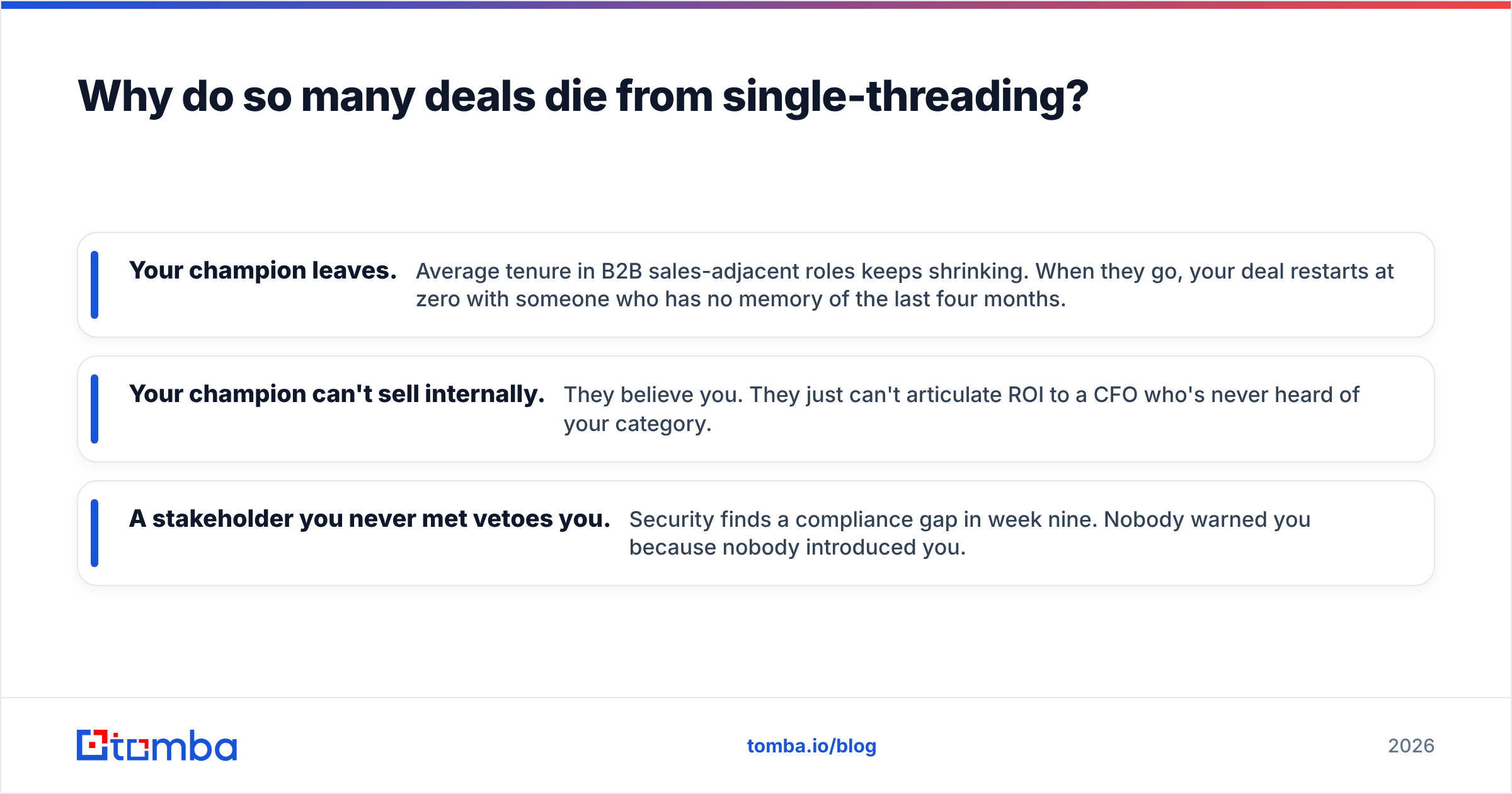
Why do so many deals die from single-threading?#
Because you built your entire forecast on one person's career stability.
Single-threading means your only real relationship inside an account is with one contact. It feels efficient. It's the highest-variance way to run a pipeline. Three things routinely kill single-threaded deals:
- Your champion leaves. Average tenure in B2B sales-adjacent roles keeps shrinking. When they go, your deal restarts at zero with someone who has no memory of the last four months.
- Your champion can't sell internally. They believe you. They just can't articulate ROI to a CFO who's never heard of your category.
- A stakeholder you never met vetoes you. Security finds a compliance gap in week nine. Nobody warned you because nobody introduced you.
The fix is unglamorous: get three or more genuine relationships per account before you forecast the deal. Genuine means a two-way conversation, not a LinkedIn connection.
The blocker is usually data, not willingness. Reps know they should multithread. They stall because they can find the VP of Engineering's name on LinkedIn but not a working email. That's a solvable problem — a domain search across the target company surfaces the full contact map by department, and an email verifier pass keeps your bounce rate from wrecking the sender reputation you need for the other six people.
What does a real decision map look like?#
A decision map is one page per open deal. It answers five questions in writing:
1. Who signs? Name, title, and how you know. "Probably the CTO" is not an answer.
2. What are the decision criteria? Not your feature list — theirs, in their words. If you can't quote it, you haven't asked.
3. What is the decision process? The literal sequence: technical eval → security review → procurement → legal → signature. Include who owns each stage and how long it historically takes.
4. What is the critical event? The reason this must happen by a date. A contract renewal, a compliance deadline, a funding milestone. No critical event means no urgency, means slip.
5. Who loses if this happens? Every purchase makes someone look wrong. Find them early.
Write it down. Deals that live only in a rep's head do not survive a pipeline review, and they do not survive that rep taking a week off.
How do you sell to a committee instead of a person?#
You stop pitching and start equipping. Three practical moves:
Build a champion kit. A one-page internal business case your champion can forward without editing: the problem in their language, the cost of inaction with a number, the implementation timeline, and answers to the three objections you know finance will raise. If your champion has to build this themselves, most won't.
Tailor by role, not by account. The security evaluator wants your SOC 2 report and a data-flow diagram. The CFO wants payback period. The end user wants a fifteen-minute hands-on. Sending all three the same deck is how deals go quiet.
Trade access for progress. When your champion asks for a discount or a custom demo, the price is a meeting with the economic buyer. This is not manipulation — it's the normal exchange rate of a serious deal.
Run a mutual action plan. A shared document with dates, owners, and dependencies on both sides. It converts vague enthusiasm into a testable commitment. If the buyer won't co-sign a timeline, you've learned something valuable about how real the deal is.
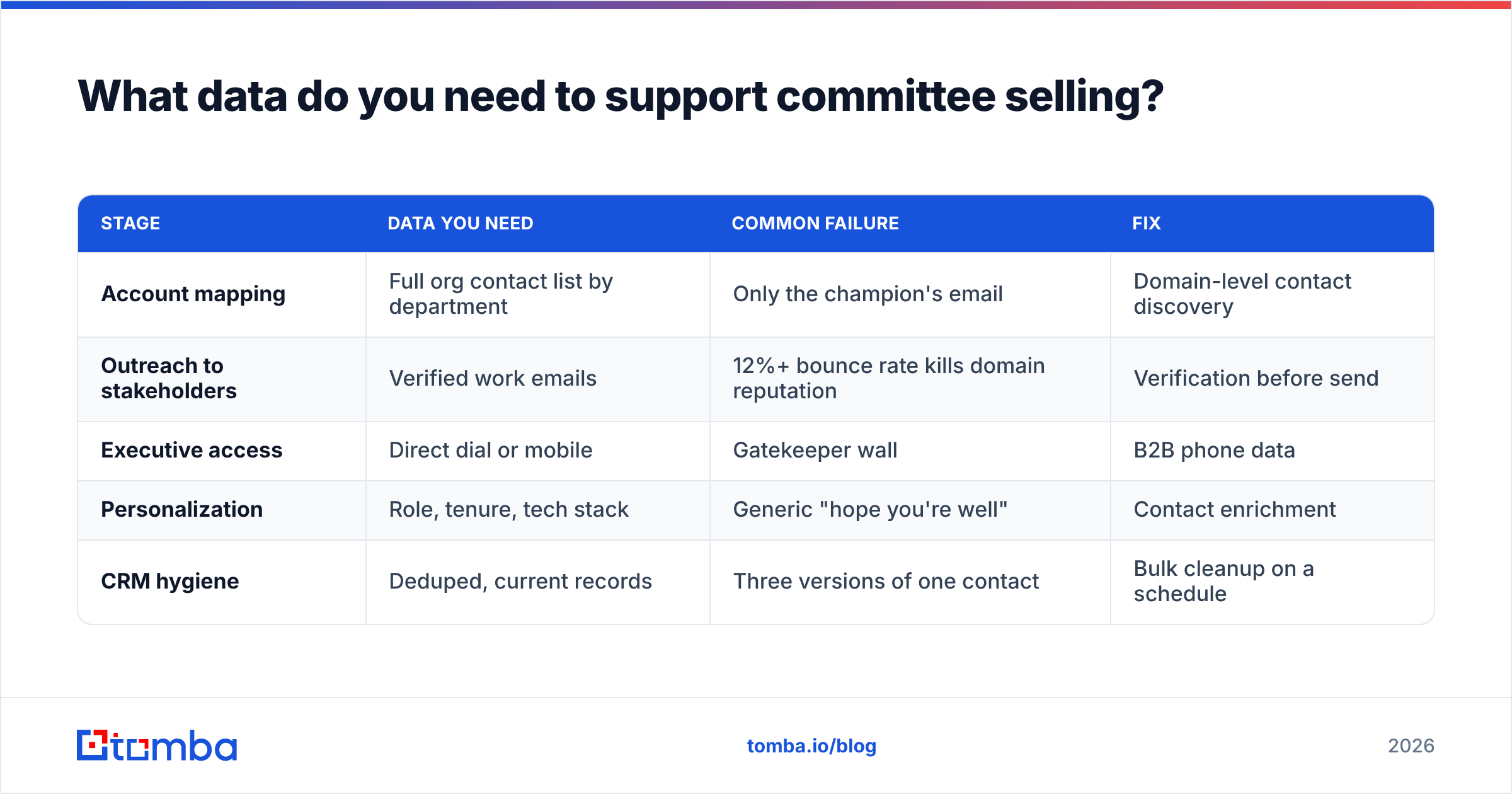
What data do you need to support committee selling?#
Multithreading is a data problem wearing a strategy costume. Here's what each stage requires:
| Stage | Data you need | Common failure | Fix |
|---|---|---|---|
| Account mapping | Full org contact list by department | Only the champion's email | Domain-level contact discovery |
| Outreach to stakeholders | Verified work emails | 12%+ bounce rate kills domain reputation | Verification before send |
| Executive access | Direct dial or mobile | Gatekeeper wall | B2B phone data |
| Personalization | Role, tenure, tech stack | Generic "hope you're well" | Contact enrichment |
| CRM hygiene | Deduped, current records | Three versions of one contact | Bulk cleanup on a schedule |
Tools in this space split roughly into three groups. Contact databases like BookYourData sell prebuilt, filterable B2B lists — strong when you want volume and coverage upfront. All-in-one platforms like Apollo bundle data with sequencing, which is convenient but ties your data quality to your sending tool. Precision finders like Tomba focus on accuracy per lookup rather than list size, and expose the whole thing through an email finder API so you can enrich inside your own workflow.
None of these replaces judgment. They just remove the excuse that you couldn't reach the CFO.
For the stakeholders you find on LinkedIn but can't email, a LinkedIn finder closes that gap directly. And when a target company runs a catch-all domain — which quietly ruins verification results for a lot of enterprise accounts — a dedicated catch-all verifier tells you whether the address is real before you burn a send on it.
How do you measure whether your decision-making process is working?#
Track four things. Ignore vanity metrics.
Stakeholders engaged per opportunity. Target three or more for deals above your median ACV. This is the single strongest leading indicator of close rate in committee sales.
No-decision rate. Deals lost to "we're staying put" versus lost to a competitor. High no-decision rates mean you're not building enough internal consensus, not that you're losing on features.
Stage-to-stage conversion. Where do deals stall? If everything dies between technical eval and procurement, your problem is a legal or security artifact you're not producing early enough.
Forecast accuracy by rep. Reps with complete decision maps forecast within 15%. Reps working from vibes miss by 40%+. That gap is your training plan.
Review these monthly, not quarterly. A win rate that moves for unexplained reasons is usually a decision-process problem showing up two stages downstream. And if you're rebuilding your qualification fields, HubSpot's research on B2B buying behavior is a reasonable free benchmark to sanity-check your own numbers against.
What should you change this quarter?#
Pick two. Not eight.
- Add a required "decision process" field to your CRM opportunity record. Not optional. Deals without it don't get forecast.
- Run a stakeholder audit on every deal above your median ACV. Count named humans per role. Anything under three gets a multithreading plan this week.
- Build one champion kit for your most common use case and measure whether deals using it convert faster.
- Kill the discovery question "who's involved in the decision?" and replace it with "walk me through what happened the last time you bought something like this."
That last swap is the highest-leverage change on the list. The first question gets you a title. The second gets you the actual process, including the review board nobody mentioned.
Where does Tomba fit?#
Decision mapping fails at the contact layer more often than at the strategy layer. You identify seven stakeholders, then reach two, then go back to leaning on your champion — and you're single-threaded again by week six.
The Tomba Email Finder exists to close that gap: find verified professional emails by domain, name, or company so every person on your decision map is actually reachable. The free tier covers 25 searches a month if you want to test it against an account you already know well, and paid plans start at $49/mo — see Tomba pricing for the Growth and Pro tiers if you're mapping accounts at volume.
Map the committee. Then reach all of it.
Related guides#
Ready to find emails that actually work?
Join 150,000+ professionals who stopped guessing and started sending. Free credits on signup — no credit card required.
Get the Tomba newsletter
Practical outbound tactics and product updates — once every two weeks.
About the author