What Is a Decision Making Unit DMU? The 2026 B2B Guide
Most B2B deals die because the rep sold to one person while five others quietly voted no. Here's how the decision making unit (DMU) actually works, who sits on it, and how to map and reach every role before your deal stalls.
TL;DR
- A decision making unit DMU is the full group of people inside a company who influence, evaluate, veto, or approve a purchase. It is not just the person who replies to your email.
- Typical B2B software deals now involve 6–11 people. That number climbs with contract value, security review scope, and headcount affected.
- There are six recurring DMU roles: initiator, user, influencer, gatekeeper, decider, and buyer. Each one kills or advances a deal for a different reason.
- Single-threaded deals — one champion, no coverage — are the most common cause of late-stage losses.
- Mapping a DMU is a data problem before it is a selling problem. Get the org structure, get verified contact data, then sequence outreach per role.
What is a decision making unit DMU?#
A decision making unit DMU is the set of people in an organization who together decide whether a purchase happens. Think of it like a mortgage application. The person who fills in the form is not the person who approves it. Neither of them has to live in the house. Your champion is the applicant. The CFO is the underwriter. The end users are stuck with the plumbing.
The idea comes from organizational buying theory — Webster and Wind's buying center model from 1972. It has survived fifty years because it keeps being true. B2B purchases are group decisions dressed up as individual conversations.
Only one member of the DMU usually talks to you. Everyone else votes in a meeting you are not invited to. Your job is to arm that room with the right argument for each seat.
Who sits on the decision making unit DMU?#
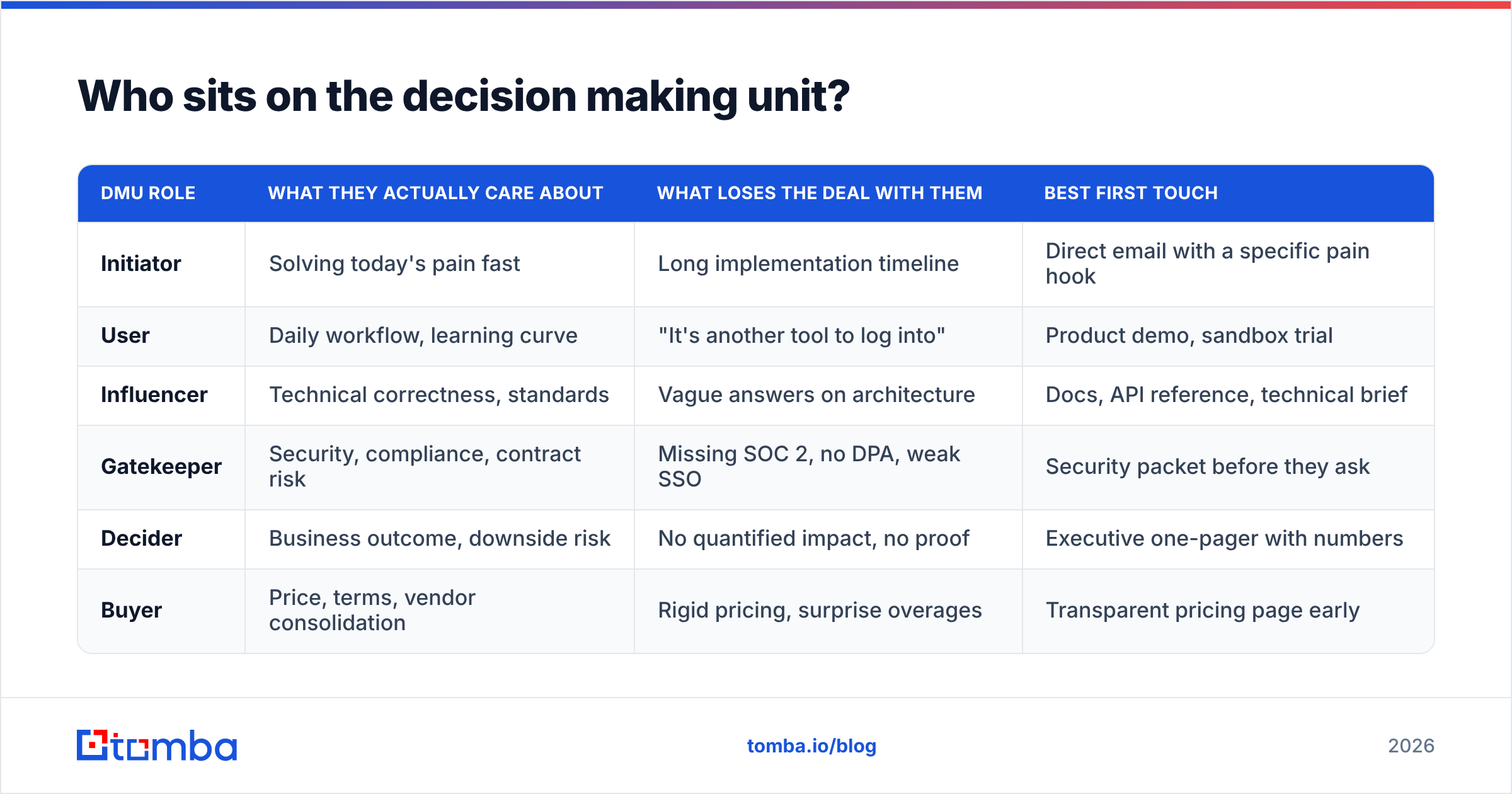
Six roles show up in nearly every deal. One person can hold two roles in a 40-person startup. In a 5,000-person enterprise, each role may be three people with conflicting incentives.
- The initiator — the person who first says "we should fix this." Often a frontline manager tired of a manual process. High enthusiasm, low authority. Great for discovery, risky as your only thread.
- The user — the team who will live in your product daily. They care about workflow disruption, onboarding time, and whether it beats the spreadsheet they already trust. Users rarely win a deal alone, but they often lose one.
- The influencer — an internal or external expert asked for judgment. A solutions architect, a data-privacy lead, a consultant, or the peer your buyer texts for a sanity check. They set the evaluation criteria before you are in the room.
The next three roles hold the budget and the veto.
- The gatekeeper — procurement, IT security, legal, or an executive assistant. They do not want your product. They want compliance, a signed DPA, SSO support, and no surprises. Gatekeepers cannot say yes, but their no is final.
- The decider — the person with real budget authority for the line item. In a $12k deal that may be a director. At $250k it is a VP or the C-suite. Deciders care about risk and outcome, not features.
- The buyer — procurement or finance running the transaction. They negotiate terms, run the vendor review, and push for annual prepay discounts. They arrive late and can add four weeks to a "closed" deal.
| DMU role | What they actually care about | What loses the deal with them | Best first touch |
|---|---|---|---|
| Initiator | Solving today's pain fast | Long implementation timeline | Direct email with a specific pain hook |
| User | Daily workflow, learning curve | "It's another tool to log into" | Product demo, sandbox trial |
| Influencer | Technical correctness, standards | Vague answers on architecture | Docs, API reference, technical brief |
| Gatekeeper | Security, compliance, contract risk | Missing SOC 2, no DPA, weak SSO | Security packet before they ask |
| Decider | Business outcome, downside risk | No quantified impact, no proof | Executive one-pager with numbers |
| Buyer | Price, terms, vendor consolidation | Rigid pricing, surprise overages | Transparent pricing page early |
Why do deals stall when you ignore the DMU?#
Because the deal was never yours to win with one person. Gartner's B2B buying research finds that buying groups for complex solutions run to roughly six to ten decision makers. Each one arrives with research they did before they ever contacted a vendor. By the time your champion replies, four other people have opinions you have never heard.
Three failure patterns come from ignoring the DMU.
Single-threaded collapse. Your champion gets promoted, laid off, or reassigned. If they were your only relationship, the deal restarts at zero. Usually as a "we've decided to revisit next year."
Late-stage veto. Security review lands in week seven and finds you do not support SAML. That is a gatekeeper you should have surfaced in week one.
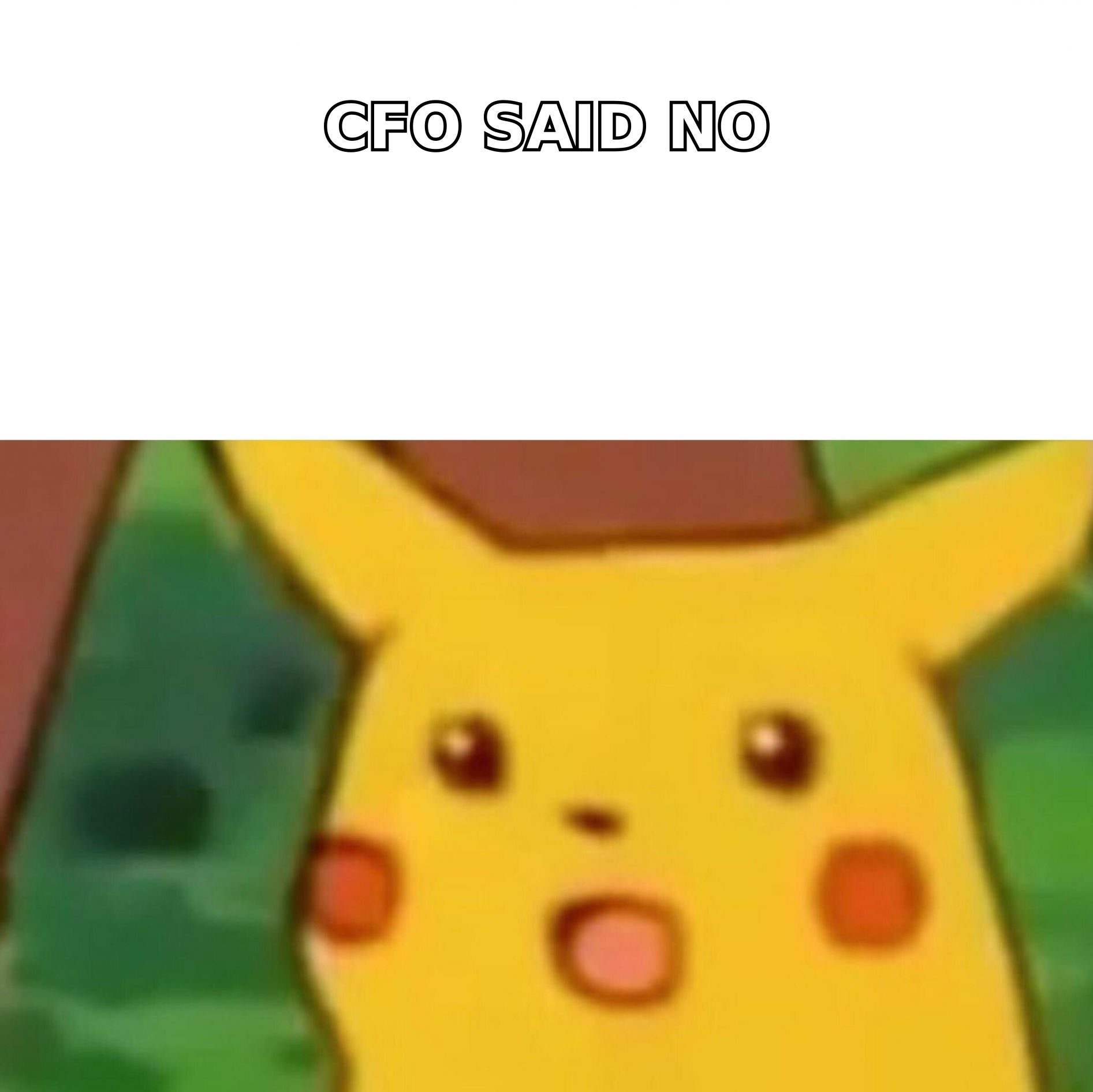
Consensus decay. Nobody says no. Everyone says "makes sense." The group cannot agree on priority, so the status quo wins by default. You lose to no decision, not to a competitor.
How big is a typical DMU in 2026?#
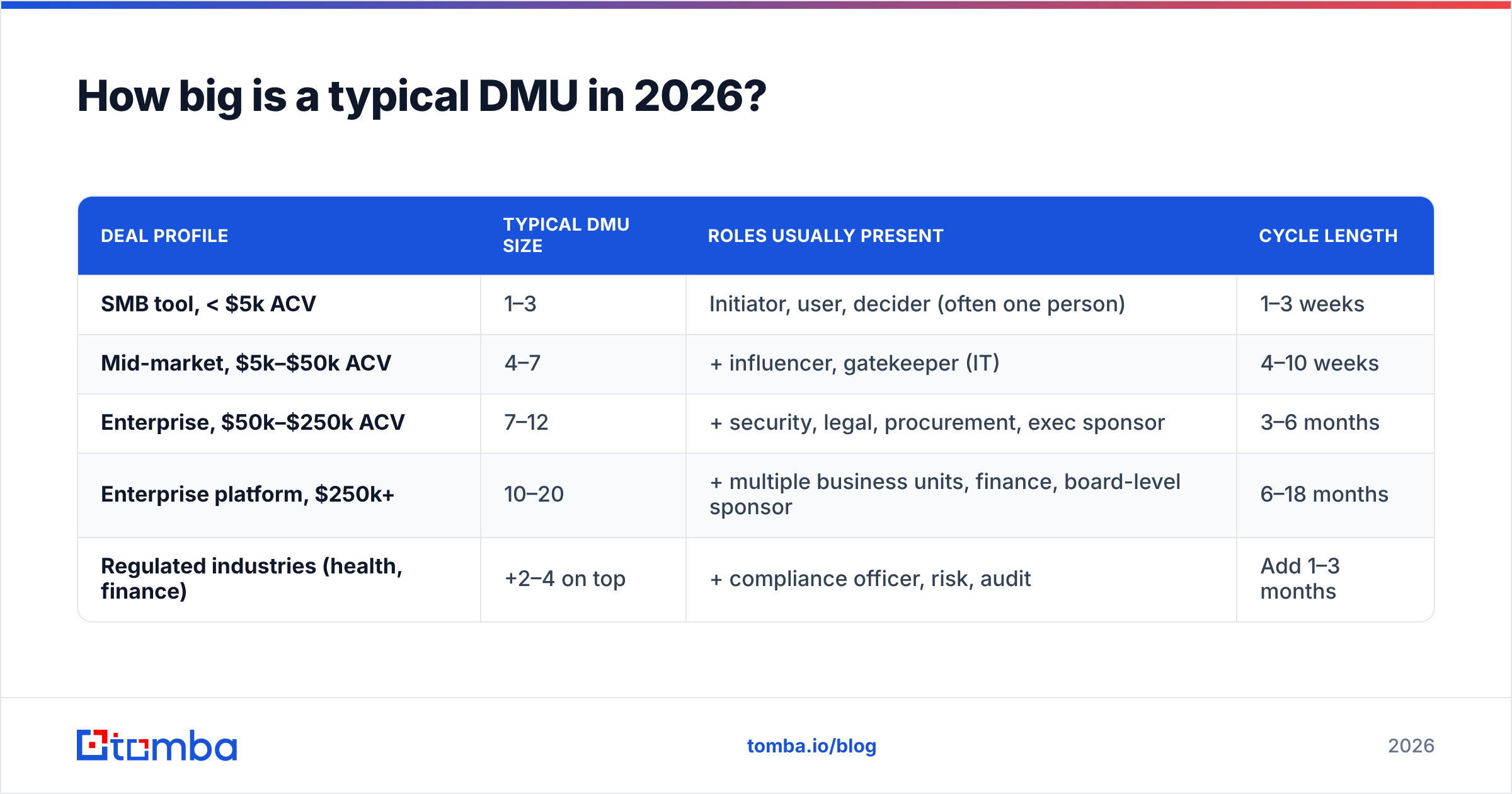
It scales with what the purchase touches, not with price alone. A useful rough model:
| Deal profile | Typical DMU size | Roles usually present | Cycle length |
|---|---|---|---|
| SMB tool, < $5k ACV | 1–3 | Initiator, user, decider (often one person) | 1–3 weeks |
| Mid-market, $5k–$50k ACV | 4–7 | + influencer, gatekeeper (IT) | 4–10 weeks |
| Enterprise, $50k–$250k ACV | 7–12 | + security, legal, procurement, exec sponsor | 3–6 months |
| Enterprise platform, $250k+ | 10–20 | + multiple business units, finance, board-level sponsor | 6–18 months |
| Regulated industries (health, finance) | +2–4 on top | + compliance officer, risk, audit | Add 1–3 months |
Two practical implications. First, if you sell a $60k platform and have two contacts in the account, you cover maybe 25% of the room. Second, DMU size is a forecasting input. A late-stage deal with one contact is not late-stage, whatever the CRM says.
How do you map a decision making unit DMU before the first call?#
Mapping is a five-step routine. It takes about 20 minutes per target account. Start with the shape of the org.
- Get the org shape. Pull leadership and team structure from LinkedIn, the careers page, and press releases. Titles hint at reporting lines. "Head of RevOps reporting to CRO" tells you where budget sits.
- Identify the likely decider by spend tier. Match your ACV to the authority level. Selling a $99 per month tool to a CTO is as wrong as selling a $200k platform to a junior analyst.
- Find the gatekeepers early. Search for security, IT ops, procurement, and legal titles. If the company handles regulated data, assume a compliance review exists and plan for it.
Now turn those names into people you can actually reach.
- Build verified contact records. Names without working emails are a list, not a map. Use a domain search to pull every public professional address at the company. Then run them through an email verifier so bounces do not burn your sender reputation mid-sequence.
- Enrich and segment by role. Attach seniority, department, and location to each contact. That lets you write per-role messaging instead of one generic blast. Contact enrichment turns a raw name list into a usable DMU map with titles, seniority tiers, and company context.
Here is how the common mapping approaches compare in practice:
| Approach | Coverage of the DMU | Data freshness | Cost per account | Best for |
|---|---|---|---|---|
| Manual LinkedIn research | High if you're patient | Very current | ~30–45 min of rep time | Named enterprise accounts |
| Domain search + verification | High across the org | Refreshed continuously | Cents per contact | Mid-market at volume |
| Prebuilt B2B contact lists (e.g. BookYourData, similar vendors) | Broad, role-filtered | Depends on refresh cycle | Per-record purchase | Fast list building, ICP-wide coverage |
| Asking your champion "who else is involved?" | Depends entirely on their candor | Real-time | Free | Every deal — but never alone |
| Intent/visitor data | Signals only, not names | Real-time | Subscription | Prioritizing which accounts to map |
The strongest workflow combines them. Use intent or visitor signals to pick the account. Use domain search plus verification to get the full contact set. Use your champion to confirm who holds the veto. None of the three replaces the other two.
How should your message change per DMU role?#
Same product, five different arguments. Write them separately.
- To the user: lead with time saved and how little changes about their day. "Your team keeps working in Sheets. The enrichment happens in the background."
- To the influencer: lead with mechanism. Show the API docs, the data sources, the error handling. Technical evaluators trust vendors who publish specifics and distrust vendors who publish adjectives.
- To the gatekeeper: lead with compliance posture. SOC 2 status, data residency, SSO, DPA availability, subprocessor list. Send it unprompted. It buys you two weeks.
The last two seats care about money.
- To the decider: lead with a quantified outcome and a downside floor. "Reps recover 6 hours a week. If they do not, you are out one quarter, not one year."
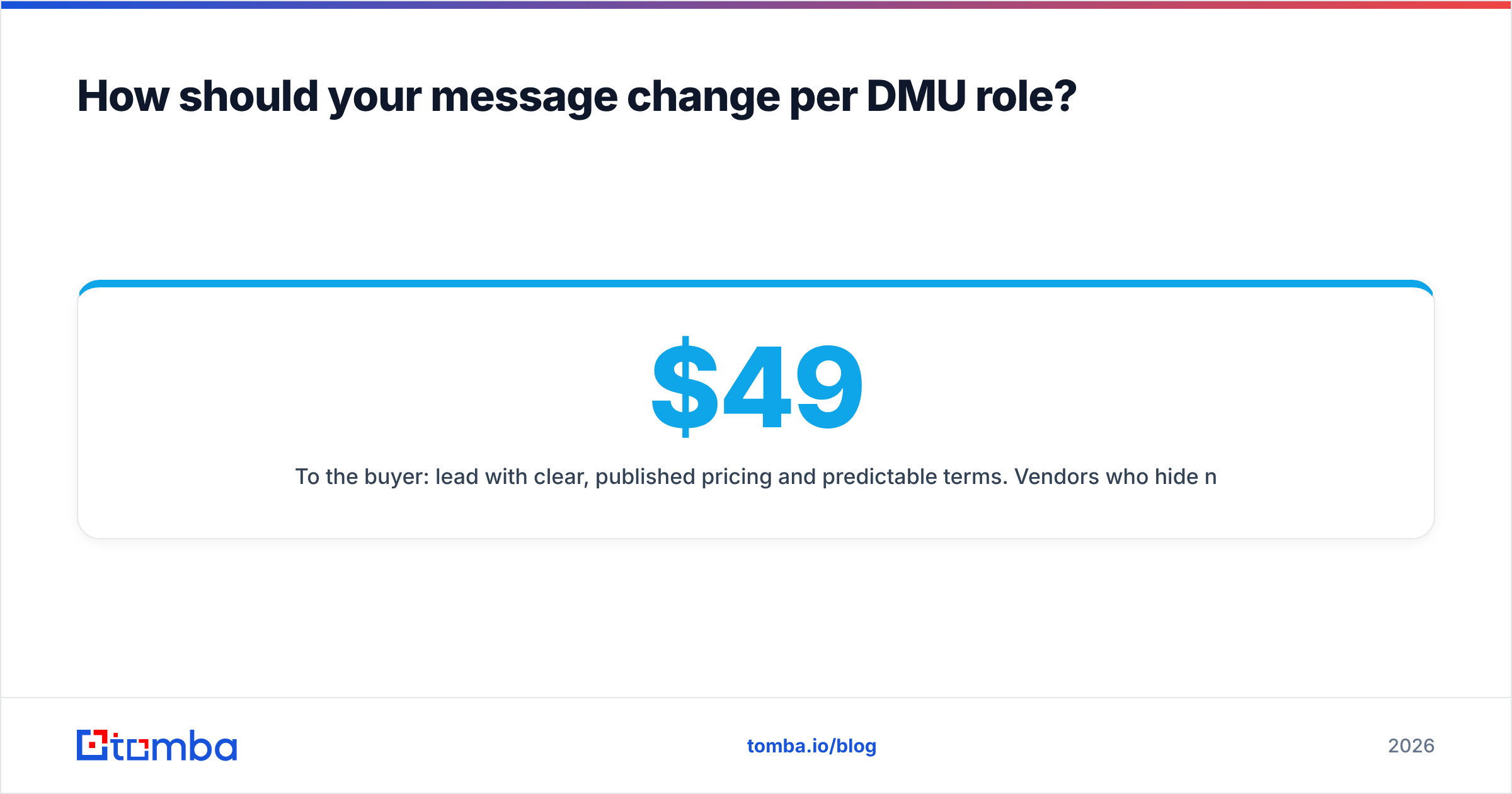
- To the buyer: lead with clear, published pricing and predictable terms. Vendors who hide numbers lose points in procurement scoring. A public pricing page — Free at 25 searches per month, Starter at $49/mo, Growth at $99/mo, Pro at $249/mo — removes a full round of back-and-forth.
Multi-threading is not spamming the org chart. Reference your champion where it helps ("Sara asked me to loop you in on the security questions"). Never send two people in the same DMU identical copy. It is the fastest way to look automated. Peer reviews help too. Influencers and deciders often check you on sites like G2 before they answer your second email.
Is a DMU the same as a buying committee or buying group?#
Functionally, yes. You will see the terms used interchangeably in most sales content, including HubSpot's sales blog. The nuance is where each term comes from.
- Decision making unit DMU is the academic and European term, rooted in organizational buying research. It emphasizes roles.
- Buying committee is the North American sales-org term. It emphasizes the meeting — the group that convenes to decide.
- Buying group is the marketing-ops framing, common in ABM. It emphasizes the account-level unit of measurement. You score and route the group, not the individual lead.
The difference matters most for RevOps. If your CRM scores individual leads, a nine-person DMU shows up as nine separate MQLs from one account. Each one gets a different sequence from a different rep. Buying-group scoring rolls contacts up to the account and measures role coverage instead. If you are rebuilding lead routing this year, that is the change worth making.
What are the most common DMU mistakes?#
Assuming the loudest voice is the decider. Enthusiasm is not authority. The person who answers fastest often has the least to lose.
Waiting for an introduction. Champions delay introductions because introductions create risk for them. Ask, but build parallel threads yourself. Most buyers do not see that as a betrayal. They see it as thorough.
Treating procurement as an obstacle. Procurement wants a defensible decision, not the lowest price. Give them a clean comparison document and a blocker becomes a co-pilot.
Ignoring the negative influencer. Someone in that room already uses a competitor, or built the internal tool you would replace. Find them before the decision meeting, not after.
Mapping once. DMUs churn. Over a six-month enterprise cycle, expect at least one member to leave or change roles. Re-verify contacts mid-cycle. A bounced email to the new CFO at week 18 is an avoidable own-goal.
Confusing coverage with contact count. Ten contacts in engineering is not coverage. Coverage means one live relationship in each critical role: decider, gatekeeper, user.
How do you know the DMU is actually moving?#
Watch for group behavior, not individual replies:
- New people appear on threads without you adding them. The strongest positive signal in B2B. It means an internal conversation happened.
- Questions shift from "what does it do" to "how would we roll it out." Evaluation has moved to implementation planning.
- Security or legal reaches out directly. Gatekeepers only spend time on deals someone already wants.
- Pricing questions get specific about seat counts and terms. The buyer role is active.
- Your champion asks for material they can forward. They are presenting internally. Give them a one-pager built for the decider, not a feature list.
The reverse is just as clear. If replies stay warm but never expand beyond one person for more than three weeks, the DMU never convened. That deal is not slipping. It has not started.
Where should you start this week?#
Pick your ten largest open opportunities. Count the verified, reachable contacts in each. If any has fewer than three, with no gatekeeper and no decider identified, that deal is single-threaded and your forecast is fiction.
Then fix the data layer. DMU mapping fails on bad contact records more often than it fails on strategy. Tomba's Email Finder takes a company domain and a name and returns a verified professional email in seconds. That is how you build a full buying-committee map — user, influencer, gatekeeper, decider, buyer — instead of hoping one champion carries the deal alone. Start on the free tier at 25 searches a month. Move to Starter at $49/mo when multi-threading becomes standard practice on your team.
Related guides#
Ready to find emails that actually work?
Join 150,000+ professionals who stopped guessing and started sending. Free credits on signup — no credit card required.
Get the Tomba newsletter
Practical outbound tactics and product updates — once every two weeks.
About the author