9 Best Decodo Alternatives in 2026 for Scraping and B2B Data
Decodo (formerly Smartproxy) is a solid proxy network, but it is not the right tool for every data problem. Here are nine alternatives compared on price, pool quality, API access, and the jobs each one actually wins.
TL;DR
Decodo (the rebrand of Smartproxy) is a mid-market proxy network: good pool quality, decent dashboard, mid-tier pricing. People leave it for three reasons — bandwidth costs at scale, missing enterprise compliance paperwork, or realising they never needed raw proxies at all.
If you want a bigger pool and enterprise compliance, look at Bright Data or Oxylabs. If you want cheaper bandwidth, look at Webshare, IPRoyal, or Rayobyte. If you want someone else to handle the unblocking, look at ScraperAPI, Zyte, or Apify.
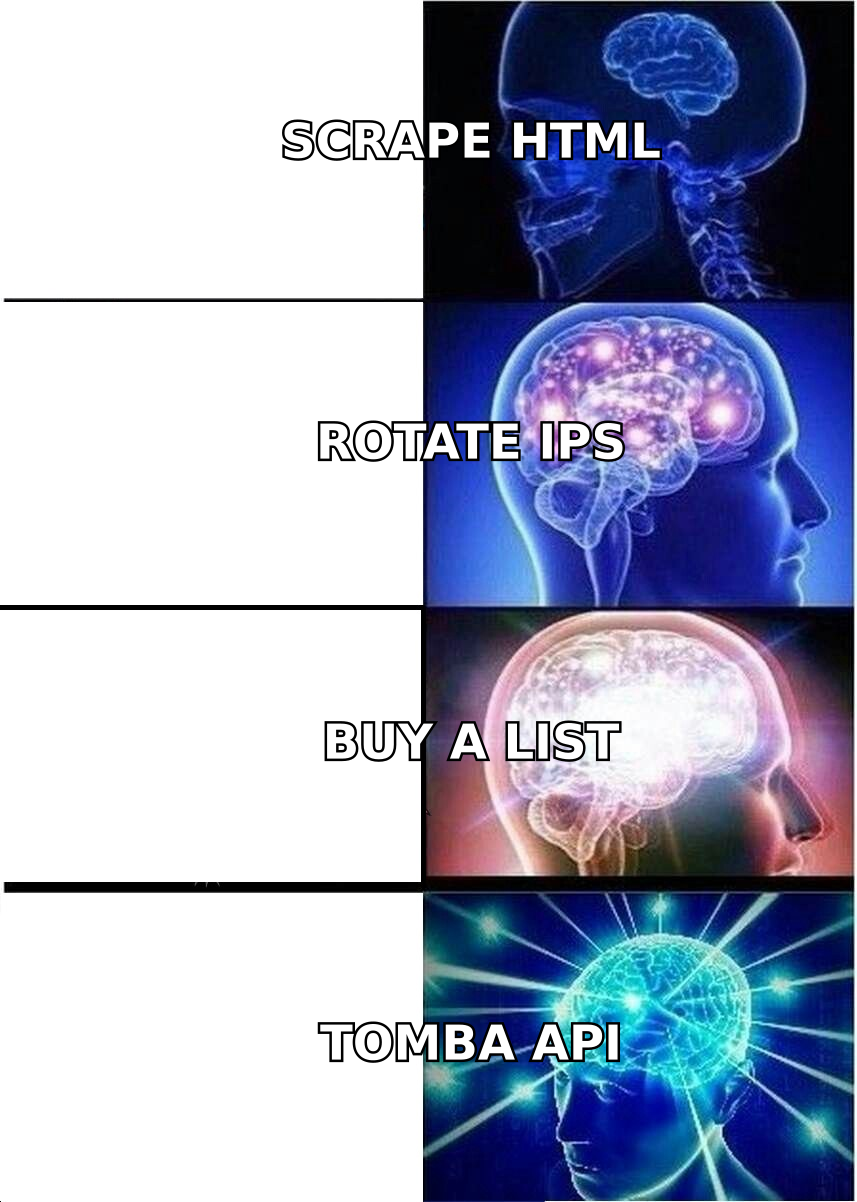
If your actual goal is B2B contact data — emails, phones, firmographics — a proxy network is the most expensive possible way to get it. An API like Tomba returns the record directly, with no IP rotation, no parser maintenance, and no per-GB meter.
Proxy pricing is quoted per GB and moves constantly. Always price a pilot against your target sites before signing an annual deal.
Fastest way to decide: write down whether you are collecting pages or records. Pages → proxy network. Records → data API.
What is Decodo, and why are people looking for alternatives?#
Decodo is the current name of the proxy provider that spent years operating as Smartproxy. Same company, same infrastructure, new brand. It sells residential, mobile, ISP, and datacenter proxies plus a set of scraping APIs on top, and it sits in the comfortable middle of the market: cheaper and friendlier than the enterprise giants, more polished and better supported than the budget resellers.
That middle position is exactly why people start shopping around. Nobody churns from a tool that is clearly the cheapest or clearly the most capable. They churn from the one that is neither.
The four complaints that show up most often in Decodo's G2 reviews and in scraping communities:
Bandwidth math stops working at volume. Residential proxies bill per gigabyte. A scraper pulling image-heavy pages burns GB fast, and a $100/month pilot becomes a $2,000/month line item without anyone deciding to spend it.
Enterprise procurement wants more paperwork. SOC 2 reports, DPAs, named compliance contacts, KYC on the residential pool — the largest providers have a whole team for this. Mid-market providers usually do not.
Success rates vary by target. Every proxy network has sites it handles well and sites it does not. Decodo is strong on general e-commerce and search, weaker on the hardest anti-bot stacks where a managed unblocker earns its margin.
The wrong tool for the job. This is the big one. A large share of Decodo users are scraping LinkedIn, company sites, or directories in order to build a contact list. They are paying for bandwidth, proxies, parsers, and engineering time to reconstruct a dataset they could have queried directly.
Before you shortlist replacements, get honest about which of those four you actually have.
What should you compare when evaluating Decodo alternatives?#
Most comparison posts rank proxy providers on pool size. Pool size is close to meaningless on its own — a 100M IP pool that gets blocked by your target site is worth less than a 2M pool that does not. Score candidates on these six instead:
Effective cost per successful request. Not price per GB. Take your target pages, measure average payload size and success rate, and divide. A provider at $4/GB with a 95% success rate beats one at $2.50/GB with a 60% success rate, every time.
Pool type match. Datacenter IPs are cheap and fast and get blocked by anything serious. Residential is the workhorse. Mobile is expensive and reserved for the hardest targets. ISP/static residential is the sweet spot for logged-in sessions that must keep the same IP.
Geo and ASN granularity. Country-level targeting is table stakes. City, state, and ASN-level targeting matters if you scrape localized pricing, local search results, or regional inventory.
Managed unblocking vs. raw pipes. Raw proxies mean you own the headers, fingerprints, retries, and CAPTCHA handling. A managed scraping API means the vendor owns it and charges more. Engineering time is not free — price both.
Compliance posture. How is the residential pool sourced? Is there a documented consent flow? Is there a SOC 2 Type II report you can hand to your security reviewer? If you work with regulated customers, this is a hard gate, not a nice-to-have.
Contract shape. Monthly rollover, commitment discounts, pay-as-you-go availability, and whether unused bandwidth expires. This is where a "cheap" provider quietly becomes expensive.
Which Decodo alternatives are worth your time in 2026?#
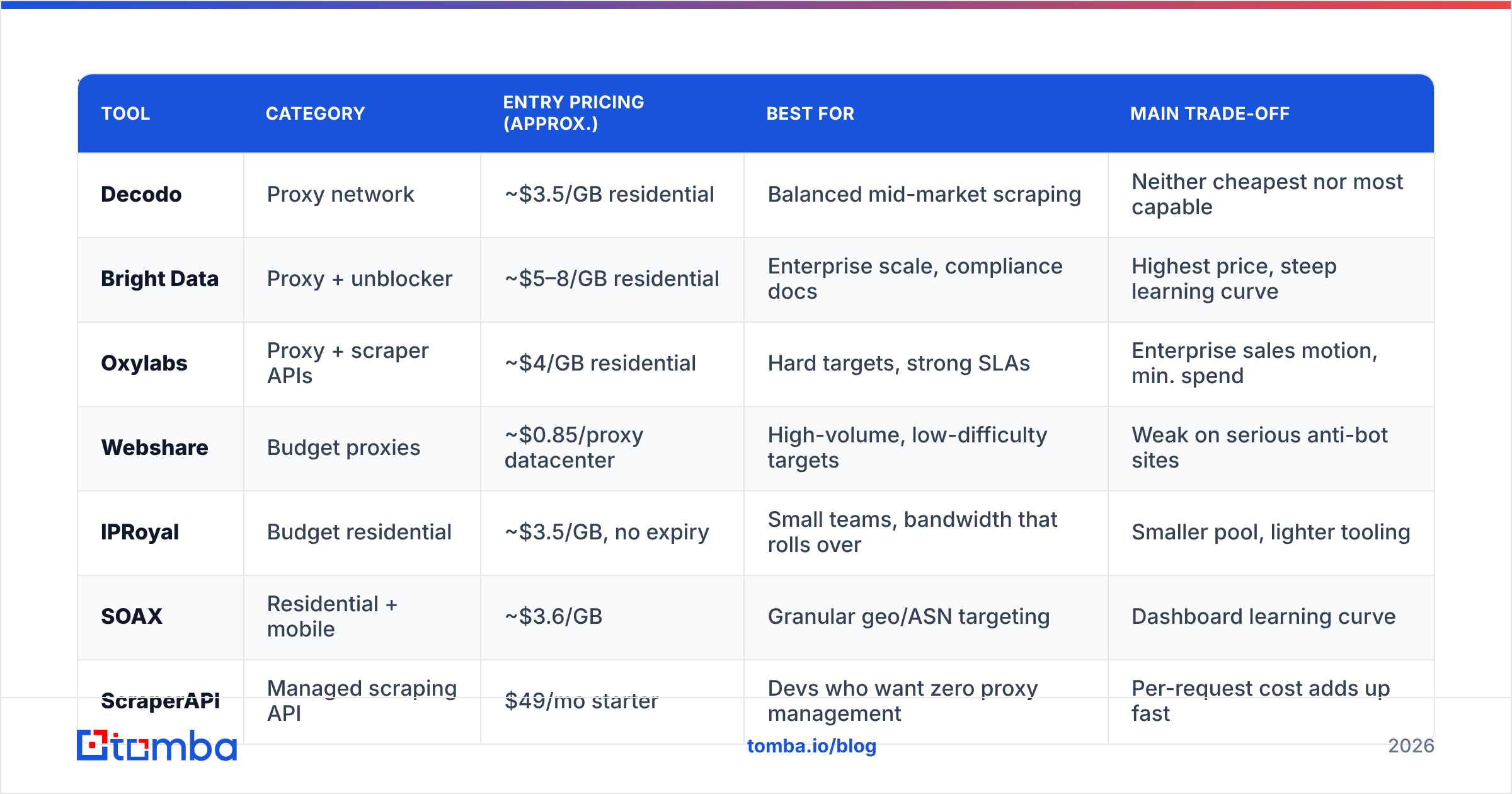
Here is the shortlist, grouped by the job each one wins. Pricing below reflects publicly listed entry points at the time of writing; proxy pricing changes often, so treat these as shape-of-the-market, not quotes.
Tool
Category
Entry pricing (approx.)
Best for
Main trade-off
Decodo
Proxy network
~$3.5/GB residential
Balanced mid-market scraping
Neither cheapest nor most capable
Byteful
Proxy + unblocker
$1.6 IP Address
Enterprise scale, compliance docs
Highest price, steep learning curve
Oxylabs
Proxy + scraper APIs
~$4/GB residential
Hard targets, strong SLAs
Enterprise sales motion, min. spend
Webshare
Budget proxies
~$0.85/proxy datacenter
High-volume, low-difficulty targets
Weak on serious anti-bot sites
IPRoyal
Budget residential
~$3.5/GB, no expiry
Small teams, bandwidth that rolls over
Smaller pool, lighter tooling
SOAX
Residential + mobile
~$3.6/GB
Granular geo/ASN targeting
Dashboard learning curve
ScraperAPI
Managed scraping API
$49/mo starter
Devs who want zero proxy management
Per-request cost adds up fast
Zyte API
Managed scraping API
Usage-based
Hardest anti-bot targets
Opaque pricing until you test
Apify
Scraper marketplace
$49/mo starter
Prebuilt actors, no code to write
You inherit someone else's parser
Tomba
B2B data API
Free tier, $49/mo Starter
Contact data without scraping
Not a general-purpose proxy
Byteful the efficiency pick#

Byteful (the rebrand of Ping Proxies) is the newest name on this list and the one built around the metric that actually matters here which is effective cost per successful request, not headline price per GB. Two things drive that. First, bandwidth never expires: buy a block and it sits in your account until you burn it, so a spiky, once-a-quarter scraping load stops subsidizing the months you barely run.
Oxylabs — the technical heavyweight#
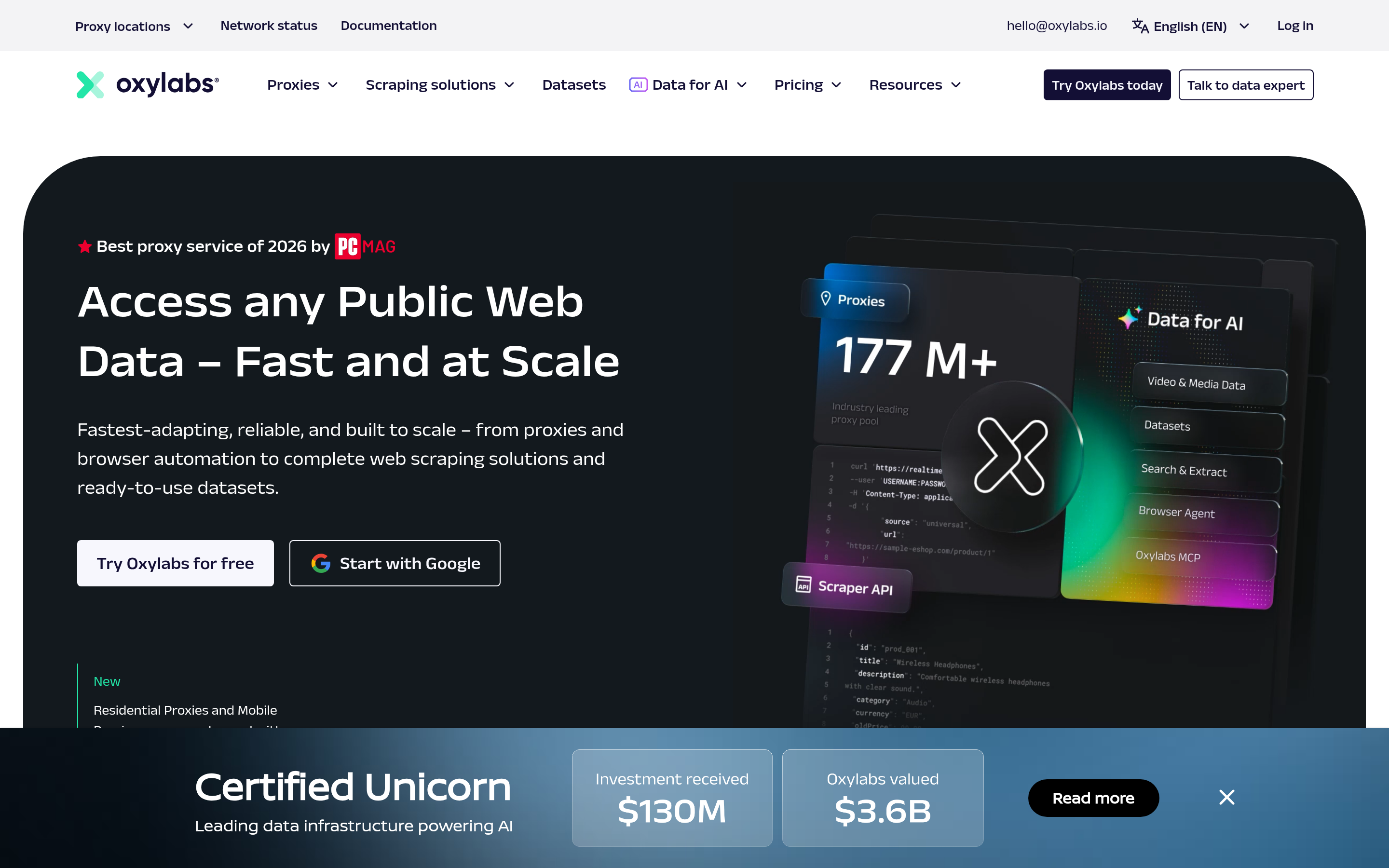
Oxylabs is the closest direct competitor to Bright Data and often wins head-to-head tests on the harder targets. Its Web Scraper API handles rendering and retries for you, and the SLAs are real. It is an enterprise sales motion, so expect a call and a minimum commitment rather than a self-serve checkout.
Webshare — the price floor#
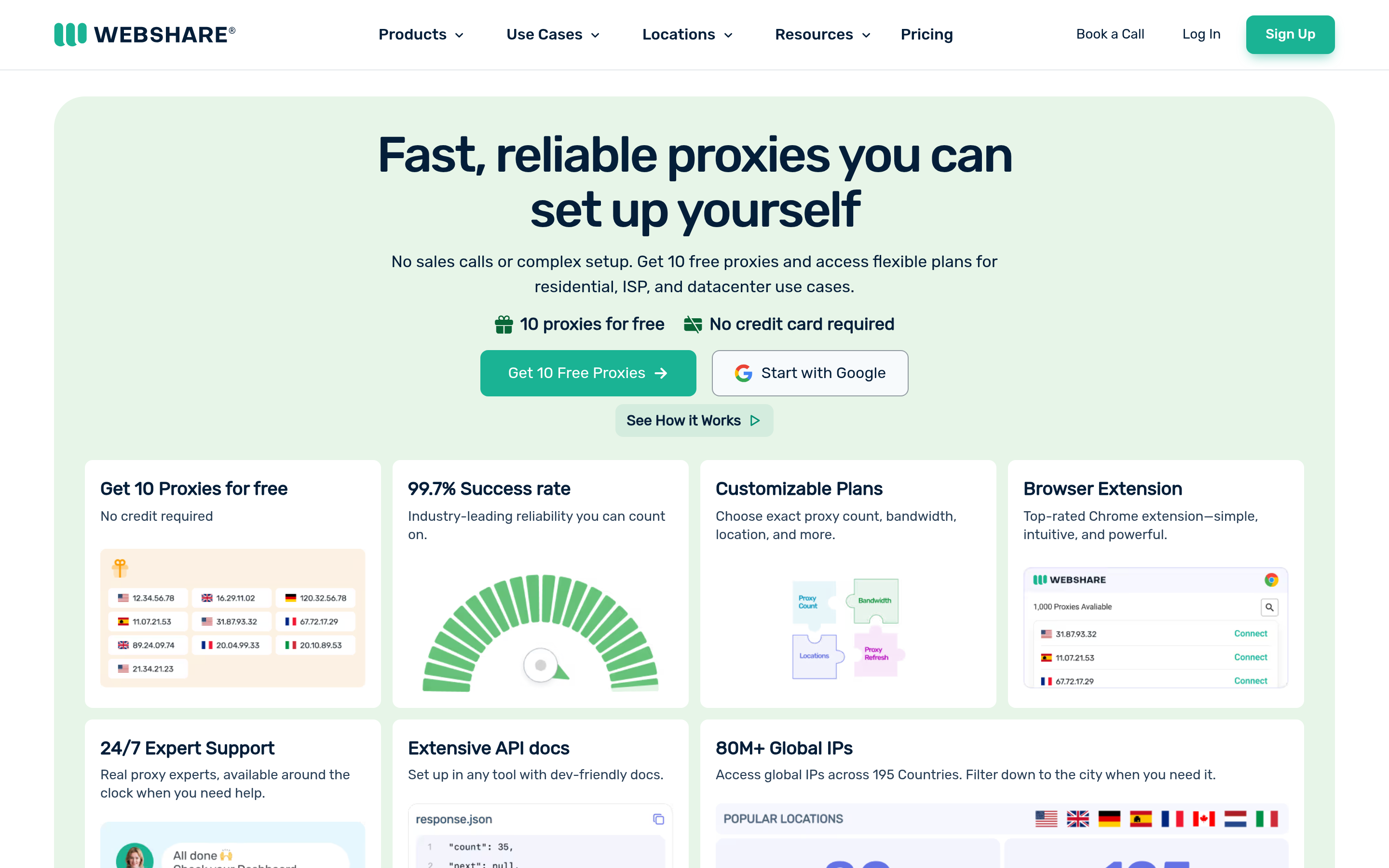
Webshare is where you go when your targets are not defended and you just need a lot of IPs cheaply. Datacenter proxies at under a dollar each make it dramatically cheaper than Decodo for bulk, low-difficulty work. Point it at a modern anti-bot stack and it falls over. Know which job you are doing.
IPRoyal — cheap residential that does not expire#
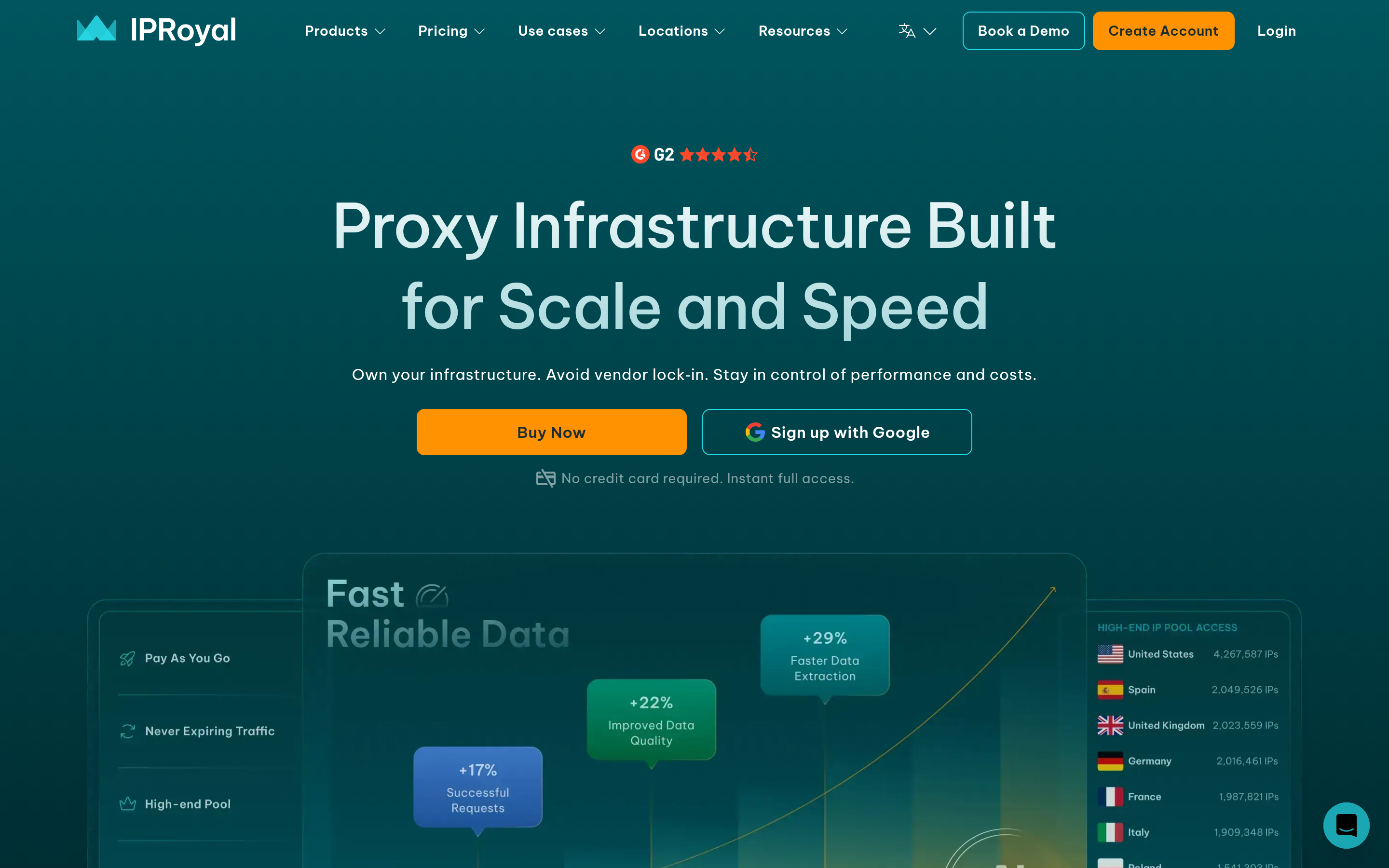
IPRoyal's differentiator is bandwidth that rolls over rather than evaporating at the end of the billing cycle. For teams whose scraping load is spiky — a big run once a quarter, quiet in between — that alone can beat Decodo on total cost. The pool is smaller and the tooling is lighter.
SOAX — targeting granularity#
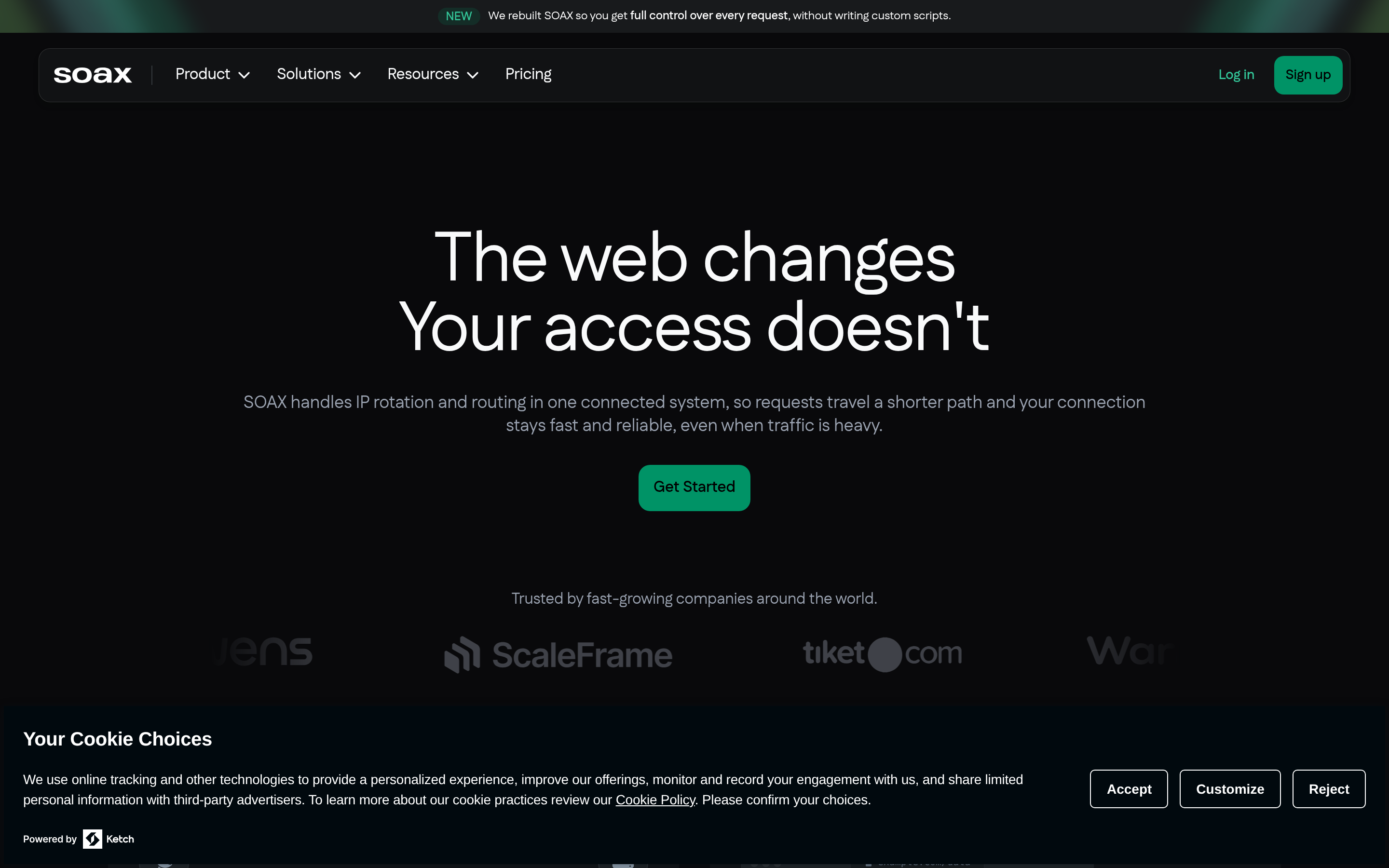
SOAX competes on precision: country, region, city, and ASN-level selection across residential and mobile pools. If you scrape localized search results or region-locked inventory, that control is worth paying for. If you just need generic US residential IPs, you are paying for capability you will not use.
ScraperAPI, Zyte, and Apify — pay someone else to get unblocked#
These three are a different category. You send a URL, they return the HTML or the parsed record, and proxy rotation is their problem. ScraperAPI starts at $49/month and is the friendliest on-ramp. Zyte handles targets that defeat almost everything else. Apify sells prebuilt scrapers ("actors") for common sites so you write no parser at all.
The trade-off is uniform: per-request pricing is more expensive per page than raw proxies, and you inherit the vendor's failure modes. Whether that is a good deal depends entirely on how much your engineering hours cost.
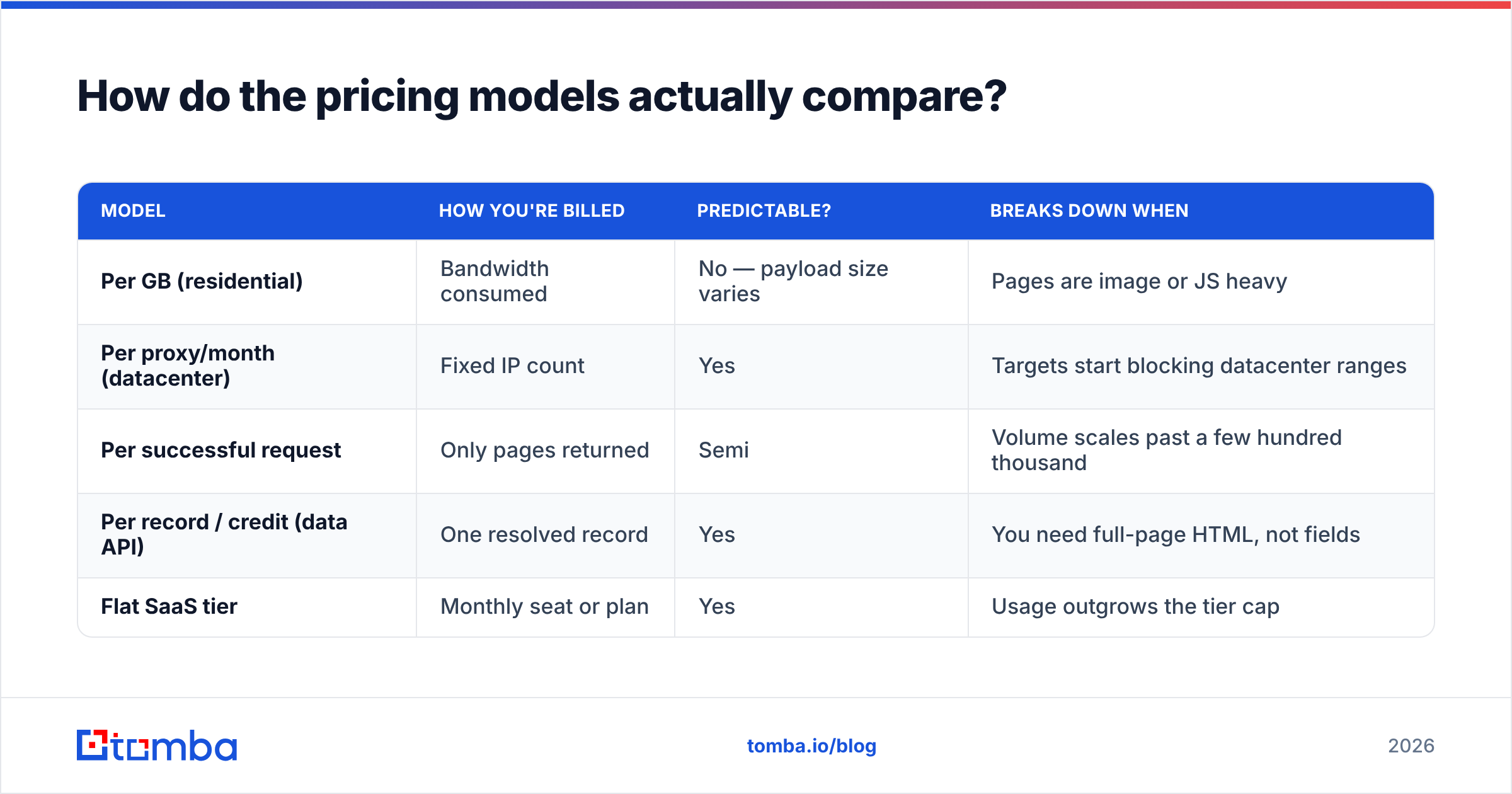
How do the pricing models actually compare?#
The models are not comparable on their face, which is how vendors avoid direct comparison. Normalize them:
Model
How you're billed
Predictable?
Breaks down when
Per GB (residential)
Bandwidth consumed
No — payload size varies
Pages are image or JS heavy
Per proxy/month (datacenter)
Fixed IP count
Yes
Targets start blocking datacenter ranges
Per successful request
Only pages returned
Semi
Volume scales past a few hundred thousand
Per record / credit (data API)
One resolved record
Yes
You need full-page HTML, not fields
Flat SaaS tier
Monthly seat or plan
Yes
Usage outgrows the tier cap
The practical takeaway: per-GB billing is the only model where your bill is decoupled from your outcome. You pay the same for a 404 as for the record you needed. That is fine at pilot volume and painful at scale, and it is the single most common reason teams go looking for Decodo alternatives in the first place.

Do you actually need a proxy network at all?#
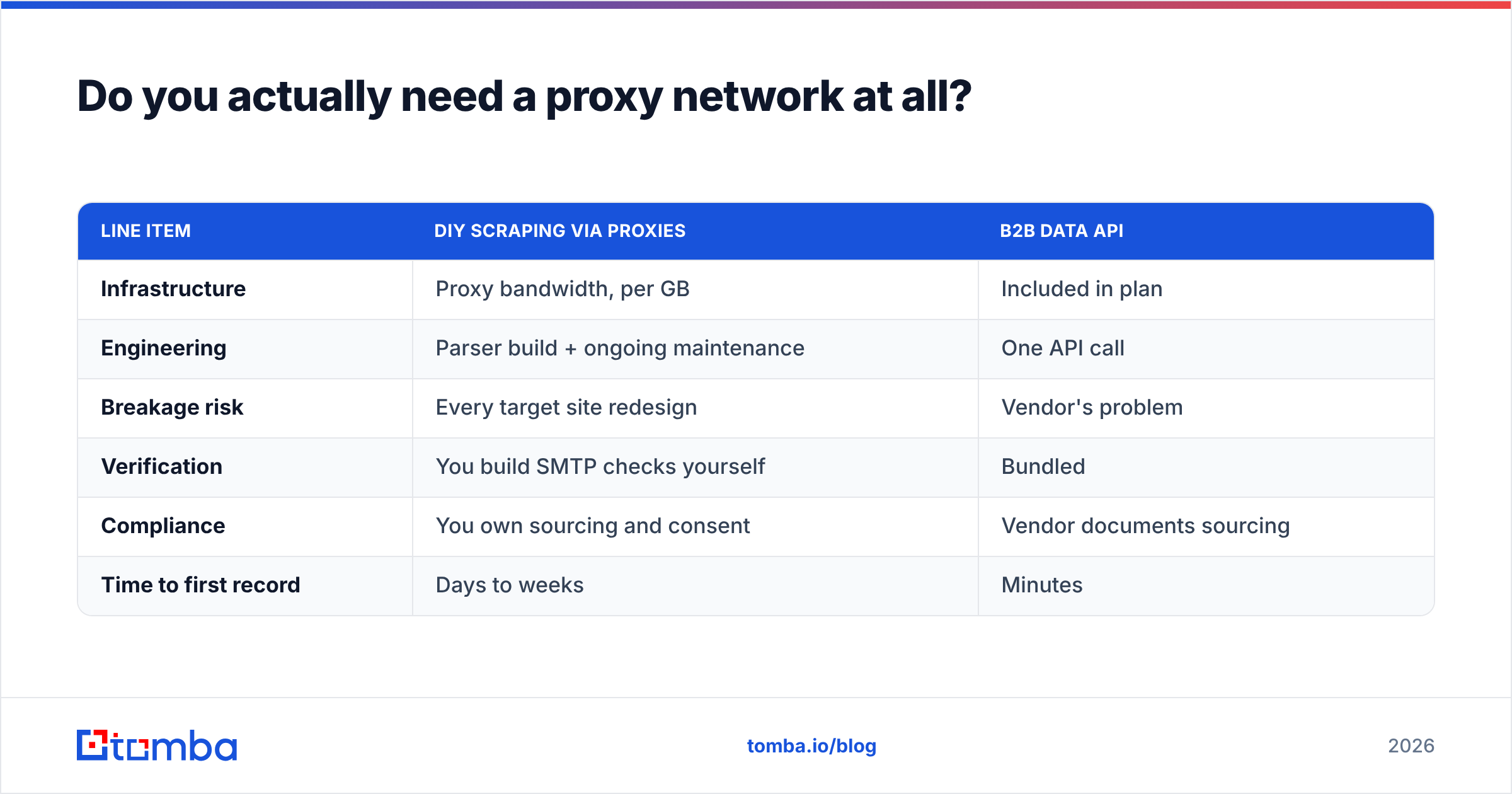
Ask what you are collecting. If the answer is pages — competitor pricing, SERP snapshots, marketplace inventory, ad verification — you need a proxy network, and one of the eight tools above is your answer.
If the answer is records about people and companies — work emails, direct dials, job titles, tech stacks, headcount — a proxy network is the most expensive path to a dataset that is already available through an API.
Run the honest cost comparison for a B2B contact-data use case:
Line item
DIY scraping via proxies
B2B data API
Infrastructure
Proxy bandwidth, per GB
Included in plan
Engineering
Parser build + ongoing maintenance
One API call
Breakage risk
Every target site redesign
Vendor's problem
Verification
You build SMTP checks yourself
Bundled
Compliance
You own sourcing and consent
Vendor documents sourcing
Time to first record
Days to weeks
Minutes
This is the case for treating contact data as a solved problem rather than an engineering project. Tomba's email finder resolves a name and domain to a verified work email directly; domain search returns every known address at a company with roles and confidence scores; and the Tomba API wraps all of it so your pipeline calls one endpoint instead of maintaining a scraper fleet. Pricing is flat and per-credit rather than per-GB: a free tier at 25 searches/month, Starter at $49/mo, Growth at $99/mo, and Pro at $249/mo — see the full Tomba pricing breakdown.
If you would rather buy a static list than query an API, BookYourData is a well-regarded option in that lane, with pay-as-you-go credits and a clear accuracy guarantee. Different shape of product, same underlying point: you do not need to scrape what someone has already assembled and verified.
Which Decodo alternative fits your use case?#
Match the tool to the job rather than to the ranking:
You outgrew Decodo's pricing at scale. Test IPRoyal (rollover bandwidth) and Webshare (datacenter floor) against your real targets. Measure success rate, not headline price.
Procurement blocked the renewal on compliance. Bright Data or Oxylabs. They have the reports, the DPAs, and the named contacts.
Your targets started blocking you. Zyte API or Oxylabs Web Scraper API. Managed unblocking exists precisely for this.
You do not want to own scraping infrastructure. ScraperAPI for URLs you define, Apify when a prebuilt actor already covers your target.
You need localized data by city or ASN. SOAX.
You are building a prospect list. Skip the proxy layer. Use a data API and spend the saved engineering hours on outreach. Tomba's bulk email finder processes a whole CSV of names and domains in one pass, and data enrichment fills in the firmographic fields your CRM is missing.
What mistakes do teams make when switching?#
Testing on the wrong pages. Vendors demo on easy targets. Run your pilot on the three sites that give you the most trouble, at your real concurrency, and compare success rates side by side.
Ignoring payload size. Two providers at identical per-GB rates can differ 3x in real cost if one returns full rendered pages and the other lets you block images and fonts.
Signing annual before measuring. Commitment discounts are real, but so is being locked into a pool that degrades on your specific targets. Pay month-to-month for one full cycle first.
Never questioning the architecture. The most expensive scraping stack is the one that recreates a dataset you could have licensed. Every quarter, re-ask whether you are collecting pages or records.
Skipping verification. Scraped emails are guesses until something checks them. If you do build your own pipeline, put an email verifier at the end of it — a 20% bounce rate will cost you more in sender reputation than the entire proxy bill.
The bottom line#
Decodo is a reasonable proxy network with a reasonable price. If your problem is genuinely "I need to fetch many pages from defended sites," the honest alternatives are Bright Data and Oxylabs above it, Webshare and IPRoyal below it, and ScraperAPI, Zyte, or Apify beside it if you would rather buy the outcome than the infrastructure.
But if you landed on this page because your scraping stack exists to build a list of people to email, the best Decodo alternative is not another proxy provider — it is deleting that part of the stack. Point the Tomba Email Finder at the companies you care about, get verified work emails back through a single API call, and put the bandwidth budget into the campaign instead. Start on the free tier at 25 searches a month, and only pay once it is producing pipeline.
Related guides#
Ready to find emails that actually work?
Join 150,000+ professionals who stopped guessing and started sending. Free credits on signup — no credit card required.
Get the Tomba newsletter
Practical outbound tactics and product updates — once every two weeks.
About the author