Decodo Pricing Reviews Pros and Cons: A 2026 Breakdown
Decodo (formerly Smartproxy) sells bandwidth, not contacts. Here's what its plans really cost per GB, where the bill quietly grows, and when a data API is the cheaper path to the same leads.
This guide covers decodo pricing reviews pros and cons in plain terms. You get the real per-GB rates, what buyers praise, what they complain about, and when a different tool does the same job for less.
TL;DR
- Decodo is the rebranded Smartproxy: a proxy and web-scraping infrastructure vendor. You buy bandwidth and IPs, not finished B2B contact records.
- Pricing is metered. Residential proxies run roughly $3.50/GB pay-as-you-go, dropping toward $1.50–$2.20/GB on committed monthly plans. Datacenter and ISP proxies cost less, but they get blocked far more often.
- The real cost is rarely the sticker price. Retries, failed requests, image-heavy pages, and unused committed GBs are where budgets leak.
- Reviews are genuinely good on support and uptime. The recurring complaints: confusing product sprawl, per-GB math that surprises finance, and a learning curve if nobody on your team writes code.
- If your end goal is verified email addresses for outbound, a data API bills per result instead of per gigabyte — usually a fraction of the cost and none of the maintenance.
What is Decodo, and what changed after the Smartproxy rebrand?#
Decodo is the company formerly known as Smartproxy. The rename landed in 2025, the product line stayed intact, and existing customers kept their dashboards and credentials. If you find a 2023 review of Smartproxy, it is describing the same infrastructure under an older logo.
The core business is proxies. These are rented IP addresses that route your requests. Target sites then see many different visitors instead of one server hammering them. On top of that sit managed scraping products: a Web Scraping API, a SERP scraper, and a social media scraper. A Site Unblocker handles headers, retries, and CAPTCHA-adjacent friction for you.
Think of it like a delivery fleet. A proxy network is the fleet of unmarked vans. The scraping APIs are the fleet plus a driver who already knows the route. You pay for distance travelled either way.
That distinction matters for anyone buying Decodo for lead generation. Decodo sells the vans. It does not sell the packages. Turning raw HTML into a clean, verified contact list is still your job. That job is where most of the time and cost lands.
How does Decodo pricing actually work in 2026?#
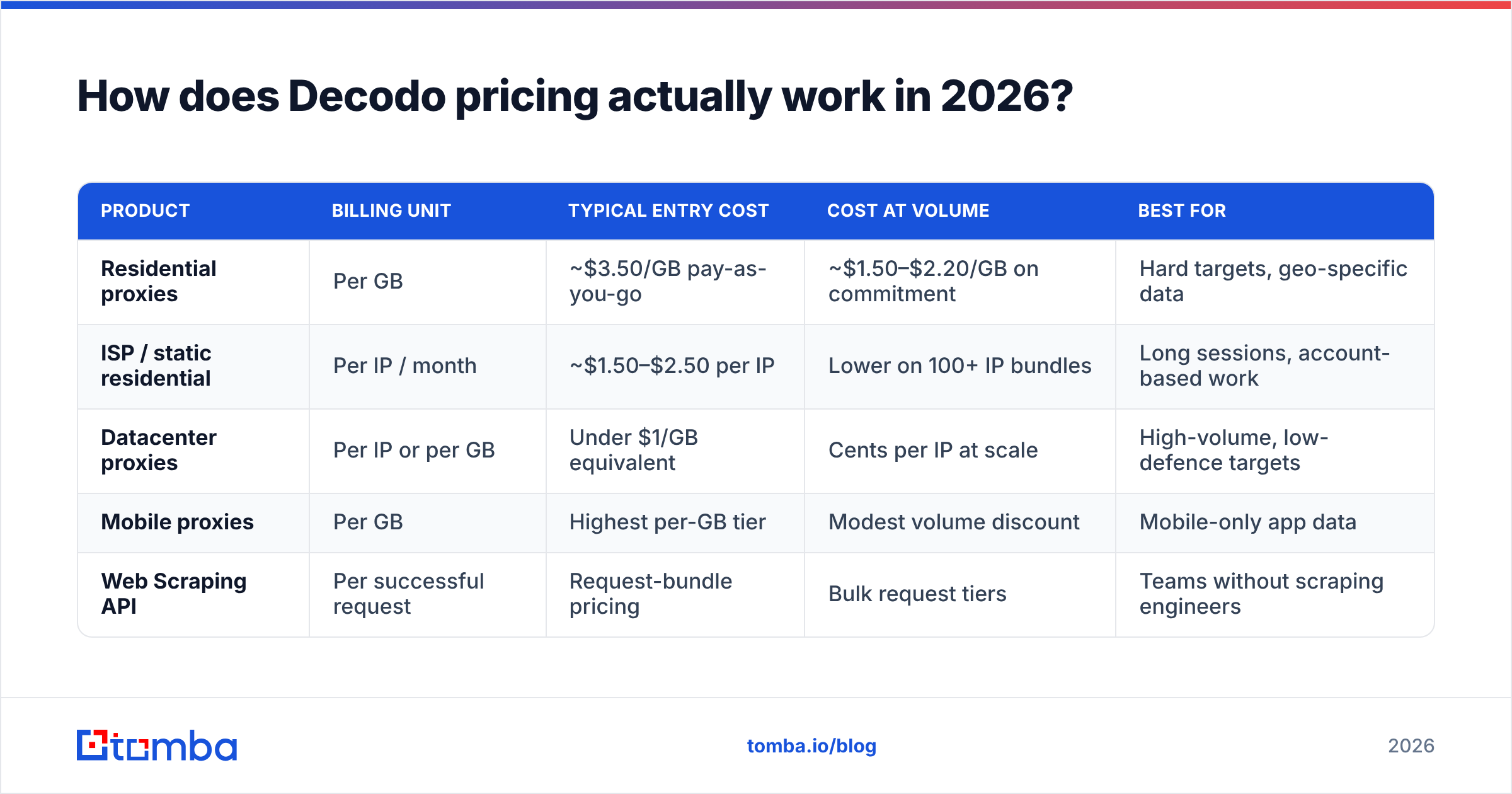
Decodo prices by product line, and each line meters differently. Residential and mobile bill per gigabyte of traffic. Datacenter and ISP proxies bill either per IP per month or per GB. Scraping APIs bill per successful request. Mixing three billing models in one account is the single biggest reason invoices surprise people.
Here is the shape of the lineup at the time of writing. Treat these as approximate bands. Decodo adjusts tiers often, so verify on the official pricing page before you budget.
| Product | Billing unit | Typical entry cost | Cost at volume | Best for |
|---|---|---|---|---|
| Residential proxies | Per GB | ~$3.50/GB pay-as-you-go | ~$1.50–$2.20/GB on commitment | Hard targets, geo-specific data |
| ISP / static residential | Per IP / month | ~$1.50–$2.50 per IP | Lower on 100+ IP bundles | Long sessions, account-based work |
| Datacenter proxies | Per IP or per GB | Under $1/GB equivalent | Cents per IP at scale | High-volume, low-defence targets |
| Mobile proxies | Per GB | Highest per-GB tier | Modest volume discount | Mobile-only app data |
| Web Scraping API | Per successful request | Request-bundle pricing | Bulk request tiers | Teams without scraping engineers |
Three mechanics decide your actual bill:
- You pay for bytes, not for rows. A product page that returns 2 MB of markup, fonts, and images costs the same as one that returns the 400 bytes you needed. Ten thousand such pages is roughly 20 GB — about $70 pay-as-you-go before a single record is parsed.
- Failed requests still consume bandwidth. A blocked or CAPTCHA'd response is a response. Aggressive retry logic can double a monthly bill without adding a single usable record.
- Committed GBs expire. Monthly plans get you the lower per-GB rate in exchange for a use-it-or-lose-it allowance. A team that over-forecasts by 30% pays the discounted rate on volume it never touched, which lands right back at the pay-as-you-go effective price.
There is a free trial and a money-back window, which is more generous than parts of this market. Use both. Run your actual target list through a trial before you commit to a tier. Average page weight on your targets is the only number that predicts your bill.

What do Decodo reviews say — and what do they leave out?#
Sentiment across review platforms sits in the "solid, not thrilling" band. On G2 and comparable directories, Decodo earns high marks for two things. The first is 24/7 human support that answers in minutes rather than days. The second is pool reliability on mainstream targets. Both hurt badly when they fail, so the scores are earned.
The critical reviews cluster around four themes, and they are worth reading literally:
- "I couldn't tell which product I needed." Four proxy types plus three scraping APIs is a lot of surface area for a first-time buyer. People buy datacenter proxies for a target that requires residential, get blocked, and blame the pool.
- "The bill grew faster than the data." Almost always retry loops or unfiltered asset downloads, not a pricing trick — but the outcome is the same for the person explaining it to finance.
- "You need a developer." The dashboard is polished. The work behind it is still code: request headers, session rotation, parsers that break when a target ships a redesign.
- "Success rates drop on hard targets." True of every provider. Sites with serious anti-bot layers degrade everyone's numbers. The honest question is whether the managed Scraping API recovers them at an acceptable per-request price.
What reviews rarely mention is the hidden line item: engineering maintenance. Parsers rot. A target redesigns its DOM and your extraction silently returns nulls for a week. Cost that at even four engineering hours a month and it usually exceeds the proxy spend itself.
What are the real pros of Decodo?#
- Genuine scale and geo-coverage. The pool runs into the hundreds of millions of IPs across 190+ locations. Country- and city-level targeting actually works, which matters for regional pricing data or localized SERPs.
- Support that responds. Repeatedly the highest-rated attribute in reviews. In infrastructure, a vendor who answers at 2 a.m. is worth a premium over one who is $0.30/GB cheaper.
- A low-friction on-ramp. Pay-as-you-go plus a trial plus a refund window means you can validate a use case for under $50 instead of signing an annual contract on faith.
- Managed scraping for teams without scraping engineers. The Web Scraping API and Site Unblocker absorb the ugliest parts — retries, fingerprints, rendering — and bill per successful request, which is a much more honest unit than bandwidth.
- Straightforward integration. Standard endpoint-and-credentials setup, decent docs, and support for the usual HTTP clients. No proprietary SDK lock-in.
What are the real cons of Decodo?#
- Bandwidth billing punishes inefficiency you can't always control. You don't get to choose how heavy a target's pages are, and you pay for every byte of it.
- Product sprawl creates buying mistakes. The cheapest plan is frequently the wrong plan, and you only discover it after your success rate craters.
- It's infrastructure, not data. There is no "give me the head of marketing at these 500 companies" button. You build that layer yourself.
- Committed plans reward accurate forecasting you probably can't do yet. Month one of any scraping project is a wild guess.
- Compliance sits with you. Scraping raises questions about terms of service, personal data, and jurisdiction. The provider supplies the pipe; your legal exposure is yours.
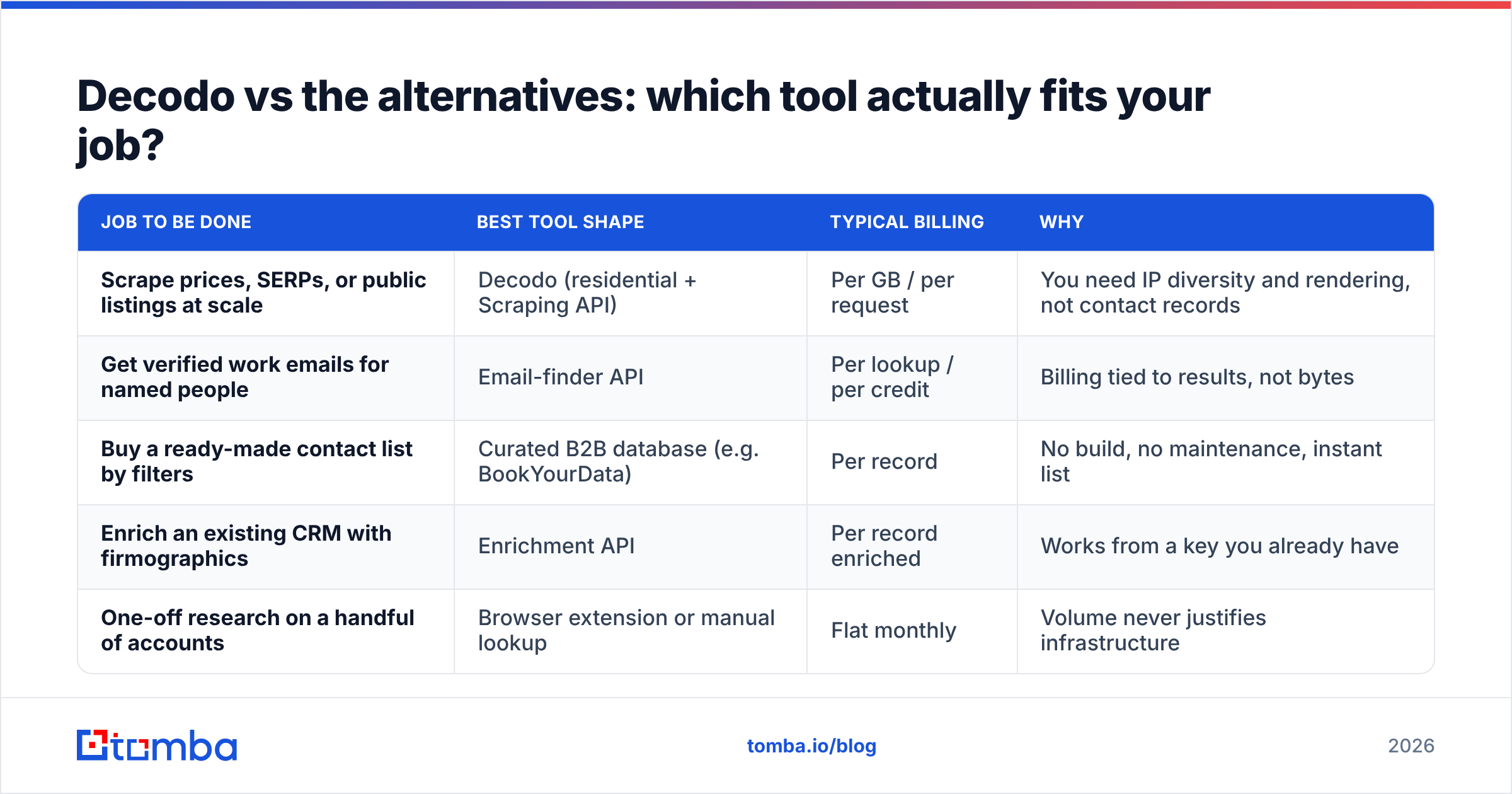
Decodo vs the alternatives: which tool actually fits your job?#
The most common buying error is comparing Decodo to tools that solve a completely different problem. Sort by what you need at the end, not by what looks adjacent.
| Job to be done | Best tool shape | Typical billing | Why |
|---|---|---|---|
| Scrape prices, SERPs, or public listings at scale | Decodo (residential + Scraping API) | Per GB / per request | You need IP diversity and rendering, not contact records |
| Get verified work emails for named people | Email-finder API | Per lookup / per credit | Billing tied to results, not bytes |
| Buy a ready-made contact list by filters | Curated B2B database (e.g. BookYourData) | Per record | No build, no maintenance, instant list |
| Enrich an existing CRM with firmographics | Enrichment API | Per record enriched | Works from a key you already have |
| One-off research on a handful of accounts | Browser extension or manual lookup | Flat monthly | Volume never justifies infrastructure |
Read that table honestly and a lot of proxy purchases evaporate. If the deliverable is "a list of people to email," you are not buying a proxy problem. You are buying a data problem, and the unit economics of the two are not close.
Run the math on a modest campaign. Five thousand target contacts:
- Proxy route:
10 GB of crawling on company sites and directories ($35 at pay-as-you-go), plus parsing, plus deduplication, plus a separate verification pass, plus the engineering time to build and repair all of it. The $35 is the smallest number in that list. - Data-API route: 5,000 lookups against a maintained index, returned already structured and already verified. No parser to fix when a site redesigns.
That's the trade. Decodo is excellent at the first route and simply isn't in the business of the second.

Is Decodo worth it for B2B lead generation specifically?#
Conditionally yes — for a narrow set of jobs.
Decodo is worth it when:
- You need data that no vendor sells: competitor pricing, marketplace inventory, job-board signals, regional SERP positions.
- You have (or rent) an engineer who can maintain parsers.
- Your volume is high enough that per-record pricing would exceed per-GB pricing.
- Geo-precision is a hard requirement.
Decodo is the wrong purchase when:
- Your deliverable is names, titles, and email addresses. That is a solved problem with a dedicated email finder, and building it from scraped HTML is rebuilding a wheel that already ships verified.
- You have no engineering capacity. The managed API helps, but you still own the parsing and the data hygiene.
- Your volume is under a few thousand records a month. Fixed infrastructure cost per usable record is brutal at small scale.
- You need deliverability confidence. Scraped addresses are unvalidated by definition; you'd still pay for an email verifier afterwards.
A useful hybrid exists, and good teams run it. Use a scraping stack to discover companies and signals, then hand the domains to a data API to resolve people and contact points. Decodo finds you the 300 companies that just posted a relevant job. A domain search turns each of those domains into named contacts with role-level filtering. Neither tool does the other's job well.
How do you cut a Decodo bill without cutting coverage?#
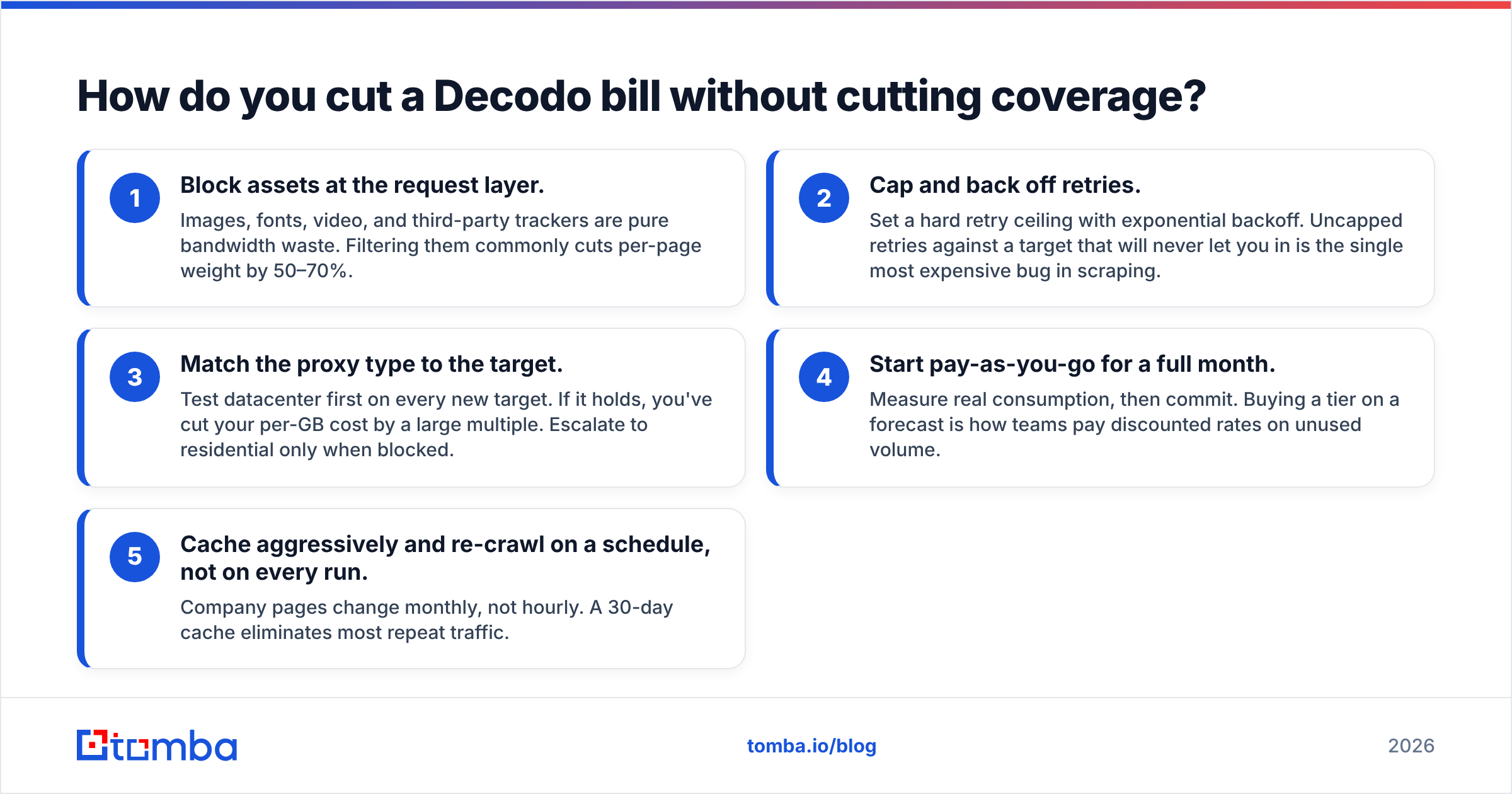
If you've decided the proxy route is right, these five levers do most of the work:
- Block assets at the request layer. Images, fonts, video, and third-party trackers are pure bandwidth waste. Filtering them commonly cuts per-page weight by 50–70%.
- Cap and back off retries. Set a hard retry ceiling with exponential backoff. Uncapped retries against a target that will never let you in is the single most expensive bug in scraping.
- Match the proxy type to the target. Test datacenter first on every new target. If it holds, you've cut your per-GB cost by a large multiple. Escalate to residential only when blocked.
- Start pay-as-you-go for a full month. Measure real consumption, then commit. Buying a tier on a forecast is how teams pay discounted rates on unused volume.
- Cache aggressively and re-crawl on a schedule, not on every run. Company pages change monthly, not hourly. A 30-day cache eliminates most repeat traffic.
Also worth doing: separate your discovery spend from your contact resolution spend in the budget. When both live in one proxy line item, nobody notices that 80% of the gigabytes went to fetching pages that a data enrichment call would have answered in one request.
What should you check before you commit to a plan?#
Run this checklist against your own targets, not against a review:
- Average page weight on your top 20 targets, measured, not estimated.
- Success rate by proxy type — test datacenter, ISP, and residential on the same sample.
- Effective cost per usable record, which is total spend divided by clean rows, not divided by gigabytes.
- Time-to-first-record, including the engineering hours to write the parser.
- Maintenance cadence — how often did your parsers break during the trial month?
Most decodo pricing reviews pros and cons roundups skip this step. It is the one that decides the bill.
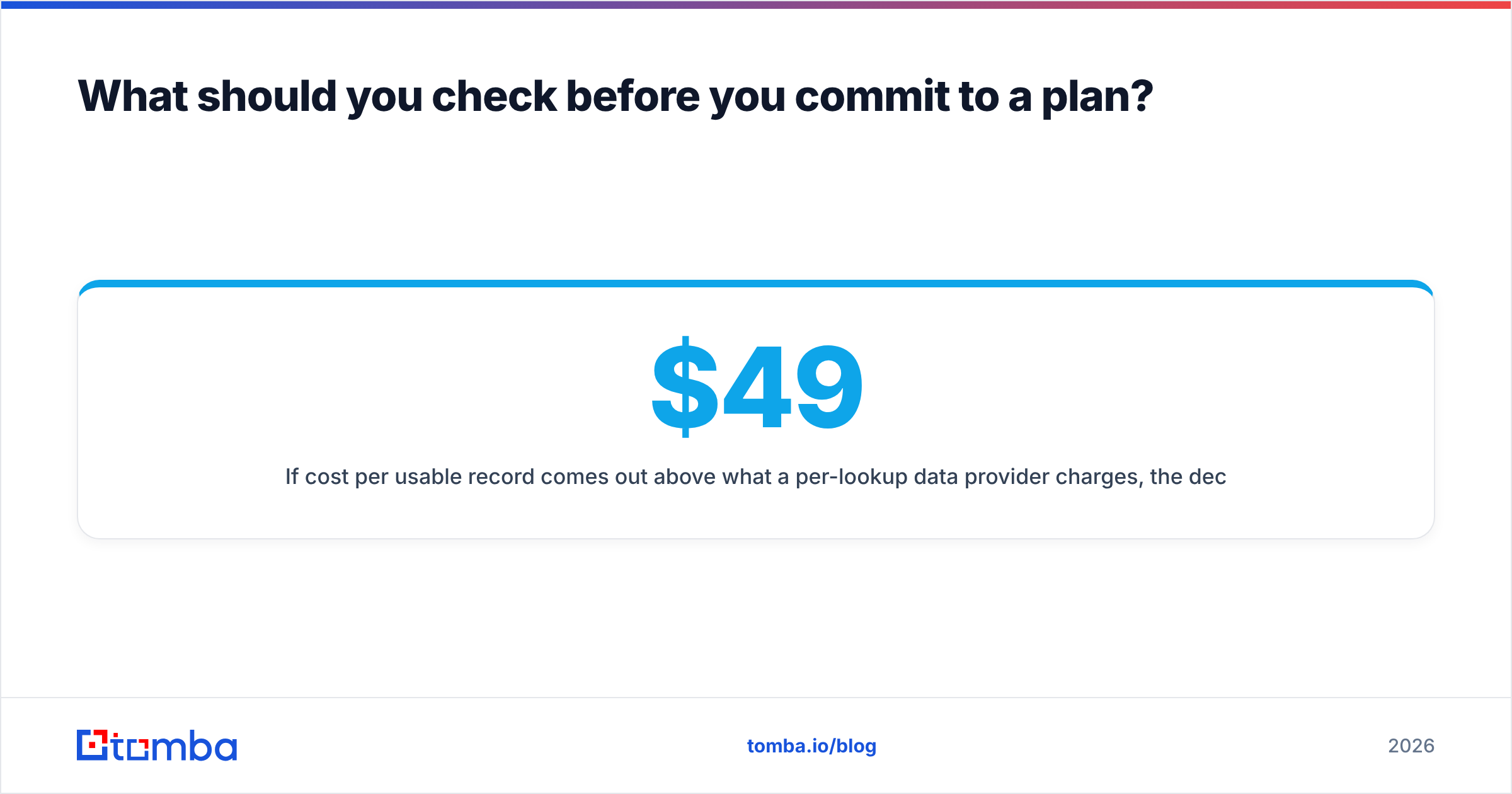
If cost per usable record comes out above what a per-lookup data provider charges, the decision is made for you. Compare it against transparent Tomba pricing — Free tier at 25 searches/month, Starter at $49/mo, Growth at $99/mo, Pro at $249/mo — and the arithmetic tends to be short.
Decodo pricing reviews pros and cons: the verdict#
Decodo is a competent, well-supported proxy and scraping infrastructure provider with fair pricing for what it is. The pros are real: scale, geo-coverage, responsive support, and a genuinely low-risk trial. The cons are just as real: bandwidth billing, product sprawl, and the fact that you still have to build the data layer yourself. That last one is why so many decodo pricing reviews pros and cons searches come from people who bought infrastructure when they needed data.
Buy Decodo for what no one sells you: bespoke web data, geo-specific signals, competitor intelligence. Don't buy it to reconstruct a contact database that already exists in maintained form.
If what you actually need is contacts, skip the pipeline. The Tomba Email Finder returns verified professional email addresses from a name and domain — no proxies to rotate, no parsers to repair, no gigabytes to forecast. Start on the free tier with 25 searches a month, wire it into your stack with the Tomba API when volume grows, and put your engineering hours toward the data that genuinely can't be bought.
Related guides#
Ready to find emails that actually work?
Join 150,000+ professionals who stopped guessing and started sending. Free credits on signup — no credit card required.
Get the Tomba newsletter
Practical outbound tactics and product updates — once every two weeks.
About the author