Definition of Prospecting: What It Actually Means in 2026
The definition of prospecting, in plain terms: not lead generation, not cold calling. Here are the four stages that make it work, and how to measure whether yours is any good.
The definition of prospecting is simple. You find people who fit your ideal customer profile, and you reach out first. No form fill. No raised hand. Just a hypothesis and a first message.
TL;DR
- The short definition of prospecting: you find people who fit your ideal customer profile and contact them before they raise a hand. It is outbound. The rep owns it. It ends when a qualified conversation starts.
- It is not lead generation. Marketing owns that, and the buyer comes to you.
- It is not cold calling either. Calling is one channel inside prospecting.
- Prospecting runs in four stages: define the ICP → build the list → verify and enrich → initiate contact. Skip stage three and the first two stop mattering.
- The metric that predicts revenue is qualified conversations per 100 contacts touched, not emails sent.
- Bad contact data is the biggest tax on the motion. Bounce rates above 5% hurt your sender reputation before anyone reads your copy.
What is the definition of prospecting?#
The definition of prospecting: finding buyers who match your ideal customer profile, collecting accurate contact data on them, and starting the first conversation. All of it happens before the buyer shows any interest in you.
Three clauses in that definition of prospecting do the real work:
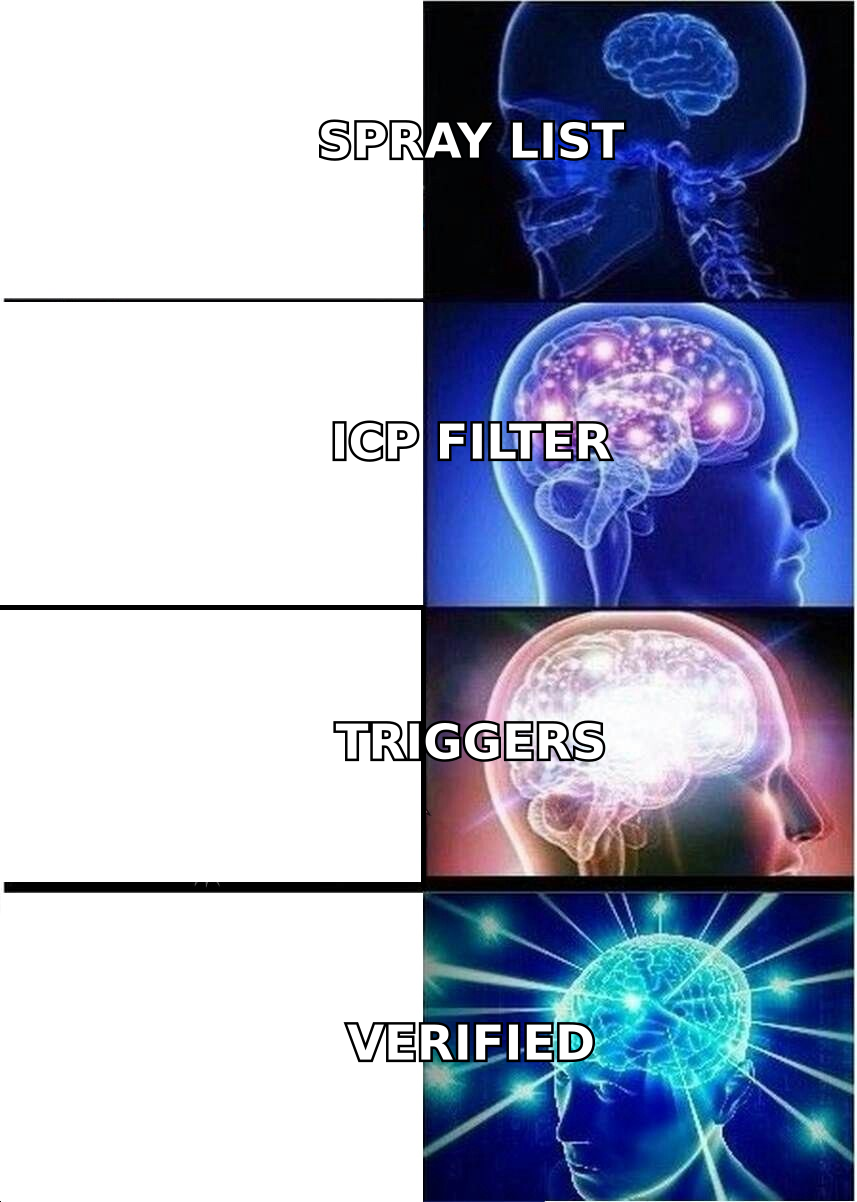
- "Match your ideal customer profile." Prospecting is targeted by design. A list of 40,000 random SaaS employees is not a prospect list. It is a spreadsheet.
- "Accurate contact data." A name with no reachable channel and no reason to reach out is not a prospect. It is a row.
- "Before the buyer shows interest." This clause separates prospecting from everything near it. The second a buyer books a demo, you are no longer prospecting. You are following up.
The word comes from mineral prospecting: walking a claim, panning gravel, throwing almost all of it away. The analogy holds up. You are not creating value in the ground. You are finding where it already sits, and getting there first.
How is prospecting different from lead generation?#
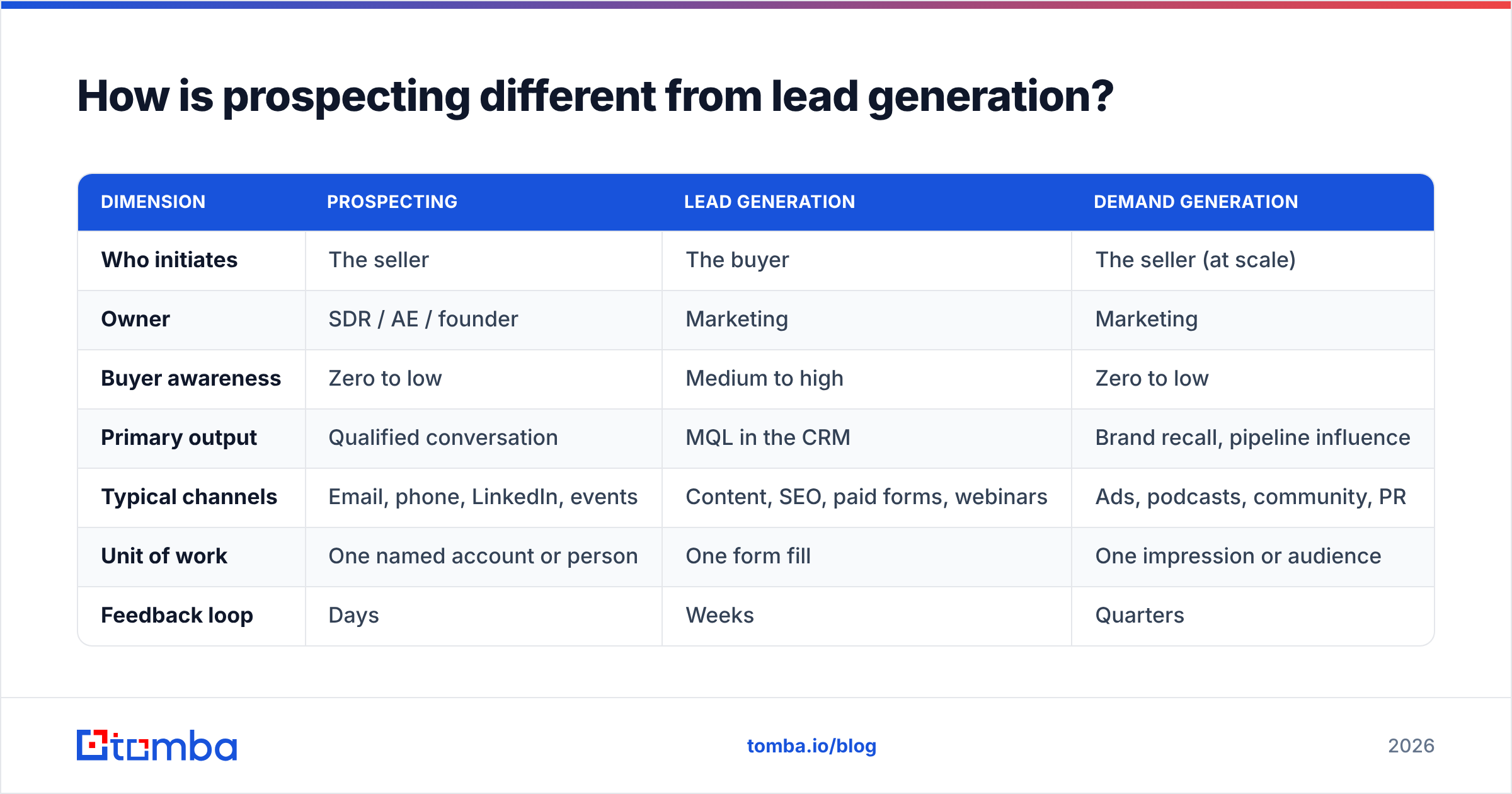
The two terms get swapped in job titles all the time. They are not the same. The clean split in the definition of prospecting is who starts the conversation.
| Dimension | Prospecting | Lead generation | Demand generation |
|---|---|---|---|
| Who initiates | The seller | The buyer | The seller (at scale) |
| Owner | SDR / AE / founder | Marketing | Marketing |
| Buyer awareness | Zero to low | Medium to high | Zero to low |
| Primary output | Qualified conversation | MQL in the CRM | Brand recall, pipeline influence |
| Typical channels | Email, phone, LinkedIn, events | Content, SEO, paid forms, webinars | Ads, podcasts, community, PR |
| Unit of work | One named account or person | One form fill | One impression or audience |
| Feedback loop | Days | Weeks | Quarters |
| Data dependency | Very high (contact-level) | Low (buyer self-serves data) | Low |
A marketing qualified lead arrives with intent attached. A prospect arrives with nothing but a hypothesis you built. That gap changes your first message, your qualification bar, your reply rate, and how much data quality matters.
Demand generation muddies the picture, because it is also seller-initiated. The difference is scale. Demand gen works on audiences. Prospecting works on named people. If you cannot say the person's name, employer, and reason for contact out loud, you are doing demand gen.
What are the stages of the prospecting process?#
Every working motion moves through the same four stages, whether a solo founder or a 40-rep team runs it. The names differ. The order does not. This is the operating version of the definition of prospecting.
- Define the ideal customer profile. Use firmographics (industry, headcount, revenue, region), the tech they already run, and triggers like funding, hiring, or a new leader. A good ICP rules out far more than it lets in. If yours does not disqualify 90% of the market, it is a market description.
- Build the target list. Pull the accounts that match, then map the buying committee inside each one: economic buyer, champion, technical evaluator, blocker. Most teams stop at one contact per account, then wonder why deals stall.
The last two stages are where most lists live or die.
- Verify and enrich. Find the working email, the direct phone, the LinkedIn profile, and one account fact you can reference. Teams skip this stage. It decides whether stages one and two produced anything usable.
- Initiate and sequence contact. Go multi-channel over two to four weeks. Each touch should add something, not repeat the ask. Stop when you get a decision, including a clear no.
Stage three earns the extra attention, because the economics live there. Take 500 well-targeted contacts with 30% bad emails. They perform worse than 350 contacts that all deliver. You lose the 150 either way, and the bounces drag your domain down for the 350 that were fine.
Why does contact data quality decide the outcome?#
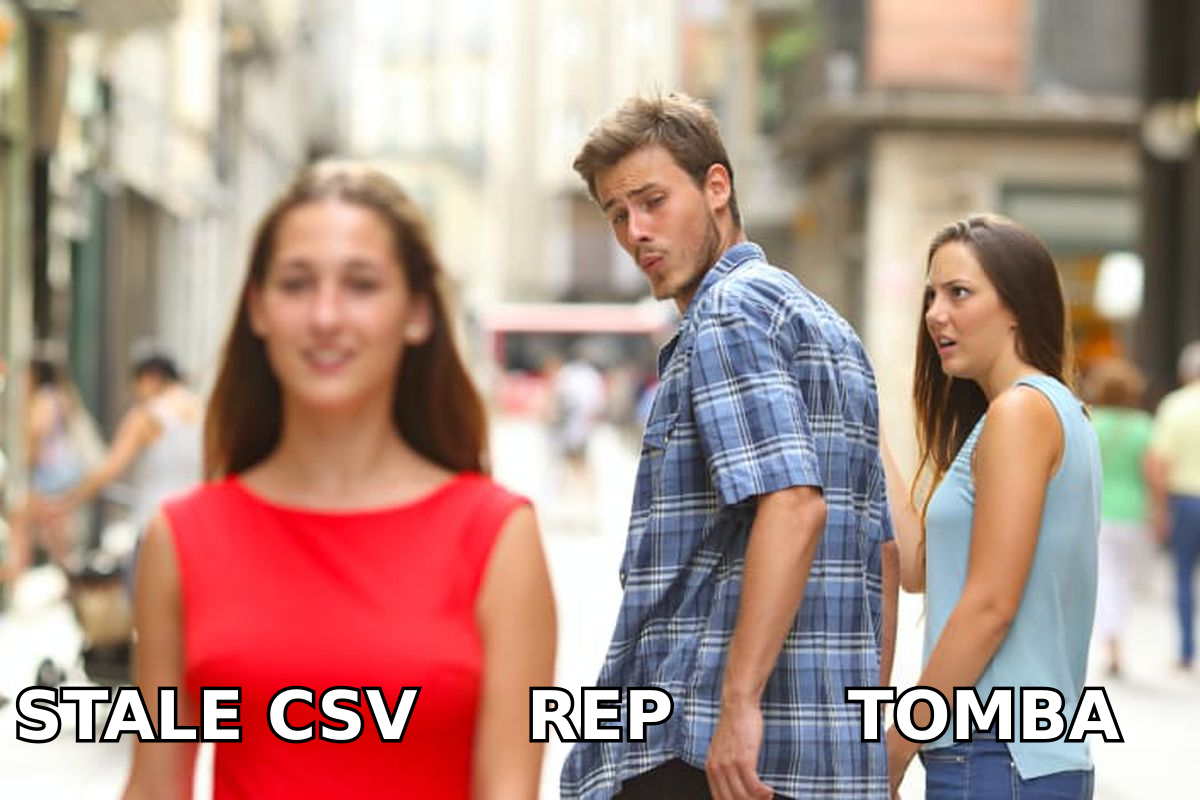
Data quality sits outside the textbook definition of prospecting, but it decides the result. B2B contact data decays 25–30% a year through job changes, restructures, and domain moves. A list you scraped 14 months ago no longer matches reality.
The decay shows up in three places:
- Deliverability. Mailbox providers read hard bounces as proof you do not know who you are mailing. Google and Yahoo's 2024 bulk-sender rules made that official. Complaint rates above 0.3% get you filtered, and not only for the bad addresses. The whole domain pays. Keeping email deliverability intact is a prerequisite, not an upgrade.
- Rep time. A rep on a 20% invalid list loses one day in five to contacts nobody can reach. Over 200 working days, that is 40 days of salary for nothing.
- Forecast accuracy. Pipeline built on unverified contacts inflates coverage. It hides a weak top of funnel until you are a quarter too late.
The fix is mechanical, not clever. Verify before you send. Re-verify anything older than 90 days. Treat catch-all domains as their own bucket instead of assuming they work. An email verifier run at list-build time costs far less than rehabilitating a burned domain.

What channels count as prospecting?#
All of them, and that is the point. Channel is a tactic. The definition of prospecting is a strategy. Ranked by typical B2B performance in 2026:
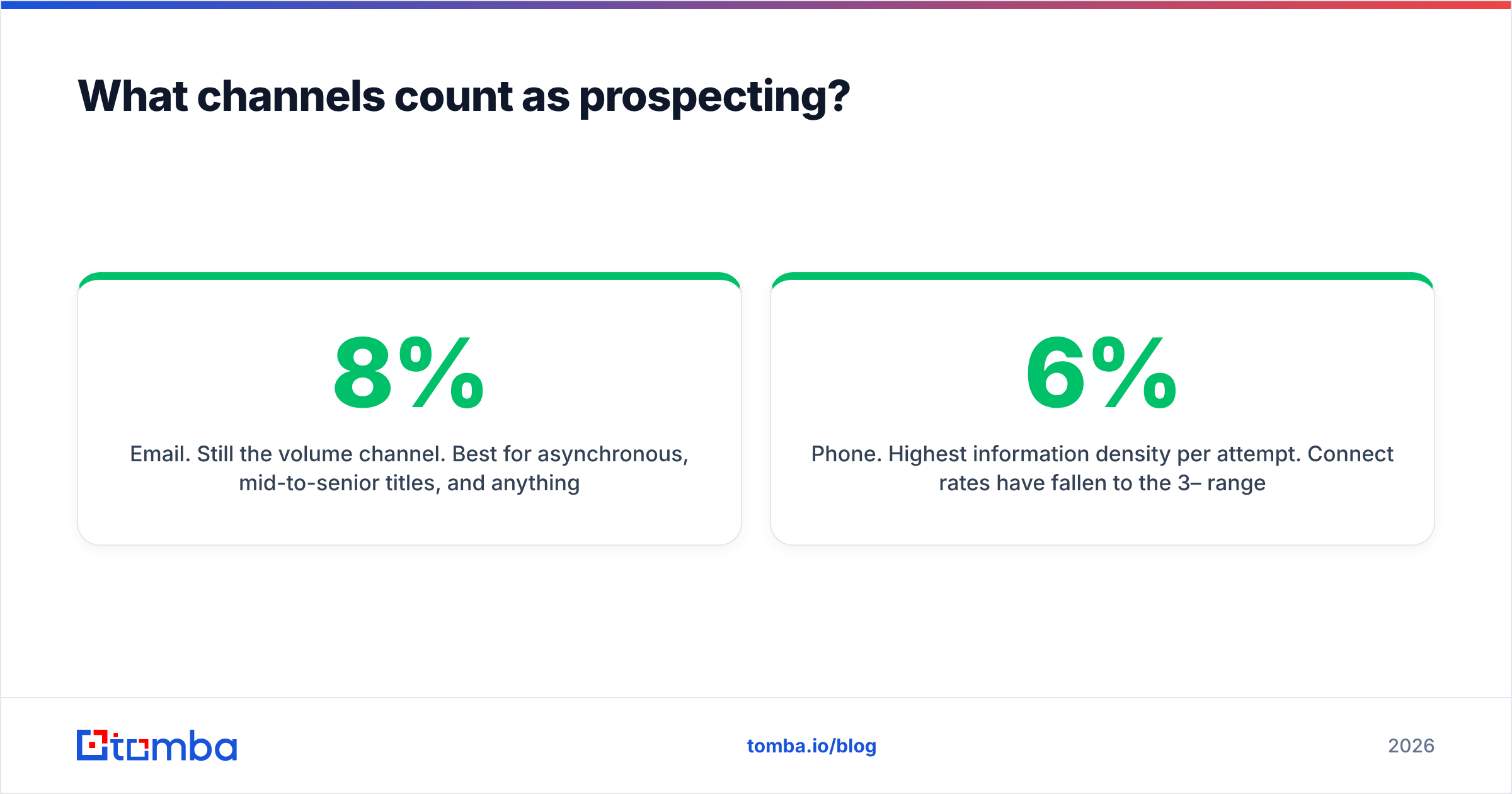
- Email. Still the volume channel. It suits async outreach and senior titles. Reply rates of 3–8% are normal for a tight sequence. Above 10% usually means a narrow niche or a warm signal you have not accounted for.
- Phone. The most information per attempt. Cold connect rates sit at 3–6%. One connect still tells you more in four minutes than six emails will.
- LinkedIn. Best as a side door. A comment or a relevant share before the connection request beats a cold InMail. LinkedIn outreach works better as a warming layer for email than on its own.
Then come the low-volume channels, which convert better and scale worse:
- Events and communities. Lowest volume, highest conversion. A hallway conversation solves the trust problem up front.
- Referral asks. Still prospecting, and structurally the easiest kind. Underused, because it means admitting you need help.
- Warm inbound signals. Site visitors who never filled a form sit in the middle. Tools that handle visitor identification turn them into contacts you can work.
Teams that outperform run at least three channels against the same contact, spaced so the touches build on each other. One channel is not a sequence. It is a hope.
How do you measure whether prospecting is working?#
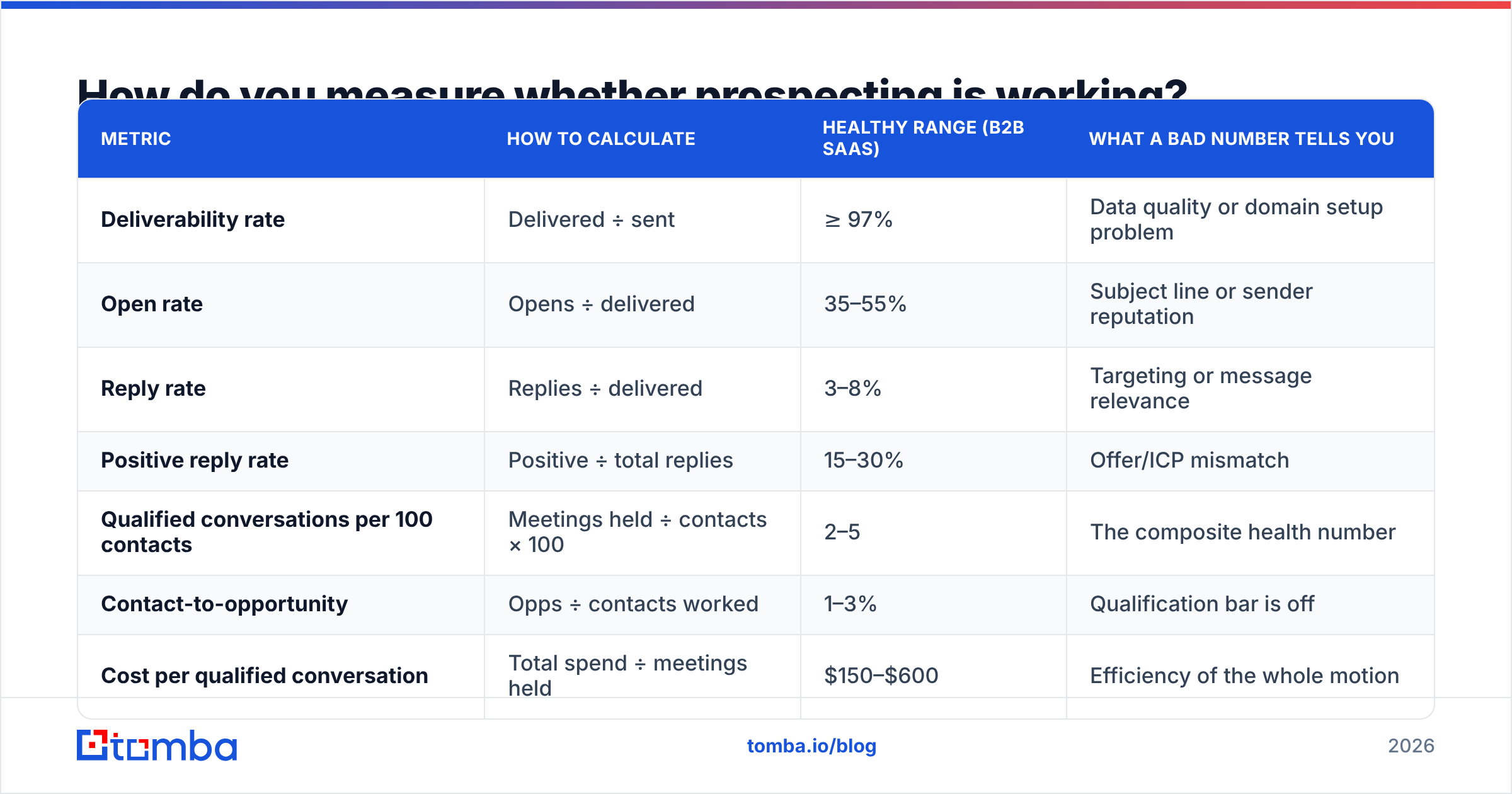
Measurement is not part of the definition of prospecting, but it is how you know the motion works. Most dashboards count activity, because activity is easy to count. The useful metrics measure conversion between stages. They force you to admit where the motion breaks.
| Metric | How to calculate | Healthy range (B2B SaaS) | What a bad number tells you |
|---|---|---|---|
| Deliverability rate | Delivered ÷ sent | ≥ 97% | Data quality or domain setup problem |
| Open rate | Opens ÷ delivered | 35–55% | Subject line or sender reputation |
| Reply rate | Replies ÷ delivered | 3–8% | Targeting or message relevance |
| Positive reply rate | Positive ÷ total replies | 15–30% | Offer/ICP mismatch |
| Qualified conversations per 100 contacts | Meetings held ÷ contacts × 100 | 2–5 | The composite health number |
| Contact-to-opportunity | Opps ÷ contacts worked | 1–3% | Qualification bar is off |
| Cost per qualified conversation | Total spend ÷ meetings held | $150–$600 | Efficiency of the whole motion |
Track the composite weekly: qualified conversations per 100 contacts touched. It folds data quality, targeting, copy, and channel mix into one number. You cannot game it by sending more. If it falls while volume rises, you have a targeting or data problem dressed up as a productivity gain. Pair it with your response rate trend to tell a copy problem from a list problem.
One caveat on open rates. Apple Mail Privacy Protection and similar features inflate them a lot. Treat opens as directional only. Reply rate is the first number in the funnel you can actually trust.
What tools does a prospecting stack need?#
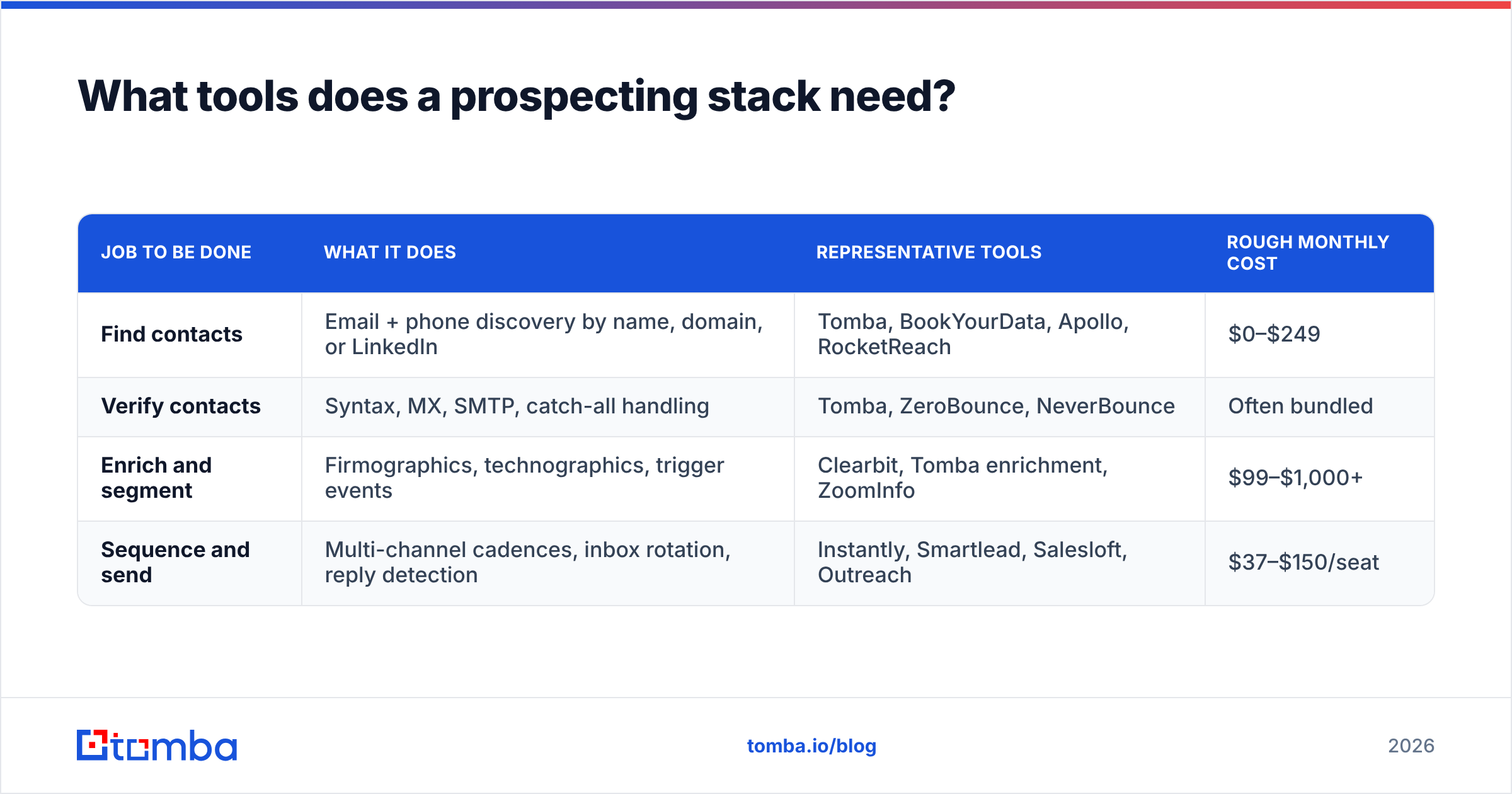
Four jobs, and two products can cover them. The categories matter more than the logos. No tool changes the definition of prospecting. Tools only change how fast you run it.
| Job to be done | What it does | Representative tools | Rough monthly cost |
|---|---|---|---|
| Find contacts | Email + phone discovery by name, domain, or LinkedIn | Tomba, BookYourData, Apollo, RocketReach | $0–$249 |
| Verify contacts | Syntax, MX, SMTP, catch-all handling | Tomba, ZeroBounce, NeverBounce | Often bundled |
| Enrich and segment | Firmographics, technographics, trigger events | Clearbit, Tomba enrichment, ZoomInfo | $99–$1,000+ |
| Sequence and send | Multi-channel cadences, inbox rotation, reply detection | Instantly, Smartlead, Salesloft, Outreach | $37–$150/seat |
On the find-and-verify side, check coverage in your geography first. Then ask whether verification is included or billed on the side, and how the vendor handles catch-all domains.
Tomba pricing starts with a free tier of 25 searches per month. Paid plans run $49/mo (Starter), $99/mo (Growth), and $249/mo (Pro). Verification and domain search come included, not metered as an add-on. BookYourData sells pay-as-you-go credits with a strong US database, which suits teams that prospect in bursts. Both are fine defaults, depending on whether your volume is steady or spiky.

If you are evaluating vendors seriously, run the same 100-contact test list through each one. Compare three things: match rate, accuracy, and cost per valid contact. Vendor accuracy numbers are marketing. Your test list is data. Review sites like G2 also catch support and billing complaints that never reach a pricing page.
Where does prospecting end and selling begin?#
The definition of prospecting ends at the qualified conversation. Discovery, demo, proposal, and negotiation are selling.
That line matters for how you organize. When one person does both — founder-led sales, full-cycle AEs — prospecting slips every time a live deal needs attention. That produces the boom-bust pipeline most small teams recognize.
When the roles split (SDR → AE), you get a different risk: a standing argument about what "qualified" means. Write the criteria down and enforce them in the CRM. Do not renegotiate them at every handoff.
A workable rule: a prospect becomes an opportunity when you confirm three things. The buyer admits a problem. Someone with budget is in the conversation. There is a reason to act inside your sales cycle. Two out of three is a nurture, not a deal. Good sales process hygiene sits upstream of every pipeline conversation, and it is the difference between a forecast and a wish.
What does good prospecting look like in practice?#
Here is the definition of prospecting applied to one team. They sell a $15k ACV product to operations leaders at mid-market logistics companies.
- ICP: 200–2,000 employees, US/EU, running a TMS, hired an ops lead in the last six months.
- List: ~800 accounts, 3 contacts each (VP Ops, Director of Logistics, COO) = 2,400 contacts.
- Verify: run all 2,400 through verification, expect to drop 8–15%, work the remaining ~2,100.
- Sequence: 4 emails, 3 calls, and 2 LinkedIn touches over 18 days, tied to the trigger event.
- Output at 3 qualified conversations per 100: ~63 meetings across the campaign.
- Pipeline at 30% meeting-to-opp and $15k ACV: ~$285k.
Run that math before the campaign, not after. If the numbers do not justify the effort, the problem is the ICP or the price. No amount of subject line testing will fix it.
Ready to build a prospect list that actually delivers?#
The definition of prospecting is simple. Execution fails on data. If you want the stage-three work handled in one place — the right person, a verified email, and a clear read on catch-all domains — start with the Tomba Email Finder.
The free tier gives you 25 searches a month. Use them to run your own accuracy test against whatever you use today. Paid plans start at $49/mo with verification included. Build the 100-contact test list, compare cost per valid contact, and let the numbers pick your stack.
Related guides#
Ready to find emails that actually work?
Join 150,000+ professionals who stopped guessing and started sending. Free credits on signup — no credit card required.
Get the Tomba newsletter
Practical outbound tactics and product updates — once every two weeks.
About the author