Definitive Healthcare Alternatives: 9 Tools Compared for 2026
Definitive Healthcare owns hospital and provider firmographics — but the price tag and annual contract stop a lot of teams. Here are 9 alternatives, what each is genuinely good at, and when a cheaper stack wins.
TL;DR
- Definitive Healthcare is strong on institutional healthcare data — hospital claims volume, IDN hierarchies, technology installs, procedure counts. It is weak, relative to its price, on verified individual contact data.
- Contracts are annual, quoted, and typically land in the five-figure range. There is no self-serve tier, so you cannot test it before you commit.
- If you need provider firmographics + claims analytics, the closest peers are IQVIA, Doximity, Trella Health and H1.
- If what you actually need is "reach the VP of Revenue Cycle at 400 hospitals," a generic B2B contact stack (Tomba, ZoomInfo, BookYourData, Apollo) costs 5–20x less and gets you further.
- Most teams that leave Definitive Healthcare don't replace it with one tool — they split into a firmographic layer plus a cheaper contact layer.
What is Definitive Healthcare and who actually buys it?#
Definitive Healthcare (definitivehc.com) is a healthcare commercial-intelligence platform. Its core asset is a curated database of US healthcare organizations: roughly 10,000+ hospitals, hundreds of thousands of physician groups, imaging centers, ASCs, long-term care facilities, plus the affiliations between them and the executives who run them. On top of that sits claims-derived analytics — what procedures a facility performs, at what volume, with which payer mix, and which technology vendors are installed.
Think of it as a Bloomberg terminal for the US provider market. It is not a lead-gen tool that happens to cover healthcare; it is a market-analysis tool that also exports contacts.
That distinction explains the buyer profile. The people who get real value are medtech and pharma commercial teams sizing territories, healthcare IT vendors mapping EHR install bases, RCM and staffing companies scoring accounts, and consultants building market reports. If your GTM motion needs to know which 340 hospitals run Epic and do more than 2,000 orthopedic cases a year, Definitive earns its money.
The people who churn are the ones who bought it as an expensive contact database. They wanted emails and phone numbers for healthcare decision-makers, got a platform priced for analytics, and discovered the contact layer was the thinnest part of the product.

Why do teams look for Definitive Healthcare alternatives?#
Five reasons come up repeatedly in G2 reviews and renewal conversations:
- Price and contract structure. Pricing is quote-only and annual. Reported deals commonly land between $15,000 and $50,000+ per year depending on seats, modules, and export volume. There is no monthly plan and no meaningful free tier, so evaluation happens through a sales-led demo rather than hands-on testing.
- Contact data decay. Healthcare has brutal job-change rates — clinical and administrative staff move constantly. Users report that direct emails and dials go stale faster than the platform refreshes them, especially below the C-suite.
- Export limits. Credits and export caps are negotiated per contract. Teams that want to push 50,000 records into their CRM often find they bought the seat but not the volume.
- US-only coverage. If you sell into the EU, LATAM, or APAC healthcare markets, Definitive's coverage largely stops at the US border.
- Overkill for the job. A lot of buyers only need account lists plus verified emails. Paying analytics-platform prices for a contact export is the single most common regret.
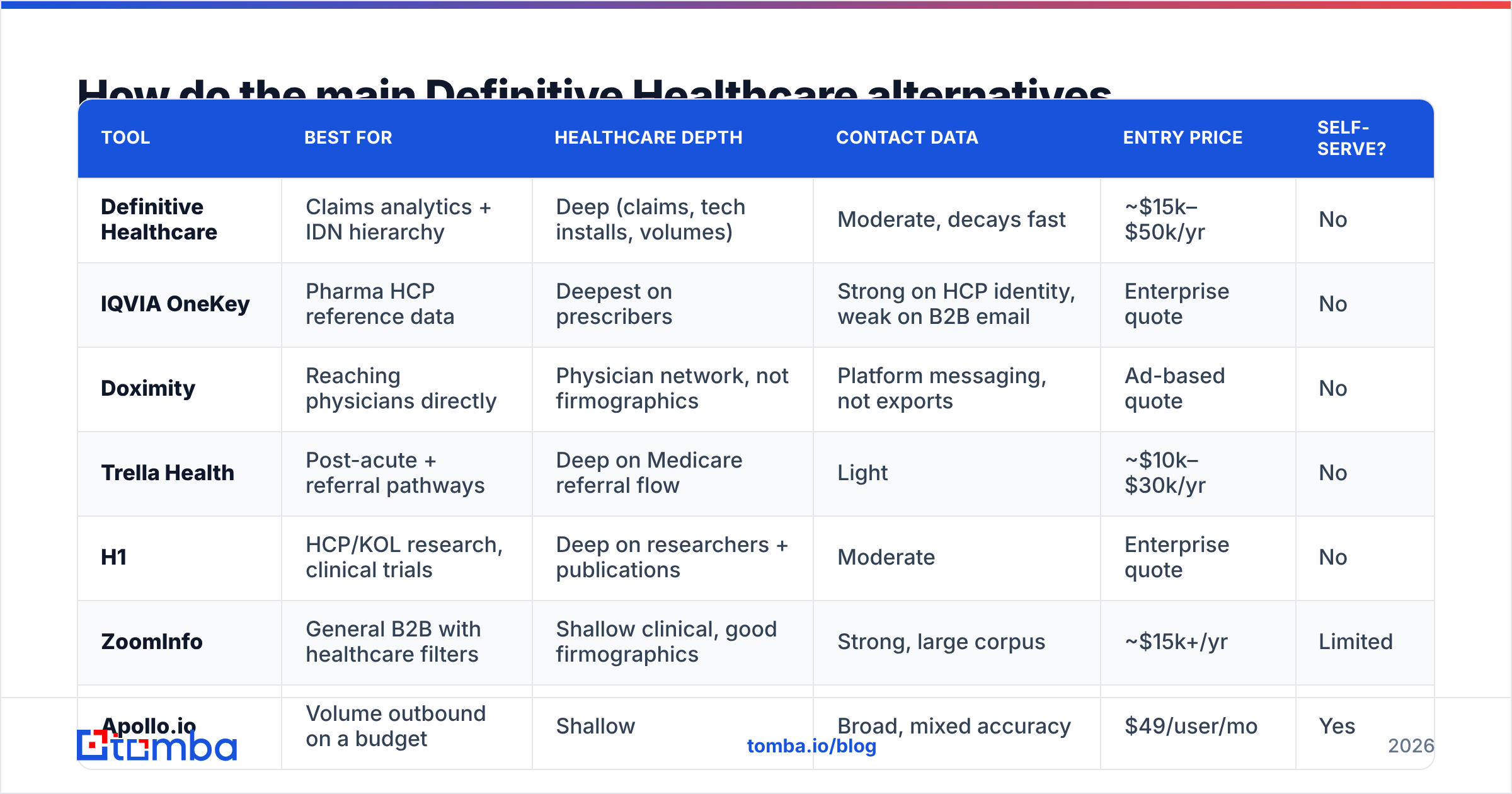
How do the main Definitive Healthcare alternatives compare?#
Here is the honest field. Prices are list or commonly-reported ranges as of early 2026 — always confirm directly, since healthcare data vendors negotiate heavily.
| Tool | Best for | Healthcare depth | Contact data | Entry price | Self-serve? |
|---|---|---|---|---|---|
| Definitive Healthcare | Claims analytics + IDN hierarchy | Deep (claims, tech installs, volumes) | Moderate, decays fast | ~$15k–$50k/yr | No |
| IQVIA OneKey | Pharma HCP reference data | Deepest on prescribers | Strong on HCP identity, weak on B2B email | Enterprise quote | No |
| Doximity | Reaching physicians directly | Physician network, not firmographics | Platform messaging, not exports | Ad-based quote | No |
| Trella Health | Post-acute + referral pathways | Deep on Medicare referral flow | Light | ~$10k–$30k/yr | No |
| H1 | HCP/KOL research, clinical trials | Deep on researchers + publications | Moderate | Enterprise quote | No |
| ZoomInfo | General B2B with healthcare filters | Shallow clinical, good firmographics | Strong, large corpus | ~$15k+/yr | Limited |
| Apollo.io | Volume outbound on a budget | Shallow | Broad, mixed accuracy | $49/user/mo | Yes |
| BookYourData | Pay-as-you-go healthcare lists | Good specialty/role targeting | Verified, accuracy-guaranteed lists | Per-record credits | Yes |
| Tomba | Verified emails for named orgs | None (bring your own list) | Strong verification + enrichment | Free tier, $49/mo Starter | Yes |
Read that table as three groups, not nine options.
Group 1 — the true peers. IQVIA, Trella, H1, and Doximity compete with Definitive on healthcare-native intelligence. They are all enterprise-priced and sales-led. You switch between them for coverage reasons, not savings.
Group 2 — the generalists. ZoomInfo and Apollo give you firmographics and contacts across every industry, healthcare included. You lose claims data and IDN hierarchy; you gain price flexibility and much larger contact volume.
Group 3 — the assembly approach. Tools like Tomba and BookYourData don't try to be a healthcare database. They turn a list of organizations and names into deliverable contact data. Paired with a free or cheap source of provider entities, this is the cheapest viable stack.
Which alternative fits which use case?#
Match the tool to the job rather than the category:
- You need claims volumes, procedure counts, and payer mix. Stay on Definitive Healthcare or evaluate Trella Health for post-acute and referral analytics. Nothing in Groups 2 or 3 replaces this. Be honest about whether an analyst actually uses these fields monthly — if the answer is "we pulled it twice last year," you're funding a report, not a platform.
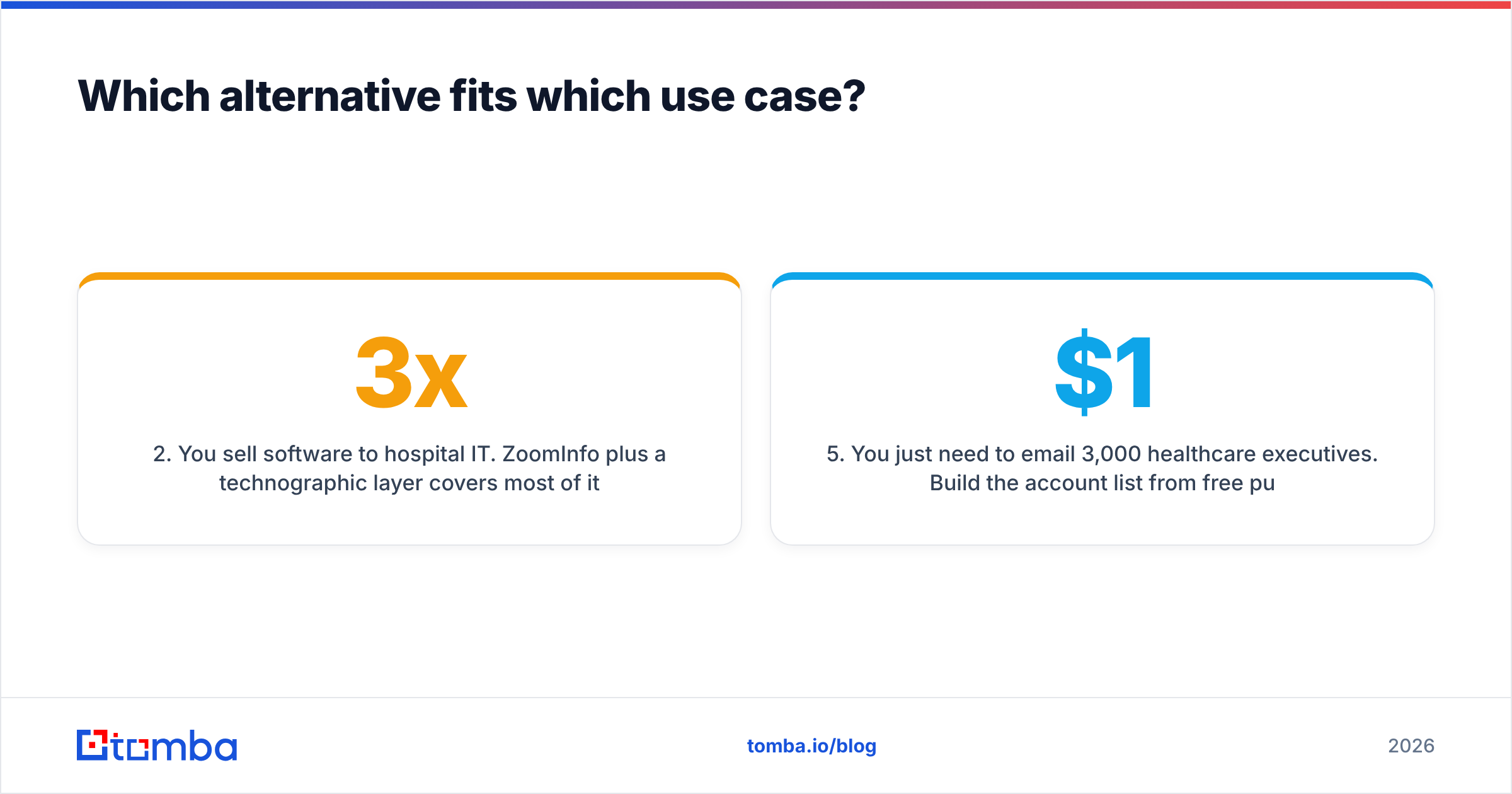
- You sell software to hospital IT. ZoomInfo plus a technographic layer covers most of it, and you can supplement install-base intel from public HIMSS and CMS data. Definitive's tech-install module is better, but the delta rarely justifies 3x the spend for a sub-$5M ARR vendor.
- You market to individual physicians. Doximity is the honest answer — it's where clinicians actually are. Treat it as a media buy, not a database purchase.
- You need pharma-grade prescriber identity. IQVIA OneKey, full stop. NPI-level reference data with affiliation history is its whole reason to exist.
- You just need to email 3,000 healthcare executives. Build the account list from free public sources (CMS Provider of Services files, state hospital association directories, NPI Registry), then run names through an email finder and an email verifier. Total cost: under $1,200/year. BookYourData is a strong alternative here if you'd rather buy a pre-built, accuracy-guaranteed list than assemble one — its per-record pricing makes small, targeted pulls easy to justify.
- You need global healthcare coverage. No single vendor does this well. Combine a regional provider registry with a contact-enrichment layer; Definitive and Trella will not help you outside the US.
What does the "assemble it yourself" stack actually cost?#
This is the option most Definitive refugees end up on, so it deserves specifics.
The insight is that healthcare, uniquely among industries, publishes enormous amounts of free entity data. CMS releases the Provider of Services file and the NPI Registry. Hospital systems publish leadership pages. State associations list member facilities. The expensive part of a healthcare database — knowing which organizations exist and how they relate — is partly a public good.
What is genuinely hard is the contact layer: turning "Kaiser Permanente, VP of Revenue Cycle" into a mailbox that accepts your message.
A working stack:
- Entity list: CMS files + NPI Registry export → free
- Org-level contact discovery: domain search to pull every known email at a facility's domain
- Named-person lookup: email finder against first name + last name + domain
- Deliverability gate: email verification plus a catch-all verifier — critical in healthcare, where large systems run catch-all domains that silently swallow mail
- Phone layer: phone finder for the accounts worth calling
- Scale: bulk email finder or the Tomba API to run it as a job rather than a spreadsheet exercise
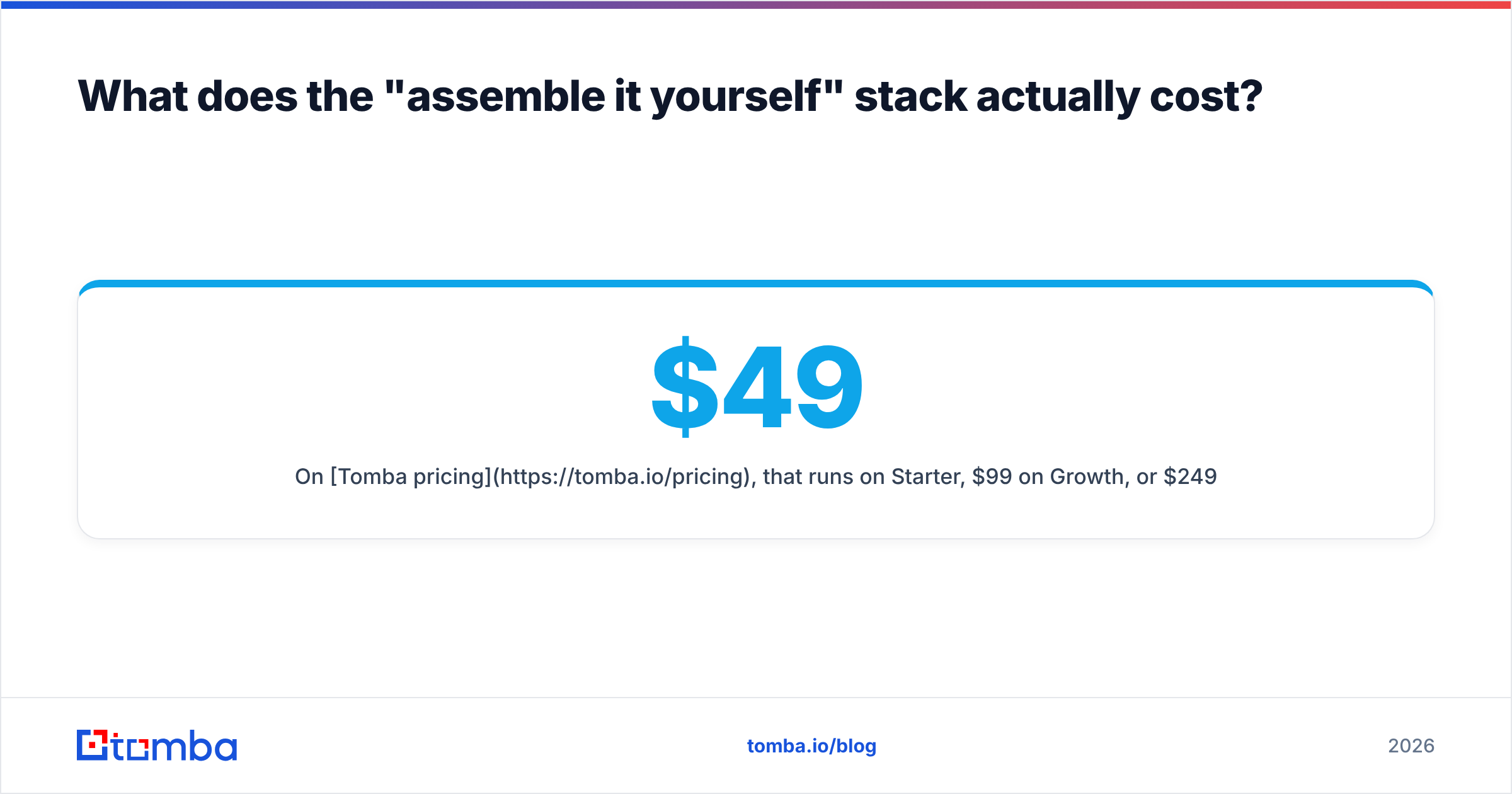
On Tomba pricing, that runs $49/mo on Starter, $99/mo on Growth, or $249/mo on Pro for high-volume teams — against $15,000+ annually for a platform whose analytics half you may barely open. The free tier gives you 25 searches to test the match rate on your own target accounts before you commit anything.
The trade you're making is real: you lose claims analytics, bed counts, and IDN rollups. If those drive your territory model, don't make this trade. If they were a nice-to-have you bought because it was bundled, you're paying a lot for a feature you screenshot once a quarter.

How accurate is healthcare contact data, really?#
Lower than any vendor's marketing suggests — and the reason is structural, not sloppiness.
Healthcare has one of the highest role-turnover rates in B2B. Nurse leaders, department directors, and RCM managers move between systems constantly. A database refreshed quarterly is already 8–15% wrong at the individual level by the time you export it. That decay hits every vendor in this list, including the expensive ones.
Three practical defenses:
- Verify at send time, not at purchase time. Any list older than 30 days should go through verification before a campaign. This single habit does more for email deliverability than switching vendors.
- Treat catch-all domains as a separate bucket. Large hospital systems and university medical centers frequently accept all mail at the MX layer, which means a "valid" result tells you almost nothing. Segment them and warm them separately, or you'll poison an otherwise healthy sender reputation.
- Anchor on the organization, not the person. Org domains are stable for decades; people are not. Store the domain and re-resolve the person each campaign cycle rather than trusting a two-year-old contact row.
If a vendor quotes you a flat "95% accuracy" for healthcare contacts without segmenting by role seniority and organization size, discount the number. Accuracy on hospital C-suite is genuinely high; accuracy on a service-line manager at a 60-bed critical access hospital is not remotely the same figure.
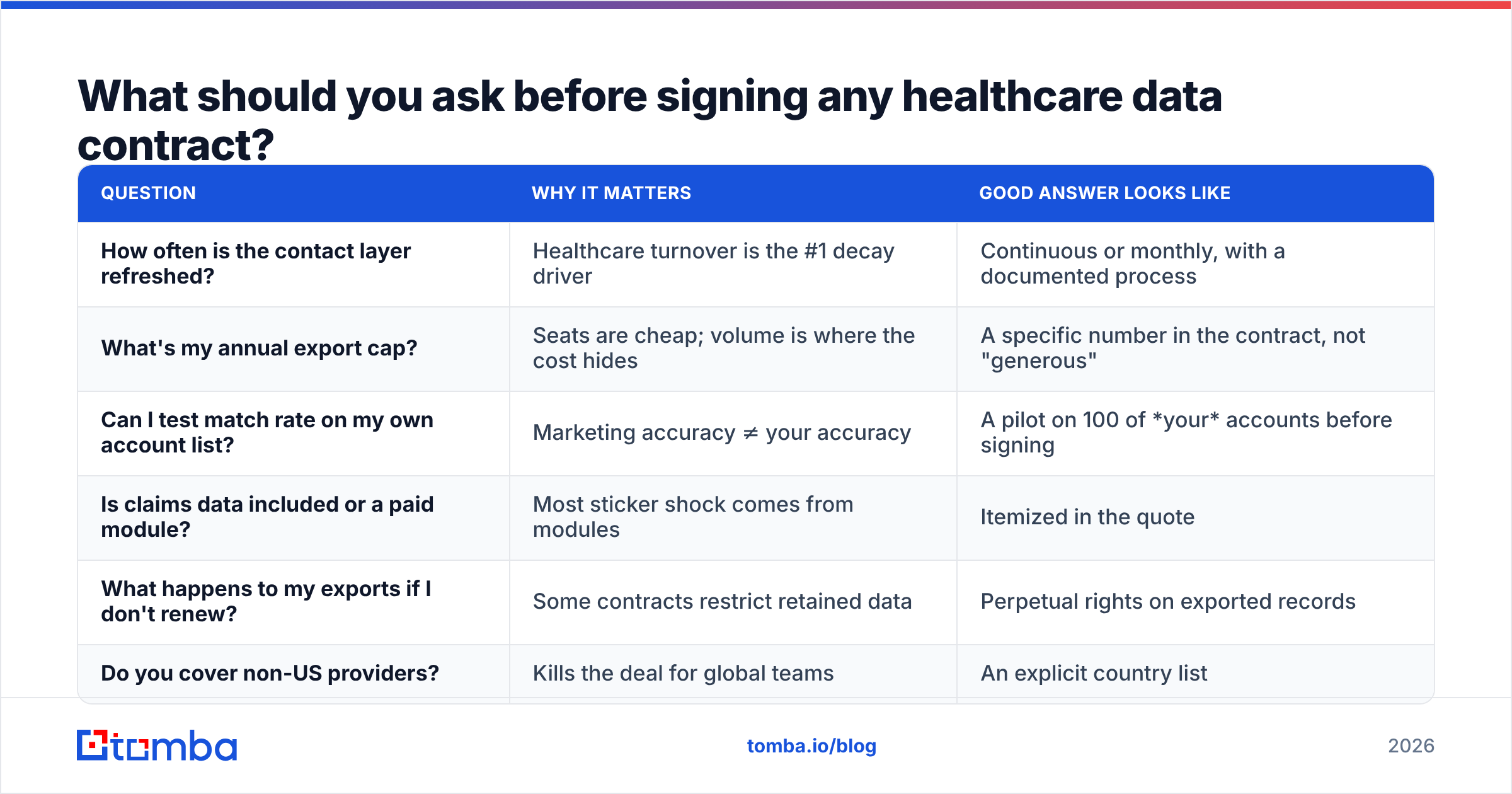
What should you ask before signing any healthcare data contract?#
Bring these to the demo. The answers separate the platforms fast:
| Question | Why it matters | Good answer looks like |
|---|---|---|
| How often is the contact layer refreshed? | Healthcare turnover is the #1 decay driver | Continuous or monthly, with a documented process |
| What's my annual export cap? | Seats are cheap; volume is where the cost hides | A specific number in the contract, not "generous" |
| Can I test match rate on my own account list? | Marketing accuracy ≠ your accuracy | A pilot on 100 of your accounts before signing |
| Is claims data included or a paid module? | Most sticker shock comes from modules | Itemized in the quote |
| What happens to my exports if I don't renew? | Some contracts restrict retained data | Perpetual rights on exported records |
| Do you cover non-US providers? | Kills the deal for global teams | An explicit country list |
The pilot question is the important one. Every vendor here will show you a demo built on accounts where their data is excellent. Insist on running 100 of your real target accounts and measuring match rate and bounce rate yourself. If a vendor refuses, that refusal is the answer.
Is switching away from Definitive Healthcare worth it?#
It depends entirely on which half of the product you use.
Stay if your team runs territory models on claims volume, if IDN hierarchy drives your account mapping, or if a market-sizing analyst opens the platform weekly. That functionality is genuinely hard to replicate, and the alternatives that match it (IQVIA, Trella, H1) are not cheaper.
Leave if the last twelve months of usage were mostly contact exports. In that case you bought a $30,000 email list, and a combination of public provider data plus a verification-first contact stack does the same job for a rounding error of the cost.
Split if you're honest that you need a bit of both. Keep one seat of a healthcare-native platform for the analyst, and move the SDR team onto a cheaper enrichment layer. This is what most mature healthcare GTM teams actually run, and it's usually 40–60% cheaper than everyone-gets-a-seat licensing. A pattern worth borrowing from adjacent categories: teams facing similar decisions with general B2B data often look at Clearbit alternatives or Apollo alternatives with the same split logic.
One more consideration: renewal timing. Healthcare data contracts are annual and auto-renew. Start your evaluation 90 days out, run your pilot in that window, and you'll negotiate from a position where walking away is credible. Start 10 days out and you'll pay list.
Ready to test the contact layer before you renew?#
If your Definitive Healthcare renewal is coming up and you suspect you're paying analytics prices for contact exports, run the test before the conversation. Pull 100 target healthcare organizations, resolve the decision-makers, verify the results, and compare the match rate and bounce rate against what you're currently getting.
Tomba Email Finder gives you 25 free searches to run that comparison — no contract, no sales call. Find emails by domain, name, or company, verify them before you send, and push the whole thing through the API if you want it running as a job instead of a spreadsheet. If the match rate holds on your own accounts, you've just found a five-figure line item to renegotiate. If it doesn't, you've spent nothing to confirm your current vendor is worth it.
Related guides#
Ready to find emails that actually work?
Join 150,000+ professionals who stopped guessing and started sending. Free credits on signup — no credit card required.
Get the Tomba newsletter
Practical outbound tactics and product updates — once every two weeks.
About the author