Definitive Healthcare vs Apollo.io: Which Data Wins in 2026
One platform maps hospitals, claims and provider networks. The other builds cold-outbound lists at scale. Here is an honest breakdown of where each wins, what they really cost, and which one your team should actually buy.
Definitive Healthcare vs Apollo.io is a common shortlist, but the two tools solve different problems. One maps the US healthcare market. The other sends email at scale. Here is the honest breakdown.
TL;DR
- Definitive Healthcare is a healthcare market intelligence platform. It covers hospital systems, IDNs, physician groups, claims volumes, technology installs and affiliations. It sells insight about organizations, not a cold-email list.
- Apollo.io is a general B2B sales database and outreach tool. You get 200M+ contacts, filters, sequences, a dialer and a light CRM. It sells reach and workflow, not depth in one industry.
- They are not really competitors. Teams that buy both use Definitive for account strategy. They use Apollo for the outbound motion on top of it.
- Pricing is the sharpest split. Apollo publishes per-seat plans from about $49/user/month. Definitive Healthcare is quote-only and usually lands in the five-figure annual range.
- Both leave the same gap: email accuracy at the moment of send. A dedicated finder and verifier layer fixes that for a fraction of either contract.
What is Definitive Healthcare, exactly?#
Think of Definitive Healthcare as a detailed map of the US healthcare system, not a contact list. It profiles 10,000+ hospitals, plus tens of thousands of physician groups, imaging centers, ASCs, long-term care facilities and payers. It then links them together with claims data, procedure volumes, referral patterns, technology installs and ownership.
The value is in the why now. Say a rep sells revenue-cycle software. She can filter to hospitals that run a specific EHR, clear a set revenue line, sit in one state, and show rising denial rates. No generic B2B database can answer that question. Generic databases do not carry claims or clinical volume data at all.
What it is not: a cold-email engine. Definitive Healthcare does list executives at those organizations. But the platform is built for analytics, market sizing and territory planning. You export a target list, then take it somewhere else to work it.
Typical buyers:
- Medtech and device companies sizing procedure volume by facility before assigning territories.
- Healthcare IT vendors targeting by EHR, PACS or RCM install base.
- Pharma commercial teams mapping prescriber networks and where care actually happens.
- Healthcare services and staffing firms ranking accounts by bed count, ownership and affiliation.
- PE and corp-dev teams running diligence on provider assets.
What is Apollo.io, exactly?#
Apollo.io is the opposite shape: wide, shallow and operationally complete. It bundles a contact database (commonly cited at 200M+ contacts and 35M+ companies) with a filtering UI, a Chrome extension, email sequencing, a dialer, LinkedIn workflows and light CRM features. All of it sits in one seat-based subscription.
The pitch is compression. Instead of buying a data vendor, a sequencer and a dialer separately, a small team buys Apollo and gets 80% of each. For a five-person SDR team with a horizontal product, that math is hard to argue with. It is also why Apollo is one of the most-reviewed products in its category on G2.
The tradeoff is depth. Apollo knows a hospital is a hospital with roughly 1,000 employees in Ohio. It does not know that the same hospital performs 4,200 orthopedic procedures a year, runs Epic, and belongs to a three-facility IDN. For healthcare selling, that gap is the whole game.

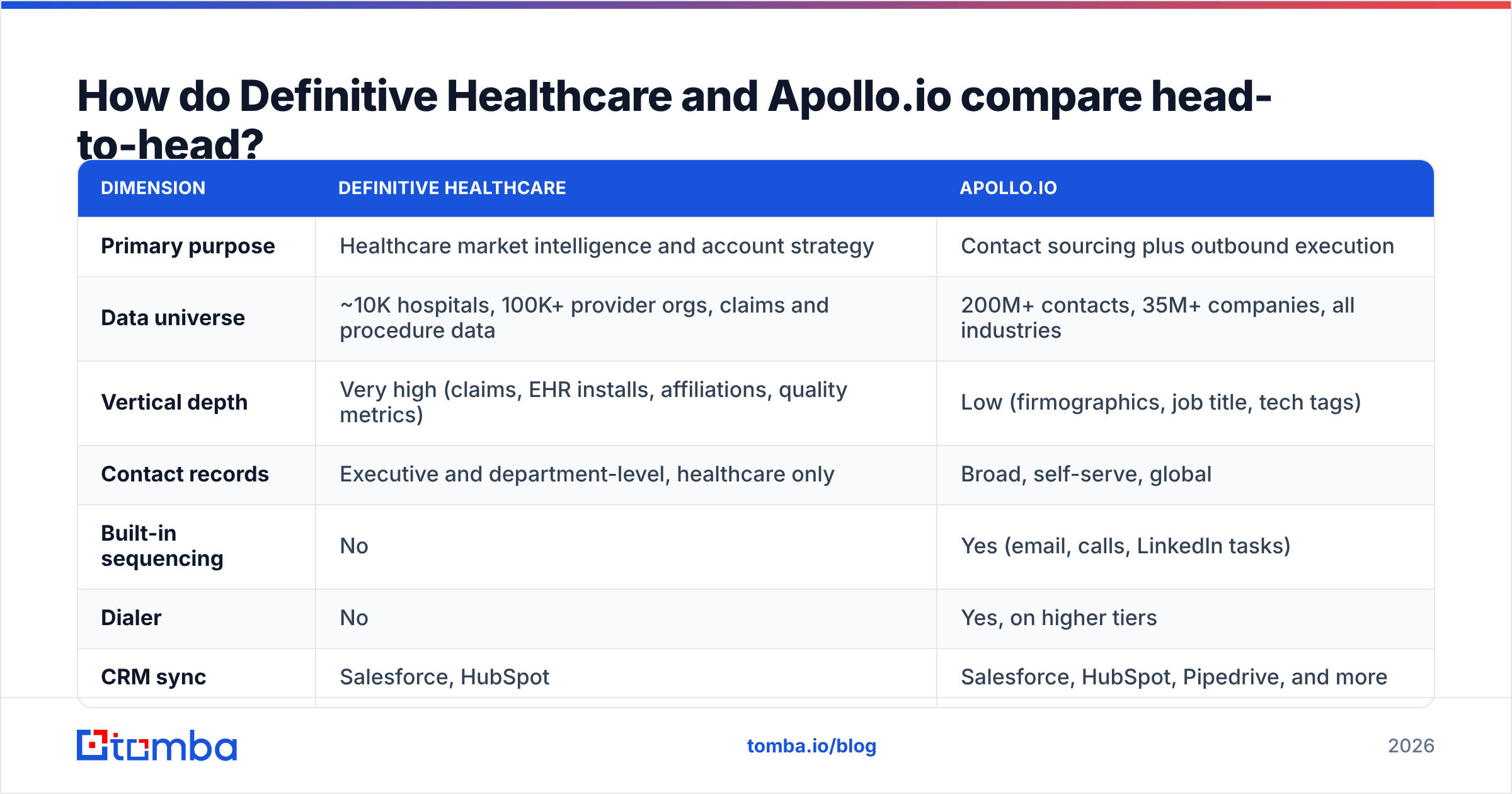
Definitive Healthcare vs Apollo.io: head-to-head comparison#
| Dimension | Definitive Healthcare | Apollo.io |
|---|---|---|
| Primary purpose | Healthcare market intelligence and account strategy | Contact sourcing plus outbound execution |
| Data universe | ~10K hospitals, 100K+ provider orgs, claims and procedure data | 200M+ contacts, 35M+ companies, all industries |
| Vertical depth | Very high (claims, EHR installs, affiliations, quality metrics) | Low (firmographics, job title, tech tags) |
| Contact records | Executive and department-level, healthcare only | Broad, self-serve, global |
| Built-in sequencing | No | Yes (email, calls, LinkedIn tasks) |
| Dialer | No | Yes, on higher tiers |
| CRM sync | Salesforce, HubSpot | Salesforce, HubSpot, Pipedrive, and more |
| Pricing model | Annual contract, quote-only | Per-seat, published tiers |
| Entry cost (2026) | Five figures annually, typically | Free tier; paid from ~$49/user/mo |
| Contract length | Annual, sales-led | Monthly or annual, self-serve |
| Time to first list | Days (onboarding, training) | Minutes |
| Best for | Healthcare-only GTM, territory planning, TAM sizing | Horizontal SMB/mid-market outbound at volume |
The table makes the real conclusion obvious. Definitive Healthcare vs Apollo.io is not a bake-off between two versions of the same product. It is a decision about which problem is blocking your pipeline: knowing which accounts matter, or contacting enough of them.
What does each one really cost in 2026?#
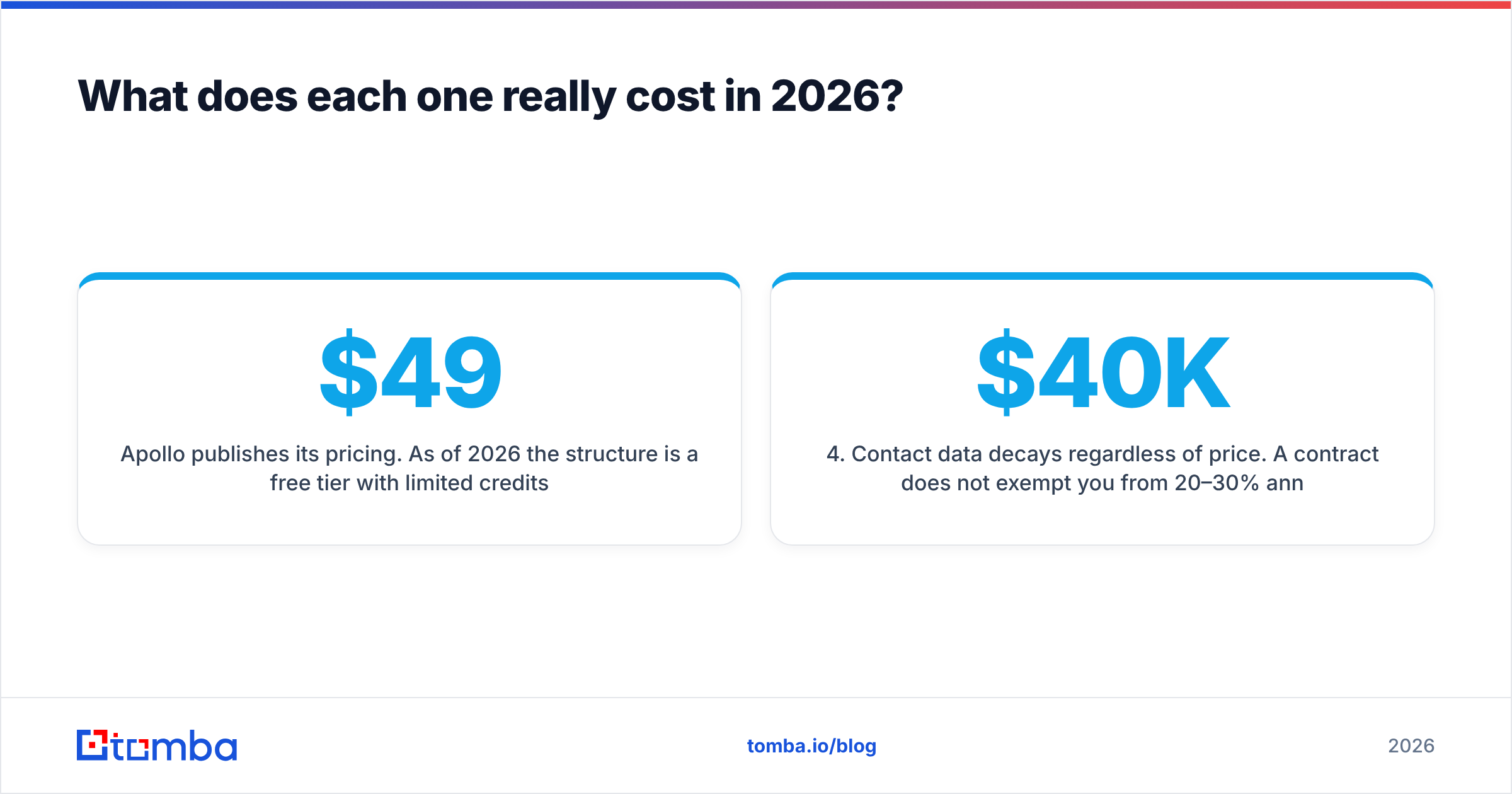
Apollo publishes its pricing. As of 2026 there is a free tier with limited credits. Paid seats start around $49 per user per month. Higher tiers run roughly $79 and $119 per user per month on annual billing. Credit limits are the real constraint, not the seat price. Watch export credits, mobile credits and sequence sends. A four-seat team on a mid tier lands in the $3,000–$5,000 per year range.
Definitive Healthcare does not publish pricing. Buyers report annual contracts in the low-to-mid five figures. The number scales with seat count, module access and export volume. Claims analytics and physician-level data are usually add-ons. That is not a criticism, because claims licensing genuinely costs money. But it does mean a demo, a procurement cycle and a 12-month commitment before you see a single record in production.
Four cost realities are worth naming before you sign anything:
- Export caps are the hidden meter. Both platforms limit how much data leaves the UI. Ask for the number in writing, per seat and per year.
- Seat minimums bite small teams. Enterprise healthcare data contracts often start at 3–5 seats. That can double the entry price for a two-person team.
- Module unbundling. Claims analytics, physician-level detail and API access are often priced separately from the base subscription.
- Contact data decays regardless of price. A $40K contract does not exempt you from 20–30% annual email churn. Verification is a separate line item either way.
Whose data is more accurate for healthcare outreach?#
Split the question, because "accuracy" means two different things here.
Account-level accuracy — is this facility real? Does it belong to this system? Does it run this volume of procedures? Definitive Healthcare wins decisively. Its data comes from claims, cost reports and licensed datasets, and it refreshes on a set schedule. Apollo builds its healthcare data from web and public sources. It routinely mislabels a 40-provider physician group as a generic "Hospital & Health Care, 51-200 employees" record.
Contact-level accuracy — will this email reach this VP of Revenue Cycle today? Neither platform is exceptional. Both are weaker than a dedicated finder. Healthcare breaks email data in three ways. Executives turn over fast. Mergers change domains overnight. And large health systems lean heavily on catch-all mail servers. A catch-all domain accepts every address at the SMTP layer, so a naive verifier marks garbage as "valid."
That is why the practical workflow for serious healthcare outbound looks like this:
- Source the account list in Definitive Healthcare, or from your own ICP model.
- Resolve the people by title. Run a domain search against each facility's real sending domain.
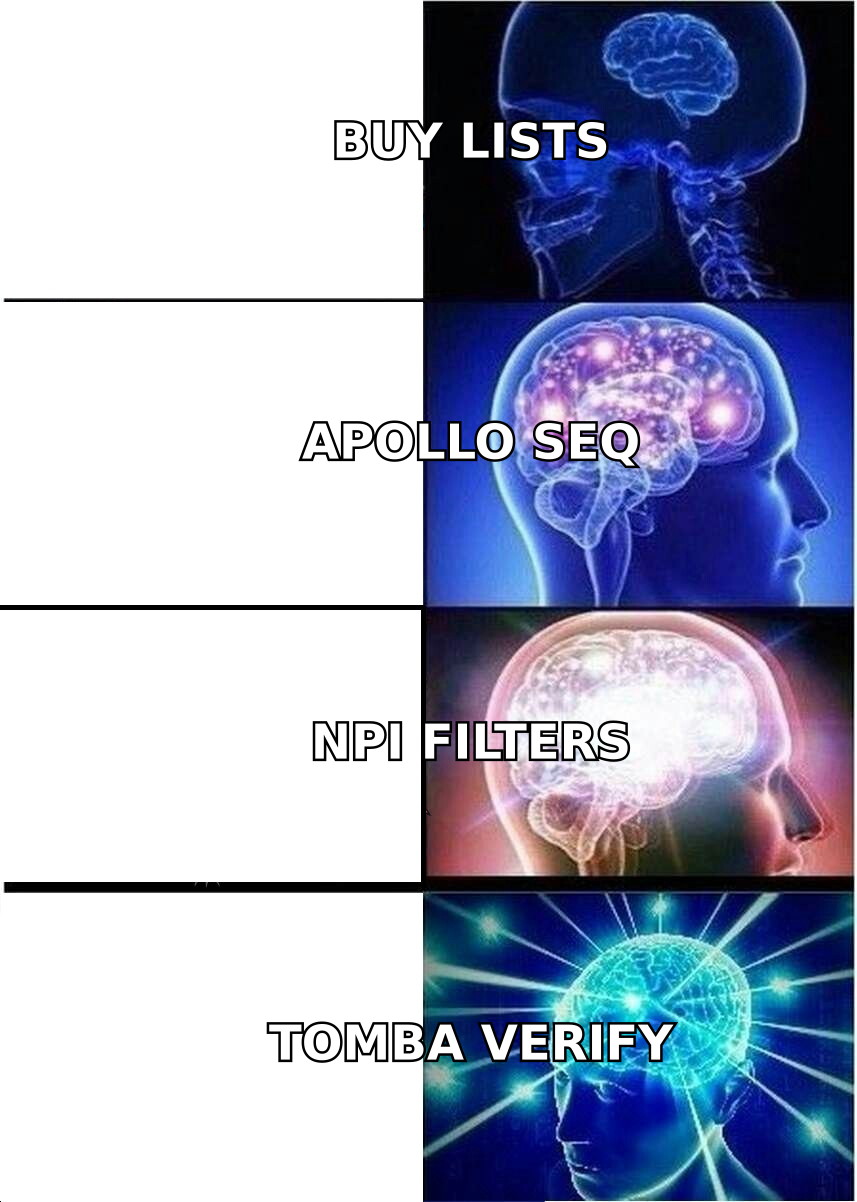
- Verify before send, including catch-all handling. A plain syntax-and-MX check is not enough. A catch-all verifier is the difference between a 2% bounce rate and a 12% one.
- Enrich what survives with role, seniority and phone, so routing and personalization have something to work with.
Which one fits your go-to-market motion?#
Match the tool to the bottleneck, not to the org chart.
- You sell only into healthcare providers and deals are $50K+. Buy Definitive Healthcare. One closed deal pays for the contract twice over. Territory planning alone justifies it.
- You sell horizontally and healthcare is one of six verticals. Buy Apollo. Depth you use 15% of the time is not worth a five-figure commitment. You need volume and a sequencer.
- You are a 2–5 person team testing healthcare as a new segment. Start with Apollo plus a verification layer. Prove the segment converts first, then upgrade to Definitive once you can tie revenue to better targeting.
The last two cases are about fixing a stack you already own.
- You have Definitive already and outbound is stalling. The problem is almost never targeting. It is contact resolution and deliverability. Add a finder and a verifier, not a second database.
- You run RevOps for a 50+ seat org. Run both, but connect them. Definitive defines account tiers and scoring inputs. Apollo or your sequencer executes. An email verification API sits between them as a hygiene gate before anything hits the sending queue.
Where do both platforms leave gaps?#
Four gaps show up in nearly every implementation review.
Domain drift after mergers. Healthcare consolidates constantly. When a regional system buys three clinics, every database keeps the old domains for months. Neither platform re-resolves email patterns at the new parent domain on its own. You need a step that re-checks the company email pattern for recently acquired accounts.
Catch-all blindness. Large health systems overwhelmingly run catch-all configurations. Standard verification returns "accept all." Most teams then either send anyway and risk bounces, or discard the record and waste it. Neither outcome is right. The correct move is a deeper catch-all-specific check.
Deliverability isolation. Neither Definitive nor Apollo tells you your sending domain is losing reputation. Push a big healthcare list through a cold domain and you will burn it. Check sender reputation and warm up properly before you scale volume. The best account list in the industry is worthless from a blacklisted domain.
Cost per usable record. Almost nobody calculates this one. Take the annual contract and divide it by the records you actually emailed and actually delivered. Teams routinely find they pay $4–$12 per usable contact from an enterprise platform. A focused finder produces verified records at a small fraction of that.
Do you need a third tool alongside them?#
Usually yes, and it is the cheapest line on the stack.
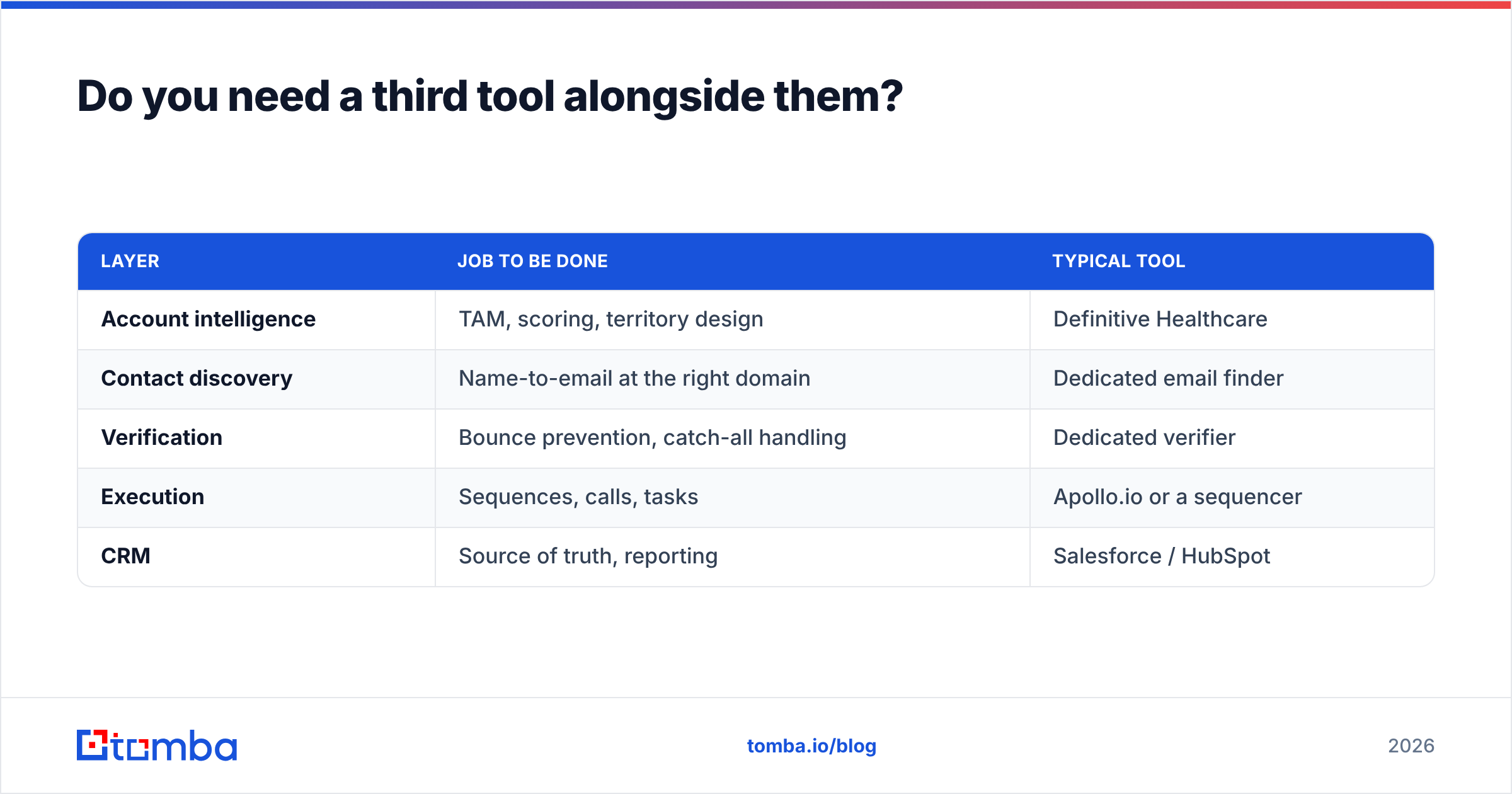
Definitive Healthcare answers which accounts. Apollo answers which motion. Neither reliably answers which mailbox, verified, today. That third job belongs to a dedicated email finder. Buying it separately costs less than the credit overage on either platform.
A practical stack for healthcare outbound in 2026:
| Layer | Job to be done | Typical tool |
|---|---|---|
| Account intelligence | TAM, scoring, territory design | Definitive Healthcare |
| Contact discovery | Name-to-email at the right domain | Dedicated email finder |
| Verification | Bounce prevention, catch-all handling | Dedicated verifier |
| Execution | Sequences, calls, tasks | Apollo.io or a sequencer |
| CRM | Source of truth, reporting | Salesforce / HubSpot |
Still deciding whether Apollo's bundled data is enough? Read a direct Apollo alternative breakdown before you commit to a year of seats. And if the blocker is simply that half your list bounces, run a bulk email finder over your existing export. It will tell you the true health of your database in an afternoon.
Which should you buy in 2026?#
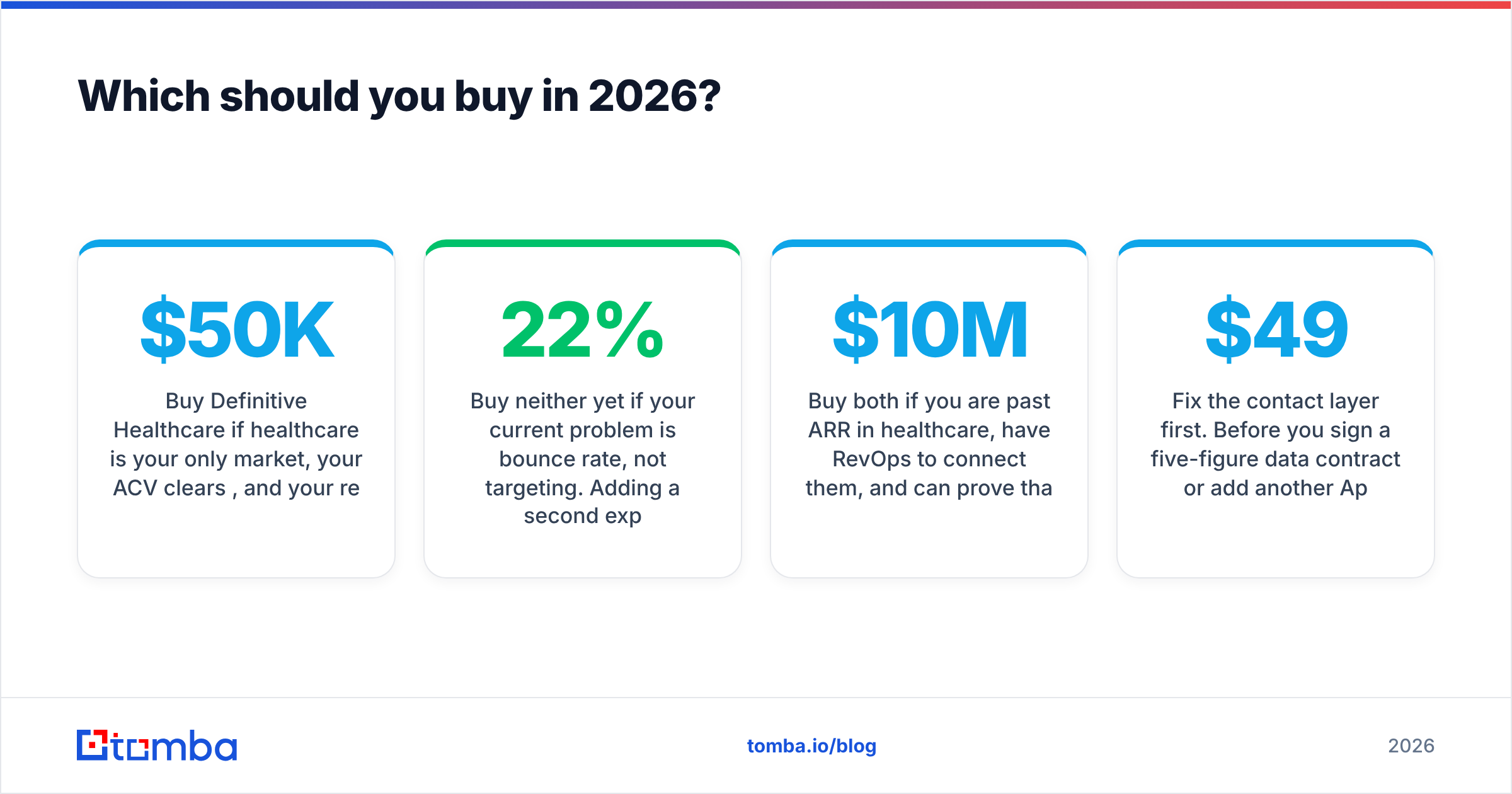
Buy Definitive Healthcare if healthcare is your only market, your ACV clears $50K, and your reps still guess which facilities are worth calling. The claims and install-base data is hard to replicate elsewhere. It changes what your team works on, not just how fast they work.
Buy Apollo.io if you sell across industries, your deals are transactional, your team is under ten people, or you want data and sequencing on one bill. The published per-seat pricing and free tier let you test in a week instead of a quarter.
Buy neither yet if your problem is bounce rate, not targeting. Adding a second expensive database to a list with 22% invalid emails just multiplies the waste. Clean first, then decide.
Buy both if you are past $10M ARR in healthcare, have RevOps to connect them, and can show that better account selection lifts win rate. At that scale the contracts pay for themselves. Just put a verification gate between the data layer and the send layer.
The honest summary: in the Definitive Healthcare vs Apollo.io debate, the two are complements dressed up as competitors. The question is never "which is better." It is "what is costing me pipeline right now — bad targets, or bad contacts?"
Fix the contact layer first. Before you sign a five-figure data contract or add another Apollo seat, run your target accounts through the Tomba Email Finder. Find verified, deliverable addresses by domain, name or company. Check them against catch-all servers. Then look at your real usable-record count. The free tier covers 25 searches a month, and paid plans start at $49/month. See full Tomba pricing for the tier that matches your list volume.
Related guides#
Ready to find emails that actually work?
Join 150,000+ professionals who stopped guessing and started sending. Free credits on signup — no credit card required.
Get the Tomba newsletter
Practical outbound tactics and product updates — once every two weeks.
About the author