Definitive Healthcare vs DiscoverOrg: 2026 Data Comparison
DiscoverOrg no longer exists as a standalone product, and Definitive Healthcare only covers one vertical. Here is what each database actually gives you in 2026, what it costs, and when a lighter contact-data stack beats both.
Definitive Healthcare vs DiscoverOrg is an odd matchup in 2026. One tool is healthcare-only. The other no longer exists as a product you can buy. Here is the short version.
TL;DR
- DiscoverOrg is not a live product. It bought ZoomInfo in 2019 and took the ZoomInfo name. The old platform was folded in. If a rep pitches you "DiscoverOrg," you are being quoted ZoomInfo.
- Definitive Healthcare is a healthcare-only intelligence platform. It covers hospitals, IDNs, physician groups, claims data, and tech install bases. It is not a general B2B database, and it does not pretend to be.
- So Definitive Healthcare vs DiscoverOrg is really vertical depth vs horizontal breadth. Pick wrong and you lose a full year of budget, not a month.
Two more things to weigh before you book a demo.
- Both are annual, seat-based, quote-only contracts. Most land in five figures. Neither has a real free tier or true pay-as-you-go.
- Do you only need verified work emails and firmographics? Then a focused email finder at $49/mo covers 80% of the job for about 1% of the spend.
Why does "Definitive Healthcare vs DiscoverOrg" barely exist as a real matchup?#
Start with the awkward fact. One of these two products was retired years ago.
DiscoverOrg was a sales-intelligence company in Vancouver, Washington. It was known for human-verified org charts and IT install-base data. In February 2019 it acquired ZoomInfo. By mid-2019 the combined company had adopted the ZoomInfo brand.
The DiscoverOrg platform, dataset, and login were merged into what is now ZoomInfo. Old contracts were migrated. There is no separate DiscoverOrg product to buy in 2026.
That matters for your shortlist in three ways:
- Old reviews describe a product you cannot buy. G2 and Capterra still carry hundreds of pre-2020 reviews. They inflate the ratings you think you are reading.
- The pricing model changed. DiscoverOrg sold datasets by department. ZoomInfo sells seat-based platform contracts with credit caps and heavy upsell.
- The human-verification story softened. DiscoverOrg had a research team that called to confirm org charts. After the merger, the focus moved to scale and automated collection.
So the honest framing is this: Definitive Healthcare, a deep vertical database, against ZoomInfo, the broad platform DiscoverOrg became.

What is Definitive Healthcare actually built for?#
Definitive Healthcare sells healthcare commercial intelligence. Its buyers sell only to providers and payers. Think medtech, pharma, healthcare IT, staffing, revenue cycle, and life-sciences services.
The dataset is built around healthcare entities, not generic companies:
- Provider entities — hospitals, IDNs, ASCs, imaging centers, long-term care, physician groups, and clinics.
- Affiliations — which physicians sit with which systems, and how that shifts after M&A.
- Claims and procedure volumes — what procedures happen where, at what volume, under which codes.
The last two buckets are the ones buyers argue about on the call:
- Technology install base — the EHR, PACS, RCM, and clinical systems each site runs, plus renewal signals.
- Executive contacts — CIOs, CMIOs, supply chain VPs, and service-line directors, mapped to those facilities.
That contact bucket is where people mistake it for a contact database. It is not one. Contacts are an output of the account intelligence, not the core asset.
Is your ICP "VPs of Engineering at Series B SaaS companies"? Then this is the wrong tool at any price.
It wins on a question no horizontal database can answer. Which 40 hospitals in the Southeast run more than 500 of this procedure a year, use Epic, and have a service-line director we have not touched? That query is worth five figures to the right team.
What do you actually get from ZoomInfo (the DiscoverOrg successor)?#
ZoomInfo is the horizontal opposite. It sells coverage across every industry. You get contact records, firmographics, technographics, intent signals, and an engagement layer on top.
The real strengths:
- Volume. Hundreds of millions of contacts across nearly every sector. Some of your ICP is in there.
- Direct dials. Inherited from the DiscoverOrg research team. Still a top reason buyers renew.
- Intent data. Topic-level surge signals from a large publisher co-op. No vertical database matches it.
- Workflow. CRM sync, list building, enrichment jobs, a browser extension, and sequencing via Engage.
The real weaknesses, based on public review patterns on G2:
- Contact decay. Titles and emails go stale. Refresh pace varies by segment, and SMB and non-US records are weakest.
- Credit anxiety. Export credits are capped. Teams ration exports instead of prospecting.
- Contract friction. Annual terms, auto-renewal clauses, and renewal price hikes drive most complaints.
- Healthcare depth. It knows a hospital is a company with staff. It does not know procedure volumes or EHR renewal dates.
How do Definitive Healthcare and ZoomInfo compare side by side?#
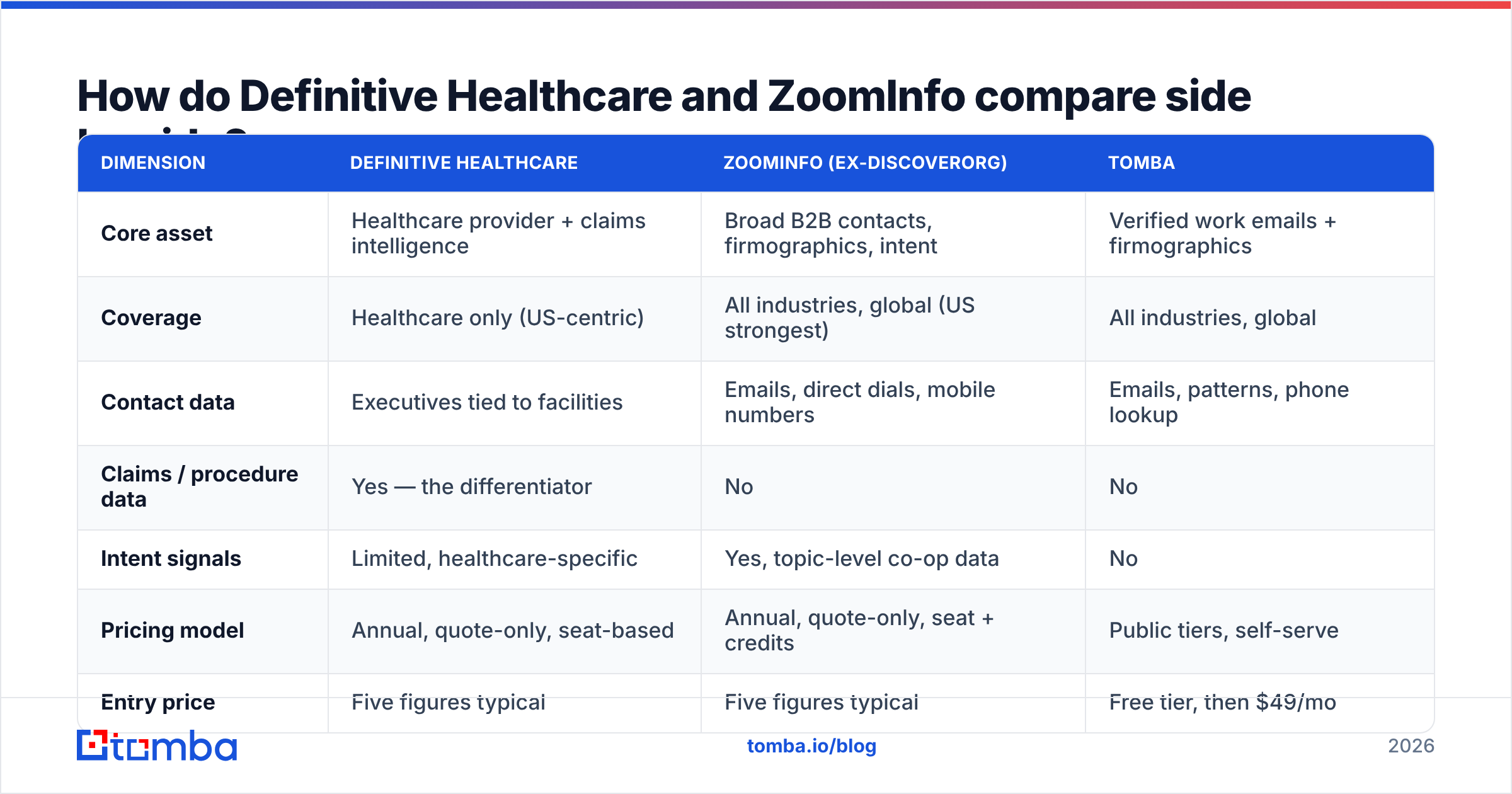
| Dimension | Definitive Healthcare | ZoomInfo (ex-DiscoverOrg) | Tomba |
|---|---|---|---|
| Core asset | Healthcare provider + claims intelligence | Broad B2B contacts, firmographics, intent | Verified work emails + firmographics |
| Coverage | Healthcare only (US-centric) | All industries, global (US strongest) | All industries, global |
| Contact data | Executives tied to facilities | Emails, direct dials, mobile numbers | Emails, patterns, phone lookup |
| Claims / procedure data | Yes — the differentiator | No | No |
| Intent signals | Limited, healthcare-specific | Yes, topic-level co-op data | No |
| Pricing model | Annual, quote-only, seat-based | Annual, quote-only, seat + credits | Public tiers, self-serve |
| Entry price | Five figures typical | Five figures typical | Free tier, then $49/mo |
| Free tier | No | No (demo only) | 25 searches/mo |
| API access | Add-on / higher tiers | Add-on, usage-priced | Included on paid plans |
| Contract term | 12 months minimum | 12 months minimum | Monthly, cancel anytime |
| Best for | Medtech, pharma, healthcare IT GTM | Multi-industry outbound at scale | Verified email sourcing on any ICP |
Neither vendor publishes list pricing. Treat any number you read online as a data point, not a quote.
Public buyer reports agree on the shape of a Definitive Healthcare vs DiscoverOrg deal. Both are annual. Both are seat-based. Both land in five figures for a small team. Both quote higher on renewal than on land.
Which one should you pick — a five-question decision path?#
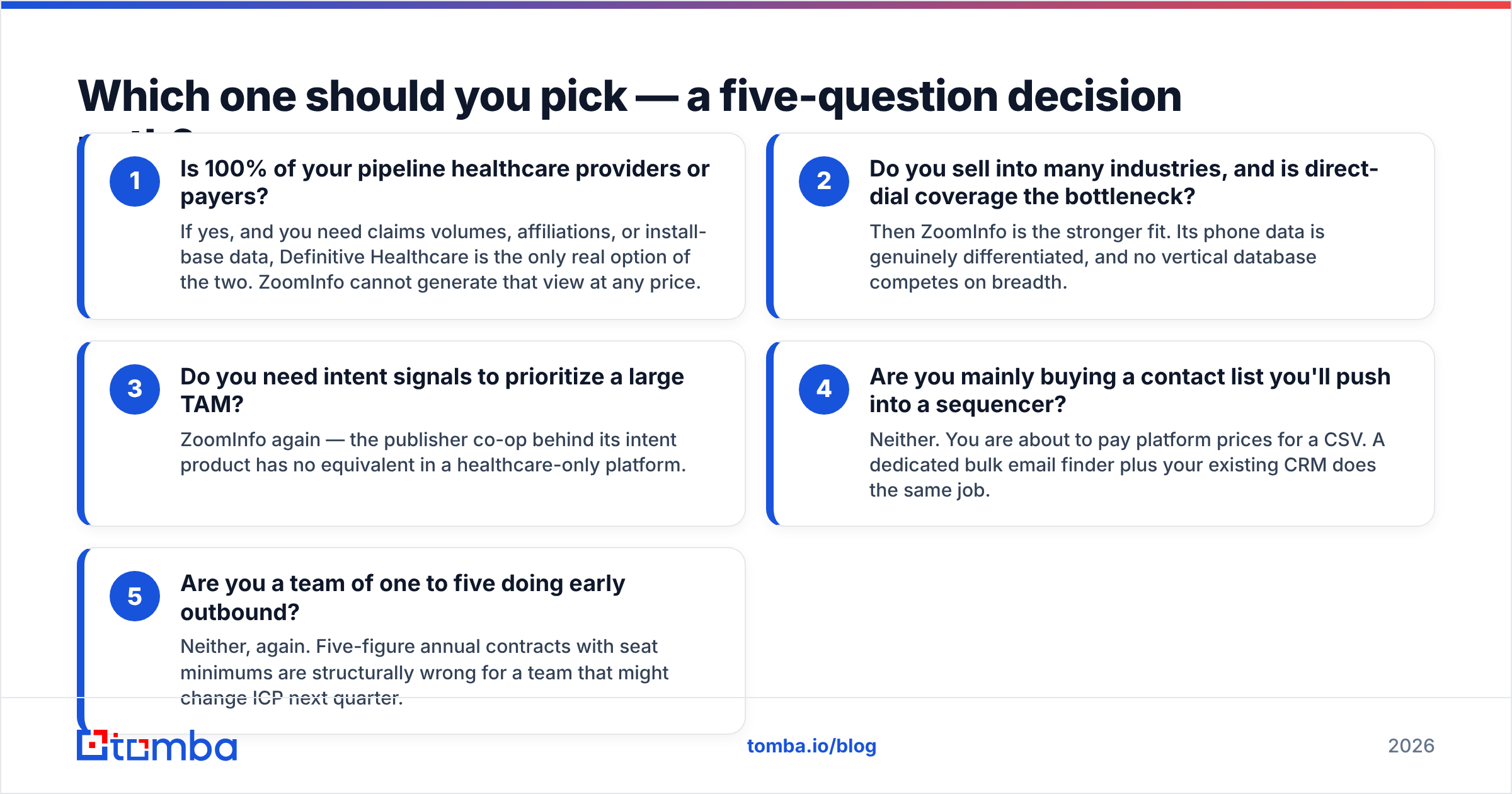
Run these in order. The first "yes" ends the exercise.
- Is 100% of your pipeline healthcare providers or payers? If you also need claims volumes, affiliations, or install-base data, pick Definitive Healthcare. ZoomInfo cannot build that view at any price.
- Do you sell into many industries, with direct dials as the bottleneck? Then ZoomInfo fits better. Its phone data is genuinely differentiated.
- Do you need intent signals to rank a large TAM? ZoomInfo again. Its publisher co-op has no healthcare-only equivalent.
The last two questions are the ones most teams skip. They are also the ones that save the most money.
- Are you really buying a list to push into a sequencer? Then neither. You are about to pay platform prices for a CSV. A bulk email finder plus your CRM does the same job.
- Are you a team of one to five doing early outbound? Neither, again. Five-figure annual deals are wrong for a team that may change ICP next quarter.
Most buyers who research "Definitive Healthcare vs DiscoverOrg" land in bucket 4 or 5. Most do not realize it until the quote arrives.

What does each option actually cost over 12 months?#
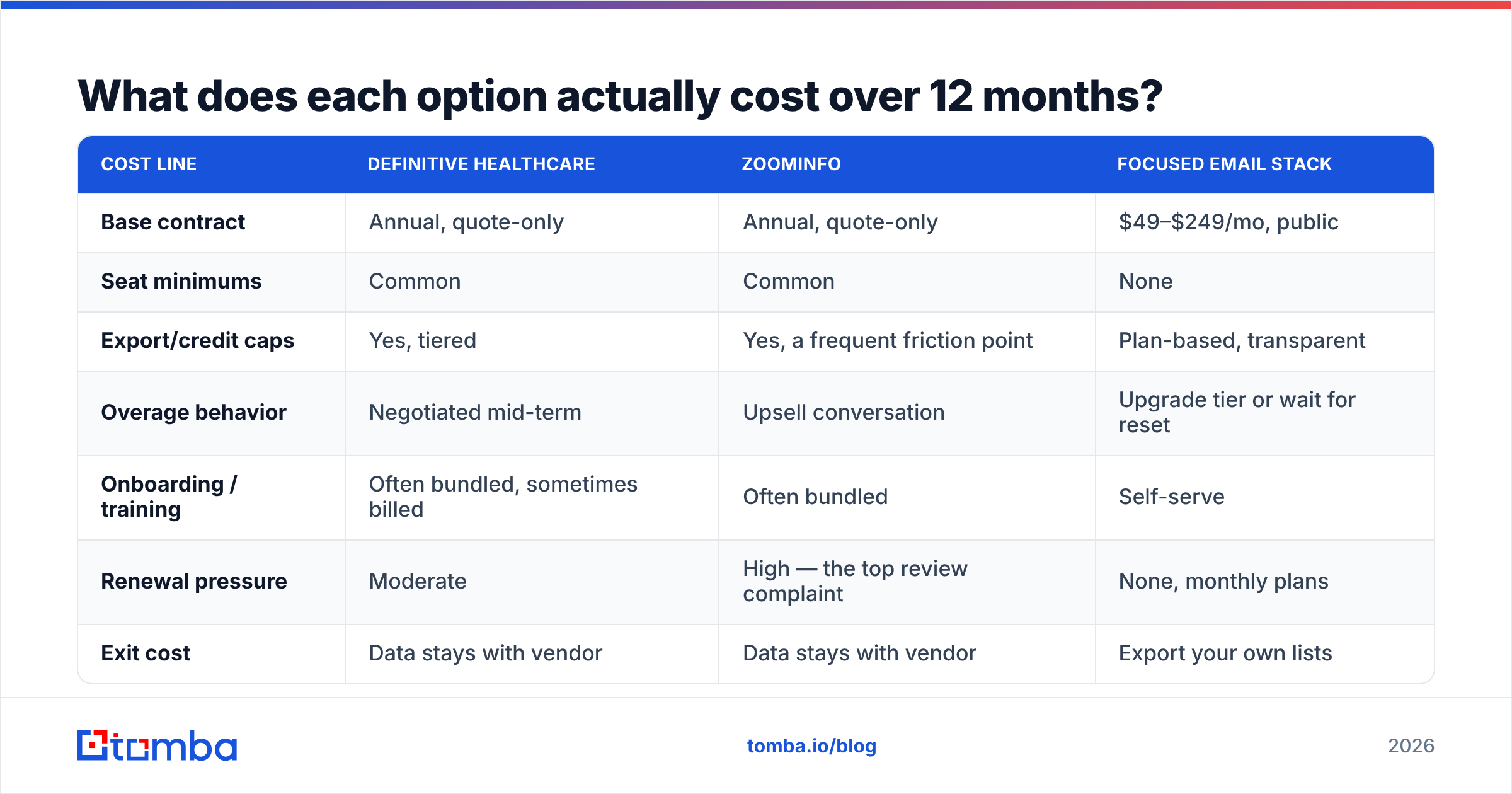
Sticker price is only part of it. Model the full year, including the lines that never appear on the order form.
| Cost line | Definitive Healthcare | ZoomInfo | Focused email stack |
|---|---|---|---|
| Base contract | Annual, quote-only | Annual, quote-only | $49–$249/mo, public |
| Seat minimums | Common | Common | None |
| Export/credit caps | Yes, tiered | Yes, a frequent friction point | Plan-based, transparent |
| Overage behavior | Negotiated mid-term | Upsell conversation | Upgrade tier or wait for reset |
| Onboarding / training | Often bundled, sometimes billed | Often bundled | Self-serve |
| Renewal pressure | Moderate | High — the top review complaint | None, monthly plans |
| Exit cost | Data stays with vendor | Data stays with vendor | Export your own lists |
The real gap in Definitive Healthcare vs DiscoverOrg pricing is commitment risk. An annual contract bets that your ICP, headcount, and motion hold for twelve months. Pivot in month three, which startups do often, and you keep paying.
Tomba's pricing runs Free at 25 searches a month, Starter at $49, Growth at $99, and Pro at $249. Enterprise is on request. There is no annual lock.
Where does a focused email-finding stack beat both platforms?#
Be clear about the boundary. A contact-data tool does not replace claims analytics or intent scoring. Need a hospital's cardiac procedure volume? Buy Definitive Healthcare. Need surge data across 400 industries? Buy ZoomInfo.
But many teams in a Definitive Healthcare vs DiscoverOrg evaluation only need three things:
- Find the right people at a target account. Feed a domain into domain search. You get addresses, patterns, roles, and confidence scores.
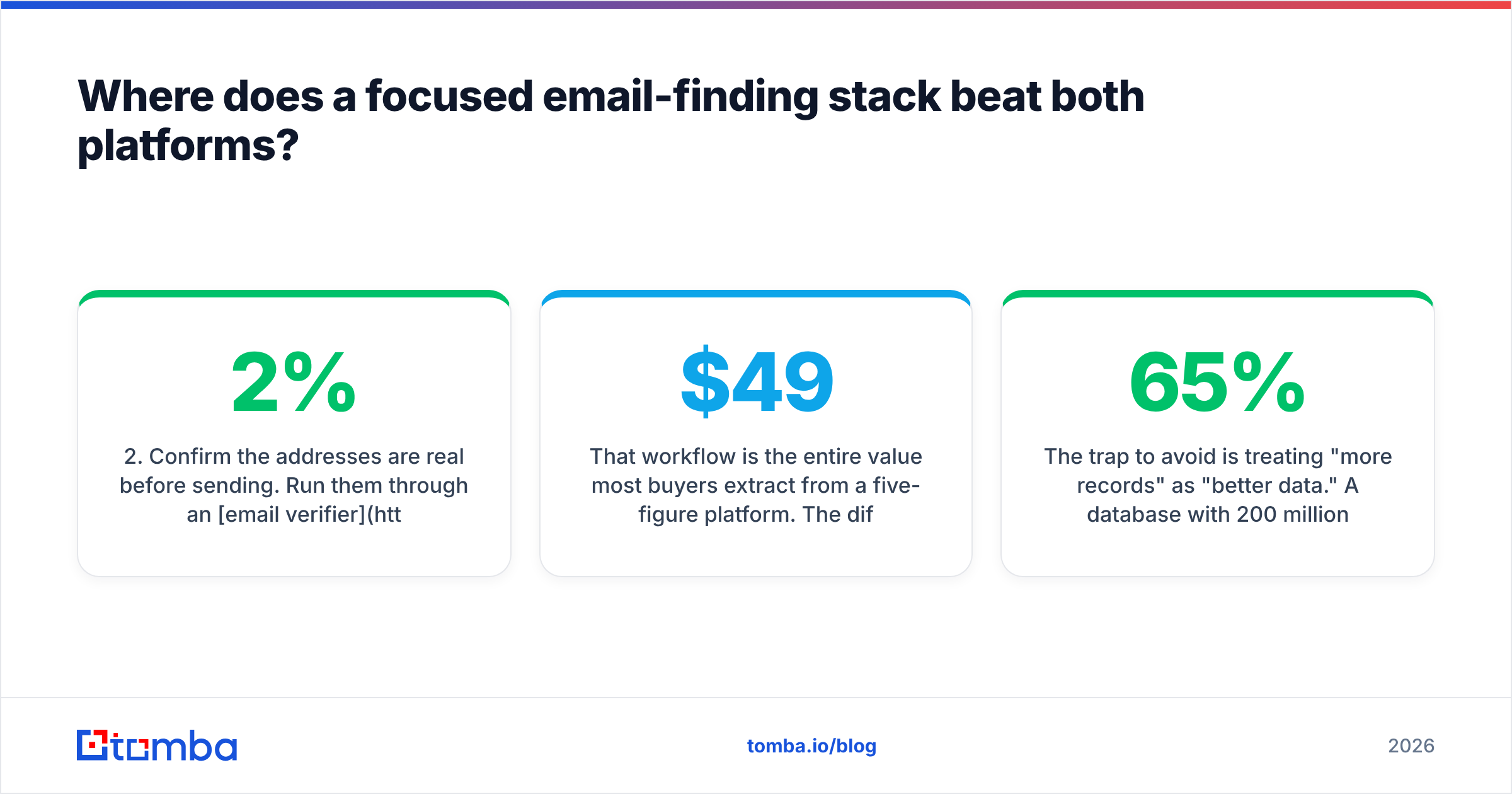
- Confirm the addresses are real. Run them through an email verifier. Keep bounces under 2% and protect your sending domain.
- Fill in the firmographics. Push the list through data enrichment for size, industry, location, and social profiles.
That workflow is most of the value buyers pull from a five-figure platform. It costs $49 a month. It runs on a public email finder API. It stops the moment you cancel.
Avoid the trap of reading "more records" as "better data." A database with 200 million contacts at a 65% deliverable rate beats nothing. A smaller source at 95% beats it. You burn domain reputation on the bounces, and that damage takes weeks to repair. Verify before you send, whoever sourced the record.
What should you ask on the sales call?#
Both vendors sell by quote. So the burden of a fair Definitive Healthcare vs DiscoverOrg comparison sits with you. Ask these in writing:
- What is the refresh cadence for my exact segment? Not the platform average. Healthcare CIOs and SMB marketing managers do not decay at the same rate.
- What is the bounce rate in my ICP? Ask for 100 sample records for your target titles. Verify them yourself before signing.
- What happens when I hit my credit cap in month seven? Get the overage price in the contract, not in an email.
Three more questions decide how the second year goes.
- What is the renewal uplift policy? Ask for a cap in writing. This is the most common post-sale regret in public reviews.
- Can I export and keep my data if I churn? Read the clause. Most enterprise data contracts say no.
- Which records are human-verified, and which are automated? For Definitive Healthcare, ask about claims-data lag. For ZoomInfo, ask how many direct dials were confirmed in the last 90 days.
If the answers stay vague, run your own 100-record accuracy test. Pull contacts from the trial for a target account list. Check them with a free email checker before you commit money. A trial that fails a 100-record test will fail a year of quota.
The verdict#
Definitive Healthcare wins if healthcare is your only market. You get provider intelligence — claims, affiliations, install base — that no horizontal database can produce. It is expensive and narrow, and the narrowness is the point.
ZoomInfo, the platform DiscoverOrg became, wins if you sell across industries. It fits teams that need direct dials at scale against a large TAM. Budget for renewal increases and credit rationing.
Neither wins if you just need verified work emails for a defined ICP. That is a $49-a-month problem sold as a $30,000-a-year problem. That gap is why Definitive Healthcare vs DiscoverOrg gets searched at all.
Before you sign anything annual, run the test that settles it. Pick 50 accounts you care about, pull the contacts, and verify them. Then look at your real deliverable rate.
Start with the Tomba Email Finder. The free tier gives you 25 searches a month with no card. That is enough to benchmark any enterprise quote against a real number instead of a demo.
Related guides#
Ready to find emails that actually work?
Join 150,000+ professionals who stopped guessing and started sending. Free credits on signup — no credit card required.
Get the Tomba newsletter
Practical outbound tactics and product updates — once every two weeks.
About the author